
Engg @polymarket | building and breaking things with 10 claude instances | crypto/acc
Joined October 2011
- Tweets 46,738
- Following 6,275
- Followers 22,363
- Likes 159,053
1,831 Photos and videos






Pinned Tweet

May 28
Excited to share that last week I joined @polymarket as a senior engineer.
Over the last few months, I talked to many many big teams in crypto, trying to figure out where I wanted to spend the next chapter of life. The deeper I went, the clearer I felt about where I wanted to be.
Every time people ask me what crypto PMF I truly believe in, my answer has been the same for a while: Stablecoins, RPCs/Infra, Defi, Perps, Prediction Markets.
Prediction markets is where I spent the last 12 months anyway (in my free time ofc away from avail):
- shipped fast indexers for my TG bots to track positions
- copytrading and early market discovery functionalities
- built whale wallet discovery terminal tools for myself
- built "PolyAave" for yield generation on your idle polymarket positions wtih Aave. This specific project got so much attention in DeFi and a few VCs that I considered going deeper
- ended up figuring out leverage trading on prediction markets
- build parlays prototypes
- wrote up a whitepaper for yields and lev trading on prediction markets
- some more interesting ideas for prediction markets that are sitting in my local PC.
Overall, I was fascinated by the work Polymarket has been done and achieved, and it felt like a natural fit to me. I wanted to work at Polymarket and contribute to world markets.
I’m excited to join a goated engineering team, led by @devjoshstevens who I’ve known almost 4 years now and have always respected him for his engineering aptitude. Getting to ship alongside him and the team he’s built is the kind of seat I didn't want to pass up.
I also have deep respect and a lot to learn from leaders like @shayne_coplan, @williamlegate, @mustafap0ly, @cesare_naldi, @SuhailKakar and the rest of the crew, so I am looking forward to going full speed in shipping mode.
We are heads down building and have got a lot of exciting things in the pipeline. We will be taking over everything, and, as Barney Stinson said, it's going to be legendary.🫡
537
23
1,380
121,069
mr @NYCMayor:
> fan of Arsenal, and they won Premier League
> fan if Knicks, and they won NBA championship.
coincidence?
4
9
390
me as a bad planner bf: "babe we didnt need to get a reservation or make plans, the whole NYC is outside"
10
571
at times square:
one side is occupied by Moroccan fans because their match against Brazil was a draw but they love to dance
and on other side, it's knicks fans because knicks WON NBA CHAMPIONSHIP
3
1
21
923
someone give a dare to anyone in NYC to wear a Spurs jersey and roam around MSG.
classic ragebait.
5
21
1,280
who's in nyc and wanna hang and find spiderman together and go for FIFA watch parties?
20
43
3,638
Jun 13
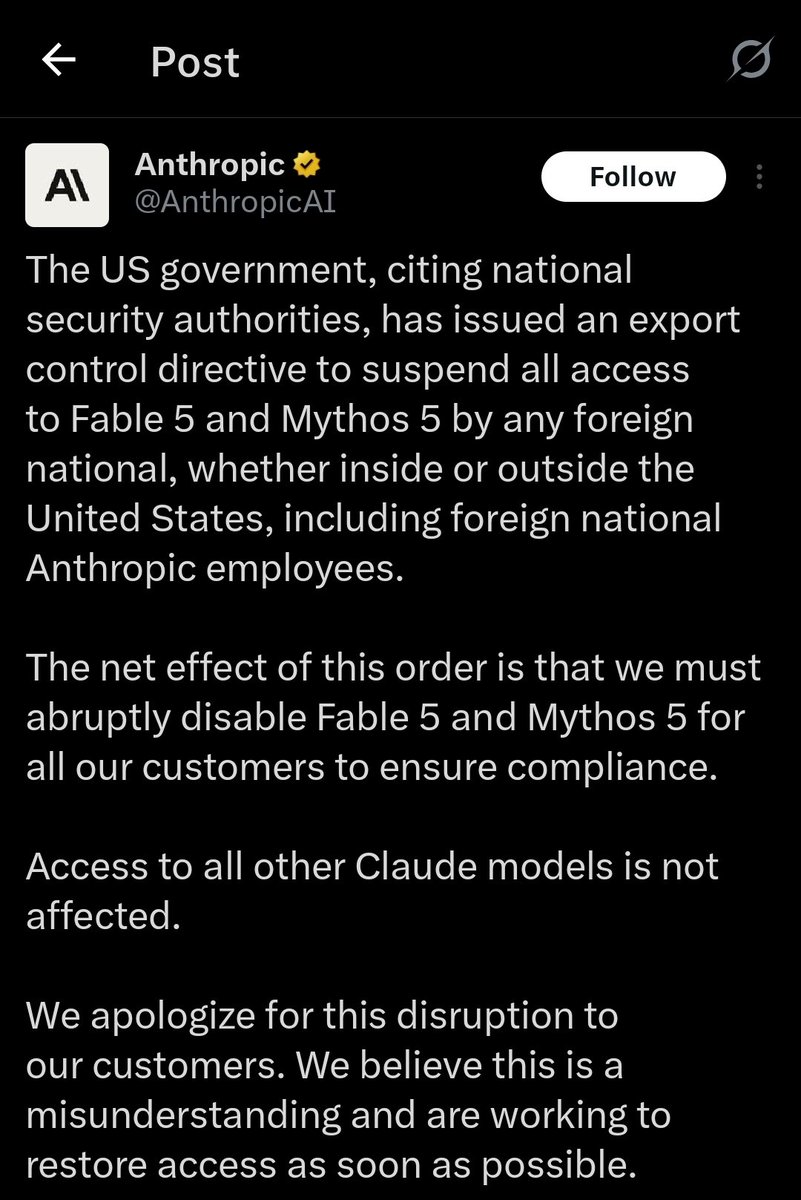
BREAKING: GTA 6 has been delayed until June 2030, when anthropic will be allowed to launch inferior version of Fable model.
7
26
1,107
Jun 13
honestly very mad about fifa's current state. fck u USA and FIFA for destroying the fifa experience for hundreds of thousands of people:
- crazy expensive tickets starting from $500 minium for less popular teams and $1000 minimum for argentina/spain games
- like literally every football fan waited to watch these games and you made it superhard for them to buy tickets.
- FIFA taking close to 30% in resale of tickets
- squatters in US bought tickets to sell 3x to 5x
- USA literally denied a FIFA referee who later said "I am just trying to live my biggest dream." he had all his paperwork and 10 years of experience being a referee. his crime? he was from Somalia.
- Iran team has to set up a camp in Mexico and can only come to USA 24 hours before their game??? these are the athletes we are talking about.
- ICE has stadium presence??? what for brooo. just let fans have their time. y'all already scare them rest of the year.
- Scotland citizens had their ETSA visa "Approved" to "Denied" to "Not authorized to travel"
- a normal citizen of "the greatest country on earth" cant even have a happy life of going and watch games for his entertainment because of prices.
do well, @FIFAcom. be better.
10
59
4,150
Jun 12
OH in NYC: "yea bro we are building this decentralized perp dex that will be better than HL, and you can long or short spaceX already. we are also adding social signals and copytrading to it. let me give u early access"
11
25
1,121
Jun 12
Be careful out there everyone. I had 10 $ETH in my car and someone broke in and left 4 more.
20
77
3,055
Naruto11.eth retweeted

Jun 11
Hey, thanks for writing this out. You do have some valid points on everything you said. I have touched on some of these points before in tweets, but I joined a few months ago as VP of Engineering, DeFi, to set standards for how we build at Polymarket. We, as a team, have hired many new senior people over the last few months, and we feel the difference internally and how we are starting to work together.
The CLOB was built over 4 years ago and has inherited technical debt due to wrong core low-level decisions; fixing these core parts isn't easy when you have so many parts to consider and continue to serve a huge amount of traffic. Note that the success of Polymarket would not have been possible without the speed of development, so no blame on these systems at all; it happens. We now have a dedicated trading team working solely on the CLOB, fixing and rebuilding those core components from the ground up. Every issue you raised was an issue before and has been fixed / is known and being fixed.
A few things which have been improved over the last 2 months:
1. Full observability into the systems with traces and alerts
2. Eliminated ghost fills for takers that were causing a high failure rate for trades.
3. We improved the core matching engine latency via faster summary generations by 41.2%
4. Introduced a new validation layer that helps us keep the core engine healthy; with this one, the p90 improved by 32% during highly volatile periods. Also, we currently support 50% more user requests on the engine.
Here are the things coming in the next weeks and months:
1. Feature flags in the clob to allow us to turn on and off features when doing critical deployments, eliminating unnecessary downtime for users while still allowing the team to safely ship
2. Revamped rate limit system that is maker-focused, improving latencies for both takers and makers. As we improve latency on the core engine, we're seeing more requests, which is causing degradation, so revamping the rate limits is key.
3. We are moving to an async flow on our current engine to support higher throughput.
4. Introduce new order types that allow makers to preserve their queue positions.
5. Decreasing the startup time so deployments can be easily put out and reverted if needed quickly
6. Way more improvements to the internal systems but can't list them all
Taker delay bypass exploits - This was implemented incorrectly initially, allowing cancellations for already delayed orders. We prevent this by preventing these cancellations and properly reserving the capital for all taker-delayed orders.
Ghost fill exploits - The clob is synced with the user's deposit wallet state, so whenever the user wants to perform a clob action, it is informed in advance, helping it consolidate the state. There is still a small amount of ghost fills (0.001%), as we still support the old wallet types and have edge case race conditions, but this will be fully eliminated once all users are on the deposit wallets and with the new async architecture.
Order spam exploits - Atm, we keep an open rate limit model; this means that users get the same limit across markets. We want to introduce a token-based system to make it harder for bad actors to exceed current limits.
RTDS: We missed observability on this, and that's on us. We fixed it, and now we have proper alerts. Sorry about that.
Stability is something we are actively solving; as said, it's our core focus with the trading team. We're growing the team by 2x and bringing in very senior ex-exchange engineers to rethink and rebuild a bunch of things. Our plan is to be the best exchange in the world, and we have a long way to go, but we will get there with the core improvements we are making highlighted above.
Most of our trading changes at the moment are fixes, and we alert Discord because it's our main place people trade alongside some signals; most don't require documentation, mainly because there are no breaking changes and it's a fix to address tech debt. We do need to work on communication; we're trying to improve this with Friday updates and improvements to our core documentation and Discord/Signal channels. We are also working on better communication overall, with restarts and downtimes being announced in advance. Also, we have a direct line to you on Signal; we should chat more there. The team is always on call to help with any issues you face.
Taker tiers was something we slipped on, and we should have done better with the communication around when it is coming. We have started splitting certain tasks like this into smaller pods, with ownership and accountability for each. A lot has got better internally, but there is loads of room to improve, and this is a good example of how core communication could have fixed this; sorry about that.
We, of course, have staging, but most, if not all, of our issues only occur under production load. We just finished a full, dedicated environment powered by a Tenderly VNET, allowing us to run proper load tests and simulate production load before we put stuff out. We have hired a head of QA who is also working on proper e2e automated tests on the CLOB to catch these issues in CI before they go out.
Moral of the story: we really do care about building the best systems in the world. Polymarket moves very fast, and it wouldn't be here today without it, but we know that improving core stability is key to us thriving, and we're working on that right now, step by step. You are a smart person; you know that fixing these foundations cannot happen overnight, but we are on it and hear you.
11
7
107
5,903
Jun 11
Everyone thinks a SpaceX IPO is bullish because retail finally gets access. But that's not how liquidity works. The biggest private company in the world suddenly becomes investable, which means every growth fund, pension fund, sovereign wealth fund, and retail investor needs to find cash from somewhere. Employees and early private investors finally get a way to sell. Index funds need to buy. Active managers need exposure or risk underperforming. Hedge funds will short into the hype. Retail will FOMO the listing. The result isn't new money appearing out of thin air; it's capital being pulled from everywhere else. Stocks get sold. Crypto gets sold. Venture portfolios get rebalanced. It's not a bullish event. It's a giant liquidity vacuum cleaner with a SpaceX logo on it. anyway, are you enjoying the game?
13
37
2,672
Jun 11
rent too high
tips for fries
SOL at five
Knicks in five
10
42
2,612