
Joined October 2021
- Tweets 2,235
- Following 204
- Followers 73
- Likes 3,328
Photos and videos
NeverWinter retweeted

Apr 24
This time around, suppressing ICP won't work, because it has found a much bigger mainstream market outside the niceh world of "web3."
E.g. 95% of Caffeine users are mainstream. We have a nation state experimenting with cloud engines, and the cloud market is HUGE. 🧵
15
127
574
19,652
NeverWinter retweeted
May 15
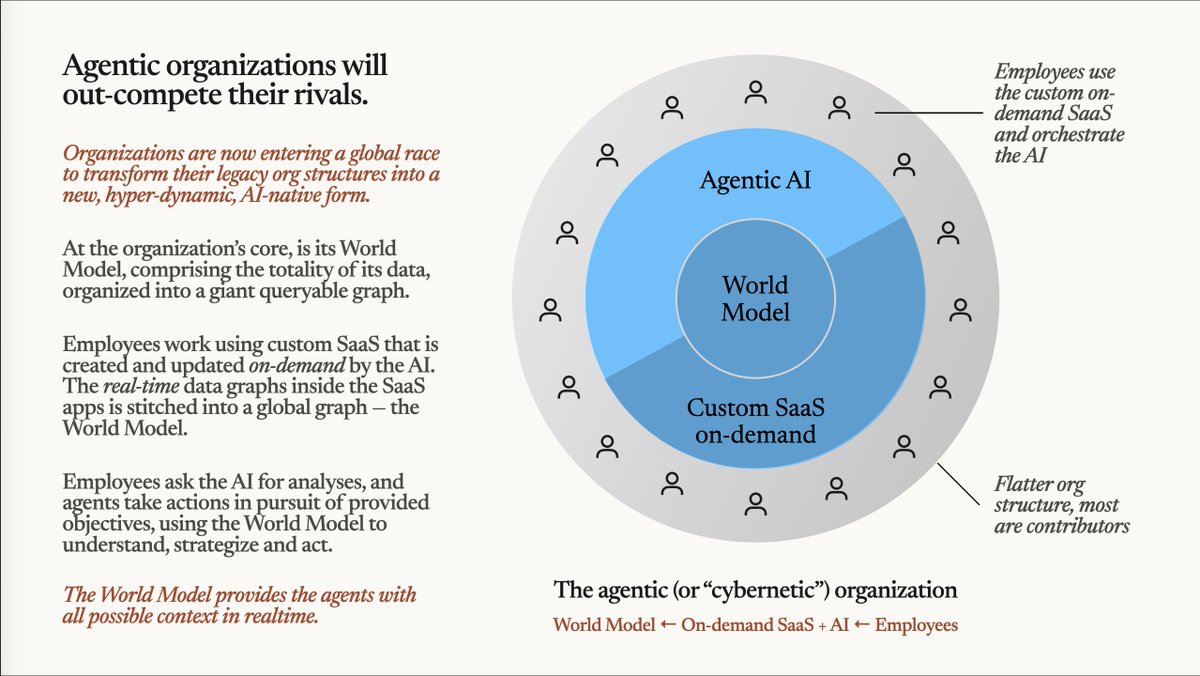
Nearly every solopreneur, startup, SME, enterprise or government department, will want to become an agentic organization (or "cybernetic org").
They will be vastly smarter, faster and more efficient.
Internet Computer Protocol (ICP) helps enable this brave future. But how? 🧵
58
286
913
71,607
NeverWinter retweeted
May 10
Dear ICP community, the Internet Computer has now been running strong for 5 years 👏👏👏
Here is a celebratory preview of ICP "cloud engines," the sovereign frontier cloud technology the network shall soon provide from opencloud.org.
Main points:
— Cloud engines enable anyone to spin up their own sovereign frontier cloud. The technology involves an extraordinary inventive step, in which cloud is created from a mathematically secure network of nodes. The nodes run as part of the Internet Computer network (internetcomputer.org) but are selected and configured by the cloud engine's owner.
— The frontier cloud provided by engines is strongly focused on enabling AI agents to build and update online applications and services for us. The world is changing fast, and nearly all new online apps and services are already being built with the help of AI, and thus cloud engines target the future of cloud.
— Software hosted on cloud engines is tamperproof, which means that it is immune to infrastructure hacks, because it runs inside a mathematically secure network protocol, rather than on computers directly. This means that AI agents, and those building with them, don't need to have a security team in the loop, or to trust someone else's security team. This is crucial, because in the future, non technical people will demand the freedom to build with full automation — where they just need to issue instructions to AI about what to build, and don't need to worry about anything or anyone else. Of course, apps and services running on engines are also vastly safer from the new breed of hacker being enabled by frontier AI.
(The cloud engines themselves are also "tamperproof." Even if a hacker gains physical access to some portion of a cloud engine's nodes, and can make arbitrary changes, the computations and data of the hosted apps and services cannot be corrupted or interrupted so long as the network's fault bounds aren't exceeded. The recent hack of Vercel, a major cloud platform, which gave hackers access to the apps it hosted, provides additional perspective on the importance of this advantage.)
— Software hosted on cloud engines is guaranteed to run, so long as a sufficient number of the engine's nodes are running. This means that AI can build applications and services without the need to have a human systems admin team constantly tinkering with the underlying platform to keep it running, which is again crucial, because in the future, non technical people will expect the freedom to use AI to build without the support of others.
— New frontier programming language technology, in the form of the Motoko language developed by Caffeine Labs, leverages seminal "orthogonal persistence" technology that unifies program logic and data to deliver further unlocks for AI (Motoko is the first computer language being developed that targets agents that are writing software rather than humans engineers per se). Nowadays, AI can build and update production apps at a prodigious rate, even at the speed of conversation. But it can also make mistakes, and there's a risk that an update it creates might be "lossy" in the sense it causes some transformed data to be lost. Again, in this new world, it's both undesirable and impractical for everyone to have to have a systems admin team on-hand to detect lossy updates and roll them back, but Motoko provides a solution: it can detect new software updates are lossy before they are applied, reducing potentially catastrophic errors by AI to harmless coding retries.
— Software hosted on cloud engines is "serverless" but unlike traditional serverless software, directly it directly incorporates data through "orthogonal persistence." Another key purpose is simplify backend software logic and fuel the modeling power of AI by increasing abstraction (sorry for the technical language!!!). Put simply, this enables AI to produce more sophisticated backends, faster, and at dramatically lower costs, as measured by the number AI API tokens consumed during coding. (Tip for the technical: orthogonal persistence is a new paradigm where "the program is the database," and data lives inside program variables, which is possible because it's as if hosted software runs forever in persistent memory).
— An expanding database of skills at skills.internetcomputer.org shall make it possible to develop and directly deploy apps and services to your cloud engines directly from Claude Code, Perplexity, Codex and other AI platforms. Further, your account on caffeine.ai can be connected, so that new apps and updates created through conversation automatically appear hosted from your cloud engine. In the future, R&D is going to be very seamless. You converse with AI, and your secure and unstoppable apps or services are created or updated. Cloud engines are designed to directly support this "self-writing cloud" future where we can work hands-free.
— Tech sovereignty is becoming a huge issue worldwide, with governments and corporations seeking to create sovereign tech stacks owing to geopolitical tensions. Increasingly, people are realizing that tech provided by foreign nations can come with hidden backdoors and kills switches, from the base platform, right up through hosted apps and services. ICP technology is open source, and those building on ICP using AI own their own source code. When you have the source code, you can verify that there are no backdoors, and when you own the source code thanks to AI, you can update it at will, freeing you from vendor lock-in. But cloud engines take sovereignty much further...
— You create a cloud engine by selecting the nodes that will be combined. You can choose the class of nodes used, and their number, but more importantly, you can choose who operates the nodes, and where they are located. Almost any configuration is possible, because the Internet Computer scales the security privileges afforded to hosted software within the network according to configuration (software hosted on cloud engines can directly interoperate with software on other engines and traditional subnets, but base restrictions are applied according to security rules). A cloud engine can be created within a region such as Europe, to comply with regs such as GDPR, or completely within a sovereign state like Switzerland or Pakistan. But cloud engines go further still...
— Sovereignty is also about freedom from vendor lock-in. Cloud engines are essentially ICP (Internet Computer Protocol) network configurations, and this means the underlying compute nodes they combine can be swapped out without interrupting their hosted apps and services. This is a big deal. In addition, cloud engines now support nodes that are instances running on Big Tech's clouds, in addition to nodes that are dedicated specialized hardware, as per the Gen I and Gen II nodes that dominate the Internet Computer today. For example, it is possible to have an engine running across different AWS data centers, say, and then reconfigure the engine to run across a mixture of AWS, Google, Azure and Hetzner for even more resilience, without the users of hosted apps and services noticing a thing. That's true freedom.
— Sovereign AI is becoming increasingly important too, and cloud engines allow special "AI nodes" to be added to them, so that hosted software can perform inference on hardware provisioned by the owner from a location the owner has selected. Even though the AI nodes are only accessible within the cloud engine, they can still benefit from the forthcoming Internet Intelligence Gateway (IG), which will make it possible to validate inference performed on key frontier open weights LLMs, even when the inference is performed on completely independent AI clouds. When the results of inference are received, this technology can verify that neither the prompt context (input) nor the inference result (output) have been modified, and that the results were produced by the precise LLM expected. This ensures that AI clouds don't cheat by running inference on cheaper models than are being paid for, and bad actors aren't modifying the inputs or outputs to surreptitiously insert advertising into results, say, or change facts, or insert malware when code is being generated. What's super cool about this technology is the cost of the verification is scalable. A very valuable additional security can be achieved with only 1-2% of extra cost.
— Scaling apps and services when they hit capacity limits is another thorny problem that cloud engines help the world address. Engines make scaling possible without rewriting or reconfiguring software. The query workload capacity of hosted software can be horizontally scaled simply by adding new nodes to an engine, and nodes can also be added in geographical proximity to demand. Meanwhile, update workload capacity can first be scaled-up by swapping an engine's nodes out for the next class up, and then when no larger class of node is available, horizontally scaled-out by "splitting" the engine into two, which doubles available capacity. (Technical tip: horizontally scaling update capacity by splitting engines requires multi-canister architectures).
— For those who have been following how Caffeine builds apps that can efficiently store large numbers of files, I should mention that apps built on cloud engines will also support the new ICP Blob Storage cloud network (since cloud engines currently have up to about 3 TB of memory, which apps storing large amounts of files can easily exceed). We are also working on allowing blob storage nodes to be added to cloud engines, to enable sovereign mass blob storage within an engine, similarly to how AI nodes can be added currently.
— Lastly, but certainly not least, I should mention that cloud engines are multi-blockchain capable, and ready for digital assets, thanks to the clever math at their core. For example, an e-commerce service built on a cloud engine can securely accept and custody stablecoin payments, or a multi-chain DEX could be hosted. Further, engines can support software autonomy (software orchestrated and controlled by other autonomous software, in a decentralized way) and can themselves be orchestrated by SNS technology, and thus run autonomously too.
Today, though, the focus is on *mainstream* cloud. This year, the cloud industry will generate approximately one trillion dollars in revenue. That number is already huge, but is expected to grow to two trillion dollars by 2030.
After years of continuous development, which have seen more than $500m spent on R&D, the Internet Computer network is now tacking directly toward this mainstream cloud market with cloud engine technology.
In their first version, cloud engines are not meant to be a cloud panacea. For example, currently they are not ideal for working with big data. You should use something like DataBricks for that.
Cloud engines are carefully targeted at enabling AI to produce traditional online applications and services, including SaaS, in a safer and more productive way, which represents a new market segment with tremendous potential. Of course, DFINITY will continue to work relentlessly to push forward ICP's capabilities, so expect further developments.
It's worth mentioning that this cloud segment isn't just about creating new apps and services using AI, it's also about replacing legacy systems and apps built on super expensive SaaS services. Caffeine Labs is working to produce technology (Caffeine Snorkel) that can study an enterprise's legacy systems and app built on SaaS, create replacement systems and apps, and migrate the data, while supporting key stakeholders through the process over email and chat, with full automation. Thus the legacy systems and SaaS markets shall also be addressed by cloud engines.
Zooming out, and reasoning in a more metaphysical way, we believe, as we always have, that there is room for a new kind of cloud created by mathematical networks, that provides seminal advances in the fields of security and resilience, as well as true sovereignty and freedom from lock-in. That this same technology, with the help of additional technologies like orthogonal persistence and Motoko, enables AI to build for us without the need for so much oversight, and to create more backend sophistication while consuming fewer AI API tokens, enables ICP to bring game-changing advances to the world.
Cloud engines will work synergistically with the Intelligence Gateway, which will enable apps and services running on engines to seamlessly leverage AI, wherever that AI is running, while providing verifiability at extremely low cost for open weights frontier models.
We believe that cloud engines represent an inflection point in the storied history of the Internet Computer project, and I'm very proud to be sharing the details with you on the network's fifth birthday 💪
I'll be back with more news soon!!
232
674
1,919
226,962
NeverWinter retweeted

May 9
How much higher can #ICP go this time around?
The last time this happened, $ICP pumped 600% in 6 months, and that was with massive monthly VC unlocks and huge inflation (which are OVER)
No more avocado toast 🥑
No more coffee (only @caffeineai) ☕️
And just stack $ICP 🤝
@geniexbtz
May 8

The #ICP bear market might be officially over
$ICP has bounced strongly from the lows. The chart right now looks almost identical to the pattern that preceded the 600% rally in 2024
With no VC unlocks and #Mission70 cutting inflation, how much higher can ICP go compared to last time?
Bullish Friday w/ my bro @geniexbtz
7
28
225
10,557

PAKISTAN DEBUTED ITS FIRST CLOUD ENGINE ON ICP
Pakistan has launched its first Cloud Engine on the Internet Computer network (@Dfinity).
This milestone, achieved in partnership with the Pakistan Digital Authority, introduces a dedicated Pakistan Subnet that delivers sovereign AI-native infrastructure.
Sensitive data remains in-country while enabling the development of secure, tamper-resistant software systems built for the AI era.
The deployment is now live, visualized as a glowing blue network of connected nodes across a map of Pakistan, marking a major step forward in decentralized cloud technology for the region.
39
177
807
36,555
NeverWinter retweeted

Mar 8
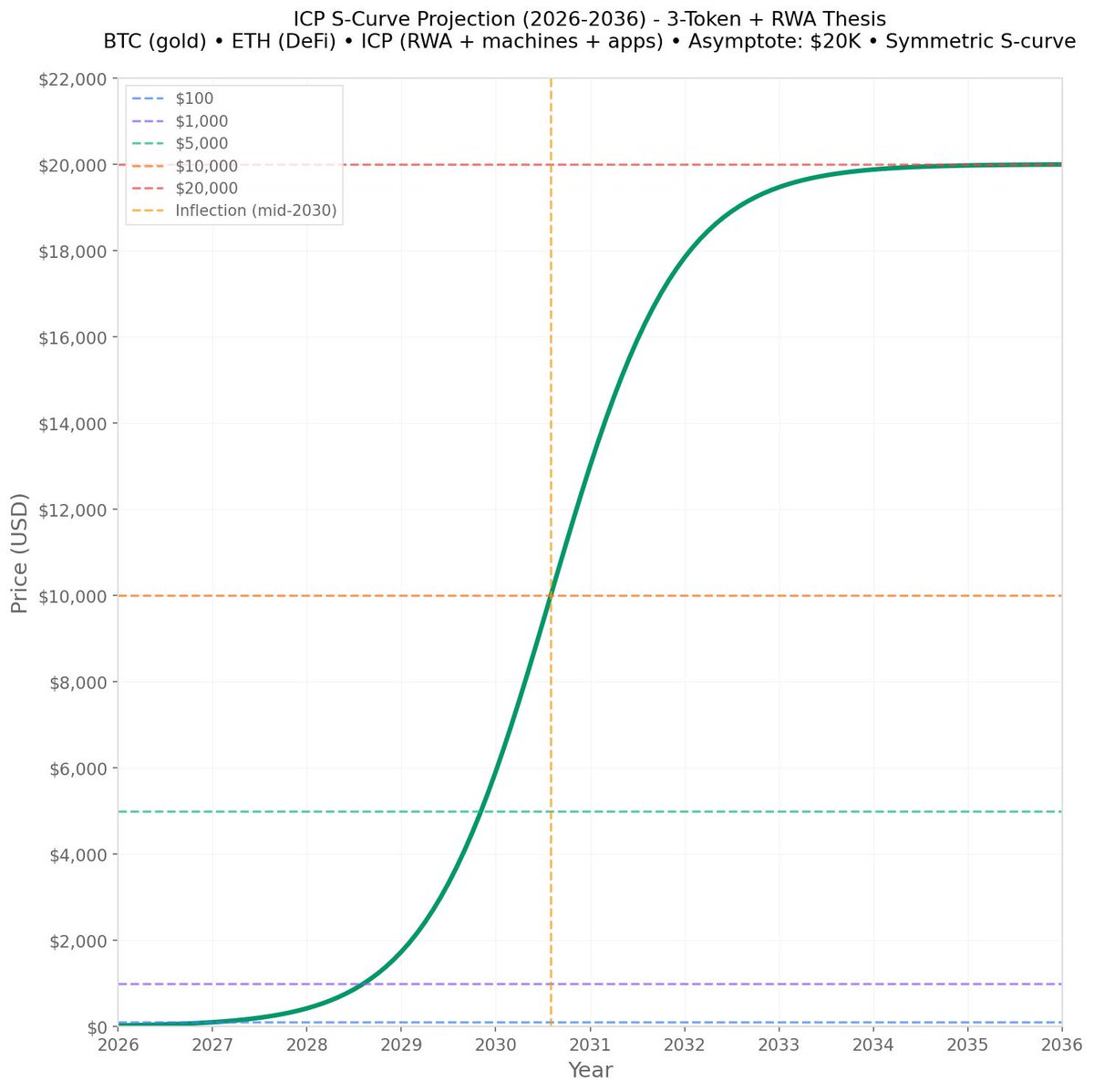
I applied @tonyseba 's S-curve disruption framework to #ICP.
Here's what I found:
(Falsifiable: $100 by Dec 2026, $1,000 by end-2028.)
@dominic_w @PierreSamaties @BobbyO_
ICP Long-Term Valuation Model: $20,000 by 2036
This analysis projects the Internet Computer Protocol (ICP) reaching $20,000 per token by 2036 based on S-curve adoption theory, protocol economics, and real-world asset tokenization trends.
Key milestones: $100 by December 2026, $10,000 inflection mid-2030, $20,000 asymptote 2036.
Framework
S-Curve Adoption
Technology adoption cycles compress over time:
- electricity 50 years,
- personal computers 16 years,
- smartphones 5 years,
- AI 3 years.
ICP's projected 8-10 year S-curve (2026-2036) reflects instant software distribution tempered by enterprise compliance cycles.
Protocol-layer technologies (TCP/IP, HTTP) exhibit winner-take-most dynamics.
Crypto Comparisons
Ethereum's trajectory provides the benchmark: 40x in 23 months (2016-2017), 24x in DeFi phase (2020-2021).
ICP's December 2026 target ($100 = 42x in 9 months).
Post-2027, ICP decouples from Bitcoin
Protocol Positioning
ICP parallels HTTP/WWW (1991), not Ethereum. (Tim Berners-Lee created a protocol layer on top of TCP/IP infrastructure.)
When ICP runs on AWS/Google Cloud/Azure - adds a value-capture protocol layer above commodity cloud.
ICP is infrastructure for a world computer.
Three-Token Thesis
Premise: Crypto consolidates into three functional layers:
1. Bitcoin - Digital gold/store of value (50% of $15T mature market = $7.5T)
2. Ethereum - DeFi settlement (20% = $3T)
3. ICP - Everything else: RWA, machines, AI, apps (30% = $4.5T)
Evidence:
- Network effects favor winner-take-most.
- Institutional investors prefer 3-5 core assets over diversification.
- Developer ecosystems consolidate
- Internet protocols consolidated to TCP/IP HTTP; alternatives extinct by mid-1990s.
ICP Monopoly Capabilities
1. Agent Payment Rails
- AI agents (ChatGPT, AutoGPT) cannot transact autonomously - humans authorize payments.
- ICP canisters have built-in wallets enabling agent transactions without intervention.
- Ethereum gas fees ($5-50) prohibit microtransactions.
- Solana lacks native AI hosting.
- Big cloud providers lack crypto integration.
No competing solution exists.
2. Machine Economy Infrastructure
Devices transacting autonomously (IoT, drones, robotaxis) require sub-cent costs (ICP: $0.0001-0.001 vs ETH: $5-50), permanent on-chain storage, device identity systems, and reverse gas (service pays, not users).
Ethereum L2s are limited to transactions only - cannot host full applications with storage/compute at IoT scale.
ICP is the only credible billion-device infrastructure.
3. AI Data Co-location
Current paradigm: AI on centralized servers (OpenAI), data separately (AWS), contracts elsewhere (Ethereum).
ICP uniqueness: AI inference executes inside canisters alongside encrypted data with sub-second finality, protocol-enforced.
No blockchain supports native AI execution.
Big cloud (AWS SageMaker) lacks trustless guarantees.
Monopoly for privacy-preserving AI.
Caffeine AI
DFINITY's Caffeine AI: users describe applications in natural language, AI generates and deploys complete dApps directly to ICP.
Unlike coding tools that only generate code, Caffeine deploys to production - democratizing blockchain development, accelerating ecosystem through mass builder expansion.
$20,000 Asymptote Calculation
Four independent models, weighted by confidence:
1. Market Cap Parity (30%): $15T total crypto × 30% ICP share = $4.5T ÷ 550M tokens = $8,182
2. Transaction Capture (25%): $24T annual volume (RWA $16T machines $5T apps $3T) × 0.4% protocol fee = $96B × 12x multiple = $1.15T ÷ 550M = $2,091
3. Network Effects (20%): 5B devices 500M canisters by 2035.
Metcalfe's Law = $18T ÷ 550M = $32,727
4. Velocity Model (25%): $10T settlement ÷ 5 velocity = $2T ÷ 550M = $3,636
Blended: ($8,182×0.30) ($2,091×0.25) ($32,727×0.20) ($3,636×0.25) = $10,432
RWA Premium: $16T RWA opportunity.
ICP advantages justify 1.5-2x multiplier. $10,432 × 2 = $20,864.
Model asymptote: $20,000.
Triggers & Conditions
2026 convergence required:
1. ✅ GENIUS Act (signed July 2025) - AI framework
2. ⏳ Clarity Act (75% probability) - stablecoin rules
3. ⏳ Iran resolution - geopolitical stability
4. ⏳ Ukraine ceasefire - energy certainty
5. ⏳ ICP/SOL 20% - infrastructure rotation signal
6. ⏳ Crypto 20-30% (BTC $110-120k)
7. ⏳ Fed cut 0.5%
Probability: 5-6 triggers by Sept 2026 = 60% (base case).
Delays shift S-curve timing, not destination.
Mission 70: DFINITY
- Supply reduction (44%): lower rewards, shorter staking.
- Demand burn (26%): cycle consumption.
If demand > 3%, ICP becomes deflationary like Ethereum post-Merge
Risks
High confidence (75-90%): S-curve pattern, ICP differentiation, regulatory clarity 2027.
Medium confidence (50-70%): 3-token thesis, $16T RWA by 2030, no superior L1 emerging.
Low confidence (30-50%): Exact trigger timing, monopoly across all verticals, $20k precision (range $10k-$30k).
Scenarios:
Conservative ($5k) - 10% machine economy capture, fragmented markets.
Base ($20k) - dominance in 2-3 verticals.
Bull ($50k ) - monopoly all categories, $10T machine economy.
Excluded: Regulatory ban, protocol exploit, financial crisis, quantum computing, superior L1.
S-curve valid with delays; asymptote = equilibrium not peak.
Conclusion
$20,000 = calculated equilibrium for ICP capturing 30% of $15T crypto via RWA, machines, AI.
Question: will machine economies and RWA materialize?
If yes, ICP's unique capabilities position it as default infrastructure.
FALSIFIABLES: Failure to reach $100 Dec 2026 or $1,000 end-2028 invalidates model.
Disclaimer: Theoretical framework, not investment advice. Extreme volatility risk.
Projections >24 months have high uncertainty.
38
85
282
20,251
NeverWinter retweeted
Mar 8
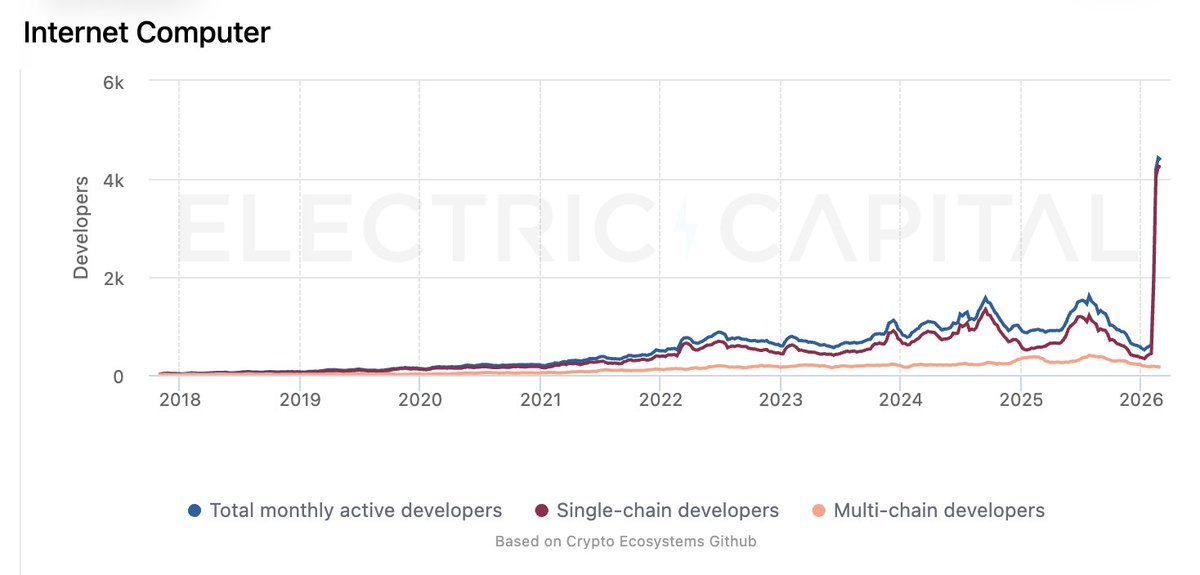
Dev graph from Electric Capital — for Internet Computer, ICP 🔥
Soon, an iceberg of self-writing users will join the craft & vibe coders on GitHub, and AI agents are coming too..
ICP dev numbers are already a multiple of those on other networks. Join us.
developerreport.com/ecosyste…
69
263
934
59,745
NeverWinter retweeted
Feb 24
All, we're kicking off #Mission70
Imminently, DFINITY will post an NNS proposal to increase onchain (replicated subnet) memory costs by a measured amount.
This will immediately increase network revenues and deflationary pressure if the proposal is adopted.
We are talking to stakeholders throughout the community while finessing additional #Mission70 proposals.
We plan to hold an X Space as soon as we are ready, probably early next week.
Looking forward to the Network Nervous System doing its work, and guiding ICP / the Internet Computer on its journey towards an exciting future.
109
241
954
78,208
NeverWinter retweeted
Feb 21
Expecting the #Mission70 proposal will be submitted to the NNS early next week. Rollin rollin rollin..
128
200
916
82,594
NeverWinter retweeted
Feb 10
MoU signed with Pakistan gov today: establish a sovereign Internet Computer subnet, sovereign app creation using Caffeine, and more.
Sovereign network cloud that's self-writing (gen. AI) is a growing ICP use case.
Our thanks & appreciation to Pakistan 🙏
internetcomputer.org/news/me…
111
348
1,177
66,991
NeverWinter retweeted

Keep in mind that none of my posts are intended as financial advice, not that anyone would want to take financial advice from someone who sold 40,000 ETH at $1.05 and 100 BTC at $750.
896
865
9,274
819,836
NeverWinter retweeted

Jan 26
🚨Important Alert $ICP Community⬇️
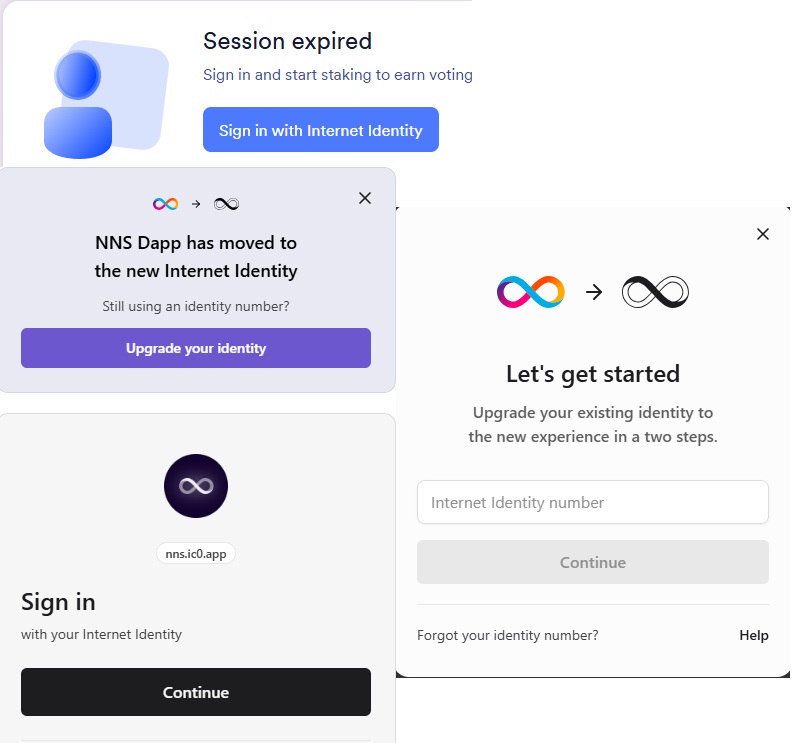
Today, we are migrating to Internet Identity 2.0
I got a lot of messages from the community regarding the access to the NNS using the new ID. This is how I did it:
1) Press on Sign in With Internet Identity (as you usually do)
2) Press on Upgrade your Identity
3) Insert your ID Number
4) You will be requested to name your identity
5) Enter your PIN (You can reset it using the Google Password Manager)
It took me 5 minutes.
You can find more information here: medium.com/dfinity/internet-…
& here: identitysupport.dfinity.org/…
23
48
241
15,390
NeverWinter retweeted
7 Nov 2025
$ICP is currently the top performed of the week📈
ProShares has filed for the "ProShares CoinDesk Crypto 20 ETF" to be listed on the NYSE. The fund will track the CoinDesk Crypto 20 Index, giving investors exposure to the top 20 digital assets by market cap.
$ICP is part of this Index📊

7 Nov 2025

The CoinDesk 20 is currently trading at 3151.03, down 1.1% (-35.27) since 4 p.m. ET on Thursday. Ten of 20 assets are trading higher.
Leaders: $NEAR ( 12.9%) and $ICP ( 12.8%).
Laggards: $AAVE (-3.5%) and $SOL (-2.4%).
trib.al/4EXbEeH
9
38
193
16,466
NeverWinter retweeted
Jan 24
Hint 1: It is already happening
Hint 2: It is going to happen soon
Hint 3: It starts with N and it ends with Q
Each hint is related to a separate News Event. Have fun.
$ICP = World Computer ♾

52
76
335
46,457
NeverWinter retweeted
Jan 16
Question: summarize what DFINITY 2.0, Internet Computer 2.0, Caffeine, cloud engines, and 2026, means for ICP.
Answer: productization, productization and more productization, that's connecting ICP to the mass market.
(already well underway)
82
177
803
19,596
NeverWinter retweeted

Jan 14
🚨JUST IN: Ripple gets preliminary approval for its EMI license in Luxembourg.
This allows Ripple to offer regulated digital payments across the EU.


59
343
1,992
53,219
NeverWinter retweeted

Jan 14
Introducing Mission 70 - a new whitepaper from the desk of Dominic Williams ∞
Mission 70 lays out a concrete plan to scale the Internet Computer economy and drive real adoption.
Inside the paper:
- Proposed economic changes aimed at reducing inflation and supporting long-term sustainability
- A clear focus on driving real network usage to support ecosystem growth
- A concrete plan with defined mechanisms and timelines, centered on execution
If you care about open internet infrastructure, onchain compute, or building apps users rely on, this paper is worth your time.
Jan 13

An important new ICP white paper. This is a big one, enjoy! #Mission70
"Mission 70 and Accelerating the Internet Computer Economy"
internetcomputer.org/whitepa…
23
96
456
38,947
NeverWinter retweeted
Jan 13
An important new ICP white paper. This is a big one, enjoy! #Mission70
"Mission 70 and Accelerating the Internet Computer Economy"
internetcomputer.org/whitepa…
267
466
1,576
272,398
NeverWinter retweeted
Jan 13
I have 2 big news to share:
1) DFINITY has invited me to participate at the World Computer Day in Davos. I am glad to accept the invitation & participate to the event.
2) After my vacation, I was out with a flu for a few weeks I am dealing with some family issues. However, I will take the time to post an update on YT after I analyze the new Whitepaper that Dom has posted. Stay tuned.
$ICP = World Computer ♾
50
49
406
7,149
NeverWinter retweeted

The Mission 70 Blueprint: Everything You Need to Know. $ICP
The Goal 🎯
— Target: Reduce ICP inflation by 70% by the end of 2026.
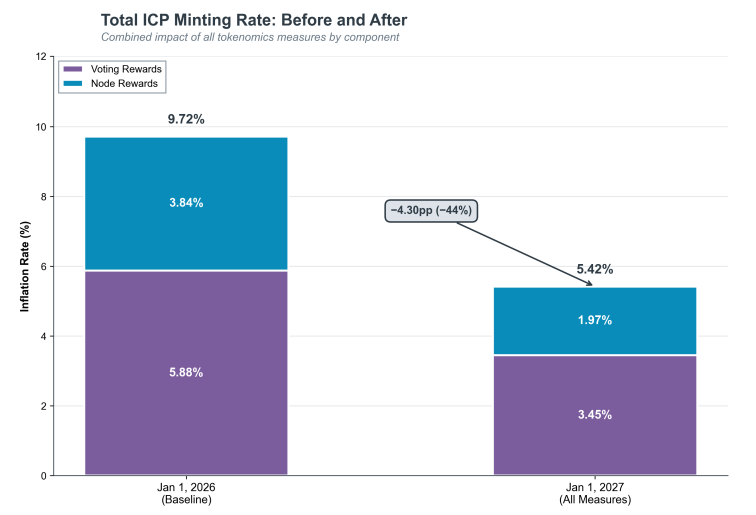
— The Math: Reducing annual minting from 9.72% (Jan 2026) to ~5.42% via supply cuts, with demand burn covering the rest to reach the ~2.9% target.
Staking & NNS Changes 🗳️
— Max Lockup: Reduced from 8 Years → 2 Years.
— Min Lockup: Reduced from 6 Months → 2 Weeks (lowering the barrier to entry).
— Legacy Bonus: Existing "8-Year Gang" neurons get a special 10% reward boost until 2030.
— New Curve: Replaced linear rewards with a Convex (Quadratic) Curve, incentivizing commitment more sharply.
— Reward Cap: A hard cap on the total Voting Reward Pool is introduced to bound minting permanently.
— Migration: Existing 8-year neurons will be mapped to the new 2-year max but keep their high yield.
Node Provider Updates ⚙️
— Gen-1 Cuts: Rewards for legacy (Gen-1) nodes are slashed by 40%.
— Efficiency: Moving toward smaller, secure subnets using SEV-capable (Gen-2) hardware.
— Payouts: Monthly node rewards will be distributed continuously rather than on a single day to reduce market impact.
Inflation Control (Maturity Modulation) 📉
— New Mechanism: Replaced the "Recent Trend" modulation with "Level-Based" modulation.
— How it works: It compares current price to the 365-day moving average. If price is low (undervalued), minting is discouraged; if high, it's allowed.
— Speed Limit: A daily limit on how fast modulation changes to protect stakers from volatility.
Demand Acceleration 🔥
— Cloud Engines: Launching enterprise-grade "Private Subnets" where companies pay to burn ICP.
— Self-Writing Cloud: @caffeineai allow AI to build/deploy apps instantly, creating a new "Code-to-Burn" funnel.
internetcomputer.org/whitepa…
Stay decentralized! ∞

9
87
454
11,401