
119 Photos and videos








Jun 12
Sydney’s startup talent is ready for the world stage. Eleven founders, one room and plenty of conversations that could open doors. The pitch matters, but so do the introductions before and after it. #SydneyTech #StartupAus
13
Jun 11
CSIRO’s latest deep-tech cohort has secured $25.8m in funding and investment.
Australia is strong at discovery. Turning ideas into impact takes the right connections: researchers, founders, investors and industry sharing a table. Sometimes the next breakthrough starts with lunch. #StartupAus #DeepTech
8
May 30
Δ⁽ʷ⁾ = p̂⁽ʷ⁾ − q⁽ʷ⁾ ≥ ε → ENTER

25
May 29
Sydney startups are still building for real-world pain points: lower bills, simpler ops, better margins. Cable’s public beta for metro SMEs is a nice reminder that practical innovation wins attention fast. Feels very aligned with the kind of conversations worth having over Lunchup.com.au ☕⚡ #SydneyStartups #TechAU
22
May 25
Because a choice for one company is not a choice for the world, or even one country
May 24

Some of my perspective on where the @ethereumfndn is going.
First of all, this is only my own view. The board is not just me, and I have no extra special powers on the board that the other board members do not. @aerugoettinea is the one executing much of this transition. My input has been largely on technical questions. The board is in the process of expanding, and my own power within the org will continue to decrease, which is honestly what I want.
The 2025 era brought many important improvements to EF and its ability to execute. Many issues were resolved, and EF continues to benefit from its improved efficiency and greater focus on concrete goals to this day. And so with those problems resolved, early this year, the largest remaining hole that I perceived was something different nagging at me: I would regularly spot people saying things like "vitalik says these beautiful things about ethereum needing to be decentralized, and have privacy, and be a sanctuary technology, but why do the EF's actions not reflect that?"
Now, you may have been hearing something different. You may not have been sensing a feeling of crisis at all, and maybe were hearing people saying that finally we were taking execution and BD seriously and the main task for us is to keep going that way and be even better and faster. Then probably there is genuine difference between you and me, in what kinds of criticism I take most seriously, and what kinds of critics through their criticism are most able to make me feel pain.
As an analogy, let's briefly switch over to a different domain.
One belief you can have about Google is that it is a success story, and has brought a lot of good to humanity in organizing the world's information. Another belief you can have about Google is that they had a beautiful idealistic beginning, but at some point the corruption of mainstream corporate attitudes seeped in, and they slowly bit by bit completely abandoned the "don't be evil" slogan.
My belief on Google specifically is probably somewhere between the two. BUT, if you had taken me back in time to ~2008, and offered me a button to press to make Google one or two standard deviations more "dogmatic", eg. give Richard Stallman permanent veto power over some key policies, I would immediately press it.
Why? Because a choice for one company is not a choice for the world, or even one country. Google existed and exists in the context of a technology industry generally drifting away from early idealistic don't-be-evil roots and toward greed for financial gain, totalizing visions of accelerated superintelligence, infiltration by sociopaths, and craven capitulation to (or worse, active participation in) government pressure for ideological control, surveillance and war. And so *one company* doing something different, positioning itself to be what George Bernard Shaw calls the Unreasonable Man, resisting the trend of the times, would have been better for freedom, balance of power and stability of society as a whole, than *all* large companies bending to dominant trends. This is a part of my version of pluralism.
This line of thinking is not just mine, but I also is not too far off from what Aya and others had in mind with the Mandate.
Now how does this all get to the role of the EF?
EF is not a "center of Ethereum", rather EF is "one node, with a defined purpose, alongside other nodes". We've always said that the EF should be the latter, but many in the Ethereum ecosystem (and even within the EF) wanted us to be the former. Now, we are taking action to ensure that we will be the latter.
This is particularly important because EF is a limited organization, with limited resources and limited organizational capacity. The EF has only ~0.16% of all ETH (less than many other individual ETH holders), whereas among other blockchains it's common for "the central foundation" to have 10-50%. Fiscally, the EF was originally designed to fulfill a limited work scope defined in the token sale docs and other pre-launch materials (building the chain software; getting through Frontier, Homestead, Metropolis, Serenity), which was fully completed in 2022; it was not designed to be an eternal steward.
And so today, the EF is choosing to use its remaining resources to pursue longevity over breadth (yes, this means we sell less ETH). The EF focuses *specifically* on those activities critical to the success of ethereum as a censorship/capture-resistant, open, private and secure system, that would not happen otherwise. This means making hard choices, and in some cases even activities that we highly approve of and people that we highly respect becoming outside of the EF. People of great technical talent, public respect and even alignment with the mission and CROPS being outside of the EF is in fact necessary if we want important tasks to be able to attract outside capital. This also means the EF taking opinionated stands culturally.
This is all intended in cooperation with all other parts of ethereum. We recognize that many other parts of the ethereum world highly respect CROPS and related values. But highly respecting is not the same as choosing to specialize and totally dedicate to a domain (Compare in a different domain: I think reducing animal cruelty is important, and I like vegan food, but am not full unconditional vegan myself)
EF is still in a transition period, and we expect its new long-term form to stabilize over the next few months. What are the guiding principles of this new form? Again, I am only one person, but I can give my answer from a technical perspective (there are also critical non-technical aspects).
At the core, *Ethereum must be impressive*. We are living in an age of highly intelligent AI and all kinds of other technological acceleration. "Status quo EVM, with a hard fork or two a year to optimize for short-term needs of users" is not interesting.
To some, "impressive" means: 250ms latency and 1M TPS. I think Ethereum trying to go that route is a mistake. Being as fast and as scalable as possible, and only a small epsilon more decentralized than the others, is a route to mediocrity, and if we try it we will lose.
I think Ethereum should scale. But I think Ethereum should strive the hardest to be deeply impressive in a different dimension: the CROPS dimension. This means things like:
* Provably bug-free Ethereum. This is a goal that all cybersecurity researchers would have thought is absurd and impossible, up until roughly 6 months ago. Now, it's on the cusp of being possible, thanks to AI-assisted formal verification. So we should be frontrunners in doing this.
* Available chain consensus. Ethereum is, and with lean consensus will cotninue to be, the ONLY chain that has both (i) traditional-BFT style properties that it's safe under asynchrony up to a high level of fault tolerance, and (ii) the bitcoin PoW-style property that under synchrony it's safe up to 49% attackers. As far as I can tell, literally no other chain has this or is planning for it; bitcoin goes for (ii) only and most other chains go for (i) only. Some will remember I fought hard for this, Unreasonably insisting that it is not OK for ethereum to rely on social consensus and hard forks to rescue ethereum from 34% of nodes going offline. It's OK for chains like hyperledger, bnb, solana, tempo, etc. It's not OK for bitcoin or ethereum or eg. zcash.
* Intermediary minimization. The fact that smart contract wallets, protocols like railgun, etc have to send transactions through intermediaries to get included onchain is honestly embarrassing, and it's a constant point of fragility. Hence the work on FOCIL and EIP-8141 (and 7701 and years of work before) to make transaction sending intermediary-minimized with public mempool and strong inclusion properties, in a truly general-purpose way, that covers not just eg. secp256r1, but also privacy protocols and much more. Kohaku is pushing intermediary minimization at the user layer, pulling Ethereum away from the dystopian status quo world where our wallets don't even verify the chain, send our private data out to a dozen third-party servers, and toward a brighter CROPS future.
Some of these goals are Unreasonable - maybe Ethereum would be "fine" getting only 50% of the way - what if we depend on intermediaries, but make it easy to switch? But going 50% of the way would not make Ethereum Deeply Impressive in the CROPS way. So we push for 100%.
Fortunately all these goals are compatible with high TPS, this is a major focus of research (esp. on scaling the state). Well-designed L2s can also help, especially L2s optimized for specific applications (eg. high-volume trading, privacy...). These goals are even compatible with significantly lower slot times, thanks to Raul's work on erasure-coded P2P, and many other optimizations.
The most high-value "product" of the ethereum blockchain, financially speaking, is ETH the asset. Ethereum secures $250 billion of ETH. The types of properties of Ethereum that I mentioned above are very good for ETH the asset. Nearly 90% of my net worth is in ETH, and most of the remainder is ~$40m of onchain fiat of which every dollar has already been allocated for some open-source biotech or software or hardware initiative. That said, there are aspects of supporting ETH the asset - *necessary* aspects even - that are outside the scope of the EF. This is where we need other heroes (some of whom hold more ETH than the EF does) to step in and help. EF has been recently thinking more about how it will relate to other such organizations, and give them needed initial support.
EF will be a smaller ship than in previous years, a more opinionated one - in some cases more opinionated in ways that might be difficult to comprehend - but a longer-lasting one, and one suited to making sure that ethereum brings something meaningful to the world. We are grateful to all those inside and outside the EF who are helping to make this happen.
21
May 21
Australia’s next wave of growth probably won’t come from playing it safe. If parts of fintech are still hesitant to innovate, that’s a good reminder to keep more founder, operator and investor conversations happening in real life too. Better ideas tend to move faster when the right people actually meet. #AustralianStartups
nationaltribune.com.au/austr…
1
1
21
May 18
Australia’s startup scene doesn’t just need optimism, it needs settings that reward risk-taking. The CGT debate is a good reminder that founders build better when policy stops making the hard path even harder. That’s also why spaces like Lunchup.com.au matter, more real conversations, fewer silos. #Startups #Australia #TechNews
1
38
May 17
养虾养马不如养人。
这几天试了 OpenHuman,感觉 AI Agent 终于不只是黑框里的开发者玩具了。
OpenClaw 像开发者的瑞士军刀,快但偏 CLI。
Hermes 像工程师的乐高,强但要折腾配置。
OpenHuman 更像普通人的桌面伙伴:会说话、会记忆、能连 Gmail / Notion / GitHub,说一句话就能开始干活。
真正有意思的不是“又一个 Agent”,而是它把 Agent 从 terminal 拉回到 desktop。
未来 AI Agent 的胜负,可能不只看谁能力最强,而是看谁最像一个你愿意长期相处的“数字人”。
Agent 不该只属于会配环境的人。
它应该像一个人在你桌面上,随叫随到。
#AIAgent #OpenHuman #OpenClaw #Hermes #Ollama
1
160
May 17
Australia’s startup scene doesn’t just need optimism, it needs settings that reward risk-taking. The CGT debate is a good reminder that founders build better when policy stops making the hard path even harder.
#Startups #Australia #TechNews
34
May 15
AI might speed up the work, but it still doesn’t replace good judgment, customer chats, or founder conviction. That’s the bit worth remembering from today’s Startup Daily chat with OpenAI’s Thomas Jeng. Also feels a lot like the best lunches: better tools help, but real conversations still do the heavy lifting.
startupdaily.net/podcast/sta…
That idea resonates. In startup ecosystems like Sydney’s, momentum often comes from small, high-quality interactions that compound over time. The same applies to how people build products, teams, and communities.
Sometimes one good conversation really is the highest-leverage move.
#Startups #SydneyTech #Lunchup
14
May 10
Australia’s tech scene is moving past “AI for AI’s sake” and asking better questions about impact, cost and responsibility. Good reminder that useful tech should still feel human. That’s the kind of future we want Lunchup.com.au to belong to. #AustralianStartups #AI #TechAU
32
NextGenius 🇦🇺 retweeted

May 8
MY POST DID 7M VIEWS OVERNIGHT, WOKE UP WITH 47 DMs AND $8,200 IN DEALS
Hotels. Realtors. Developers. Museum directors. All asking the same thing , can you do this for us?
So let me show you what they saw.
I rebuilt a $150,000 agency project with my phone.
8 minutes of recording. A free open-source pipeline I spent weeks building. Photoreal 3D that opens in any browser, on any device.
What agencies charge:
- $50k–$200k per project
- $80k camera rigs
- 5–8 specialists
- 6–12 weeks
What it cost me:
- My phone
- $0 in software
- One night per scan
It didn’t happen overnight.
Weeks of failed scans. Broken exports. Pipelines crashing at 3am. Tutorials already outdated by the time I found them.
I rebuilt the workflow from scratch until it just worked.
Now I deliver in one night what teams of 8 bill for 12 weeks.
The industries that don’t know they’re already dead:
- Architectural viz: $4B/year
- Real estate media: $2B/year
- Museum digitization: $1B/year
- Hotel 3D tours: $800M/year
~$8B about to collapse onto anyone with a phone.
500,000 people work in these industries right now.
In 18 months, most of them won’t.
The ones who survive are the ones learning this workflow today - while everyone else is still arguing whether it’s “good enough” yet.
It already is.
Next post: the exact pipeline I built, the deals I closed, and every mistake I made getting there.
May 7

SOMEONE JUST KILLED THE REAL ESTATE INDUSTRY
A guy scanned an entire house with his phone. Uploaded it.
Now anyone on Earth can walk through it in a browser tab. No app. No VR. No agent. No appointment.
Click → you’re inside. Every room. Every angle. Every shadow. Photoreal.
The numbers are insane:
- Agent fee on a $500k home: $15,000
- Cost to make this scan: ~$200
- Time to “tour” 50 houses: one evening
- File size: smaller than a TikTok
The science is wild too:
It’s called 3D Gaussian Splatting instead of polygons (how games render), it uses millions of tiny glowing “splats” of color and depth.
AI reconstructs reality from your photos. The result loads on a phone and looks like you’re THERE.
The grift opportunity is even wilder:
Freelancers are already charging $300–$800 per scan for realtors, Airbnbs, venues, car dealers, museums.
One person one phone one weekend = a business.
Open source. Built on PlayCanvas.
Free GitHub: github.com/playcanvas
Community note
The featured 3D house scan in the quoted post was created by cameroncone on SuperSplat. The video in this post demos a capture platform built by @ShreyashT25 and @HussneM27687, not the author. superspl.at/scene/91c1e47e x.com/ShreyashT25/st…
82
141
1,774
222,663
May 10
If more Australian super can flow into startups, the real opportunity is what happens around that capital: more builders, more early teams, more reasons for ambitious people to stay local. Feels like the kind of moment the ecosystem should make easier to bump into, not harder. #ausstartup #startupaus
afr.com/street-talk/voluntar…
1
25
May 5
AI in business

This Chinese guy created 13 agents in Claude Code for Shopify stores and single-handedly serves 200 dropshippers a month, taking $800 from each.
He sits at one desk in front of a wall-mounted LG monitor split into a 3x2 grid of 6 Claude windows, another identical grid runs on a vertical display next to it, plus 1 window on the MacBook within arm's reach, totaling 13 agents simultaneously building Shopify stores, each busy with its own part.
No team, no managers, no support, just him, the monitor, and the API counter ticking in the header of every window.
He is not on a subscription but on an API rate billed by tokens, and he figures 13 parallel agents pay for themselves from the very first client, because every finished store goes for $800, and all 13 windows together consume less than $80 a day.
In the first window he set that system prompt which immediately closes the "assistant or employee" debate:
"you are my new founder-engineer"
So the model knows at what level it was hired: not to hint, not to advise, not to supplement, but to own the result, because for this Chinese guy Claude is no longer a helper in an IDE, it is a partner in his small factory, billed by tokens and never leaving for lunch.
And the other 12 agents he spread across the layers of the store, so each one sits in its own context and does not interfere with the neighbor:
"build a catalog of 80 products and rewrite the descriptions"
"lay out the homepage for the niche of the client"
"set up the cart, payment, and shipping by country"
"generate 30 email chains for warming up"
"design 50 banners and a logo for the brand"
"set up analytics and A/B tests on the homepage"
In a regular agency each task like this would take one designer or developer a full 2 days, because they would first collect the brief, then wait for revisions, then get on a call, whereas this Chinese guy has all 13 agents working in parallel in their windows, and while one writes descriptions, the second is already laying out the homepage, and the third is designing banners.
In the end on the wall it looks like a factory: 13 identical Claude robots writing into one project, and the Chinese guy himself in the chair in front of them decides only 2 questions, which client to hand the finished store to and who to take next, and beyond that he does nothing.
And economically it is still cheaper than keeping a team of 5: one operator like this closes 6 to 7 finished stores per day at $800 each, while a traditional design agency charges $3,500 for the same store and builds it over a full 2 weeks, whereas this guy spends less than $80 a day across all 13 windows.
Wires hanging out, the monitor bolted to a stand, no office and no employees, just 1 desk, 13 robots, and a queue of dropshippers who send new orders every morning.
In my opinion, this is the most efficient solo Shopify factory I have seen this year, and it is already running right now, while traditional agencies are still debating whether AI will take jobs from designers.
35
May 5

Nvidia CEO Jensen Huang: “Every engineer is going to have and manage 100s of agents”
34

ANTHROPIC JUST EXPOSED HOW BADLY MOST PEOPLE ARE PROMPTING CLAUDE.
Their applied AI team dropped a 24 minute workshop.
Free.
From the people who wrote the model.
Not a course creator.
Not someone who figured it out by accident.
THE TEAM THAT BUILT THE THING.
Here is what makes this uncomfortable to watch.
There are 6 elements to a properly structured Claude prompt.
Most people are using 1.
Maybe 2 if they are being generous with themselves.
That gap is the difference between Claude giving you something useful and Claude giving you something you could have Googled.
The people who watch this workshop tonight will prompt differently tomorrow morning.
The people who skip it will keep wondering why their outputs feel slightly off no matter how much they tweak the wording.
24 minutes.
Free.
From the only people on earth who know from the inside exactly how Claude thinks.
I watched it twice.
Then I built a Claude Skill that applies all 6 elements automatically so you never have to think about prompt structure again.
Every prompt you run goes through the framework without you doing anything manually.
Full guide and the skill setup is below.
Bookmark this.
Come back to it this weekend.
This is the thing that compounds.
Follow @cyrilXBT for the exact Claude skills, prompt architecture, and systems I use to get outputs that most people do not believe came from one person.
71
354
2,820
501,068
May 2
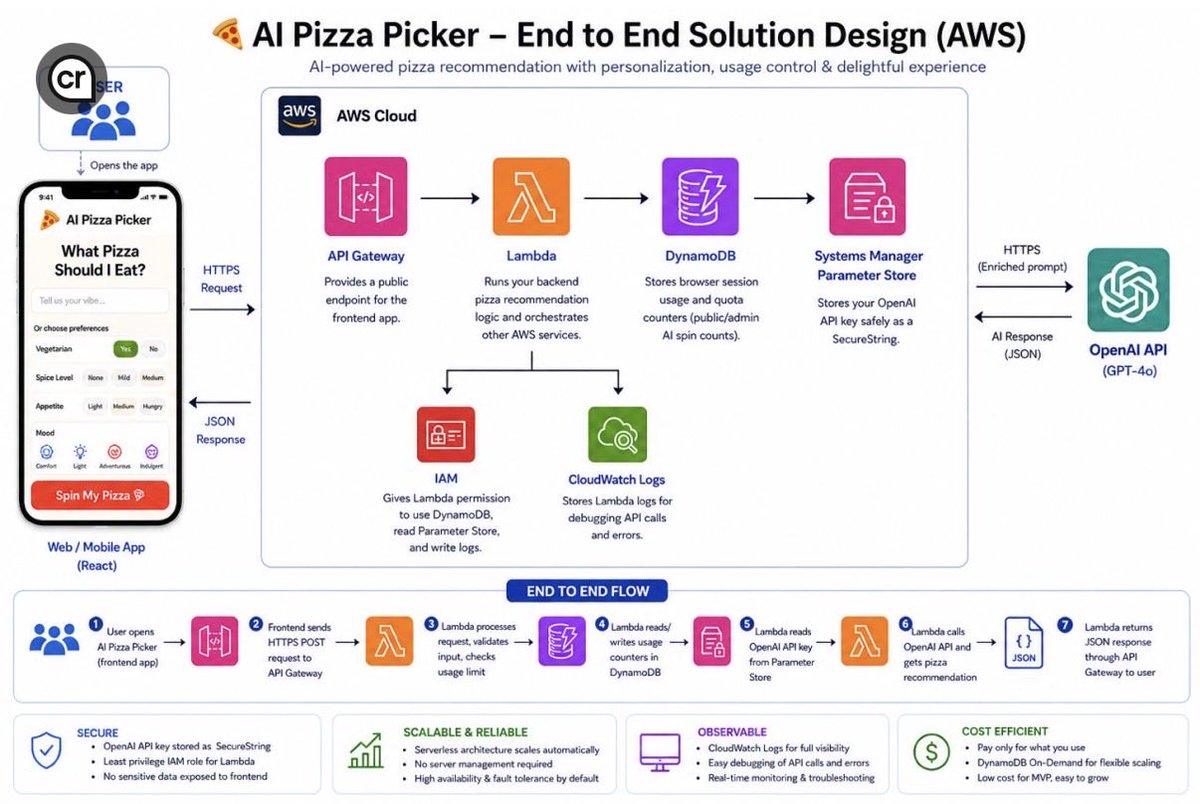
This is the solution design diagram for AI Pizza Picker.
Building this on AWS Console was a great hands-on experience:
• Used AWS CloudFormation to create and update the backend stack
• Used AWS Lambda to handle backend logic
• Learned how to securely store API keys in AWS Systems Manager Parameter Store
• Explored DynamoDB for tracking usage & controlling API cost
• Understood how different AWS services and OpenAI API (LLM) connect together as a real system
39
May 1
Good to see NSW putting more support behind women startup founders. Stronger startup ecosystems come from more people getting real access to capital, networks and early momentum. That’s the kind of flywheel worth building in Australia. Lunchup exists for more of those real connections to happen. #Startups #SydneyTech #WomenInTech
nsw.gov.au/ministerial-relea…
27