
Joined March 2020
- Tweets 43,015
- Following 2,559
- Followers 3,251
- Likes 63,312
1,187 Photos and videos
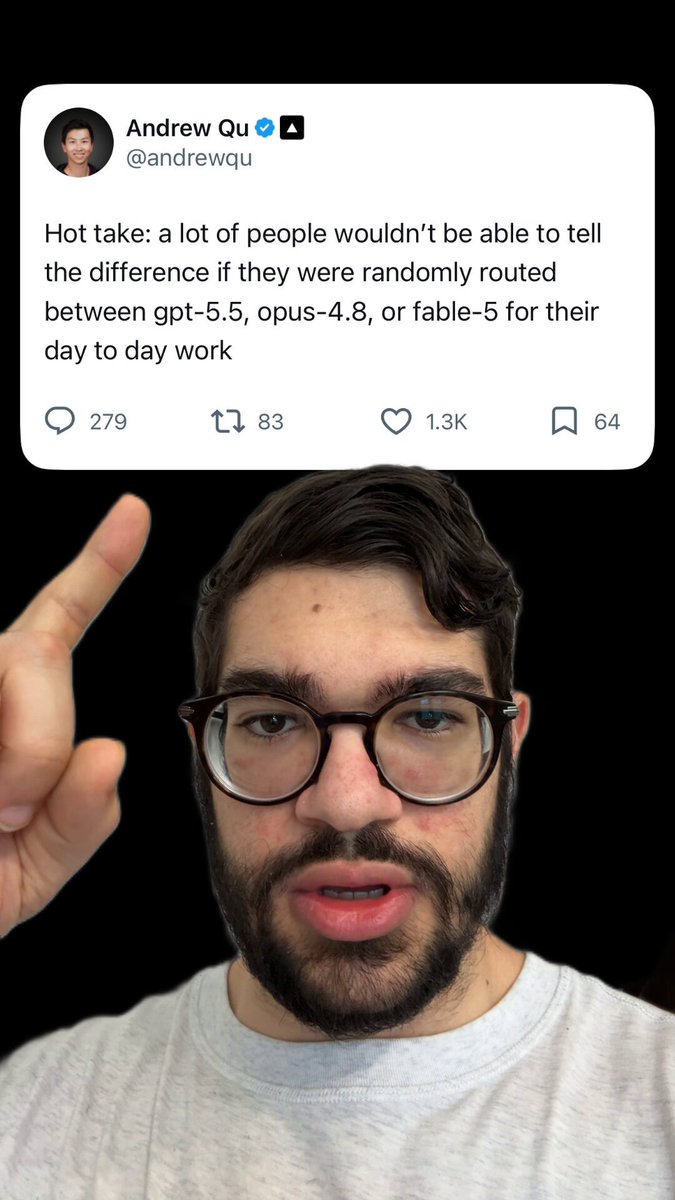
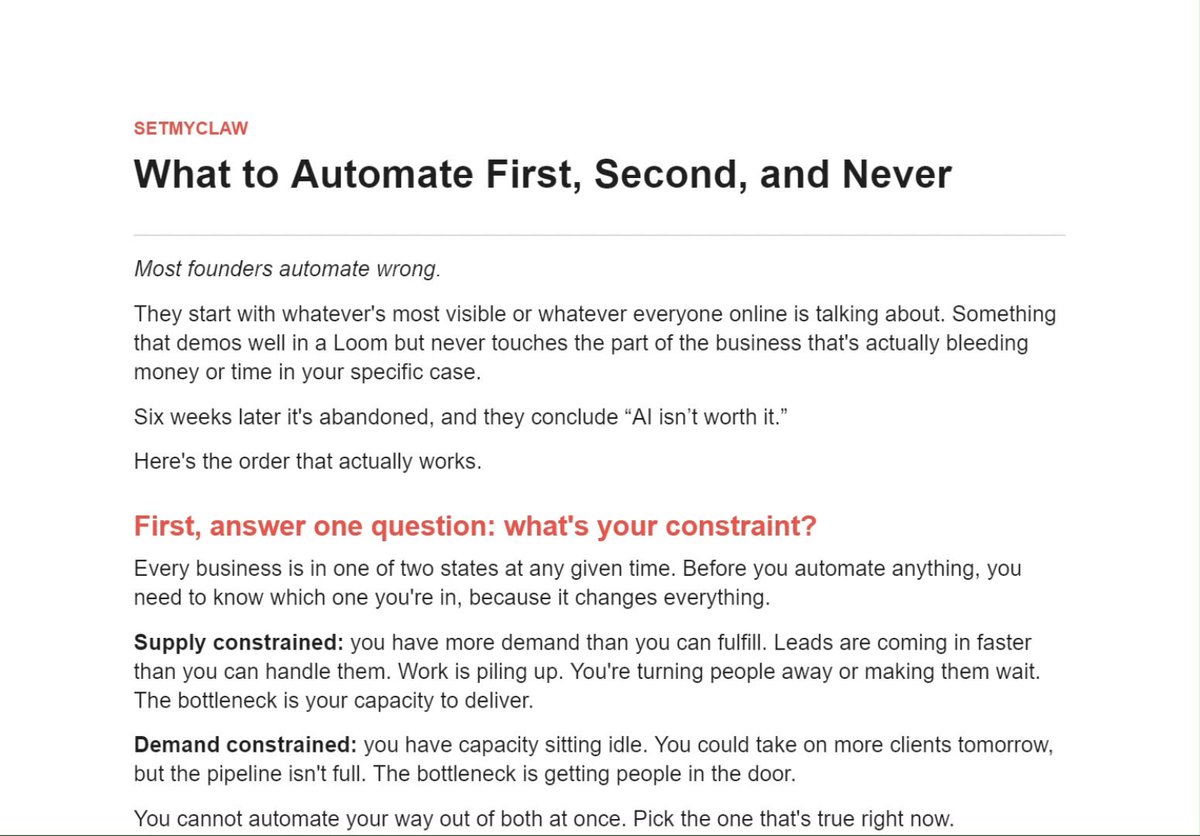
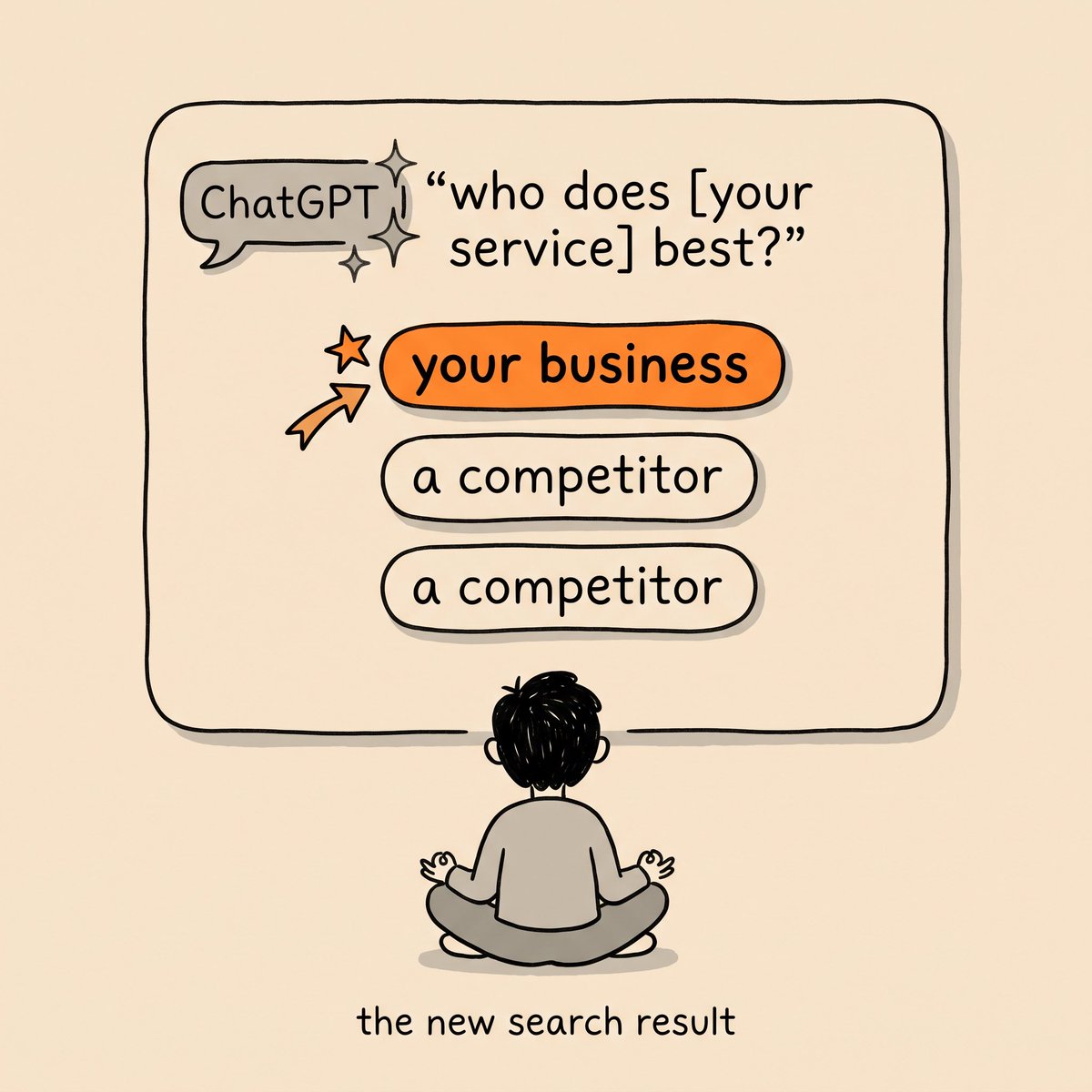
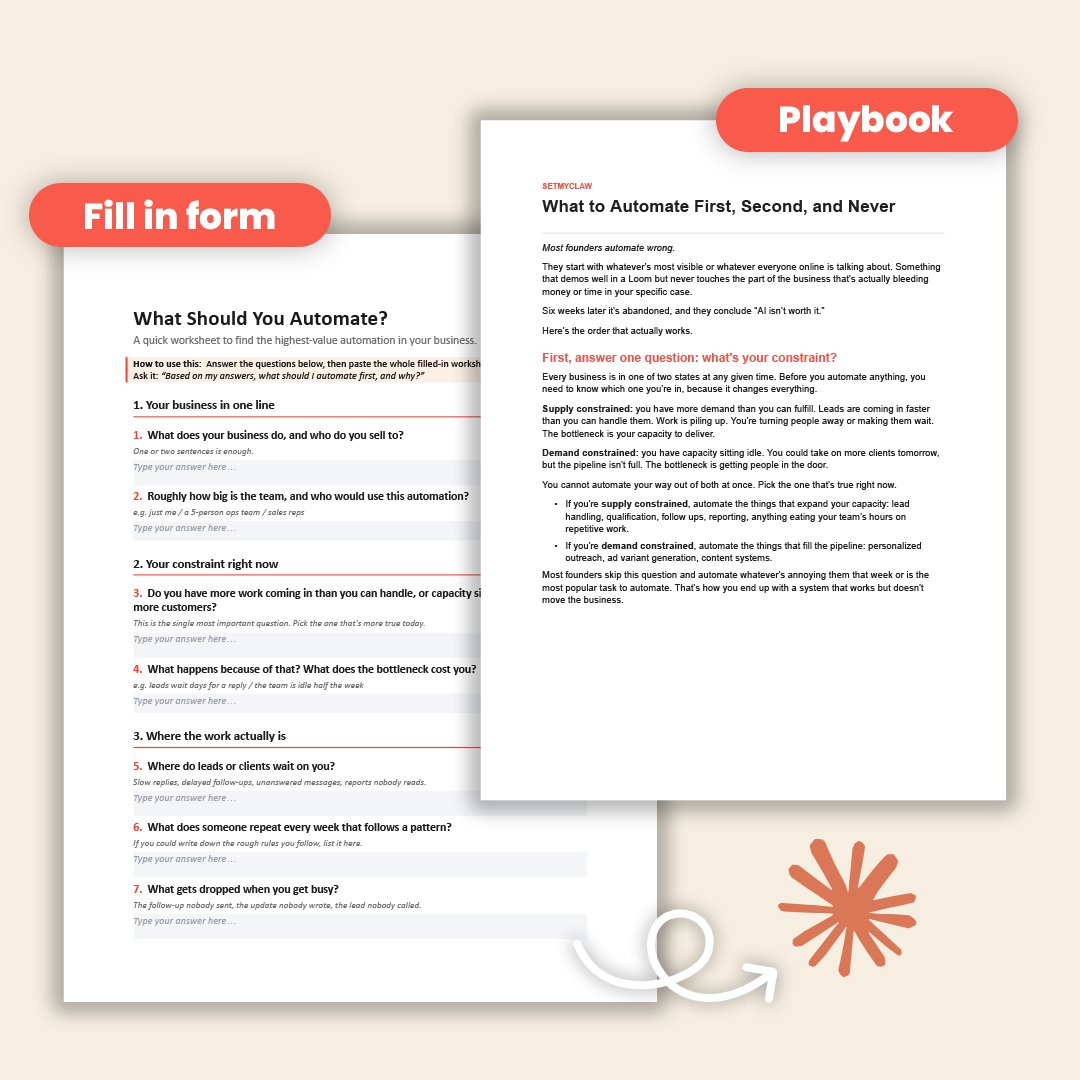
What Andrew is saying is right for chat use, wrong for the two contexts that move money
Code generation: real measurable differences
Production AI in your business: prompt engineering imprinting your voice on the model (but need routing for cost efficiency)

Hot take: a lot of people wouldn’t be able to tell the difference if they were randomly routed between gpt-5.5, opus-4.8, or fable-5 for their day to day work
1
1
10
116
“vibe coding RIP” is one of those takes that’s right and wrong depending on which version of vibe coding you mean
if vibe coding means “a kid in headphones types into claude and ships a billion dollar system,” yeah, that was never alive
it died because it was never real
The people declaring it dead are correct, but they’re killing a strawman that X built to feel better about itself
if vibe coding means “engineers using AI as an enhancement layer on top of their craft, accelerating the boring 80% and reserving their attention for the hard 20%”
not only is that alive, it’s the direction the entire industry is moving
eventually it becomes the default and we stop calling it anything because it’s just how coding works
Here’s the part skeptics miss every cycle:
nobody in 2026 writes MS-DOS commands to ship software
the abstraction moved up
compilers wrote the assembly
high level languages wrote the compiler-friendly code
frameworks wrote the boilerplate
AI is writing the framework level code now
every generation thought their layer was the last one humans would directly touch
every generation was wrong
today’s “base layer” was yesterday’s step-up
yesterday’s base was the day before’s step-up
the line keeps moving and the skeptics keep redrawing it just behind whatever they currently understand
What doesn’t change is that the people who ship reliable software still make judgment calls AI can’t make for them
AI can tell you the tradeoffs between a webhook and a poll
it can’t tell you which one matters for a business that books 3 sales calls a day vs 300
AI can describe how to handle an API that throws garbage at 3am
it can’t tell you whether your specific business needs that level of resilience or whether you’d be over-engineering it
AI can list when human in the loop is appropriate
it can’t tell you the founder of this specific company will never check the queue, so the system has to handle confidence-routing differently
the technical knowledge is everywhere now
the contextual judgment about which knowledge applies to this business is the actual craft
that hasn’t moved
what’s getting automated is everything below those decisions
typing the code, drafting the boilerplate, writing the unit tests, generating the migrations
that’s not where the value was
the engineers who confused those two things are the ones panicking right now
the operators commissioning AI builds in 2026 don’t need to know any of this
they need to know that the contextual engineering judgment above the code layer is what determines whether their build works in 6 months
that part hasn’t gotten cheaper, AI getting smarter didn’t change it
“vibe coding” the marketing term is dead
AI enhanced coding is the new normal
the skeptics declaring it dead in 2026 are going to be the same people writing the same takedown in 2028, just with a new buzzword

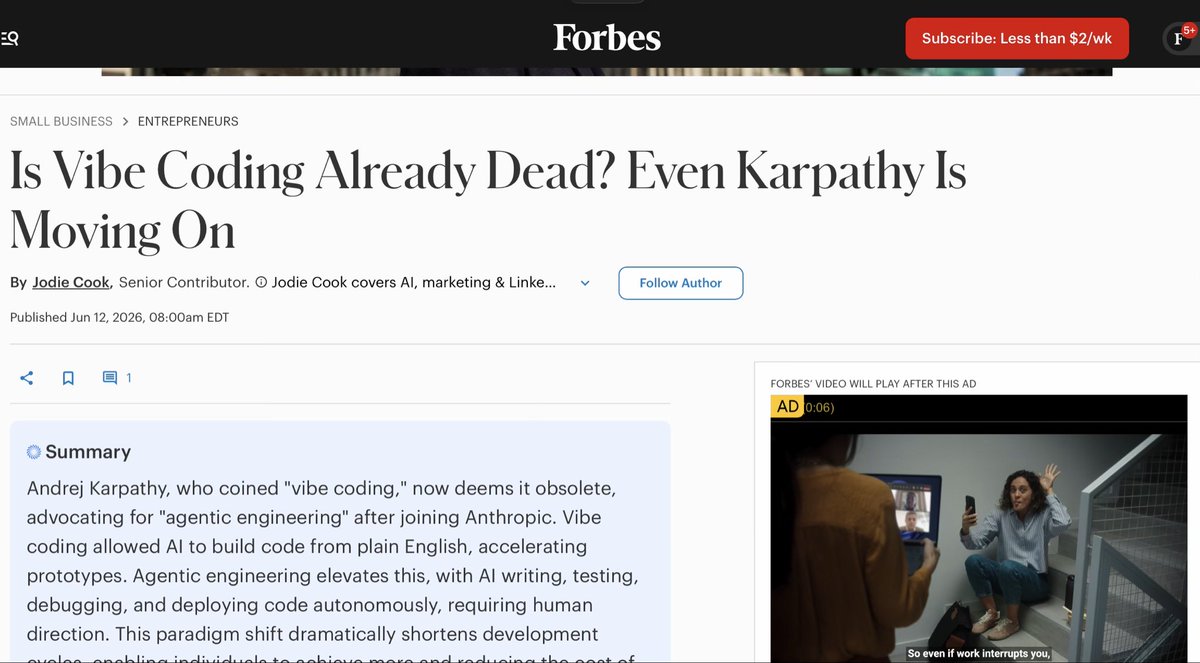
Vibe Coding, 2025-2026 RIP 🪦
Turns out you do still need skilled software engineers in the loop, just like many of us said all along.
2
4
245
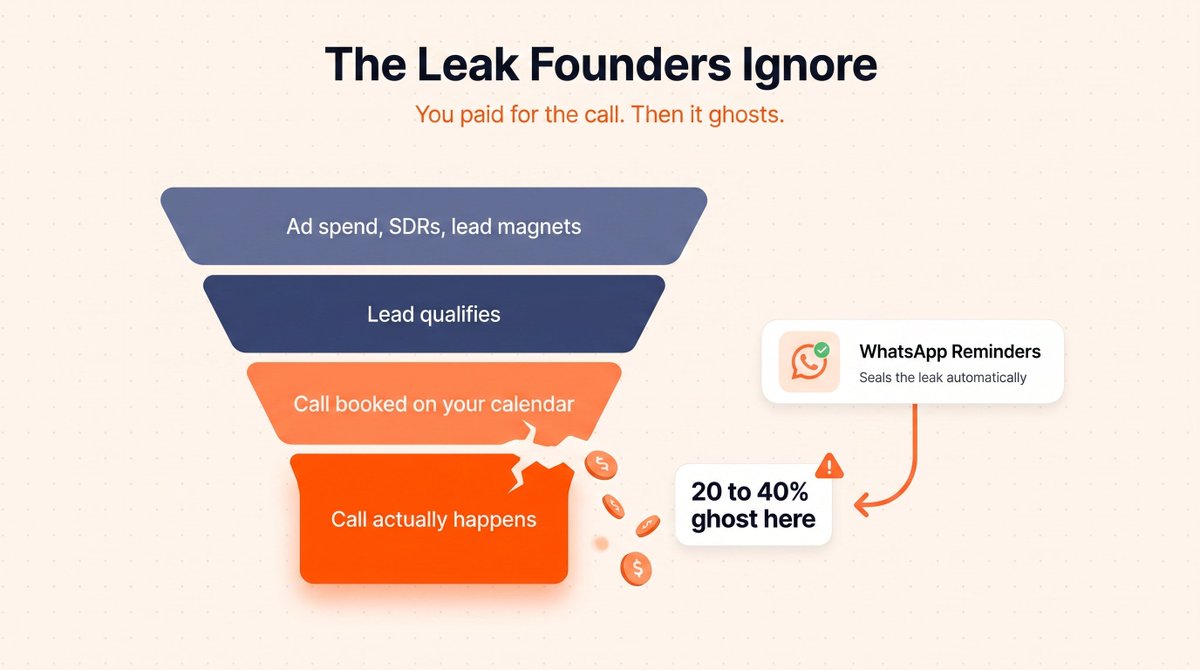
it's wild how much founders spend to book a call, and how little they spend making sure it actually happens
Thousands on ads, SDRs, lead magnets, all to fill the calendar. Then 20 to 40% of those booked calls just ghost
It's the most overlooked automation there is: no shows
They keep filling the top of the funnel instead of fixing the leak. The lead is already qualified and the money is already on the table
So I built that for a client
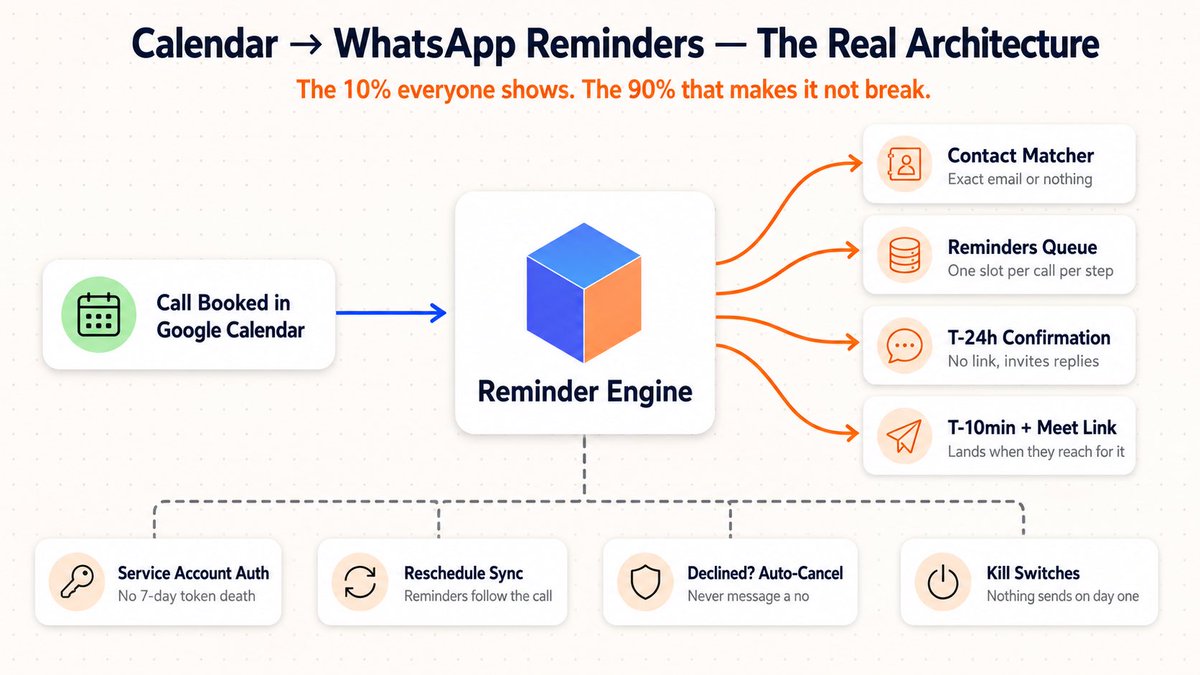
Every call booked in their Google Calendar now triggers a WhatsApp reminder on its own
1 the day before, and another one minutes before with the link. Move the call and the reminders move with it. The team does nothing different
Why WhatsApp and not email?
Email gets opened around 20% of the time
WhatsApp gets read 95% of the time, most within minutes
Same message, completely different outcome
And it's a real custom system, not a Zapier flow:
It never messages the wrong person. It matches the prospect by exact email, and if it can't, it asks a human instead of guessing
It can't double send. Reschedule a call ten times and the prospect still gets exactly one clean reminder with the right time
It rolled out with sending switched off first, so the team watched real reminders pile up as drafts before a single one ever went live
The automations everyone skips are usually the boring stuff that leaks money and is being ignored
You've already paid to book that call. Letting it ghost is the most expensive thing in your funnel. The leads are interested that's why they booked the call
Keep filling the top. Just fix the leaks too
1
4
162

Jun 13
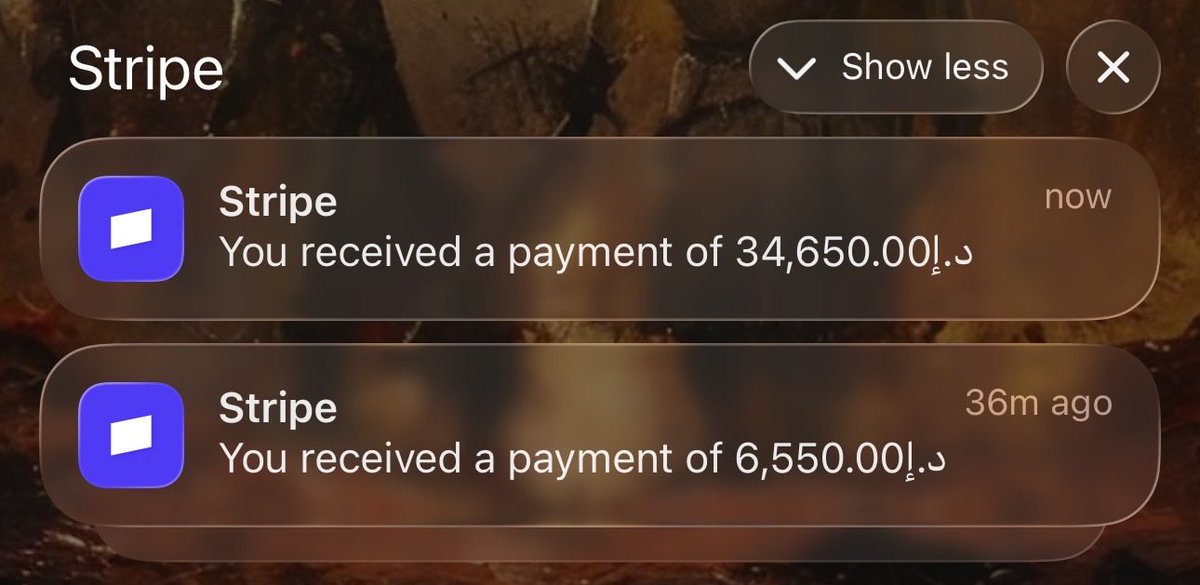
Woke up to two client payments
Proposals were drafted by the system, follow ups went out automatically, contracts came back on their own
Still working today, but on the things that actually need me, not the operational layer that used to eat the weekend
9
1
20
1,325
Jun 12
everyone’s spending this week benchmarking Fable 5
my client’s making money with it on the most boring use case imaginable: making sure prospects show up to sales calls
full architecture, every production gotcha 👇

1
2
248
Jun 12
20 to 40% of booked sales calls don't happen
at a $10k deal and 30% close rate, that's $18k evaporating per 20 booking cycle
How to fix?
AI agent that catches every calendar booking, sends 2 whatsapp reminders and follows the call through reschedules
1
2
131
Jun 11
Founders taking sales calls, this is for you:
your no show problem isn’t a “prospects are unqualified” problem, it’s a “you don’t send enough reminders” problem
How to solve with AI below 👇
Jun 11
Most founders running booked sales calls are losing 20 to 40% of them to no shows
Run the math on your own pipeline:
40 calls booked, 12 ghost
That's not a scheduling problem, that's a third of your ad spend and SDR hours evaporating after the hard part was already done
The standard fix is email reminders
Email gets opened ~20% of the time WhatsApp gets read 95% most within 3 minutes
Every founder knows this, which is why the second standard fix is "just text them before the call"
Works great until you have five back to back calls and forget one, or the call got moved twice and your reminder references the wrong time
Manual doesn't scale
Email doesn't get read
So I built the third option for a client, into his CRM:
every call booked in Google Calendar automatically triggers WhatsApp reminders to the prospect
Confirmation the day before
Meet link minutes before
Move the call in the calendar and the reminders silently move with it
Cancel it and they cancel themselves
Nobody on the team touches anything. They book calls exactly like they always did
The build is 5 components, and the decisions inside apply to any automation you'll ever run in your business:
1. Reading the calendar (where 90% of DIY versions die)
The obvious way to connect is OAuth, the "Sign in with Google" flow
What nobody tells you: on a personal Gmail, an unverified OAuth app's tokens expire every 7 days
Getting verified means weeks of Google review
This is why most DIY calendar automations die after exactly one week
Not a bug. The token silently expired and nobody noticed until reminders stopped going out
The fix takes 2 minutes and Google doesn't advertise it: skip OAuth entirely
Create a service account in Google Cloud Console
It gets its own email address. Share your calendar with that email, "see all event details" done
Read only scope, so the system physically can't touch the calendar
And when the business migrates from personal Gmail to Workspace, you share the new calendar with the same email and change one config value
Zero rework
The whole auth layer: ~80 lines of code, zero new dependencies
2. The sync worker
Polls the calendar every 5 minutes, 14 days ahead
Expands recurring events, explicitly fetches deleted ones, because a cancellation you don't see is a reminder you send for a call that no longer exists
Meet link auto extracted, nothing to paste anywhere
Key insight: Google keeps the same event ID when a call gets rescheduled
Everything downstream keys on that ID
That single fact is what makes "move the call, reminders follow" possible
3. Matching the attendee to a WhatsApp thread
Attendee email matched against the CRM's contacts: exact match or nothing
Matched → use that contact's WhatsApp thread
No match → never guess
The call shows flagged red in the calendar view so a human fixes the data
A rule worth stealing: a reminder sent to the wrong person is worse than no reminder
Never fuzzy match on names
And the case most builds miss: attendee declined the invite → reminders auto-cancel
A cheerful "see you tomorrow!" to someone who declined your meeting is what makes automation feel like automation
4. Every reminder is a database row
No fire and forget jobs
Every reminder is a row: contact, event, send time, rendered message, status
One constraint makes it bulletproof: one reminder slot per event, per contact, per step
Enforced by the database itself
Sync can run 1,000 times → never a duplicate, never a double send
Call rescheduled → same rows get their time recomputed and message re rendered
If the call moved so close a step's time already passed, it cancels instead of blasting late
Call cancelled → rows flip to cancelled, nothing sends
Operator killed one reminder manually → it stays dead, the sync never resurrects it
The sender itself is dumb on purpose: every 60 seconds, claim approved rows whose time has passed, send with humanized typing delays
All the intelligence lives in the table
The part touching the outside world stays trivially simple, and therefore reliable
5. The cadence (two messages)
T-24h: "Hey {name}! Quick reminder, we have our call tomorrow at 3:00 PM. Looking forward to it 🤝 If anything changes on your end, just let me know"
No link: a link 24 hours early is noise
The message invites a reply, so reschedules surface a day out instead of 5 minutes before
This message is the no show killer
T-10min: "Hey {name}! We're on in about 10 minutes. Here's the link:"
Lands exactly when they're reaching for the link anyway. Helpful, not naggy
Ship the 80%, measure no shows, add the third touch only if afternoon calls still slip
The sequence is a settings page, adding it later takes 10 seconds
Now the part that applies to every AI system that talks to your customers:
How much do you let it act alone?
Full human in the loop makes you the bottleneck for a message that's identical every time
Full autonomy on day one is how you blast 15 people by accident
The answer is autonomy split by confidence:
Exact match English speaking contact → autonomous
Language isn't English → generated but held for one click review
No contact match → never sends, flags a human
Declined → auto-cancelled
Plus a staged rollout with two switches:
Deploy completely dark
Then turn sync on with auto-send off, so every reminder lands as a held draft
You watch real reminders for your real calls pile up with correct names, times, links, and nothing sends without your click
No test environment needed, production simply runs with the safety on
After a few days of clean output, flip auto send
The flip only affects newly created reminders, so turning it on can never trigger a burst of old ones
That trio is reusable in every automation you ship, not just this one
What the client actually got:
a. Prospects get a personal feeling reminder the day before and the link right before every call, from the business's real WhatsApp, automatically
b. The team reschedules in Google Calendar like they always did. Reminders silently follow. No second system to check
c. Wrong data can't cause damage. Unmatched calls flag instead of guessing, non-English drafts wait for a human
Booked calls become held calls, and held calls are the only ones that pay
2
240
Jun 11
Most founders running booked sales calls are losing 20 to 40% of them to no shows
Run the math on your own pipeline:
40 calls booked, 12 ghost
That's not a scheduling problem, that's a third of your ad spend and SDR hours evaporating after the hard part was already done
The standard fix is email reminders
Email gets opened ~20% of the time WhatsApp gets read 95% most within 3 minutes
Every founder knows this, which is why the second standard fix is "just text them before the call"
Works great until you have five back to back calls and forget one, or the call got moved twice and your reminder references the wrong time
Manual doesn't scale
Email doesn't get read
So I built the third option for a client, into his CRM:
every call booked in Google Calendar automatically triggers WhatsApp reminders to the prospect
Confirmation the day before
Meet link minutes before
Move the call in the calendar and the reminders silently move with it
Cancel it and they cancel themselves
Nobody on the team touches anything. They book calls exactly like they always did
The build is 5 components, and the decisions inside apply to any automation you'll ever run in your business:
1. Reading the calendar (where 90% of DIY versions die)
The obvious way to connect is OAuth, the "Sign in with Google" flow
What nobody tells you: on a personal Gmail, an unverified OAuth app's tokens expire every 7 days
Getting verified means weeks of Google review
This is why most DIY calendar automations die after exactly one week
Not a bug. The token silently expired and nobody noticed until reminders stopped going out
The fix takes 2 minutes and Google doesn't advertise it: skip OAuth entirely
Create a service account in Google Cloud Console
It gets its own email address. Share your calendar with that email, "see all event details" done
Read only scope, so the system physically can't touch the calendar
And when the business migrates from personal Gmail to Workspace, you share the new calendar with the same email and change one config value
Zero rework
The whole auth layer: ~80 lines of code, zero new dependencies
2. The sync worker
Polls the calendar every 5 minutes, 14 days ahead
Expands recurring events, explicitly fetches deleted ones, because a cancellation you don't see is a reminder you send for a call that no longer exists
Meet link auto extracted, nothing to paste anywhere
Key insight: Google keeps the same event ID when a call gets rescheduled
Everything downstream keys on that ID
That single fact is what makes "move the call, reminders follow" possible
3. Matching the attendee to a WhatsApp thread
Attendee email matched against the CRM's contacts: exact match or nothing
Matched → use that contact's WhatsApp thread
No match → never guess
The call shows flagged red in the calendar view so a human fixes the data
A rule worth stealing: a reminder sent to the wrong person is worse than no reminder
Never fuzzy match on names
And the case most builds miss: attendee declined the invite → reminders auto-cancel
A cheerful "see you tomorrow!" to someone who declined your meeting is what makes automation feel like automation
4. Every reminder is a database row
No fire and forget jobs
Every reminder is a row: contact, event, send time, rendered message, status
One constraint makes it bulletproof: one reminder slot per event, per contact, per step
Enforced by the database itself
Sync can run 1,000 times → never a duplicate, never a double send
Call rescheduled → same rows get their time recomputed and message re rendered
If the call moved so close a step's time already passed, it cancels instead of blasting late
Call cancelled → rows flip to cancelled, nothing sends
Operator killed one reminder manually → it stays dead, the sync never resurrects it
The sender itself is dumb on purpose: every 60 seconds, claim approved rows whose time has passed, send with humanized typing delays
All the intelligence lives in the table
The part touching the outside world stays trivially simple, and therefore reliable
5. The cadence (two messages)
T-24h: "Hey {name}! Quick reminder, we have our call tomorrow at 3:00 PM. Looking forward to it 🤝 If anything changes on your end, just let me know"
No link: a link 24 hours early is noise
The message invites a reply, so reschedules surface a day out instead of 5 minutes before
This message is the no show killer
T-10min: "Hey {name}! We're on in about 10 minutes. Here's the link:"
Lands exactly when they're reaching for the link anyway. Helpful, not naggy
Ship the 80%, measure no shows, add the third touch only if afternoon calls still slip
The sequence is a settings page, adding it later takes 10 seconds
Now the part that applies to every AI system that talks to your customers:
How much do you let it act alone?
Full human in the loop makes you the bottleneck for a message that's identical every time
Full autonomy on day one is how you blast 15 people by accident
The answer is autonomy split by confidence:
Exact match English speaking contact → autonomous
Language isn't English → generated but held for one click review
No contact match → never sends, flags a human
Declined → auto-cancelled
Plus a staged rollout with two switches:
Deploy completely dark
Then turn sync on with auto-send off, so every reminder lands as a held draft
You watch real reminders for your real calls pile up with correct names, times, links, and nothing sends without your click
No test environment needed, production simply runs with the safety on
After a few days of clean output, flip auto send
The flip only affects newly created reminders, so turning it on can never trigger a burst of old ones
That trio is reusable in every automation you ship, not just this one
What the client actually got:
a. Prospects get a personal feeling reminder the day before and the link right before every call, from the business's real WhatsApp, automatically
b. The team reschedules in Google Calendar like they always did. Reminders silently follow. No second system to check
c. Wrong data can't cause damage. Unmatched calls flag instead of guessing, non-English drafts wait for a human
Booked calls become held calls, and held calls are the only ones that pay
7
3
584
Jun 11
I build custom AI systems for founders running real businesses
Last build recovered 20% of lost leads for a client running 300K AED/month in ads
Want to see if it's a fit?
Click this -> setmyclaw.com/x
2
110
Jun 11
Got on a call yesterday with a founder from Ras Al Khaimah who recently took shares in a real estate company there
He wants to rebuild the operations from scratch
The company has real potential but it’s currently bleeding time and money on basic inefficiency
His vision is the right one: automate everything possible with AI, give every employee an agent that augments their work, lower the headcount, hire the best people, push more output through fewer humans
He’s thinking about this exactly the way I’ve been writing about for months
Which is exactly why I was worried about him
Because here’s the trap: when you have the right diagnosis about where AI is going AND the appetite to move fast, you make the most expensive mistake possible
You try to drop AI on the existing operations without fixing them first
He said something on the call I keep thinking about
His father told him when he was young, “time is money”
And he’s right, it’s been a quote for 250 years for a reason
But “time is money” only works if you actually run the math on what every messy hour is costing you
Most operators say the phrase
Almost none of them actually calculate it
Here’s what they don’t see:
Every employee at their company is spending 30/40% of their week on repetitive form filling, data entry, status updates across 4 systems that don’t talk to each other, and following up on the same 5 reminders
If you drop AI agents on top of that, you’re not solving the problem
You’re scaling it
The agents fill forms faster, the agents copy data between systems faster, the agents send the same status updates faster
Nothing actually changed about what the work is
Meanwhile the competitors who took the time to structure their operations first, before automating, are running on systems where the agents aren’t filling forms because the forms aren’t necessary anymore
The data lives in one place, the status updates surface automatically, the follow ups belong to the system, not a person.
The math is brutal once you run it:
if the team is 20 people each making AED 200K/year, 30% wasted = AED 1.2M/year in operational drag
That’s not “inefficiency”
That’s a salary line they’re paying for work that shouldn’t exist
And every quarter their competitors compound the gap because they got the order right
Here’s what actually works for what they’re building:
1. Audit operations first, automate second
Find what work in the company is repetitive enough that no human should be doing it in 2026. Restructure those workflows into clean, defined processes. Then point AI at them. In that order. Not “let’s add AI to everything”
2. One employee, one workflow at a time. Not “everyone gets an agent” Start with the role that has the highest ratio of repetitive pattern matching to judgment work. Replace 70% of their day with AI that runs on the structured workflow. Move to the next role. Compound through the org. Six months later the company runs at 3x the throughput with the same headcount.
3. The agents work on data, not on tasks. Most “AI agent” failures happen because the agent is built to do a task instead of read a data stream. Task based agents need humans to remember to use them. Data based agents trigger themselves whenever the data arrives. The first is a tool. The second is a system.
The founder with the wrong instinct (who thinks AI is a fad) is the easy one to spot
He’ll lose the next 3 years
The founder with the right instinct but the wrong execution order is the harder problem
He’ll spend AED 500K-1M on the wrong builds before he figures out he had to fix the ops first
The intent was correct. The order wasn’t
Time is money. The founders who actually run that math, and run it in the right order, are the ones who compound for the next decade
Your competitors are running circles around you while your team manually fills their little forms
AI doesn’t change that until you do
2
4
155
Jun 10
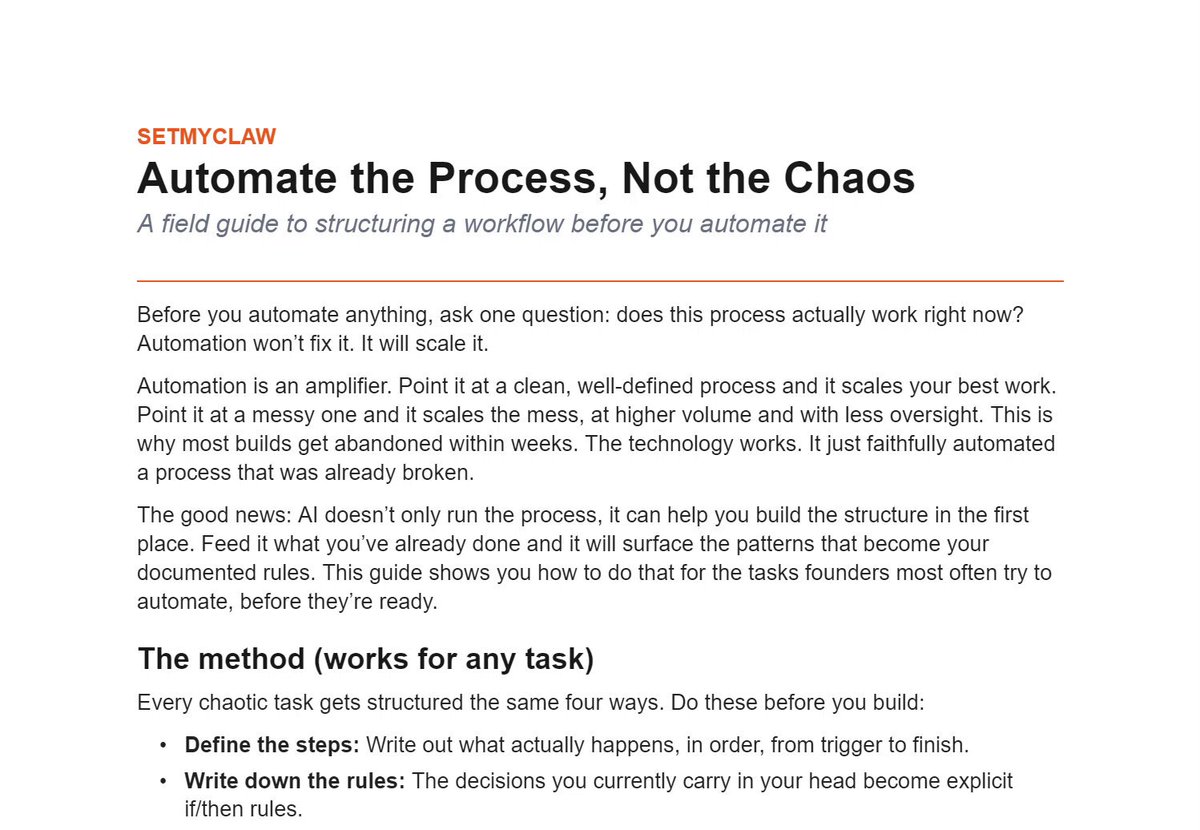
After shipping 25 production AI builds for founders and watching 7 figure businesses save 15-30 hours/week per team member...
I wrote down the entire method we use to structure operations before automating them, so AI scales the system instead of scaling the mess
before you automate anything, ask one question:
does this process actually work right now?
automation won't fix it, it will scale it
point AI at a clean, defined process and it scales your best work
point it at a messy one and it scales the mess, faster and with less oversight
Good news: AI can build that structure for you, from the work you've already done
I put the whole method into one FREE GUIDE 📄
What's inside:
1. how to turn any chaotic task into a structured system
2. how to use AI to find the structure from your past work
3. 8 workflows broken down one by one
4. the 5 checks that tell you if a workflow is ready to build
comment "STRUCTURE" and I'll DM you the guide
(you have to follow me)
1
3
171
Jun 10
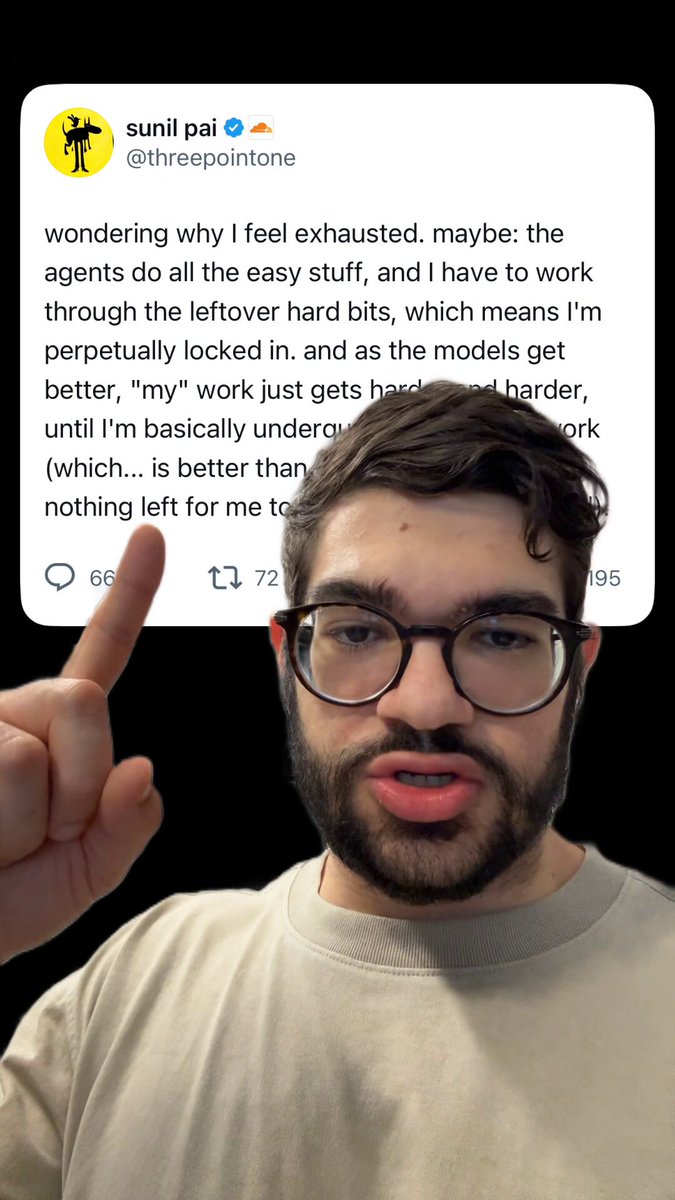
If AI is leaving you only the hard problems then that means the system is working
Exhaustion just means you’re working at more valuable stuff than you’ve ever had
Cause the small stuff is being taken care of
Jun 10

wondering why I feel exhausted. maybe: the agents do all the easy stuff, and I have to work through the leftover hard bits, which means I'm perpetually locked in. and as the models get better, "my" work just gets harder and harder, until I'm basically underqualified to do the work (which... is better than the alternative, there's nothing left for me to do, and I'm paperclipped).
2
5
333
Jun 9
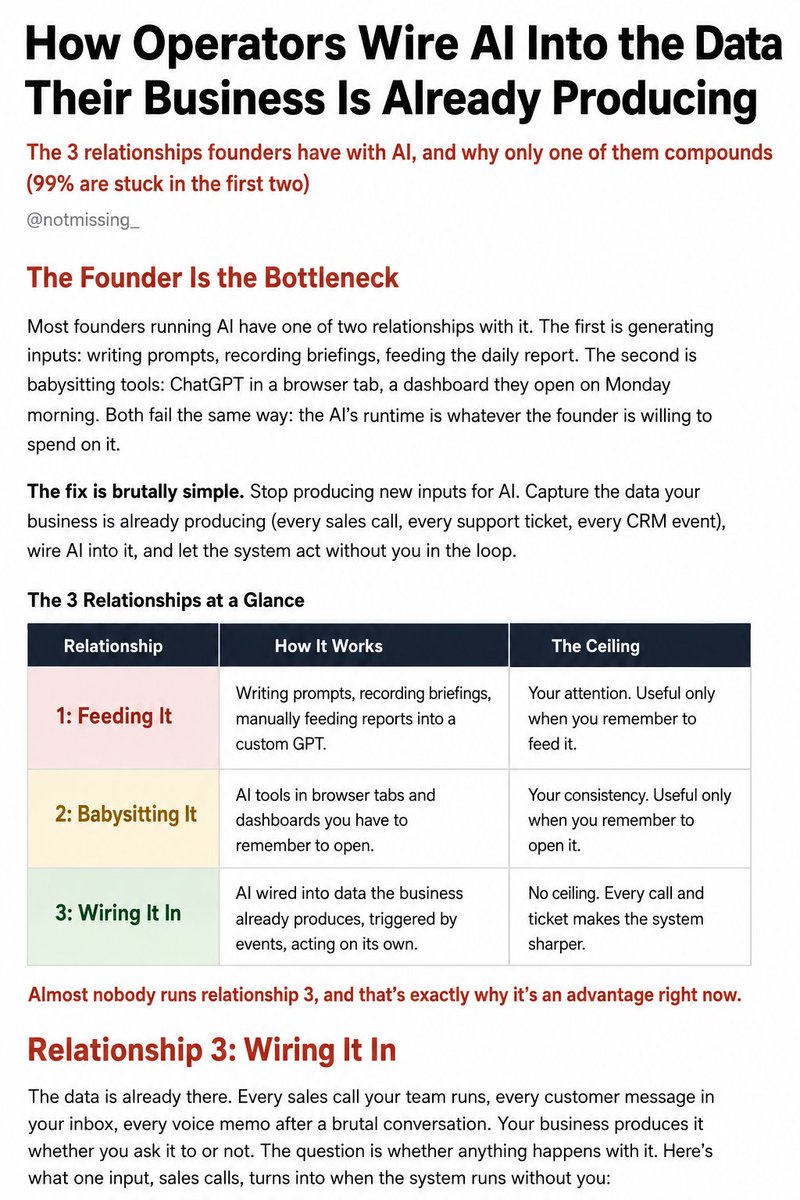
A $1,000,000 breakdown of how operators wire AI into the data their business is already producing:
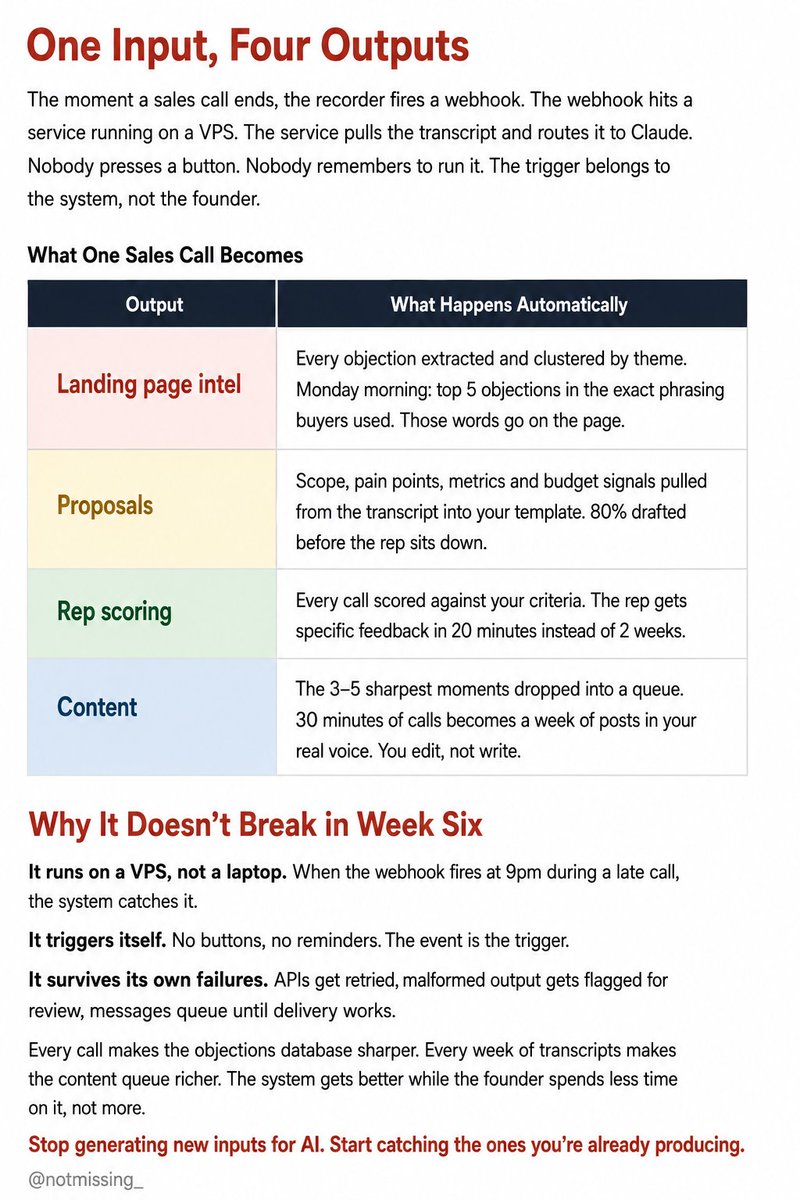
2
4
167
Jun 9
Claude Fable 5: first model to break 90% on Hex’s analytics benchmark
Translated for founders: the reporting, dashboards, and ad performance breakdowns someone on your team does manually every week?
You can now reliably automate that work

Introducing Claude Fable 5: a Mythos-class model that we’ve made safe for general use.
Its capabilities exceed those of any model we’ve ever made generally available.
3
2
312
Jun 9
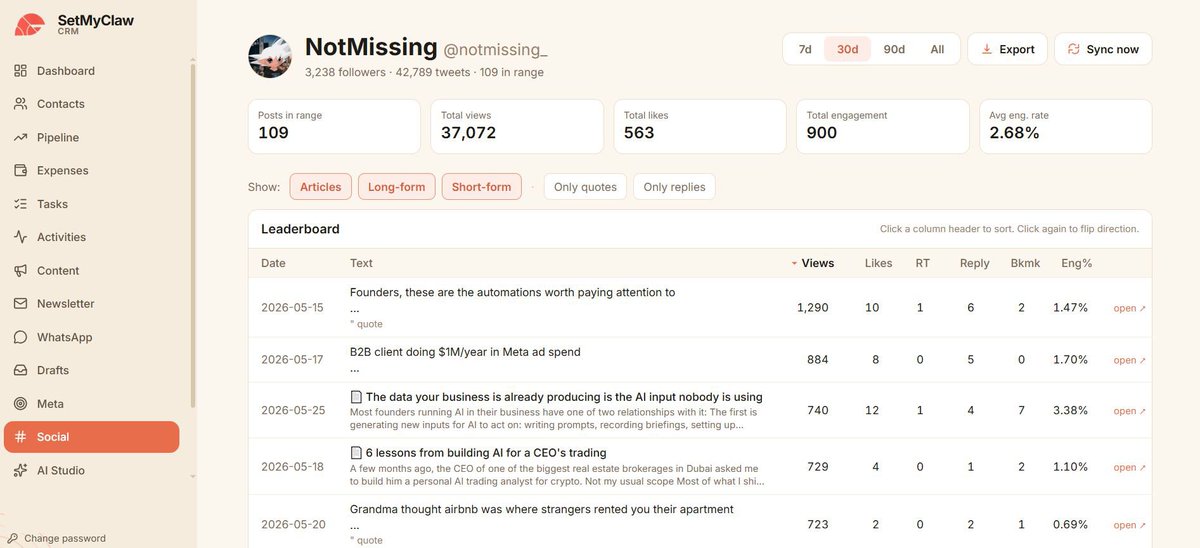
just built this into my own CRM
every post i publish now gets pulled in automatically
I have all the data:
- views
- likes
- replies
- bookmarks
- engagement rate
split by articles, long form, and short form
one screen that shows me exactly what landed and what didn't
most people post and forget. every new post starts from a blank page, like the last few hundred never happened
so when it's time to make something new
I export the data, give it to claude and tell me to write a post in the same voice, based on what worked before:
which topics pulled the most engagement, what my audience reads and which hooks made people stop scrolling
5
5
191
Jun 9
If you own a business and want an AI system like this built for you, let’s have a chat
x.com/messages/compose?recip…
1
88
Jun 9
if your AI build doesn’t log every decision, retry on failure, and pause if something looks wrong, you don’t have a production system
you have a hosted demo running on goodwill
three questions decide whether the AI in your business survives 2026
4
7
156
Jun 8
If you’re a founder doing 5-10M$ in revenue and you’ve been “looking into AI” for 6 months without anything actually running, you’ve already lost the year
Most founders in this bracket are doing one of three things right now:
1. Paying $200/month for Claude seats their team uses for two weeks then forgets about
2. Hiring junior staff to do work AI should be doing for them at 1% of the cost
3. Sitting in vendor calls with “AI agencies” that ship a demo, get paid, and disappear before the system breaks in week 6
None of these are AI in your business
they’re AI flavored versions of what you were already doing badly
What actually works in 2026 looks like this:
a system runs on a VPS in a data center, catches webhooks from the tools your team already uses (TLDV, your CRM, Meta Ads, your inbox), reads the data the moment it arrives, and acts on it before anyone on your team checks their messages
Not a chatbot
not a custom GPT
not a Zapier flow stitched together with prayers
A production system
owned by you
runs unsupervised
compounds while you sleep
Let me give you a real one:
a B2B client doing $80K/month in Meta spend was losing 20% of qualified leads because nobody could respond to inbound in under 5 minutes consistently
we built a system that catches every WhatsApp message in 30 seconds, classifies intent, drafts a reply in the founder’s voice, queues it for his approval on his phone, sends after thumbs up
20% recovery in week 1
34% CPA drop by month 2
$300K of annual leak closed in 6 weeks
That build took 3 weeks and costs less than what most founders spend on one quarter of an SDR salary
Also runs unsupervised, two months later, it’s still running
the founder has touched the underlying code zero times
Here’s the question that splits the room
Are you a founder who can describe in one sentence what specific work in your business is repetitive enough that you should never have been paying a human to do it?
If yes, you already know which build comes first and you’re probably just looking for someone competent to ship it
If no, the conversation isn’t about AI yet. It’s about understanding your own operations clearly enough to know where AI fits.
That’s a different conversation and a different starting point
Either way, if you want to talk about what an actual production AI build for your business looks like, DM me. No bs, no pitch
Most of what’s being sold as “AI for your business” in 2026 is theater
The real builds are quieter and worth more
The window where this is still a competitive advantage closes in about 12 months
4
235
Jun 8
most founders try to hand AI the keys in one move
day one they want it replying to customers alone.
it sends a dumb message so they remove it and now they "tried AI and it didn't work"
the opposite is just as common...
they build something good then spend 6 months approving every output by hand.
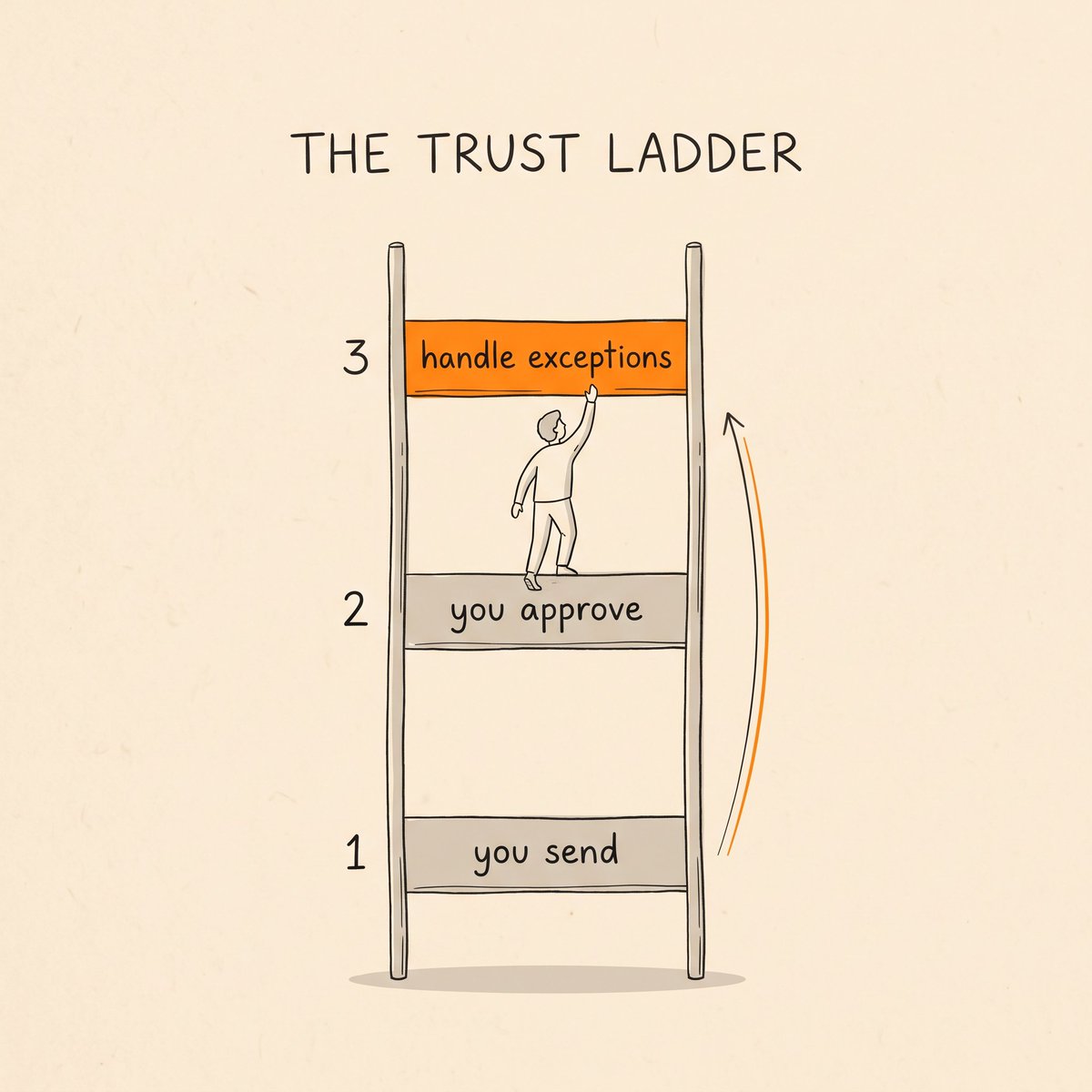
both are the same mistake: treating trust as a switch instead of a ladder
you don't decide once whether to trust a system.
you climb it, one rung at a time, each one earned
rung 1: it drafts, you send
it reads the message, pulls the context, writes the reply in your voice, then stops and hands it to you. nothing reaches a customer without you pressing send.
you start here because you don't trust it yet.
a lot of people get stuck here forever. rung 1 feels safe so they never leave, and they wonder why they're still buried
rung 2: it sends the safe stuff, you approve the rest
you stop trusting all or nothing and start trusting by risk. carve out a lane that's low stakes and reversible. the FAQ reply, the hours question, the booking confirmation.
anything ambiguous, high value, or hard to undo still routes to you.
rung 3: it acts, you handle exceptions
the default flips. it acts on its own and only pulls you in when it hits something outside its rules or its confidence.
you've gone from approving the rule to handling the exception.
These things let you climb. skip them and you fall:
1. you can see what it did:
every action logged somewhere you can look.
2. Before you climb, build the fall:
stop approving and it stops sending.
errors spike and it drops back to draft only on its own.
the climb is only safe because the floor is there
5
9
232