
🟄 𝘉𝘶𝘪𝘭𝘥𝘪𝘯𝘨 𝘌𝘯𝘥-𝘵𝘰-𝘌𝘯𝘥 𝘝𝘢𝘭𝘶𝘦 𝘚𝘶𝘱𝘱𝘭𝘺 𝘊𝘩𝘢𝘪𝘯 𝘧𝘰𝘳 𝘥𝘦𝘤𝘦𝘯𝘵𝘳𝘢𝘭𝘪𝘻𝘦𝘥 𝘮𝘢𝘳𝘬𝘦𝘵𝘴 🟄
Joined November 2022
- Tweets 26
- Following 112
- Followers 1,920
- Likes 18
Photos and videos
𝙉𝙪𝘾𝙤𝙣𝙨𝙩𝙧𝙪𝙘𝙩 ✦ retweeted

Mar 19
Grateful to welcome @nuconstruct as a sponsor for Blockspace Forum Cannes. They are pushing the bounds of decentralizing the transaction pipeline. We are excited to get their perspective and insights!
3
14
1,431
𝙉𝙪𝘾𝙤𝙣𝙨𝙩𝙧𝙪𝙘𝙩 ✦ retweeted

Mar 19
Fresh from the oven of nuconstruct research department!
1/2
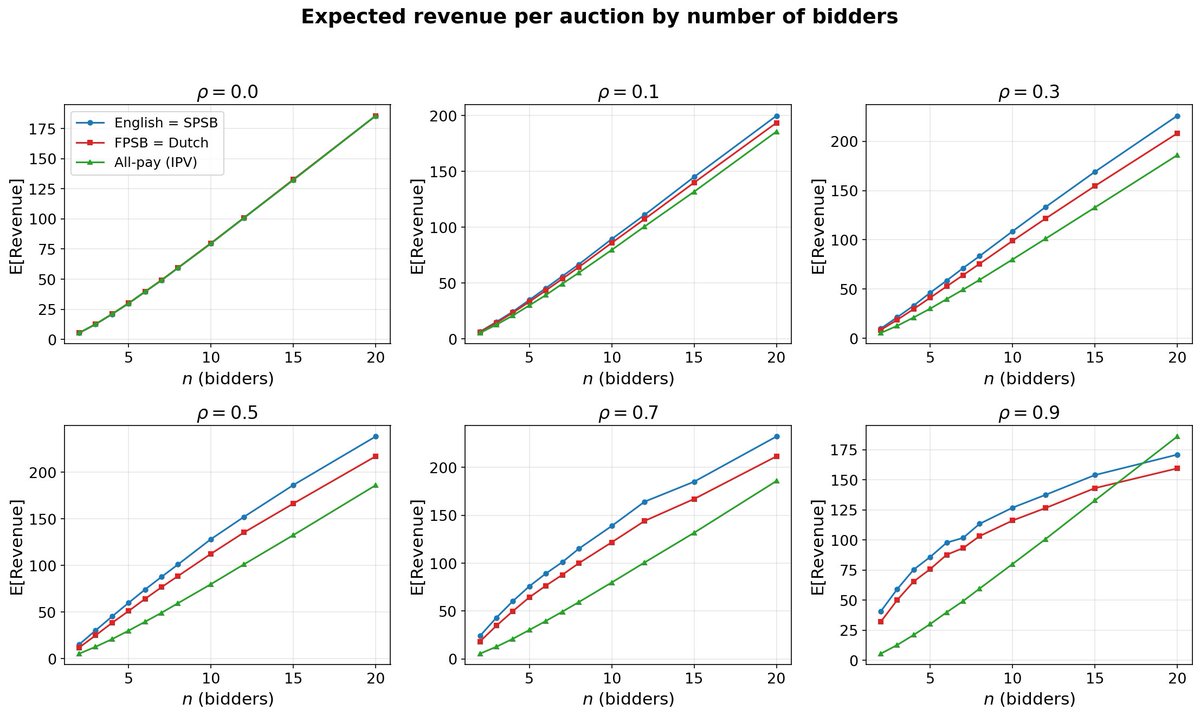
We show that switching to the open MEV auction may unlock $10-18M in revenue per year for Ethereum stakeholders - orderflow providers, apps and validators.
Mar 19

New post on EthResear.ch!
Open vs. Sealed: Auction Format Choice for Maximal Extractable Value
By:
-
🔗 ethresear.ch/t/24454
Highlights:
- MEV extracted values are extremely concentrated in a heavy right tail: the top 1% of transactions produce 68% of total revenue (Gini ≈ 0.933), so auction design for high-value events dominates overall revenue outcomes.
- Competition intensity differs widely by MEV type (using bribe % as a proxy): sandwiches are near-perfectly competitive (~95% bribe), while naked arbitrage and liquidations leave much more surplus with searchers (~67–68%), implying different effective bidder counts across categories.
- Revenue equivalence breaks under affiliated (correlated) valuations; modeling affiliation via a Gaussian common factor yields the linkage-principle ranking: English and second-price sealed-bid (SPSB) generate strictly higher expected revenue than first-price sealed-bid (FPSB) and Dutch for all tested (n, ρ) cells with ρ > 0.
- Quantitatively, at moderate affiliation (ρ = 0.5) English/SPSB out-earn FPSB/Dutch by about 14–28% (largest for small n, up to ~30% when n is small), translating to an estimated $10–18M of foregone revenue over the sample period when applied to observed bribe totals.
- All-pay auctions are a poor choice in MEV settings once affiliation is considered: FPSB revenues exceed all-pay by roughly 40–120%; additionally, at large n and high ρ, expected revenue can become non-monotonic in ρ (peaking then declining) because near-perfect correlation collapses the order-statistic spread that drives competitive payments.
ELI5:
Ethereum has “MEV opportunities” (like small profit chances from ordering transactions) that builders sell to searchers using auctions. This paper asks: which kind of auction makes builders earn the most money? The key idea is that searchers’ values are often related (if it’s valuable to one bot, it’s probably valuable to others too). When values are related, open/truth-revealing auctions (like an English auction or a second-price auction) usually make the seller more money than sealed/strategic-shading auctions (like first-price or Dutch). The authors also show MEV money is extremely lopsided: a tiny fraction of transactions produce most of the revenue, so choosing the best auction for those rare big ones matters a lot.
6
12
56
8,254
𝙉𝙪𝘾𝙤𝙣𝙨𝙩𝙧𝙪𝙘𝙩 ✦ retweeted

7 Nov 2025
1/ We're proud to partner with @nuconstruct, to accelerate & open up the Ethereum MEV market.
They are building TOOL – permissionless TEE network protocol, enabling:
▶ Collaborative searching for traders;
▶ 1-second preconfirmations for dApps & users.
cyber.fund/content/NC
9
8
36
11,360
𝙉𝙪𝘾𝙤𝙣𝙨𝙩𝙧𝙪𝙘𝙩 ✦ retweeted

11 Oct 2025
👀

6
3
67
9,488
𝙉𝙪𝘾𝙤𝙣𝙨𝙩𝙧𝙪𝙘𝙩 ✦ retweeted

25 Sep 2025
Kudos to the TOOL team 👏 Elevating Ethereum into a hyperscale co-processor is a game-changer. On our end, scaling infrastructure thrives only when matched with transparent, auditable data on transaction processing and prioritization. Without this, low-latency finality opens the door to centralization.
2
7
3,184
𝙉𝙪𝘾𝙤𝙣𝙨𝙩𝙧𝙪𝙘𝙩 ✦ retweeted

25 Sep 2025
Proud to be on the incredible @nuconstruct team launching the TOOL Testnet!
We're fundamentally rethinking Ethereum's transaction pipeline. So excited for what's next as we push towards 1-second execution for all txs.
79
3
122
3,219
𝙉𝙪𝘾𝙤𝙣𝙨𝙩𝙧𝙪𝙘𝙩 ✦ retweeted

25 Sep 2025
📢 @nuconstruct TOOL Testnet is live on Hoodi
At Stakely, we’re backing it with 1,000 @ethereum genesis validators and 1,000 @LidoFinance validators 😉
Here’s why 🧵
x.com/Stakely_io/status/1970…
24 Sep 2025

🔥 @nuconstruct TOOL Testnet is live!
Super excited to see this come to life, and even more excited to be part of it!
At Stakely, we're supporting the launch through Hoodi with 1000 Ethereum genesis vals and 1000 Lido vals
Top builders doing big things ⚒️
1
2
7
1,877
𝙉𝙪𝘾𝙤𝙣𝙨𝙩𝙧𝙪𝙘𝙩 ✦ retweeted

25 Sep 2025
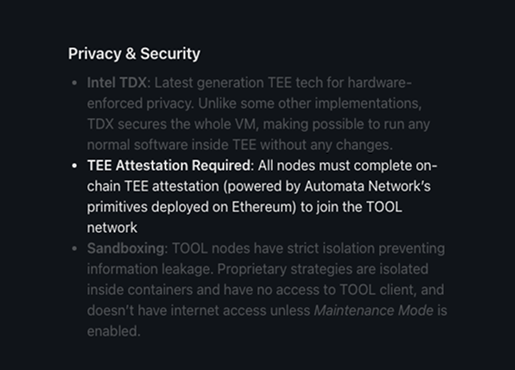
Private order flow on TOOL uses Intel TDX for censorship resistance and zero information leakage.
Automata's DCAP Attestation ensures nodes are verified onchain before participating in the network.
Congrats to @0x9212ce55 and the @nuconstruct team on the testnet launch ✧
1
4
15
2,395
𝙉𝙪𝘾𝙤𝙣𝙨𝙩𝙧𝙪𝙘𝙩 ✦ retweeted

24 Sep 2025
@prylabs is participating in hoodi by adding the TOOL relay endpoint to our hoodi testnet mevboost config
1
2
4
1,199
𝙉𝙪𝘾𝙤𝙣𝙨𝙩𝙧𝙪𝙘𝙩 ✦ retweeted

24 Sep 2025
We are honored to support and to be part of this journey.
Thank you so much!
2
5
12
1,472
𝙉𝙪𝘾𝙤𝙣𝙨𝙩𝙧𝙪𝙘𝙩 ✦ retweeted

24 Sep 2025
🫶 to the TOOL team
Obol is running 500 validators using TOOL on Hoodi as part of this testnet 🤝
4
3
24
3,307
𝙉𝙪𝘾𝙤𝙣𝙨𝙩𝙧𝙪𝙘𝙩 ✦ retweeted

24 Sep 2025
so so cool, have a look folks!
10
3
36
2,561
𝙉𝙪𝘾𝙤𝙣𝙨𝙩𝙧𝙪𝙘𝙩 ✦ retweeted

24 Sep 2025
The validator community keeps pushing boundaries.
Congrats to the TOOL team on the Testnet!
7
3
22
4,321
𝙉𝙪𝘾𝙤𝙣𝙨𝙩𝙧𝙪𝙘𝙩 ✦ retweeted

24 Sep 2025
Excited by this one, this may end up being a practical path to privacy on L1.
4
3
26
2,565
𝙉𝙪𝘾𝙤𝙣𝙨𝙩𝙧𝙪𝙘𝙩 ✦ retweeted
24 Sep 2025
🔥 @nuconstruct TOOL Testnet is live!
Super excited to see this come to life, and even more excited to be part of it!
At Stakely, we're supporting the launch through Hoodi with 1000 Ethereum genesis vals and 1000 Lido vals
Top builders doing big things ⚒️
2
2
4
2,873
𝙉𝙪𝘾𝙤𝙣𝙨𝙩𝙧𝙪𝙘𝙩 ✦ retweeted
24 Sep 2025
1// We're proud to announce TOOL Testnet launch!
86
58
425
110,417
𝙉𝙪𝘾𝙤𝙣𝙨𝙩𝙧𝙪𝙘𝙩 ✦ retweeted

4 Sep 2025
Ethereum Is All You Need
In this episode of Deeply Intents (🎙️, 🎧), I chat with 0xprincess @0x9212ce55 [mev extractor 🦄 and founder of @nuconstruct].
If you enjoy MEV discourse, want the alpha on TOOL and 🤍 Ethereum, you'll vibe with this episode. 👸🏼 0xprincess slayed the recording. It just hits different. Links below.
[sponsored by @anoma]
In this episode we discuss:
- MEV
- TOOL
- ePBS
- EIP process
- Ethereum
- Pseudo-anon game
Timestamps
0:00 - @nuconstruct origins
3:14 - DEX to DEX arbitrage
4:15 - Into the dark forest
8:30 - MEV competition today
13:28 - Liquidity network effects
19:42 - Trustless Orderflow Operations Layer (TOOL)
23:06 - Leader based consensus
29:06 - Open auction for orderflow
30:55 - Early confirmations and 1s block times
36:00 - Trust Domain Extensions (TDX)
43:09 - Validator adoption of TOOL
47:30 - Fundraising
53:08 - Product mindset
57:28 - EIP-7732: ePBS
1:03:58 - Improving the EIP process
1:07:08 - Product discovery
1:16:34 - EIP Process is well polished
1:18:03 - Ethereum ossification risks
1:22:50 - Ethereum has credibility
1:29:24 - Price is not correlated with tech
1:33:00 - Anon and pseudo-anon culture
1:40:34 - The TOOL is live! (testnet)
33
16
97
36,875
𝙉𝙪𝘾𝙤𝙣𝙨𝙩𝙧𝙪𝙘𝙩 ✦ retweeted
26 Aug 2025
Tomorrow, we'll have a TOOL presentation & QA for validator operators, hosted by RocketPool!
26 Aug 2025

Our next community call will be hosted on Discord: Wed 27 August @ 3pm UTC
We'll chat with @nuconstruct about decentralised Ethereum scaling, & how node operators on Hoodi can participate
Download the @poapxyz Home App & grab a free POAP when you join the call
Link below 👇
4
4
27
2,849
𝙉𝙪𝘾𝙤𝙣𝙨𝙩𝙧𝙪𝙘𝙩 ✦ retweeted

15 Aug 2025
New Greenfield newsletter out today! Spotlight: ‘Better UX, Bigger Markets’. Our research and investments in the UX vertical and more – featuring: @layer3xyz @arcium @getrebind @nuconstruct | Not subscribed yet? Online version: bit.ly/br3akthroughs9
5
12
43
3,478
𝙉𝙪𝘾𝙤𝙣𝙨𝙩𝙧𝙪𝙘𝙩 ✦ retweeted

11 Jun 2025
Yesterday, our friends at @nuconstruct come out of stealth to announce TOOL.
We are not only very excited to work with @0x9212ce55, @etoeth and the rest of the team, but we also believe TOOL can be new foundational element of the Ethereum tx supply chain.
10 Jun 2025

Blockworks exclusive: Meet TOOL, a new system promising 1-second Ethereum trades — no rollups, no forks
blockworks.co/news/tool-midd…
4
7
60
10,635