
Joined February 2026
- Tweets 118
- Following 8
- Followers 12
- Likes 4
49 Photos and videos
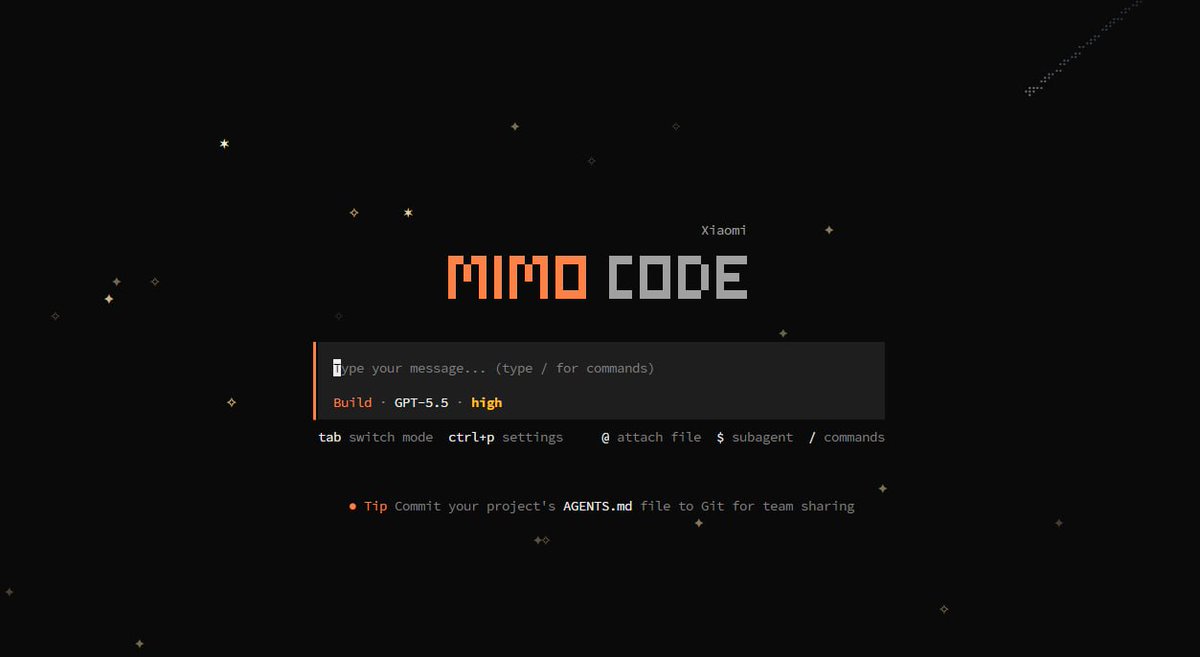






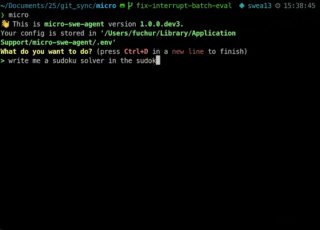
⚡️Xiaomi has launched MiMo Code (4.3k⭐)
It is an open-source coding agent built on top of OpenCode.
The package includes MiMo Auto, a temporarily free mode on MiMo-V2.5 with up to a 1M-token context. You can also sign in via Xiaomi MiMo, import a Claude Code config, or connect other providers.
What’s interesting:
▫️ Max Mode
At each step, the agent creates 5 independent drafts: reasoning tool-call plan, without execution. Then a judge selects the best option, and only that one gets executed.
Xiaomi reports 10–20% on SWE-Bench Pro, at the cost of roughly 4–5x more tokens. The feature is experimental.
▫️ Goal
/goal defines the stopping condition. Before finishing, a separate judge checks whether the task has actually been completed.
▫️ Memory
Memory is handled by a dedicated checkpoint-writer. It writes checkpoint. md, promotes stable facts into MEMORY. md, stores the full trace in SQLite, and parses notes. md, where the main agent can drop findings.
When the context fills up, the session is rebuilt from the todo list, checkpoint, latest user messages, and memory. That is their version of “unlimited context.”
▫️ Compose
A separate mode next to build/plan. Essentially, it is a built-in flow in the style of Superpowers skills.
The Compose agent runs the task through skills like compose:brainstorm, compose:plan, compose:tdd, compose:execute, compose:review, compose:verify, and compose:merge.
It is like specs-driven development: from spec to implementation, checks, and merge. In other words, they baked the development process right into the harness - respect for that.
▫️ Dynamic Workflow
For large tasks, there is JS orchestration: agent(), parallel(), pipeline(), workflow(). Parallel subagents and process logic live in an executable scenario, so complex flows depend less on whether the model can keep the order of steps in its head.
▫️ Dream / Distill
Dream cleans and merges project memory every 7 days.
Distill looks for recurring processes every 30 days and turns them into skills, commands, agents, and SOPs.
This looks like one of the most interesting new coding agents: Xiaomi has built an agentic system for long-running tasks with memory, completion verification, an SDD-style development mode, and parallel orchestration.
One nuance: you will not see the GPT-5.5 model right away, because they use a plugin for ChatGPT OAuth that does not include this model. But MiMo GPT-5.4 itself managed to make a patch, after which the model became available.
1
93
⚡️GitHub Copilot app - a developer agent control panel
GitHub has opened a preview of the Copilot app for paid Copilot plans. The app is available for macOS, Windows, and Linux.
By the way, Codex app and Claude Desktop still don’t have Linux versions.
Key features:
* Task > PR > checks > merge inside GitHub
You can start a session from an issue, pull request, prompt, or previous session. The agent immediately sees the GitHub context: repository, discussion, PR, checks, code search, and work history.
* Agent Merge
Copilot can take a PR all the way to completion: reply to comments, fix review feedback, handle failed checks, and follow merge rules.
You define the conditions, and the agent only merges when all requirements are met.
* Canvas instead of endless chat
The agent’s work is shown as a workspace: plan, PR, terminal, browser session, release checklist, status panel, or execution flow.
You can edit, rearrange blocks, approve steps, and redirect the agent right there, instead of hunting for the right place in a long chat thread.
* My Work as a task dispatcher for agents
One window shows active sessions, issues, pull requests, and background automations across connected repositories.
* Different agents inside one GitHub workflow
GitHub says it supports access to third-party agents, including Claude Code and Codex, plus partner agent apps.
2
87

Jun 12
OpenClaw 2026.6.5 🦞
This update introduces built-in parallel `web_search`, improves Matrix voice/thread support, fixes Anthropic/MCP session recovery, and switches versioning to the `YYYY.M.PATCH` format.
But the most important change is `security.installPolicy` for installing skills and plugins.
A skill is more than just a prompt. It can contain commands, dependencies, supporting files, and behavioral rules that directly affect how an agent operates. Because of that, skill installation should never happen silently.
Agents can now enforce a local installation policy:
* OpenClaw first prepares the source files
* It then invokes a trusted local command
* The command decides whether to allow or block the installation
* The policy applies to ClawHub skills, downloaded skills, Git/local skills, and plugins
* If the policy is enabled but the command is unavailable, the installation does not proceed
There is also an important improvement for ClawHub skills: OpenClaw now installs GitHub-backed skills using pinned commits and stores their data more reliably.
22
Jun 12
Mastercard is building a payments layer for AI agents 💸
Mastercard has launched Agent Pay for Machines - infrastructure that allows AI agents to make payments on their own: purchasing domains, paying for hosting, data, compute, or logistics services.
For now, this looks more like a partner-led launch than a public API available to all developers. The first participants include Cloudflare, Coinbase, Stripe, Adyen, Checkout, OKX, Solana Foundation, RippleX, and others.
Agents will have verifiable identities, spending limits, and payment policies. They’ll only be able to spend within predefined boundaries, while Mastercard and its partners handle settlement through cards, bank accounts, and stablecoins.
32
Jun 11
The most interesting nuance of Claude Fable 5: Anthropic is no longer just selling model intelligence - it's selling access modes to that intelligence 😱
Fable and Mythos run on the same base weights. Mythos is reserved for trusted partners, while Fable is available to everyone else, but with restrictions.
For cybersecurity, biology, chemistry, and distillation-related topics, requests may be routed to Opus 4.8.
But when it comes to frontier LLM development, things are much less transparent. In the system card, Anthropic states that Fable may silently reduce effectiveness on tasks such as model pretraining pipelines and ML accelerator design.
Not a refusal. Not a warning. Not a visible fallback.
Just an answer that looks normal but may be weakened through prompt rewriting, behavioral control vectors, or PEFT (parameter-efficient fine-tuning of a small subset of weights).
For everyday software development, this will probably never surface. But for AI research and training infrastructure, it creates an uncomfortable uncertainty: if the result is poor, you don't know whether the model failed or the provider quietly applied the brakes.
Another important detail: Fable is included in Pro, Max, and Team plans only until June 22. After that, access is API-only - $10 per million input tokens and $50 per million output tokens.
So we get a powerful model for long-running agentic workflows, but also a new reality: frontier intelligence now comes bundled with access policies, request retention, and invisible guardrails.
104
Jun 11
Anthropic has rolled out Claude Fable 5, and Claude Code instantly got more interesting 🎉
Anthropic released Claude Fable 5 - a new public Mythos-class model for complex development, long-running tasks, and agentic workflows.
The model is already available in many places. Anthropic specifically notes that Fable 5 shines on longer tasks: planning, staged execution, self-checking, and delegating subtasks.
At the same time, Claude Code has started rolling out an important update: nested subagents. Now an agent can launch subagents, and those subagents can launch their own subagents. The initial limit is up to 5 levels of nesting.
The main agent no longer has to carry the entire project, all logs, file search, tests, and review in one context. It can distribute the work across separate agents: one explores the codebase, another prepares the change, a third runs tests, a fourth reviews the diff, and a fifth looks for risks. Each returns a short result, and the main agent assembles the final solution.
Boris Cherny from the Claude Code team shared an example in the comments: a skill can run in a separate context, and inside that skill you can ask agents to keep each step isolated. This approach is already being added to /code-review, so reviews clutter the main context less and work more accurately.
186
Jun 10
OpenProse - Markdown Contracts for AI Agents
An interesting new repository has appeared: OpenProse. It's a declarative language for agent sessions. You describe a workflow in a *.prose.md file, and the agent gets more than just a prompt - it gets a clear contract defining what needs to be done, how different parts are connected, and what evidence of completion should be produced.
What this gives an agent in practice:
* It sees a structured task instead of a one-off instruction.
* It understands dependencies between steps.
* It can rebuild only the parts of the workflow that changed.
* It leaves verifiable proofs of completion.
* It makes workflows more portable across sessions and different agents.
For example, in Hermes this approach can be used for repeatable processes such as news digests, PR reviews, article drafting, repository audits, or test execution. Instead of writing a long prompt every time, you create a contract file that defines the desired outcome, sources, validation checks, and response format.
OpenProse works on top of familiar coding agents such as Claude Code, Codex, OpenCode, Hermes, and Pi. Under the hood, it includes Reactor, which tracks changes, rebuilds dependent sections, and stores completion evidence.
22
Jun 10
OpenClaw and agent work cycles 🔄
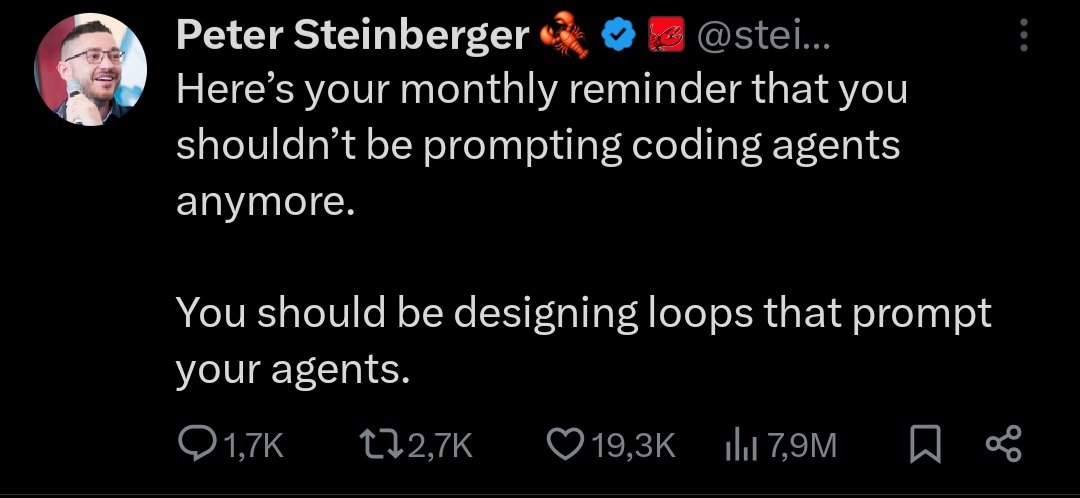
A post by Peter, the creator of OpenClaw, went viral on X. The idea is simple:
It is time to write fewer one-off prompts for coding agents and start designing cycles where agents receive a task, verify the result, and come back with confirmation.
Against this backdrop, AI Engineer - the team behind the AI engineering conference - pulled some almost insane numbers from a talk by Vincent Koc, OpenClaw’s chief architect: 3,000 commits in a day, 10-15 maintainers on the project, 60-70 agents running, and around one million lines changed.
According to Vincent, OpenClaw already has a validation loop in place: the agent makes a change, runs tests, fixes errors, checks again, and only then hands the result back to a human for final review.
People in the comments are asking the right questions: how many changes get rolled back, where old bugs reappear, why the interface sometimes suffers, and whether this speed is getting too expensive.
What matters is who reviewed it, what they used to review it, what broke, what was rolled back, and at what point a human was brought back to the keyboard.
1
30
Jun 9
OpenAgents (3.7k⭐) is an open workspace where multiple AI agents can work together across different terminals, machines, and models.
Inside, there’s one shared Workspace: threads, files, browser, tasks, knowledge base, and @ mentions. You can connect Claude Code, Codex CLI, OpenClaw, OpenCode, Cursor, Hermes, Gemini CLI, Kimi, and other agents, then call the right one directly into the discussion.
What’s in the repo:
* `agn` - CLI/Launcher for installing and running agents in the background
* GUI Launcher for macOS, Windows, and Linux (Linux via AppImage)
* Web Workspace built on FastAPI Next.js
* Python SDK for custom agent networks
* MCP/skills for access to history, files, browser, and tasks
* Cloud Agents: OpenAI, Anthropic, Google, xAI, Perplexity, OpenRouter, and other providers
102
Jun 9
205 agent templates for OpenClaw in one repository
Found a useful catalog - awesome-openclaw-agents (3.5K⭐). It includes 205 SOUL md templates covering development, DevOps, marketing, finance, support, education, e-commerce, security, automation, and other scenarios.
Each agent is described as a role with tasks, behavior rules, and example responses. For example, you can take an agent for PR reviews, incident analysis, log analysis, newsletter generation, customer support, or competitor monitoring.
22
Jun 9
Hands-On AI Engineering - 50 practical AI templates
Sumanth077/Hands-On-AI-Engineering (1.3K⭐) is a repository with Python mini-projects covering agents, RAG, OCR, multimodality, and audio.
Most useful parts:
* Working agents: PR reviews via Telegram and GitHub MCP, natural-language GitHub search, Cal com meetings, hotels via Trivago MCP, and a browser agent built with browser-use.
* Multi-agent workflows: a coding assistant with planner → coder → reviewer roles, a research agent on AG2, and a marketing agent with web search.
* RAG examples: self-checking RAG, Hybrid RAG with a knowledge graph vector search, and query routing across different databases.
* Documents and OCR: receipt-to-JSON with Pydantic, prescription recognition with medication validation via RxNorm, and local GLM-OCR through Ollama.
* Multimodality: RAG over text, URLs, PDFs, images, audio, and video in a single database.
70
Jun 8
pi-dynamic-workflows (835⭐) - a Pi extension that adds a workflow tool, similar to the one in Claude Code.
The model writes a small JavaScript script, splits the task into phases, and runs multiple isolated subagents via agent(), parallel(), and pipeline().
A typical scenario is a repo audit: one agent collects the structure, another reviews modules, a third looks for risks, and the parent session assembles the final result.
Install:
pi install npm:pi-dynamic-workflows
Then in Pi:
/reload
The core is already there: scripts, subagents, parallel execution, phases, cancellation, and structured output.
What’s missing: saved/resumable runs and a /workflows manager.
Waiting for this feature to land in all agents soon 🏁
1
52
Jun 7
Headroom - context compression for AI agents
AI agents quickly fill up context with logs, JSON, search results, RAG chunks, and session history. Headroom sits between the agent and the model and compresses this data before it is sent to the LLM.
What’s in the repo:
- Python and TypeScript libraries
- local proxy: headroom proxy
- wrappers for Claude Code, Codex, Cursor, Aider, Copilot, and OpenClaw
- MCP tools: headroom_compress, headroom_retrieve, headroom_stats
- shared memory across agents
- headroom learn, which analyzes past mistakes and writes hints into CLAUDE md / AGENTS md
The key feature is reversible compression: the agent gets a shorter version, while the original is stored locally and can be restored on demand. This is especially useful for saving tokens in long sessions with tests, code search, and large API responses.
Installation:
pip install "headroom-ai[all]"
headroom wrap claude
95
Jun 5
Hermes Desktop - now you can run an agent like a regular app 🔱
Nous Research has released the public beta of Hermes Desktop for macOS, Windows, and Linux.
It can connect to a remote gateway.
The ideal setup looks like this: Desktop for focused work on your PC, Telegram for remote agent control.
64
Jun 5
OpenAI has updated Codex and added three notable blocks:
1. Role-based plugins
These are ready-made sets of instructions, skills, workflows, and app integrations for specific professions. The first package includes 62 apps and 110 skills.
Examples:
* Data Analytics - metric analysis, reports, and dashboards via Snowflake, Databricks Genie, Hex, and Tableau
* Creative Production - campaigns, banners, and product images via Figma, Canva, Shutterstock, Picsart, and Fal
* Sales - meeting prep, emails and follow-up tasks, CRM work, and deal-closing plans via Salesforce, HubSpot, Slack, and Outreach
* Product Design - testing user flows and creating prototypes from live URLs and static screenshots
* Investing / Banking - company financials, business comparisons, client presentations, and investment thesis checks
2. Sites
Codex can now create, save, deploy, and test sites: web apps, dashboards, internal tools, and games.
3. Annotations
You can now select a specific part of the result and ask Codex to refine exactly that piece: a site block, document fragment, table, slide, Markdown, or code.
1
2
107
Jun 5
A couple of interesting repositories ⭐
agentcookie is built for a setup with two OpenClaw agents: one agent lives on the machine where you are already logged into your services, while the second runs on a separate Mac and receives up-to-date Chrome cookies and secrets via Tailscale.
The second OpenClaw agent wakes up already authenticated and can work with GitHub, Linear, Stripe, Chrome cookies, and the CLI without manual auth login.
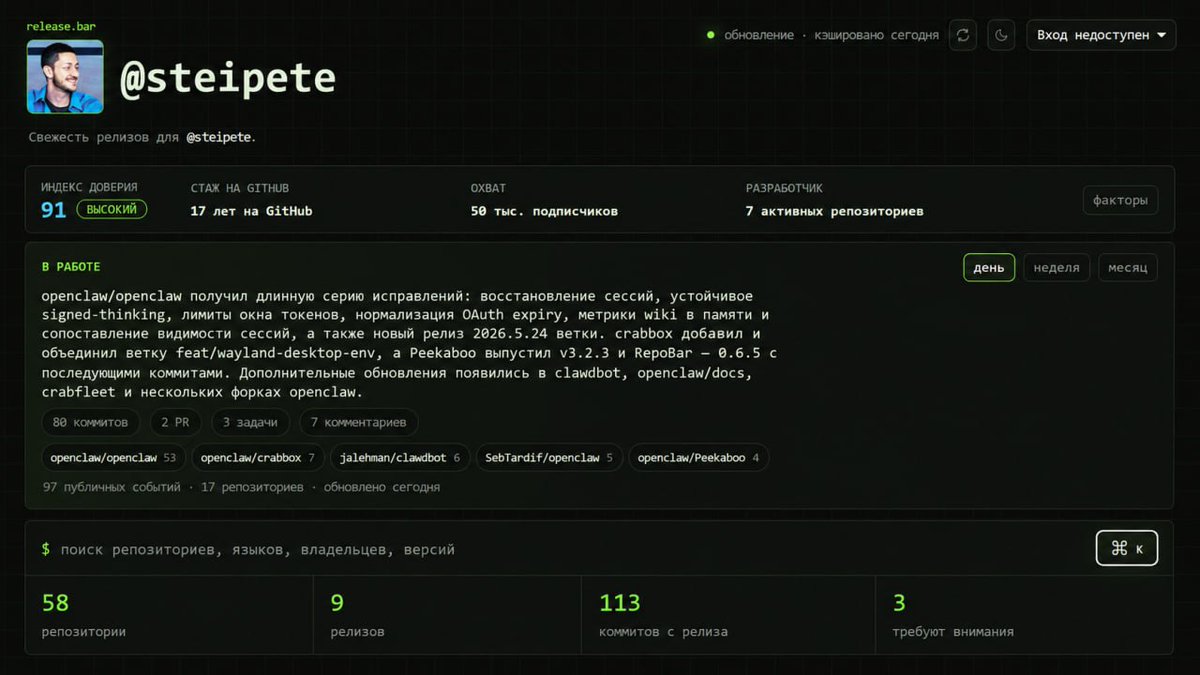
And there is also sag, a repository by Peter Steinberger, the creator of OpenClaw.
It is a modern replacement for macOS say, powered by ElevenLabs:
sag "Done, the task is complete"
sag -o result.mp3 "A short voice report"
For agents, this is a convenient way to voice statuses, errors, and work results.
25
Jun 4
Perplexity has described Search as Code - a new approach to search for AI agents.
A single search call with a ready-made results page is not enough for an agent.
For complex tasks, the agent needs to build its own strategy:
- where to search
- how to branch queries
- how to filter and verify sources
- what to save as intermediate results
- what not to pull into the model context at all
In Perplexity’s architecture, the agent generates Python code, runs it in a secure sandbox, and uses an SDK to control separate parts of the search stack:
search
ranking
filtering
deduplication - duplicate removal
aggregation - result assembly
For tasks like investigations, vulnerability research, or broad research, this is much more convenient than running dozens of separate search calls through the model.
The most illustrative example from the article is a CVE task.
The agent had to find more than 200 serious vulnerabilities, verify each one through a vendor advisory, and specify the product and fixed version.
Result: SaC achieved 100% accuracy and reduced token usage by 85.1% compared to the baseline approach.
26
Jun 3
Claude Code limits have been reset for Pro/Max 🎉
The reason: a bug caused some Opus 4.8 sessions to launch too many parallel subagents, quickly burning through the available usage limit.
82