Decentralized Reputation Protocol
Joined February 2024
- Tweets 188
- Following 135
- Followers 794
- Likes 153
16 Photos and videos

Pinned Tweet

12 Sep 2025
Unlocking Verifiable Reputation with @openranknetwork and @eigencloud 👇
12 Sep 2025

Every day we delegate trust to black box algorithms - for search, social feeds, rewards, commerce and marketplaces. in doing so, we get no agency, no explanation, no recourse.
meanwhile spam, manipulation, and misaligned incentives keep compounding. the cost of trust on the internet has never been higher.
@openranknetwork and @eigencloud are changing this now 🧵👇
2
3
2,501
OpenRank retweeted

7 Nov 2025
The internet has become great at distribution but terrible at deciding what deserves our time.
You can already see the outlines. Community Notes has become table stakes on X because a crowd that explains why a claim is misleading beats a mystery box. Stack Overflow’s accepted answers turn help into legible signal. Subreddit mods use templates and rules to keep a vibe. Prediction markets turn “I think” into “I’m willing to stake this,” and suddenly the fog around breaking news thins.
This is curation surfacing as an act of rebellion. A single company or individual should no longer be the lone tastemaker. Groups and communities are turning the tides around. Even if they lack the distribution, they are willing to fight to become the destination which in turn would bring back the pendulum of attention.
The ad-based internet priced attention. It did not price participation. Now we sit between two worlds. On one side, global feeds that maximize scroll. On the other, an emerging stack where open social graphs, onchain markets and verifiable compute can make community judgment legible. Crypto’s early experiments hint at it. Token launches try to reward the right people but recreate the same problem: no shared, verifiable way to tell signal from noise. Onchain data tools show fragments of the solution, but the algorithms are private and incentives still flow through platforms with no agency towards the communities they serve.
If we want a better web, we need to lean in and explore curation as an integral form factor. Communities should get a viable way to not only coordinate, curate and create value. But also capture and distribute value to participants. And this is my hope and aspiration for crypto - to serve as the plumbing that powers new coordination mechanisms and business models on the Internet.
This is the narrow path we are building toward. We built @openranknetwork, a reputation protocol, to help differentiate signal from noise on the internet. It helps bring reputation scores and ranking to social apps, crypto wallets and tokens, in a verifiable way.
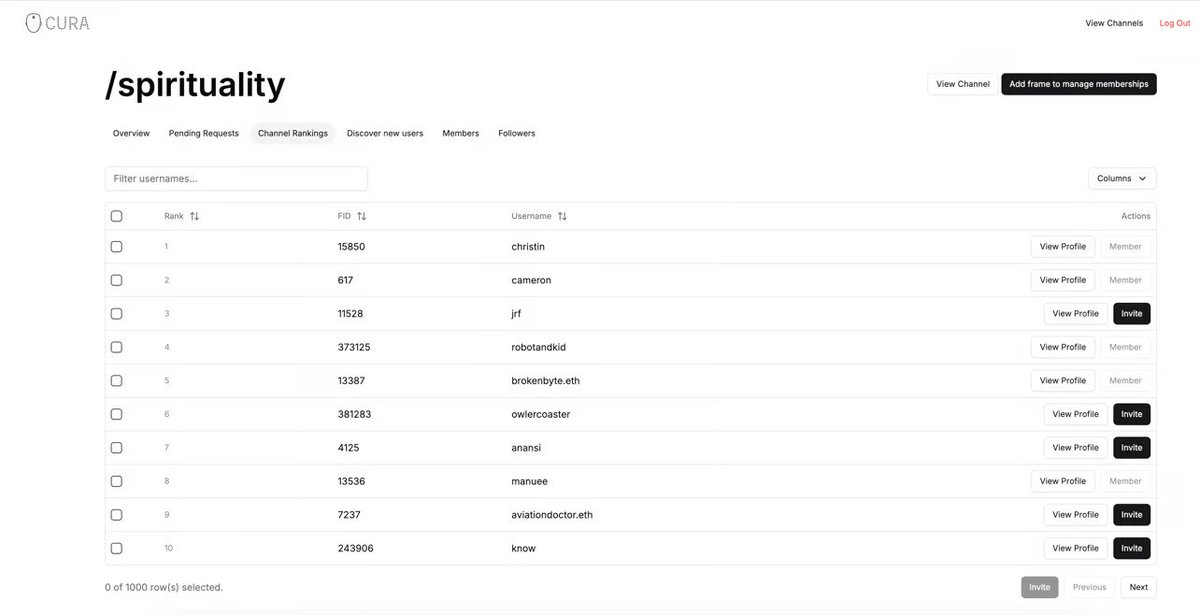
We’ve now built a community-first social app, @cura_network, where every community owns its feed, its rules, and its rewards. Think of it as a sovereign client for your corner of the internet. You get a homepage you can tune, a leaderboard you can defend, and a wallet you can use to pay contributors on a schedule you set. The point isn’t to replace your Discord, or your X timeline. It’s to give you a home where the best of your community accumulates, and where the judgment behind it is legible.
Under the hood, Cura runs on open protocols. We use @farcaster_xyz protocol for reading/writing open social data; OpenRank to turn raw signals - follows, likes, replies, link quality, onchain actions, into a community‑specific algorithm; @eigencloud to make the OpenRank compute verifiable. Each ranking produces a cryptographic commitment and an onchain trail so that communities get full agency on the algos that power feeds or distribute money.
we’re just getting started on bringing curation back to the internet.
give this piece by @joeljohn a read!
7 Nov 2025

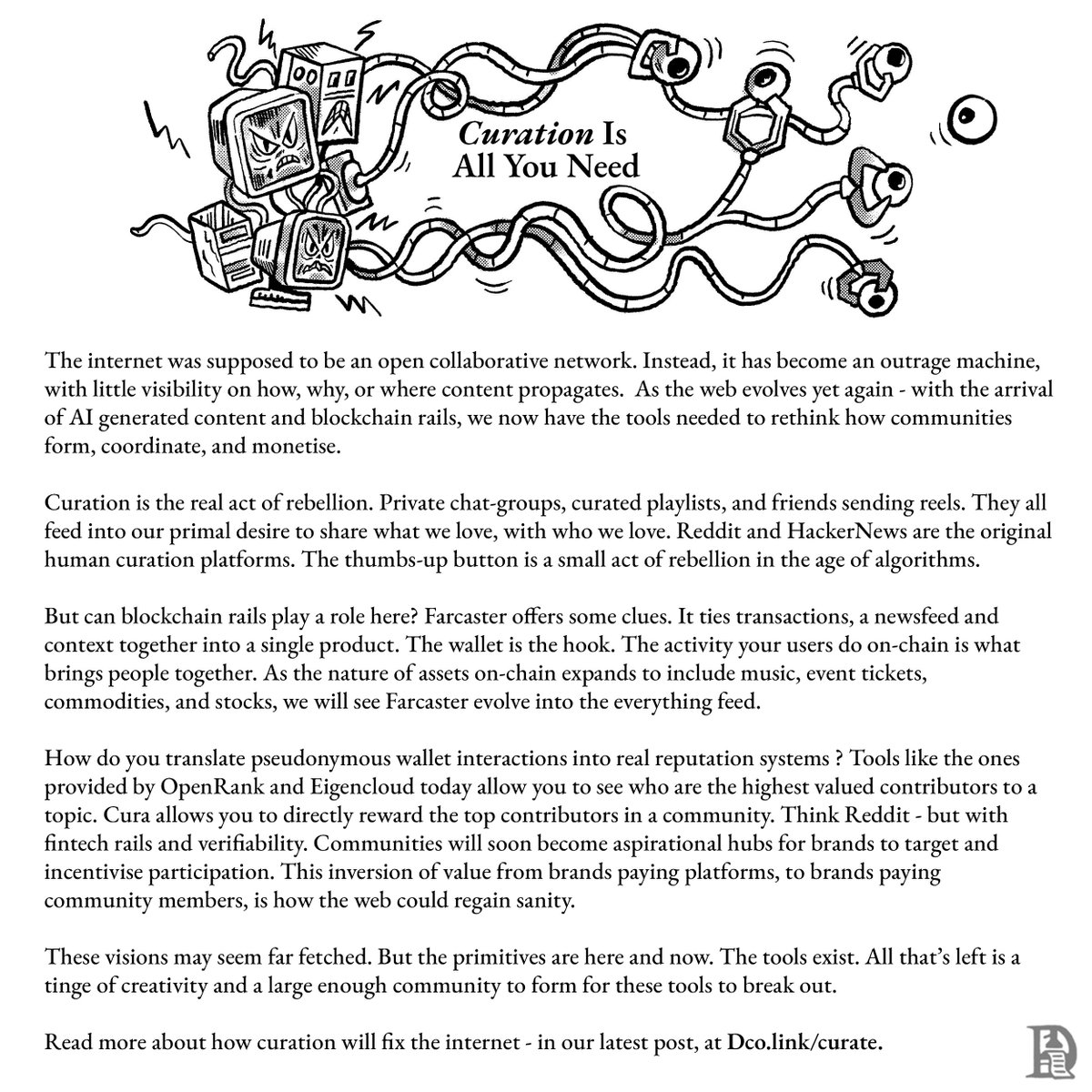
What's the reason you spend more time in private groups than you do on the feeds these days?
It is curation.
Our latest explains how @eigencloud, @openranknetwork, and @farcaster_xyz are building the primitives needed to create a verifiable web and power curation.
Link below
8
4
39
10,694
OpenRank retweeted

7 Nov 2025
What's the reason you spend more time in private groups than you do on the feeds these days?
It is curation.
Our latest explains how @eigencloud, @openranknetwork, and @farcaster_xyz are building the primitives needed to create a verifiable web and power curation.
Link below
9
17
75
35,465
OpenRank retweeted
30 Sep 2025
excited to build alongside @eigencloud to power a verifiable reputation system for the internet. we've been working on this integration for a few months with a world class protocol and infra team.
With @openranknetwork and @eigencloud, we're getting closer to making algorithms accountable to users, not the other way around.
30 Sep 2025

AI’s trust problem ends today.
We're thrilled to launch two new services, EigenCompute and EigenAI on EigenCloud. A new foundation for building truly verifiable apps and agents.
One of the biggest upgrades to AI since the launch of GPTs.
More 🧵 ↓
3
3
25
12,431
OpenRank retweeted
12 Sep 2025
Every day we delegate trust to black box algorithms - for search, social feeds, rewards, commerce and marketplaces. in doing so, we get no agency, no explanation, no recourse.
meanwhile spam, manipulation, and misaligned incentives keep compounding. the cost of trust on the internet has never been higher.
@openranknetwork and @eigencloud are changing this now 🧵👇
12 Sep 2025
Reputation runs the internet.
Search, feeds, airdrops: all black boxes.
@openranknetwork EigenCloud make them verifiable:
☑️ Algorithms you can read
☑️ Scores you can audit
☑️ Operators with skin in the game
@cura_network is live proof: verifiable feeds, auditable leaderboards, weekly rewards, all on open rails.
More in 🧵⬇️
ALT Verifiable Reputation: OpenRank x EigenCloud
3
7
37
13,393
OpenRank retweeted

12 Sep 2025
Reputation runs the internet.
Search, feeds, airdrops: all black boxes.
@openranknetwork EigenCloud make them verifiable:
☑️ Algorithms you can read
☑️ Scores you can audit
☑️ Operators with skin in the game
@cura_network is live proof: verifiable feeds, auditable leaderboards, weekly rewards, all on open rails.
More in 🧵⬇️
ALT Verifiable Reputation: OpenRank x EigenCloud
32
56
218
132,279
OpenRank retweeted

28 Aug 2025
1. not debating either, just trying to understand your pov. it is a tagline and is meant to be used as an anthem by asking to build and position the most important thing eigencloud does: verify/ verifiability
2.
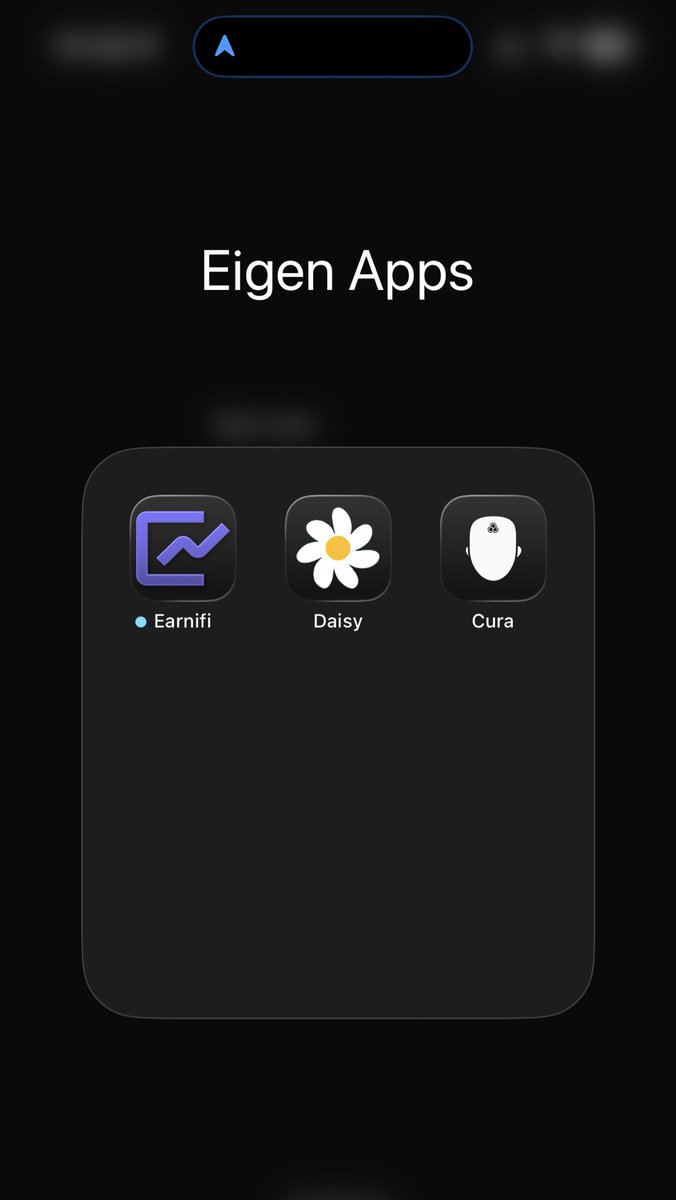
a) I love @openranknetwork’s @cura_network that is currently using EigenCompute.
I use Cura to manage our 7k community eigenlayer and eigencloud channels on Farcaster and now going beyond FC to X and other socials
b) @daisypayapp / live on apple store apps.apple.com/us/app/daisy-…
I use Daisy to check new cool creators and how i can participate in different campaigns and earn points
c) @goearnifi app, i have it installed on my phone, i havent used it myself but i can say this is the one of the coolest apps on the App Store with it being ranked at #1 finance app (and consistently top 5) in the finance category
Earnifi also won a mainstream award
apps.apple.com/us/app/earnif…
x.com/sreeramkannan/status/1…
19 Jun 2025

Apps on EigenCloud.
Earnifi just won Best Financial Services App at the 2025 American Business Awards. (@TheStevieAwards)
Not a crypto award, a mainstream win. 🏆
Built on @OpacityNetwork .
Powered by @eigencloud.
📍 Problem:
Workers need small advances. Payday loans exploit them.
📍 Solution:
Prove earned but unpaid income privately.
📍 Result:
Earnifi become the #1 paid finance app in the App Store.
This is the verifiable cloud in action:
✅ Real-world app
✅ Cloud-scale programmability
✅ Crypto-grade verifiability
Congrats @ArynChadha and team for all the success!
Build Anything. Verify Everything.
EigenCloud.
1
4
329
OpenRank retweeted

27 May 2025
ep3: sit n scroll
walking through crypto tools, mini apps & more!
today’s episode is @cura_network
built on @openranknetwork
6
4
55
2,165
OpenRank retweeted
27 Mar 2025
this is going to become a default for token distribution, incentives and rewards
launch tokens and distribute them to your friends and other reputable people, wherever they are!
this is a great example of programmable social
- launch token on rainbow
- find reputable users on farcaster using openrank scores
- distribute tokens to their verified wallets
some potential lists of reputable users:
- GitHub developer ranking
- Community leaderboards
27 Mar 2025

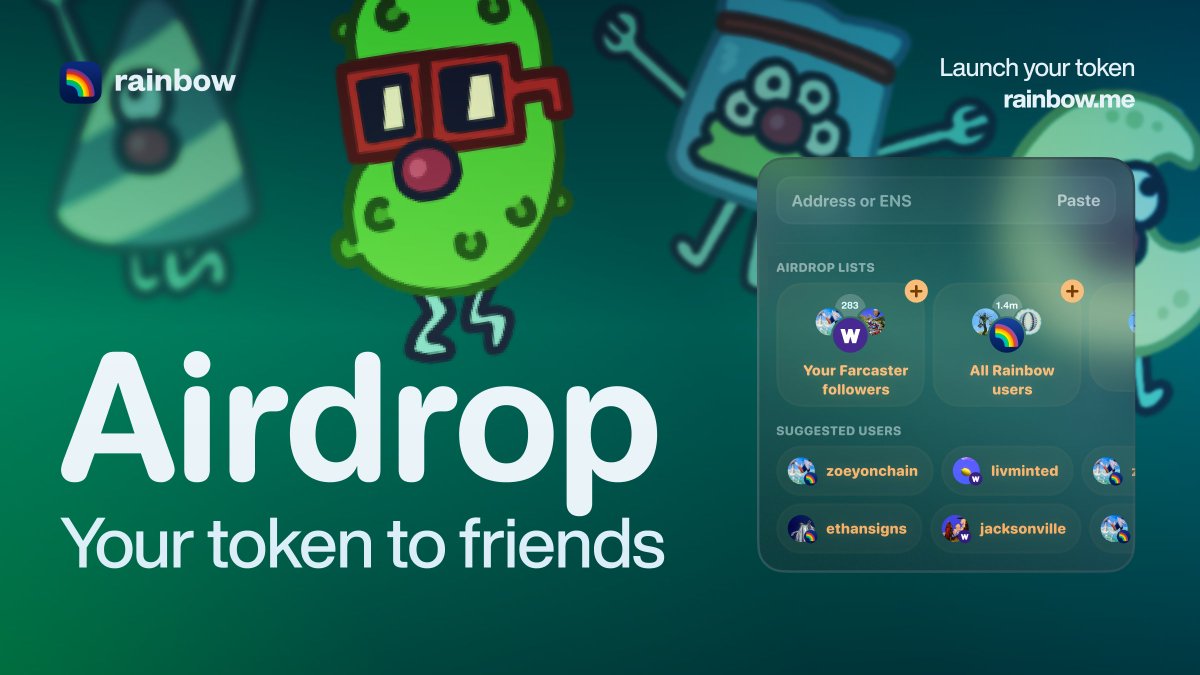
One of the coolest things about the Rainbow Token Launcher is the feature that lets you airdrop your token to your friends and fav communities
You can manually enter the addresses/ENS names for your friends, or you can choose from 4 airdrop lists to spread your token even further
Airdrop Lists available today:
-Rainbow Points Weekly Leaderboard (1k people)
-Farcaster Top Users (1k people)
-Rainbow Points Whales (420 people)
-Suggested Farcaster Users based on your social graph (100 people)
But we need your help coming up with good ideas for what Airdrop Lists we should add next!
Bonus for clever and innovative, out of the box ideas.
3
3
17
6,652
OpenRank retweeted

20 Mar 2025
checkr now integrates @openranknetwork to filter users by their farcaster score
if attention moves markets, we must rank those capturing it
@MLeeJr has been driving the most attention to $drb lately
5
14
82
9,687
OpenRank retweeted

11 Feb 2025
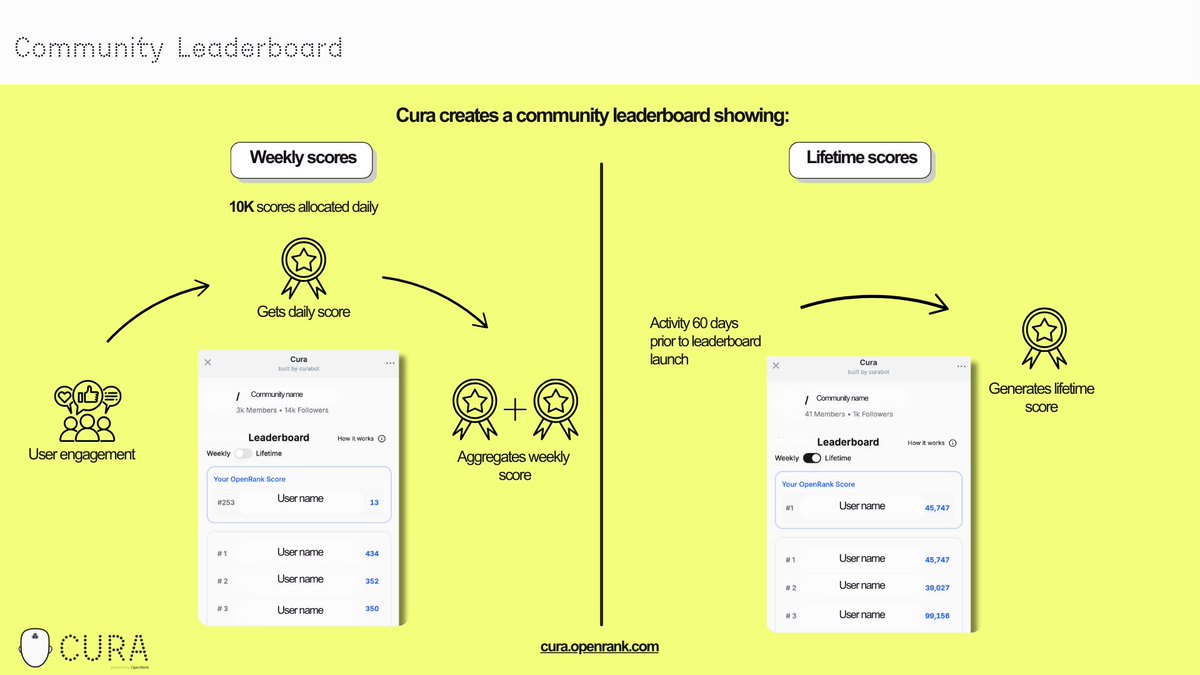
Want to reward top contributors in your #community? You can do that with Cura’s leaderboard. But wondering what is a leaderboard? Take a look👇
#communitybuilding #web3 #communityengagement #blockchain #crypto
@openranknetwork @SahilDewan
1
3
632
OpenRank retweeted
10 Feb 2025
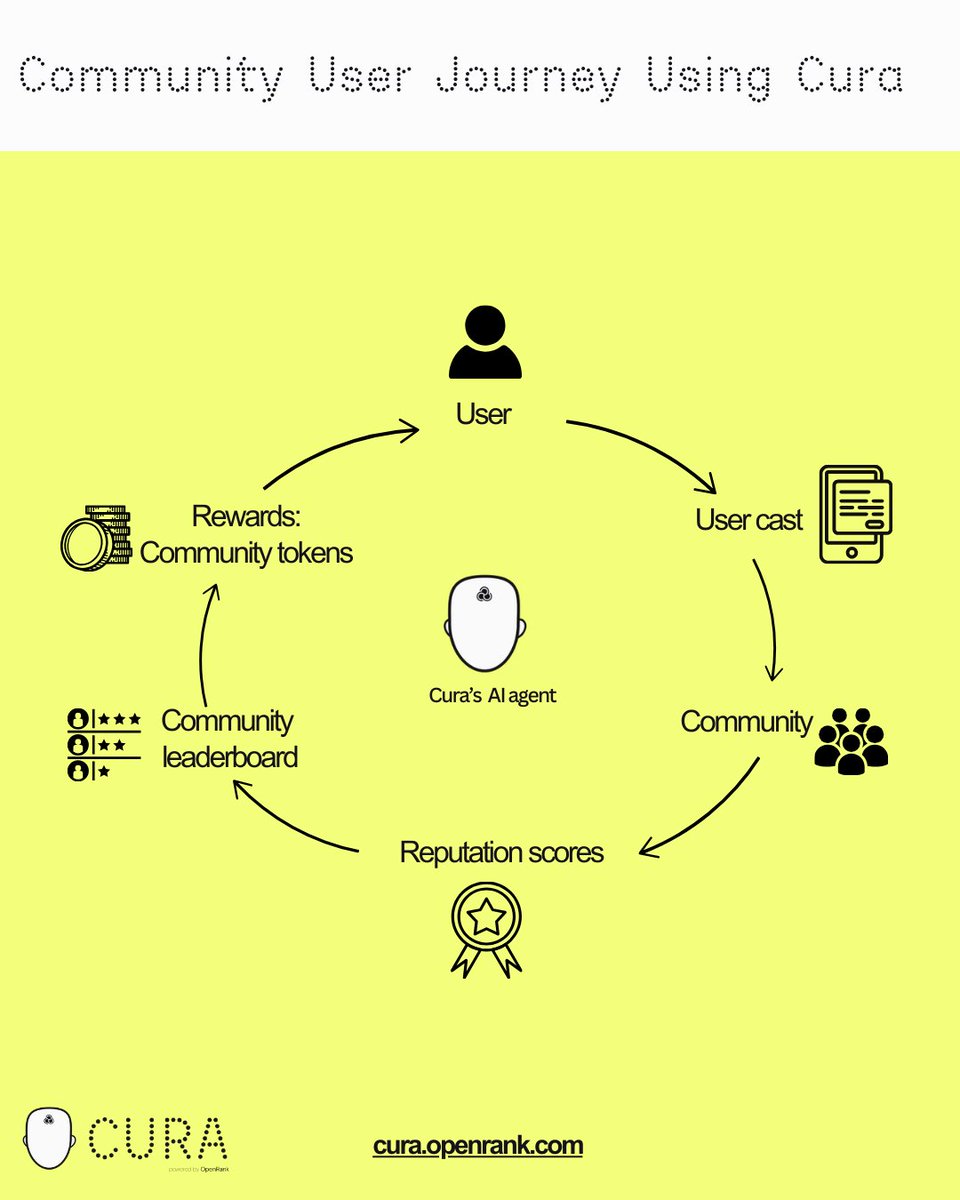
A smooth #community flow - #Engagement, recognition, and rewards. Cura's AI agent powers user journeys and builds thriving communities. 🌟
#Web3Community #OnchainSocial #CryptoRewards #TokenGated #CryptoNews #CommunityFirst #DecentralizedSocial
1
1
438
10 Feb 2025
What's Cura, and why should it matter to #communities and community entrepreneurs? Watch this clip to hear founder @sahil explain it in the most relatable way!
@Cura_social
#communitybuilding #web3 #communityengagement #blockchain #Crypto
10 Feb 2025

Curious why Cura? and what it means for #communities? Hear our founder @sahil at @gmfarcaster. You can watch the full podcast to learn more details: youtube.com/watch?v=Rf7_mjn9…
#communitybuilding #web3 #communityengagement #blockchain #crypto @openranknetwork
5
595
4 Feb 2025
Love that @CoinbaseWallet wants to help creators and users connect, come together. We have so many incredible #communities, projects, and ideas, but it’s still really challenging to help them truly connect and thrive. This is why we are building @Cura_social — to empower communities to come together, connect meaningfully, and to reward meaningful engagement.
@SahilDewan
#Web3 #Web3Community #onchain

1
376
4 Feb 2025
Leaderboards, rewarding engagement and tokens can transform communities. Hear what channel owners have to say: @humpty0x, pichi and @JonathanColton
CC: @Cura_social @in_nebula_gkw
4 Feb 2025

The newsletter recapping the final episode of the @openranknetwork miniseries is out now
We get together to chat about the challenges of building communities on Farcaster, how leaderboards help recognize and reward active community members, and the potential channel tokens have in incentivizing positive activity and enabling channel collaboration
news.cryptosapiens.xyz/the-e…
1
3
455
30 Jan 2025
The future of community engagement and channel tokens🔥A must-listen for anyone building in #Web3.
@SahilDewan @humpty0x @0xMoe_
30 Jan 2025
In our latest chat with @SahilDewan and @0xMoe_ we explored the future of Farcaster and how tokens are transforming engagement
Highlights you can’t miss:
✅ How DEGEN pioneered tipping to reward creators & spark exponential growth
✅ HAM’s gamified approach to community engagement with continuous experimentation
✅ How channel tokens make these tools accessible to everyone, scaling innovation across Farcaster
✅ The big vision: creating thriving, self-sustaining ecosystems for every community
Ready to learn how to grow and reward YOUR community?
Watch now on YouTube:
youtu.be/e-JoKIOIaWg
2
1
355
29 Jan 2025
Spot on! The evolution of token launches has definitely streamlined the process, but usability and community alignment remain key gaps. Channel tokens are game-changing in that regard—they bring utility and visibility to community contributions. With @Cura_social and OpenRank, we’re making it easy to recognize and reward meaningful engagement in real time. 🚀

i think this video captures the idea of the token meta in recent months on farcaster and outside of it
we've nailed the idea of fair launches pretty well now; i dare say that the platforms that exist now to launch tokens have made it too easy
however, theyre still missing the key ingredient to make those tokens usable to build communities with them
thats why channel tokens have the potential to be super powerful primitives for growing communities onchain
channel tokens allow you to easily reward community members based on their positive contributions
want more? community members can also see their contributions being ranked in real time using channel leaderboards thanks to openrank
1
4
844
OpenRank retweeted
24 Jan 2025
A revolutionary way to supercharge your communities! Automated rewards, quality engagement, meaningful leaderboards and a self-sustaining community—all in one platform. 🏆
Stay tuned for @Cura_social, where #communities thrive! #Web3
1
5
175
OpenRank retweeted

22 Jan 2025
What if your community could thrive with fair launches, fair rewards, and a self-sustaining economy?
In our latest episode, @SahilDewan and @DharmiKumbhani join us to break down the future of channel tokens on Farcaster:
- How they reward quality contributions
- Why community wallets are game-changers
- The role of tokenomics in cross-community collaboration
Whether you’re a creator, moderator, or community entrepreneur, this conversation is packed with insights to level up your community.
1
3
13
1,493