
Makers of Infrahub, the AI-ready data management platform for powering reliable network and infrastructure automation at scale.
Joined June 2023
- Tweets 23
- Following 32
- Followers 63
- Likes 2
16 Photos and videos






May 5
Your AI coding assistant now knows Infrahub.
Here's how.
Infrahub Skills is an AI skills package for infrastructure engineers and platform teams using Infrahub.
It gives your AI coding assistant built-in expertise on Infrahub.
Describe what you want in plain language, and it produces a valid, best-practice:
⏭️ schemas
⏭️ generators
⏭️ transforms
⏭️ checks
and more
Whether you’re prototyping a new use case, extending an implementation, or onboarding a new engineer, Skills helps you get more out of Infrahub, faster.
Want to learn more? Read Phillip Simonds blog post.
bit.ly/48UNGu8
Want to see it in action?
Join the livestream on May 11 with Benoit Kohler and S Phillip Simonds.
Register today!
bit.ly/4cB1Naw
1
2
110
Apr 16
That feeling when you discover Infrahub on GitHub…
Instant fan. 😍
What was your first reaction to seeing Infrahub?
...
Hat tip to community member Steinn Örvar for the image.
1
26
Apr 9
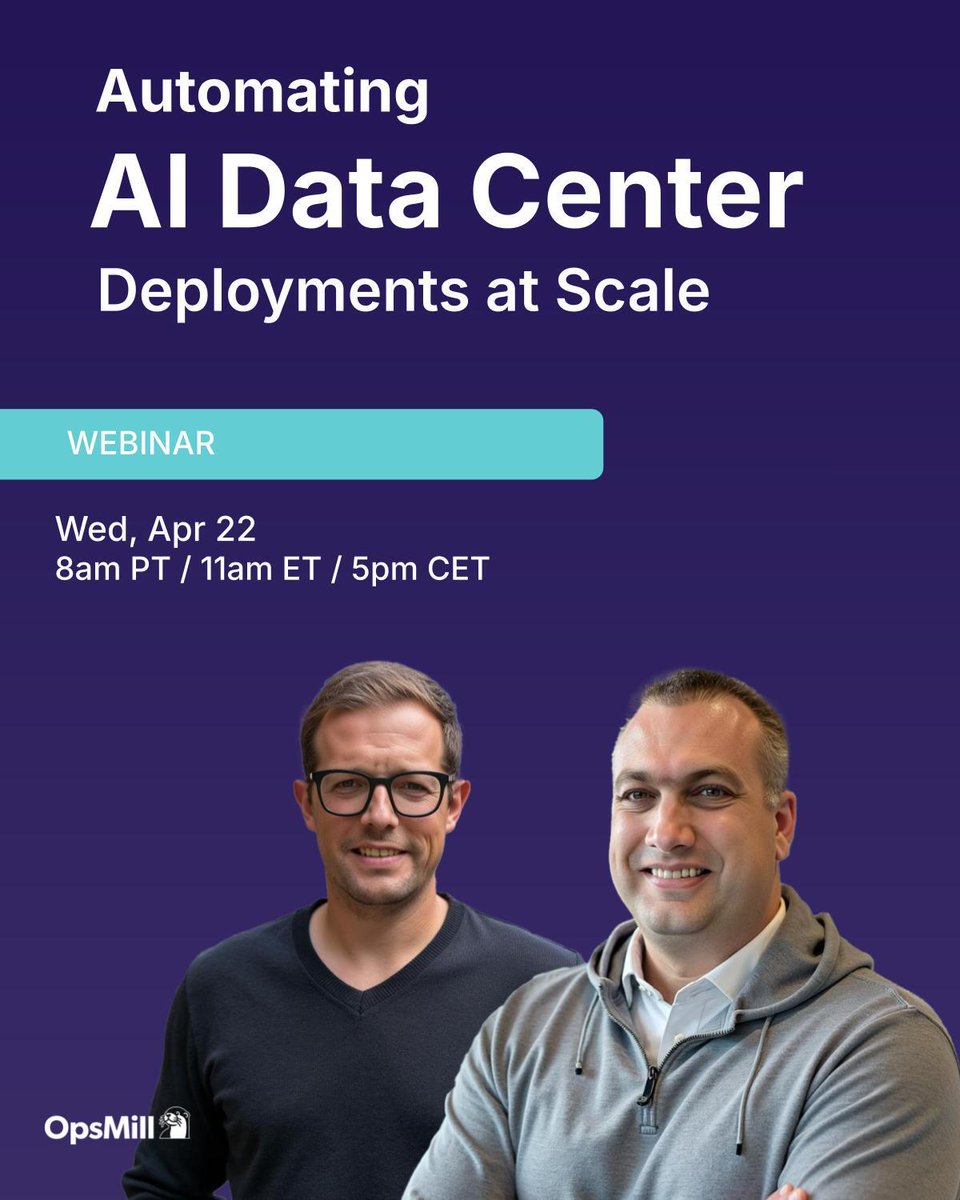
️A complete AI data center fabric, built from minimal design inputs, in under 15 minutes.
That's what design-driven automation in Infrahub delivers on Day Zero. Equally interesting is what comes later…
Infrahub stores design intent alongside the infrastructure it produces. Every site is generated from the same validated template. No variation, no drift.
When you need to add a rack or roll the same fabric across 40 more sites, Infrahub runs the same automation that built Day One, scoped only to what changed. One system. The full lifecycle.
On Apr 22, Wim Van Deun and @damgarros will discuss and demo the new AI Data Center Reference Solution, an end-to-end Infrahub implementation built from real-world deployments.
Register to save your seat and get the recording after the call:
riverside.com/webinar/regist…
1
1
110
Apr 7
What’s the difference between version control in NetBox or Nautobot vs Infrahub?
“For them, it’s a plugin. For us, it’s everything.”
CEO @damgarros calls it straight on the Tech Bytes podcast with Ethan Banks and Drew Conry-Murray.
Full episode (and the second key product differentiator):
youtube.com/watch?v=gya70LdQ…
1
1
142
Mar 10
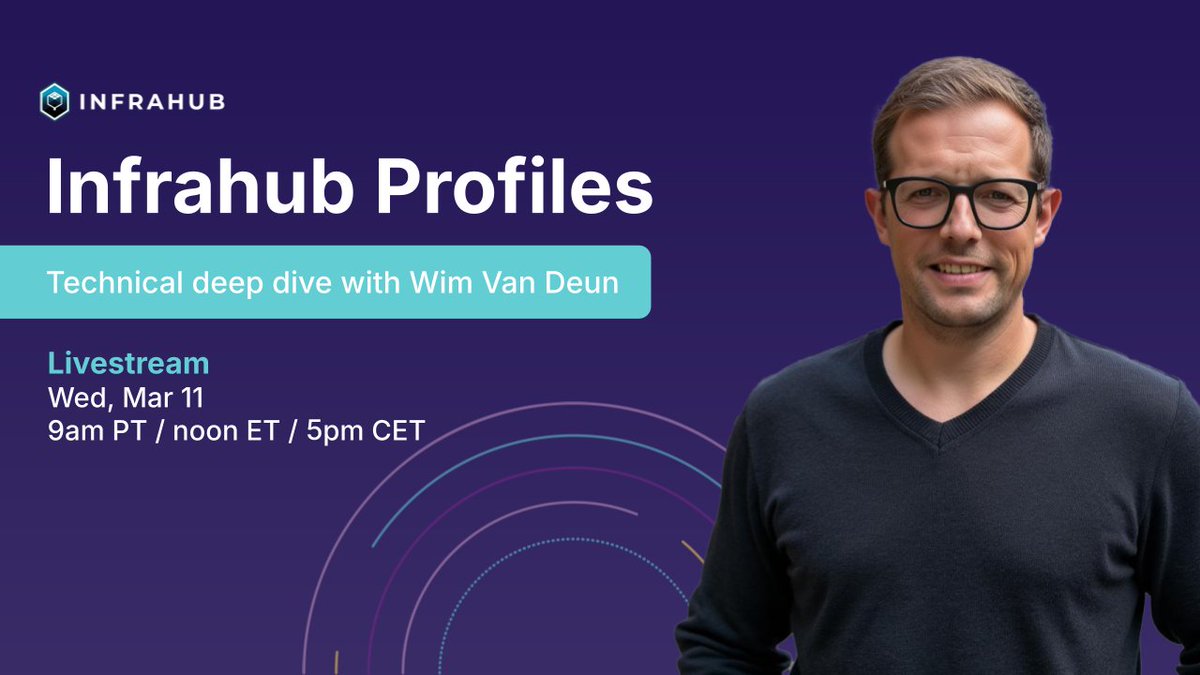
Roll up those sleeves! Time to get your hands ✋ ✋ dirty with data in a live technical demo of Infrahub Profiles.
If you've ever had to write custom scripts to push a standard change across hundreds of devices, Profiles are worth understanding.
Change a Profile once and that update propagates to every inheriting object automatically, with every exception visible and auditable rather than buried in an override file.
Tomorrow, OpsMill Product Manager Wim Van Deun is walking through a complete Profiles use case from the ground up. You'll see exactly how to:
→ Define a schema from scratch to model your use case
→ Create Profiles and assign values
→ Link Profiles with object templates for scalable, consistent configuration
→ Solve a concrete use case end-to-end
Wed, Mar 11 ⚡️
9am PT / noon ET / 5pm CET
Streaming live here on X, or catch the livecast through the OpsMill accounts on LinkedIn and YouTube.
🤓 For helpful overviews of the Profiles concept, see:
- Profiles explainer: opsmill.com/blog/network-sta…
- Intro to Profiles webinar: youtu.be/ZHyx7tkzFJQ
lnkd.in/eV6PDWBM
1
1
92
Feb 20
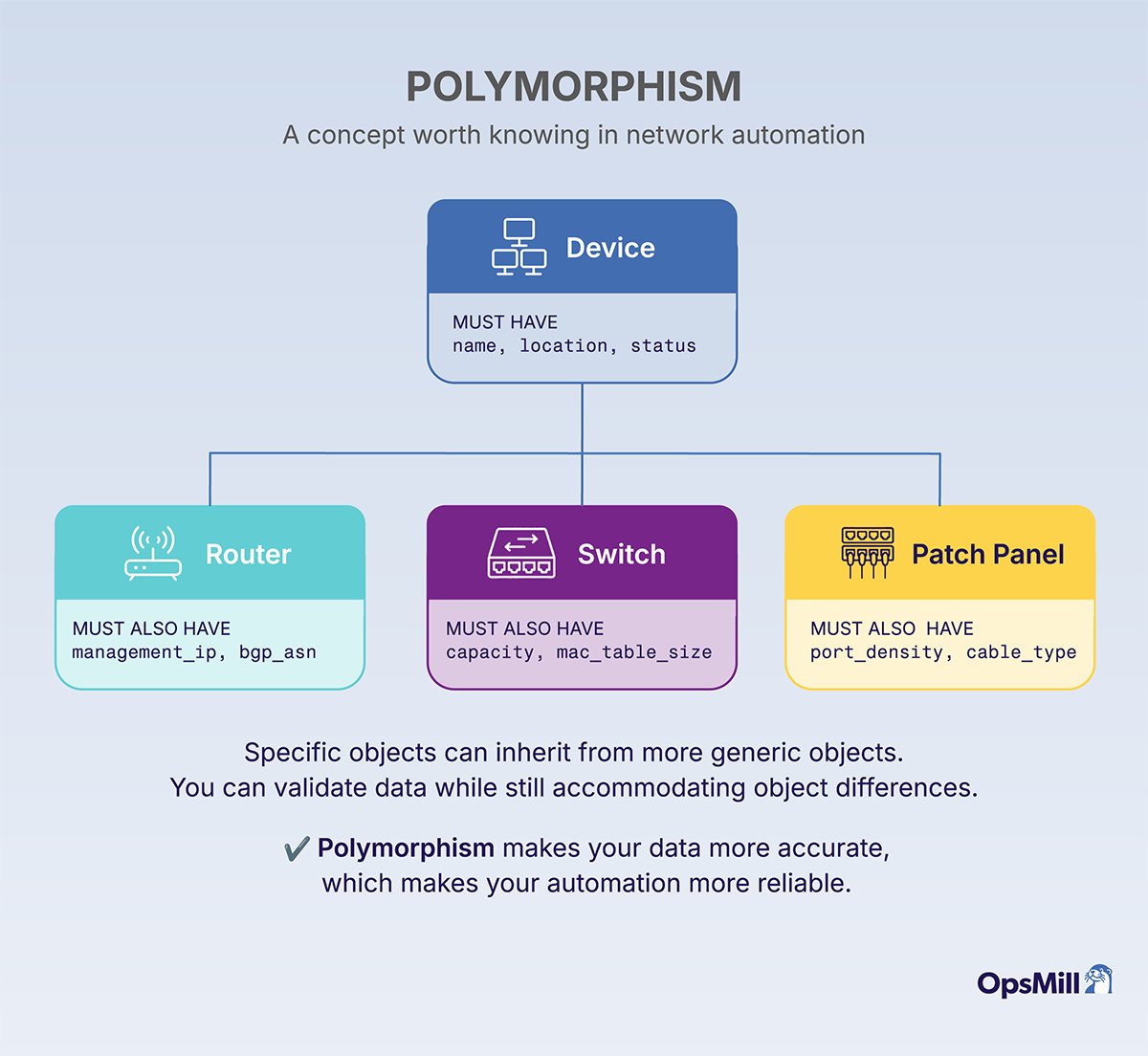
Polywhat? Polymorphism.
It's a concept that's very important to network automation so let's break it down.
→ Poly = many
→ Morph = form or shape
A polymorphic data model supports many data forms.
Why is this important? We'll use devices as an example.
There are many kinds of devices: routers, switches, firewalls, patch panels, etc.
All of these devices share a very small number of attributes, like name and location. But their attributes soon diverge according to their function.
A router has a management IP but a patch panel doesn’t. A patch panel has a cable type but a switch doesn’t.
The way many tools accommodate these differences is to have a generic “device” object that leaves most fields optional. That way you can use it to log anything.
But when almost all fields are optional you can’t validate data against requirements. It’s possible to add a router without a management IP.
You can imagine the chaos (or perhaps you’ve experienced it) when all of your devices may or may not be missing key details. You don’t know what you can trust.
With polymorphism, you can have a single “device” object but that generic object can have specialized objects that inherit from it.
So you can specify that a router must have all the shared attributes of a generic device (like name and location) AND it must also have attributes specific to a router (like a management IP).
Now you know. Polymorphism makes your data model more accurate, which makes your automation more reliable. And yes, we use it in Infrahub. 😎
2
184
Feb 16
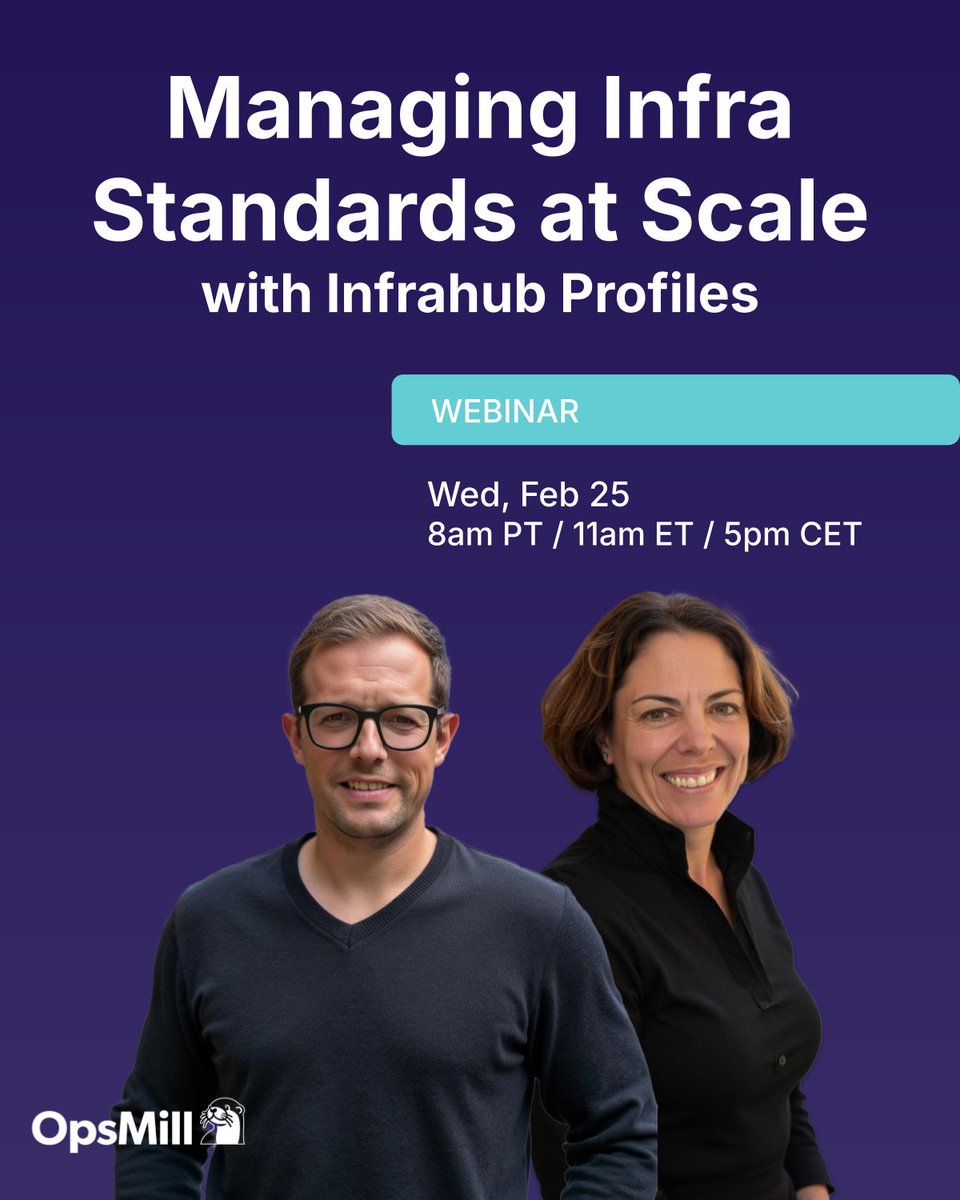
Next week, our product team is going to be walking through an incredibly powerful feature in Infrahub called Profiles.
In most systems, if you update a template, your running configs stay the same.
That’s because in most systems, your standards and templates lose connection to your infrastructure after it’s deployed.
The result is that every time you make a DNS change, or you need to activate spare ports, or your security policies evolve, you're stuck scripting or making manual updates to whatever’s affected by those changes.
😖 That’s painful and it doesn’t scale.
And that’s where Infrahub Profiles come in.
Profiles track the standards your objects use. When a standard changes, Profiles propagate those changes _automatically_ across your entire deployment. No scripts or manual updates required.
If you’d like to hear more about how Profiles work and use cases where they shine,
join Head of Product Yvonne Jouffrault and Product Manager Wim Van Deun on next week’s webinar.
Wed, Feb 25, 2026
8am PT | 11am ET | 5pm CET
Register here to join live and get the recording after the call:
riverside.com/webinar/regist…
1
2
114
Feb 11
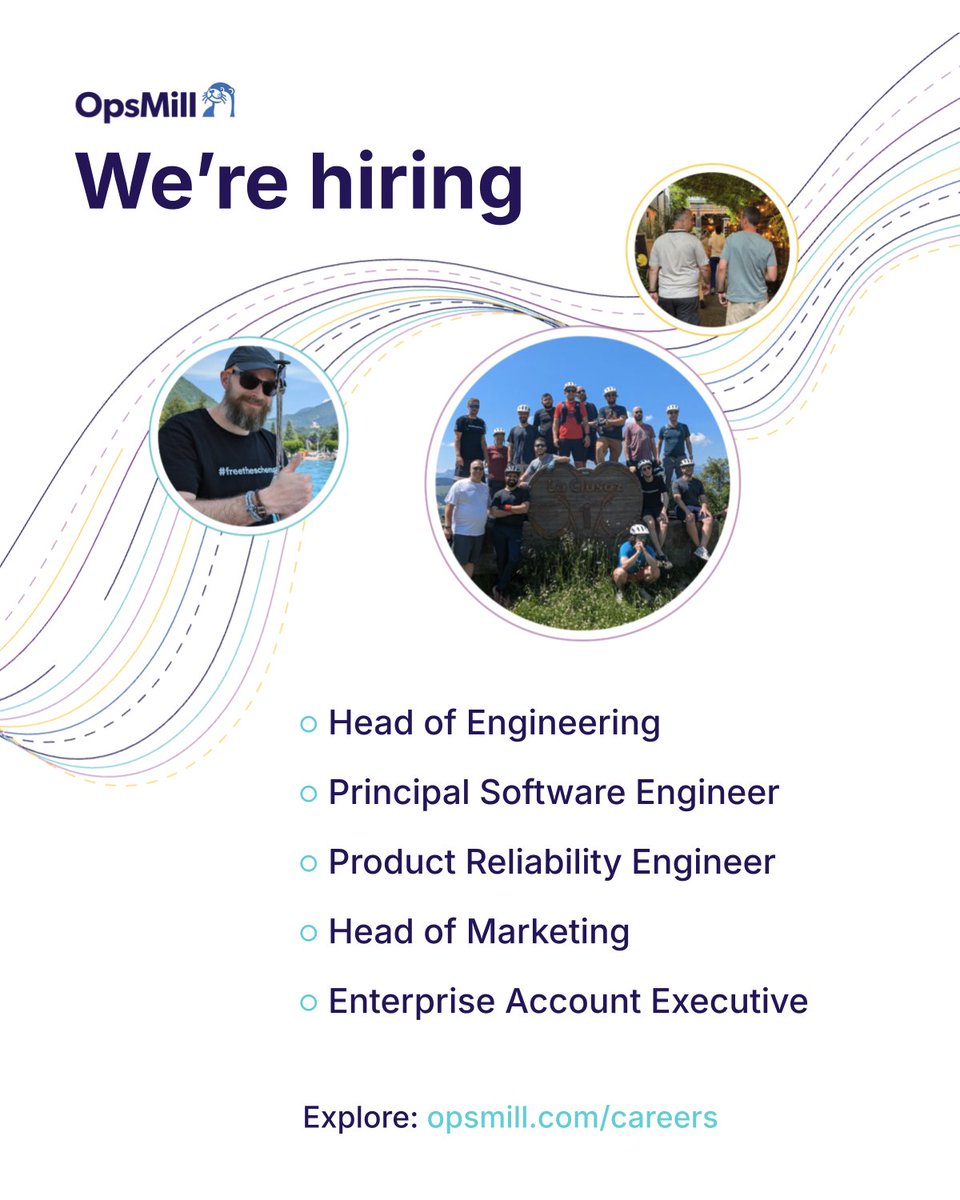
OpsMill is growing! 🚀
And we're looking for a few talented otters to help us push the boundaries of infrastructure automation.
Right now we have openings for:
→ Head of Engineering
→ Principal Software Engineer
→ Product Reliability Engineer
→ Head of Marketing
→ Enterprise Account Executive
If you're curious about what it's like to work on hard problems with smart people, if you want to build something meaningful, and if you value balance as much as impact, this might be for you.
We're fully remote. You get equity. You'll have real influence on the direction of the product and the company. And twice a year, we all get together in person. (Coming up! London 🇬🇧)
You'll work on Infrahub, the infrastructure data platform that's changing how teams approach network automation. You'll see your work deployed in production networks at some of the world's most demanding organizations.
Curious? Take a look at what we're building and who we're looking for.
👉 opsmill.com/careers
2
1
1
152
Feb 10
🥽 LIVESTREAM Feb 18: Automating brownfield networks
Join us for a live technical walkthrough of how to use network discovery to build the data foundation for infrastructure automation on a brownfield network.
Alex Gittings, Solutions Architect at OpsMill, and Pieter van Os, founder of Slurp'it, will take you through:
→ Quick introductions to Slurp'it's network discovery capabilities and Infrahub's infrastructure management platform
→ Real-world use cases where Slurp'it data becomes essential in your Infrahub workflows
→ Hands-on demo using Infrahub Sync to sync data from Slurp'it to Infrahub
Wed, Feb 18, 2026
7am PT | 10am ET | 4pm CET
Join us live here on X. No registration required.
1
1
97
Feb 3
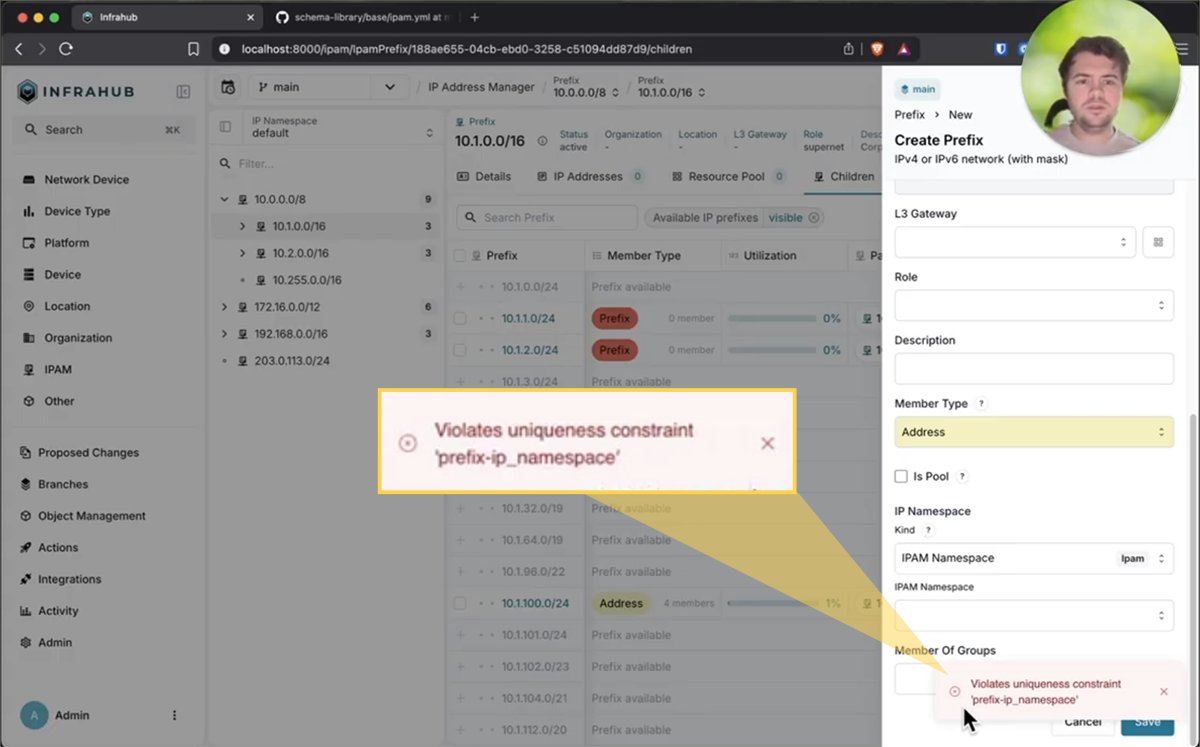
Namespaces let you isolate IP address space without conflicts.
They're perfect for VRFs, isolated environments, or any scenario where you need overlapping IPs.
We just dropped a quick video walking through how namespaces work in Infrahub. Very simple but powerful!
See the full vid on YouTube:
youtube.com/watch?v=T5Qiy-13…
1
31
Jan 29
Great ideas die without budget. ☠️
Maybe you've felt this pain. You KNOW your automation project will save time, reduce errors, improve reliability, all that good stuff. But it goes nowhere.
The problem is that you haven't been trained to speak in ROI. (And execs aren't trained to understand operational impact.)
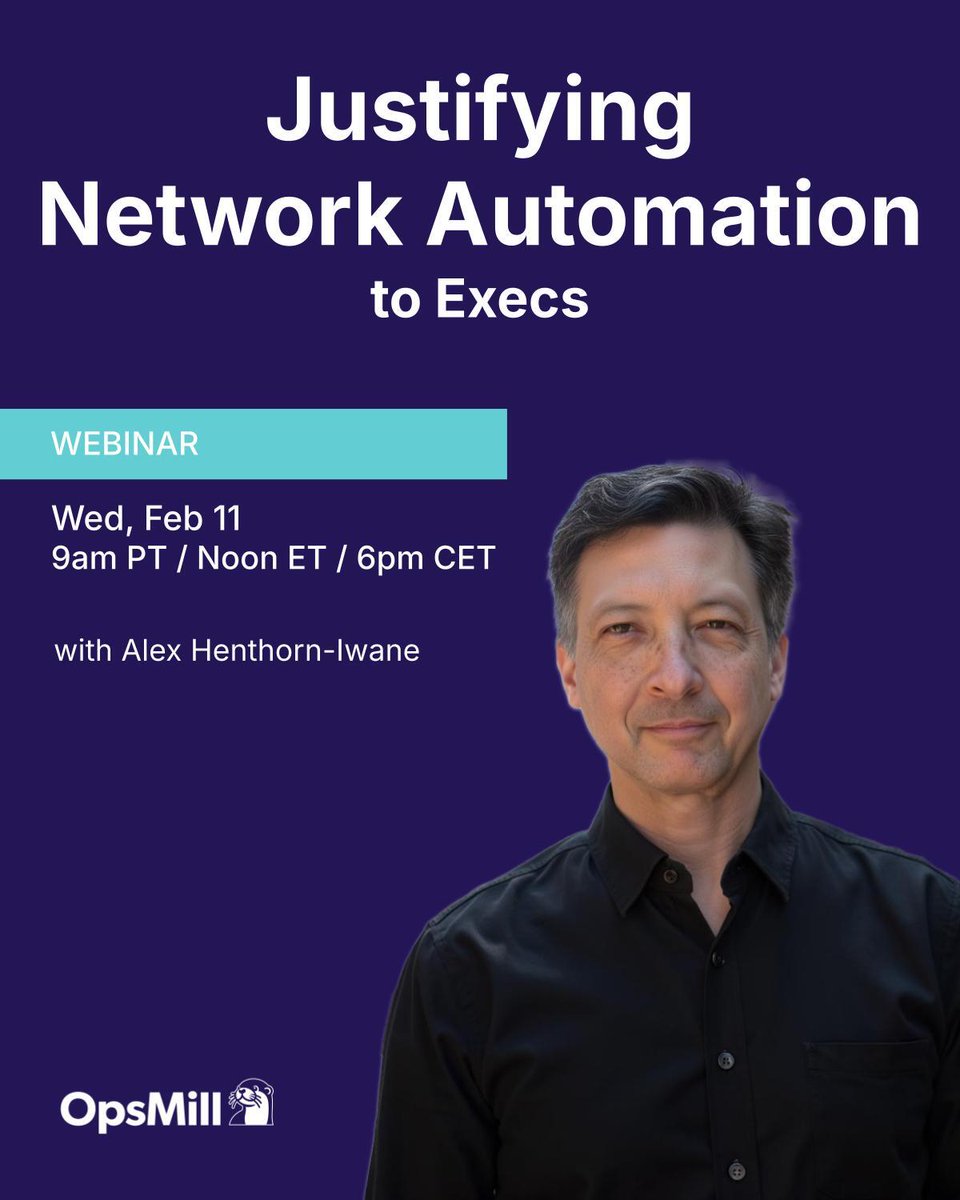
Our head of marketing Alex Henthorn-Iwane is running a webinar to fix this: Justifying Network Automation to Execs
It's a practical roadmap, specifically for network engineers, to help you move from technical vision to funded reality.
You'll learn:
• When to start building your business case
• How to establish trust with decision-makers
• How to connect automation outcomes to metrics execs care about
• How to structure numbers so they resonate
Wed, Feb 3
9am PT / noon ET / 6pm CET
Register to save your seat and get access to the recording
riverside.com/webinar/regist…
1
27
Jan 27
You've probably written a script like this before:
Pull data from a source of truth, loop through devices, generate configs or API payloads, dump them somewhere useful.
It works. Until you need a slightly different format for another tool. Or someone asks "Wait, which version of this script are we using?" Or you realize there's no way to test it before pushing to production.
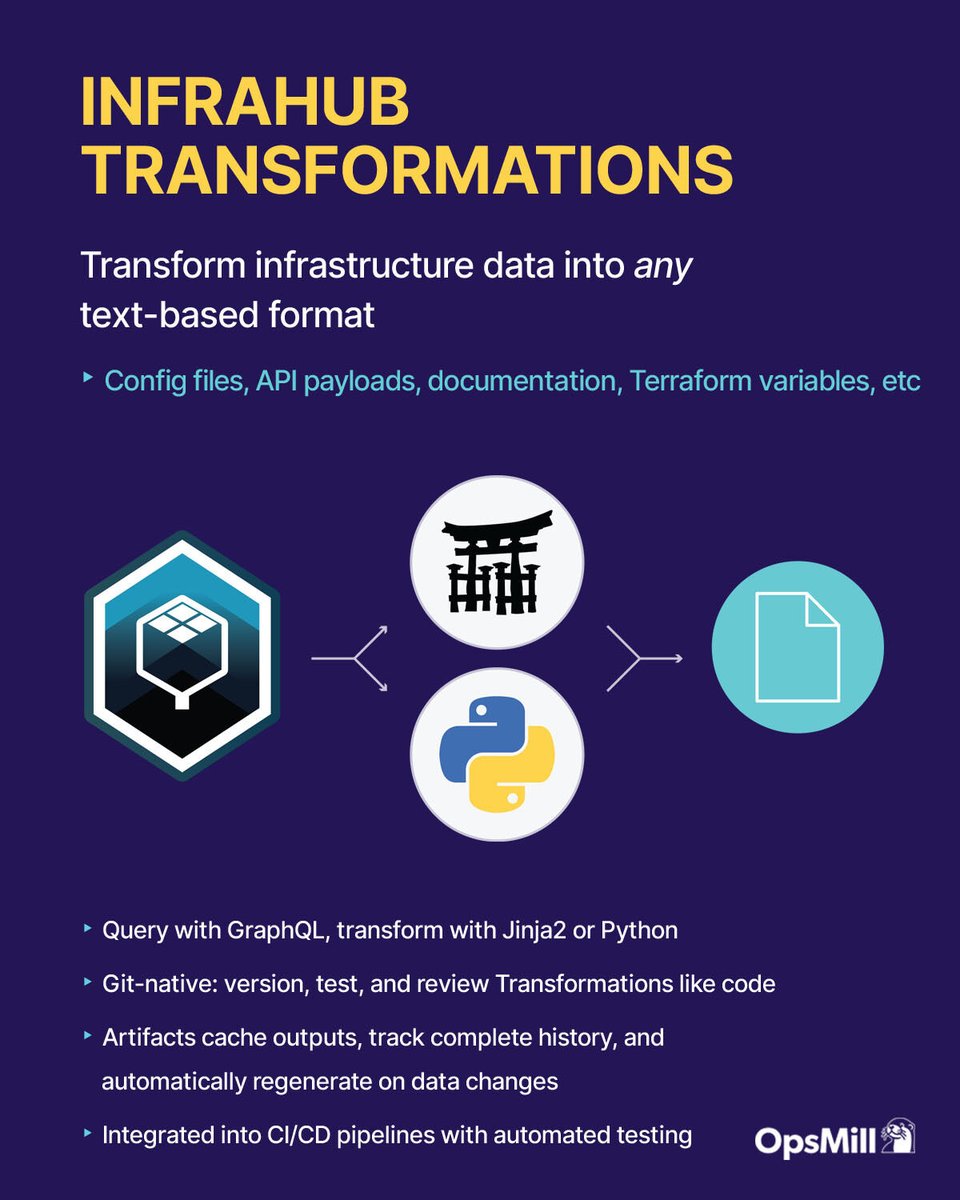
That’s why we built Infrahub Transformations.
The concept is simple: query your infrastructure data with GraphQL, then transform it into whatever text-based format you need using Jinja2 or Python.
Generate configs in various vendor flavors, API payloads, Terraform variables, documentation, cabling plans, whatever you need.
What makes it even more useful: Transformations are versioned in Git, testable, and reviewable like code.
We wrote up how Infrahub Transformations work over on the blog, and included some resources to help you explore them further: opsmill.com/blog/infrahub-tr…
2
160
Jan 22
Hot take? Maybe the term "NetDevOps"has done us more harm than good.
A lot of network engineers saw the DevOps piece and thought "That's not me, I'm no software developer!"
The terminology itself became intimidating.
We asked Claudia de Luna, Eric Chou, Urs Baumann and a bunch more engineers what they think about it and this is what they said.
What's your take?
1
1
149
Jan 20
If you've ever tracked IP addresses in a spreadsheet, you already know this pain…
You find "the" spreadsheet. (Is this version current?)
You pick an available IP.
Someone else allocated it 10 minutes ago in their own copy.
Now you have duplicates. 🚨
And that's just IPs. What about VLAN IDs? BGP ASNs? Circuit IDs?
You might be spending hours each week managing resource allocation manually. But there's a better way.
Resource allocation can be ✅ automated, ✅ conflict-free, and ✅ integrated directly into your infrastructure workflows.
Learn all about how Infrahub Resource Manager works:
opsmill.com/blog/infrahub-re…
2
1
112
Jan 13
New year, new Infrahub!
We recently released Infrahub 1.6 and 1.7, bringing improvements in usability, data governance, and platform reliability to help infrastructure teams operate at scale with less friction.
A few highlights:
🔎 Audit metadata on every object (1.7): Metadata now tracks who created or updated each object and when, providing accountability and making reviews, debugging, and governance workflows easier.
🔗 Profiles can now support relationships in addition to attributes (1.7): This helps you express complete infrastructure patterns in one place and makes it easier to apply the same pattern consistently across many objects.
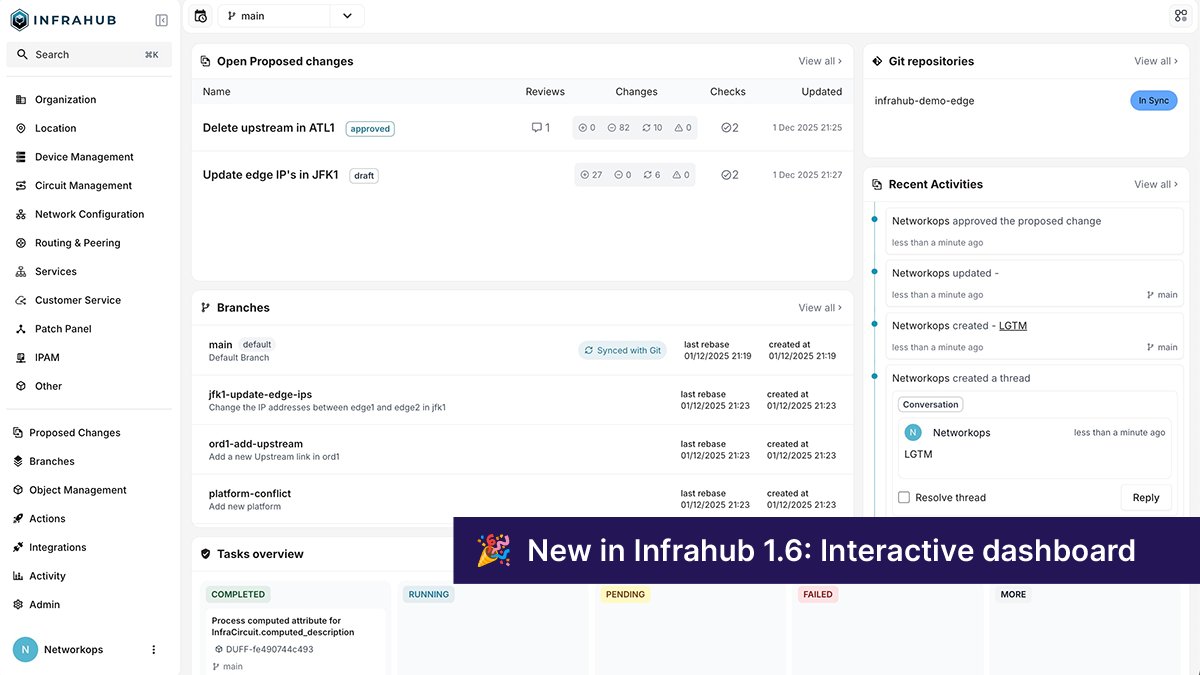
🎛️ Interactive dashboard (1.6): A new home page surfaces proposed changes, Git sync status, branches, recent activity, and tasks in one view, making it easier to triage reviews.
🔀 Branch management improvements (1.6): A new branch report provides visibility to ease maintenance decisions, while support for selective synchronization of Git branches and explicit merge commits gives teams more control over Git-backed workflows.
In 1.7, we also upgraded critical backend dependencies to ensure optimal performance, security, and long-term maintainability.
More details on the blog:
🗒️ Infrahub 1.6: opsmill.com/blog/infrahub-1-…
🗒️ Infrahub 1.7: opsmill.com/blog/infrahub-1-…
1
1
280
22 Apr 2024
Want to see what we're building for infrastructure management? The @packetcoders community is getting a tech deepdive this Wednesday! x.com/packetcoders/status/17…
22 Apr 2024

📢 Landing this Wednesday is our April Tech Session: An Intro to Version Controlled SoT with Opsmill. This is a members-only session. Learn more about joining over at: buff.ly/3Qeeqwe #networkautomation
279
OpsMill retweeted

17 Apr 2024
I’m #hiring a network automation expert to help our open-source community and customers with our soon-to-launch infrastructure management platform at OpsMill. 100% remote, UK, EU or USA linkedin.com/jobs/view/38999…
3
12
12
2,933
16 Apr 2024
OpsMill founders @rmaunier and @damgarros spoke recently with OVNI Capital about the challenges and successes that have marked their entrepreneurial journeys. Podcast/video in French, English auto-subtitles available: youtube.com/watch?v=dJp9U7QS…
3
4
903