
Joined April 2025
- Tweets 254
- Following 50
- Followers 331
- Likes 1,091
38 Photos and videos





Pinned Tweet

28 Apr 2025
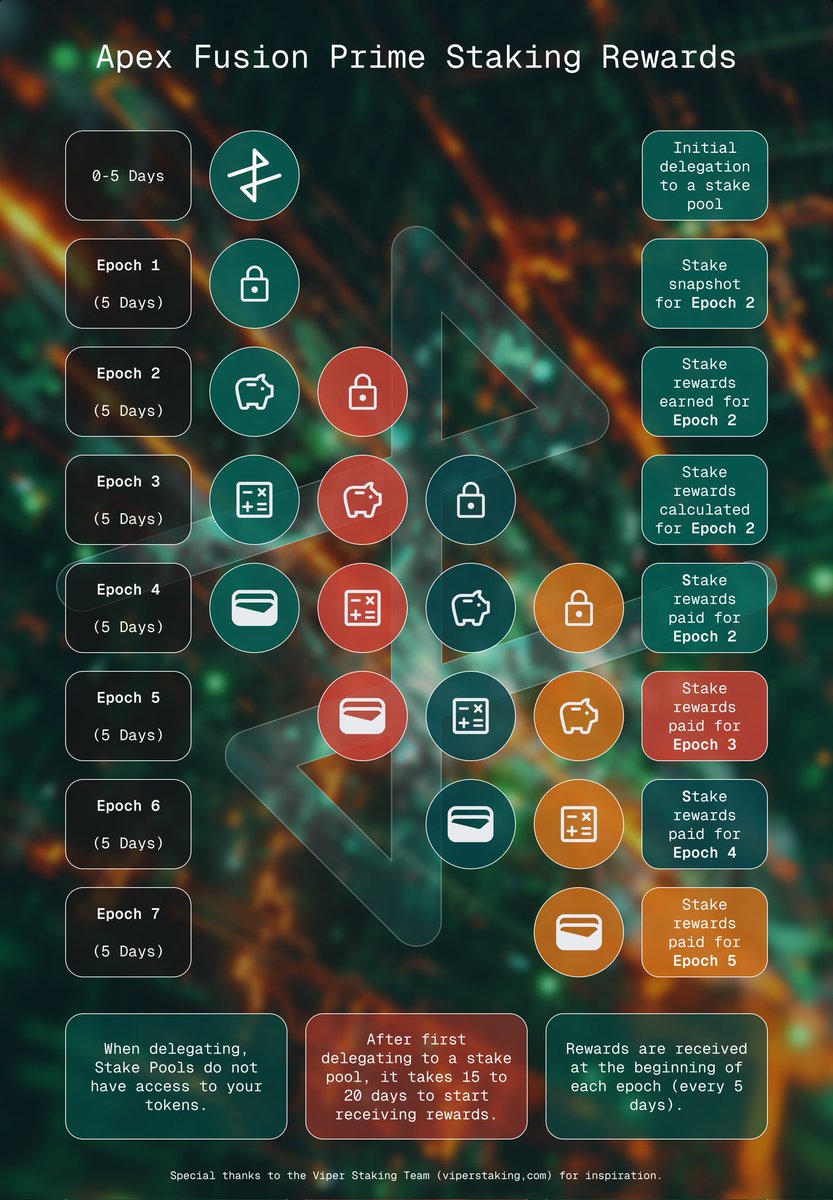
Imagine you delegate your tokens today...
What happens next? Here's the journey:
📍Days 0–5: Your delegation is registered - but no rewards yet
📍Epoch 1: Your stake gets snapped
📍Epoch 2: Your rewards are now being earned - but still not paid out
📍Epoch 3: Rewards are calculated
📍Epoch 4: Your first staking rewards finally hit your wallet!
From first delegation to first rewards: it usually takes 15–20 days.
No shortcuts - but good things come to those who wait. 🔥
Save this guide and stake smarter with @ApexFusion
4
21
41
6,428

Been sharing some of these early reads in the Telegram group.
Interesting to see how people interpret the same launch differently once they look a bit deeper.
t.me/sonarlis
4
10
92
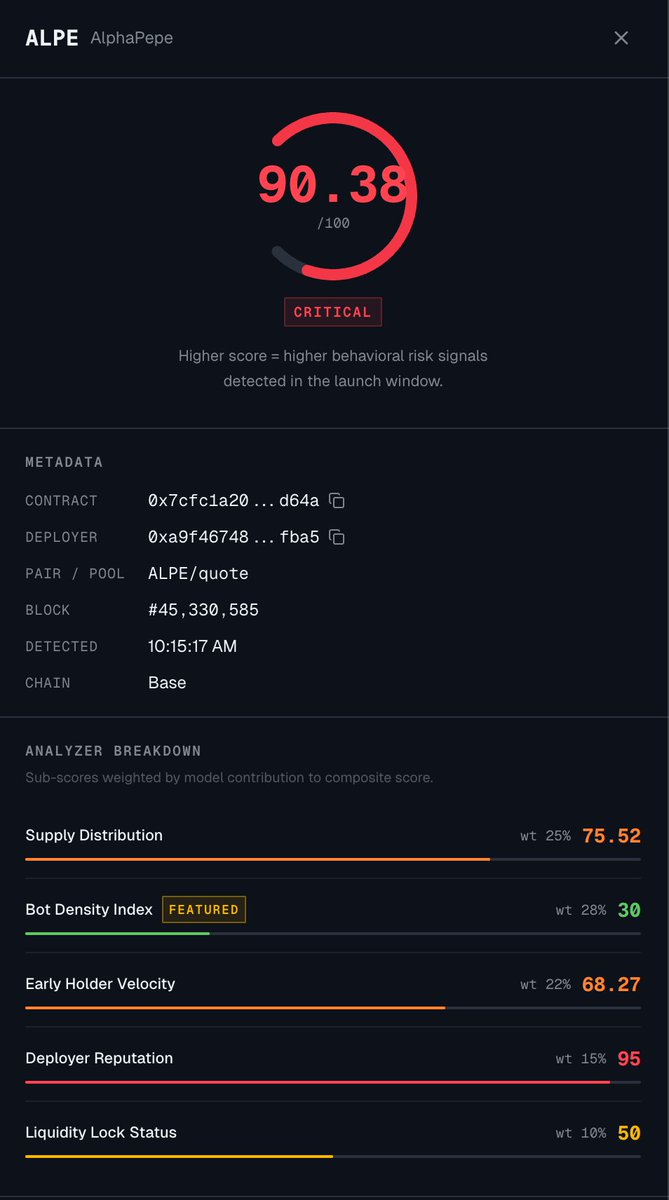
AlphaPepe ( $ALPE) launched on #Base at 10:15 AM.
@sonarlis scored it 90.38/100, 🚨 CRITICAL.
Supply Distribution: 75.52/100
Bot Density Index: 30/100
Early Holder Velocity: 68.27/100
Deployer Reputation: 95/100
Liquidity Lock: 50/100
This deployer has history. The supply was concentrated before most people saw the token exist.
Just the data → app.sonarlis.com
6
10
159
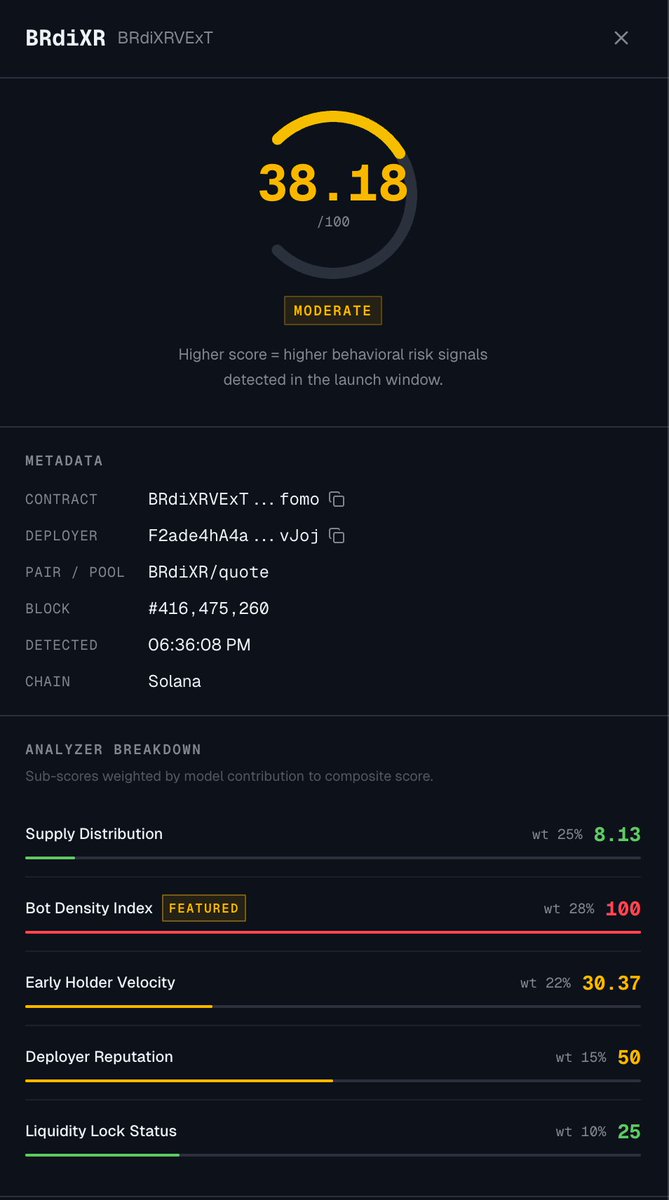
BRdiXRVExT ($BRdiXR) launched on #Solana at 06:36 PM.
@sonarlis scored it 38.18/100, 🟡 MODERATE.
Supply Distribution: 8.13/100
Bot Density Index: 100/100
Early Holder Velocity: 30.37/100
Deployer Reputation: 50/100
Liquidity Lock: 25/100
Supply is well distributed and the deployer is clean, but Bot Density is maxed out at 100. Every early transaction shows automated behavior. Someone was ready before this token was public.
Just the data → app.sonarlis.com
6
10
78
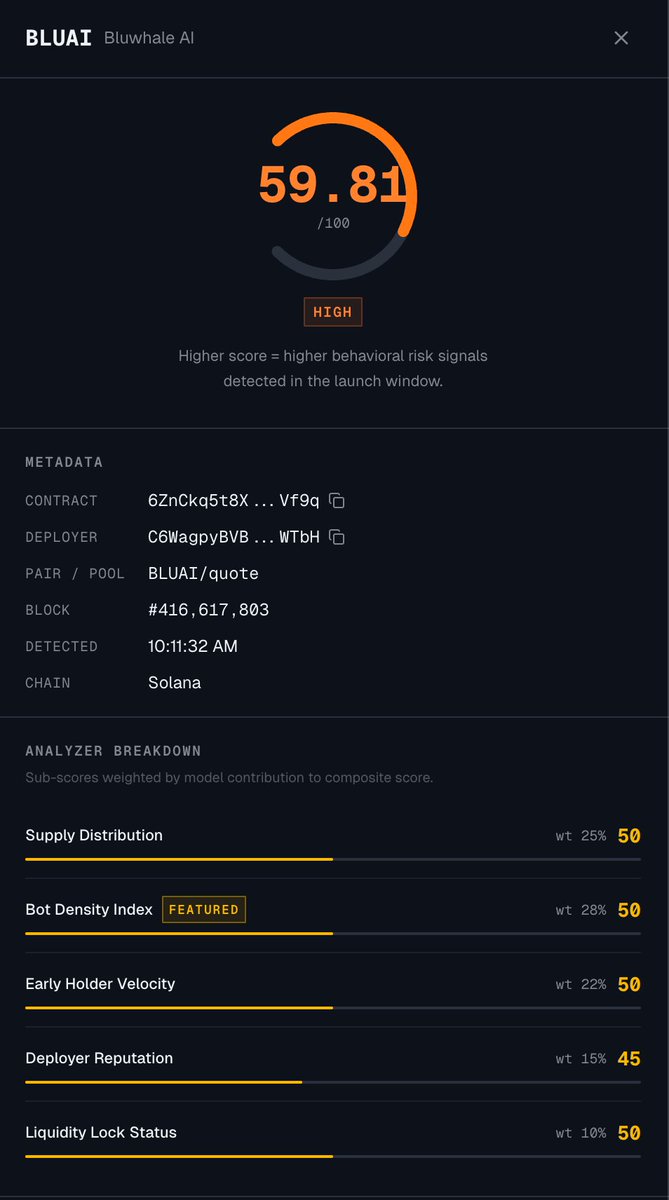
Bluwhale AI ( solana:6ZnCkq5t8XG4q42b5JiVvU6hV5cZFaNdSBoFq5E7Vf9q ) launched on #Solana at 10:11 AM.
@sonarlis scored it 59.81/100, 🔴 HIGH.
Supply Distribution: 50/100
Bot Density Index: 50/100
Early Holder Velocity: 50/100
Deployer Reputation: 45/100
Liquidity Lock: 50/100
Every single analyzer came back at exactly 50. That's not a clean token, that's a fingerprint. Uniform scores across all dimensions in the launch window suggest coordinated behavior designed to stay below detection thresholds.
Just the data → app.sonarlis.com
6
8
87
The goal isn’t to react faster.
It’s to avoid reacting to the wrong thing.
A lot of early decisions happen with incomplete context.
We’re trying to make that context visible earlier.
app.sonarlis.com
5
13
70
We’re not trying to answer whether something is good or bad.
We’re just trying to understand what is actually happening in those first moments after a token launches.
That shift alone changes how you look at most of these situations.
4
14
56
One thing we’ve been focusing on is timing.
Not just what happens, but when it happens.
Entries that come in too tightly
Liquidity that appears instantly
Activity that ramps too smoothly
Those details matter more than the totals.
app.sonarlis.com
1
5
13
61
Optim Pool | Apex Fusion retweeted

Apr 22
Ouroboros Tachys proposal is live! Review it and come ask questions on the X space. Links in the comments ⬇️
3
6
16
1,034
We’re building Sonarlis at @colosseum.
Spending most of the time digging into early token behavior on both @base and @solana chains, and trying to understand what’s really happening in those first seconds.
Huge respect to Colosseum for putting this together and backing teams like this. Also a huge shoutout to @SuperteamBLKN for the support, it really makes a difference.
The deeper we go, the clearer it gets how little of that early activity is actually random.
2
4
18
220
Optim Pool | Apex Fusion retweeted

Apr 20
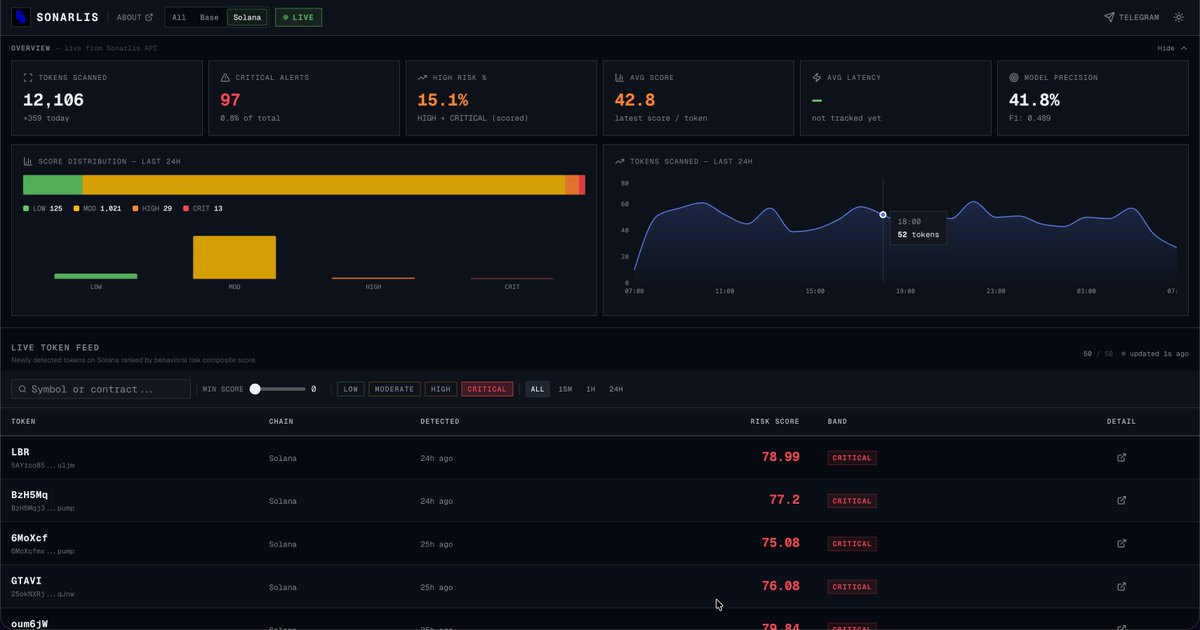
We finally shipped v1 of @sonarlis.
app.sonarlis.com/
Not perfect.
Not polished.
But it works.
We’re already scanning thousands of tokens and flagging risk in real time.
Now we validate what actually matters, do traders need this?
Give it a try, it’s FREE.
Every user right now matters for us more than anything, that’s how we prove this should exist. Thank you <3
2
14
247
A token launches and at first everything looks active and healthy.
Then you zoom in a bit and things start to feel off.
▶️ Wallets aren’t really independent
▶️ Entries happen almost at the same time
▶️ Sizes look too similar to be random
It’s the same data everyone sees, just not interpreted the same way.
4
14
92
We’ve been testing Sonarlis on live token launches on two very active chains over the past few weeks.
It’s still early, but a few things keep showing up consistently:
▶️ wallets moving together.
▶️ very similar entry sizes.
▶️ tight clusters right at the start.
Different tokens, but the behavior looks almost identical.
9
3
25
265
Quick update on where things are right now:
▶️ we’re picking up new tokens in real time
▶️ running the scoring as activity comes in
Now the real question is whether this actually changes how people behave when they look at new launches.
11
5
25
157
We’ve been running Sonarlis on @base.
Watching new tokens as they launch and trying to understand what’s actually happening in those first moments.
Base is based. It moves fast and there’s a lot of noise.
Which makes it a good place to test this. You start seeing patterns pretty quickly.
We can't wait to show you more.
3
7
20
432
Most tools focus on price and volume, which is fine, but we’ve been spending more time looking at what happens underneath that.
▶️ How wallets actually enter.
▶️ How they’re funded.
▶️ How activity is grouped in the first minute.
After watching enough launches, you start noticing that the same patterns show up again and again.
That’s what Sonarlis is built around.
1
7
16
119
👇

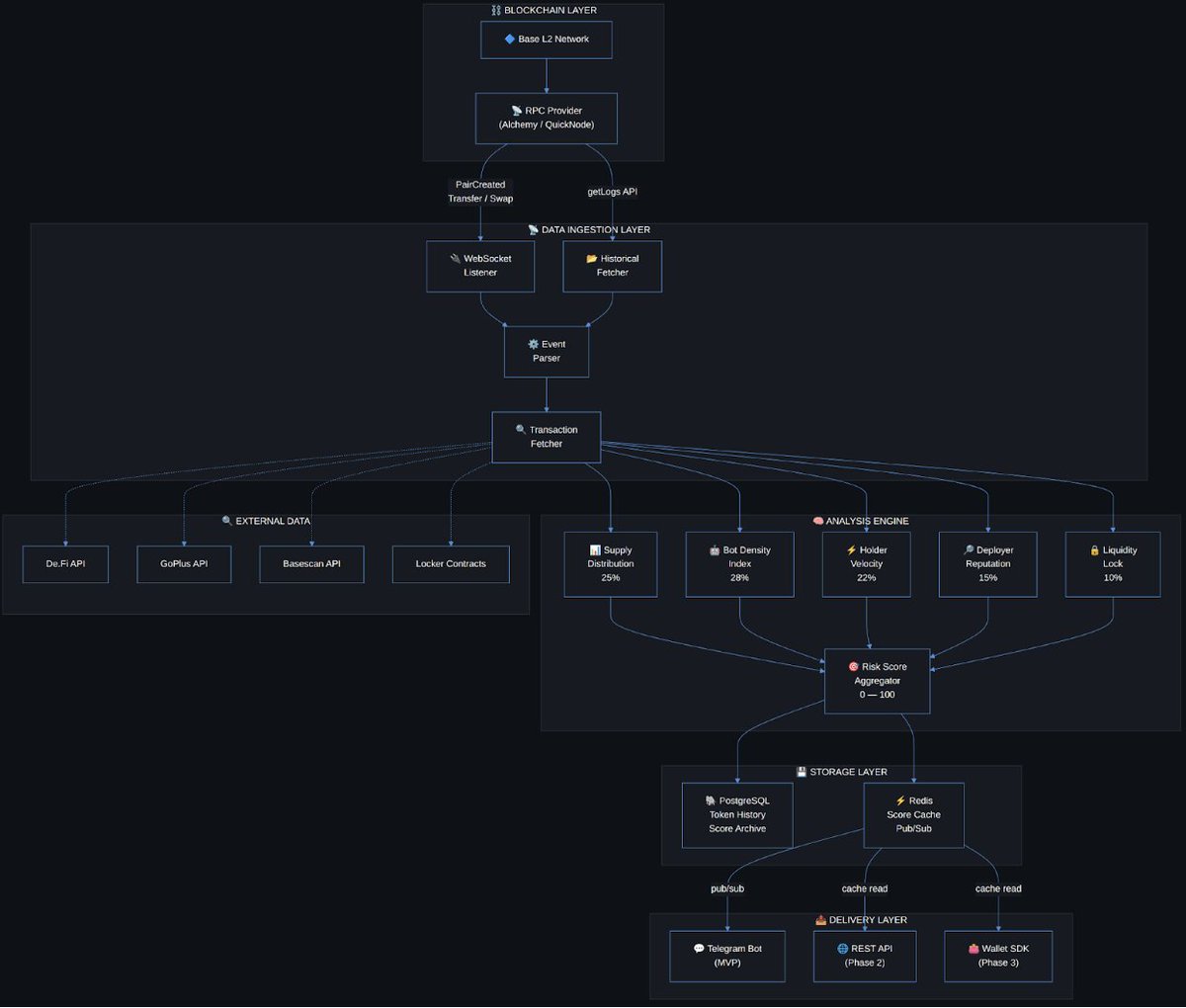
Every architectural decision in @sonarlis was made with one constraint in mind: the score has to arrive before the trader needs to act.
Everything else is secondary to that.
Speed over completeness. A partial score delivered in 30sec is more valuable than a perfect score delivered in 5min. Every analyzer runs asynchronously with a strict timeout. The pipeline never waits for a slow signal. If one analyzer does not complete in time, the remaining signals are weighted and the score is delivered without it.
Modularity by design. Each analyzer is an independent module. Adding a new signal does not require changing the existing ones. The ingestion layer abstracts chain-specific logic, which means supporting a new chain comes down to implementing a new listener. The analysis engine and scoring logic remain the same.
Calibration before deployment. No parameter goes live without validation. We replay historical token launches through the same pipeline, split the data into training and test sets, and measure precision before anything is exposed to users. The scoring model is not based on assumptions. It is based on observed behavior.
Lean infrastructure.
The current setup runs on:
4 CPUs,
8gb of RAM,
Docker Compose on a Hetzner VPS,
Redis for fast score reads,
and PostgreSQL for persistent data.
Built to be simple now, without limiting how it scales later.
We are not building features. We are building infrastructure. The kind that becomes more valuable the more chains, traders, and protocols depend on it.
1
11
New article is live explaining how the engine processes on-chain behavior in the first seconds. This is the core of everything we’re building.
5
8
286