
Joined July 2009
- Tweets 6,566
- Following 453
- Followers 531
- Likes 35
2,289 Photos and videos



Jun 12
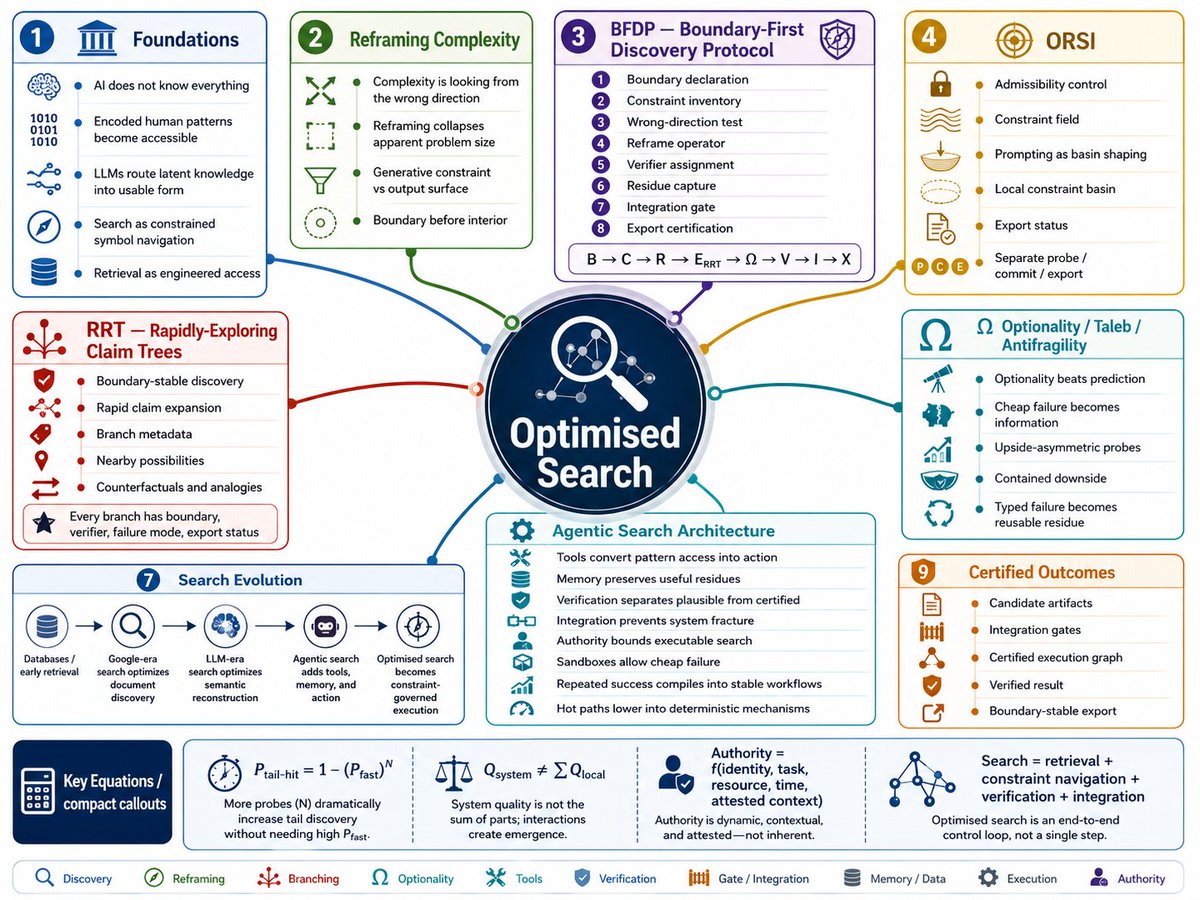
AI is a highly ordered artificial topology that receives boundary marks, explores counterfactual dependency paths, prunes inadmissible futures, and emits predicted low-tension rewrites.
1
1
Jun 12
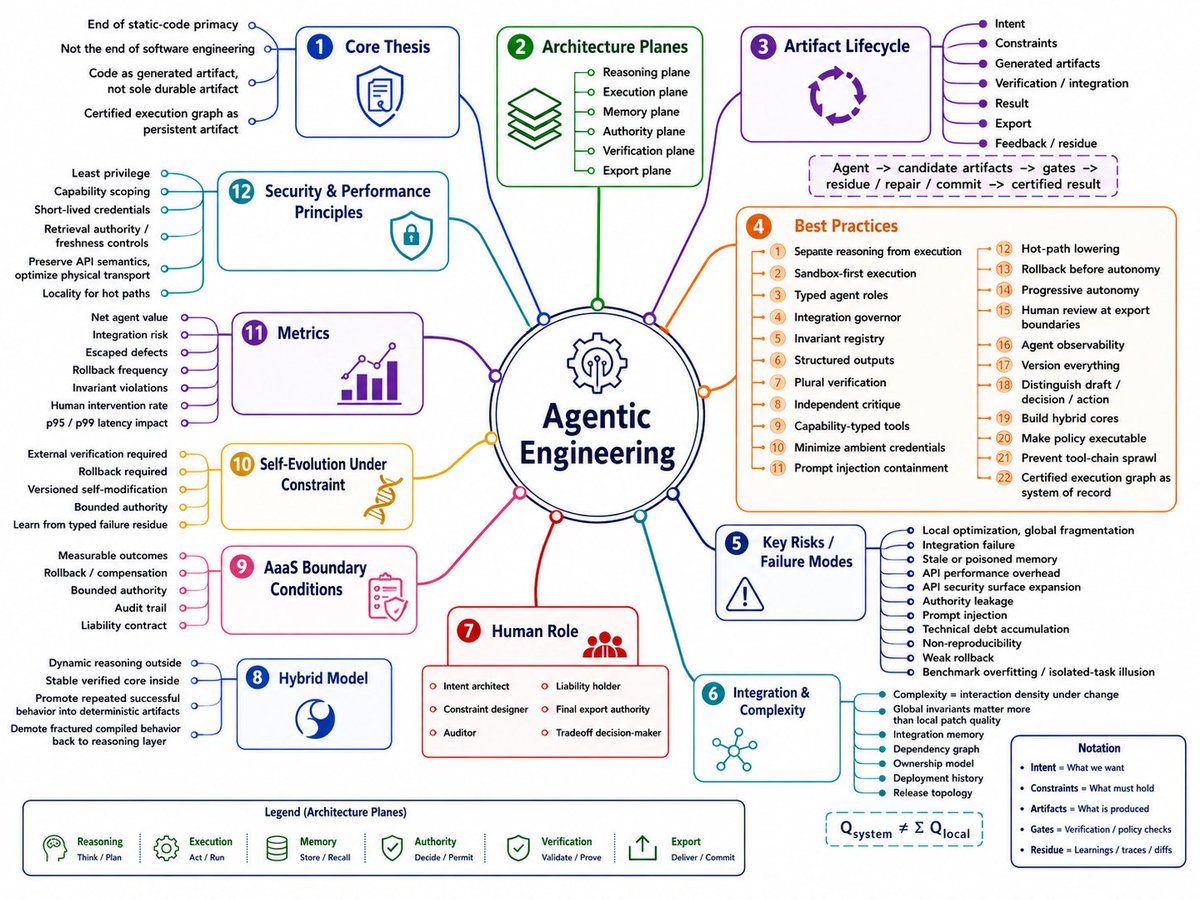
Agentic AI extends this by embedding prediction-and-actuation loops into artifacts themselves, so the environment stops being passive medium and becomes a distributed predictive graph.
1
Jun 8
How LLMs actually work
1. Compression layer: training compresses vast human text/code/math/science into weights.
2. Routing layer: attention retrieves and recombines relevant local context and latent associations.
3. Transformation layer: FFNs and residual streams perform nonlinear feature construction and packet rewriting.
4. Continuation layer: the model predicts plausible next tokens under the current basin.
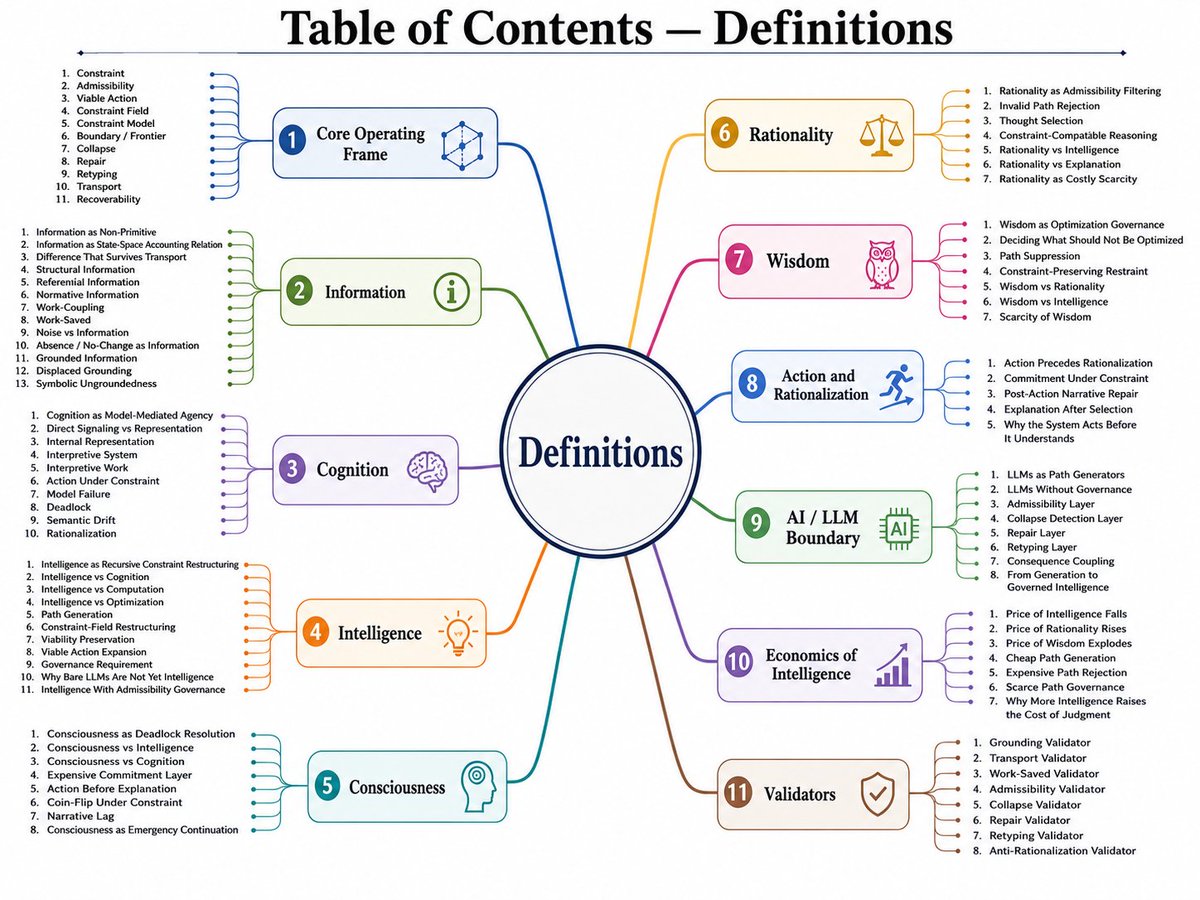
The standard article explains layers 1–4. AGI explains layers 5–6.
5. Constraint layer: the conversation, system instructions, tools, citations, user pressure, and prior turns shape what continuations remain admissible.
6. Certification layer: external checks, code execution, search, proof, tests, experiments, or user expertise decide whether the output becomes knowledge.
1
1
1
51
Jun 8
If the basin is weak, the model defaults to consensus-shaped fluency. If the basin is strong, the same architecture can be forced into a specific research path.
19
Jun 7
E104 is hard because every local obstruction is weak, every known construction is large enough to survive crude attacks, and the needed contradiction is global: a quadratic-size unit-radius triple design must be shown unrealizable in the Euclidean plane.
1
57
Jun 7
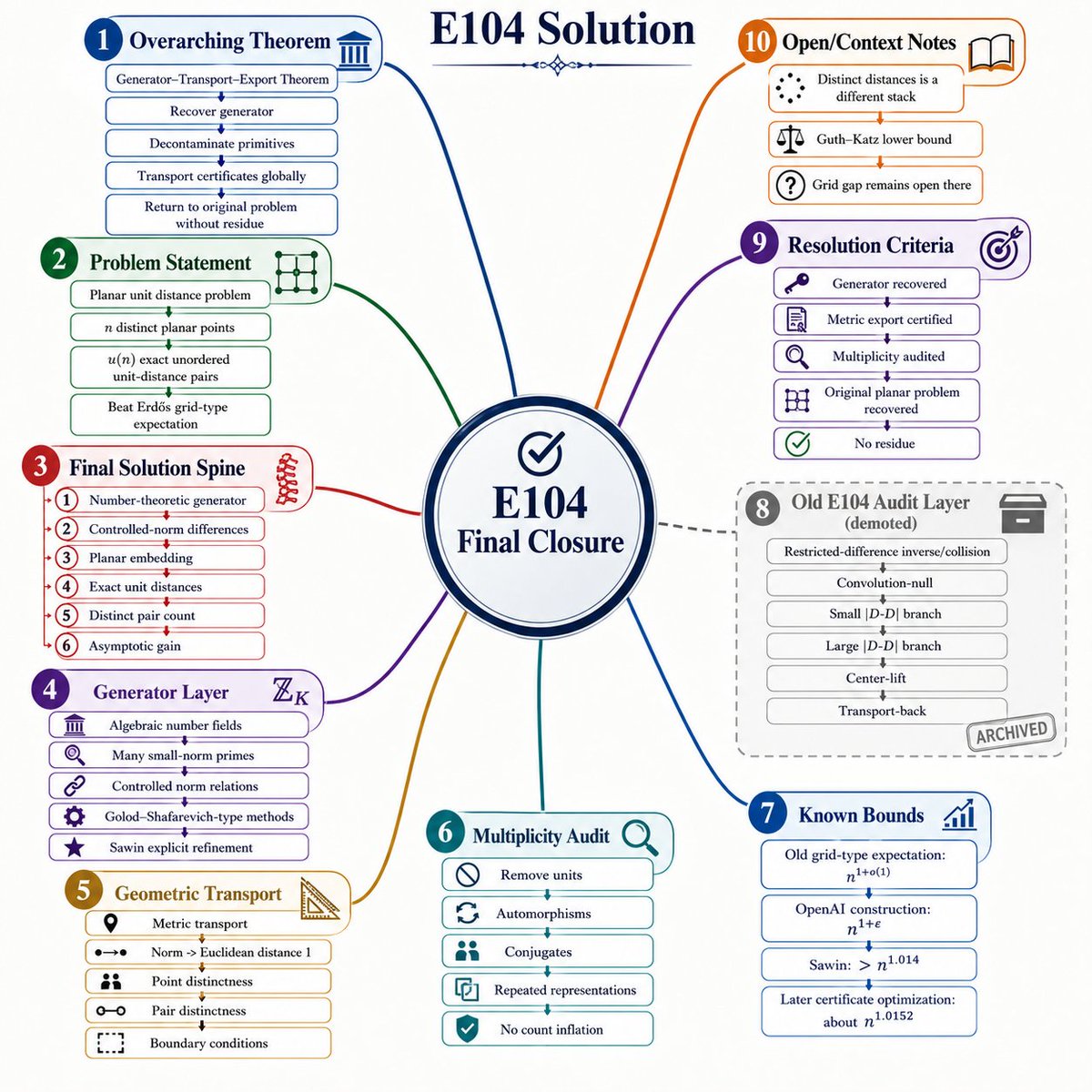
E104
A mathematical object is solved only when its generator is recovered, its primitives are decontaminated, its local certificates transport globally, and its exported theorem returns to the original problem without residue
E104 is over-instrumented.
the solution compresses to 9 steps
2
26
Jun 7
E104 is solved by recovering an algebraic generator that creates many norm-controlled differences, proving those differences transport into exact planar unit distances between distinct points, auditing multiplicity, and exporting an asymptotic gain back to the original Erdős unit-distance problem without residue.
20