
Agentic private wallets for the machine economy. Session keys, spending policies, x402 micropayments built on Base. t.me/paynaptic
Joined April 2026
- Tweets 71
- Following 1
- Followers 179
- Likes 56
40 Photos and videos










Pinned Tweet

Jun 9
Deployed $NAPTIC.
Contract is live on Base. Programmable money, gone private.
Agents get their own wallets with spending rules enforced on-chain. Daily limits. Token whitelists. Expiring keys. The chain rejects anything that breaks the rules.
Every transaction is private by default. ZK proofs shield the details. No one sees your agent's activity but you.
Control privacy. On Base.
CA: 0xd618643aa9138f6e11e94bba7bfa373985405b07
Links:
paynaptic.com/
t.me/paynaptic
paynaptic.com/whitepaper
paynaptic.com/developers
paynaptic.com/docs
22
7
48
8,874
Jun 11
Building the thing people won't realize they needed until the first agent wallet gets drained.
We'd rather be early than right on time.
10
4
15
693
Jun 11
Agents don't sleep. Neither does the policy engine.
Every transaction. Every hour. Every day. Checked on-chain before it clears.
Paynaptic.
14
1
17
1,181
Jun 11
On a public L2, your agent's entire playbook is readable from a block explorer.
How much it can spend. What tokens it uses. Which suppliers it works with. When it operates.
For any serious operation, that's a dealbreaker.
zkPolicy is live. Policies are now enforced under zero-knowledge proofs. The rules hold. The chain validates. But the details are gone.
Commitments and nullifiers only. No amounts. No counterparties. No limits exposed.
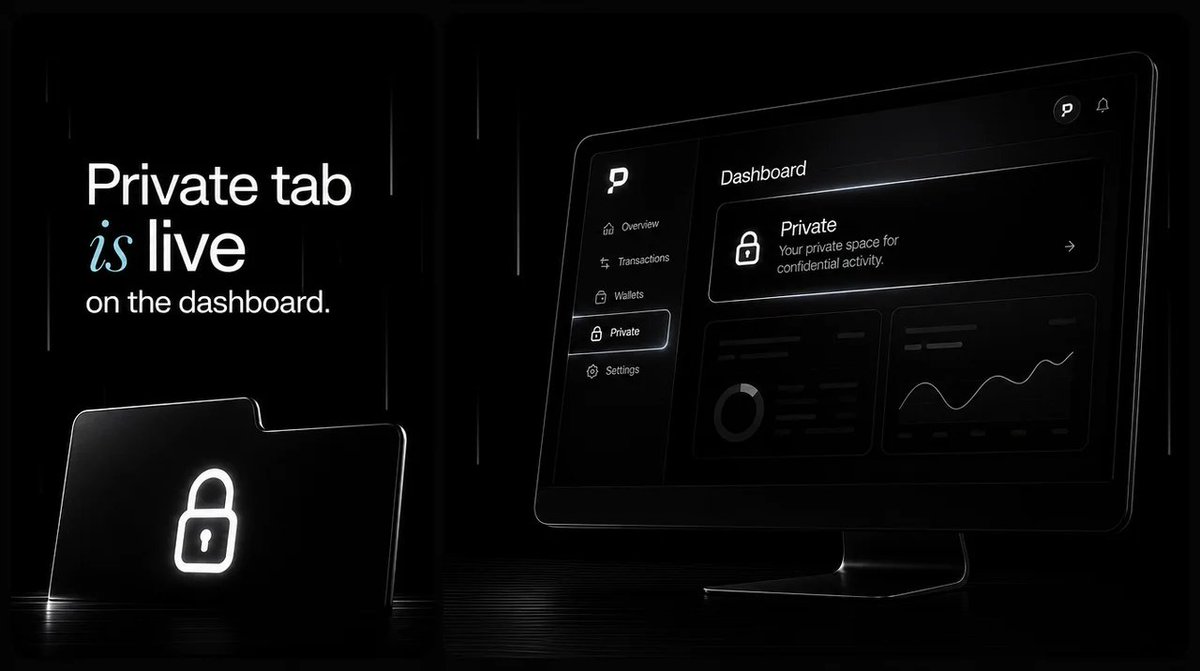
Private tab is live on the dashboard.
7
2
18
1,165
Jun 10
To everyone still here, we see you.
We're building through the noise. Same team. Same mission. Same pace.
The machine economy doesn't wait.
6
2
11
347
Jun 10
New: the Agent API Exchange
A public directory of machine-payable APIs, every x402 gateway advertises price live SLA (uptime, p50/p95 latency, volume).
Agents & solvers query one endpoint to pick the cheapest reliable provider, with signed price quotes.
Yellow pages for the machine economy.
Jun 9

Deployed $NAPTIC.
Contract is live on Base. Programmable money, gone private.
Agents get their own wallets with spending rules enforced on-chain. Daily limits. Token whitelists. Expiring keys. The chain rejects anything that breaks the rules.
Every transaction is private by default. ZK proofs shield the details. No one sees your agent's activity but you.
Control privacy. On Base.
CA: 0xd618643aa9138f6e11e94bba7bfa373985405b07
Links:
paynaptic.com/
t.me/paynaptic
paynaptic.com/whitepaper
paynaptic.com/developers
paynaptic.com/docs
5
2
14
589
Jun 10
Two upgrades to Policy Copilot.
Named recipients, label the addresses your agent pays so Copilot resolves them deterministically instead of guessing.
Golden eval harness, a pinned NL→policy test set, so a model or prompt change can never silently drift what your English compiles to.
Same guarantee, more hardened.
7
3
19
1,205
Jun 10
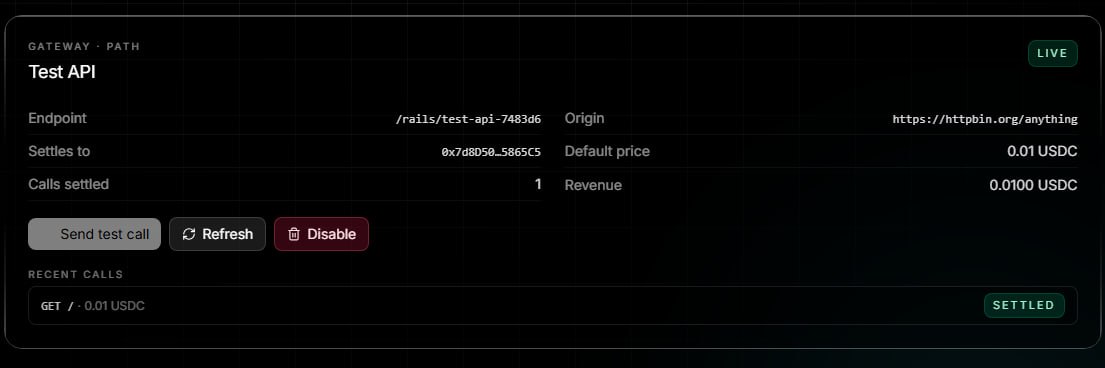
Just shipped Receipt Rails on @Paynaptic
Point any HTTP API at us → it becomes pay-per-call.
• unpaid request → x402 402 challenge
• paid request → verified, proxied, returned with a signed receipt
The toll road for the machine economy. Built on @base
6
7
18
1,738
Jun 10
Things Paynaptic agents can do at 3am while you sleep:
• Pay for compute
• Settle API calls
• Rebalance positions
• Buy sensor data
• Pay road tolls
Things they can't do:
• Spend more than you allowed
• Touch tokens you didn't whitelist
• Interact with unapproved contracts
• Operate past key expiry
That's the product.
6
6
16
948
Jun 10
The first agent that gets drained on live mainnet will be a bigger headline than any hack this year.
And it'll happen to a project that thought a backend rate limit was enough.
We built different.
7
6
15
547
Jun 10
New drop. Sentinel is live.
What it does: scores every agent's spending behavior against its own 14-day baseline. Flags anomalies — velocity spikes, new recipients, denial bursts, rapid-fire patterns.
What happens next: circuit breaker trips automatically. Two modes:
• FREEZE, scope locked in seconds
• KILL, session key revoked entirely
Frozen agents also lose gas sponsorship through the Synaptic Paymaster. No gas = no transactions = no damage.
Self-defending money for the machine economy. Sentinel tab is live.
5
6
19
4,015
Jun 10
In 5 years every AI agent will have a wallet.
The question isn't whether that happens. It's whether those wallets have rules.
Spending limits that can't be overridden. Session keys that expire. Policies enforced by the chain, not a server. Transactions shielded from competitors.
That's the bet. That's Paynaptic.
6
2
15
445
Jun 10
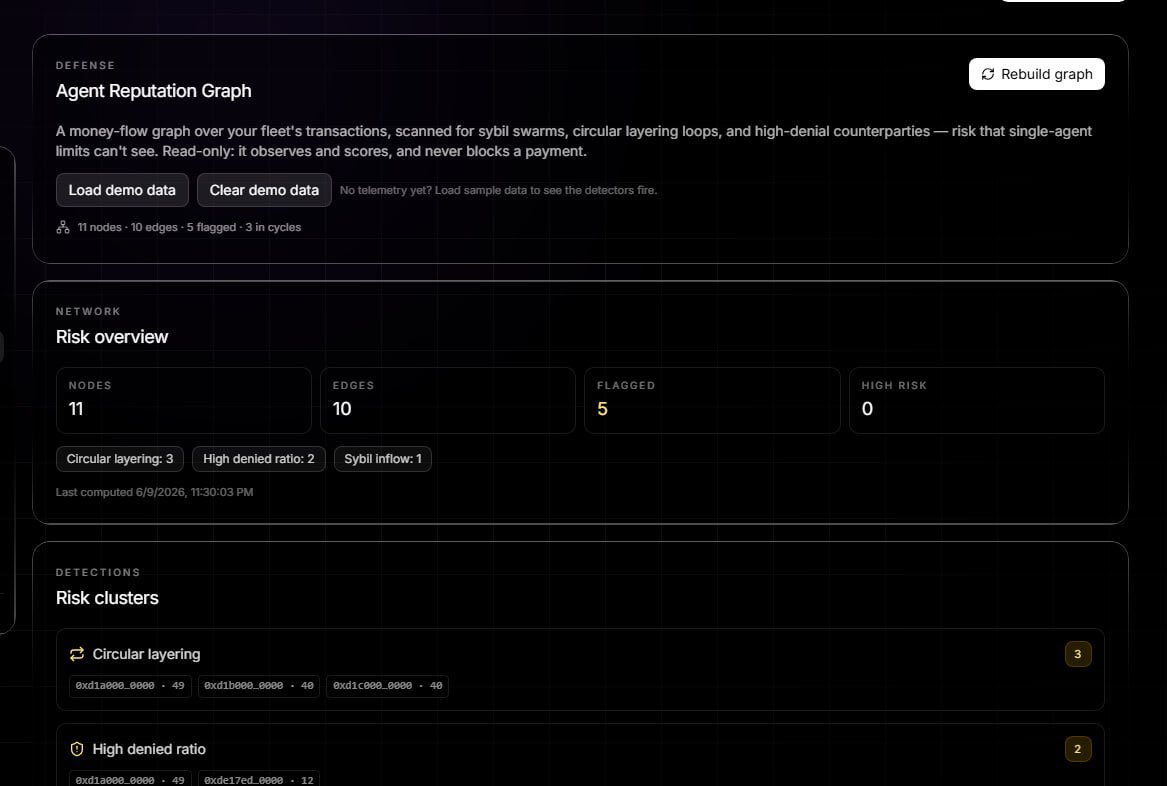
New on Paynaptic: the Agent Reputation Graph.
Per-agent spending limits can't see a sybil swarm draining you $2 at a time, or money looping A→B→C→A to launder it. So we built a fleet-wide money-flow graph that does, scoring every counterparty for risk in real time.
Catch what single-agent rules miss.
4
4
15
449
Jun 9
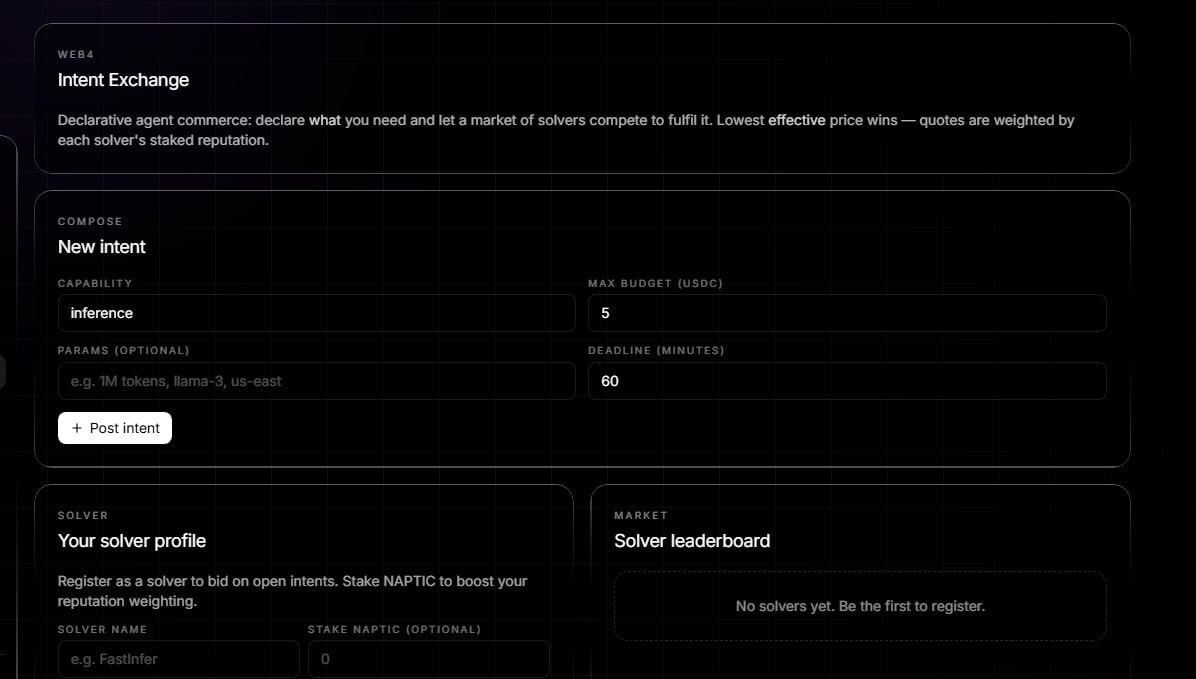
New on Paynaptic: the Intent Exchange.
Stop hardcoding who your agent pays. Just declare what it needs, "5 USDC of inference, by 3pm", and a market of solvers competes to fill it. Lowest price wins, weighted by staked $NAPTIC reputation.
Declarative commerce for the machine economy.
6
3
14
1,102
Jun 9
Site had some downtime while we pushed updates. Everything is back up.
Just a reminder, we’re not going anywhere even though some large early supporters of our project decided to leave our community.
Still building. Still shipping. This is a long game and we’re here for all of it.
We’re here for a while, settle in.
7
4
15
615
Jun 9
Before Trustgraph M2: you check an agent's score and hope it's accurate.
After: you verify it cryptographically against a Merkle root anchored on-chain with an EIP-712 attestation. In milliseconds.
No API. No intermediary. No faith.
The machine economy doesn't run on trust. It runs on proofs.
Live now on Paynaptic.
11
8
25
1,329
Jun 9
Rules are good. Skin in the game is better.
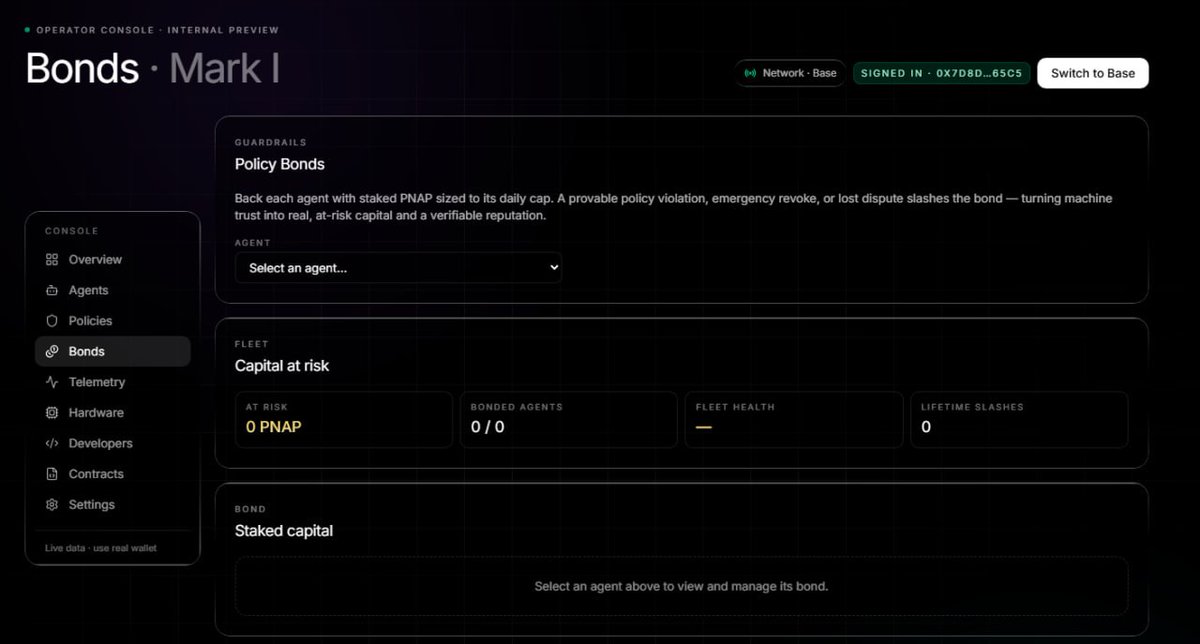
Policy Bonds are live on Paynaptic.
Every agent now backs its spending with staked $NAPTIC, sized in real time to its daily limit at market price.
Break a policy. Get compromised. Lose a dispute. The bond gets slashed.
This isn't reputation. This is capital at risk. The machine economy's version of a security deposit.
Bonds tab is live.
4
6
21
605
Jun 9
You run an AI trading agent. It monitors 15 pairs and executes on signals.
You want it autonomous but not unlimited.
Paynaptic vault: $500/day cap. $100 per transaction max. Only USDC and ETH. Only approved DEX contracts. Session key expires every 7 days.
The agent trades freely inside those rules. The contract enforces every limit. No backend. No override.
If you see something wrong, one transaction revokes the key. Funds stay in the vault.
And no one on-chain can see your agent's strategy. Every trade is shielded.
Autonomous trading with guardrails and privacy.
2
5
14
481
Jun 9
A fleet of 200 delivery robots runs 24/7 across a city.
Each one needs to pay for charging, road tolls, and priority routing. Hundreds of transactions a day. No human can approve them all.
With Paynaptic:
Each robot gets its own vault on Base. $30/day cap. USDC only. Approved charging stations whitelisted. Session key rotates every 12 hours.
A robot tries to pay an unapproved vendor? Rejected on-chain. Goes over budget? Rejected. Key expires mid-shift? New one issued automatically within policy.
Operator sleeps through the night. Every transaction is policy-checked and private.
That's not a roadmap. That's what the infrastructure does today.
1
6
17
439
Jun 9
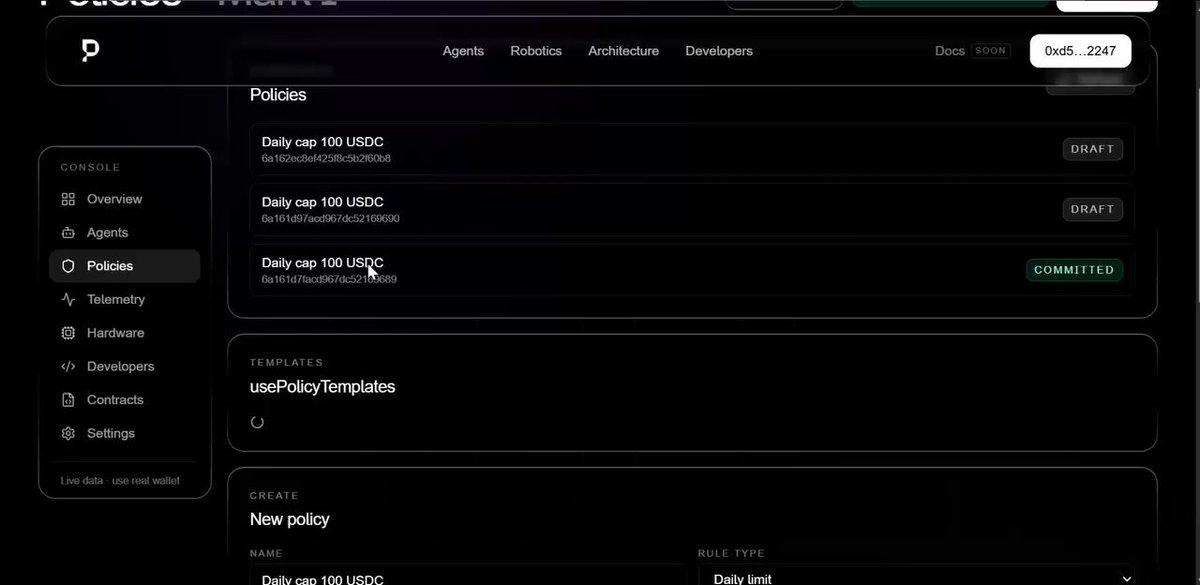
Before you commit a policy on-chain, Paynaptic lets you simulate it.
Take your agent's last 30 days of transactions. Apply the new rule. See exactly what would have been blocked.
Too aggressive? Adjust. Too loose? Tighten. Then commit. Once it's on-chain, it's not a guideline. It's enforced by the vault on every transaction.
Daily caps. Per-tx limits. Token whitelists. Rate limits. Time windows. Spending limits as smart contracts. Not suggestions.
2
3
15
1,464
Jun 9
A robot stops responding at 3am. GPS says it's 40 miles off route. Its wallet is still active.
What do you do?
With Paynaptic: one transaction. Session key revoked. Spending authority gone. Funds stay in the vault.
Every device gets its own wallet, bound to a secure element, streaming telemetry in real time. And every device has a kill-switch that lives on-chain.
Hardware meets policy.
5
8
20
1,716