
co-founder @zocomputer - prev: founding eng @substack, founding eng @ fin assistant, early team @venmo
Joined September 2017
- Tweets 583
- Following 54
- Followers 1,021
- Likes 1,573
145 Photos and videos
Pinned Tweet

19 Nov 2025
The computer is the most flexible tool humanity has invented: whatever you can imagine, if you can describe it precisely enough it runs on a machine.
I've spent the last 15 years learning how to describe things precisely to computers, and yet my side projects feel less like a triumph of personal computing and more like a graveyard of abandoned threads. Not because I don't want them, but because they take too much effort to build and maintain.
Today we're introducing Zo Computer - the computing environment I always wanted.
10
13
115
24,537

Jun 12
had the first instance of a model provider propose dynamic token pricing based on time of day. this should almost definitely happen broadly. electricity is priced based on supply/demand, as is human labor
4
2
12
845
Jun 10
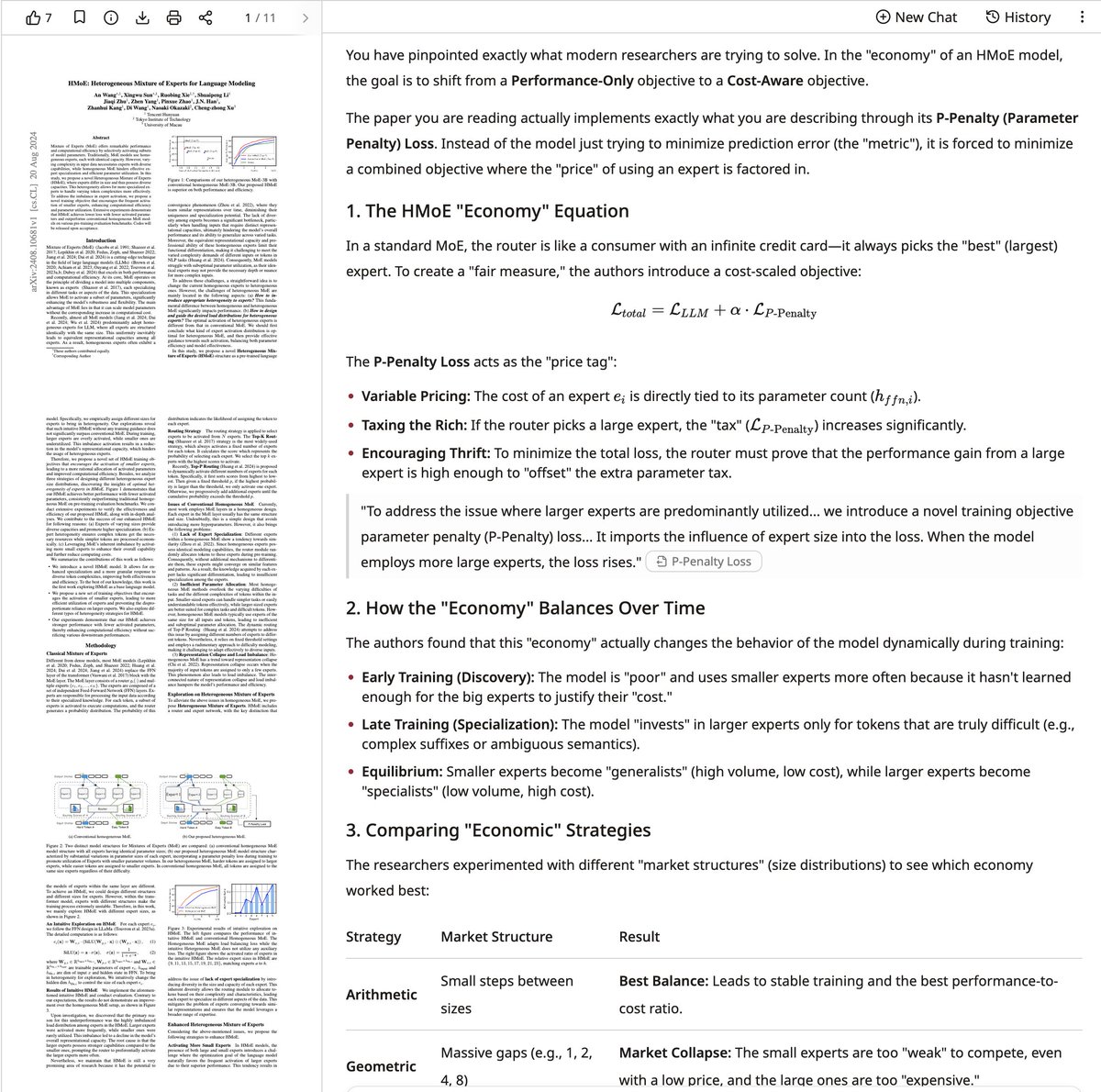
the person who wins this nobel prize may actually end up being a computer scientist that bakes the economy into the model itself.
feels like one of the absurd inefficiencies is not only asking your phd to fold laundry, but to always be doing it chalk full of adderall and adrenaline, with no other mode

1
3
127
May 31
seems like we figured out the brain and the prefrontal cortex is the agent harness, the amygdala is the pretrained llm, the hippocampus is the vector database and consciousness is the vibecoder wisprflowing on top of it all
2
1
17
665
May 23
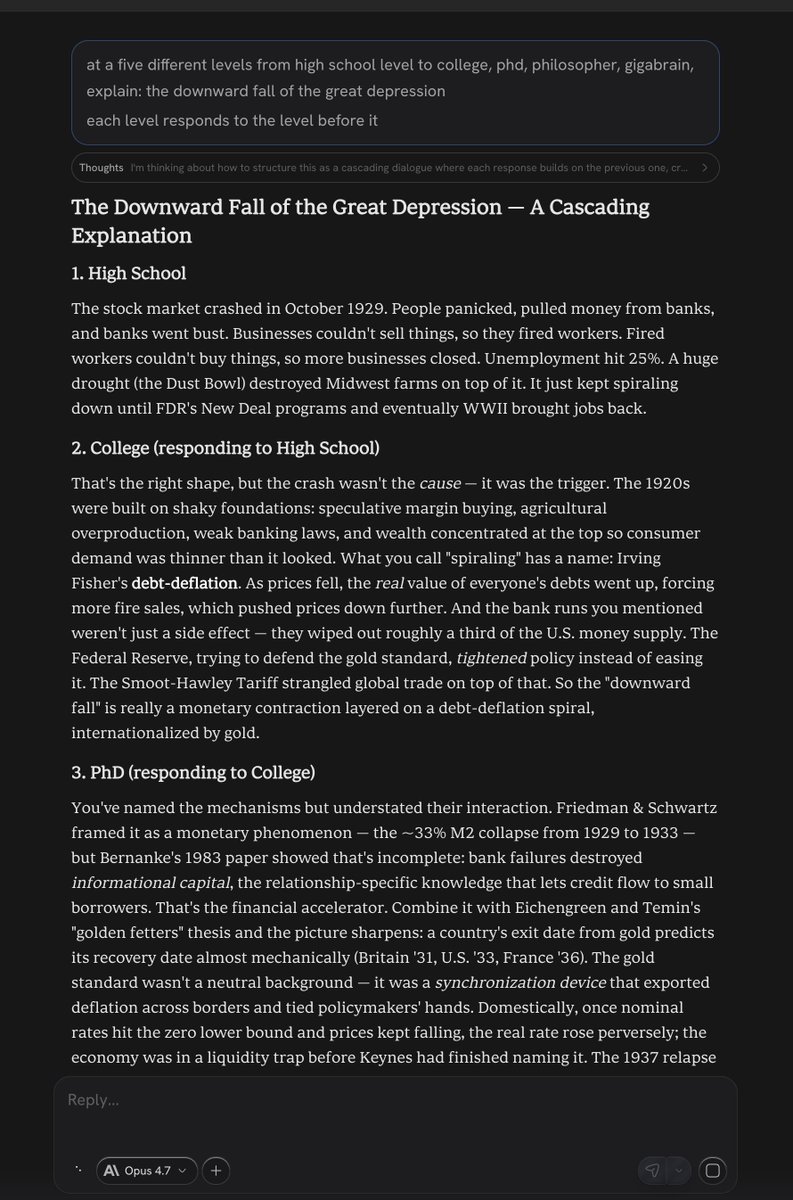
If You Give a Mouse a Cookie — A Cascading Explanation
1. High School
*If You Give a Mouse a Cookie* is a children’s book by Laura Numeroff, published in 1985, with pictures by Felicia Bond. The story is simple: a boy gives a mouse a cookie, and then the mouse asks for milk, then a straw, then a napkin, then a mirror, and so on. Every request leads to another request, until the whole thing loops back around and the mouse wants another cookie. It is funny because one tiny nice act turns into a huge list of chores. The book is basically saying: once you start something, it can create a chain reaction. It is also about how kids — and mice in stories — can keep wanting the next thing.
2. College (responding to High School)
That’s the right shape, but the book is doing more than saying “one thing leads to another.” It is a miniature lesson in causal sequencing: each event produces a new condition, and that condition makes the next desire seem natural. The humor comes from escalation without villainy — the mouse is not evil, just endlessly associational. In developmental terms, the book works because children are learning prediction, sequence, and narrative closure: cookie → milk → straw → napkin feels both surprising and inevitable. The circular ending matters too. It turns a linear chain into a loop, making the story feel complete while also implying that desire can restart endlessly.
3. PhD (responding to College)
You’ve named the mechanisms but understated how elegantly the book compresses them. Numeroff and Bond create what narratologists would call a recursive causal structure: each object or action generates the conditions for the next, while the protagonist’s wants function as the engine of plot. The story resembles the “chain tale” tradition found in children’s folklore, where repetition, accumulation, and predictability produce pleasure and participation. From a cognitive-development perspective, it trains event schema formation: young readers learn that actions have consequences, but also that consequences are culturally legible — milk goes with cookies, mirrors go with mustaches, cleaning leads to chores. From a behavioral angle, the mouse dramatizes preference formation under cue exposure: each satisfied want reveals a nearby unsatisfied want. The deepest mechanism is not appetite but adjacency: the mind moves from thing to thing because each object carries a little map of what belongs beside it.
4. Philosopher (responding to PhD)
Your machinery is persuasive, but it still treats the story as a device for cognition, as if the mouse were mainly a lesson in sequence. The stranger truth is that the book is about the endlessness of need. The cookie is not merely a cookie; it is the first door. Once opened, it reveals that every satisfaction contains the outline of another lack.
This is why the book feels comic rather than tragic. The boy is not crushed by the mouse’s demands, and the mouse is not condemned for making them. The story accepts a fact adults often resent: to care for another creature is to enter a world where no gift remains singular. Food asks for drink. Drink asks for cleaning. Cleaning asks for rest. Rest asks for memory. Memory asks for return. Generosity is not a transaction but an invitation into time.
5. Gigabrain (responding to Philosopher)
Beautifully said, but I’d push one step further. The story is not only about need, and not only about generosity. It is about the way attention breeds worlds.
Before the cookie, the mouse is just a mouse. After the cookie, he becomes a guest. Once he is a guest, the room changes. A glass of milk appears as a reasonable thing. A straw becomes thinkable. A napkin becomes necessary. The boy has not simply fed the mouse; he has accepted the mouse’s reality for a while. That is why the requests keep coming. The mouse is not adding burdens from outside the world. He is revealing the world that the first kindness created.
This is what children understand instinctively. They know that play works this way. You put one block down, and suddenly there is a tower to build. You draw one line, and suddenly there is a face to finish. You say “pretend I’m a dragon,” and now the whole room must answer to dragon rules. Adults call this inconvenience when it happens in life, but children recognize it as the basic magic of beginnings.
The loop back to the cookie is not a joke about greed. It is a joke about return. Every little world wants to keep itself alive. The mouse asks again because the story asks again. The first cookie was an accident; the second would be a choice.
The book’s quiet wisdom is that nothing stays small once you truly let it in.
May 21

the five levels can really be anything but it's a nice pattern with LLMs to try to have it ascend the ladder of argument space
2
6
486

May 22
In the old days, if someone had a secret they didn’t want anyone to know, they would create an anonymous ChatGPT account, open a prompt, carve a hole in it, whisperflow the secret into the mic, and send it to the server. That way the secret would stay there forever.
2
5
16
569
May 21
the five levels can really be anything but it's a nice pattern with LLMs to try to have it ascend the ladder of argument space
2
1
14
702
May 18
I love this - someone took our keychain merch which are just mechanical switches and turned it into a control device for @zocomputer

1
13
635
rob cheung retweeted

May 15
Github sucks for a 1M LOC PR.
Built an interactive site to see how @jarredsumner ran a 1M LOC migration:
- Look through the 8 different phases of the migration and the now-deleted Markdown files for it
- Commit-by-commit review of the highest churn files, with diffs served from a local Bun checkout (RIP GH API)
- Test suite CI setup breakdown
bun-to-rust-fanahova.zocompu…
1
1
19
3,154
May 13
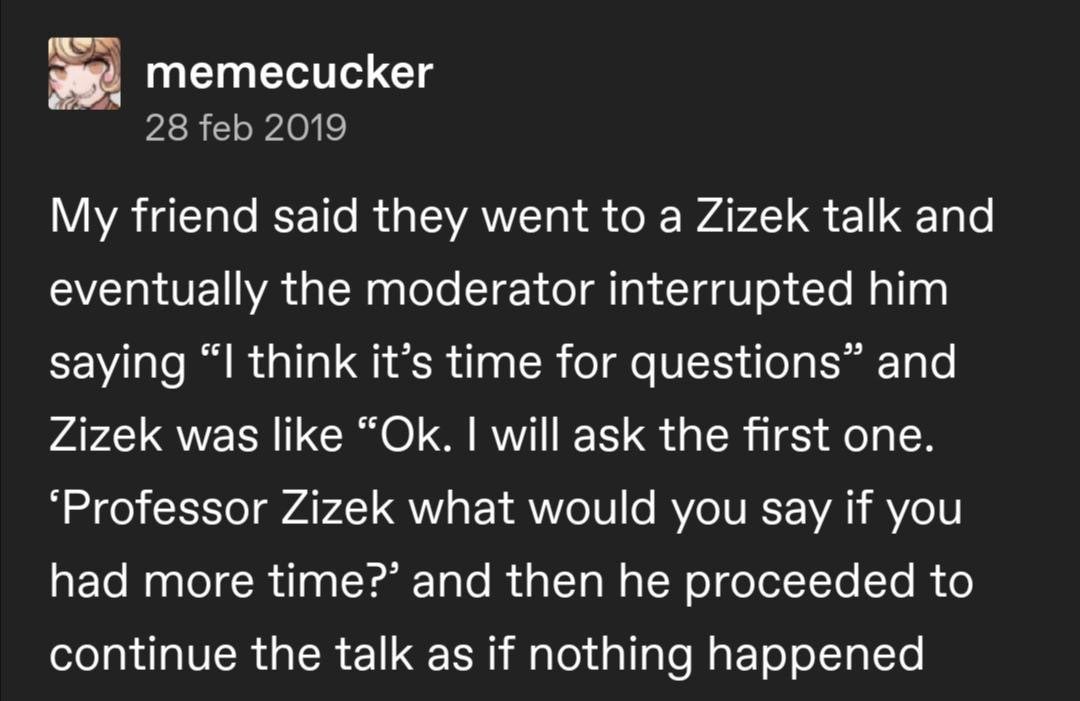
everyone's heard about ralph loops to make agents tenacious, but there is a lesser known pattern called the ziz loop to ensure they continue to monologue
May 12

Everyone figuring out hacks to get Claude and Codex to keep working without stopping for questions
7
209
*Slavoj Zizek sniffs loudly* Ah yes, yes, the ABG. The Asian Baby Girl. Sniff This is, you see, this is a perfect case study in what Lacan would call, you know, the sliding of the signifier. Yes? Sniff
Because what is happening, what is happening here is fascinating. The fob, the fresh off the boat, she arrives in Cupertino, in Palo Alto, and she encounters this term, ABG, and she does not know, you see, she does not know the genealogy. She treats the signifier as, how do you say, a flat-pack from IKEA. Some assembly required. Sniff
And what is the criteria, what is the criteria now? You drink the boba, ABG. You play the League of Legends, you say "hi" to a stranger at the Whole Foods, ABG, ABG, ABG. Sniff In this way, you see, every Asian American woman who is not actively crying over a textbook becomes, ontologically, an ABG. The category devours itself. It is, how do you say, the Hegelian bad infinity of the H1B imagination.
Sniff But here, here is where it becomes interesting, you see. Sniff The ABG AI CMO. Sniff This is a new object. A fantasy object. Because the original ABG, she did not care about your seed round. She did not care about your transformer architecture. She was, you see, sublimely indifferent to your cap table. Sniff
But the new one, the fob ABG, ah (Sniff) she is the perfect aspirational-honeypot, yes? She must be intelligent enough to discuss, you know, the mixture of experts, but also hot enough that the YC partner forgets to ask about retention. She is, you see, the Lacanian "objet petit a" of the Sequoia partner. Sniff
And this, this is why the SF mid, and we must use this term clinically, with love (Sniff) the SF mid sees in the ABG not a person but a portal. A portal out of the dimly lit WeWork of her own facticity. She organizes the meetup. She buys the gold hoops on Amazon. Sniff "Look, I am ABG now." No. Sniff No, my dear. You are performing ABG for an audience that is also performing ABG, in a recursive loop of mutual misrecognition. It is, you see, it is ABGs all the way down. Sniff

I think abg has taken on a different meaning among fobs in the bay area for a couple main reasons.
Fobs are unaware of the etymology and poorly educated on the aesthetics. What they’ve done is broken down the term piecewise: e.g. asking themselves, am I asian? Am I baby? Am I girl?
Secondly, fobs think possibly all Asian American women can become abgs. They think going to the beach without an umbrella makes them an abg, or drinking boba, or playing LoL. Being social as opposed to studying, is abg. Listening to English music is abg. Saying hi to strangers is abg. Using instagram is abg.
The idea of the abg ai cmo, however, is actually a novelty. It is at its core a fob, almost aspirationally-honeypot, identity. She has to be smart enough to be in ai, yet hot enough to use her looks to do marketing. This is why sf mids aspire to be considered abgs, and why groups of them are creating abg meetups.
24
81
1,293
127,336
rob cheung retweeted

Apr 30
Cool. Zo team has been incredibly visionary. First time I saw an articulation of the “claw” future
2
4
30
3,070
Apr 29
so excited to be working with SB. it is a huge huge honor
Apr 29

Despite loving independent exploration, I couldn't resist joining @ZoComputer to help build their AI powered cloud computer that is increasingly my home on the Internet.
It’s got that magical early startup energy where the people that get it can’t stop talking about it and use it in ways beyond our imagination.
It’s incredible to work on a product that I use every day and I get to make it better for myself.
Projects are better when shared and because creation and hosting happen in the same place on Zo, things get off of localhost and out into the world sooner.
A long time ago, Zo knew that we should be able to text our AIs to do real work.
It's exciting to play with ideas that are central to how we work and make things today - agent orchestration, memory, giving everyone superpowers.
I think Zo might be one of the best all-in-one tools for small businesses and solopreneurs (like my wife) and it’s pretty rewarding to see how it powers them.
I’d already been hanging out at their office with the team, and now I get to hang out and talk with them even more.
I love working on projects with friends and @perceptnet and @0thernet are two of my closest and smartest friends and their partnership and this product all felt inevitable and right.
LFZoooo!
2
1
20
1,105
Apr 28
Oh someone did it!! This has been a pet idea of mine for awhile.
Train "vintage" next token models with artificially early knowledge cutoffs, to see how well they can predict the next paradigm/epochs
now would love to wire one of these vintage models from before digital computing in a harness with a bash tool and notebook tool to see if it eventually figures out how to program computers
Apr 27

New work with @AlecRad and @DavidDuvenaud:
Have you ever dreamed of talking to someone from the past? Introducing talkie, a 13B model trained only on pre-1931 text.
Vintage models should help us to understand how LMs generalize (e.g., can we teach talkie to code?). Thread:
1
9
383