
Engineering Leadership | Software Architecture & Engineering | Thoughts at pkritiotis.io
Joined July 2009
- Tweets 116
- Following 207
- Followers 97
- Likes 287
9 Photos and videos

Pinned Tweet

19 Aug 2024
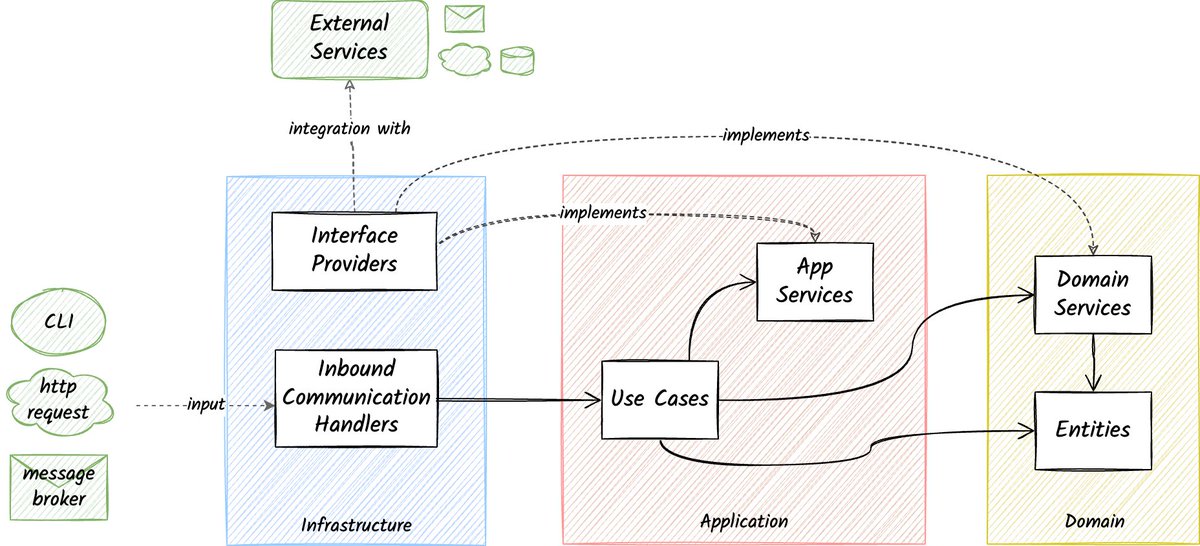
If you’re a software engineer, you need to be familiar with Clean Architecture.
As software evolves and changes, without a solid design approach, your codebase will quickly become a mess and every new feature addition risky and error-prone.
You need direction, a system, a philosophy.
You need an architecture that allows you to introduce changes confidently and with less friction.
Enter Clean Architecture.
It’s a design philosophy that introduces dependency rules to decouple components based on their purpose/concern.
Discovering Clean Architecture was a revelation for me and transformed how I’ve been coding since.
For a comprehensive introduction with an example implementation in Go, check out my updated blog post here: pkritiotis.io/clean-architec….
4
18
1,096
Staying technical as an Engineering Manager - the struggle, the need, the meaning and thoughts on approaching it.
This is a topic I keep coming back to. Not a framework, more of a personal essay on where I’m at today after a few years of wrestling with it pkritiotis.io/staying-techni…
1
33
2 Aug 2024
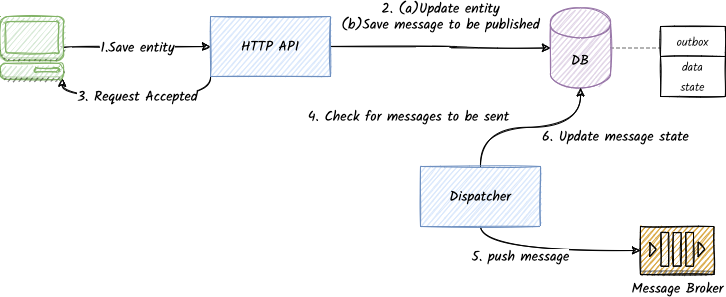
One of the most powerful patterns I’ve used in distributed systems is the outbox pattern.
The outbox pattern ensures at-least-once guaranteed delivery of messages after a database operation.
It’s a simple pattern, but its implementation poses a few challenges for developers.
Check out my post for an introduction and the challenges of implementation: pkritiotis.io/outbox-pattern…
And my sample implementation in Go: github.com/pkritiotis/go-out…
1
411
27 Jul 2024
Even if your team enforces rigid, questionable rules, don't go your own way and be a reckless cowboy.
You're part of a team.
Your team's success is your success.
Break the rules and nothing will work—Not even your way.
Help your team.
Work with them.
Challenge the rules, but stick to them while they're in place.
Show why you disagree, and back it up with data.
Hear the other side of the story.
Reach an agreement.
Often there's a reason that a 'dumb' rule is there.
And if it's truly dumb, you'll have more success persuading your team by working with them, not against them.
2
163
25 Jul 2024
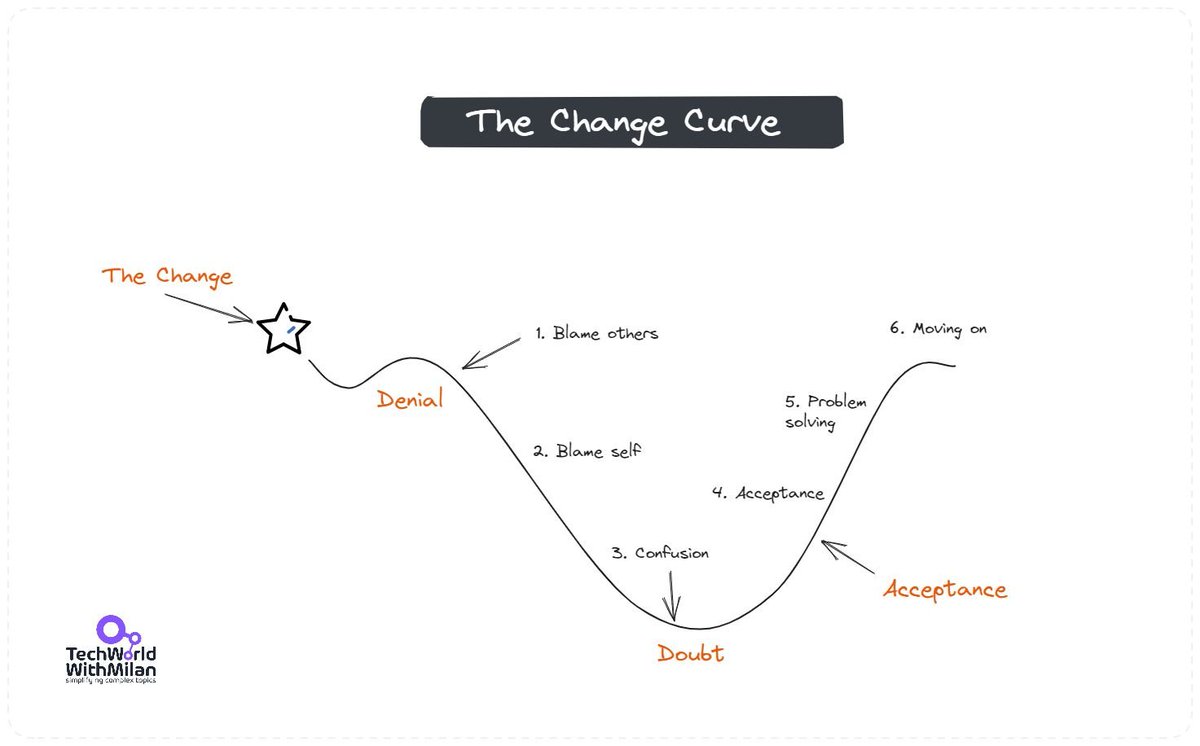
I first encountered the Change Curve a few years ago during my training as a new Engineering Manager.
Learning about the stages has been invaluable, helping me adapt my actions based on the team's state:
• Denial → Listen, explain, and empathize
• Resistance/Doubt → Encourage exploring different perspectives
• Acceptance → Acknowledge and support
• Commitment → Celebrate and plan ahead
Change is inevitable, and even if it seems negative, you should try to make the best of it.
Embrace it, and it can lead to hidden opportunities.
25 Jul 2024

𝗛𝗼𝘄 𝘁𝗼 𝗰𝗼𝗮𝗰𝗵 𝗽𝗲𝗼𝗽𝗹𝗲 𝘁𝗵𝗿𝗼𝘂𝗴𝗵 𝘁𝗵𝗲 𝗖𝗵𝗮𝗻𝗴𝗲 𝗖𝘂𝗿𝘃𝗲?
In today's newsletter, we delve into the profound benefits of two essential skills for every leader: 𝘂𝗻𝗱𝗲𝗿𝘀𝘁𝗮𝗻𝗱𝗶𝗻𝗴 𝗮𝗻𝗱 𝗹𝗶𝘀𝘁𝗲𝗻𝗶𝗻𝗴 𝘁𝗼 𝗽𝗲𝗼𝗽𝗹𝗲. These skills enhance your leadership and empower you to make informed decisions.
We examine how the change curve helps us understand other people's reactions during new situations and changes and how to listen to people properly.
Check it out from the following link: newsletter.techworld-with-mi….
#career #management #coaching
2
119
24 Jul 2024
Standups are not policing meetings.
They are feedback meetings.
Their real value lies in:
• Spotting and addressing blockers
• Progress awareness
• Clearing up any confusion
• Aligning priorities
Regular standups are crucial for team alignment and smooth, efficient progress
64
21 Jul 2024
The CrowdStrike incident is a strong reminder that systems fragile by design are at the mercy of Murphy’s Law: if something can go wrong, it eventually will.
It was only a matter of time.
What's scary is we don’t know how many other important systems are just as fragile and haven't failed yet. Very few knew what CrowdStrike was three days ago.
As long as there is a possibility for failure, it will likely happen again. Our only hope is to minimize the impact.
To be honest, I was surprised to learn that a third-party software update could cause such a big problem for an OS. I’m not an expert in this domain, but I'm sure there are trade-offs in design choices.
General-purpose software including OSes, can't be perfect for all situations. The CrowdStrike event makes us question the choice for critical systems that can't afford to fail.
Fixing the process that led to this issue is the first step, but it won't solve everything.
The problem lies in the design. We must learn from this incident and be more cautious with software design, especially for high-impact, critical systems.
1
4
134
20 Jul 2024
Staying strictly fixated on any Agile framework and enforcing written-in-stone rules is inefficient.
Avoid common pitfalls by embracing the Agile philosophy over framework rigidity, and adapt it to fit your needs.
Read more in my latest blog post: pkritiotis.io/agile-philosop…
3
117
19 Jul 2024
The value of improving areas that reduce the cognitive load of the team is often underestimated.
- Automate long manual processes and mundane and error-prone tasks.
- Reduce uncertainty through documentation, tests, validation processes.
- Build utilities that simplify your team's workflow and boost its productivity.
All of the above can have outstanding results for enabling a smooth execution and stability.
18 Jul 2024

Solve problems that nobody wants to!
A lot of times you might hear recurring issues inside the team or the organization.
They may be:
- some parts of the codebase are really hard to understand,
- lack of documentation on certain parts,
- lack of tests and overall confidence in certain parts.
When you hear such recurring issues, the best thing you can do is to try to solve them. Your fellow engineers, manager and the whole organization will appreciate you for doing this.
It also sets you apart from others, because you are showing the courage to face the issue and grit to resolve it.
1
4
143
17 Jul 2024
The most influential tool that has completely transformed my learning is Zettelkasten.
This personal knowledge management (PKM) system helps me organize my thoughts and knowledge.
I discovered Zettelkasten 5 years ago and have seen mind-blowing improvements in:
• Knowledge retention & understanding
• Connecting information
• Idea generation
• Thought clarity
If you're serious about learning, a PKM is a game-changer. It doesn't have to be complicated or strict. If you don't use one, you need to.
5
269
13 Jul 2024
Striving for regularity is one thing; enforcing rigid processes is another.
In Agile, following the philosophy isn't the same as blindly enforcing a rigid, strict framework.
They might work for some, but I suspect they’re inefficient for most. Adaptability > rigidity.
1
2
114
13 Jul 2024
Writing a blog post that expands on this topic. Coming soon!
1
2
78
7 Jul 2024
Naming in software is tough, but there are some real gems out there.
One of my favorites is @martinfowler's Strangler Fig Pattern.
The metaphor is brilliant: a strangler fig (new system) grows around its host (legacy system), gradually replacing it and eventually taking over.
6
274
1 Jul 2024
Middle management in engineering is a tough job, one of the toughest.
You’re the bridge between your team and the higher-ups, balancing both worlds.
With Superiors:
• Secure fair team workloads and timelines.
• Push for quality of life improvements for your team.
• Advocate for interesting projects that could provide growth opportunities for your team.
• Cover and justify your team’s missed goals and mistakes.
With Your Team:
• Absorb pressure without stressing your team out.
• Balance demands with a practical approach.
• Keep them motivated, even when delivering tough decisions.
Mastering this balancing act is challenging but incredibly rewarding!
10
601
27 Jun 2024
3. Motivation
Unmotivated people don’t want to work.
According to Daniel Pink, motivation comes from mastery, autonomy, and purpose.
Make sure your team has the tools to grow, the freedom to make decisions, and a clear understanding of their impact.
1
1
81
27 Jun 2024
4. Performance Management
Everyone needs guidance and feedback to stay on track.
Recognize good behaviour and offer timely corrective timely feedback when needed.
Make feedback a regular part of your 1:1s. Performance evaluations shouldn’t be a surprise to your reports.
1
1
64
27 Jun 2024
These are the 4 pillars I use for People Management:
1. Alignment
2. Growth
3. Motivation
4. Performance Management
Keep communication open, build trust, provide support, and celebrate progress.
A thriving team achieves amazing results!
I would love to hear your thoughts!
46
27 Jun 2024
The trickiest part of being an Engineering Manager? People Management
As a leader, to be successful, you need to build trust and ensure your team is empowered and performing at their best.
Here are the 4 pillars I use for people management as an Engineering Manager:
1
1
55
27 Jun 2024
2. Growth
More capable team members → more opportunities and more chance for success.
Growth is a shared responsibility between the employee and the manager.
Help your reports set personal goals and provide the coaching and resources needed to achieve them. Review regularly.
1
1
43
27 Jun 2024
1. Alignment
Make sure that your team members know what success looks like.
Every person has their individual role responsibilities but they also need to understand team goals.
Have regular discussions about roles and expectations during your 1:1s.
1
1
38