
76 Photos and videos





May 19
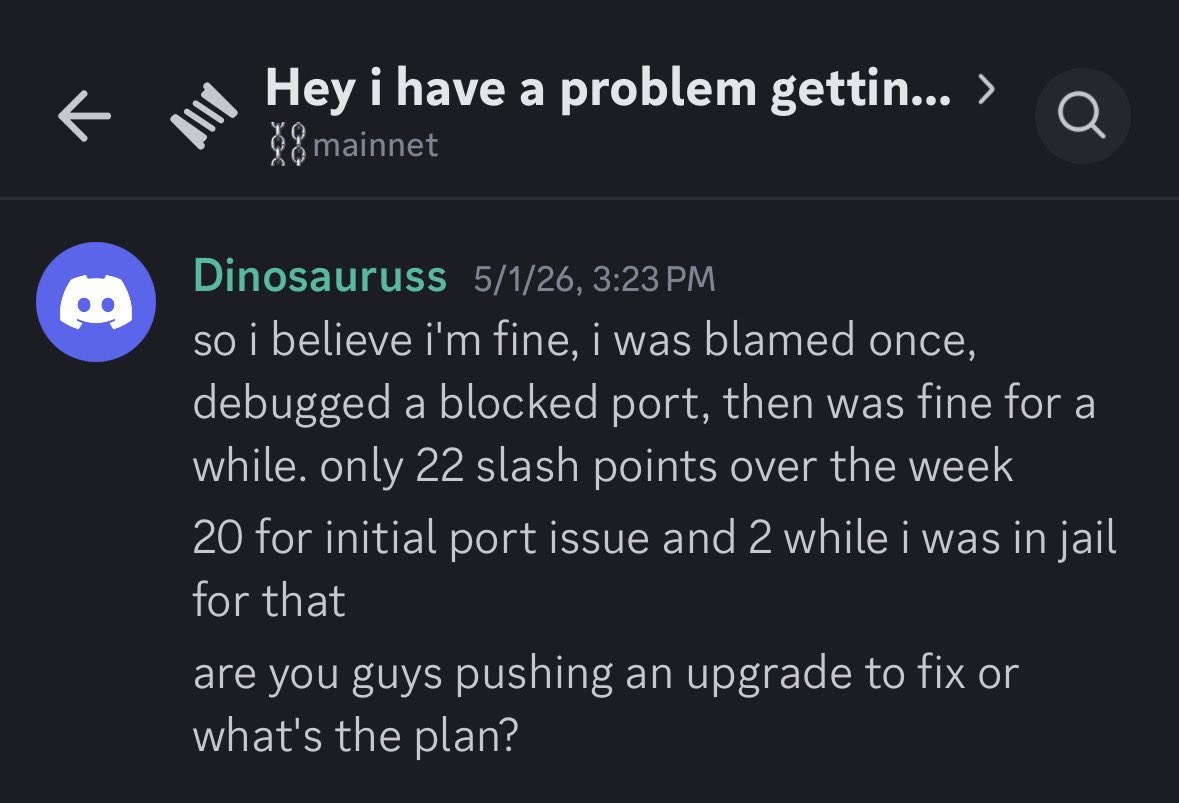
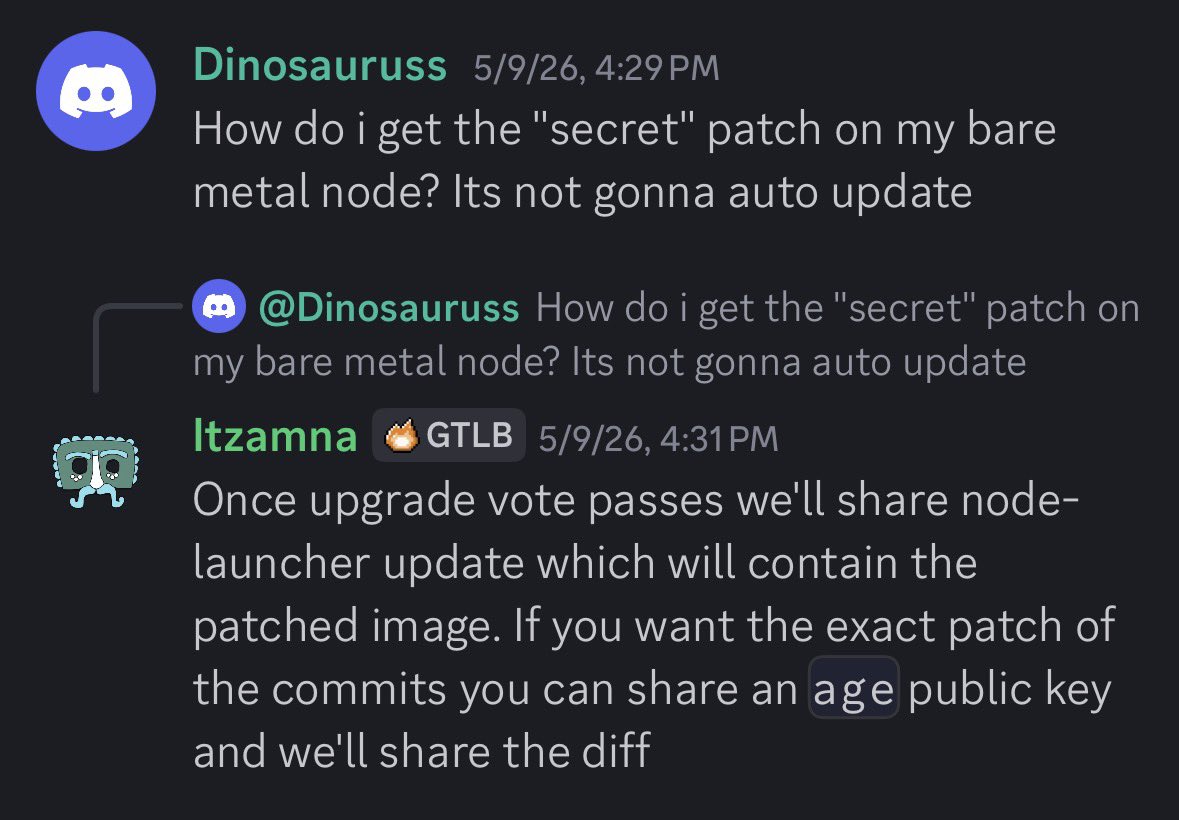
The latest TC release 3.18 was done as a private binary (something we had done before when patching crits). There was a long-standing practice that if a node requested, by signing a message with their validator key, devs would send them the validator-key encrypted diff of the security patch. That’s exactly what the malicious node did in this case. It’s possible even that the private release spooked them into speeding up their timeline for the attack. I find this class of attack very interesting. Networks need to be designed maximally defensive, even against their own validators. In this case, a malicious validator can still get the source code for patches and exploit them before the code goes out. I wonder if this puts an end to that practice. It all exists on a spectrum of decentralization. I actually don’t disagree with @jpthor that closed source TSS might be the move from here. Anyone who is saying that’s “the end of the experiment” is either a crypto-anarchistic maxi that lost the plot or an NK hacker astro-turfing protocols into not making sound trade-offs between security and decentralization.
6
5
51
14,149
May 18
Ok, I'm going to go ahead and say it. Silence Labs' DKLS implementation, and Vultisig's go wrapper of it, is not ready for primetime use on @THORChain.
8
6
89
16,059
May 18
Second, the DKLS implementation that supports ECDSA has had a few dozen commits by 2 authors, with the last release dated July 2025. By contrast, Binance's tss-lib implementation that TC inherits from has commits date from last month, with far more contributors and commits. github.com/silence-laborator…
2
20
2,209
May 18
In total, DKLS seems very promising, and seems to have worked out for @vultisig so far. That said, the comparative leap to move THORChain from GG20 tss-lib v1.0 to v3.0 is relatively lean. Just give keygen messages a version flag so that current vaults can continue signing using legacy keyshares, then cutover and deprecate the TC fork once a new keygen is successful. THEN move to DKLS later. IMO that's the safest path to getting TC back up and running ASAP, safely.
4
3
59
2,032
Pluto 🚢 retweeted

May 7
All crypto conferences should be held in Miami.
23
7
151
21,818
May 4
I am pleased to announce a tender offer to acquire @THORChain.
1/2 cash 1/2 stock.
Offer expires EOD.
May 4

Nothing stops this train.
14
1
57
13,900
Apr 29
The ADR process was probably my favorite contribution I made to the THORChain protocol. Formalized governance processes benefit all.
Apr 29
Ever seen "ADR" mentioned in THORChain discussions and wondered what it means?
An ADR, or Architecture Decision Record, is how THORChain proposes and formalises major changes to the protocol. New features, tokenomics updates, chain integrations, fee structures, node incentives. If it changes how THORChain works, it's gone through an ADR.
The process is open. Anyone can draft one, it gets published publicly, the community discusses it, and nodes vote to accept or reject it. No backroom decisions, no unilateral changes. Every significant shift in the protocol's architecture is documented, debated, and recorded permanently.
Recent examples include ADR 021 which established the marketing fund, ADR 023 which introduced reserve burn improvements, and ADR 025 which is currently redirecting the dev fund to a new treasury.
It's like an audit trail of every major decision THORChain has ever made, publicly accessible and permanently on record.
dev.thorchain.org/architectu…
5
2
87
4,040
Pluto 🚢 retweeted

Apr 27
Sat down with @pluto_hbr for @OnTheBrinkCIV to talk KelpDAO, deep security in DeFi, Aave, LayerZero, Thorchain, Harbor, and where DeFi goes from here
castleisland.vc/pluto-harbor…
4
3
21
7,819
Mar 11
Proud of the team. Long road ahead. We’re confident in our design and ready to scale. 🤝
Mar 11

We’re coming up on 3 months since Harbor’s launch. We’re proud to say that our initial rollout phase is complete, and the protocol has performed to the team’s high standards:
100% swap completion rate, 212x week-over-week growth, 74% of quotes won on routes/wallets supported. Furthermore:
* $500k volume processed to-date, next stop: $1M!
* Live in 5 wallets: @THORWallet (as of today!), @THORSwap, @xverse, @orangerockxyz, @wire_wallet.
* 3 more wallets launching very soon, all made possible via @SwapKitPowered .
* Maximum size: $10k, increasing to $20k soon.
* Routes: ETH/BTC and BTC/USDT, with more planned.
* Roadmap: multi-book routing, chains (BNB, Tron), DEX aggregation.
Stay tuned as we continue shipping!
🚢
1
19
1,694
Feb 25
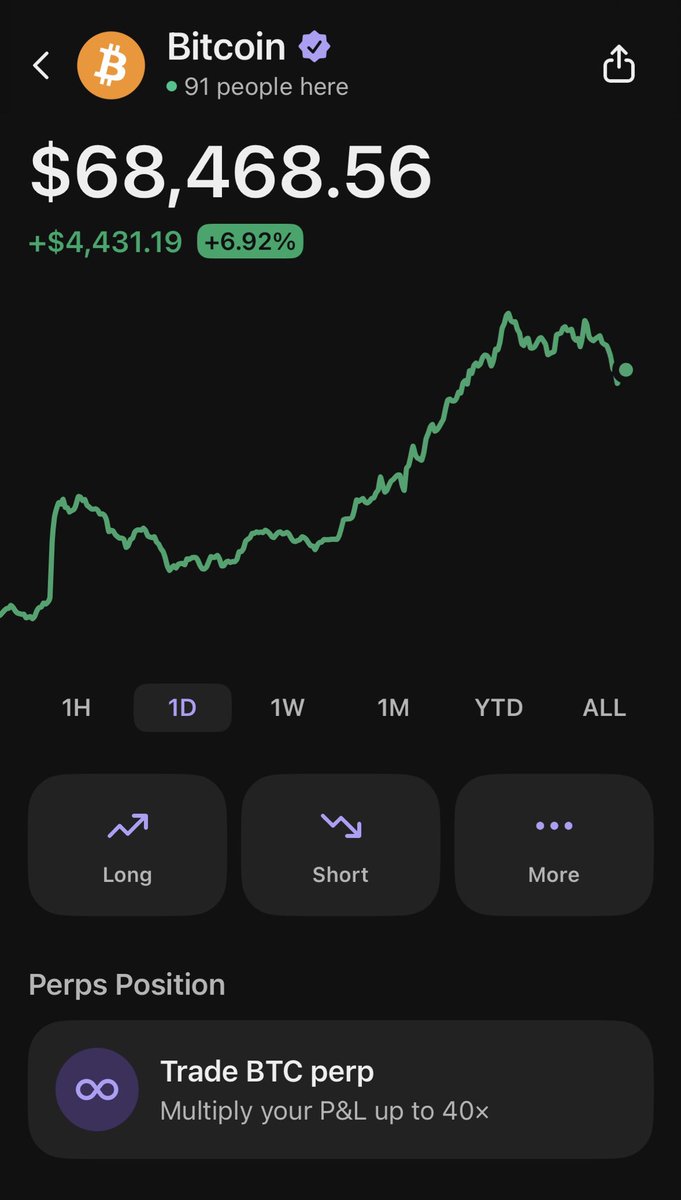
The prevalence of leverage trading in crypto is a byproduct of how hard it is to buy and sell spot native assets for the average user.
Don’t believe me? Search “Bitcoin” in @phantom wallet. The only options are Long & Short (“Trade BTC Perp”). This isn’t self-custodial, self-sovereign crypto. It’s paper Bitcoin. And it’s allowed various firms to profit at retail’s expense for too long now.
End perp reliance. Stop holding wrapped, bridged equivalents. Improve native trading capabilities in wallets. Buy and hold spot. Don’t let the sharks take your Bitcoin.
We’re building @Harbor_DEX for the next chapter.
8
1
27
1,991
Jan 30
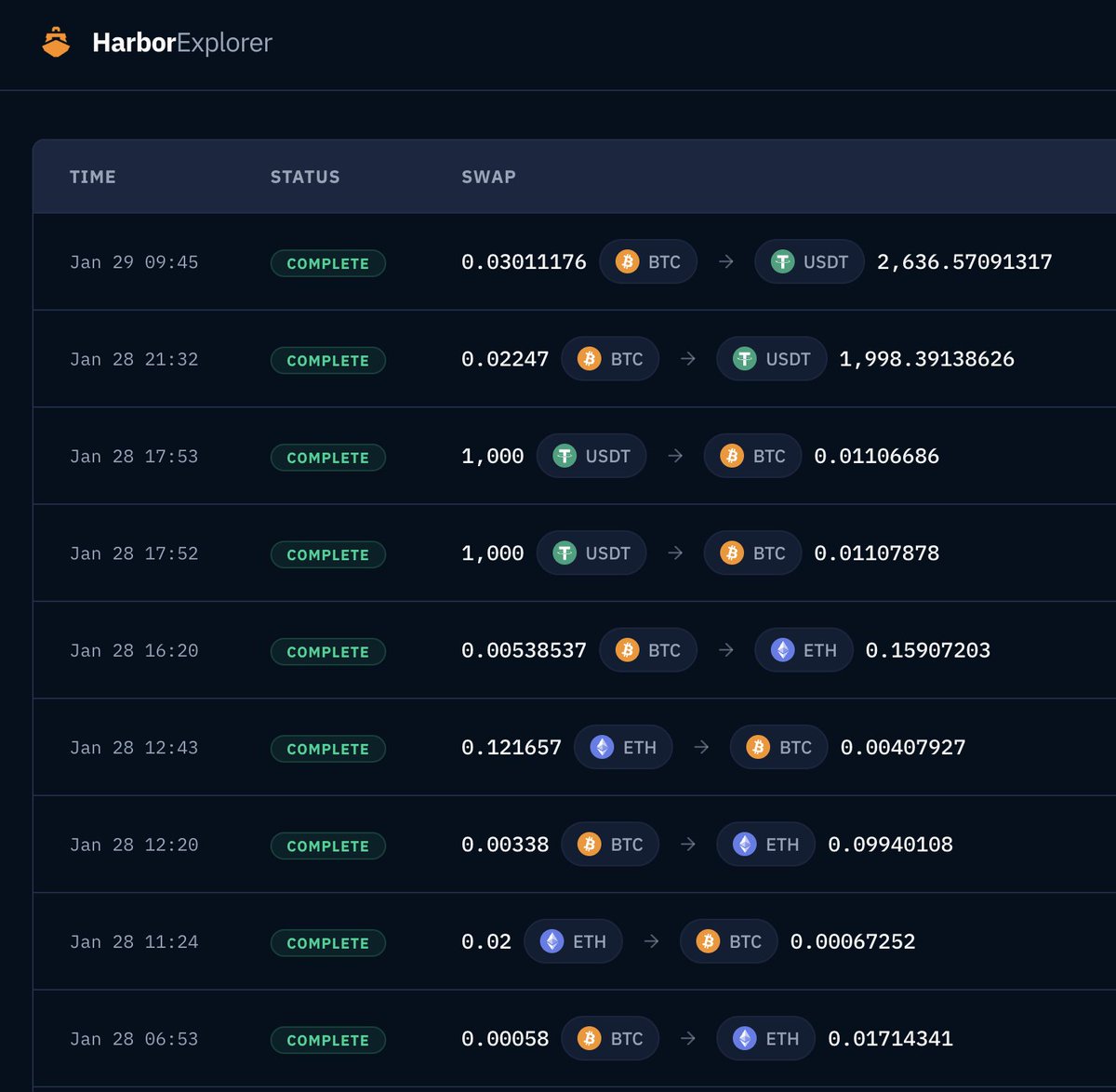
We just had a $4.1k BTC<>USDT swap via @THORSwap on @Harbor_DEX. If you take into account Binance’s 10 bps taker fee, the swap was 2 bps cheaper than Binance! We’ll post our explorer soon that transparently surfaces quote, execution and comparable oracle/CEX pricing.
Jan 29

Slowly and deliberately, @Harbor_DEX is increasing its max swap size, validating execution quality at each milestone before moving up.
$5k swap next week?
5
3
44
3,549
Pluto 🚢 retweeted

Jan 29
Slowly and deliberately, @Harbor_DEX is increasing its max swap size, validating execution quality at each milestone before moving up.
$5k swap next week?
5
21
10,011
Pluto 🚢 retweeted

23 Dec 2025
1/ Why We Backed Harbor 🧵
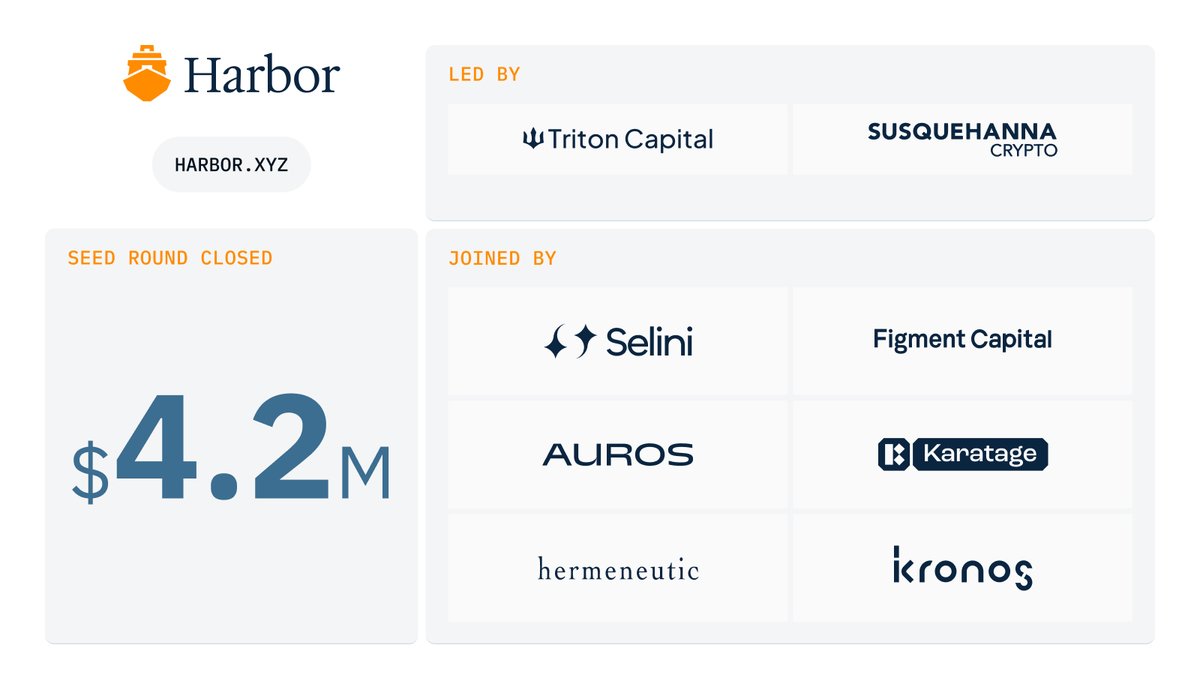
I’m excited to share that Triton Capital (@Triton_xyz) has co-led Harbor’s (@Harbor_DEX) pre-seed round alongside Susquehanna Crypto! 🧜♀️
This investment is a no-brainer for me: it’s the rare combo of an exceptional founding team with deep founder-market fit AND a massive market opportunity in the next era of high-performance DeFi.
@ovedm606 @pluto_hbr
🧵👇
12
2
38
1,988

17 Dec 2025
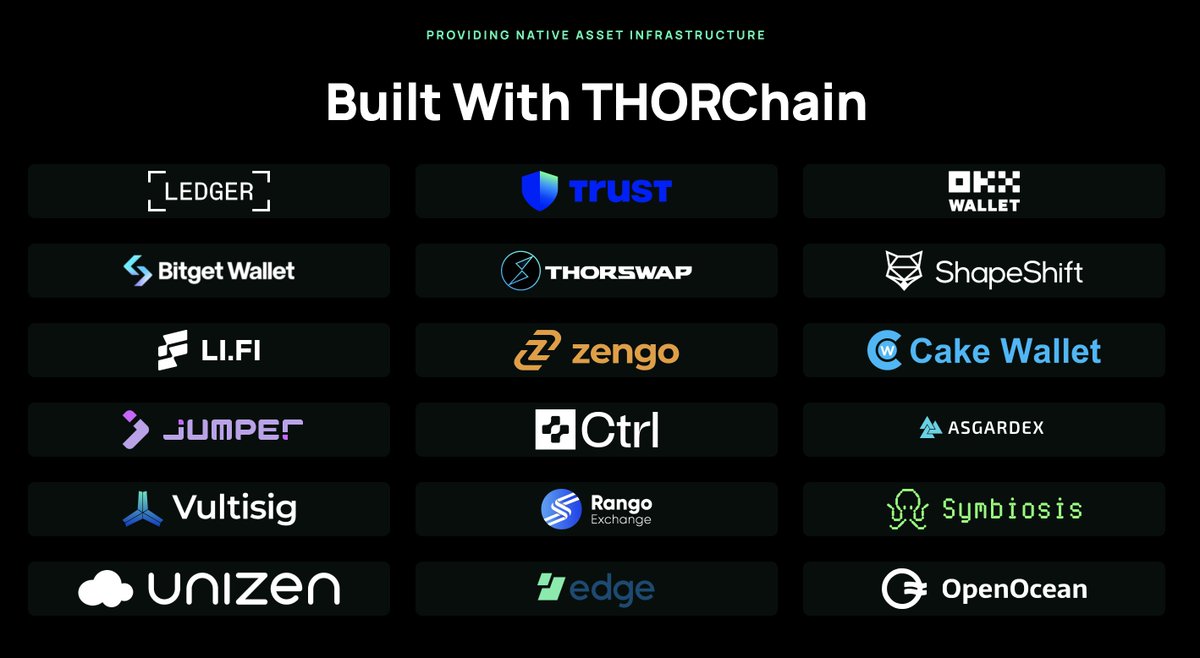
Harbor founding eng @eridanus_dev led the charge for business development at THORChain, then @SwapKitPowered came in and secured the bag. Once again, we're all working together to push forward the vision. These, and the wallets that enabled it, are the real heroes of cross-chain.

5
2
40
3,373
16 Dec 2025
Incredibly grateful to be working alongside my co-founder, @ovedm606, on our bold mission. In June, we closed $4.2m in funding from top investors. It wouldn’t have been possible without his help. Michael is the secret weapon that will bring our incredible tech to the mainstream.
16 Dec 2025

3
1
50
3,773
Pluto 🚢 retweeted

11 Dec 2025
I’m excited to share that I am one of the founding engineers of @Harbor_DEX. Working with this team to reach this point has been incredible, and I’m fired up about everything we’re building toward. Before I get back to building, I want to share how I think about Harbor’s current work, longer-term vision, and why it’s important.
We built Harbor to serve the cross-chain swapping market, a space that often gives users a bad deal. Cross-chain swaps are:
- often slow (10-40 minutes sometimes for BTC swaps)
- price insensitive (slippage tolerances up to 300 bps): gives plenty of room for poor execution
- opaque in terms of quoting and execution: hard to know what is happening behind the scenes
These factors, coupled with the growing ubiquity of cross-chain aggregators, put liquidity providers in a classic race to the bottom to win volume. However, once the volume is won liquidity networks face little obligation to execute at their quoted price. With wide slippage tolerances available there is the incentive and opportunity for liquidity networks to “quote high, execute low”.
While we can’t fix the slow BTC block times, we can provide more transparency and better execution for cross-chain swappers. On Harbor, the network attempts to execute your swap at exactly the price you were quoted. If the market has moved, the network will slowly move your order towards your slippage tolerance, creating a mini dutch auction among Market Makers for each swap. Competition in this sense will yield the best possible execution for users.
Our current work centers on improving the cross-chain swapping space, but our larger mission at Harbor is to narrow the gap between CeFi and DeFi in liquidity, performance, and feature-set. As self-custodianship becomes more important, we aim to serve a secure and accessible backend that gives any private key access to transparent financial primitives.
I’m grateful to share a bit about what we’ve been working on and where we are heading, and I’m excited to engage more publicly with the community as we build toward this vision.
10 Dec 2025
Today, we are launching Harbor, a Layer 1 network with native asset vaults capable of custodying diverse assets, such as Bitcoin and its UTXO variants (Litecoin, Zcash), Ethereum and its respective L2s, Solana, and more. Harbor’s first application is a cross-chain order book, providing fast and efficient spot trading to service the burgeoning market of cross-chain swaps.
The network employs a dual-actor marketplace to ensure fair pricing and execution for cross-chain swaps. Existing solutions are susceptible to the flaws of solver-based designs, where an “all-or-nothing” approach incentivizes solvers to price quotes ever-higher in the hopes of earning business, but are free to execute wherever they please within a wallet’s price tolerance (usually 3%). Harbor solves this problem by having two separate entities that are naturally opposed to one another: the central limit order book (CLOB) and a smart order router.
The CLOB represents the interest of market makers: performant, programmatic trading APIs allow extremely tight pricing, usually within a single tick of the market’s best bid or ask, at meaningful size.
The smart order router represents the interests of swappers: placing limit orders at exactly the quoted amount, allowing market makers to compete to fill at that price, or regressing the order down the book until it fills or refunds due to price tolerance.
This design ensures that no single market maker is responsible for the execution quality of a swap. The swap is worked through the order book, ensuring the best possible pricing, utilizing liquidity provided by multiple makers, while preventing quotes higher than fillable orders.
We believe Harbor’s design— a hybrid DEX securing custody through threshold signature vaults and a decentralized validator set, paired with a high performance matching engine for speed and execution, along with the ability to support other purpose built “subnets” utilizing its vaults— positions Harbor as the best L1 design capable of delivering neutral, efficient, decentralized, native asset rails. Follow us for more details about our upcoming plans, intro blog post, whitepaper and more.
14
7
86
8,438
Pluto 🚢 retweeted

11 Dec 2025
Proud to be the frontend launch partner of @Harbor_DEX. Welcome to the cross-chain family! 🫡
Harbor's innovative cross-chain order book aims to provide fast and efficient non-custodial spot trading with greater transparency for accurate execution.
For now quotes will be capped conservatively at $200 for BTC/USDT and ETH/BTC pairs, ramping up in size and new routes as the protocol scales.
Watch this space for more updates 👀
10 Dec 2025
Today, we are launching Harbor, a Layer 1 network with native asset vaults capable of custodying diverse assets, such as Bitcoin and its UTXO variants (Litecoin, Zcash), Ethereum and its respective L2s, Solana, and more. Harbor’s first application is a cross-chain order book, providing fast and efficient spot trading to service the burgeoning market of cross-chain swaps.
The network employs a dual-actor marketplace to ensure fair pricing and execution for cross-chain swaps. Existing solutions are susceptible to the flaws of solver-based designs, where an “all-or-nothing” approach incentivizes solvers to price quotes ever-higher in the hopes of earning business, but are free to execute wherever they please within a wallet’s price tolerance (usually 3%). Harbor solves this problem by having two separate entities that are naturally opposed to one another: the central limit order book (CLOB) and a smart order router.
The CLOB represents the interest of market makers: performant, programmatic trading APIs allow extremely tight pricing, usually within a single tick of the market’s best bid or ask, at meaningful size.
The smart order router represents the interests of swappers: placing limit orders at exactly the quoted amount, allowing market makers to compete to fill at that price, or regressing the order down the book until it fills or refunds due to price tolerance.
This design ensures that no single market maker is responsible for the execution quality of a swap. The swap is worked through the order book, ensuring the best possible pricing, utilizing liquidity provided by multiple makers, while preventing quotes higher than fillable orders.
We believe Harbor’s design— a hybrid DEX securing custody through threshold signature vaults and a decentralized validator set, paired with a high performance matching engine for speed and execution, along with the ability to support other purpose built “subnets” utilizing its vaults— positions Harbor as the best L1 design capable of delivering neutral, efficient, decentralized, native asset rails. Follow us for more details about our upcoming plans, intro blog post, whitepaper and more.
1
10
42
5,713
Pluto 🚢 retweeted

10 Dec 2025
Today, we are launching Harbor, a Layer 1 network with native asset vaults capable of custodying diverse assets, such as Bitcoin and its UTXO variants (Litecoin, Zcash), Ethereum and its respective L2s, Solana, and more. Harbor’s first application is a cross-chain order book, providing fast and efficient spot trading to service the burgeoning market of cross-chain swaps.
The network employs a dual-actor marketplace to ensure fair pricing and execution for cross-chain swaps. Existing solutions are susceptible to the flaws of solver-based designs, where an “all-or-nothing” approach incentivizes solvers to price quotes ever-higher in the hopes of earning business, but are free to execute wherever they please within a wallet’s price tolerance (usually 3%). Harbor solves this problem by having two separate entities that are naturally opposed to one another: the central limit order book (CLOB) and a smart order router.
The CLOB represents the interest of market makers: performant, programmatic trading APIs allow extremely tight pricing, usually within a single tick of the market’s best bid or ask, at meaningful size.
The smart order router represents the interests of swappers: placing limit orders at exactly the quoted amount, allowing market makers to compete to fill at that price, or regressing the order down the book until it fills or refunds due to price tolerance.
This design ensures that no single market maker is responsible for the execution quality of a swap. The swap is worked through the order book, ensuring the best possible pricing, utilizing liquidity provided by multiple makers, while preventing quotes higher than fillable orders.
We believe Harbor’s design— a hybrid DEX securing custody through threshold signature vaults and a decentralized validator set, paired with a high performance matching engine for speed and execution, along with the ability to support other purpose built “subnets” utilizing its vaults— positions Harbor as the best L1 design capable of delivering neutral, efficient, decentralized, native asset rails. Follow us for more details about our upcoming plans, intro blog post, whitepaper and more.
27
13
100
39,109