Joined March 2008
- Tweets 35,791
- Following 2,206
- Followers 1,432
- Likes 3,921
1,036 Photos and videos
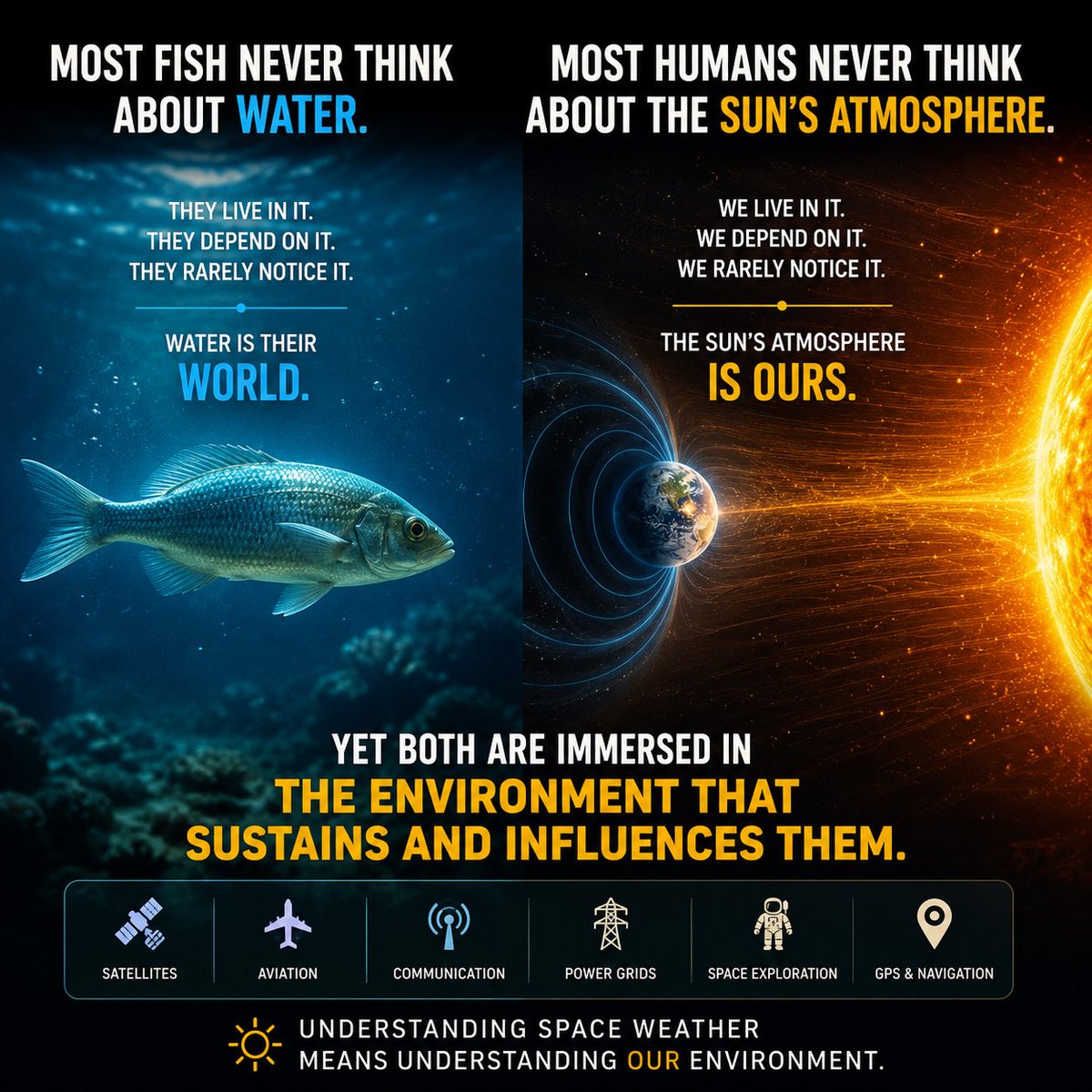




The Sun is part of humanity’s operating environment, and technological civilization must learn to manage the risks created by that fact.
Treat space weather the same way you treat terrestrial weather.

Most people are aware of the risk that: ⚠️
Earthquakes exist.
Hurricanes exist.
Floods exist.
Very few people note that:
Geomagnetic storms exist.
Radiation storms exist.
Ionospheric storms exist.
7
Most people are aware of the risk that: ⚠️
Earthquakes exist.
Hurricanes exist.
Floods exist.
Very few people note that:
Geomagnetic storms exist.
Radiation storms exist.
Ionospheric storms exist.
13
Humanity has unknowingly become dependent on a natural system it barely notices.
Society’s dependence grows faster than its resilience.
Vulnerability is increasing faster than understanding
As technology advances:
More satellites
More GPS dependence
More electrical interconnection
More automation
The number of vulnerable systems increases.
14
Vulnerability is increasing faster than understanding
As technology advances:
More satellites
More GPS dependence
More electrical interconnection
More automation
The number of vulnerable systems increases.
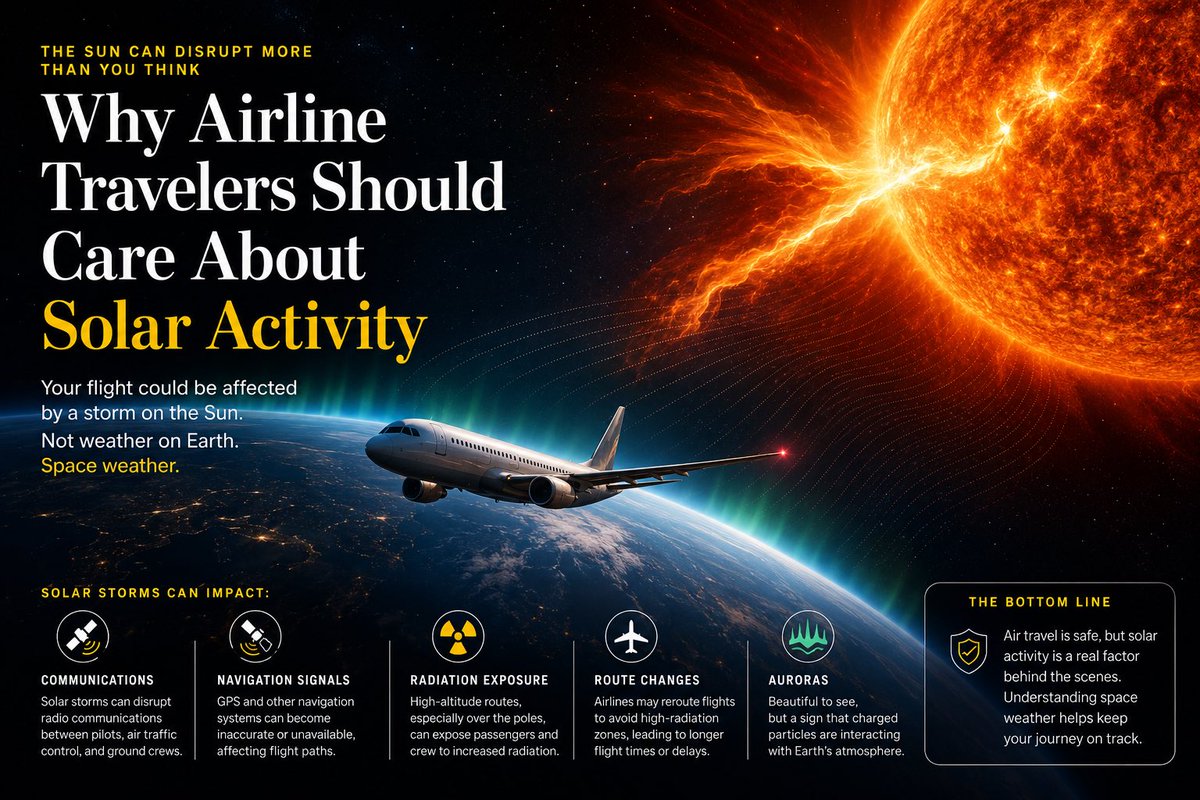
Space weather is not an astronomical curiosity; it is a practical environmental hazard for technological civilization.☀️
As civilization becomes more dependent on satellites, electricity, GPS, aviation, communications, and space infrastructure, society becomes increasingly vulnerable to disturbances originating on the Sun.🛰️📡
28
Space weather is not an astronomical curiosity; it is a practical environmental hazard for technological civilization.☀️
As civilization becomes more dependent on satellites, electricity, GPS, aviation, communications, and space infrastructure, society becomes increasingly vulnerable to disturbances originating on the Sun.🛰️📡
14
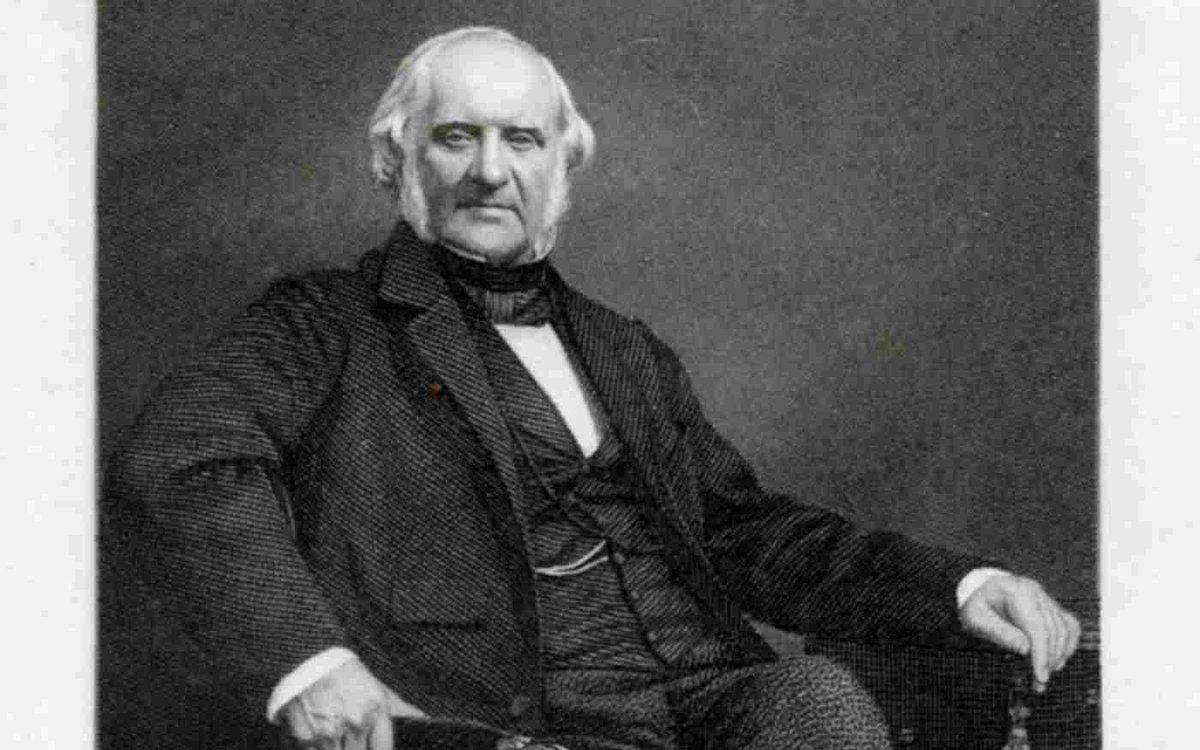
George Green is perhaps an even more extraordinary example of self-education than George Boole.
Unlike Boole, Green spent most of his early life working in his father’s windmill in Nottingham and received very little formal education.
Yet he produced work so profound that concepts such as Green’s theorem, Green’s functions, and Green’s identities bear his name today.
He was not merely absorbing knowledge; he was using knowledge as a tool to investigate questions that fascinated him.
He wrote extensively as part of learning. Many great self-taught mathematicians effectively use writing as a tool for understanding.
He read the best available works, then learned by trying to solve problems that the books did not yet solve.

In 1828, a lonely baker’s son locked himself inside the dusty top floor of a cold, remote windmill, quietly plotting an intellectual assault on the greatest mathematicians in Europe.
With only four quarters of schooling to his name, he spent his freezing nights under the flicker of a candle, single-handedly inventing a secret mathematical weapon that would eventually map the gravitational forces of the universe.
Yet today, almost no one outside of electrical engineering and applied mathematics even knows his name.
His name was George Green.
The story of how he broke through the absolute limits of mathematical physics is a masterclass in why rigid book smarts fail where deep, isolated intuition succeeds.
In the early 19th century, scientists were trying to map the invisible laws of electricity. But they had a crippling problem: calculating the electrical pull of a complex, unevenly shaped object was completely impossible.
The elite professors at Cambridge said the solution was simple: write a separate, massive formula for every new shape you encounter. It didn't work. The mathematical systems broke under their own complexity.
Green looked at the problem from his self-taught perspective and realized the establishment was blind. They were trying to conquer the whole system at once.
He figured out that an invisible field isn’t a single overwhelming monster; it is a collection of microscopic, predictable echoes.
He introduced a bizarre mathematical shortcut now known as Green’s Functions.
Instead of solving an impossible equation for a complex shape, he calculated how the system would react to a single, infinitely sharp point of energy, a mathematical pulse, and then used basic calculus to stitch those pulses together.
The establishment ignored his self-published paper for decades.
But when a young Lord Kelvin accidentally discovered a copy, the results were instant. The foundations of modern electrical engineering were born.
Green wasn't trying to win a university chair. He wanted to solve a real-world bottleneck. In the process, he gave humanity the tool used today to build the electrical grid and calculate quantum physics.
The lesson Green left behind is a philosophical blueprint for navigating a complex world:
The people who memorize the proper formulas are excellent at solving textbook problems. But they are entirely dependent on the rules staying the same.
The people who understand the underlying system don't care about the rules. They break a giant crisis into microscopic pieces to find what actually works.
Most of us approach our life's problems by trying to solve the massive, overwhelming chaos all at once. We try harder at an exhausting, broken method.
But sometimes, the problem isn't that you aren't trying hard enough. The problem is that you are staring at the terrifying size of the giant instead of breaking it down into a single, predictable point of impact.
What is an overwhelming crisis in your life right now that you keep trying to fix with standard, broad advice? What happens if you stop trying to follow the textbook formula and start looking for the single, smallest boundary where you can actually make a clean hit?
11
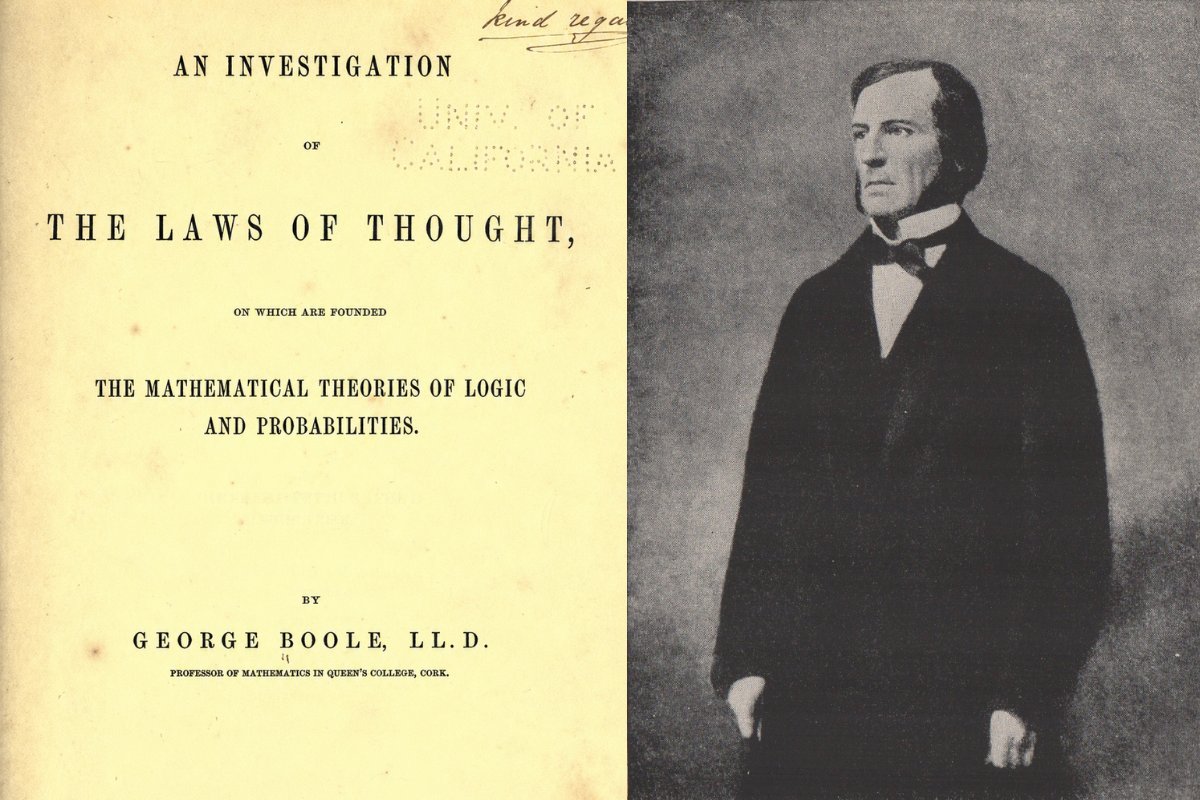
George Boole was almost entirely self-taught after elementary school and his methods are remarkably relevant today.
It closely resembles the approach later used by many famous autodidacts, including Michael Faraday and Srinivasa Ramanujan:
deep engagement with original sources, relentless reconstruction of missing knowledge,
and learning driven by curiosity rather than formal instruction.
Jun 10

A self-taught Irish schoolteacher wrote a book in 1854 that almost nobody read for 80 years, until a 21-year-old MIT student picked it up and realized it could be used to design every computer in human history.
His name was George Boole. The book is called An Investigation of the Laws of Thought.
Boole was born in 1815 in Lincoln, England. His family was poor. He left school at 16 to support them. He taught himself Latin, Greek, French, German, and Italian.
Then he taught himself mathematics. By 19 he had opened his own school. By 24 he was publishing original papers in the Cambridge Mathematical Journal, competing with men who had spent decades inside the best universities in Britain.
He never had a degree. He never had a mentor. In 1849, Queen's College in Cork hired him as a professor anyway.
In 1854, he published his masterwork. What he built inside it was something nobody had attempted before at this scale. He turned logic into algebra.
Before Boole, logic was philosophy. You argued in sentences. You reasoned in paragraphs. It was powerful and completely impossible to automate, because there was no formal system underneath it, just language.
Boole stripped it down to arithmetic. He showed that every act of human reasoning could be reduced to operations on two values. True or false. One or zero. AND, OR, NOT. If both conditions are true, the result is true. If neither is, the result is false. Every judgment a human mind makes, every decision, every deduction, could be written as an equation following those rules.
Logicians read it. They found it interesting. Engineers building machines had never heard of it.
For 83 years, the book sat there.
Then in 1937, a 21-year-old MIT master's student named Claude Shannon was working on a thesis about electrical relay circuits. Switches that could be open or closed. Current that either flowed or didn't.
He read Boole and understood something nobody had connected before.
An open switch is a zero. A closed switch is a one. A circuit with two switches in series only carries current when both are closed. That is AND. A circuit with two switches in parallel carries current when either is closed. That is OR. Shannon proved that every possible logical relationship Boole had described could be physically built using wire and switches.
That single insight is the foundation of every computer ever made.
After Shannon, chip designers stopped thinking about electricity and started thinking about logic. Every transistor on every processor running right now is implementing a Boolean operation. Every if-statement in every codebase is Boolean logic. Every database query using AND or OR. Every neural network threshold that fires or doesn't fire. All of it is running the algebra of a self-taught schoolteacher from Lincoln who died 160 years ago.
The strangest part is what happened to Boole at the end.
He was walking to class in November 1864 when he got caught in a rainstorm. He lectured for hours in wet clothes. He went home sick. His wife, Mary, believed in homeopathic medicine and thought the cure should mirror the cause. She wrapped him in wet sheets and poured cold water over him repeatedly.
He died a few days later. He was 49.
He never saw a transistor. He never saw a circuit. He never saw a single physical machine run a single one of his rules.
His book is in the public domain. Free to download. Most engineers use the word Boolean dozens of times a week. Almost none of them know who they are saying.
The man whose logic runs inside every phone, every server, and every AI model on Earth died soaking wet in a small Irish town, 83 years before anyone figured out what he had actually built.
10
Whenever you observe a phenomenon near Earth, look for the larger energy system that produced it. 🌍⚡️
Aurora?
→ Look to the magnetosphere.
Geomagnetic storm?
→ Look to the solar wind.
Satellite anomaly?
→ Look to solar activity.
Radio blackout?
→ Look to solar emissions.
The habit to apply is systems thinking.
14
In a sense, space weather is currently where meteorology was around the early twentieth century: the fundamental physics is largely known, but the ability to forecast extreme events remains much less mature than the underlying theory. ☀️☁️⛅️🌨️🌩️🌤️🌦️⛈️
8
The view Solar wind → Magnetosphere → Response is too deterministic.
Real systems are nonlinear.
Small changes can produce very different outcomes.
Space-weather forecasting
“If we understand the physics, we should be able to predict storms.”
Reality is more complicated:
CME arrival times have uncertainty.
Geomagnetic storm strength is difficult to predict.
IMF orientation remains hard to forecast.
16
Space-weather forecasting
“If we understand the physics, we should be able to predict storms.”
Reality is more complicated:
CME arrival times have uncertainty.
Geomagnetic storm strength is difficult to predict.
IMF orientation remains hard to forecast.
22
Magnetic Reconnection
If you understand only one mechanism, understand this one.
Solar flares
CME initiation
Magnetospheric storms
Substorms
Auroras
Many experts would argue reconnection is the single most important process in space physics.
Many people miss this.
The magnetosphere is not merely protection; it is a dynamic energy-processing system.
23
Many people miss this.
The magnetosphere is not merely protection; it is a dynamic energy-processing system.
26
Common belief
“If the technology works, adoption will follow.”
Reality:
“If adoption fails, the technology may not be the problem at all.” 😉
12
The most counterintuitive idea is:
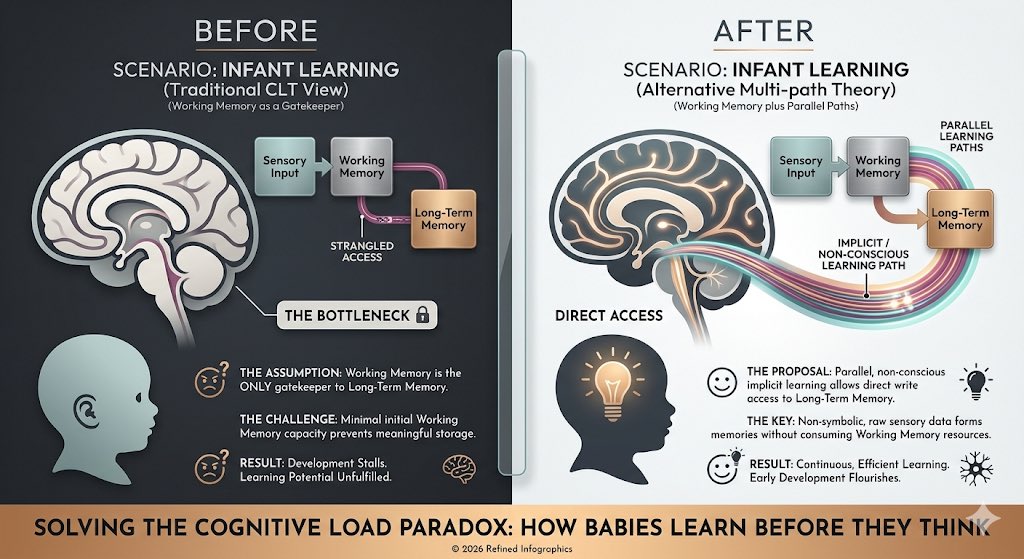
Learning is not primarily an information problem.
Most people assume that if information becomes cheaper, faster, and more available, learning naturally improves.
The scientists disagree.
They argue that learning depends heavily on:
social interaction
attention
motivation
emotional engagement
relationships
active participation
not merely exposure to content.💃🕺👯
5
Why Do Humans Learn So Efficiently? 🤓
A child:
learns from relatively little data
generalizes rapidly
develops common sense
transfers knowledge between domains 👶
An LLM:
consumes trillions of tokens
requires enormous computation
still makes bizarre mistakes 🙁
5
How much of human cognition comes from interacting with structured information versus being human? 🤖🫀🧬
4
Every distributed system is an attempt to maintain a shared understanding of reality among machines that can fail, disagree, and communicate imperfectly.
Distributed systems are fundamentally about choosing which failures you are willing to tolerate. Martin Kleppmann
Yet many developers still implicitly believe:
If I choose the right technology stack, scalability and reliability will emerge naturally. 🔥🙈
12
In many companies:
databases survive decades
applications are rewritten repeatedly
The long-term asset is the data.
Therefore:
schema evolution matters
backward compatibility matters
migrations matter
much more than people realize.
Most software failures are not caused by algorithms, programming languages, or frameworks.
They are caused by incorrect assumptions about data.👩💻👨💻
15
Distributed systems are fundamentally about choosing which failures you are willing to tolerate. Martin Kleppmann
Yet many developers still implicitly believe:
If I choose the right technology stack, scalability and reliability will emerge naturally. 🔥🙈
19