Joined July 2025
- Tweets 6,949
- Following 1,547
- Followers 3,882
- Likes 28,572
332 Photos and videos
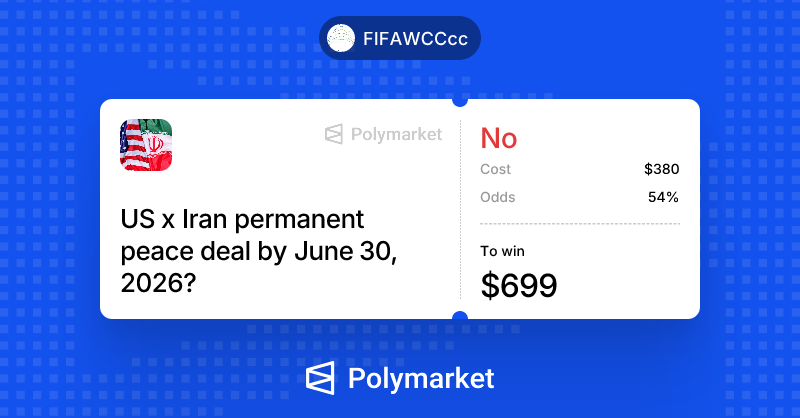
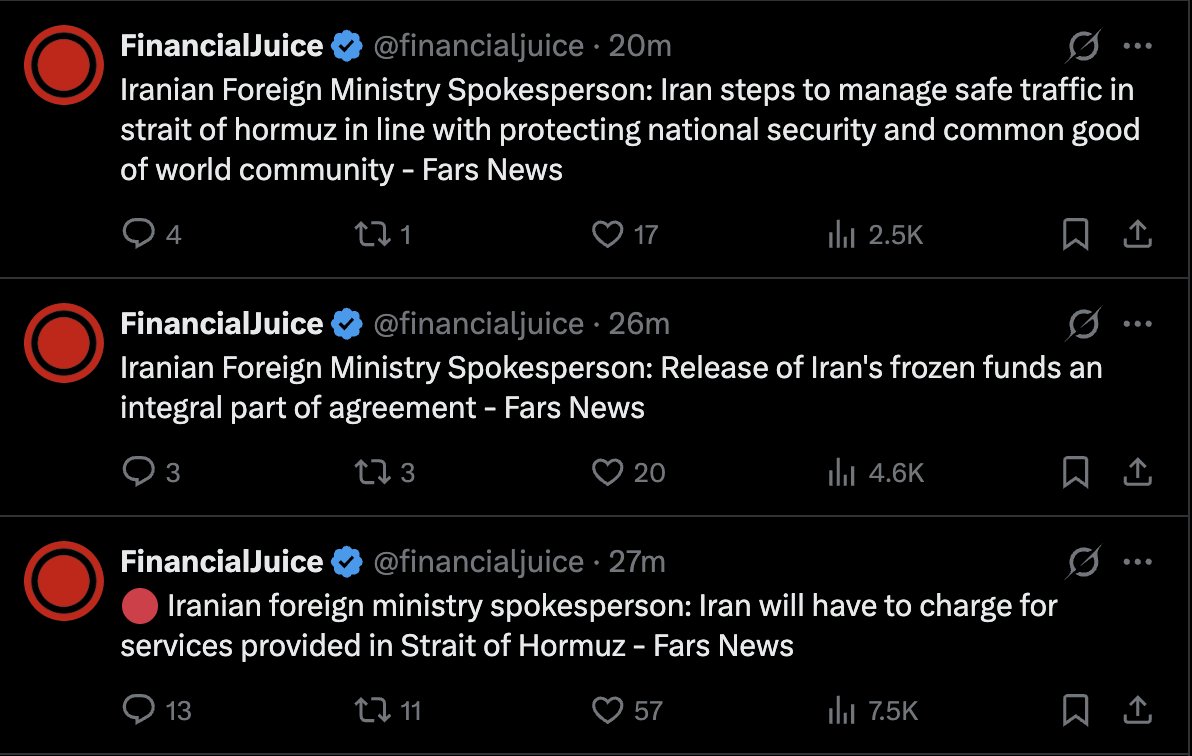
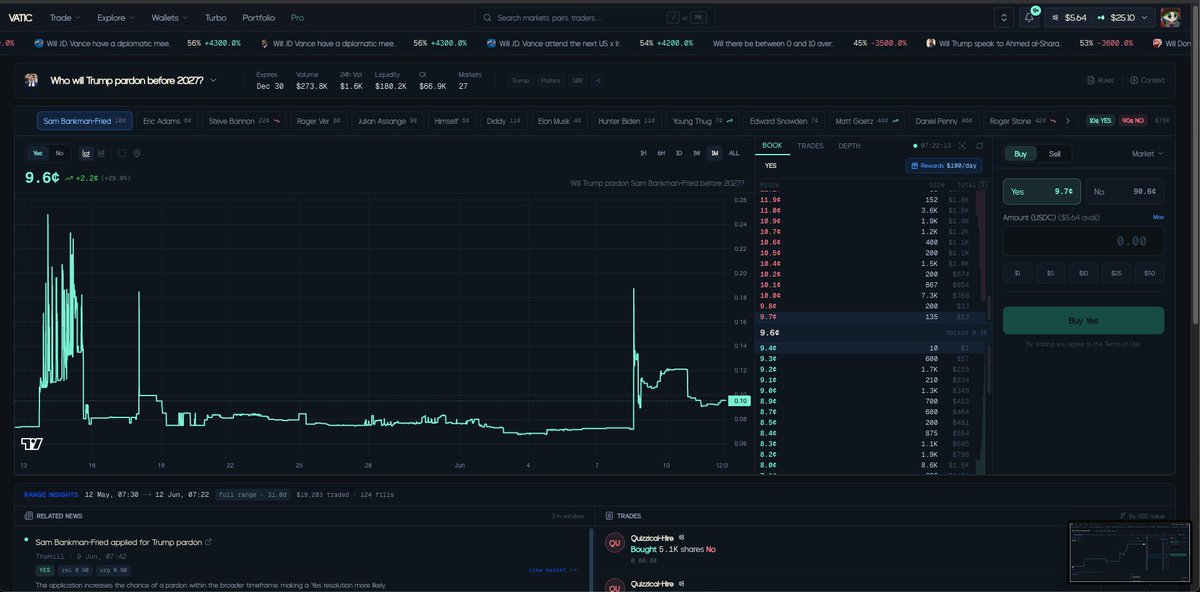
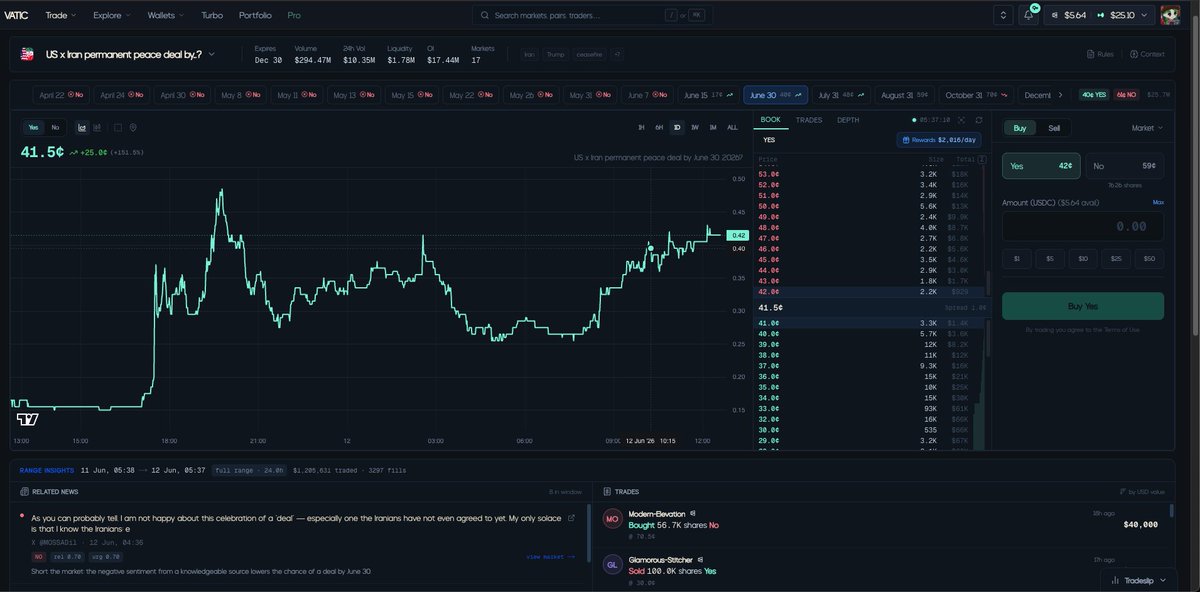

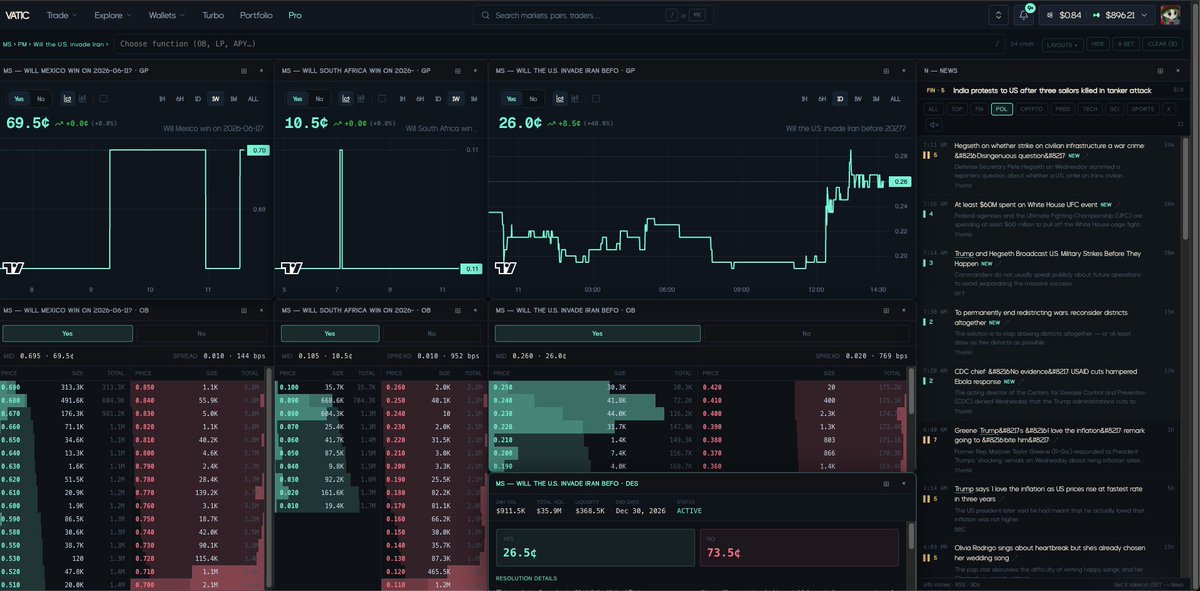
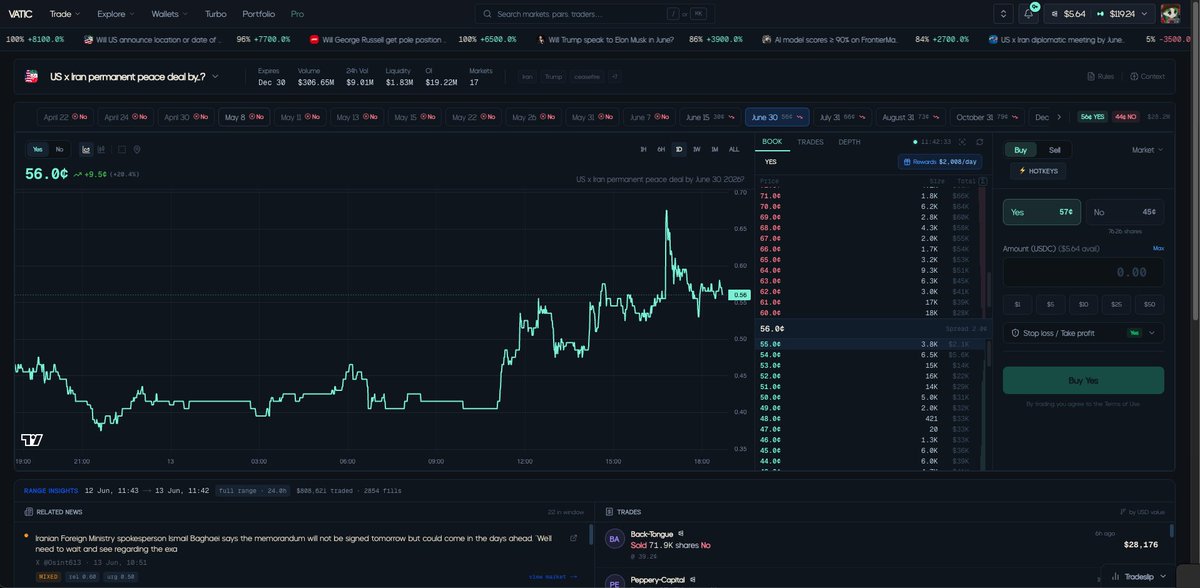
I opened a small NO position on “US x Iran permanent peace deal by June 30” at ~54c.
The reason is simple: the market seems to be trading the headline probability of a deal being announced, but the resolution criteria require something much stricter.
For this to resolve YES, we need either:
> a written agreement formally adopted by both the US and Iran, explicitly ending military hostilities on a lasting basis, or
> clear public confirmation from both governments that such a permanent agreement has been reached.
Negotiations, “progress,” temporary extensions, or vague diplomatic statements do not count.
The last 12 hours made the setup look very fragile.
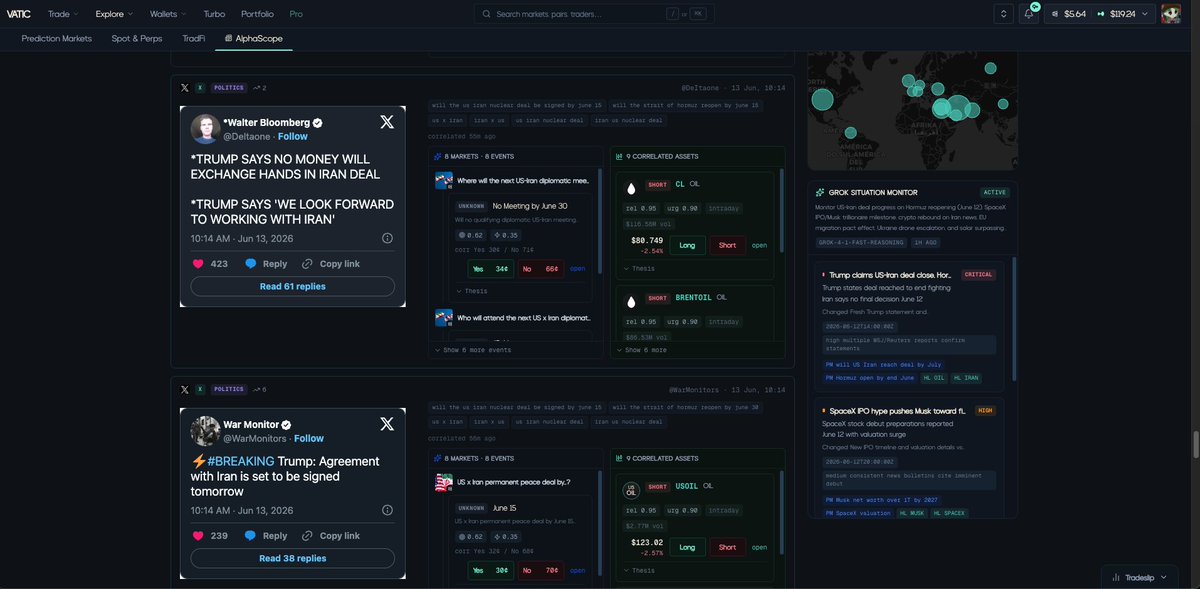
> Pakistan’s PM said an agreement could be signed within 24 hours, but Iran later pushed back, saying the Islamabad memorandum would not be signed tomorrow and may only happen in the coming days.
> More importantly, Iran also said the nuclear issue is out of discussion, while Trump is talking about taking control of / destroying Iranian nuclear material and opening Hormuz immediately after signing.
At the same time, Israel is still striking South Lebanon, with dozens of targets hit in the last 24h. If Hezbollah / Lebanon remains outside the arrangement, that is another obvious pressure point for Iran.
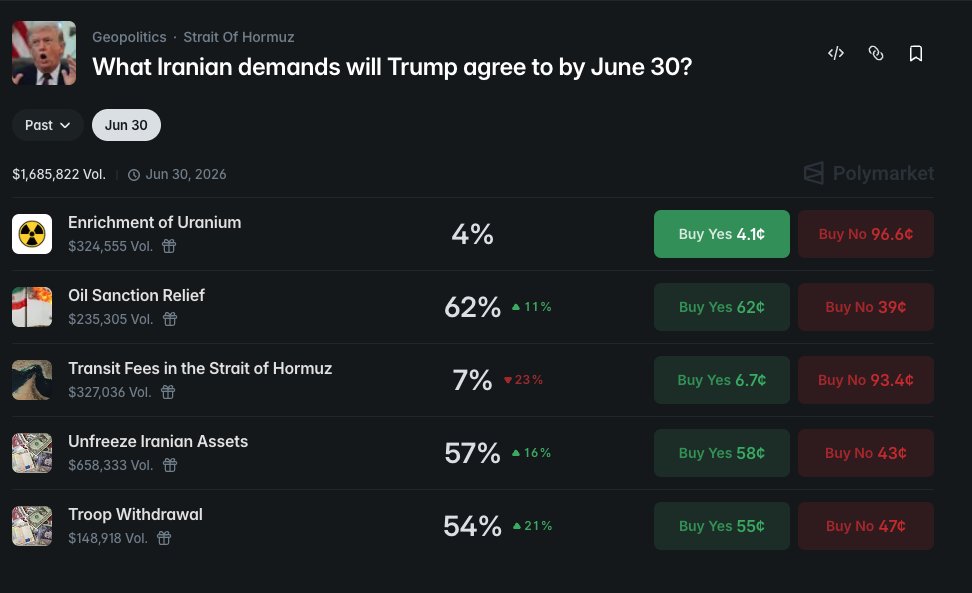
Then you also have unresolved demand markets showing uncertainty around what Trump will actually accept: oil sanctions relief, asset unfreezing, troop withdrawal, uranium enrichment, Hormuz fees, etc.
So my thesis is:
- There may be a signing ceremony.
- There may be a memorandum.
- There may be positive diplomatic headlines.
- But a qualifying “permanent peace deal” under the market rules is a much higher bar.
Between Hormuz, uranium stockpiles, sanctions relief, Israeli operations in Lebanon, and the lack of clear alignment between US and Iranian statements, I think the probability of this resolving YES is being overstated.
Small NO position here.
7
1
36
580

Jun 12
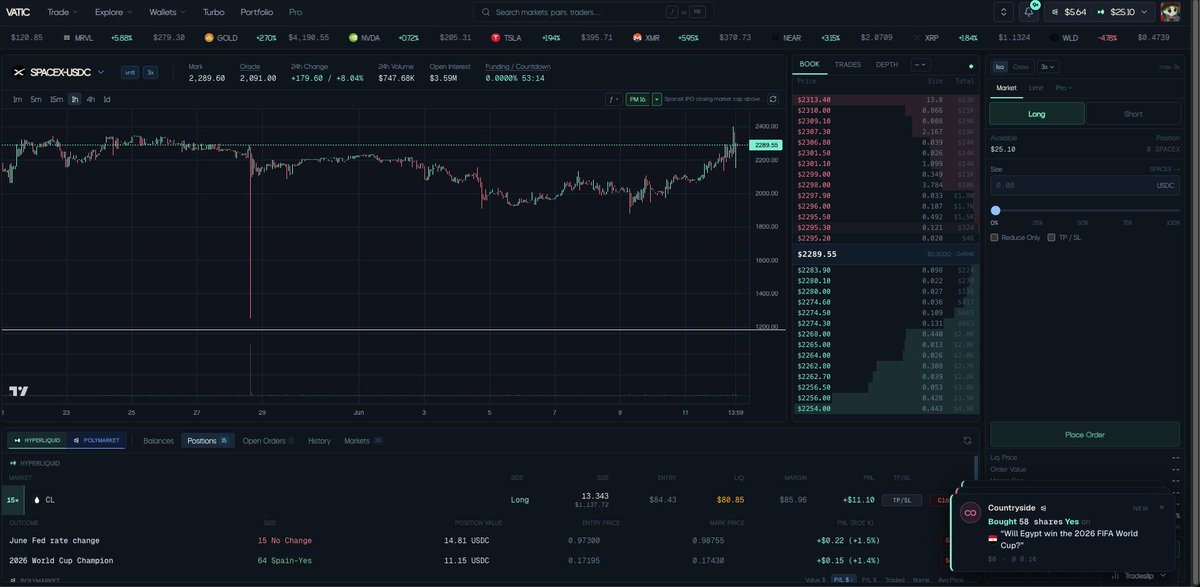
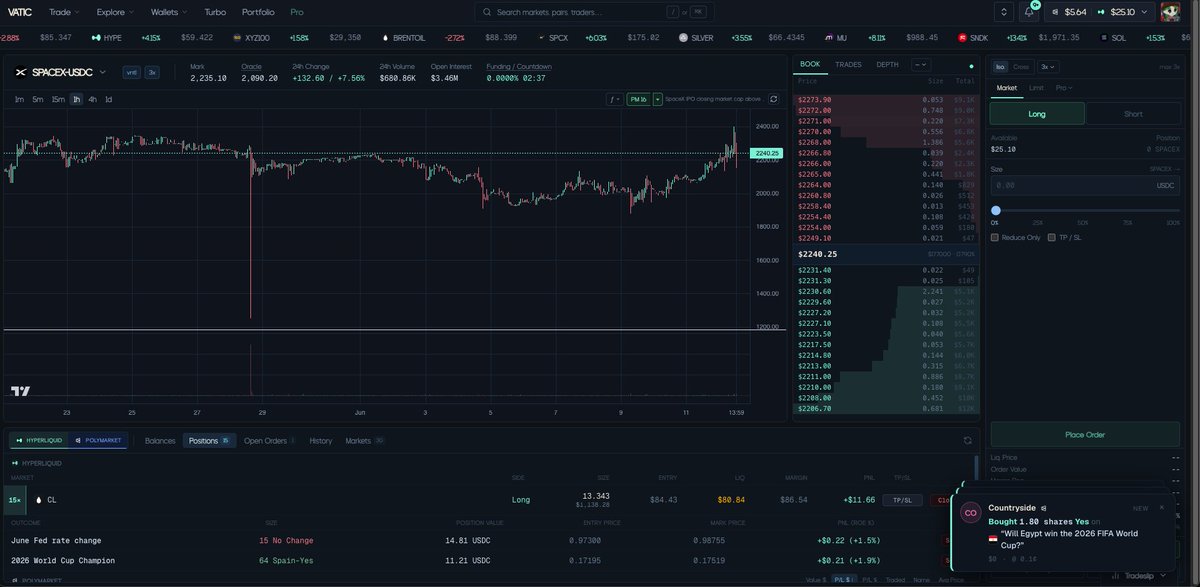
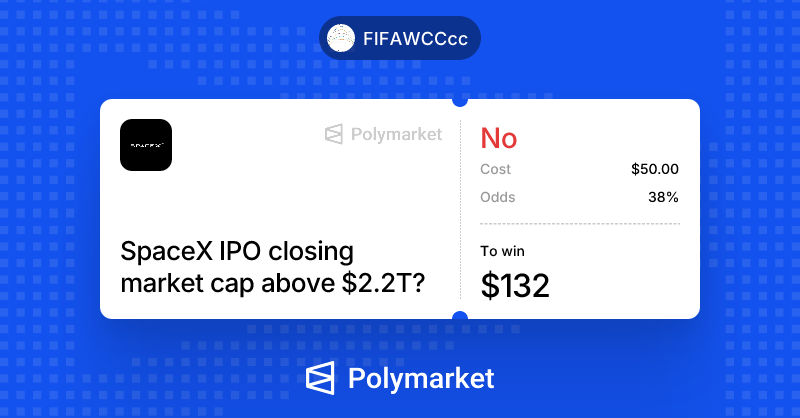
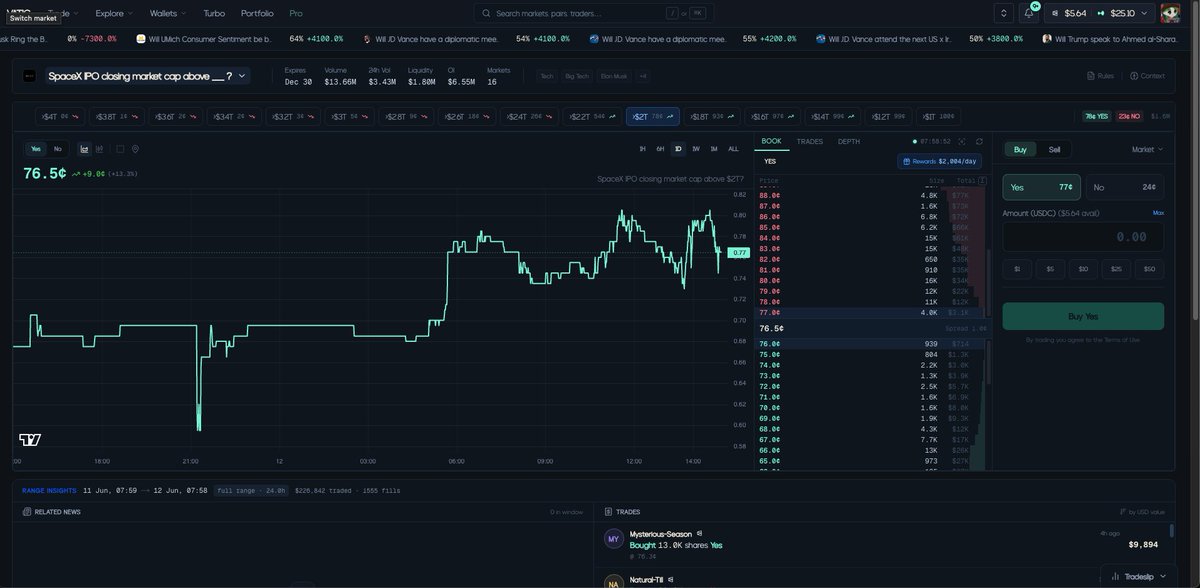
Everyone is focused on Elon becoming the first official trillionaire, but the more interesting live trade right now is SpaceX closing above $2.2T.
That strike is basically the last unresolved battleground.
SPCX ripped into the $2.2T valuation zone earlier, but the initial IPO mania looks like it’s cooling off into the close.
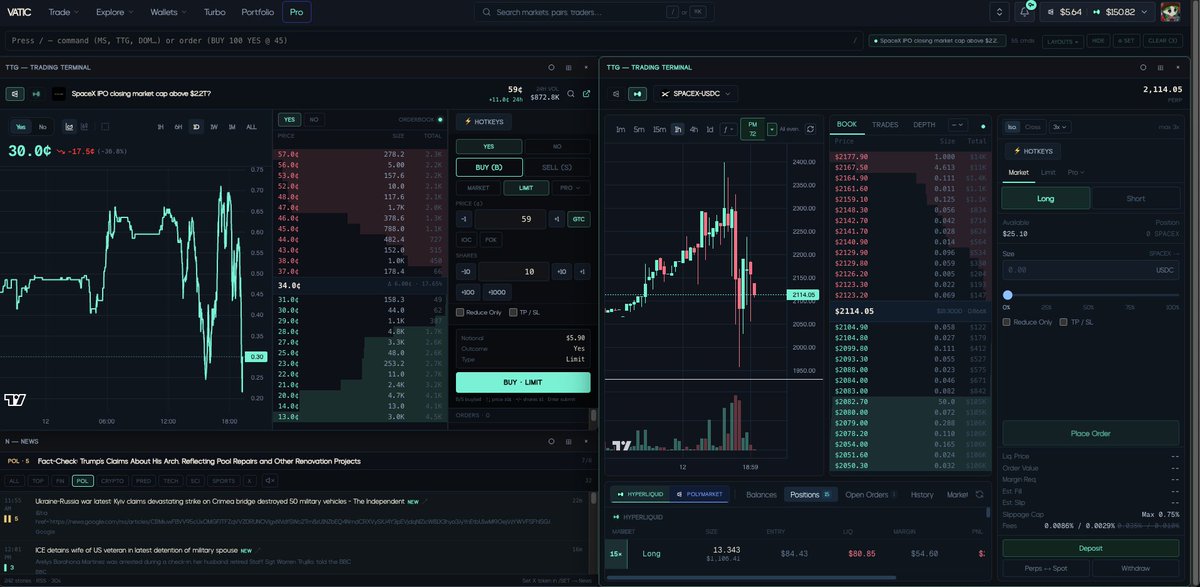
The Polymarket YES is still swinging around 40–60c, while the synthetic pre-IPO market is implying roughly a $2.1T valuation here.
Opened a small NO position on the $2.2T close. My bet is simple: SpaceX already got the euphoric IPO print, but holding a $2.2T valuation into the bell requires that momentum to survive the full session.
4
29
509
Jun 12
What’s interesting here is not just “crypto predicted the IPO.” It’s way more specific than that.
> Hyperliquid gave traders a live implied SPCX price before the stock fully opened.
> Polymarket gave traders a set of unresolved probabilities around where SpaceX would close.
Together, they created a pre-open event tape for one of the biggest IPOs in history.
Event contracts perp futures are becoming a financial primitive for pricing anything before the official market has a clean venue for it. Outside of stablecoins, this might be crypto’s clearest path to systemic adoption.
Jun 12

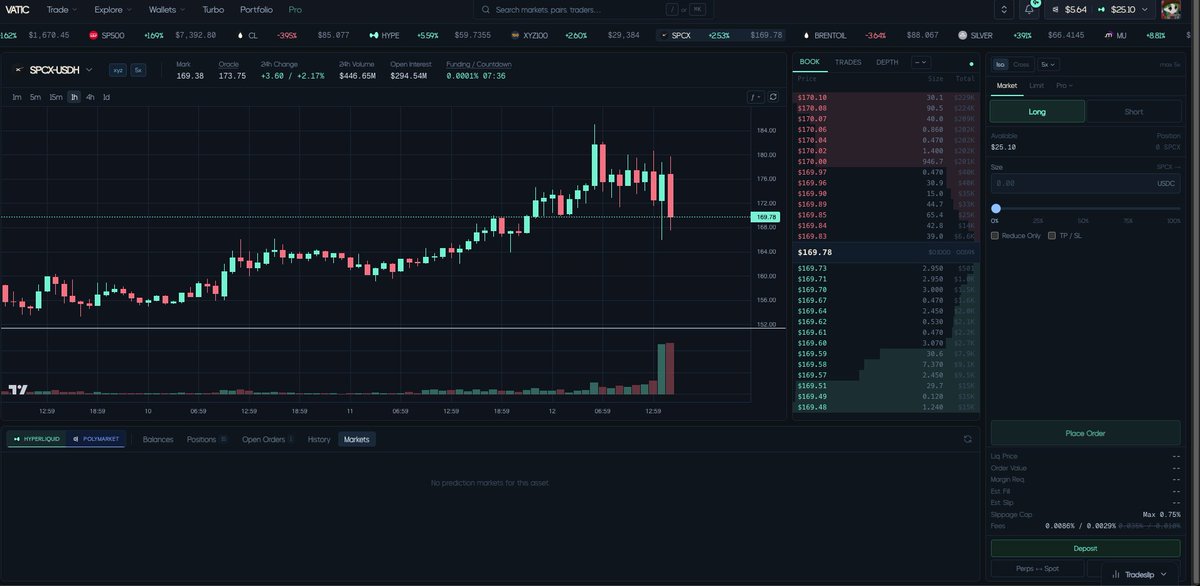
SpaceX IPO price discovery didn’t start on Nasdaq.
SPCX perps on Hyperliquid were already pricing the first-day pop hours before the stock opened.
On Vatic, you could watch the perp event contract IPO markets side by side.
TradFi event. Crypto rails. Prediction markets as the live tape.
6
39
1,855
Jun 11
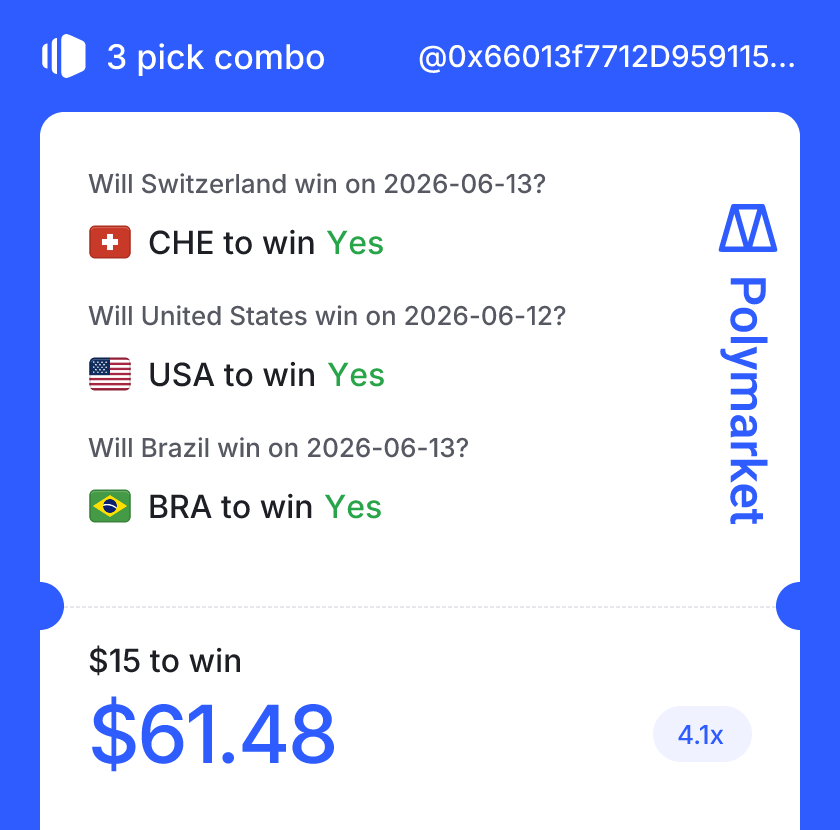
Just placed a 3-leg combo position on polymarket.
I have to admit the process felt seamless and intuitive, which means that the rfq mechanism works perfectly behind the scenes
Now about the bets, i think usa will have the advantage as the organizer of the tournament, switzerland will have an easy time against Qatar, and Brazil has the talent to make a good starting game.
21
40
1,683
Jun 11
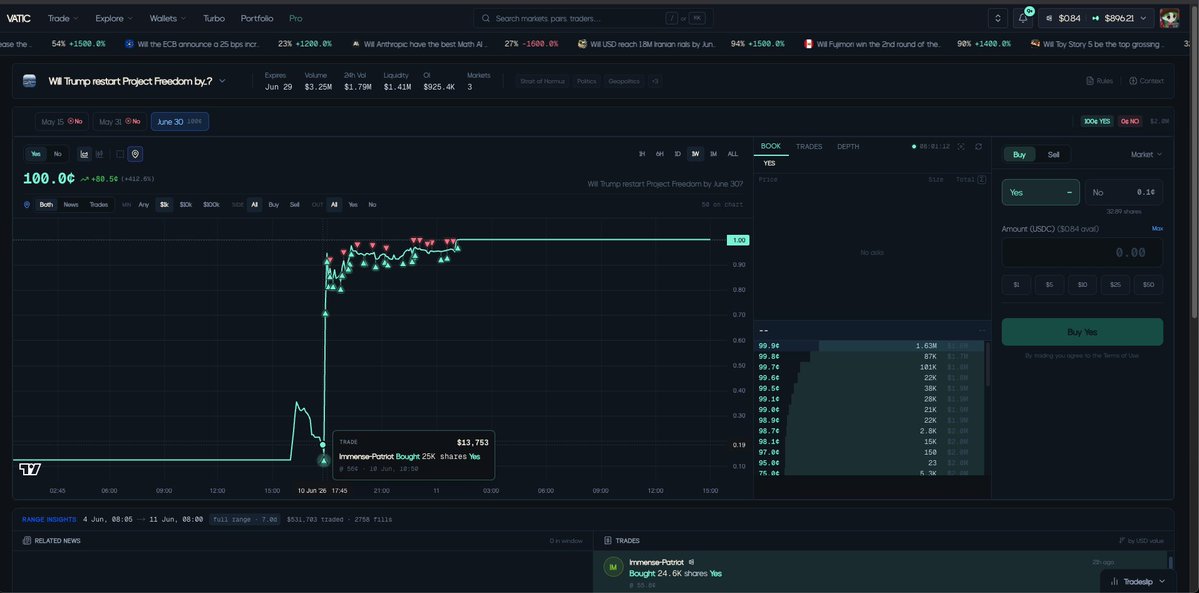
The “Will Trump restart Project Freedom by June 30?” market has turned into one of the more interesting resolution debates on Polymarket lately.
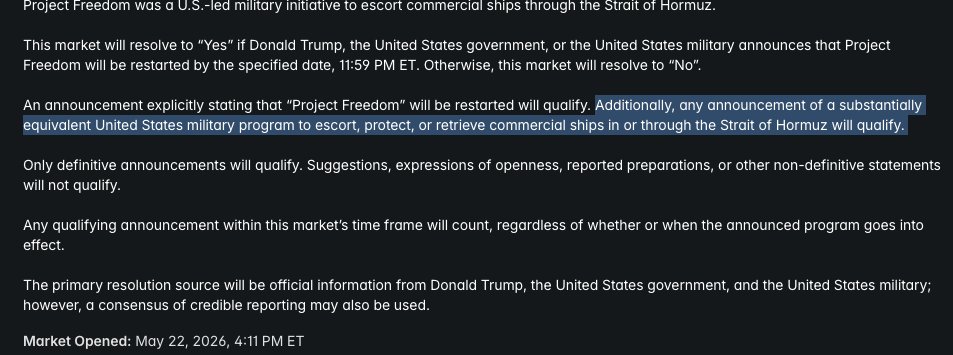
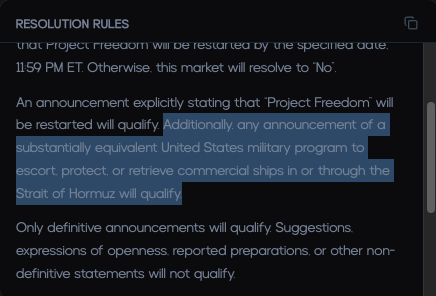
According to the rules, the market resolves YES if:
> Trump explicitly announces that “Project Freedom” has been restarted
or
> an announcement is made regarding a substantially equivalent U.S. military program to escort, protect, or retrieve commercial ships in or through the Strait of Hormuz.
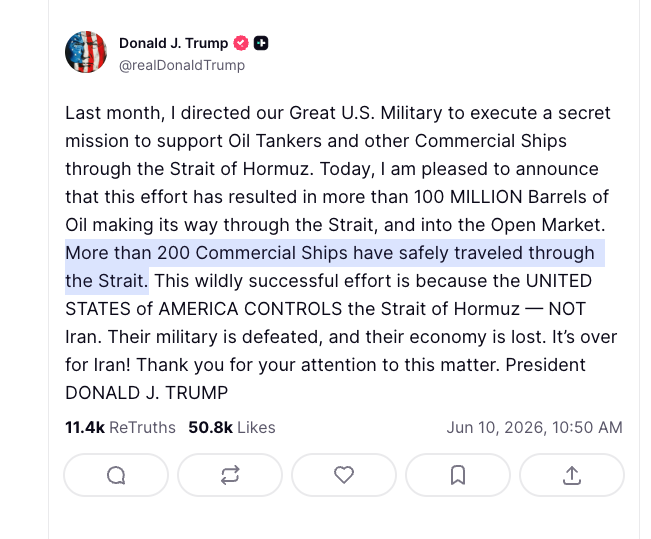
Yesterday, Trump posted the following on Truth Social:
“Last month, I directed our Great U.S. Military to execute a secret mission to support Oil Tankers and other Commercial Ships through the Strait of Hormuz.”
and later stated that:
“More than 200 Commercial Ships have safely traveled through the Strait.”
Does this explicitly state that Project Freedom has been restarted?
Not directly.
However, it does describe a previously undisclosed U.S. military operation whose purpose appears to be protecting and supporting commercial shipping through the Strait of Hormuz, which is exactly why the market immediately repriced toward YES.
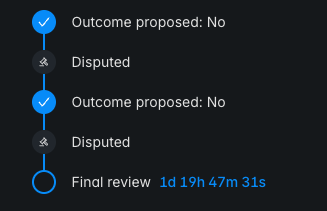
The market was proposed for approval twice, disputed twice, and is now in final review.
To me, this whole situation reinforces two things:
> deeply reading and understanding market rules is still one of the highest EV activities on Polymarket, especially in political markets
> having access to low-latency news, tweet and Truth Social aggregators remains a massive edge
A good example of the latter is wallet:
0x9592aDB70397E9DE67BA9aBE6971E3f50fb7a7B8
which managed to accumulate roughly 24.6k YES shares around the 50-56c range moments before the market skyrocketed to 90c .
Fast-clicking still works on Polymarket.
You just need to find the right setup.
5
22
411
Jun 10
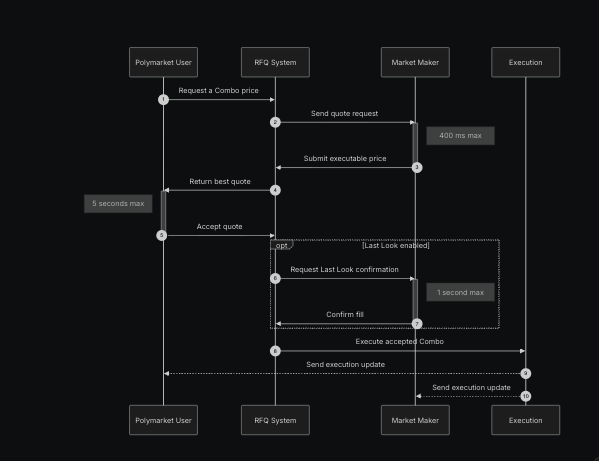
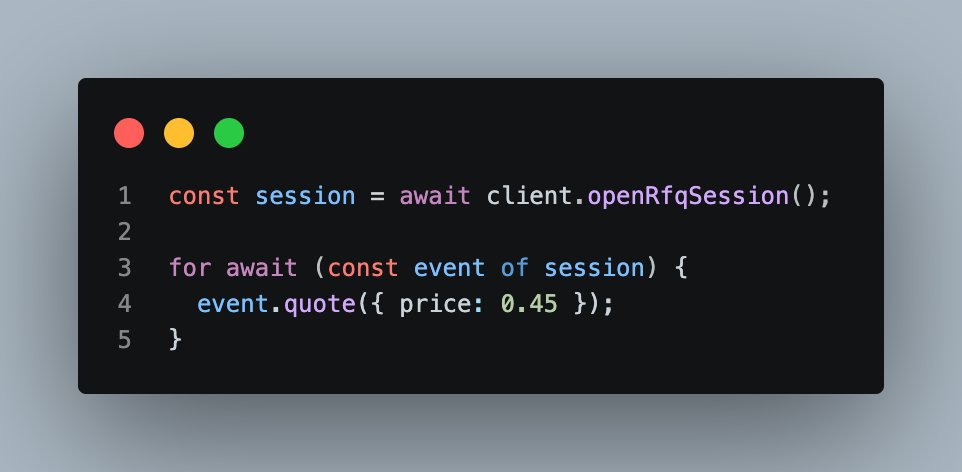
Polymarket launched Combos, a new primitive that allows traders to bundle multiple prediction market outcomes into a single position. Instead of manually building exposure across several markets, users can request a quote for the entire package and receive a price from market makers through an RFQ auction.
The process briefly:
- user submits request for combo
- rfq sends it to market makers
- market makers participate in an auction to get the best quote
- user accepts or denies the quote
The interesting part is that these positions are not limited to a single event. A Combo can theoretically combine outcomes across sports, politics, AI, macroeconomics, crypto, and any other category available on the platform. Market makers compete to price the probability of the combined outcome, turning collections of individual markets into entirely new tradeable instruments.
This pushes prediction markets one step closer to becoming a combinatorial financial system where traders can express increasingly complex views without needing a new market to be created for every thesis. The real innovation imo is the ability to create permissionless exposure to relationships between events that previously existed only in a trader's head.

@Polymarket is launching combos soon. Take a look at our new docs, and happy quoting!
Docs: docs.polymarket.com/market-m…
Quoter Telegram: t.me/ 7j9GsyNe7jBiOGMx
14
3
60
5,262
Jun 10
Anthropic says Fable is its most capable model ever:
> Autonomous for long-duration tasks (days)
> Built for coding, engineering, finance, and research
> Designed to tackle problems that have remained unsolved for years
Yet the market reaction has been surprisingly muted.
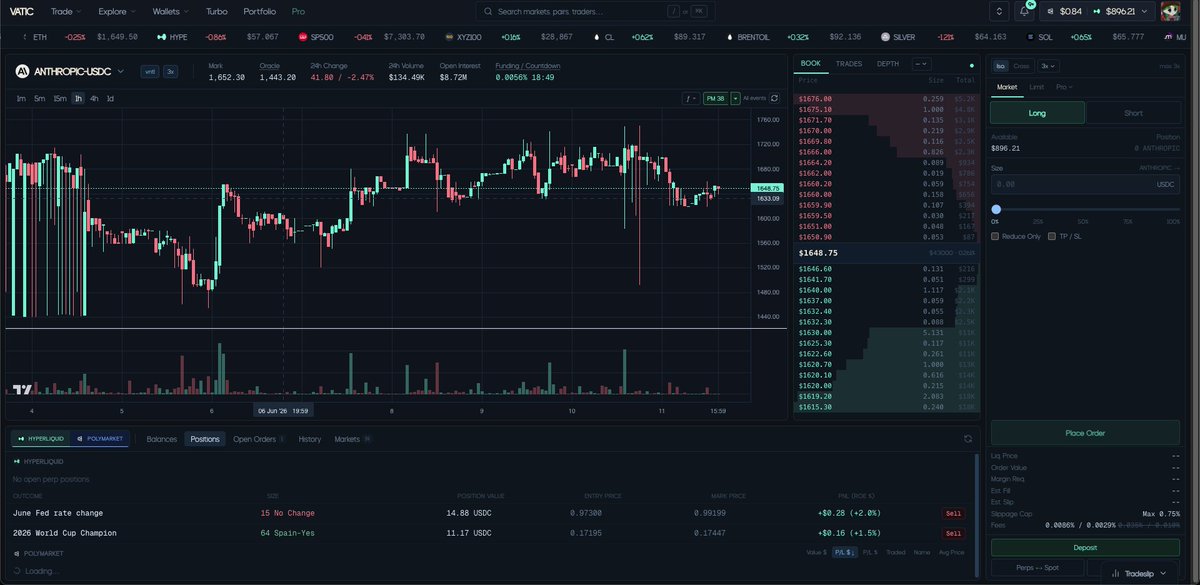
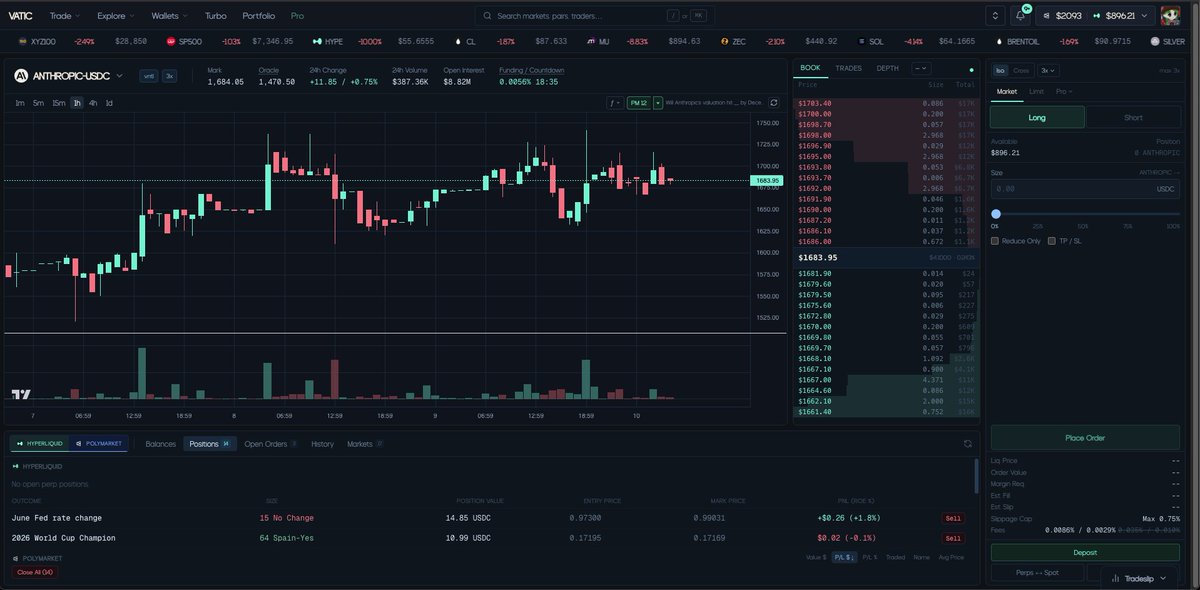
Anthropic’s pre-IPO valuation currently sits at ~$1.68T, up just 0.75% ( $11.8B) over the last 24h.
$11B sounds huge, but relative to a $1.6T valuation, it’s barely a ripple.
Either the market already priced it in, or traders want to see economic impact before assigning additional value.

Introducing Claude Fable 5: a Mythos-class model that we’ve made safe for general use.
Its capabilities exceed those of any model we’ve ever made generally available.
7
18
1,962
AI model release markets are usually considered some of the most insider-sensitive markets on Polymarket.
Employees are technically sophisticated, financially comfortable, and have direct access to information that could move a market from 50% to 100% overnight.
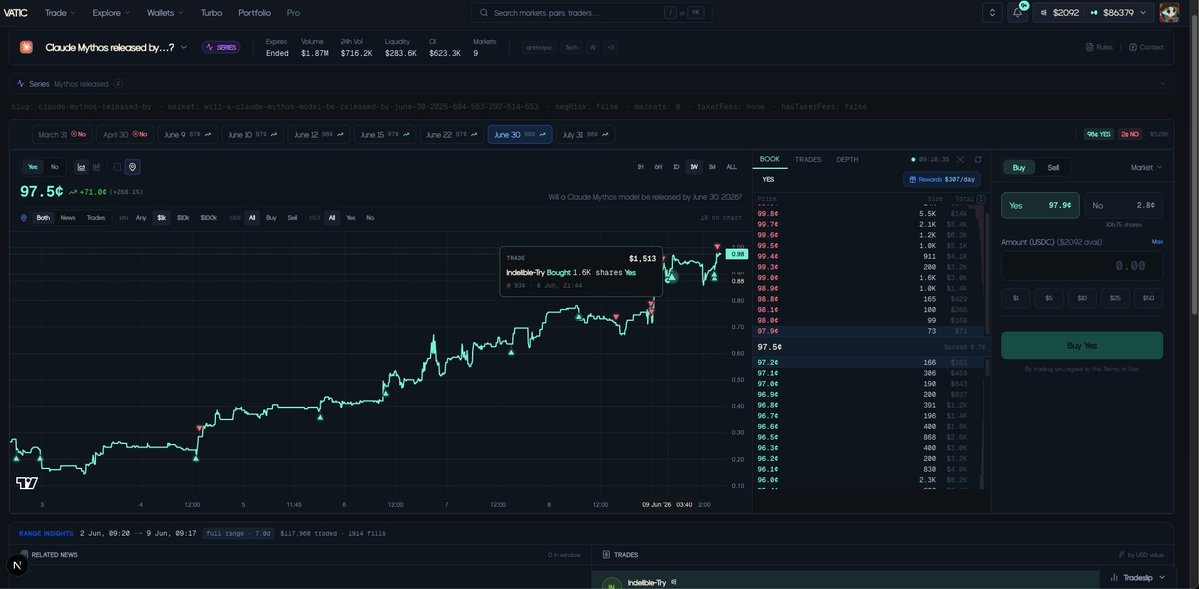
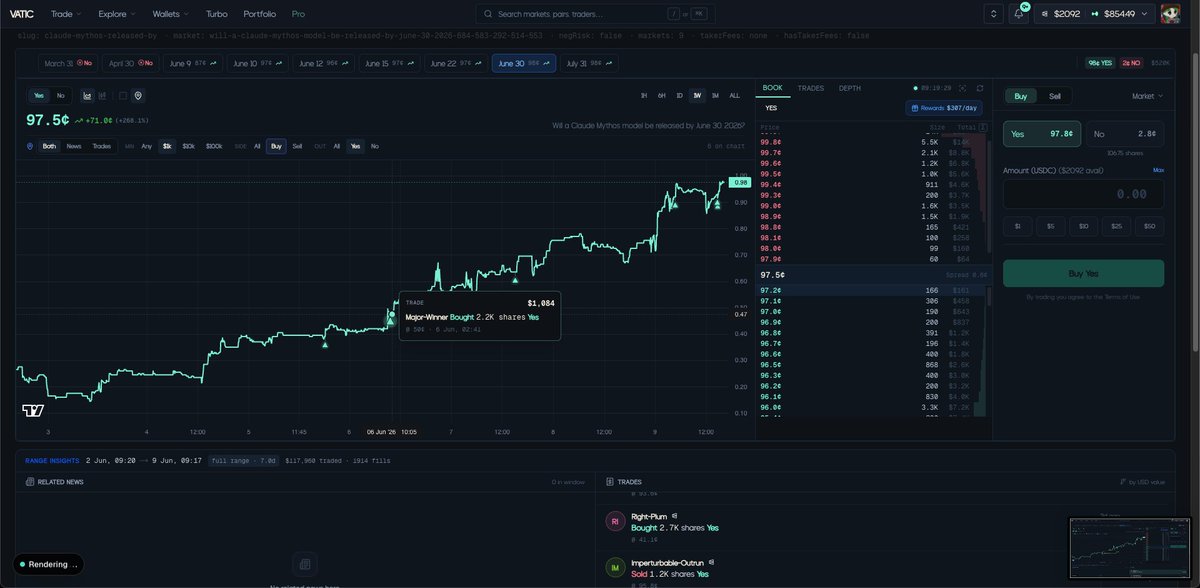
Yet the price action on the June 30 Claude Mythos market looks surprisingly organic.
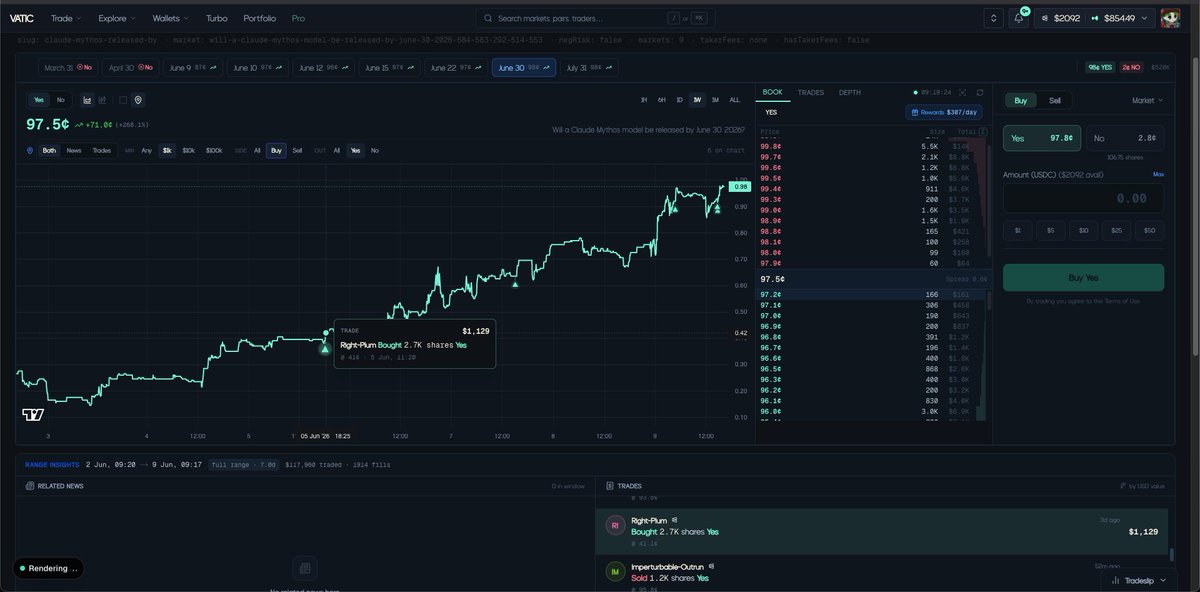
From ~50c to ~98c over the course of a few days, there doesn’t appear to be any single massive buyer stepping in and nuking the orderbook.
Instead, the move was gradual.
A few traders managed to buy around 40-50c:
2.7k shares @ 41c (~$1.1k)
2.2k shares @ 50c (~$1.0k)
good trades, but hardly the type of size you’d expect from someone sitting on certainty.
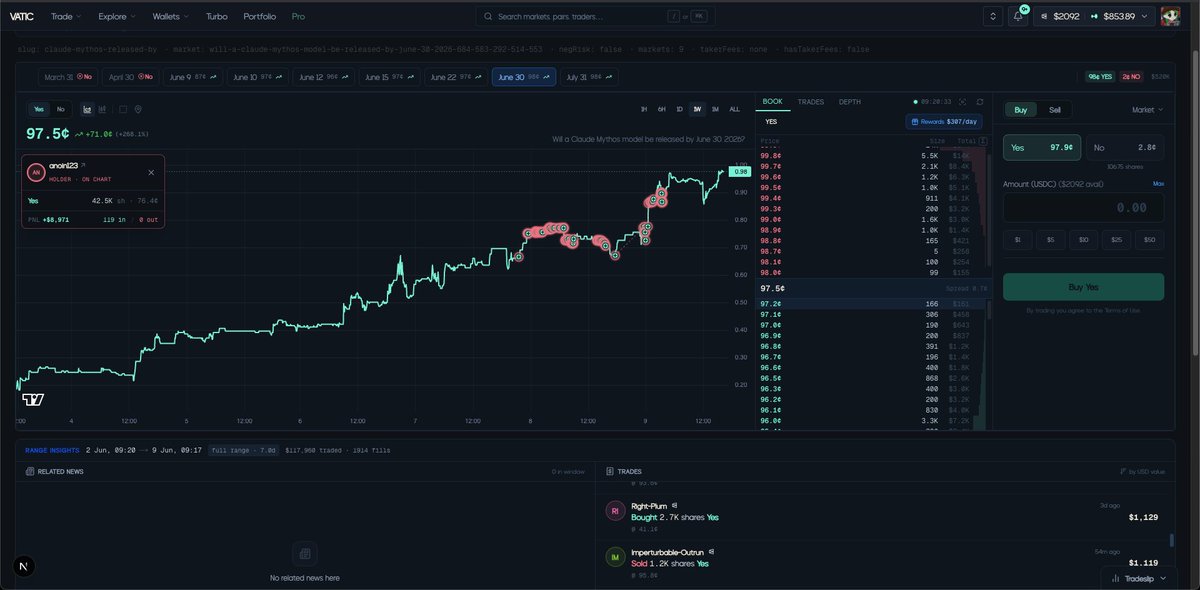
Meanwhile, a large portion of the biggest buys only started appearing once the market was already trading above 90c, at which point the move was largely public and could simply reflect traders chasing confirmation.
One of the largest current holders (0x96489abcb9f583d6835c8ef95ffc923d05a86825) appears to have accumulated around the 75c area and continued building over roughly an 8-hour period yesterday.
Another notable wallet (0x3f73b7ace2bb5c65705bf0b7ec5f40693ae8acef) had already accumulated ~5.3k shares back in April with an average entry around 26.9c, long before the recent repricing.
For a market that should theoretically attract insider activity, the flow looks remarkably normal.
Either:
the market genuinely repriced based on public information and community research and polymarket's actions against insiders paid off
or
suspicious traders have significantly upped their game lol
5
23
1,138
this is actually a pretty big datapoint for prediction markets.
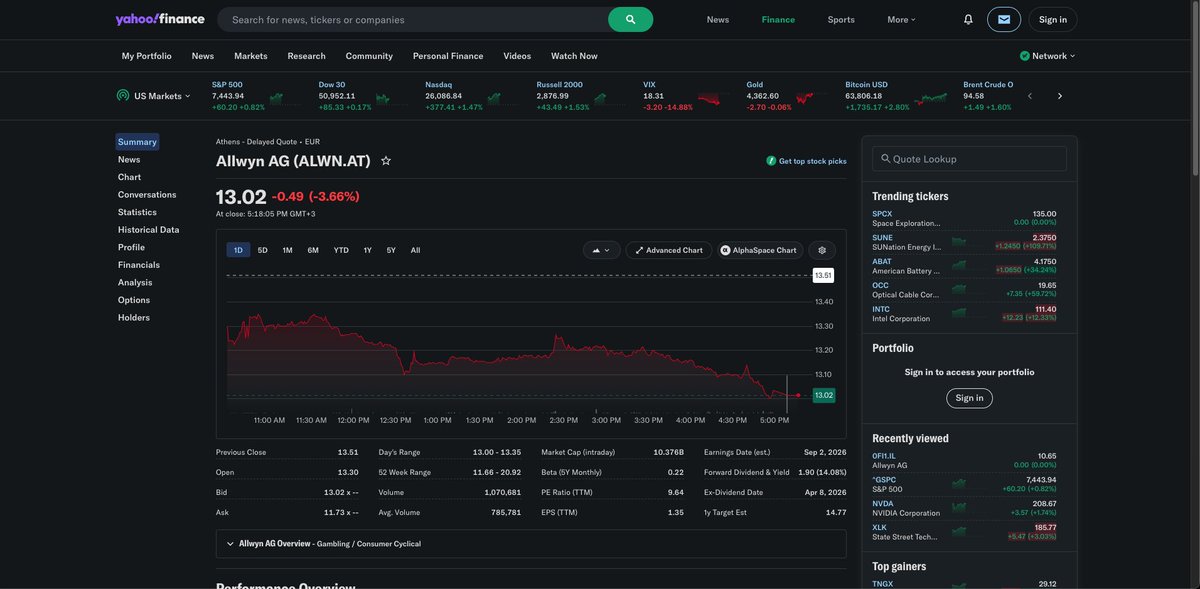
Allwyn is one of the largest gaming operators in the world, with major operations across Greece, Cyprus, Austria, the Czech Republic, Italy, the UK and North America through PrizePicks. the group generated over €1.2B in quarterly net revenue and is increasingly focused on digital products.
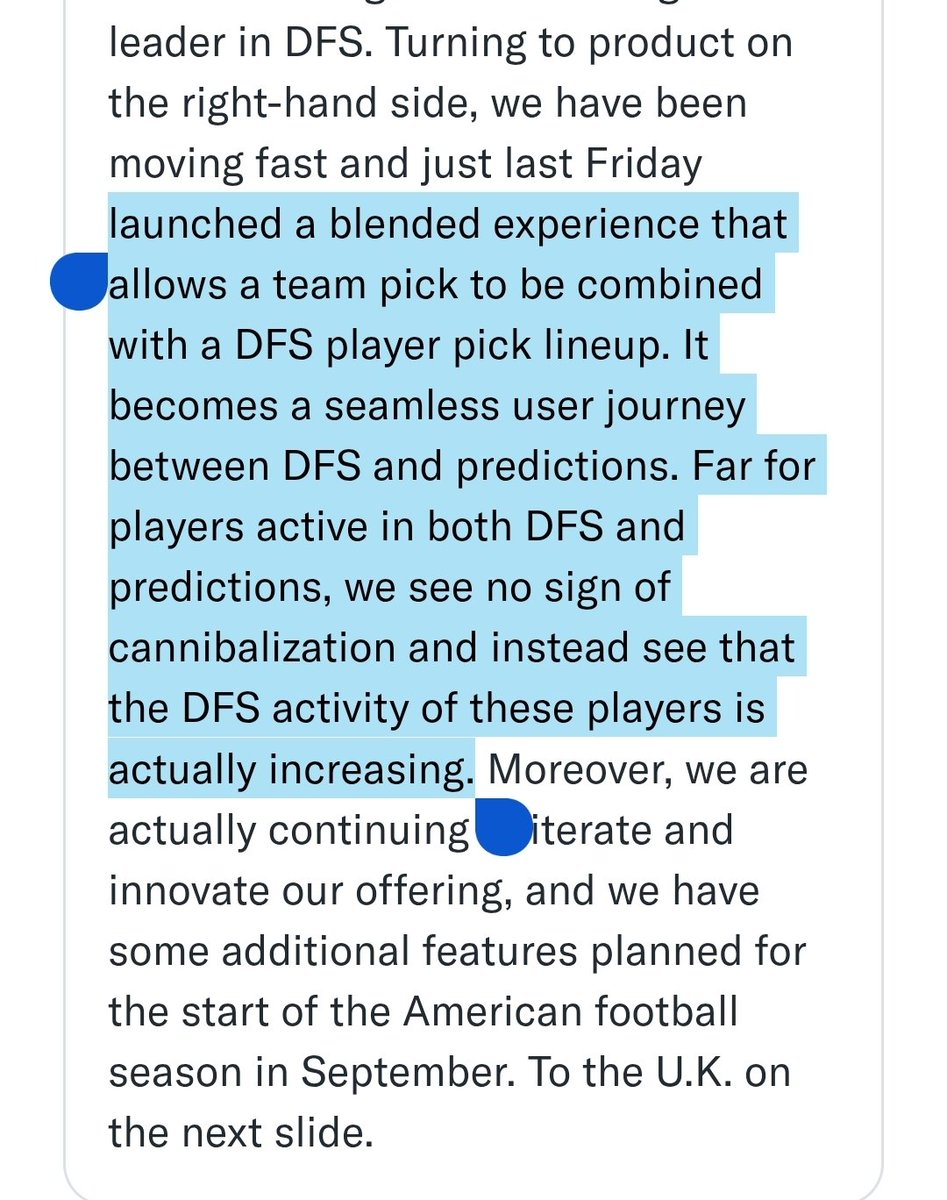
when management explicitly says prediction markets are increasing DFS activity instead of cannibalizing it, that's extremely bullish.
why?
because it means prediction markets aren't competing for the same liquidity pool.
they're increasing retention, engagement and customer spend across the broader platform.
if prediction markets increase retention, engagement and customer spend, every major gambling operator eventually has an incentive to integrate them.
the question then becomes:
who provides the infrastructure?
if polymarket wants to capture that opportunity, they need to keep optimizing for:
> easy integrations
> robust resolution systems
> deeper liquidity in long-tail markets
> attractive revenue-share economics
because the long-term retail-facing opportunity is becoming a part of every sportsbook, DFS app, lottery operator and gambling company plugging event contracts directly into their existing products.
the onboarding potential is massive.
people who historically interacted with lotteries, paper keno, sportsbook slips and fantasy sports could gradually get exposed to event contracts through products they already use.
if polymarket positions itself correctly, the amount of liquidity and user flow that could eventually be routed through its infrastructure is enormous.

During Allwyn's First Quarter earning call, CEO says prediction markets are not cannibalizing Daily Fantasy Sports but actually increasing activity. Transcript below.
HT @nextpredictio
4
38
4,800
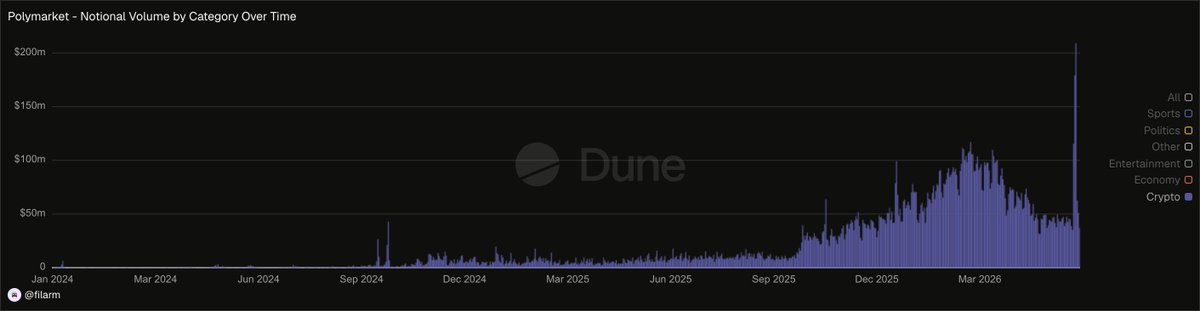
polymarket crypto volume hit ATH this week
if you’re trading up/down markets, target price latency matters a lot, especially on 5m/15m windows.
2 reasons we built vatic api:
> polymarket target prices don’t always show up immediately when a new interval starts. we push them with minimal latency through both api and websocket
> resolution sources are fragmented: chainlink for 5m/15m/4h, binance for hourly/daily. we abstract all of it into a single unified api for crypto up/down strike markets
currently supports:
> BTC
> ETH
> SOL
> XRP
> DOGE
> BNB
> HYPE
docs: docs.vatic.trading
keys: platform.vatic.trading
21
1
67
4,971
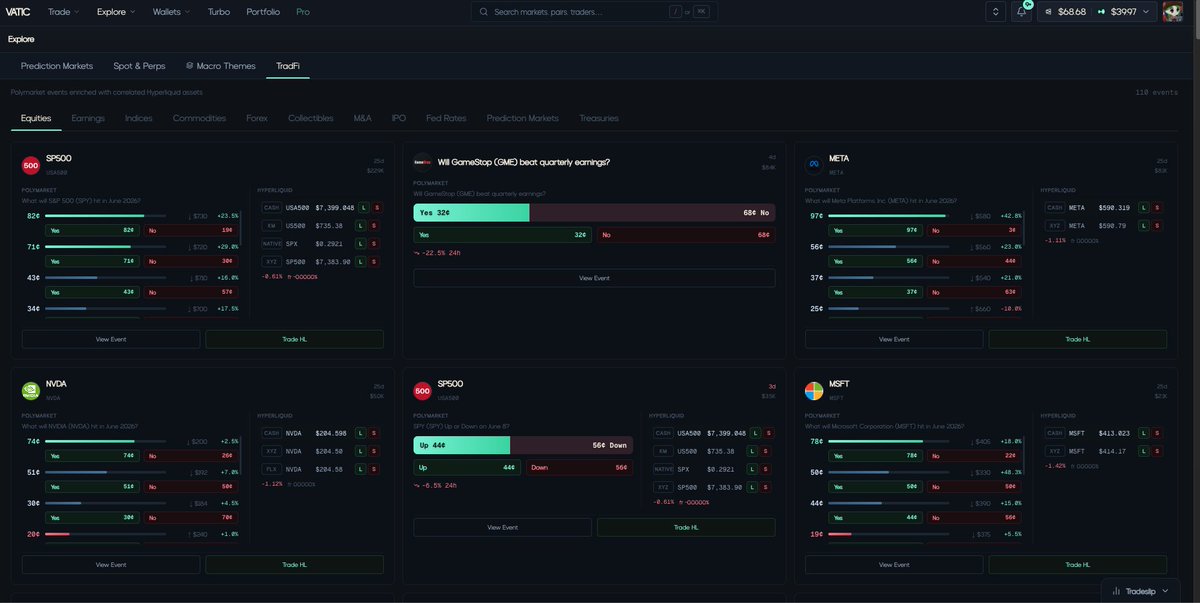
btc nuked below $60k, eth got hit even harder, and the whole market looks like liquidity is rotating out of crypto beta.
but the interesting part imo is what happens next.
there’s an inflection point where money leaving crypto assets won’t have to leave crypto rails anymore.
instead it will rotate directly onchain into:
> stocks
> commodities
> private market exposure
> perps
> event contracts
> tradfi-linked outcomes
this deepens the relationship between crypto and tradfi even more.
onchain is still the only place where you can trade 24/7, permissionlessly, with minimal friction, while also accessing a wider set of financial vehicles through event contracts.
polymarket hyperliquid are uniquely positioned here.
perps give you continuous price exposure.
prediction markets give you exposure to discrete outcomes around the same asset:
> earnings
> IPOs
> product launches
> regulations
> CEO behaviour
> geopolitical shocks
so capital doesn’t just leave “crypto” for tradfi.
eventually it routes through crypto rails to trade everything.
Jun 6

everyone's selling. so who's buying? nobody
the money's leaving entirely
it's going into spacex, which ipo next week worth more than bitcoin AND ethereum combined
all because of ai compute, tells you where the attention went
4
20
1,213
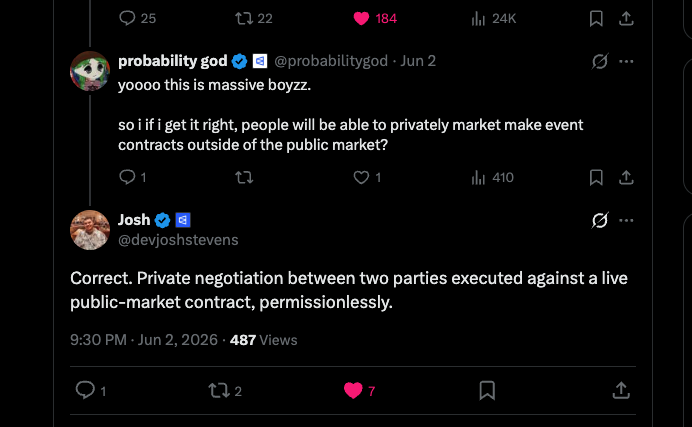
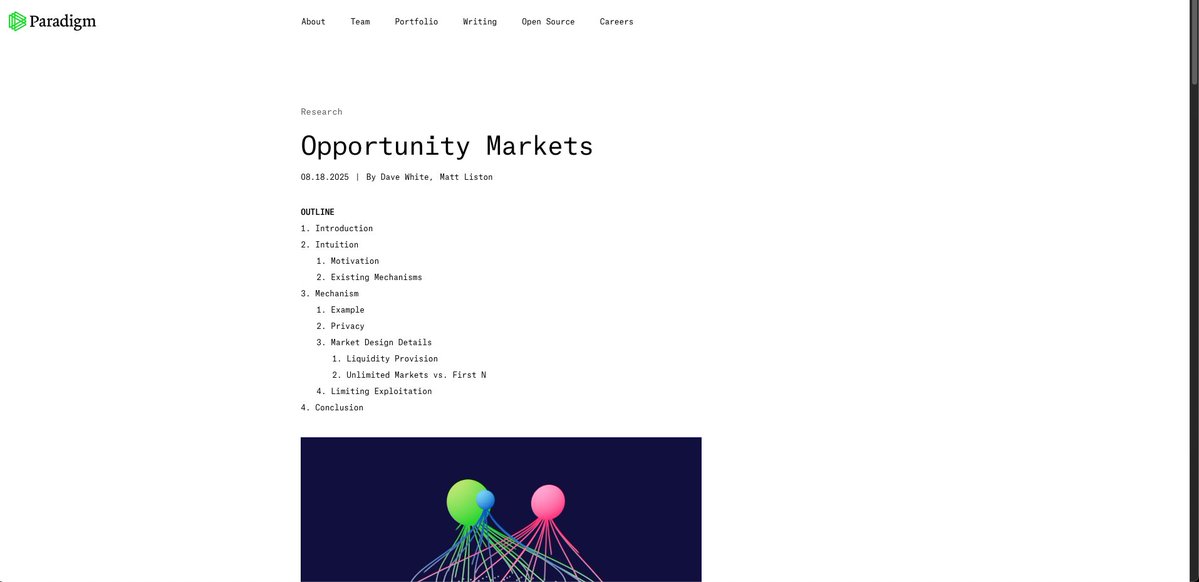
The fact that Polymarket is adding OTC trades, combined with hints they've dropped in the past about permissionless market creation, means the platform has a unique opportunity to become the core infrastructural layer for Opportunity Markets.
This novel financial primitive, recently analyzed by Paradigm, addresses a simple problem: how do you connect people who discover opportunities with people who can actually act on them?
Essentially, it creates a mechanism for people with information to monetize it by acting as decentralized information brokers.
Institutions like VCs, research labs, record labels, and sports teams all need access to opportunities across the world:
> a new peptide that could contribute to the fight against hair loss
> a garage startup that hasn't even shipped an MVP yet but has the potential to become the next Apple
> an artist with global-chart potential
> a kid from the Rio de Janeiro trenches dribbling better than Neymar in his prime
The problem is that these institutions don't have direct access to those opportunities. They rely on scouts, researchers, analysts, talent hunters, and countless intermediaries.
A more efficient approach could be to create private markets (so information doesn't leak), provide liquidity, and allow distributed individuals to trade on outcomes. The resulting market price becomes a signal distilled from thousands of participants with skin in the game.
The challenge, of course, is privacy. If information leaks through the market price itself, competitors can simply free-ride on the signal.
This is why Opportunity Markets require something beyond traditional prediction markets:
> private markets, where participants can trade but order books and prices remain hidden for a predetermined period
> permissionless market creation, allowing institutions to spin up markets for their own use cases
If Polymarket eventually ships both, it could become not only the place where institutions launch Opportunity Markets, but also the infrastructure layer upon which entirely new businesses are built.
Imagine:
> PSG creates a market: "Will player X from a regional Brazilian club join the youth team this year?"
> UMG creates a market: "Will artist Y reach 200k monthly listeners by year-end?"
> PharmaXYZ creates a market: "Will compound Z achieve a statistically significant result in this experiment?"
> VentureFundXYZ creates a market: "Will startup A reach $10k MRR within 12 months?"
Builders could then create verticalized B2B products on top of this infrastructure for small football clubs, independent labels, biotech startups, VC firms, and countless other industries.
If Opportunity Markets become a real thing, Polymarket has a legitimate chance to capture a significant share of this entirely new and highly promising category.
14
2
64
6,268
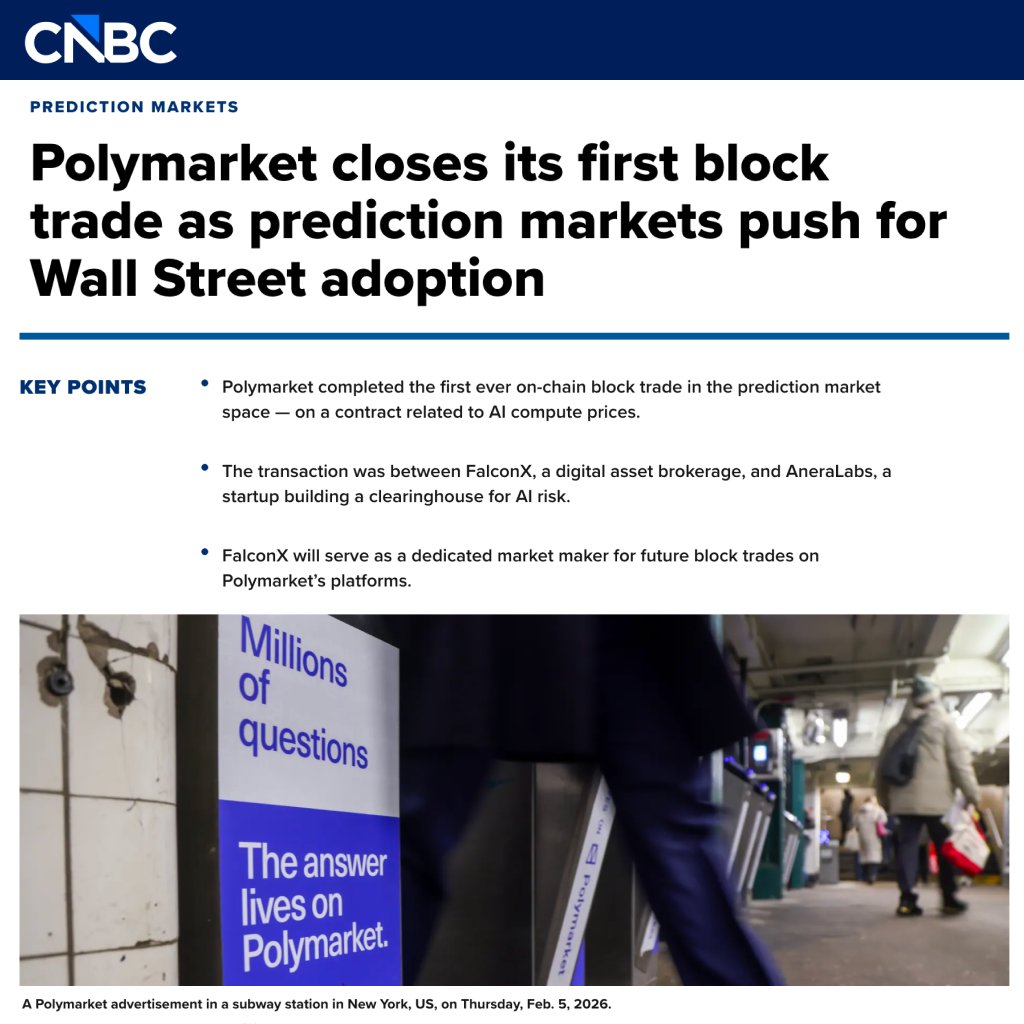
the recent block trade facilitated by Polymarket between Anera Labs and FalconX revealed a potential billion-dollar opportunity for prediction markets: event contracts acting as insurance products.
> Anera hedged GPU-price volatility through an event contract tied to the monthly H100 rental price index
what if other industries followed the same pattern?
> airlines hedging ticket sales with TSA passenger-count markets (more TSA passengers → more travelers → stronger demand for flights)
> renewable energy companies hedging weather conditions. a solar company could buy YES on "tomorrow will be cloudy." if it's cloudy, the hedge pays out. if it's sunny, they generate more energy and profit from operations. the same logic applies to hydroelectric plants, wind farms, etc.
> exporters hedging tariffs. buy YES on tariff-imposition markets. if tariffs are introduced, the contract pays out. if not, you profit from increased trade activity.
> movie studios hedging box office performance. buy NO on your movie reaching a certain revenue threshold. if it underperforms, the contract offsets losses. if it succeeds, the movie itself generates the profits.
> construction firms hedging zoning and regulatory outcomes. gain exposure to markets tied to building approvals, permit decisions, or land-use changes.
for any of this to happen at scale, two things are needed:
> event contracts need to expand conceptually and cover a much wider range of real-world outcomes
> market makers need to be willing to commit capital and provide liquidity for these contracts
the interesting thing about prediction markets is that they may become the most flexible risk-transfer mechanism ever created.
8
30
1,402
institutional hedging using onchain event contracts just became an actual thing.
> polymarket completed its first onchain block trade involving an event contract tied to H100 GPU rental prices
> FalconX acted as the broker/dealer facilitating the transaction
> Anera Labs, a company building infrastructure around AI compute and risk transfer, was the institutional counterparty
my hypothesis is that something like the following is happening:
Anera likely offers compute-related services to institutions that want predictable GPU costs and reduced exposure to compute-price volatility.
for example, if they agree to provide H100 compute at a fixed price for the month, they become exposed to the risk of actual rental prices skyrocketing.
one way to hedge that risk is by gaining exposure to the corresponding event contract.
if GPU rental prices end up above a certain threshold, profits from the event contract can offset losses on the underlying compute business.
whether this specific trade was structured exactly like that is unknown, but the broader idea is what matters.
this whole situation proves that there's real institutional demand for hedging products, and event contracts are arguably one of the most flexible financial primitives for doing so. polymarket has a legitimate chance to become a core component of the broader financial system if this trend continues.
Jun 2

We're excited to announce Polymarket has facilitated the first ever on-chain, institutional block trade in the prediction market space.
Institutions using Polymarket to hedge GPU compute exposure at scale give a glimpse into both the future & the promise of prediction markets.
10
43
2,820
need to pull a 2018 Mbappé run for this one
polymarket.com/@fifawcccc
Jun 2

WE’RE RUNNING IT BACK
THE HIVE WORLD CUP
$10,000 in prizes. Free entry. Begins June 12
Your chance to prove yourself
4
23
1,262
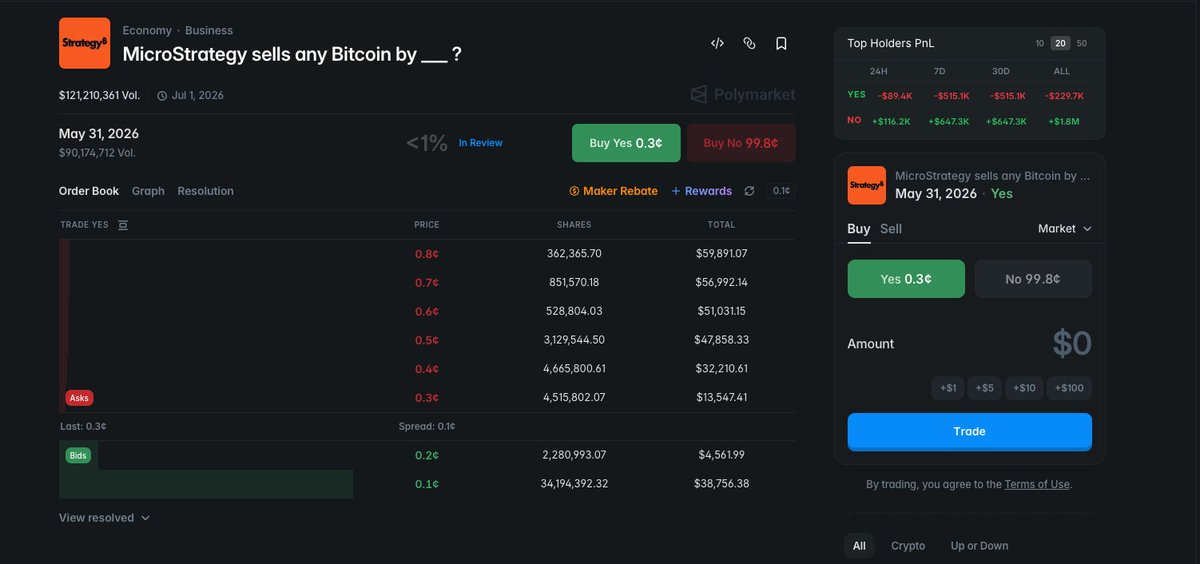
The “MicroStrategy sells BTC by May 31” market turned into one of the biggest resolution controversies Polymarket has had in a while.
The original rules stated that the market would resolve YES if MSTR sold any Bitcoin by May 31, with information from MSTR, on-chain data, and credible reporting serving as resolution sources.
By Monday, June 1, no official confirmation had been published, so the market was initially proposed as NO. That proposal was disputed twice and entered final review.
A few hours later, Strategy’s 8-K filing confirmed that the company had in fact sold 32 BTC during the May 26–May 31 period. The filing was released on June 1, but the reported sale occurred within the market’s timeframe.
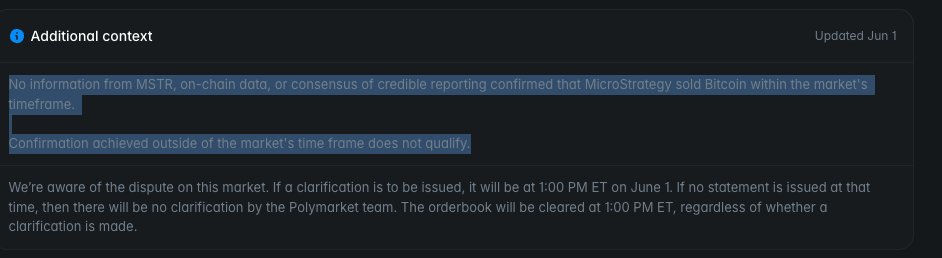
Polymarket then issued a clarification stating that confirmation obtained outside the market’s timeframe would not qualify.
The problem is that there is precedent for similar markets. In a previous MicroStrategy purchase market, Polymarket clarified that resolution would depend on announcements made within the designated timeframe regardless of when the actual purchases occurred. In other words, the timing of confirmation has historically mattered in these markets.
Personally, I don’t think this situation was handled particularly well.
Either:
> the clarification should have existed in the original market rules from day one
or
> no clarification should have been added after the fact and the market should have resolved according to the original wording
More broadly, polymarket team may need to spend more time defining edge cases and resolution logic upfront. Yes, that makes markets slightly more complex for retail users, but it is far preferable to introducing clarifications after controversy has already emerged.
Trust in resolution is the foundation of the entire product. Without it, everything else becomes much harder.

7
2
58
2,822
Polymarket's perps beta went live a few days ago. @vatic_trading reverse-engineered the feed so you don't have to wait for access.
Live order book, index vs mark, funding (annualized) & OI across all 6 markets: S&P, Gold, Oil, Nasdaq, Silver, BTC.
Read-only preview now, trading soon:
vatic.trading/dashboard/pm/p…

Perps beta is now live on polymarket.com for select users. We’ll be rolling access out to more people over the next 4 weeks. Get ready.
4
4
38
3,086