
D2D Telecom analyst. I run the AST SpaceMobile Podcast & the SpaceMob Store. Live in Sweden 🇸🇪
Joined August 2015
- Tweets 23,627
- Following 614
- Followers 4,777
- Likes 29,549
3,447 Photos and videos










Pinned Tweet

May 12
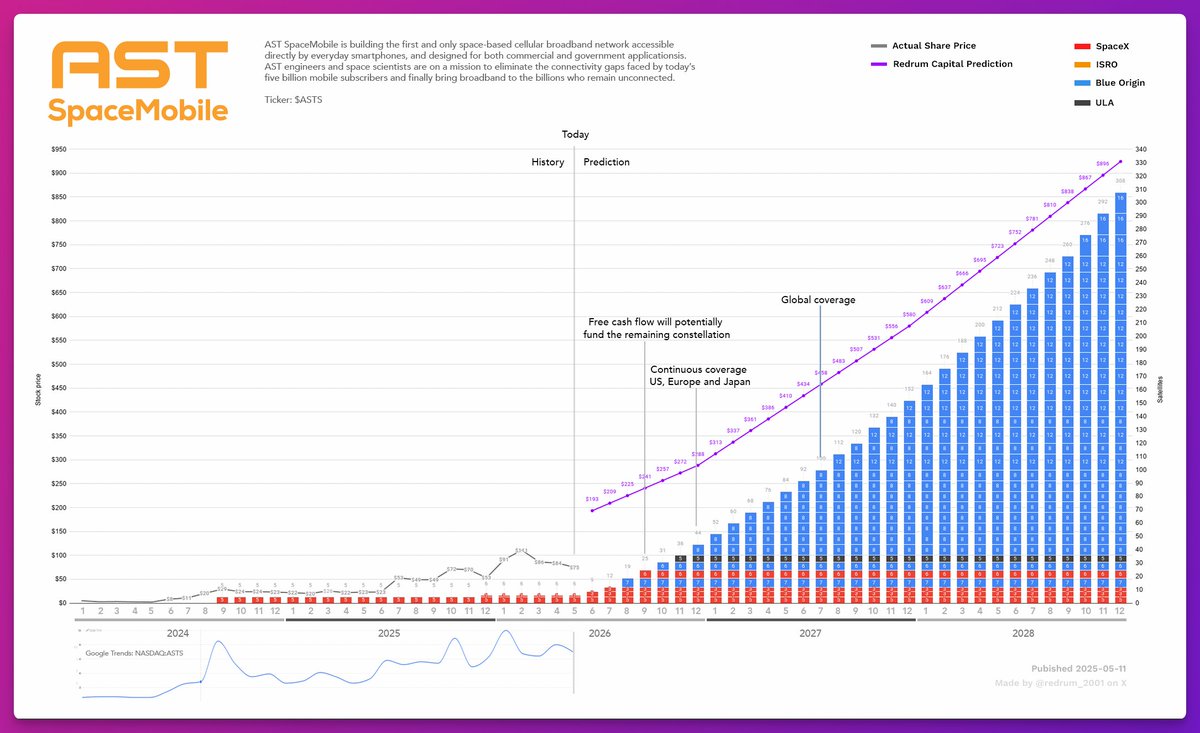
$ASTS - Launch Prediction Chart 🚀
ℹ️ Deployment plan to reach around 45 satellites in orbit during 2026
ℹ️ AST has communicated that they plan for 248 satellites by the end of 2028
ℹ️ Next launch is planned to be three satellites (BB8-BB10) on a Falcon 9 in June
💡 I predict 44 satellites in orbit at the end of 2026
💡 I predict a steady increase in production cadence, reaching 6 satellites a month by July
💡 I predict 7 satellites to be launched in August - 3 on Falcon 9, 4 on New Glenn
I update this chart on a monthly basis, or when something occurs that affect these predictions.
✅ Make sure to follow for future updates.
Latest chart is always the pinned post on my profile.
10
25
164
11,702
$ASTS - 🚨New episode featuring @thekookreport is live on the AST SpaceMobile Podcast!
🎙️ Kook's Weekly - The SpaceX IPO Global Market Realignment
✅ SpaceX D2D Market Validation
✅ AST SpaceMobile Batch 1 Launch
✅ Government and Defense Satcom
✅ AI Data Centers in Space
✅ Direct to Device Competition
----------
Kook breaks down the seismic shifts in the telecommunications and space sectors, specifically focusing on the massive market validation provided by SpaceX's entry into the public eye. As SpaceX CFO Brett Johnson and Gwynne Shotwell highlight a $1.6 trillion total addressable market for Direct to Device (D2D) services, AST SpaceMobile stands as the primary beneficiary of this newfound global attention. This analysis explores why the great global bear hug of AST SpaceMobile by incumbent telecom minnows is the logical response to SpaceX’s disruptive ambitions.
The discussion dives deep into the upcoming Batch 1 launch, featuring five Bluebird satellites stacked and ready for deployment on a Falcon 9. Kook addresses the technical milestones, debunking long-standing bear theories regarding satellite stacking and mechanical separation. With the Toyota Camry of spaceships handling the heavy lifting, the focus shifts to the operational cadence of Batch 2 and the massive technological leap represented by the upcoming ASIC-powered Bluebirds, capable of 200 Mbps speeds.
Beyond commercial cellular service, Kook highlights the burgeoning government and defense opportunities. With mentions of Seal Team 6 utilizing the technology and a $30 million contract from the Space Development Agency (SDA), the value of large orbital arrays becomes undeniable. The discussion also touches on the futuristic prospect of AI data centers in space, where AST SpaceMobile’s massive solar arrays provide a unique competitive advantage for power-hungry orbital computing.
Finally, the episode examines the European market through the Satellite Connect Europe JV with Vodafone and explains recent market volatility. Despite temporary sell-offs, the long-term thesis for AST SpaceMobile remains anchored by unique IP, regulatory moats, and a SpaceMob community that is more committed than ever. This is a defining moment for investors to understand the non-linear path toward industry dominance and why the biggest gains are often compressed into the shortest timeframes.
youtube.com/watch?v=ND-RU_3w…
2
5
32
2,936
$ASTS - Kook reflects on the path from proof-of-concept to massive valuation and why the next leg of growth will be faster than the last.
“𝘛𝘩𝘦 𝘢𝘨𝘰𝘯𝘺 𝘵𝘩𝘢𝘵 𝘪𝘵 𝘵𝘰𝘰𝘬 𝘵𝘰 𝘨𝘦𝘵 𝘵𝘰 𝘯𝘪𝘯𝘦𝘵𝘺 𝘪𝘴 𝘨𝘰𝘪𝘯𝘨 𝘵𝘰 𝘣𝘦 𝘳𝘢𝘱𝘪𝘥𝘭𝘺 𝘤𝘰𝘮𝘱𝘳𝘦𝘴𝘴𝘦𝘥 𝘰𝘯 𝘵𝘩𝘦 𝘱𝘢𝘵𝘩 𝘵𝘰 𝘯𝘪𝘯𝘦 𝘩𝘶𝘯𝘥𝘳𝘦𝘥. 𝘞𝘦'𝘷𝘦 𝘥𝘰𝘯𝘦 𝘵𝘩𝘦 𝘩𝘢𝘳𝘥 𝘱𝘢𝘳𝘵 𝘢𝘯𝘥 𝘸𝘦'𝘳𝘦 𝘢𝘣𝘰𝘶𝘵 𝘵𝘰 𝘴𝘵𝘢𝘳𝘵 𝘵𝘩𝘪𝘴 𝘱𝘢𝘵𝘩 𝘰𝘧 𝘴𝘤𝘢𝘭𝘪𝘯𝘨 𝘮𝘢𝘴𝘴𝘪𝘷𝘦𝘭𝘺.”
The transition from production hell to operational cadence creates convex value growth that the market often fails to price correctly until the flywheel is already spinning.
1
4
708
$ASTS - Listen to the latest episode:
🎙️ Kook's Weekly - The SpaceX IPO Global Market Realignment
Listen and subscribe to the AST SpaceMobile Podcast here: pod.link/1832680690
2
631
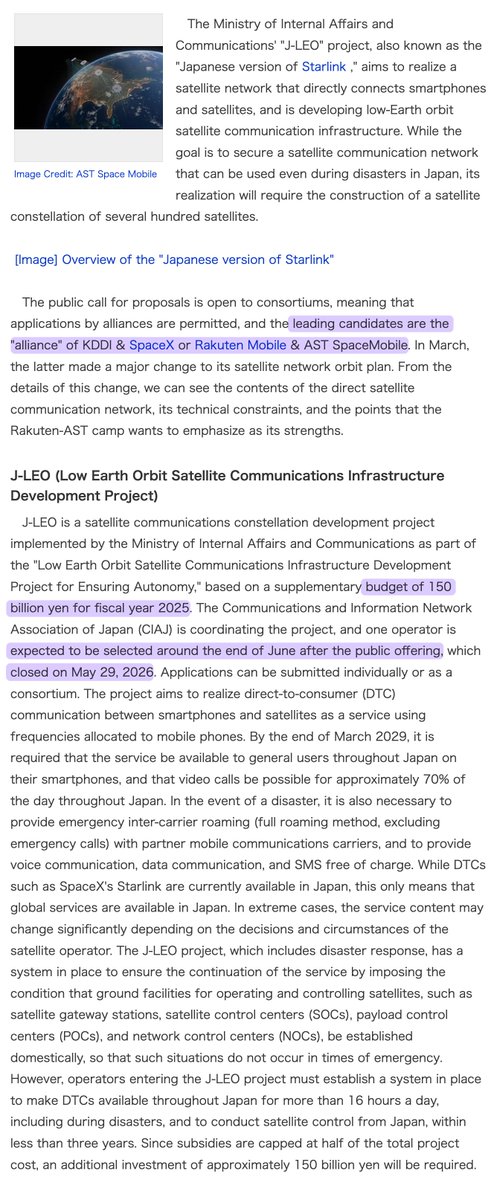
$ASTS - AST SpaceMobile could be awarded $1 billion this month 👀
"one operator is expected to be selected around the end of June"
The J-LEO Project is a massive Japanese government initiative aimed at building an autonomous, domestic satellite network to allow smartphone-to-satellite connectivity.
Backed by a substantial $1 billion budget through the Ministry of Internal Affairs and Communications (MIC), the program focuses on:
* Providing direct-to-smartphone communication (DTC).Ensuring that vital satellite ground infrastructure is physically located in Japan for national security and autonomy.
* Guaranteeing free emergency services (SMS, data, and voice) during national disasters.
Currently, two major consortiums are competing for the project:
Rakuten Mobile partnering with AST SpaceMobile
KDDI partnering with SpaceX.
Exciting times.
37
83
616
111,811
REDRUM 🅰️ retweeted

Jun 12
Couple notes from $ASTS annual meeting
Midband BB (Block 3) could be launched by end of year. Expected to start manufacturing it after BB45
ASIC BBs in progress expected to 2x peak data speed for near 200 Mbps
Fully funded to 100 BBs
Accelerating commercial DAs & possible pre payments
31
85
630
121,318
Jun 11
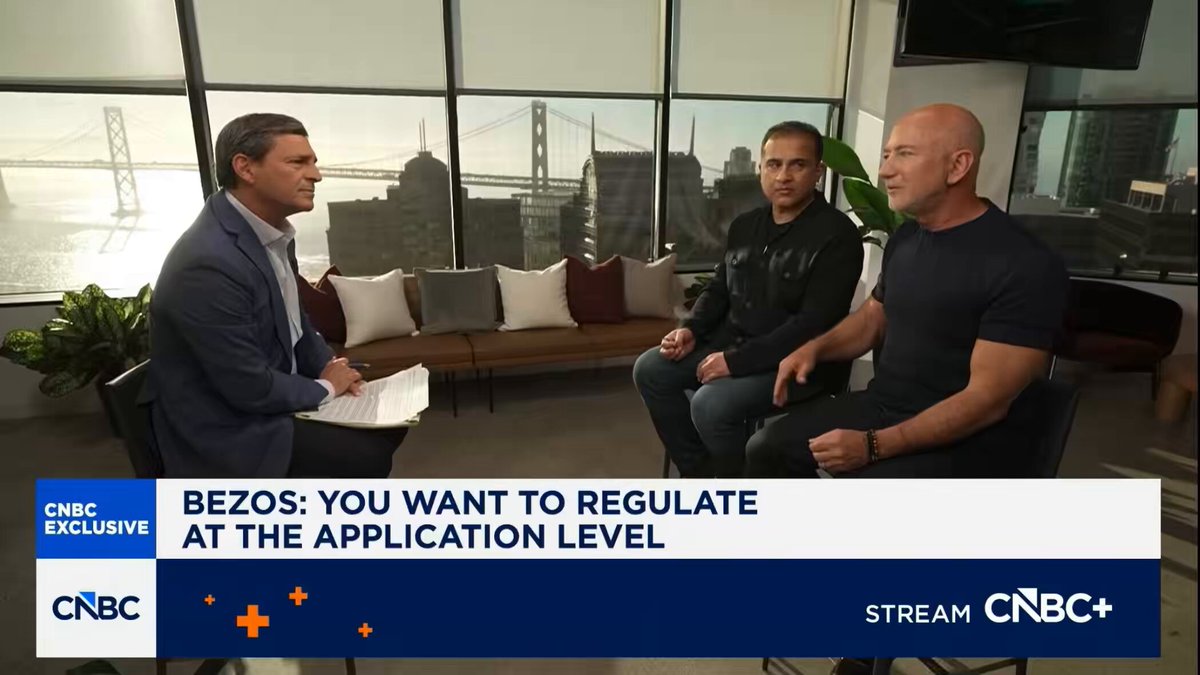
$ASTS - Jeff Bezos on Blue Origin:
“We will be flying again before the end of this year” 🚀
Bullish.
2
23
241
15,729
Jun 11
$ASTS The AST SpaceMobile Podcast has a YouTube channel!
Catch full video episodes, and exclusive content you won't get anywhere else.
Hit that subscribe button and never miss an episode:
youtube.com/@ASTSpaceMobileP…
2
35
3,514
Jun 11
$ASTS - The shield and the illusion: AST SpaceMobile, SpaceX's S-1 and what LATAM operators can still do
In May 2026, SpaceX's S-1 became the most explicit statement the market has seen regarding Elon Musk's intentions for the telecommunications business. By valuing its connectivity segment against a total market of $1.6 trillion, SpaceX isn't signaling a partnership with mobile carriers. It's signaling their replacement, to the greatest extent that physics allows. Not in twelve months. But the ten-year timeframe is clear.
In response, the industry has rallied around a single name: AST SpaceMobile. The question worth answering honestly is whether this protection is sufficient and what Latin American operators should do in the meantime.
The statement that changed the framework
From the beginning of this series, we've argued that the real danger of Starlink's MVNO isn't the percentage of satellite traffic. It's the control of the SIM card and the data ecosystem built around it. SpaceX's S-1 confirms that argument was correct, and amplifies it.
The document is not just a financial presentation for investors. It's a strategic positioning statement. By framing its connectivity segment against a $1.6 trillion TAM, SpaceX is telling markets—and regulators—that its ambition is not to be a complement to the mobile operator ecosystem. It's to be the ecosystem. Existing operators' terrestrial infrastructure appears in this narrative as a transient asset: useful until satellite density becomes sufficient to make it obsolete, but dispensable within a ten-year timeframe.
To understand the magnitude of that in Latin America: the combined revenue of the region's leading mobile operators—Claro, Movistar, Telcel, TIM, Tigo, Personal, and the local operators in the twelve main markets—is in the range of $80 to $90 billion annually. All of that is within the Total Asset Market (TAM) that SpaceX allocated to itself in its IPO prospectus. Not a portion. All of it.
Timing matters
SpaceX won't have the satellite density needed to eliminate terrestrial networks in urban areas in two years. Probably not even in five. But the MVNO doesn't need that density to start capturing what matters most: SIM cards, end-customer billing, and behavioral data. That can happen long before the first satellite replaces the first urban tower.
AST SpaceMobile: who it is and what it's really building
Founded in 2017 by Abel Avellan, AST SpaceMobile wasn't created to compete with mobile operators. It was created to be their orbital infrastructure. This fundamental difference has structural implications for everything the company does: how it raises capital, how it negotiates with partners, how it designs its technology, and how it positions its product with regulators.
The mission is technically ambitious: to connect conventional smartphones , without any modifications, directly to satellites in low Earth orbit. No specialized terminals. No additional equipment. Just the same iPhone or Galaxy that the user already has in their pocket.
The architecture that makes it possible
The technical difference between AST and Starlink isn't one of scale, it's one of design. Starlink uses thousands of small satellites with a high-volume approach: many nodes, narrower signals, and coverage based on density. It's effective for messaging and basic data, but the limited transmission power of a typical smartphone—around 0.2 watts—imposes a ceiling on what that architecture can deliver without modifying the device.
AST solves that problem by inverting the design: instead of putting intelligence in the number of satellites, it puts it in the size of the antenna. Its next-generation BlueBird satellites deploy antenna arrays of 2,400 square feet—about 223 square meters—the largest commercial communications array ever deployed in low Earth orbit. That aperture acts as a high-gain receiver capable of capturing and amplifying the weak signal from a smartphone from an altitude of 500 kilometers.
The computational core powering this is the proprietary AST5000 integrated circuit, developed over 150 man-years of engineering. It processes 10 GHz of instantaneous bandwidth per satellite, handles the Doppler shifts inherent in LEO flight, and delivers peak speeds of 120 Mbps per cell. In tests with its Block 1 satellites, AST achieved 98.9 Mbps of real-world speed on unmodified smartphones. For reference: that's residential broadband speed, not emergency connectivity.
The result of this design is that the AST satellite operates as an orbiting cellular base station, compatible with 3GPP 4G and 5G standards. The user's smartphone doesn't detect a different network; it detects their carrier's network, with the satellite acting as just another cell. The handover between the ground tower and the satellite occurs seamlessly, just as it does today between adjacent cells in an urban network.
Abel Avellan describes it bluntly: “Nobody is remotely close to our technical capability to deliver hundreds of megabits directly to a phone from something flying at 70,000 miles per hour 500 kilometers above you. That competitive advantage is unique.”
The business model: why operators are partners, not customers
AST's capital structure is not accidental. Its strategic investors include AT&T, Verizon, Vodafone, Rakuten, Alphabet (with 3.8 percent of the capital), in addition to institutional support from Vanguard with approximately 21.4 million shares and BlackRock with 14.5 million. The Cisneros Group, one of Latin America's largest media and technology conglomerates, is also a strategic shareholder.
That's not a customer list. It's a list of owners. The major global operators have a direct financial interest in AST succeeding as an infrastructure provider, not as a competitor. That alignment of incentives is the mechanism AST uses to protect itself in a market where it would otherwise be vulnerable.
The monetization model is equally clear: when a user connects via an AST satellite, they continue using their existing carrier plan, and the revenue generated is split 50/50 between AST and the carrier. The user does not sign any contract with AST. They do not activate any additional services. They do not switch carriers. The carrier retains the billing, the business relationship, and the data asset. AST charges for the satellite capacity provided.
This approach solves two of the most costly problems in the telecommunications business. First, customer acquisition costs: AST doesn't invest in marketing or distribution; it relies on the sales networks of its 60 global partner operators. Second, remote coverage capital expenditures: the operator can extend its coverage map to areas where building towers is economically unfeasible, without investing a single dollar in terrestrial infrastructure.
The scale in 2026
As of May 2026, AST has six operational satellites in orbit. The goal for the end of the year is to reach between 45 and 60 units, with launches scheduled every one or two months. Next June, a Falcon 9 will carry BlueBirds 8, 9, and 10; a critical mission that gained greater urgency after the loss of BlueBird 7 due to an anomaly in Blue Origin's New Glenn rocket, which led to an FAA moratorium on that launch platform.
On the manufacturing side, the 500,000-square-foot facility in Midland, Texas, is currently processing BlueBirds 11 through 33, with a production rate targeting more than ten satellites per month. AST reported over $70 million in total revenue for 2025 with a gross margin of 68.6 percent and closed a $1.075 billion convertible note issuance in February 2026. Total available liquidity amounts to approximately $3.9 billion, sufficient to support the estimated annual capital expenditure of $1.2 billion.
The FCC has already authorized AST's commercial service in the United States under the Supplemental Coverage from Space (SCCS) program, with the capacity to operate a constellation of up to 248 satellites. With nearly 60 global operating partners representing more than 3 billion subscribers, and contractual revenue commitments exceeding $1.2 billion, AST has completed its transition from a demonstration company to a scaling infrastructure utility.
Architectural investment: why AST and Starlink are not the same game
For Latin American operators, understanding the structural difference between the AST model and Starlink Direct to Cell (D2C) is not a technicality. It is the key to the entire strategy.
Starlink operates its own satellite network and integrates it with operators who provide spectrum. The SpaceX satellite uses the operator's licensed frequencies to connect to the end user's device. The satellite technical layer is provided by SpaceX. The operator is the spectrum enabler and, in the best-case scenario, the commercial channel. If SpaceX moves toward becoming an MVNO, the operator ceases to be a channel and becomes an anonymous wholesale provider.
AST operates under a different logic. Its satellites act as orbiting base stations, integrated into the operator's core network as just another cell. The standard is 3GPP. The spectrum belongs to the operator. Billing is handled by the operator. The customer doesn't notice any difference. In the Starlink model, the risk is that SpaceX could retain the SIM card. In the AST model, the operator retains the SIM card while AST operates the infrastructure that extends its coverage into space.
Avellan's distinction regarding Amazon/Globalstar is relevant in this context: “Basically, we see that capacity as an emergency SOS system. To provide real broadband, you need hundreds of megahertz of allocated spectrum… our focus is broadband. That's a completely different proposition.” This isn't corporate modesty; it's product positioning that establishes AST as the only direct-to-device broadband alternative with native integration into the operator's core network.
The honest verdict: a royal shield, but not a permanent solution
The analysis of AST SpaceMobile circulating in telecom investment and strategy communities converges on an uncomfortable but correct point: AST is a lifeboat, not a silver bullet.
The distinction matters because many operators are treating AST as if solving the rural coverage problem were enough to win the strategic war. It isn't.
AST gives operators three concrete and valuable things. It gives them real coverage without terrestrial capex in areas where building towers is not feasible. It gives them customer relationship retention even when they are off the terrestrial network. And it gives them a line of defense against SpaceX in the battle for coverage. These three things have real value and are defensible.
What AST can't do is reverse the structural commoditization of the mobile business. SpaceX didn't create that process. It was the result of two decades of price competition, digital disintermediation, and the migration of value to application platforms. What SpaceX is doing is accelerating that process and adding a SIM capture threat that didn't exist before. AST blocks that capture, but it doesn't return the value that has already migrated.
In other words, with AST, operators can remain relevant in the future. Without AST (or an equivalent solution), they may remain as anonymous infrastructure. But remaining relevant in the future is not the same as having solved the underlying problem. It's about having bought time to solve it.
AST SpaceMobile is the mechanism that allows the telecommunications industry to buy time to survive the orbital era. What they do with that time is the real strategic question.
LATAM: the perfect geography, the most exposed regulatory position
Latin America possesses conditions that make it one of the most relevant markets for the next stage of satellite connectivity. These include challenging geography, low coverage density across vast territories, industrial sectors (mining, agribusiness, energy, logistics) with critical connectivity needs in the field, and a mobile market of over 700 million connections with expanding digital penetration. However, it also presents specific vulnerabilities.
AST's Latin American partners have already been identified
The agreements that AST SpaceMobile has formalized to date include operators with a direct presence in Latin America. However, one of them requires a closer look. Telefónica is listed among AST's partners, but its Latin American presence has changed radically in the last twelve months. Under the leadership of Marc Murtra, who took over as CEO in January 2025, the company executed an accelerated exit from Hispam: it sold its operations in Argentina to Telecom Argentina for $1.245 billion, in Peru to Integra Tec International for just $1 million, in Uruguay and Ecuador also in 2025, and in Colombia it sold 65 percent of its operation to Millicom for around $400 million.
In the first quarter of 2026, the operator completed its exits from Colombia and Chile, the latter sold to Millicom and Xavier Niel's fund. The sale of Mexico to Melisa Acquisition was announced in April 2026. Murtra himself stated it unequivocally: the goal is to concentrate on Germany, Spain, the United Kingdom, and Brazil (the only Latin American market that Telefónica considers strategic in the long term). In other words, Telefónica's agreement with AST is, in practice, an agreement with Vivo Brasil, not with a pan-regional operator.
The Latin American geographic coverage that the agreement represented on paper has been dramatically reduced. Millicom (Tigo) covers Bolivia, Paraguay, Honduras, Guatemala, El Salvador, Nicaragua, Costa Rica, Panama, and Colombia; and by partially absorbing Telefónica's Colombian operation, it expands its exposure precisely in the markets with the largest proportion of rural territory without coverage and the smallest scale to justify tower expansion. Telecom Argentina, which acquired Movistar Argentina's operations, consolidates its position in a market with vast stretches of the Pampas and Patagonia lacking viable coverage. Liberty Latin America operates in Puerto Rico, the Dominican Republic, Jamaica, Panama, Costa Rica, and other markets in the Caribbean and Central America.
The resulting map differs from what AST's partner ecosystem suggested a year ago. With Telefónica now focused on Brazil, the Latin American weight of the agreement falls on Millicom, Telecom Argentina, and Liberty Latin America—three operators with a real presence but without the pan-regional coverage that Telefónica Hispam provided. What remains missing from that list is equally revealing: operators without an agreement with AST (and who rely on the Starlink Direct to Cell model as their only satellite coverage option) are in a weaker strategic position.
The most significant absence in this ecosystem is América Móvil. The dominant operator in Mexico and the largest in Latin America by number of subscribers (with Telcel, Claro, and their regional brands present in seventeen countries in the region) does not appear in any AST SpaceMobile filing , any public list of operator partners, or any corporate statement available as of the date of this publication. This omission is not a minor detail. It is, in itself, a strategic fact of paramount importance.
It could mean that América Móvil is evaluating the situation without making a commitment, waiting to see how the constellation scales before negotiating from a position of need. It could mean that it prefers the Starlink Direct-to-Cell model, which maintains coverage without relinquishing a 50 percent revenue share to a third party. Or it could mean that negotiations are underway, but no agreement has been reached on terms. What it cannot mean, given the size of the operator and the geographic coverage at stake, is indifference.
In Mexico, Telcel operates in the world's largest Spanish-speaking mobile market, with over 60 percent market share. If this operator reaches an agreement with AST, the satellite broadband layer will be integrated into the country's most extensive network, and rural access will become a Telcel asset. If it doesn't reach such an agreement, and Movistar Mexico—a Telefónica subsidiary—has it operational first, the coverage gap will be reversed for the first time in the competitive history of the Mexican market. And if América Móvil ends up relying solely on the Starlink model, customer relations in areas without terrestrial coverage will be subject to SpaceX's logic, not its own. Any of these three scenarios has consequences that extend far beyond the signal map.
The regulatory window is closing
The most underestimated risk in Latin America is not technological. It is regulatory, but in a different sense than is usually discussed.
The danger isn't that regulators will block AST. It's that operators who don't actively participate in defining the regulatory framework for supplemental satellite coverage will end up in an environment designed by their competitors. In Mexico, the Telecommunications Regulatory Commission (CRT), which replaced the IFT in October 2015 and operates under the Digital Transformation and Telecommunications Agency of the federal government, will have to define whether AST's satellites using spectrum licensed by Movistar or Telcel are an additional cell of that network, an independent satellite service, or something new. This categorization determines who can participate, under what conditions, and with what obligations regarding universal service, portability, data location, and lawful interception.
In Brazil, Anatel faces the same problem with Claro and TIM as potential partners for AST. In Colombia, Chile, and Peru (where Telefónica already has relationships with both satellite providers), the question is when, not if, this regulatory discussion will take place. The operator that approaches the regulator with a structured technical proposal, public policy arguments, and an implementation timeline will have an advantage over one that waits for authorization to come automatically.
The WRC-27 (World Radiocommunication Conference 2027) will establish global spectrum rules for non-terrestrial networks. What Latin American administrations present there will define the framework for the next decade. Operators not participating in that discussion today will not be part of the 2028 results.
What LATAM carriers should do — with or without AST
The strategic agenda for Latin American operators is not new. The three previous installments in this series have outlined it from different angles. What changes with SpaceX's S-1 and the consolidation of the AST ecosystem is the urgency: it's no longer about positioning for a future threat. The threat has a date, a legal structure, and a public offering document that quantifies it at $1.6 trillion.
Five actions define the difference between the operators who will emerge stronger from this transition and those who will end up as anonymous capacity providers.
1. Negotiate access to AST from an active position, not a position of need.
Operators entering negotiations with AST after SpaceX has achieved critical mass in their market will be negotiating from a position of weakness. Those entering now (with customers, spectrum, licenses, brand recognition, and regulatory relationships as assets) can negotiate terms that preserve control over the end-user relationship. The 50/50 revenue-sharing model is the current market benchmark, but that figure isn't set in stone for markets with different dynamics. What is clear, however, is that those who arrive late will have less leverage.
2. Monetize your own data assets before the competition arrives
Claro, Telcel, and Movistar have years of experience tracking the mobility, consumption, and behavior of hundreds of millions of users. This asset isn't being monetized to its full potential. The first step is to build their own data platform (geolocated advertising, market intelligence, alternative credit scoring, financial services) before Starlink arrives and does exactly the same thing with the same users on its own SIM card. The M-Pesa model in Kenya remains the most cited and least imitated benchmark in Latin America. The window of opportunity to be the operator that arrives before the bank is not permanent.
3. Build vertical proposals for high-value sectors
The most immediate opportunity lies not with the mass consumer. It lies with businesses and industrial sectors that require continuous and guaranteed connectivity in the field: mining in Chile and Peru, agribusiness in Brazil and Argentina, logistics and transportation in Mexico and Colombia, energy in Venezuela and Ecuador, and tourism in nature destinations throughout the region. These customers pay enterprise rates, have multi-year contracts, and don't switch providers based on price. The operator that arrives first with a guaranteed coverage proposal (using AST's satellite layer as an invisible part of its network) has a competitive advantage that no newcomer can immediately replicate.
4. To exert regulatory pressure for the principle of reciprocity
The correct regulatory argument is simple: same services, same rules. If Starlink bills the end user as a mobile operator, it must contribute to the universal service fund, respect number portability, and comply with data localization obligations under local legislation. If AST operates spectrum from a licensed operator in Mexico, Colombia, or Brazil as if it were a cell of that network, the regulatory framework must reflect that technical reality. Neither of these positions is anti-competitive. They are principles of regulatory equivalence that protect both the user and the historical investment of established operators.
5. Organize a common regional front on data
No single Latin American operator has the individual scale to compete with the global dataset SpaceX will build if it manages to position itself as an MVNO in ten markets simultaneously. But the combined scale of regional operators does. A data consortium among the leading operators in the six largest Latin American markets (without the need for a merger, by federating the information asset under shared governance) would create a comparable critical mass. In Europe, operators have explored similar schemes against Google and Meta. In Latin America, no one has yet implemented such a strategy. SpaceX's S-1 is the catalyst needed to make that conversation happen.
Time is not neutral
The four installments in this series have followed the same argument from different perspectives. Physics establishes the limits of what the satellite can do. Musk's strategy explains why those limits don't matter as much as they seem, because the real value lies not in the bits transmitted but in the data generated. The industry's response establishes that AST SpaceMobile is real, functional, and the most coherent counterproposal to SpaceX's progress. And this article concludes with the point all these elements make: time is not neutral.
Every week a Latin American operator remains silent on the AST conversation, every quarter it fails to build its data platform, every regulatory cycle it lets pass without actively participating, is time working in SpaceX's favor. Not because SpaceX is already winning—not yet—but because every delay by the operator reduces its negotiating leverage and widens the advantage of the one that arrives with greater scale, more data, and less reliance on local agreements.
AST SpaceMobile is the most concrete mechanism the industry has today to buy that time. But buying time only makes sense if it's used. The question that defines the next stage of mobility in Latin America isn't whether satellites will win. It's who will be on the other side of the table when that happens.
Operators who come to that table with customers, data, spectrum, and a strong regulatory position will remain players. Those who arrive without those assets will be someone else's infrastructure.
This text is a translation of an article from TeleSemana: telesemana.com/blog/2026/06/…
7
15
107
14,502
Jun 11
Also in audio: x.com/redrum_2001/status/206…
Jun 11

$ASTS - 🚨New episode featuring is live on the AST SpaceMobile Podcast!
🎙️ Buying Time in Space: Starlink’s Threat and the A.S.T SpaceMobile Lifeboat
✅ SpaceX S-1 Market Disruption
✅ Orbital Infrastructure vs MVNO
✅ Latin American Telecom Shifts
✅ SIM Card Ecosystem Control
✅ Regulatory Reciprocity Principles
----------
The telecommunications landscape is facing a seismic shift following the release of the SpaceX S-1 prospectus. This document outlines a bold strategy to capture a 1.6 trillion dollar market, signaling a move that could potentially replace traditional mobile carriers. As SpaceX positions itself to become the ecosystem rather than a complement to it, the industry is rallying around AST SpaceMobile as a critical strategic defense. This episode explores why the battle is not just about satellite traffic, but about the control of the SIM card and the valuable data ecosystem surrounding the end user. Primary keywords covered include AST SpaceMobile, ASTS, D2D, Telecom, Direct to device, stock, and investing.
Abel Avellan and the team at AST SpaceMobile have developed a unique technical architecture designed to serve as orbital infrastructure for existing operators. By using massive antenna arrays, the largest ever deployed in low earth orbit, AST SpaceMobile can deliver residential broadband speeds directly to unmodified smartphones. This approach allows partners like AT&T, Verizon, and Vodafone to extend their coverage without the massive capital expenditure of terrestrial towers in remote areas. We analyze the 50/50 revenue-sharing model and how it incentivizes global operators to support AST SpaceMobile as a utility rather than a competitor.
The situation in Latin America is particularly intense, with geography and industrial needs in mining and agriculture creating a high demand for field connectivity. We examine the recent shifts in the region, including Telefonica’s exit from several markets and the curious absence of América Movil from current partner lists. The discussion covers the regulatory challenges ahead, focusing on the principle of reciprocity—ensuring that satellite providers follow the same rules as terrestrial operators regarding universal service and data localization. Finally, we outline critical actions for operators to emerge stronger from this transition. AST SpaceMobile provides the industry with the time needed to adapt, but survival depends on how that time is used.
Make sure to subscribe for future episodes.
youtu.be/3X-u1wQ4WmU
2
5
870
Jun 11
$ASTS - 🚨New episode featuring is live on the AST SpaceMobile Podcast!
🎙️ Buying Time in Space: Starlink’s Threat and the A.S.T SpaceMobile Lifeboat
✅ SpaceX S-1 Market Disruption
✅ Orbital Infrastructure vs MVNO
✅ Latin American Telecom Shifts
✅ SIM Card Ecosystem Control
✅ Regulatory Reciprocity Principles
----------
The telecommunications landscape is facing a seismic shift following the release of the SpaceX S-1 prospectus. This document outlines a bold strategy to capture a 1.6 trillion dollar market, signaling a move that could potentially replace traditional mobile carriers. As SpaceX positions itself to become the ecosystem rather than a complement to it, the industry is rallying around AST SpaceMobile as a critical strategic defense. This episode explores why the battle is not just about satellite traffic, but about the control of the SIM card and the valuable data ecosystem surrounding the end user. Primary keywords covered include AST SpaceMobile, ASTS, D2D, Telecom, Direct to device, stock, and investing.
Abel Avellan and the team at AST SpaceMobile have developed a unique technical architecture designed to serve as orbital infrastructure for existing operators. By using massive antenna arrays, the largest ever deployed in low earth orbit, AST SpaceMobile can deliver residential broadband speeds directly to unmodified smartphones. This approach allows partners like AT&T, Verizon, and Vodafone to extend their coverage without the massive capital expenditure of terrestrial towers in remote areas. We analyze the 50/50 revenue-sharing model and how it incentivizes global operators to support AST SpaceMobile as a utility rather than a competitor.
The situation in Latin America is particularly intense, with geography and industrial needs in mining and agriculture creating a high demand for field connectivity. We examine the recent shifts in the region, including Telefonica’s exit from several markets and the curious absence of América Movil from current partner lists. The discussion covers the regulatory challenges ahead, focusing on the principle of reciprocity—ensuring that satellite providers follow the same rules as terrestrial operators regarding universal service and data localization. Finally, we outline critical actions for operators to emerge stronger from this transition. AST SpaceMobile provides the industry with the time needed to adapt, but survival depends on how that time is used.
Make sure to subscribe for future episodes.
youtu.be/3X-u1wQ4WmU
1
3
34
4,392
Jun 11
$ASTS - For Latin American operators, the arrival of orbital connectivity is not just a technological upgrade but a high-stakes battle for strategic relevance.
“𝘈𝘚𝘛 𝘚𝘱𝘢𝘤𝘦𝘔𝘰𝘣𝘪𝘭𝘦 𝘪𝘴 𝘵𝘩𝘦 𝘮𝘦𝘤𝘩𝘢𝘯𝘪𝘴𝘮 𝘵𝘩𝘢𝘵 𝘢𝘭𝘭𝘰𝘸𝘴 𝘵𝘩𝘦 𝘵𝘦𝘭𝘦𝘤𝘰𝘮𝘮𝘶𝘯𝘪𝘤𝘢𝘵𝘪𝘰𝘯𝘴 𝘪𝘯𝘥𝘶𝘴𝘵𝘳𝘺 𝘵𝘰 𝘣𝘶𝘺 𝘵𝘪𝘮𝘦 𝘵𝘰 𝘴𝘶𝘳𝘷𝘪𝘷𝘦 𝘵𝘩𝘦 𝘰𝘳𝘣𝘪𝘵𝘢𝘭 𝘦𝘳𝘢. 𝘞𝘩𝘢𝘵 𝘵𝘩𝘦𝘺 𝘥𝘰 𝘸𝘪𝘵𝘩 𝘵𝘩𝘢𝘵 𝘵𝘪𝘮𝘦 𝘪𝘴 𝘵𝘩𝘦 𝘳𝘦𝘢𝘭 𝘴𝘵𝘳𝘢𝘵𝘦𝘨𝘪𝘤 𝘲𝘶𝘦𝘴𝘵𝘪𝘰𝘯.”
To avoid becoming anonymous wholesale providers, regional giants must leverage this window to build data platforms and secure regulatory reciprocity before the SpaceMob takes over.
1
1
7
712
Jun 11
$ASTS - Listen to the latest episode:
🎙️ Buying Time in Space: Starlink’s Threat and the A.S.T SpaceMobile Lifeboat
Listen and subscribe to the AST SpaceMobile Podcast here: pod.link/1832680690
1
1
4
700