
Joined January 2023
- Tweets 583
- Following 599
- Followers 275
- Likes 433
74 Photos and videos












Pinned Tweet

May 15
this interview made my middle aged non technical brain hurt. all i learned is that dram mkt is being held up by a cartel. price gouging won't last forever. innovation will win at the end. $INTC (NFA).
summary accurate, @bubbleboi ?
May 15

I interviewed @bubbleboi about his ratings of AI supply chain bottlenecks.
We talked about DRAM, advanced packaging, CPO, HBF, PCBs, power delivery, etc.
0:00 HBM, DRAM, the cartel
7:24 Silicon photonics, CPO, Lumentum lasers
11:35 Advanced packaging: TSMC vs Intel
13:49 HBF: Sandisk/SK monopoly window
17:02 Memory accelerators TurboQuant
22:35 PCBs Unitika
27:27 Power: transition from 48V to 800V
31:32 Outsourced assembly test, fiber coupling
36:23 HBM vs DRAM vs NAND in 2-3 years
42:03 Where will hardware founders come from?
44:10 Alt accelerators: Etched, Taalas, MatX
48:43 Emerging tech: CPO bearishness
49:23 Hyperclouds
49:53 HBF timeline CXL
51:48 Voltage cooling wall
56:30 Rapid fire: Intel, Nvidia, TSMC, Alphabet
1:05:25 ASML, Hynix, Lumentum, Wolfspeed
1:13:25 Building conviction in Intel
1:19:37 Pitching Intel to funds
1:22:39 X accounts, analysts why care about any of this
1
5
3,329
May 23
$iren fam. u know what this means...who got the power?
May 22

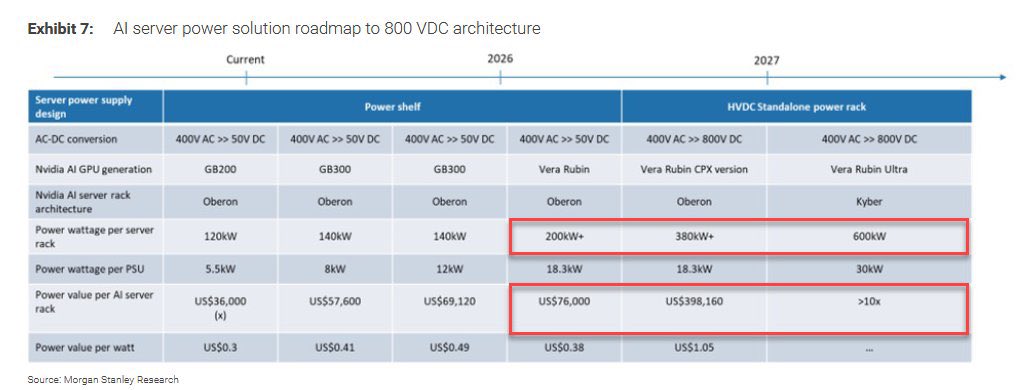
Everyone is focusing on the soaring memory cost in the Vera Rubin rack. But the real shocker in this Morgan Stanley slide is actually power, because the industry is now talking about moving from roughly 120kW per rack today toward potentially 600kW per rack by the Vera Rubin Ultra generation in 2027, which is an almost unimaginable escalation in power density within an incredibly short period of time.
To put this into perspective, many traditional enterprise datacenters historically operated at only a few kilowatts per rack, while even modern hyperscale campuses today often consume only tens of megawatts in total facility power draw. But once you begin deploying hundreds or thousands of 600kW AI racks simultaneously, the math becomes almost absurd because a large-scale Vera Rubin Ultra cluster could eventually consume gigawatts of electricity, effectively rivaling the energy demand of a mid-sized city.
And this is where the market still massively underestimates the second-order implications of the AI boom, because the bottleneck is no longer simply semiconductors, GPUs, or memory supply. The bottleneck increasingly becomes electricity itself.
The US power grid can barely keep up with current AI infrastructure demand already, while transmission congestion, transformer shortages, substation constraints, cooling limitations, permitting bottlenecks, and aging grid infrastructure are becoming increasingly visible across major datacenter hubs. Importantly, grid infrastructure cannot scale at semiconductor speed. You can accelerate chip production with enough capital expenditure and engineering talent, but building transmission lines, substations, generation capacity, cooling systems, and interconnection approvals often requires many years due to environmental reviews, local opposition, labor shortages, and physical construction constraints.
This is precisely why we continue believing the AI buildout is not a two-to-three-year investment cycle, but instead a decade-long industrial transformation that increasingly resembles the buildout of railroads, electricity networks, and telecom infrastructure during previous industrial revolutions.
And this is also why energy infrastructure is quietly becoming one of the most important and underappreciated AI trades globally.
The winners are no longer just GPU companies. The winners increasingly include utilities like Constellation Energy and Vistra, nuclear-related plays like Oklo and NuScale Power, gas infrastructure companies like Kinder Morgan and Williams Companies, grid and electrical equipment suppliers like GE Vernova, Eaton, Schneider Electric, and Vertiv, as well as transformer, cooling, and datacenter infrastructure providers that now sit directly inside the physical backbone required to support next-generation compute.
Hyperscalers themselves are starting to understand this reality. Companies like Microsoft, Amazon, Alphabet, and Meta are no longer simply software companies buying servers. They are increasingly becoming quasi-energy infrastructure companies because securing long-duration power availability is becoming strategically inseparable from securing compute capacity itself.
That is why nuclear power is quietly returning to the center of the conversation. Hyperscalers may eventually fund or directly partner on nuclear generation projects out of pure necessity because renewable intermittency alone cannot reliably support ultra-high-density AI clusters operating continuously at scale.
In many ways, AI is beginning to collide with physical reality. You cannot run trillion-dollar next-generation compute infrastructure on transmission systems and grid architectures that were largely built decades ago for a completely different industrial era.
The semiconductor story may have started the AI race, but energy infrastructure may ultimately determine who wins it.
1
105
May 22
This is for future $iren retail.
Stakeholders > stockholders.
Also hoping this is a precursor to their next deal signing.
Setting expectations that even w the next deal, there’s more.
May 22

𝐓𝐡𝐞 𝐑𝐨𝐚𝐝 𝐀𝐡𝐞𝐚𝐝
IREN has been building Layer 1 for eight years. We are deploying Layer 2 at scale right now. And with Mirantis, we have taken the first deliberate step toward Layer 3.
The physical infrastructure advantage comes first.
Everything else compounds from there.
It has become almost cliché to say we are still in the early innings. But it genuinely feels that way. The opportunity feels generational. We have assembled the key inputs to be in a position to compound a genuine time-locked competitive advantage – and right now, the biggest opportunity in the world is simply bringing more of that compute online. These journeys are rarely linear. There will be speed bumps and challenges along the way that we cannot yet see. But we have never been more excited about what lies ahead, and intend to make the most of it.
111
May 21
pretty much every morning i wake up and check X for a deal announcement by $iren.
ever since feb.
how about u?
43
May 21
i think about this when i invest:
“Given a 10 percent chance of a 100 times payoff, you should take that bet every time.” -jeff bezos
12
May 21
why doesnt jensen acquire neoclouds like $iren since he clearly sees value in verticalization?
2
343
May 20
if u here jensen speak today in the @nvidia EC… uses the word “VERTICALIZATION” quite a few times - all positive connotation.
wants to help @AnthropicAI secure power.
hmmm which neocloud is grid connected (est 5 GW) and partnered w nvidia?
answer: $iren
1
260
midlife investor retweeted

May 19
I still own $IREN because I think the market is underestimating both the $NVDA alignment and how hard its power footprint is to replicate.
If the company can turn ~5 GW of secured power into Nvidia-aligned AI cloud capacity then the market may start valuing the 10x gap between its power base and near-term AI cloud needs.
May 19

"The biggest bottleneck right now in AI is no longer just the models or the GPUs."
Power, data centers, cooling, interconnect, time to compute. The bull case for $IREN sits on the physical layer.
60
72
1,013
1,300,332

May 16
i hear a lot about "constraints, bottlenecks, time to compute, etc." what this means is that there are opportunities.
$iren is built on this growing demand (and little supply). listen, i have no idea what a gigawatt even is. (do you?) but being middle aged tells me that iren...
2
3
4,945
May 16
all that to say: a deal WILL come. hard being patient when you see the likes of kevin xu, who actually introduced a lot of people to iren, swing trading their way to 90k from 35k in the same period (nice trade on Bot @kevinxu) while we still have to endure...
1
2
169
May 16
the ebbs and flows of being an $iren holder. but as a middle-aged man who's seen a thing or two: better to build your house on solid foundation than sand.
we will be vindicated one day.
s/o
@mikealfred
@BitcoinAIGuy
@jiahanjimliu
@BlackPantherCap
@JoshInvestsAI
4
7
229
May 16
pretty sure everyone who is espousing the wonders of photonics… dont really know what photonics is.
134
midlife investor retweeted

May 15
I interviewed @bubbleboi about his ratings of AI supply chain bottlenecks.
We talked about DRAM, advanced packaging, CPO, HBF, PCBs, power delivery, etc.
0:00 HBM, DRAM, the cartel
7:24 Silicon photonics, CPO, Lumentum lasers
11:35 Advanced packaging: TSMC vs Intel
13:49 HBF: Sandisk/SK monopoly window
17:02 Memory accelerators TurboQuant
22:35 PCBs Unitika
27:27 Power: transition from 48V to 800V
31:32 Outsourced assembly test, fiber coupling
36:23 HBM vs DRAM vs NAND in 2-3 years
42:03 Where will hardware founders come from?
44:10 Alt accelerators: Etched, Taalas, MatX
48:43 Emerging tech: CPO bearishness
49:23 Hyperclouds
49:53 HBF timeline CXL
51:48 Voltage cooling wall
56:30 Rapid fire: Intel, Nvidia, TSMC, Alphabet
1:05:25 ASML, Hynix, Lumentum, Wolfspeed
1:13:25 Building conviction in Intel
1:19:37 Pitching Intel to funds
1:22:39 X accounts, analysts why care about any of this
29
95
1,055
244,849
May 15
@leopoldasch missed the 5:30 PM filing window. probably not by accident.
4 reasons why:
(1) alpha preservation: If disclosing a new position ruins the entry price on an ongoing trade, a six-figure SEC fine is a rounding error compared to the cost of market slippage
cont'd ...
1
1
10
12,062
May 15
(3) Regulatory Friction: The fund could be in a standoff with the SEC over a Confidential Treatment Request to keep a specific, high-stakes holding off the public record.
1
2
2,125
May 15
(4) Operational Scaling: The fund’s explosive growth from $250M to $5.5B may have outpaced its internal compliance infrastructure, leading to back-office bottlenecks. (this one doubtful.)
1
1
1,890