
@fhenix Prev: BD Gaming @0xPolygon Growth @AxieInfinity
Joined December 2010
- Tweets 142
- Following 883
- Followers 583
- Likes 940
9 Photos and videos





(Rian*) retweeted

31 Oct 2025
x402 is really cool but it's missing one critical component: privacy.
Really fun experimentation by our engineer @rogue_rotkosky merging FHE and x402.
Check out the app! fhenix402.vercel.app/

3
6
24
1,915
(Rian*) retweeted

31 Oct 2025
16
15
67
17,814

Cool proposal from Carter.
Encrypted intents powered by FHE unlock a fairer, MEV-resistant coordination layer - something we’ve been building toward with CoFHE.
When computation stays private and verifiable, everyone wins.
23 Oct 2025

1/ 1inch x Encrypted Intents🔒
What could happen if DeFi’s leading intent-based DEX @1inch integrated fully homomorphic encryption (FHE via @fhenix )?
A new era of private, fair, and verifiable coordination would be unleashed.
Let’s unpack what this means👇

4
4
31
2,372
"If your privacy depends on a vendor’s attestation key, you have a service agreement - not privacy."
Watch the full recording of TEE vs FHE discussion for more hot takes:
x.com/i/broadcasts/1vOxwdBQb…
8
6
29
1,789
Three things just changed:
1/ FHE decryption got 20,000× faster
2/ Private DeFi is unlocked
3/ Fhenix made it happen
READ HOW ↴
x.com/FhenixIO/status/197522…
30
49
211
39,436
TEEs had a good run, but this @intel response is exactly why we've been building toward FHE-first systems.
The attack itself? Not shocking. But Intel basically saying "not our problem" kills any enterprise adoption path for TEE-only privacy.
Here's what people miss: this isn't just about SGX dying. It's about what comes next. Pure MPC is still a non-starter for most applications - too slow, too complex, breaks with scale. But FHE? That's your new building block for the web.
With FHE, your compute happens on encrypted data. No trusted hardware needed. No "trust the box" assumptions. Just math protecting your private state while still letting you build programmable applications on top.
The era of "good enough" privacy is over. Time to build the real thing.
5
1
10
575
(Rian*) retweeted
2 Oct 2025
The latest in TEE drama: I’ve known about WireTap for a while; paired with Battering RAM, it reinforces a point many of us have lived with for years: TEEs were a breakthrough, but can no longer serve as a single trust anchor.
Quick context on where I’m coming from. I was the first to bring encrypted computation into blockchains: MPC with the Enigma whitepaper (2015), then TEEs with @SecretNetwork (2020), and today FHE with @fhenix. Each was right at the time; each has a place going forward. But only FHE can credibly be considered the end-game.
Why FHE? Because it’s the only cryptographic solution that’s simple to build on. Pure MPC is a Rube Goldberg machine — communication-bound and fundamentally limited. I wrote both my Master’s and PhD dissertation on MPC. If anyone has sunk costs in MPC, it’s me. And yet I’ll say it: it can’t take us further.
On the flipside, TEEs struggle under an expanding physical and micro-architectural attack surface. Still, projects employing TEEs like @SecretNetwork are the only real test cases we have for privacy at scale. Credit to them for building in public, patching, and reinforcing what will remain a key ingredient in privacy tech. It just can’t be the only (or main) line of defense. That must come from cryptography.
So are TEEs dead? No. That’s a lazy take. TEEs still deliver solid defense-in-depth and cheap privacy in high-trust environments. And for huge LLMs that need GPUs and low latency, GPU-TEEs may remain a pragmatic bridge (see @SecretNetwork AI Cloud).
With that said, all the anti-TEE privacy projects celebrating this “victory” should be more humble. How many of you are actually in production? That includes Fhenix, which I’m building right now. We all have a long way to go — and most of the posts I’ve seen from MPC/FHE/ZK projects are being disingenuous about their own privacy pitfalls.
Where we’re failing, as a community, is vocabulary. We need clear privacy levels — something as legible as @l2beat’s rollup stages, but for privacy: what’s protected, against which adversary, with which residual risks. I’m drafting a framework; if you want to pressure-test it or contribute, DM me.
The takeaway: treat TEEs as a component, not the foundation. Build toward FHE-first systems with MPC-hardened keying — and be explicit about the privacy level you’re actually delivering. That’s how we make programmable privacy for chains real.

8
16
42
4,301
(Privacy Builders Assemble*)
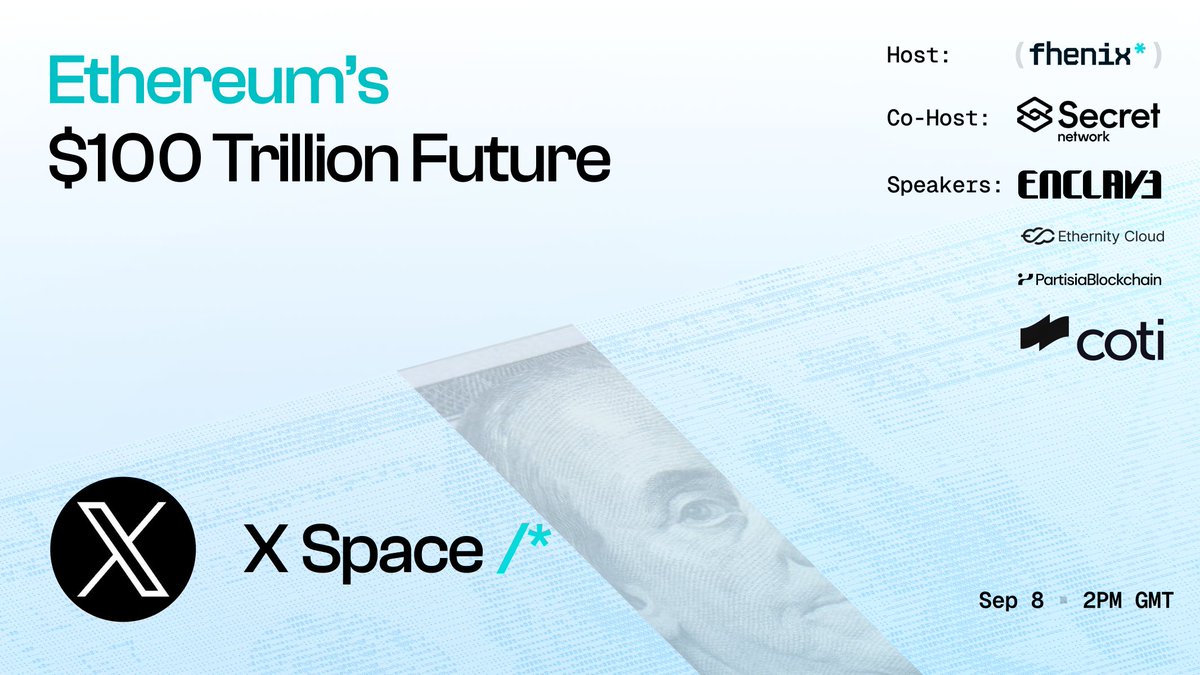
Ethereum wants to scale to $100T. But without confidentiality, it’s a dead end.
Next Monday we’re gathering the sharpest minds in privacy to discuss how confidential compute becomes the missing block of DeFi.
Sep 8, 9AM EST 🔗x.com/i/spaces/1ZkKzZwkjqvKv
Speakers:
*Guy Zyskind, Founder @fhenix
*Guy Itzhaki, CEO @fhenix
*Auryn Macmillan, CEO @EnclaveE3
*Iosif Peterfi, Founder & CEO @Ethernity_cloud
*Anewbiz, CMO @SecretNetwork
*Bruce Ahn, Chief of Staff @partisiampc
*Shahaf Bar-Geffen, CEO @COTInetwork
*Joshua Maddox, CEPO @COTInetwork
*Gavin Thomas, CEO @tenprotocol
If you care about DeFi’s future, this is where the conversation starts.
39
35
122
35,564
(Rian*) retweeted

8 Jun 2025
🧵1/6: Introducing BigNumberGame on @fhenix 🧠🔐
A game where two players submit encrypted numbers, and the contract determines who submitted the larger number — without ever decrypting them on-chain!
Let’s break down the contract function by function 👇
4
6
26
3,506
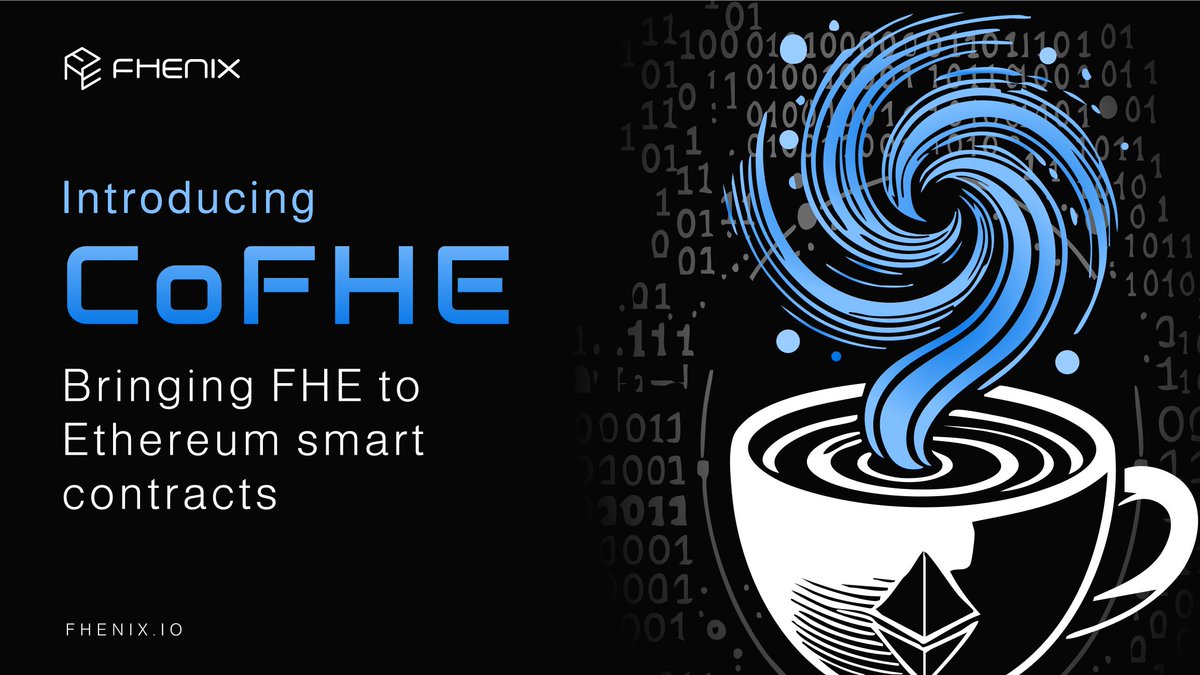
Introducing ☕️CoFHE: FHE with a Single Line of Code!
CoFHE is bringing FHE to Ethereum smart contracts—enabling encrypted computation with a single Solidity import. Now live on Ethereum Sepolia testnet, with more EVM chains coming soon!
cofhe-docs.fhenix.zone/
31
49
214
26,510
Kinexys by @jpmorgan highlighted @fhenix as a technology solution provider in a whitepaper exploring privacy solutions for the tokenized investment fund industry. 👀
Read it here: jpmorgan.com/kinexys/content…

762
276
773
18,423

A gas free future.
Let's discuss?
🎙️ @real_n3o
🎙️ @rianrab
🎙️ @achilleas40
⏰ 9am PST FRI March 22
x.com/i/spaces/1dRKZEPrlkQxB
20 Mar 2024

17
25
155
23,961
(Rian*) retweeted

18 Mar 2024
It’s time.
Introducing the Forbes Legacy Pass: 1,917 soulbound passes curated for you - the creators, entrepreneurs and change-markers shaping the Web3 world.
Learn more about our flagship membership club 🧵
forbes.com/legacy-pass/
630
1,180
2,350
302,504
(Rian*) retweeted

7 Dec 2023
Tattoos, but put them on-chain 🌹 👀
7 Dec 2023

First tattoo sold by @allentattoo on @cocreateink 🌹
Beta access beginning to roll out today 🤩
#onPolygon @0xPolygonLabs



2
4
25
2,899