
Building the navigation layer for the physical AI era. Your movement creates real-world intelligence, and you own its value.
Joined May 2022
- Tweets 1,015
- Following 88
- Followers 44,333
- Likes 863
243 Photos and videos









Pinned Tweet

Feb 4
The new Roam app is live: refined look, better user experience.
Available Now ⬇️
153
116
389
57,699
Jun 12
The future of autonomy starts with the network supporting it.
Mar 30

The industrial revolution of the modern era is taking shape.
Roam is putting you at the cutting edge of it all.
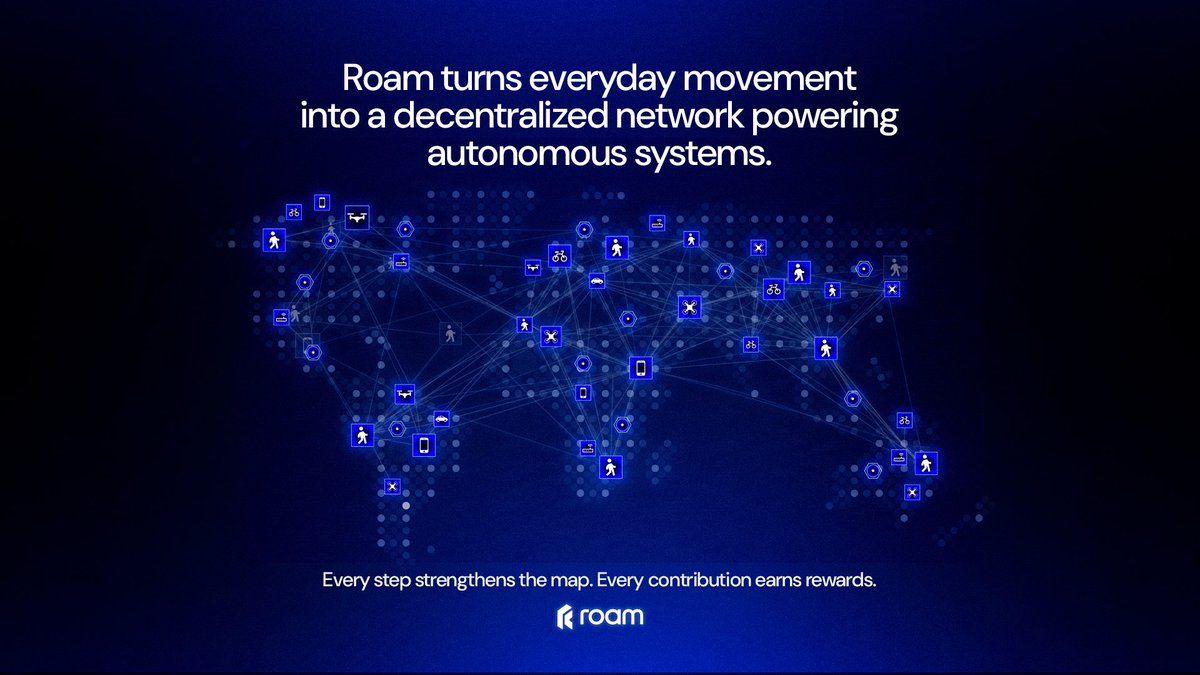
Through data sharing from your mobile device, you can help power the future of autonomous robots.
One network. Millions of contributors.
Welcome to Roam.
4
2
43
1,326
Jun 10
A strong signal that robotics is entering a new era of scale.
Jun 10

🤖 UPDATE: Tether is leading NEURA Robotics’ Series C round of up to $1.4 billion, one of the largest robotics funding rounds ever, to help power autonomous robots with AI and onchain payments.

4
4
48
1,328
Jun 8
Physical AI won’t scale without the infrastructure behind it. Partnerships like this will only become more common.

Today, NVIDIA and Doosan Group announced a collaboration to advance physical AI and AI factory infrastructure.
Our companies will explore robotics, AI factory power solutions and advanced electronics materials for next-generation data center systems.
Read more: nvda.ws/49LgyWk

7
5
52
1,520
Jun 4
Roam's network compounds with every new device, proven by telcos already buying our coverage data.
Every phone, vehicle, drone, or IoT node adds another layer of real-world intelligence. Coverage expands horizontally, while depth of understanding stacks vertically.
Better data improves the system. Better outputs attract more users. More users generate even better data.
It starts with you. Download the Roam app today.
41
31
129
3,975
Jun 1
This is the kind of full-stack reference design that can speed up the entire robotics ecosystem.

NVIDIA announces the first open humanoid robot reference design built for robotics research.
The NVIDIA Isaac GR00T Reference Humanoid Robot combines the @UnitreeRobotics H2 humanoid robot, @SharpaRobotics Wave five-fingered hands for dexterous manipulation, Jetson Thor onboard compute, and Isaac GR00T open software and models, giving researchers a full-stack platform from data capture to model deployment.
Read the #NVIDIAGTC Taipei announcement: nvda.ws/4ef9VOr
7
2
55
2,187
May 28
The Roam Referral Rally is on.
More tickets. Better odds.
It’s that simple!
May 19
The Roam Referral Rally is LIVE!
Invite friends to Roam and you’ll both earn tickets in the lottery draw.
More referrals = more tickets = better odds in the draw.
500 USDC Roam Points are up for grabs.
Campaign runs from May 19 to Jun 9.
Share your referral code and start rallying now!
10
14
66
2,599
May 25
Important numbers to consider as Physical AI scales:
For teleoperation and cloud coordinated systems, latency must stay below 100ms, with sub 20ms as the ideal. Yet, in real world 5G networks, tail latency spikes above 270ms are common during congestion or tower handovers.
Jitter is even more damaging. When latency fluctuates between 20ms and 300ms, control systems cannot stabilize, leading to phantom braking, oscillation, and higher error rates.
Then there is the handover problem.
As drones, autonomous vehicles, and robots move, they constantly switch between cell towers. These transitions are highly unstable. Ping pong handovers can drive latency spikes up to 85 percent. At speed, even a 500ms delay can translate into positional errors of tens of feet, turning routine operation into a collision risk.
This is not an edge case. It is a structural limitation of centralized networks.
Roam offers a different path.
By building a decentralized connectivity layer powered by everyday users, Roam turns the network into a distributed, real time data fabric. Instead of relying on fragile tower transitions, connectivity becomes continuous, adaptive, and strengthened through global participation.
As machines take on more responsibility in the real world, network reliability becomes mission critical. Roam ensures the signal keeps up.
8
10
86
2,741
May 21
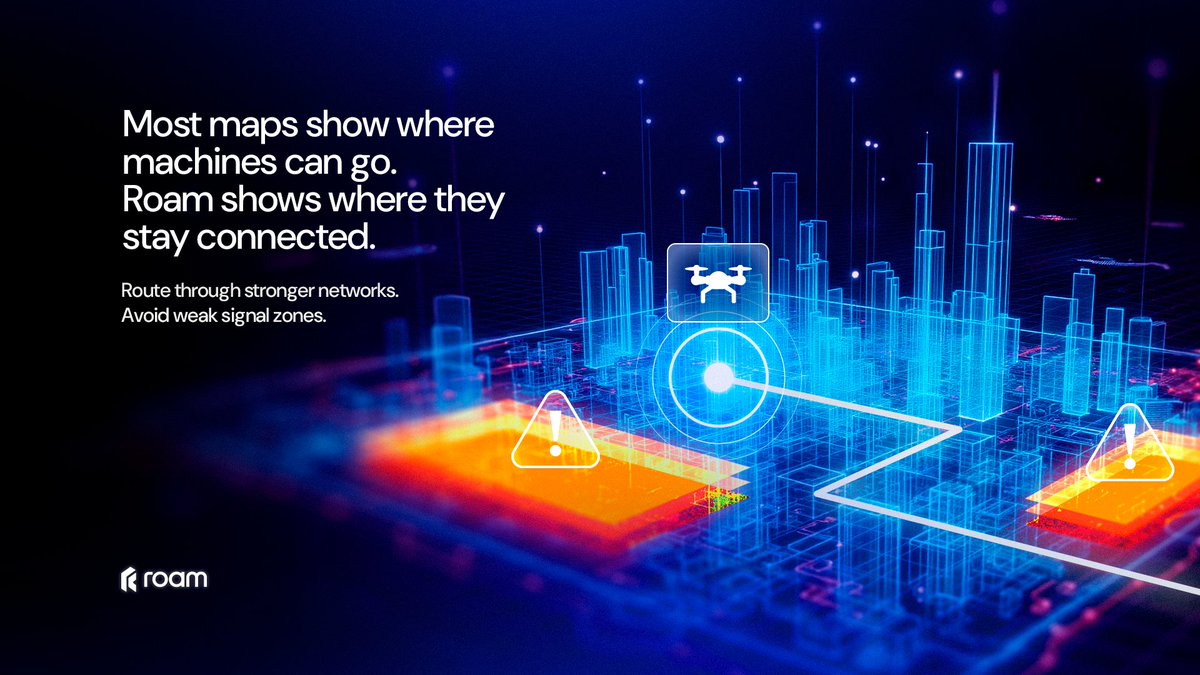
Autonomous machines need a connectivity layer that moves as fast as the real world does.
Apr 16
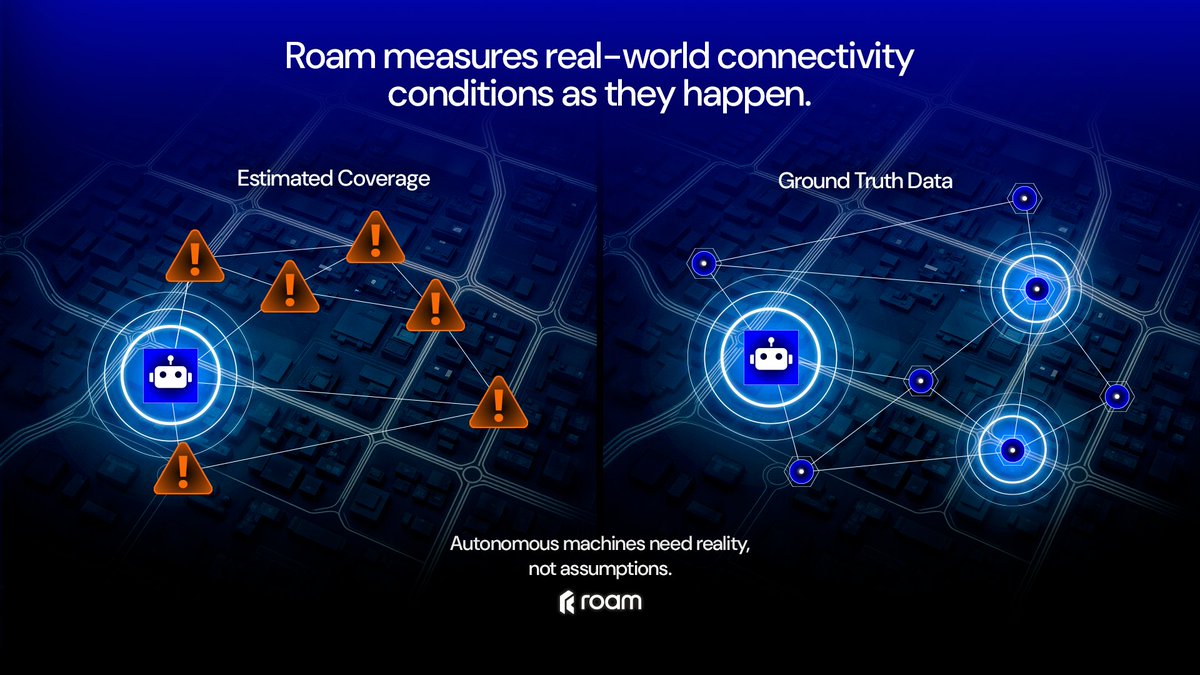
Traditional telecom infrastructure relies on limited, outdated snapshots of network performance.
Spoiler alert: This doesn’t bode well for Physical AI, the new frontier of real-world intelligence that depends on continuous, real-time connectivity awareness.
Roam bridges that gap with a user-powered data layer that reflects real conditions in real time.
Join us in creating a shift from static reporting to living intelligence.
11
10
96
2,764
May 19
The Roam Referral Rally is LIVE!
Invite friends to Roam and you’ll both earn tickets in the lottery draw.
More referrals = more tickets = better odds in the draw.
500 USDC Roam Points are up for grabs.
Campaign runs from May 19 to Jun 9.
Share your referral code and start rallying now!
52
31
150
9,995
May 18
The leaderboard is LIVE, and the community has been working hard to climb the ranks.
If you haven’t checked it out yet, now’s the time!
May 12
The Roam Leaderboard is now LIVE in the app.
Check your rank locally and globally, all-time, or even in last 30 days, to see how you stack up against the community.
Download now and comment your rank below!
19
10
105
3,065
May 14
Heads up! Roam app v2.1.13 is LIVE.
Upgraded referral mechanics backend improvements.
A new campaign will launch soon that requires the latest version.
You don't want to miss this.
Update today!
27
19
138
4,835
May 14
Eight hour shifts nailed. Worldwide deployment loading...
May 13

Watch a team of humanoid robots running a full 8-hr shift at human performance levels. This is fully autonomous running Helix-02 x.com/i/broadcasts/1dJrPEVbZ…
12
10
61
2,624
May 12
The Roam Leaderboard is now LIVE in the app.
Check your rank locally and globally, all-time, or even in last 30 days, to see how you stack up against the community.
Download now and comment your rank below!
85
53
183
8,899
May 8
Aging populations across developed economies are shrinking the workforce at a structural level. Often referred to as the Silver Tsunami, this shift is creating labor shortages that cannot be solved by immigration or higher wages alone.
In sectors like warehousing, labor scarcity is already driving adoption of autonomous mobile robots. In agriculture, the rising average age of farmers is accelerating the need for autonomous machinery such as self-driving tractors.
AI is no longer adhering to the “replacement theory” to cut human labor costs. It’s replacing roles that no longer have humans available. Automation becomes essential for maintaining continuity of operations.
As a result, ROI is shifting. If a robot is the only system capable of maintaining output, reliability becomes the most important metric. A failure is no longer an inconvenience. If a robot goes offline, there is no human fallback, and the supply chain breaks.
This is where Roam becomes critical.
As Physical AI systems scale, they depend on continuous, resilient connectivity and real-world data. Roam provides a decentralized connectivity and data layer that strengthens with every device and environment mapped, reducing single points of failure and ensuring these systems remain operational when it matters most.
10
6
70
3,171
May 6
Your mobile device generates data every time you’re out for a run, meeting a friend, or scanning the ice cream aisle at your local grocery store to reward yourself for that run earlier in the day (we won’t judge).
Roam turns all of that movement into rewards.
Your device becomes part of a global network, capturing real-world connectivity signals as you go about your day.
That data becomes infrastructure for physical AI.
Contribute passively. Earn $XRO. Build the network that powers what comes next. (And enjoy that ice cream while you’re at it.)
60
39
134
5,358
May 1
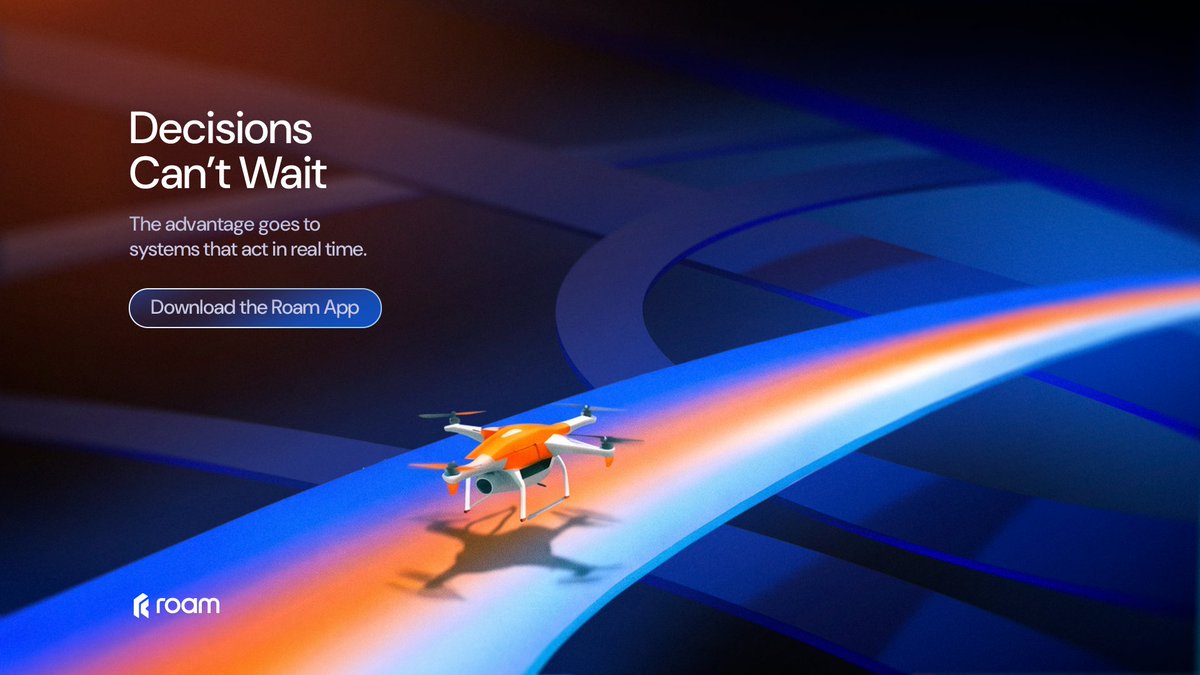
Physical AI isn’t confined to factory floors. It’s moving through transportation, defense, logistics, and anywhere decisions meet execution. Rising costs, labor gaps, and unpredictable environments aren’t waiting for perfect autonomy.
The advantage goes to systems that can operate today.
Telcos already tap our coverage data for real revenue and your device powers it.
Download the Roam app today to join in!
10
9
87
3,273
Apr 29
AI is emerging as the core intelligence layer of modern systems, driving coordination, optimization, and decision-making across increasingly complex digital and physical environments.
At the same time, Decentralized Physical Infrastructure Networks (DePIN) are reshaping infrastructure ownership by distributing control across networks of individuals and organizations that deploy and operate real-world physical assets, transforming infrastructure into an open, participant-driven system rather than a centralized one.
The challenge is that these two revolutions have evolved in parallel rather than in unison. One decentralizes the physical world, the other advances intelligence in the digital one. This separation limits how effectively they can reinforce each other.
Roam addresses this by acting as the connective layer between decentralized physical networks and AI-driven coordination, linking real-world infrastructure with adaptive intelligence systems in a unified framework where data, connectivity, and decision-making continuously reinforce each other in real time.
Download the Roam app today if you’re ready to lead this movement with us.
14
9
83
3,675
Apr 27
Roam's first-ever Zealy Sprint is LIVE!
Earn top spots for Roam Points USDT prizes, all while earning discord roles along the way.
Games, referrals, beta testing, AMAs, all on a fresh leaderboard.
Join now: zealy.io/cw/roamnetwork
25
20
114
6,731
Apr 23
Most robotics progress looks like a game-changer, but real value comes from what actually works when the mission is set.
The winners separate deployed capability from theoretical demos and build accordingly.
Roam gets this; and we're building the live digital map AI systems need, powered by your mobile device.
Join us. Download the Roam App today.
59
54
137
4,475