🚨
Local dependence → manifold hypothesis
Distant independence → Markov random fields
New preprint: the latter works in conjunction first, massivly improves data efficiency, and can be exploited by DNNs arxiv.org/abs/2411.15095
With
@itsrainingdatasites.google.com/view/wmtai
🎉I'm happy to announce that our paper "Breaking the curse of dimensionality in structured density estimation" was accepted to NeurIPS 2024. 🎉
with:
Wai Ming Tai (Nanyang Tech. Uni. - sites.google.com/view/wmtai )
and
@itsrainingdata (U Chicago)
-Preprint forthcoming-
NeurIPS preprint: arxiv.org/abs/2410.07685
Standard models for spatial, sequential, hierarchal, etc data result in drastically reduced effective dimension for density estimation. This effective dimension is orthogonal to other approaches such as sparsity or manifold hypothesis.
Just noticed that Tsybakov (author of one of my favorite textbooks: Intro. to Nonparametric Estimation) wrote a nice extension of my 2021 NeurIPS paper "Beyond Smoothness: Incorporating Low-Rank Analysis into Nonparametric Density Estimation."
Exciting!
hal.science/hal-04557030/
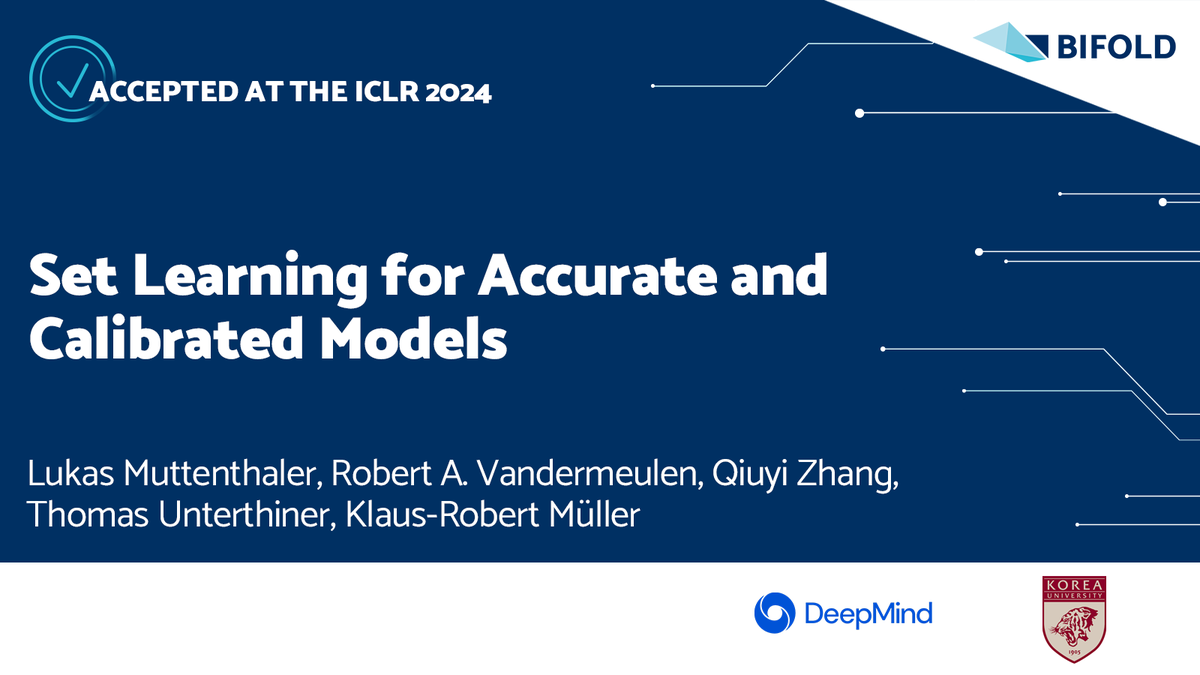
ALT Set Learning for Accurate and Calibrated Models” is accepted at the 12th International Conference on Learning Representations (ICLR) 2024.
Authors: Lukas Muttenthaler, Robert A. Vandermeulen, Qiuyi Zhang, Thomas Unterthiner, Klaus-Robert Müller
Wrap up: Are you worried about miscalibration of your model outputs but tired of post-hoc temperature scaling and think label smoothing is a hack? Then just train with OKO - a principled set learning approach for more accurate and better calibrated models. OKO is very simple to use: Just change your sampling strategy from standard single data point sampling to set sampling and compute cross-entropy for the sum of set data point logits rather than for single data point logits. Because this forces a model to bring all class logits onto the same scale, your model will be much better calibrated!
OKO got accepted to #ICLR2024🎉🥳 OKO is very simple to use: Just change your sampling from single data point sampling to set sampling and compute cross-entropy for the sum of set data point logits rather than for single data point logits. You will get much better calibration! 🔥
🚨 Preprint alert🚨 Are you worried about miscalibration of your model outputs but tired of post-hoc temperature scaling and think label smoothing is a hack? Then just train with OKO - a principled set learning approach for better model calibration! (1/5)
arxiv.org/abs/2307.02245
🔥The CfP for Re-Align is up 🔥
If you are broadly interested in the alignment of two or more representation spaces, consider submitting to our workshop at #ICLR2024 and join us in beautiful Vienna!
🚨Call for Papers🚨
The Re-Align Workshop is coming to #ICLR2024
Our CfP is finally up! Come share your representational alignment work at our interdisciplinary workshop at @iclr_conf: representational-alignment.g…
1/4
What aspects of human conceptual knowledge do machine learning objectives fail to adequately capture? Could we use small datasets of human similarity judgements to improve model representations and get better downstream performance? @lukas_mut's cool new work has the answers!
It seems like all math tests for LLMs involve just the direct application of various rules, like a bunch of trig or calc rules, to solve the problem. How about getting a LLM to prove the intermediate value theorem or some other proof that requires a clever construction?
Freshman: I don't know how to solve this problem. It's too hard!
Tutor: OK, first let's do this tiny step.
Freshman: Yeah, yeah. I know /that/. But that doesn't solve my problem.
Tutor: OK, now let's take the next tiny step.
...