
currently transitioning to 3.0
Joined July 2009
- Tweets 834
- Following 167
- Followers 63
- Likes 1,332
21 Photos and videos












Jan 16
Writing, as the ability to think and articulate well your thoughts, will probably remain the only useful tool in a future where humans would heavily rely on AI to run their days. Clearly prompting will be an edge when everything else will be democratized

43
Enuma Elish retweeted

3 Nov 2023
Hamas crypto funding, the WSJ, and the Warren Letter | Medium
We've had 90 submissions to my WSJ fact-checking bounty. 30 have been paid out. Based on all the evidence so far, here's what we know:
medium.com/p/b89cac007683
55
485
1,528
285,479
Enuma Elish retweeted
26 Oct 2023
blockchain data is sufficiently malleable and subjective that you can make it say anything you want. journalists working with on-chain data should know this.
you're never going to get specific answers from on-chain data. the correct attitude to the data should be hedging and humility. it is completely irresponsible to make hard factive claims about clusters of addresses. (my credentials on this: I cofounded an on-chain data company – I've been puzzling over on-chain data for seven years).
it is a fact that the Warren letter, which relies exclusively on the WSJ reporting, specifically states "[PIJ and Hamas] raised over $130 million in crypto", with no caveats or emphasis of the uncertainty of the underlying data. we know now that this is false. there's no data which supports a claim this strong, period.
the WSJ whether they like it or not, are willing patsies for Warren in this case. what they _should_ have done, if they wanted to stress the nUaNcE in the data, is to specifically and immediately refute the Warren letter, to the extent that it was unsupported by their own reporting. (and to be clear, the mealy mouthed journos that are trying to weasel out of this would _not_ be able to defend the claims in the Warren letter.)
part of the reason we in the crypto space are so upset is because the WSJ set the table for Warren to come in and start to crack down aggressively on crypto based on this terrorist financing canard. if the WSJ had been intellectually honest, they could have reacted to the letter and issued some follow-up reporting emphasizing the uncertainty in the data.
they did not do this. they doubled down, and now when pressed, are falling back on much weaker claims ("these wallets are PIJ-linked" "Wallets associated with Hamas received "up to" 93m" etc). meanwhile, the Warren letter is outstanding, an atrocity.
I know as a journalist when the subject of your article reacts harshly to your reporting, you take that as a cue that you're over the target, and your instinct is to double down. in this case, that's wrong. accept that you paired hard claims with extremely subjective data, and that was inappropriate. listen to, dare I say, the experts.
23
111
609
60,895
Enuma Elish retweeted

4 Jun 2023
IMPORTANT!!
@biancoresearch TWITTER ACCOUNT HAS BEEN HACKED. BELIEVE IT OR NOT, HE'S HITTING A WALL GETTING @Twitter SUPPORT TO GET SITUATION UNDER CONTROL
JIM IS NOT SELLING A BIANCO COIN. THIS IS A MASSIVE SCAM HE IS TRYING TO RECTIFY. PLEASE RETWEET THIS FOR THE GREATER GOOD
60
614
1,031
201,896

Enuma Elish retweeted

9 Sep 2022
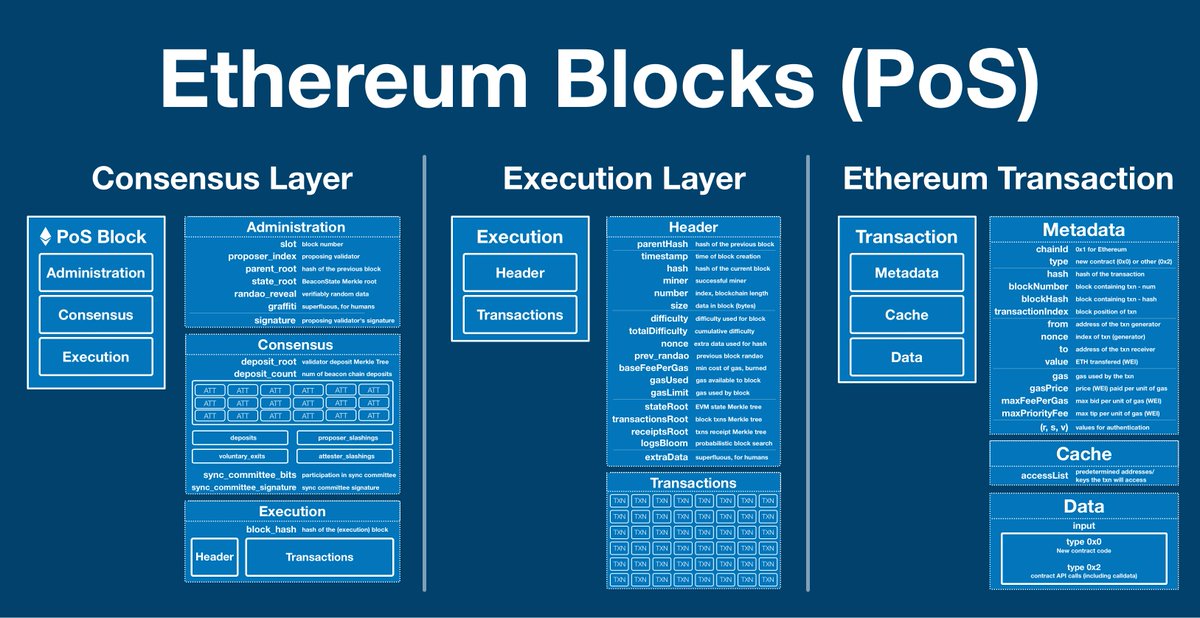
(1/21) @ethereum Fundamentals: PoS Blocks
In less than 1 week, the Ethereum blockchain will Merge with the Beacon Chain and the World Computer will transition from PoW to PoS. The blockchain will never be the same.
A field-by-field guide to on-chain future.
29
156
433

If enough people tweet this maybe @GaryGensler will come on Bankless.
Engage with the community Mr. Chairman. We just wanna talk!
52
201
842

12 May 2022
Just remember. Just when you think it is over, it starts all over again 😉

22 Apr 2022
Hi @IsdrsP , after watching ur talk from @EFDevconnect I would like to ask you some questions. @LidoFinance as of today is sitting on 3.2M ETH, that’s 100k validator nodes on the beacon chain after the merge. You mentioned in the talk that only 21 permissioned operators have…1/2
2
22 Apr 2022
been curated so far. Is it safe to say that after merge, and if no additional operators are selected, the 100k nodes will be split amongst these 21 entities? Or will they each get a max cap and the rest of nodes will remain “inactive” until more operator have been onboarded? 2/2
6 Apr 2022
#Ethereum the byte-code is made up of 2 parts; the creation and the runtime. Once a contract is deployed, the creation code is executed once and the runtime is storedz