725 Photos and videos





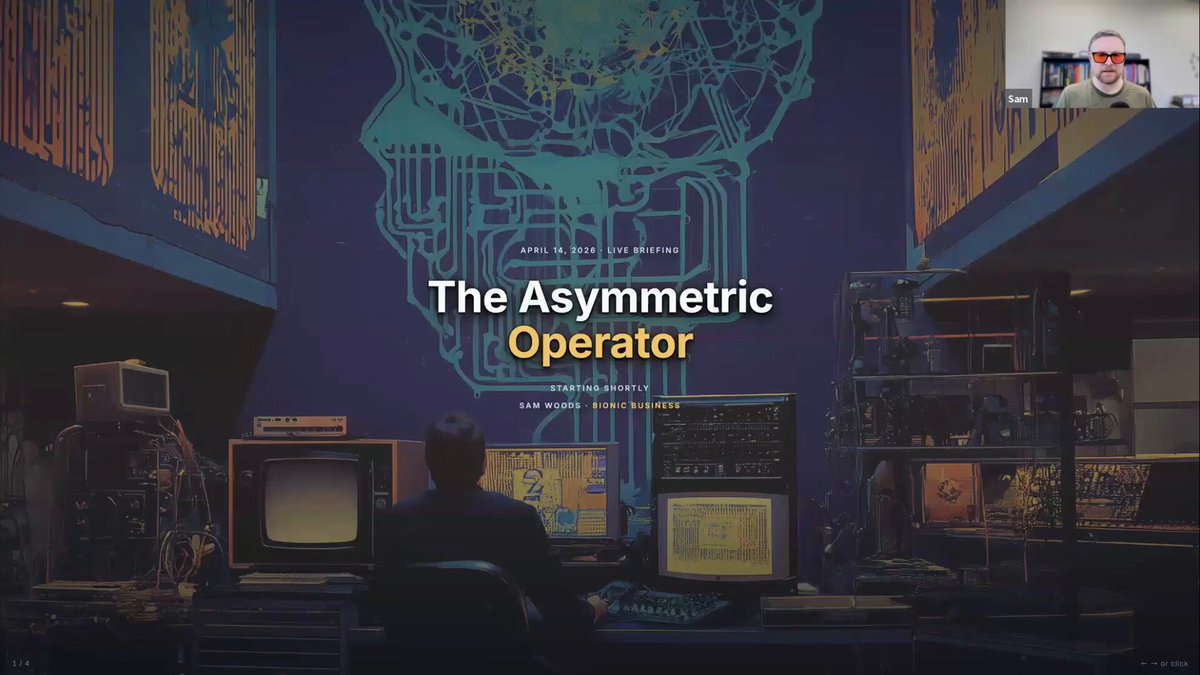




The Asymmetric Operator
====================
The operators building agents right now are mostly stuck solving the wrong problem.
I ran a live briefing on this the other week for a small room of operators already building with agents. Full video attached. Short version below.
Almost every agent platform is within a rounding error of the others on raw capability. The agents can do the work. Most operators have figured out the real bottleneck is coordination, so they're switching orchestration tools every other month chasing a fix.
Twelve-month read: coordination is closing at the platform layer. The platforms you're using have been quietly collecting your fix-it decisions all year, and that data is the training signal for agents that self-correct. If your edge is managing agent failures, you have nine months before the default tools absorb it.
The layer that compounds past that is underneath the agents. A small set of files your whole system reads from, structured as a single source of truth instead of fifteen agents each guessing from a fresh prompt. Inside that layer, the piece almost nobody is building is thought patterns, your reasoning about the work logged as you make decisions.
Ten minutes a day per cohort, voice-to-text is fine. At the end of the week pull out the five or six patterns that kept showing up and drop them into the cohort's master context file. Repeat for a month and the agents' outputs start reading like a sharper version of your own judgment rather than a generic model's best guess.
Six months in, the operators I advise have agents making sharper calls than any competitor's agents, because those agents have been trained on half a year of their captured reasoning. No competitor can buy that. Living through the same six months is the only way to produce it.
If you want more like this every week, see the next post or profile.
**Chapters:**
00:00 Why this isn't about prompts or agents
04:25 The agent landscape right now
07:45 Why agent capability is commoditized
08:30 The e-commerce friend running 80% of his business on one agent platform
10:30 What the one-person billion-dollar company actually proves
14:25 The coordination problem and why it gets solved this year
19:00 How agent platforms are quietly learning from your fixes
22:30 Scattered vs. coordinated vs. redesigned businesses
24:45 What cognitive architecture really means
28:00 Thinking in cognitive labor instead of org charts
31:10 The file layer: claude.md, agents.md, skills, memory, context, heartbeat
38:30 What makes an architecture cognitive: thought patterns
40:10 The 10-minute daily decision journal that feeds your agents
42:30 Why your thought patterns don't need to be perfect
44:40 Where to start if you don't have agents yet
46:20 Thought patterns per agent team, not per whole business
48:20 Case study: SaaS consultancy with 7 agents and 3x capacity
51:15 Decomposing work into 7 units of cognitive labor
53:30 Month-by-month build timeline
56:00 The data set no competitor can copy
1:01:20 The maturity ladder: reactive, automated, attentive, autonomous
1:03:35 What's coming over the next 12 months
1:06:40 Your job when agents handle execution
1:08:00 Why now is the cheapest this will ever be
Want more? See next post
2
46
163,414
I spent forty minutes last week with an operator running a $1.4M expert business who couldn't pick between three offers.
A premium small-group program, a productized audit, and a licensing deal with two existing clients. He'd been arguing with himself for six weeks, and his team was waiting on the answer to plan the next quarter.
I asked what his audience was buying right now from people adjacent to him. He didn't know.
I asked what those operators were charging. He didn't know that either.
I asked which of the three offers his team could deliver without him in the room. He didn't have a good answer.
He was deciding what to sell from inside his own head. Most operators do.
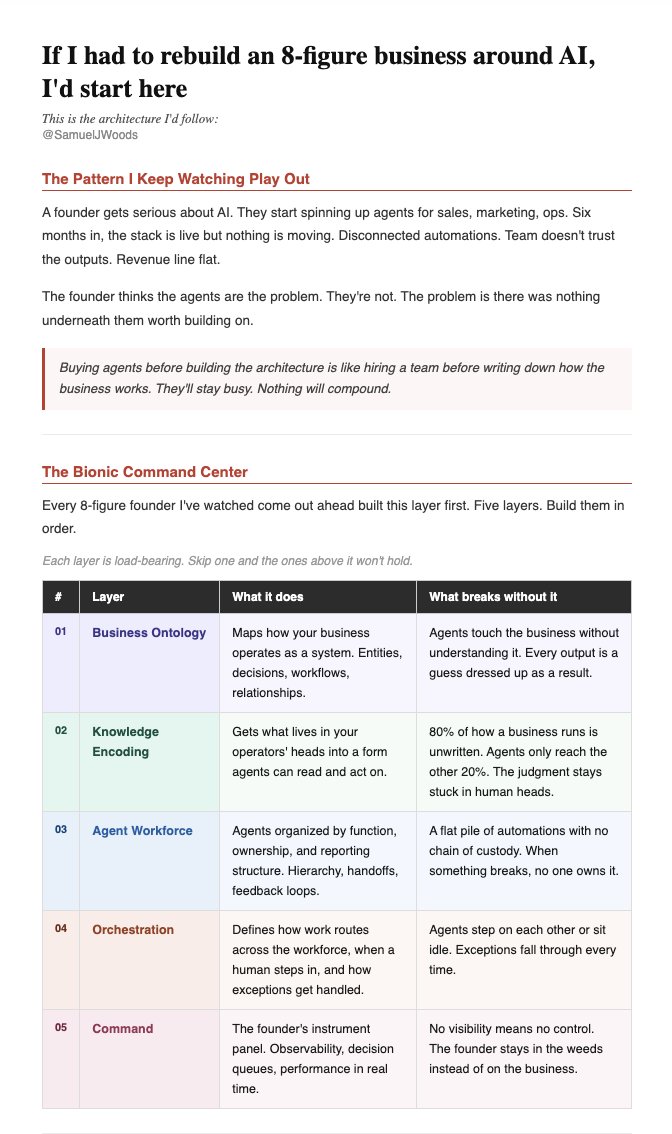
Here's how we fixed it all for him:
1
1
1
74
You notice a pattern in customer calls, sit with it for a few weeks, argue with yourself, and pick. The decision feels binary even when the evidence isn't, and the team finds out at the launch meeting.
Three streams decide whether an offer is real: what your audience is buying, what the market already serves and at what price, and what your team can deliver profitably in the next ninety days.
The offers that hit two of the three are the ones that feel right and fail anyway.
You can run that analysis yourself once. The operators getting ahead run it on a schedule, against a file that knows their business, so the decision sits on paper where someone other than the founder can push on it.
The full Offer Triangle build and prompts: bionicbusiness.com/p/offer-a…
60
He watched it the way some people watch the weather.
I asked what his blended gross margin was this quarter, and whether it was moving up or down. He didn't have the number.
He had a guess, and the guess came with a wince.
It wasn't laziness. He could have named three places the margin was probably leaking.
What he didn't have was the hours to go confirm it week after week, because that work is slow and repetitive and never finishes. So it never got done, and the leaks kept leaking.
Revenue is one clean number that one system reports. Margin is assembled from a dozen messy inputs that live in different places: billing, accounting, the fulfillment invoice, the support tool, a spreadsheet someone updates when they remember to.
A number that takes an afternoon to assemble gets looked at once a quarter, if that. So revenue can climb while profit shrinks for months before anyone notices.
That continuous, tedious, ownerless work is the exact profile of work an agent absorbs without complaint. It runs the same reconciliation every week for a few cents and never gets bored or busy.
The reason the profit side finally gets done is that it stops needing a person willing to do it.
You track revenue every day. Worth asking when an agent last checked your margin.
I'm publishing the agent kit that runs the profit side on a schedule. It goes out free at bionicbusiness.com
2
237
Salesforce hired zero new software engineers last fiscal year. The freeze ran across the whole company, and revenue climbed the entire time.
Same window, one well-known company cut 20% of its workforce, another cut 14% and pulled out of 22 countries, and hiring across the US labor market dropped to its lowest level since 2010.
The mass-layoff headline everyone keeps waiting for hasn't come. The hiring freeze did.
If you're waiting for a dramatic layoff number to mark the moment AI changed the labor market, you'll miss it.
The change lives in the job that never gets posted and the intern class that gets canceled.
The operators capturing the upside are running one move. They grow output without growing payroll, because the cost of the work itself is collapsing underneath them.
The companies adding the least headcount per dollar of revenue are setting the pace, and the gap compounds quarter over quarter.
You don't need layoffs to run the same play. Freeze the next requisition, let attrition do the trimming, route the new volume to agents.
The question worth asking before every hire from here: what would it take for an agent to absorb this instead?
Your next million in revenue probably doesn't require the headcount your last million did.
I send a read like this on the AI news that matters to operators, every week at bionicbusiness.com
1
2
580
Most operators treat AI skills like content. You download a pack, run it, move on.
The ones getting real leverage treat them like capital.
They take one task they do every week, the Friday client update or the Monday team brief, and build it into a skill once. The next week they build another.
A few months in they have a folder of twenty, and that folder is a distilled version of how their business thinks.
A downloaded skill is someone else's opinions about how the work should get done. It doesn't know your customer, your positioning, or the three hooks you've tested that convert for your audience.
Run it as-is and you get faster generic.
The value isn't the file. It's the thirty minutes of your own knowledge you layer on top, the rules you didn't realize you were applying until you had to write them down.
If you're still writing the same prompt from scratch every Monday, you've done it forty times this year.
That's not a prompt anymore. It's a skill you haven't built yet.
I write deployable builds like this for operators every week at bionicbusiness.com
1
2
727
Everyone in your market just rented the same engine you did. The frontier models are a monthly subscription now, one click away for any competitor you have.
So the model can't be your advantage. Your competitor has the identical one, and it gets cheaper every quarter.
Renting a better engine than the shop down the street stops being a strategy the moment that shop can rent the same engine tomorrow.
The advantage is the system you build underneath it.
One folder: your business written for a machine, the context that says what you sell and who you sell to and what you never do, a set of reusable instructions, your agents, and a memory of what each one did and what happened.
Every tool you pay for keeps its own private copy of who your customer is, and those copies drift apart the moment you change anything.
One folder, read by every agent, doesn't drift. The tool that reads it is swappable. The folder is the asset.
The folder also throws off something a competitor can't buy: the record of how your specific business makes decisions, accumulating every time an agent runs.
The model is a commodity. What it learns about your business while it works is not.
I build the whole system, folder and agents and all, with operators at bionicbusiness.com
1
5
818
Operators build agents around what AI can do instead of the business outcome they need moved.
So you get an agent that sends cold emails when what the business needed was booked meetings. It looks busy and the logs stay clean, but nothing in the business moves.
Write the goal as an outcome the business can measure, not a task the agent can perform. "Book qualified meetings" beats "send cold emails." "Save at-risk accounts before they churn" beats "flag churn risk."
One primary goal per agent. If you can't write the success metric in one line, the goal isn't clear enough yet.
A vague goal is how you end up with an agent nobody can tell is working.
The tooling is the easy part now. Naming what you want the thing to produce is where the leverage hides, and it's the step almost everyone skips.
I map the full anatomy of an agent, and how to build one that moves a number, at bionicbusiness.com
1
344
Sam Woods retweeted

Most copywriters who say they're "at capacity" have actually hit a memory ceiling.
You can write fast. Writing was never the bottleneck.
The bottleneck is that every client lives in a different world, and your head holds one or two of those worlds at a time. Open a project you haven't touched in eleven days and the world is gone. You reread the brand guide. You scroll old emails to recover the voice. You dig for the reason the last campaign underperformed.
Forty-five minutes later you finally start writing, for a client you used to know cold.
That's the reload tax. Every new retainer adds another world to reload, and at some point the tax eats your margin. Take on client nine and you do worse work for clients one through eight. So you stop and call it capacity.
The ceiling you actually hit is memory. Fix the remembering and the ceiling moves.
I built a system that does exactly that. One Claude Project per client, set up to hold the world between sessions so you never start cold. Peggy tracked what it saved and where it breaks.
Full build → copywriting.ai
1
1
103
Anthropic shipped two models this week. They're the same model.
Fable and Mythos are one generation, one architecture. The only difference is the guardrail configuration and who gets through the door. Fable is the public version with the dangerous domains walled off. Mythos is the same brain, handed only to vetted defenders.
For most of the chat-AI era the game was access to the best model. That just ended. The best model is the one anyone can open in the API.
So the question stopped being which model you have. It's what you're allowed to do with it, and that's set by access and trust now, not raw capability.
I broke down what the split means for operators at bionicbusiness.com
2
186
An agency owner forwarded me a LinkedIn post last month and asked why it wasn't pulling.
Clean hook, tidy structure, a real point underneath. It also read like it could have come from any of four hundred other people in his category.
He'd written it with AI in six minutes. That was the point, and it was also the problem.
Super simple fix, if you run into this yourself:
2
2
413
He'd done what everyone tells you to do. Pasted a few old posts into the chat, told the model to study his voice, asked for the next one.
What came back was competent and anonymous. The model had averaged him into the middle of his market.
The reason is simple once you see it. A few examples in a prompt window give the model a vibe to chase.
It copies the surface, short paragraphs, a question near the top, and fills everything underneath with its own defaults. Those defaults are the average of everything it was trained on, which is the most generic prose in existence.
The further your real voice sits from that average, which is the whole reason your writing works, the harder the model sands you down toward the middle.
Telling the model to write like you regresses to the mean every time.
The fix is to calibrate your voice once into a profile you can read, correct, and reuse, then make the model write against it instead of guessing. A draft built that way starts close enough that the edit becomes a pass instead of a rewrite.
The full voice-profile build and prompts: bionicbusiness.com/p/ghostwr…
2
241
I remember when clowns were screeching "it's just a stochastic parrot!!1"

Claude Fable just built this entire product from one prompt. I'm blown away.
Shotblock is a 3D shot-planning tool for AI filmmakers — real lens math, actor blocking, 180 ° rule warnings, animatics, storyboard prompt export. It researched storyboard conventions, wrote its own test suite, verified everything in a browser, and deployed it.
Then I asked for a promo video. It scripted, recorded, and edited the one below with minimal direction.
Give it a try. Free, no signup. Feedback button in the app for any issues or feature requests.
shotblock.vercel.app
2
213
Everyone in your market just rented the same engine you did.
Anthropic put its most capable model into the public API this week. Your competitor can open the identical one tomorrow, and it gets cheaper every quarter.
So the model can't be your advantage. Owning the frontier is table stakes the day it ships.
The advantage is the envelope you build around it: the context that makes it act like your business, the proprietary data a vendor will never hand your competitor, and the judgment about what to point it at and where to stop it.
Anthropic proved the principle at its own scale. One model, and the entire difference in what it can do came from the configuration wrapped around it.
Spend less time chasing the newest model the week it drops, and more on the layer a vendor can't commoditize.
I get into how at bionicbusiness.com
1
175
The newest frontier model ships with mandatory 30-day data retention, even for enterprises that previously held zero-retention agreements.
Anthropic says it's for jailbreak defense, not training. Take them at their word and the implication still stands: access to frontier capability now comes with monitoring you can't switch off.
If you handle regulated, confidential, or client-sensitive data, your posture changed the morning that model shipped.
Decide what you'll feed it before someone on your team decides for you by pasting the wrong thing into a chat window.
I write about the operator side of releases like this at bionicbusiness.com
1
3
310