Decoration Day, Armistice Day and Remembrance Day have all been days to honour Canada's veterans.
For a time, our day of remembrance fell on the same day as Thanksgiving.
But Remembrance Day as we know it has been celebrated 1931.
This is the story.
Before there was ever an Armistice Day or Remembrance Day, there was Decoration Day.
Held on the weekend closest to June 2 it honoured the Battle of Ridgeway fought on June 2, 1866. The battle saw 850 Canadian fight 750 Irish-American during the Fenian Raids.
During the raids, nine Canadians were killed and 33 were wounded.
The first Decoration Day was held in 1890, when flowers were laid at the foot of the Canadian Volunteers Monument at Queen’s Park in Toronto to honour the 24th anniversary of the battle.
From 1890 to 1918, Decoration Day was the day to remember those killed during the Fenian Raids, the NW Resistance and the First World War.
After the First World War, a motion was introduced in Parliament to create Armistice Day, held on the second Monday of November.
On Nov. 6, 1919, an appeal was issued to King George V.
He stated that Armistice Day should honour the end of fighting of the First World War, with two minutes of silence at 11 a.m. on Nov. 11.
This was the case for two years until May 1921.
In 1921, an Act of Parliament declared that Armistice Day would be held on the Monday closest to Nov. 11 and that’s also when Thanksgiving would be celebrated.
Making two holidays into one was unpopular with both the public and veterans.
In 1931, MP A.W. Neil introduced a motion to have Armistice Day be observed on Nov. 11.
MP C.W. Dickie moved that the day be known as Remembrance Day, rather than Armistice Day, to put the emphasis on the soldiers, and not the end of the war.
That is how the Armistice Day Act was adopted, and Nov. 11, 1931 marked the first ever Remembrance Day in Canada.
Since then, the day has commemorated not just those who served in the First World War, but Second World War, Korea, Peacekeeping, Afghanistan and more.
I hope you enjoyed that look at the history of Remembrance Day.
If you enjoy my Canadian history content. If you enjoy my work, you can support it with a donation at 👇
buymeacoffee.com/craigu
Sources:
Government of Canada:
canada.ca/en/department-nati…
Canadian War Museum:
warmuseum.ca/firstworldwar/h…
Canadian Encyclopedia:
thecanadianencyclopedia.ca/e…
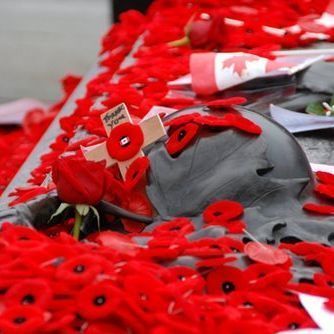
ALT Color photograph of a war memorial covered in hundreds of red remembrance poppies. A black military helmet rests on the stone surface, surrounded by poppies, red roses, small Canadian flags, and handwritten notes. A wooden cross with a poppy is visible among the tributes. A person's hand appears on the left edge. The scene is outdoors on a gray stone memorial.
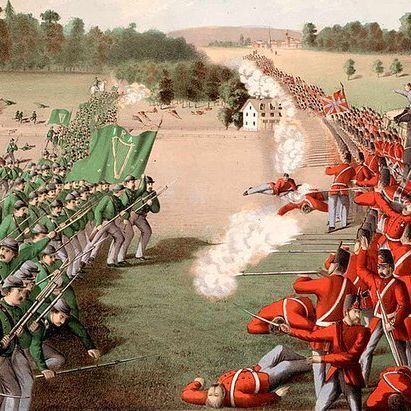
ALT Color illustration of a historical battle scene on a grassy field. Green-uniformed soldiers on the left advance in formation with green flags and bayonets, firing rifles. Red-uniformed soldiers on the right fire back, with smoke from guns. Fallen soldiers lie on the ground. A white house and trees are in the background. A mounted officer in red leads on the right.
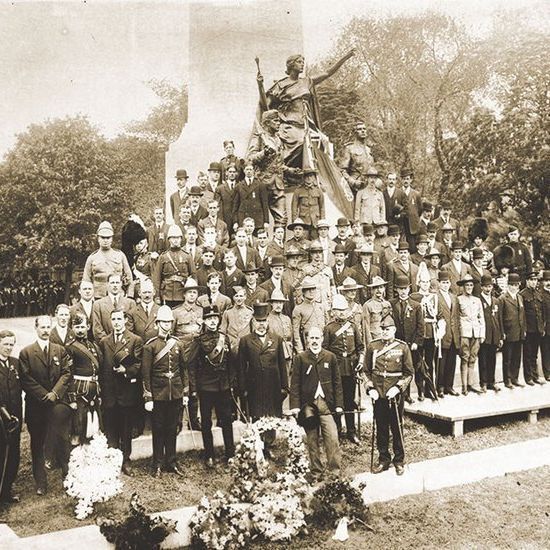
ALT Sepia-toned photograph of a large group of men, many in military uniforms with medals and hats, posing in front of a tall stone war memorial topped with a statue of a winged figure holding a torch. The men stand in multiple rows on a platform and ground, some holding rifles. Floral wreaths are placed at the base. Trees and a crowd are visible in the background. The image shows age with scratches and fading.
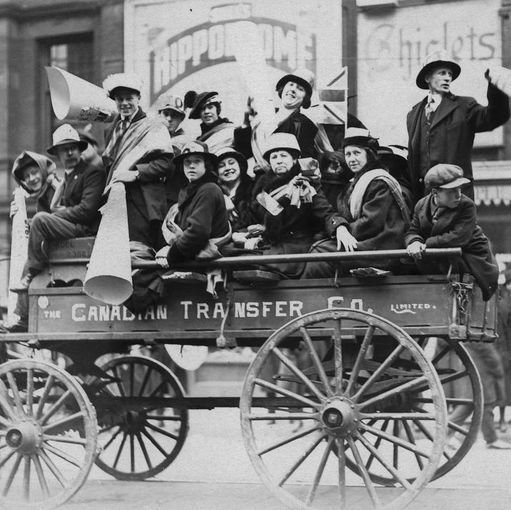
ALT Black and white photograph of a group of people riding on top of a horse-drawn wagon labeled "THE CANADIAN TRANSFER CO. LIMITED." Men and women wear early 20th-century clothing including hats, coats, and scarves. They hold large paper megaphones and rolled banners, waving at the camera. A building in the background has signs reading "HIPPODROME" and "Tickets." The scene is on a city street with other pedestrians and vehicles visible. The image shows signs of age with scratches and grain.