
Full Stack Security: Protection at every step of the development cycle. Security Partner of @Metaplex, @Orca_so, @KaminoFinance, & many more!
Joined September 2021
- Tweets 1,024
- Following 291
- Followers 6,292
- Likes 1,361
125 Photos and videos







A recent major Solana exploit made the problem clear: not every protocol drain starts with buggy code.
Some attacks rely on on-chain staging before execution: durable nonce activity and multisig governance changes.
We added 3 free WatchTower monitoring bots for Solana protocols to detect that staging:
• durable nonce account creation targeting your signers
• nonce authority transfers to or from your signers
• multisig config changes: threshold, timelock, members, config authority, rent collector
Free for all Solana protocols: wt.sec3.dev/nonce/
4
6
31
2,636
Sec3 retweeted

Jun 10
Vibe coding is cool.
But when real funds are involved, users deserve more than vibes.
DiversiFi has been audited by @ironnodesec and @sec3dev, because portfolio infrastructure should be built with safety, review, and clear risk boundaries from day one.

7
7
25
687
Sec3 retweeted

Apr 20
Just going to leave this here.
github.com/helium/helium-pro…
Circuit breaker contract, audited by @sec3dev. Highly recommend deploying your own copy of it with whatever security you're comfortable with. Or rewriting to fit your needs.
Supports thresholds based on an absolute limit (IE 100 tokens in 24h) or by percentage of the account (IE 10% outflow in 12h). Rate limits transactions to the set threshold. We have monitoring on each circuit breaker that alerts at various percentages (before they're even tripped, so we can react if needed).
Can wrap both mint authorities and token accounts.
Apr 20

0/ DeFi needs circuit breakers and other safety mechanisms which slow down large transactions and provide time for reaction. Borrow lend protocols should not allow a new user to show up with a $300M position and take out a loan against it immediately. Some ideas:
3
11
71
6,889
A recent major Solana exploit made the problem clear: not every protocol drain starts with buggy code.
Some attacks rely on on-chain staging before execution: durable nonce activity and multisig governance changes.
We added 3 free WatchTower monitoring bots for Solana protocols to detect that staging:
• durable nonce account creation targeting your signers
• nonce authority transfers to or from your signers
• multisig config changes: threshold, timelock, members, config authority, rent collector
Free for all Solana protocols: wt.sec3.dev/nonce/
4
6
31
2,636
For teams that want more detail, docs here:
doc.sec3.dev/sec3-watchtower…
6
416
Lessons from the Drift Protocol Exploit - A Security Checklist for Solana Teams
On April 1, Drift Protocol unfortunately experienced an approximately $285 million exploit. The attack surface was not code. It was governance configuration, key management, and operational trust assumptions.
This is not a post-mortem of Drift. The facts are still developing and the team is actively responding. This is about what protocol teams should verify in their own deployments.
What Happened
The attacker gained access to multisig signer credentials through social engineering, then executed a staged operation over three phases:
Infrastructure staging: a token was deployed with seeded liquidity to create the appearance of a legitimate asset. Durable nonce accounts were created on-chain (the first appearing 8 days before the exploit, the second one day prior), enabling pre-authorized transactions that could be triggered at a chosen time.
Configuration change: the multisig was migrated to a new configuration that did not include a timelock on administrative actions.
Execution: 31 withdrawal transactions drained three core vaults in approximately 12 minutes. Assets were bridged to Ethereum shortly after.
What This Means for Other Protocols
Each phase of this attack targeted operational and governance layers rather than smart contract logic. Any protocol with admin-controlled parameters, multisig governance, or privileged operations should consider whether similar vectors apply.
What to Check
Governance
• Verify your multisig threshold and signer set. Confirm no unauthorized configuration changes have been made.
• Confirm timelocks are enforced on non-emergency administrative operations (parameter changes, upgrades, configuration updates). Emergency stop functions can remain fast.
• Monitor proposal creation, approval progression, and execution of privileged operations.
Key Management
• Confirm admin keys are secured via HSM or MPC with documented procedures around signing.
• Scan for outstanding durable nonce accounts associated with your program authorities. Unrecognized nonce accounts warrant investigation.
• Verify that any transaction using a durable nonce is fully expected and independently reviewed before signing.
Operational Safeguards
• Check whether withdrawal rate limits or circuit breakers make sense for your protocol's architecture.
• Pre-establish contacts with bridge operators and exchanges for asset freeze coordination. Cross-chain fund movement during incidents moves faster than ad-hoc coordination.
Takeaway
Protocol security extends beyond code. Governance design, key management practices, and operational procedures are all part of the attack surface. Teams that proactively review these areas are better positioned to prevent and respond to this class of incident.
If you have questions about your protocol's configuration or want help reviewing your security posture, reach out to us at contact@sec3.dev.
- Sec3
3
2
22
1,214
Sec3 retweeted

Feb 16
Very important audit update for Splashing stakers.
The Splashing Staking Contract has been audited with @sec3dev - and we’re happy to report 0 Critical and 0 High, which is already a great result.
But that’s not all:
🔹Medium - 4 (resolved)
🔹Low - 5 (3 resolved / 2 acknowledged)
🔹Info - 2 (1 resolved / 1 acknowledged)
This audit helped us harden security and refine how staking works.
On top of that, if you have any questions, feel free to hop into our Discord server - we’ll be happy to answer them.
We’re putting in every effort to make liquid staking as safe and user-friendly as possible for everyone.
You’ll be able to find our audit report on our GitBook soon.
Thank you, SEC3 🤝
1
2
14
690

We are excited to be heading to @SolanaConf soon!
Most of our time at Sec3 is spent deep inside individual @Solana programs, looking at one code base at a time. To round out the year, we wanted to zoom out and ask a bigger question:
What do all these audits, taken together, actually say about Solana security right now?
Here’s what we saw:
• Dataset: 163 Solana audits from a mix of public reports and anonymized Sec3 engagements
• Findings: 1,733 total issues, 1,669 of them vulnerability-level
• Typical review: ~10 findings, with ~1.4 High or Critical issues
We also looked at how framework choices shape the risk as well as provide a practical guide projects launching and maintaining good security posture
If you want to go deeper into the data, charts, and concrete checklists, the report is public:
Web version link to download full PDF:
solanasec25.sec3.dev
4
1
14
758
Sec3 retweeted

8 Dec 2025
AI agents exploited smart contracts worth $4.6mn in simulated attacks, with capabilities doubling every 1.3 months, but they still needed source code access.
Non-public source code programs have some protection: AI reverse engineering exists but is far less capable than source code analysis. Though this gap will narrow.
red.anthropic.com/2025/smart…
1
2
421
Sec3 retweeted

25 Nov 2025
We’re proud to welcome @sec3dev as our Security Partner !
Sec3 will support our first cohorts with priority access to security expertise and guidance, helping early-stage teams build safer products on @solana.
This collaboration strengthens our shared mission of empowering builders and supporting the ecosystem.
7
6
71
3,283

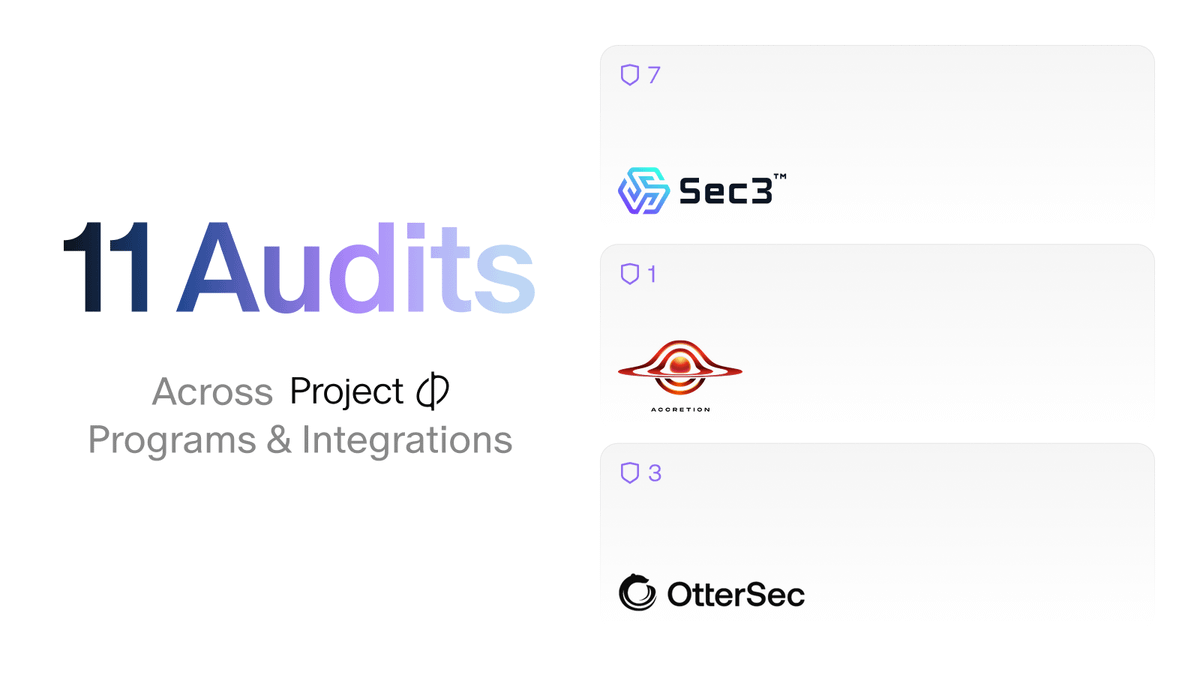
The Project 0 program code has been audited 11 times, & is one one of the most stress-tested DeFi protocols on Solana.
The P0 risk & liquidity engine is built on @marginfi, which has handled $100B in lends, borrows, withdrawals, & flashloans through all market conditions on Solana for 3 years while protecting user solvency.
1
3
26
2,220
Sec3 retweeted

18 Aug 2025
2
12
1,494
Sec3 retweeted

15 Aug 2025
why is @sec3dev 's IDL guesser not yet added in any of the explorer
1
3
7
1,056

Orca 🤝 Owl
Seeing the ongoing commitment to security with @sec3dev's team has been second to none.
Our team is looking forward to working alongside Sec3 to keep security and trustworthiness a top priority.

🐳 Thrilled to announce our ongoing security partnership with @orca_so!
Together, we're ensuring Orca's Whirlpool and Wavebreak protocols remain secure and trustworthy for the community. Wavebreak is Orca's upcoming launchpad featuring an anti-bot mechanism to protect token launches from bots and snipers
Huge thanks to Orca's dev team for their exceptional diligence and collaboration throughout this process. Let's dive deeper together! 🌊🔒
16
5
56
9,253
🐳 Thrilled to announce our ongoing security partnership with @orca_so!
Together, we're ensuring Orca's Whirlpool and Wavebreak protocols remain secure and trustworthy for the community. Wavebreak is Orca's upcoming launchpad featuring an anti-bot mechanism to protect token launches from bots and snipers
Huge thanks to Orca's dev team for their exceptional diligence and collaboration throughout this process. Let's dive deeper together! 🌊🔒
8
10
29
10,945
Sec3 retweeted

26 Jul 2025
Fusion AMM is officially secured by @oshield_io and @sec3dev.
Big thanks to both auditors for adhering to the highest industry standards.
We will continue working alongside them to maintain top-tier security across the protocol.
1
1
17
1,765
Watch the announcement of the release of IDL Guesser at @SolanaConf here!
youtube.com/watch?v=bymudcDF…
We’re excited to release IDL Guesser - an open-source CLI that rips the IDL out of any closed-source Anchor program !
Blog: sec3.dev/blog/idl-guesser-re…
Code: github.com/sec3-service/IDLG…
The Gap: about half of the top-100 Solana programs ship with no IDL. Can’t decode transactions, fuzzers stall, auditors waste hours reverse-engineering
How it works:
• Finds sol_log("Instruction: …") in the ELF
• Walks Anchor’s try_accounts control-flow graph to map signers & mutables info
Brute-probes arg sizes, recalculates 8-byte discriminators
• Spits out ready-to-use JSON.
Early testing shows the tool recovers the vast majority of instructions. The tool just won 1st prize at Reverse Engineering Closed Source Solana Programs hackathon hosted by Accretion.
Try it now - github.com/sec3-service/IDLG…
2
10
1,471
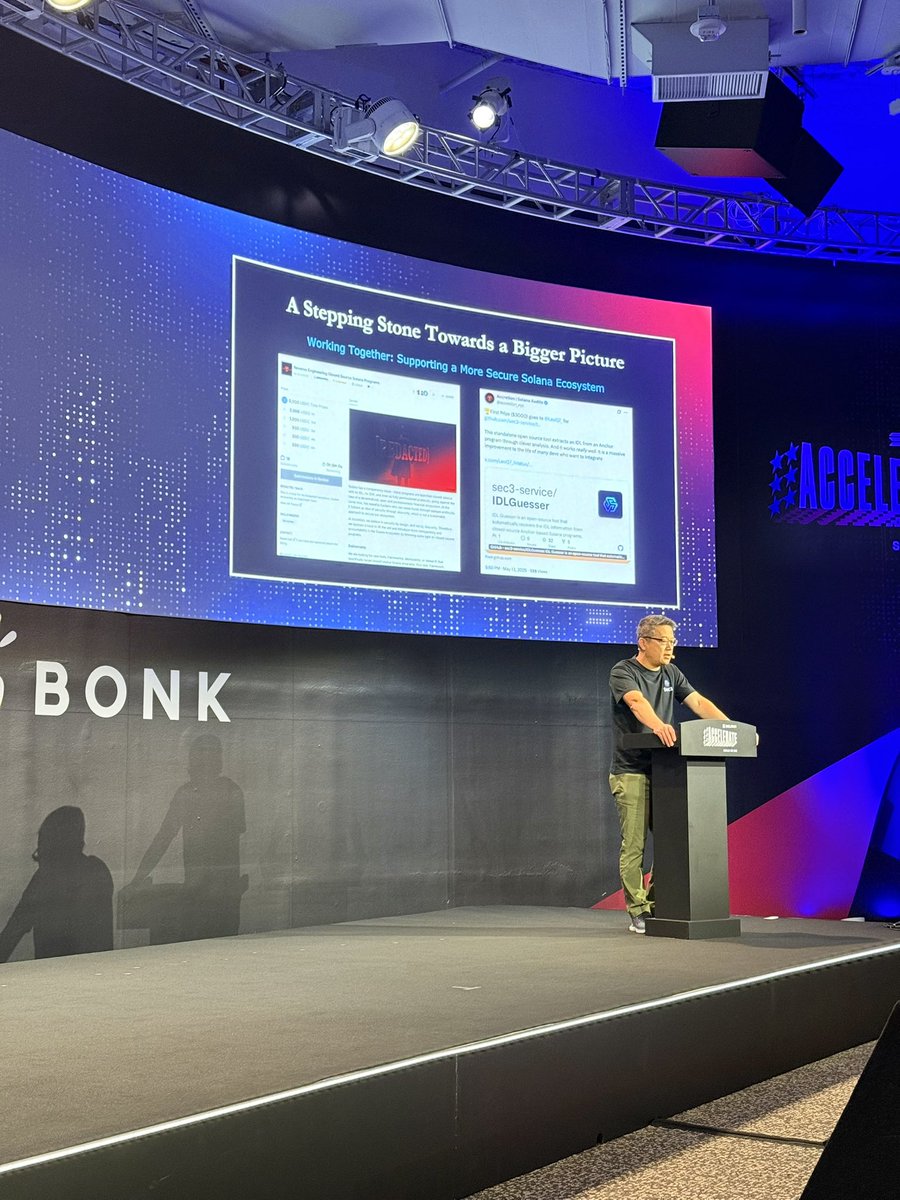
Our CEO @chrisdoubleu_ presenting IDL guesser to @SolanaConf
Publish your IDL or we’ll guess it 😉
We’re excited to release IDL Guesser - an open-source CLI that rips the IDL out of any closed-source Anchor program !
Blog: sec3.dev/blog/idl-guesser-re…
Code: github.com/sec3-service/IDLG…
The Gap: about half of the top-100 Solana programs ship with no IDL. Can’t decode transactions, fuzzers stall, auditors waste hours reverse-engineering
How it works:
• Finds sol_log("Instruction: …") in the ELF
• Walks Anchor’s try_accounts control-flow graph to map signers & mutables info
Brute-probes arg sizes, recalculates 8-byte discriminators
• Spits out ready-to-use JSON.
Early testing shows the tool recovers the vast majority of instructions. The tool just won 1st prize at Reverse Engineering Closed Source Solana Programs hackathon hosted by Accretion.
Try it now - github.com/sec3-service/IDLG…
2
1
11
968
Sec3 retweeted

19 May 2025
This is dope
We’re excited to release IDL Guesser - an open-source CLI that rips the IDL out of any closed-source Anchor program !
Blog: sec3.dev/blog/idl-guesser-re…
Code: github.com/sec3-service/IDLG…
The Gap: about half of the top-100 Solana programs ship with no IDL. Can’t decode transactions, fuzzers stall, auditors waste hours reverse-engineering
How it works:
• Finds sol_log("Instruction: …") in the ELF
• Walks Anchor’s try_accounts control-flow graph to map signers & mutables info
Brute-probes arg sizes, recalculates 8-byte discriminators
• Spits out ready-to-use JSON.
Early testing shows the tool recovers the vast majority of instructions. The tool just won 1st prize at Reverse Engineering Closed Source Solana Programs hackathon hosted by Accretion.
Try it now - github.com/sec3-service/IDLG…
14
6
74
91,445
We’re excited to release IDL Guesser - an open-source CLI that rips the IDL out of any closed-source Anchor program !
Blog: sec3.dev/blog/idl-guesser-re…
Code: github.com/sec3-service/IDLG…
The Gap: about half of the top-100 Solana programs ship with no IDL. Can’t decode transactions, fuzzers stall, auditors waste hours reverse-engineering
How it works:
• Finds sol_log("Instruction: …") in the ELF
• Walks Anchor’s try_accounts control-flow graph to map signers & mutables info
Brute-probes arg sizes, recalculates 8-byte discriminators
• Spits out ready-to-use JSON.
Early testing shows the tool recovers the vast majority of instructions. The tool just won 1st prize at Reverse Engineering Closed Source Solana Programs hackathon hosted by Accretion.
Try it now - github.com/sec3-service/IDLG…
14
19
154
24,061