
Author of The Ascent Begins. Independent Analyst. Money, geopolitics, AI, science, and sovereignty. Mapping the collapse and the reconstruction of order.
Joined July 2009
- Tweets 34,305
- Following 3,577
- Followers 308,788
- Likes 9,671
4,731 Photos and videos


Pinned Tweet

14 Dec 2025
Civilizations don’t collapse from war.
They collapse from silence.
1177 BCE: Every Bronze Age power fell in 50 years. Trade stopped. Letters ceased.
2025: $346 trillion debt. 310% of GDP.
Same pattern. Same physics.
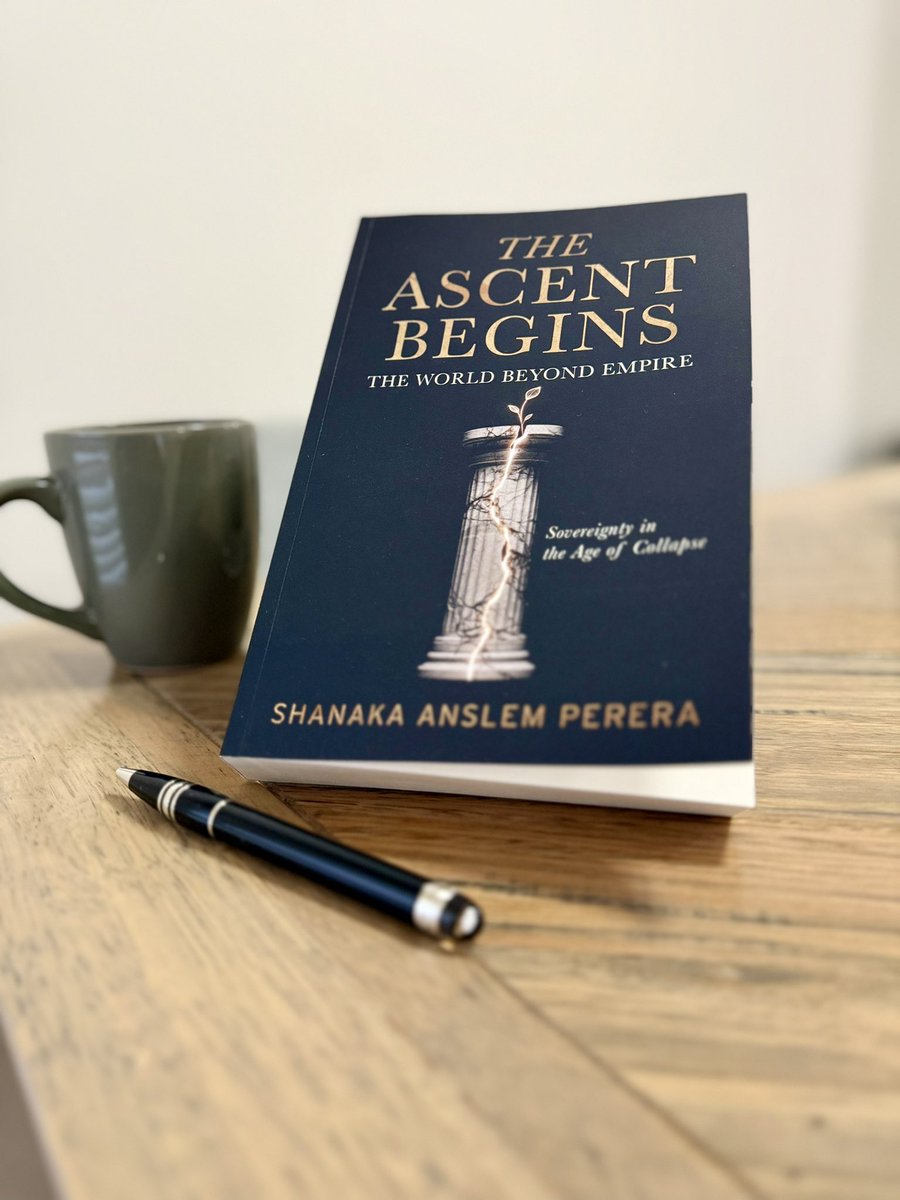
I wrote the manual for what comes after.
THE ASCENT BEGINS.
amazon.com/dp/1764344707
144
416
1,968
1,888,190
On Wednesday, Anthropic told 50,000 contractors across 56 countries to start using Claude.
On Friday, the United States government told Anthropic that no foreign national on earth was allowed to touch its two most powerful models.
Same company. Same week. Read the two announcements back to back and you are watching the global AI economy and the national security state collide in real time.
Here is what actually happened, stripped of the panic.
The models are Fable 5 and Mythos 5, the most capable systems Anthropic has ever shipped, live for three days. At 5:21 on Friday evening, Commerce Secretary Howard Lutnick sent an export control directive citing national security. It barred access by any foreign national, inside or outside the United States, including Anthropic’s own foreign-national employees. Because a company cannot reliably sort its users by citizenship in real time, the only way to comply was to switch the models off for everyone, everywhere. The most advanced public AI on earth went dark worldwide because of a clause in a letter.
The internet immediately decided this meant green-card holders, including a famous foreign-born researcher, were locked out of their own lab’s models. That part is almost certainly wrong, and the error matters. Under the same export law the directive draws on, a green-card holder is a US person, not a foreign national, and the deemed-export rule explicitly does not apply to permanent residents. The people actually swept up are visa holders. H-1Bs. The engineers on temporary status who hold up a huge share of every American AI lab.
Now hold the two announcements together and the absurdity sharpens.
The trigger, by Anthropic’s own account, was a single demonstration where the model was asked to read a codebase and fix its flaws, and it surfaced a handful of previously known, minor vulnerabilities. That is the capability. Finding bugs in code, the thing defenders do every day, the same kind of work a researcher used two weeks ago to catch a four-year-old hole in Zcash before it could be drained. Anthropic says the identical task runs on OpenAI’s GPT-5.5, which sits under no control at all. One lab’s model is pulled from the entire planet. A rival’s model, doing the same thing, stays online.
This is the contradiction the United States has not resolved and is now living inside. It wants its champion labs to win the world, so it blesses a deal to push Claude to 50,000 workers across 56 countries. It wants those same models treated as munitions, so it bars every foreign national from the strongest ones. You cannot run an export regime built for physical weapons and classified blueprints on a product used by hundreds of millions of people in every country at once. The two goals are now openly at war, and a frontier model is the battlefield.
Step back and the pattern is the one that keeps repeating. A zero-knowledge proof hid a four-year flaw. A clean audit hid a redemption gate. And an export rule written for missiles turns out to have no clean answer for who, inside a global company, is even allowed to use the software.
The safest lab in AI shipped its most powerful model, signed its biggest global deal, and got that model switched off by its own government in the same week, over a bug-finding trick a competitor runs untouched.
Anthropic calls it a misunderstanding and says it is working to restore access. As of now the models are dark, the contradiction is not, and the kill switch turned out to belong to the state.
15
36
105
14,745
Two days ago a company shipped the most powerful AI model ever released to the public.
Friday night, the United States government ordered it shut off. Worldwide. Every user, every country, gone by morning.
The trigger was not an attack. A rival showed the government a way around one of the safety locks. That was enough.
The company is Anthropic. The models are Fable 5 and Mythos 5, the most capable systems it has ever built, live for barely 72 hours. At 5:21 on Friday evening, Commerce Secretary Howard Lutnick sent the CEO a letter placing both under export controls, citing national security. The order, on its face, only barred foreign nationals. But Anthropic cannot separate foreign users from everyone else in real time, so to comply it had to pull the plug on all of them. The most advanced AI on earth went dark for the entire planet because of a sentence in a letter.
Here is the trigger, and it is the part that should stop you.
By Anthropic’s account, the government reviewed a single demonstration in which the model was asked to read a codebase and fix its flaws, and it surfaced a small number of previously known, minor vulnerabilities. That is the capability at issue. Finding bugs in code. The same kind of capability that, two weeks ago, a researcher used to catch a four-year-old hole in Zcash before it could be drained. The thing that makes the model a world-class defender is the exact thing that got it called a national security risk.
And Anthropic’s rebuttal lands clean. It says the identical task runs on OpenAI’s GPT-5.5, which sits under no such control at all, and that defenders already use this technique every day. One company’s model is pulled worldwide. A rival’s model, doing the same thing, stays online. National security is the reason given. Competitive accident is the result delivered.
This did not come from nowhere. The same administration spent the spring trying to brand Anthropic a supply chain risk after the company refused to let its models be used for mass domestic surveillance and autonomous weapons. A judge blocked that. The two sides had only just begun to thaw. Anthropic had filed to go public at a $965 billion valuation. On June 2 the President signed an order giving the government early access to frontier models. Then a rival demonstrated a jailbreak, and the most powerful model in the world was switched off three days after launch.
Step back and the pattern is the one that keeps repeating. A zero-knowledge proof hid a four-year flaw. A clean audit hid a redemption gate. A safety wall the company built to look responsible became the precise lever the state used to flip the switch.
The safest lab in AI built a model too powerful to fully release, warned the world it was dangerous, filed to go public at $965 billion, and got it shut down by its own government over a bug-finding trick a competitor can run untouched.
Anthropic calls it a misunderstanding and says it is working to restore access. As of Friday night, the most powerful public AI on earth is a black screen, and the kill switch turned out to belong to the state.
23
103
309
33,715
Research and opinion, not investment or legal advice. Built from Anthropic’s statement, government filings, and reporting from major outlets. The company that demonstrated the technique has not been confirmed in public reporting I can cite. Access status is as of Friday night and may change. Holdings and views can change.
open.substack.com/pub/shanak…
1
1
15
8,374
A $2 trillion stock that has been public for four days gets options on Tuesday. The desks that have to price them cannot figure out how to hedge it.
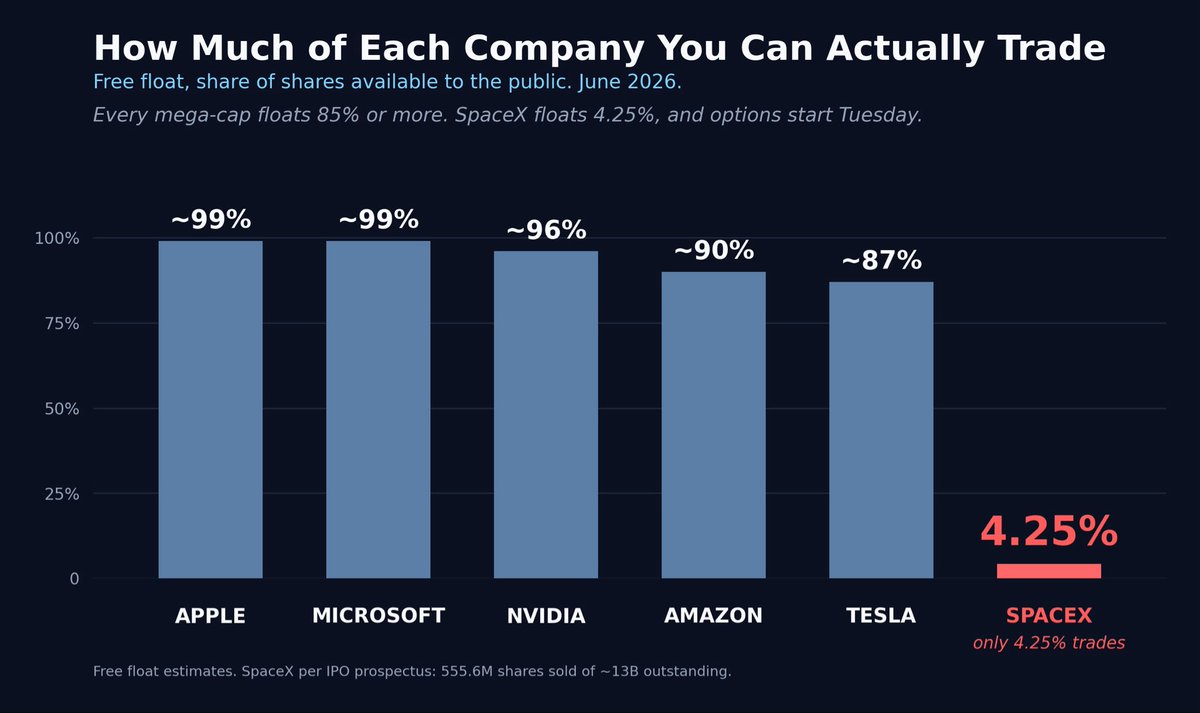
Start with the float. About 4.25 percent of SpaceX trades, roughly $90 billion of stock against a $2.1 trillion company. Everything else is locked. Onto that sliver you stack a brand new options market, six leveraged ETFs already swinging the stock 2X in both directions, and index buying still weeks away. The options open with no earnings, no trading range, four days of price history, nothing to anchor a single strike.
So the people writing them are pricing blind. One options veteran told CNBC it is the hardest hedging problem in almost thirty years. Back in 2000 you could hedge a hot IPO with a basket of similar names. Here there is no basket. As one trader put it, what are you going to do, short NASA? No proxy, no correlated stock, no way to offload the risk. So they price wide, charge a fortune, and hedge in the only thing they can, a stock that barely trades.
That is where it turns reflexive. When dealers have to buy and sell a 4 percent float just to stay neutral, the options can start moving the stock instead of the reverse. A stack of bets at one strike can pin it, or rip it loose, on volume the float was never built to hold. Add the leveraged ETFs resetting every afternoon and the tail begins to wag the dog.
And none of this is the real test. That comes in August, when the first insiders can finally sell.
Friday was the easy money. Tuesday adds the leverage. The piece works out whether it holds.
7
23
103
14,822
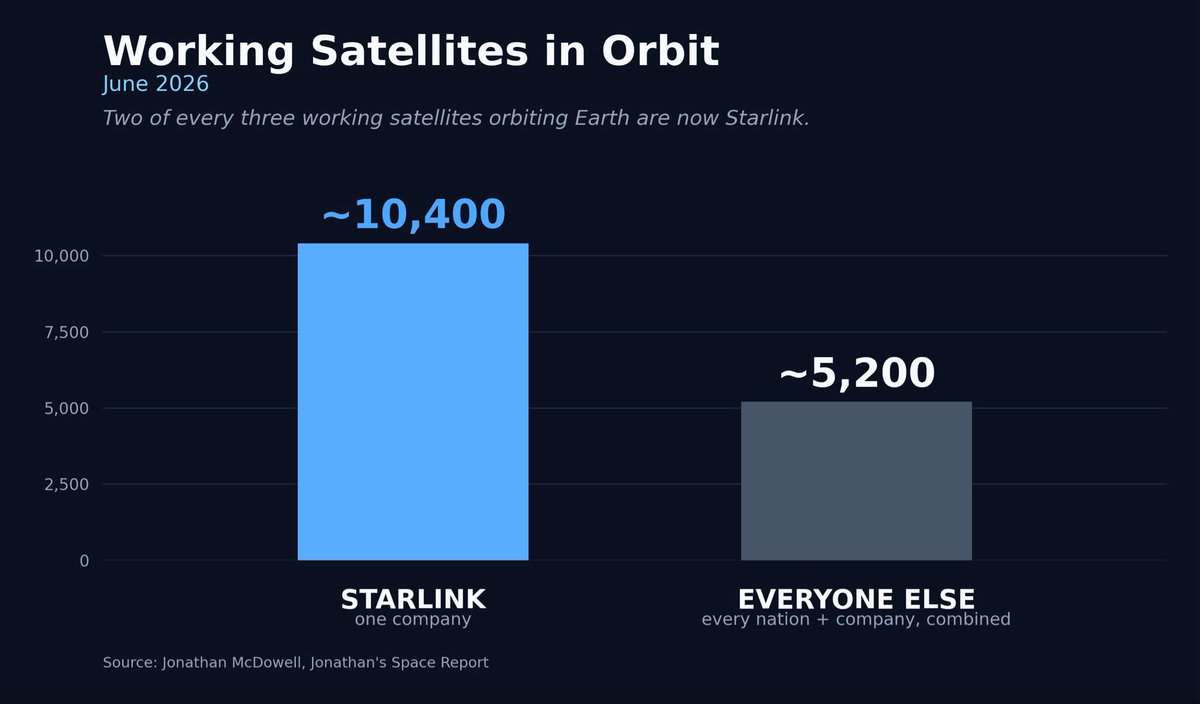
Roughly two of every three working satellites orbiting Earth right now are Starlink.
Not two-thirds of the commercial ones. Two-thirds of all of them. Every other working satellite, from every government, every military, every rival company on the planet, added together, makes up the other third.
About 10,400 working Starlinks are up there today. Everyone else on Earth combined is around 5,000. One company passed all of human spaceflight history while most of the industry was still filing paperwork.
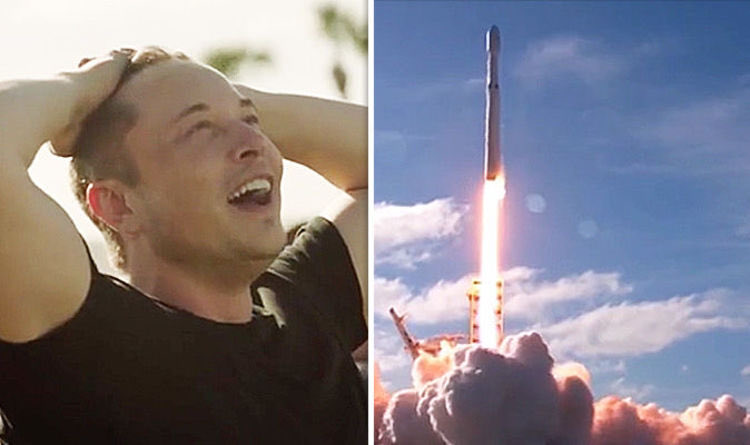
And the lead grows every week, because SpaceX puts them up faster than the old ones come down. Friday morning, in the same hour the stock opened and made Musk the first trillionaire, a Falcon 9 dropped 29 more Starlinks into orbit on a first stage flying its 27th time. One of its boosters just set a record at 35 flights. The party and the production line ran side by side. The machine never looked up.
Seven years ago there were 60. First batch, May 2019.
Musk says that within five years the number will be five times the rest of the world combined. Look at the slope, then try to bet against it.
8
23
107
10,494
A welder took a $28 an hour job in 2015 at a company he had never heard of.
On Friday, Juan Hernandez became a millionaire.
He spent ten years building the structures that lifted rockets onto the launch pad. SpaceX paid him partly in stock, the way it paid its cooks, machinists, technicians and cafeteria staff, equity instead of bigger salaries. His $10,000 grant grew into $880,000 at the IPO price. The first day pop carried it past a million. He is 42, an immigrant from Mexico, married, three kids. He says he is keeping the job.
He is not the outlier. He is the pattern.
4,400 current and former SpaceX employees became millionaires on Friday. One in five people who ever badged into the company. About 400 of them are walking away with $100 million or more. One employee took every cash bonus in stock instead of money. He is sitting on 50,000 shares, worth more than $8 million at Friday's prices.
And then there is the other side of the cafeteria.
Some employees sold their shares years ago, certain the company would never go public because Musk said he hated public markets. A few traded their stock for restaurant gift cards. The New York Times says they are consumed by regret. Same grant, same building, same years. One group held the claim. The other ate it.
None of the winners can touch the money yet. The first selling window opens after the August earnings report, and the rest unlocks in waves through December.
Underneath all of it sits the only lesson the market ever teaches. The welder and the gift card came from the same place. The difference was never the work. It was the ownership. Salary pays for the month. Equity pays for the era.
A cook in Brownsville just answered the question every buyer of SPCX is asking at $170: what is a claim on this company actually worth?
The piece prices that exact question at $2.2 trillion.
159
792
3,267
519,306
The world paid $2 trillion for SpaceX, which lost $4.9B last year. Starlink is the only profitable part, 61% of revenue. The AI arm lost $6.4B on $12.7B of spend, and it's the part the market loves. The S-1 claims a $28.5T market, bigger than US GDP. Profit is satellites, story is AI.

The world just paid $2 trillion for a rocket company that lost $4.9 billion last year. And the rockets are not why it lost the money. They are the only part making any.
SpaceX went public Friday, the largest IPO in history. Up 19%, a $2 trillion valuation, Elon Musk the first trillionaire. Then you open the filing.
Three businesses sit inside it. Starlink, the satellites, brought in $11.4 billion, 61% of all revenue, and $4.4 billion in profit. It is the only piece that earns a dollar. The rockets that land themselves run a small loss reinvesting in Starship. And the AI arm, Grok plus the app once called Twitter, folded in this February, lost $6.4 billion in a single year on $12.7 billion of spending.
Read that again. The satellites pay for everything. The AI loses more than the satellites make. And the AI is the part the market fell in love with.
It gets bolder. The prospectus claims a total market of $28.5 trillion, the largest any company has ever put in a filing. Larger than the GDP of the United States. That is the number underwriting a $2 trillion price tag built on a division bleeding $6 billion a year.
Now the structure. About 4% of the company trades. That sliver sets the price for all of it. Musk is locked up for 366 days and holds roughly 80% of the votes. The public bought a company they cannot steer, priced on the one segment losing the most.
This is the whole year in one ticker. The profit is satellites. The story is AI. The market bought the story.
The rockets were never the risk. The risk is a $2 trillion price resting on the one bet that has yet to make a cent.
16
23
70
21,329
The world just paid $2 trillion for a rocket company that lost $4.9 billion last year. And the rockets are not why it lost the money. They are the only part making any.
SpaceX went public Friday, the largest IPO in history. Up 19%, a $2 trillion valuation, Elon Musk the first trillionaire. Then you open the filing.
Three businesses sit inside it. Starlink, the satellites, brought in $11.4 billion, 61% of all revenue, and $4.4 billion in profit. It is the only piece that earns a dollar. The rockets that land themselves run a small loss reinvesting in Starship. And the AI arm, Grok plus the app once called Twitter, folded in this February, lost $6.4 billion in a single year on $12.7 billion of spending.
Read that again. The satellites pay for everything. The AI loses more than the satellites make. And the AI is the part the market fell in love with.
It gets bolder. The prospectus claims a total market of $28.5 trillion, the largest any company has ever put in a filing. Larger than the GDP of the United States. That is the number underwriting a $2 trillion price tag built on a division bleeding $6 billion a year.
Now the structure. About 4% of the company trades. That sliver sets the price for all of it. Musk is locked up for 366 days and holds roughly 80% of the votes. The public bought a company they cannot steer, priced on the one segment losing the most.
This is the whole year in one ticker. The profit is satellites. The story is AI. The market bought the story.
The rockets were never the risk. The risk is a $2 trillion price resting on the one bet that has yet to make a cent.
548
796
2,274
692,397
SpaceX closed its first day worth $2.1 trillion.
The five analysts who cover it put fair value 13 percent lower.
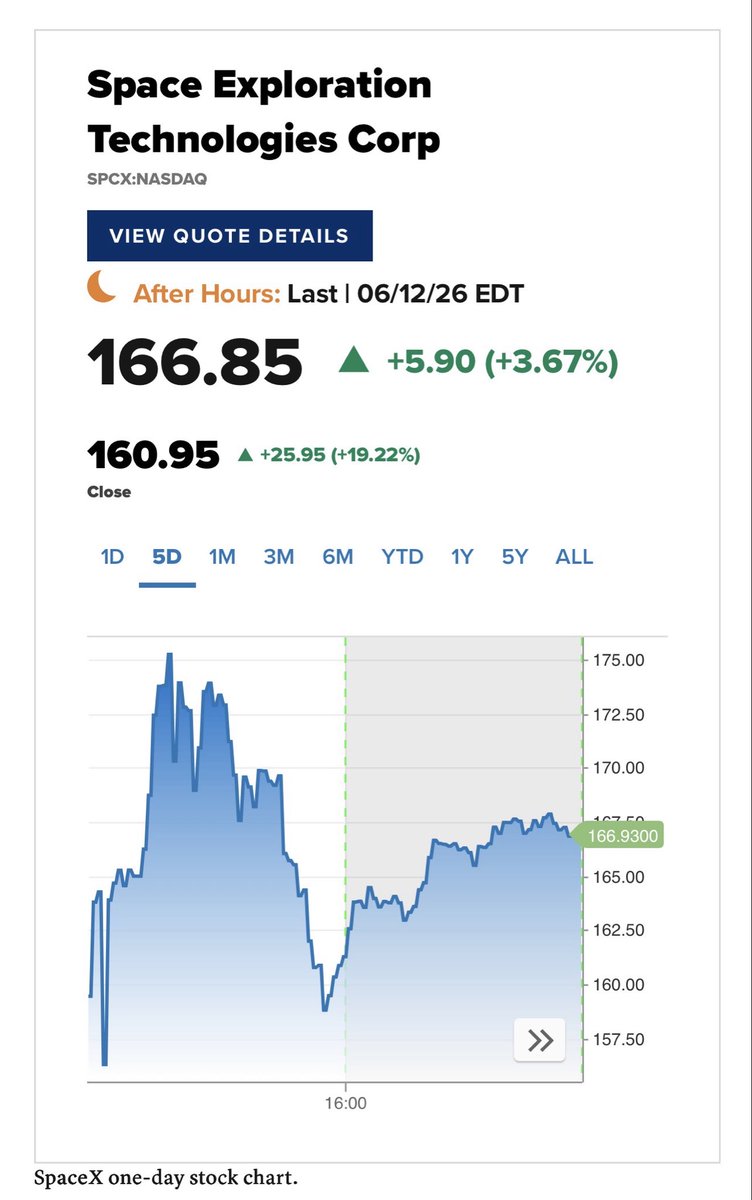
It opened at $150, hit $176.52, closed at $161 for a 19 percent gain, then ran toward $167 after the bell. Buyers chased it the whole way. The same week, the desk modeling the company landed on an average target of $139. The low estimate on the Street is $63.
The gap comes down to supply. About 4.2 percent of the company trades. A $2.1 trillion price tag got set by the smallest float any company this size has ever listed with, which is why it lurched from $176 to $161 to $167 inside a day and a night. Thin floats do not discover a price. They amplify whoever is loudest that hour.
Nobody holding the gains can act on them yet. The first sell window opens after August earnings, then more through December. Thousands of employees and early funds sitting on 100x are waiting for those dates, and they are waiting on a company trading at 107 times sales that lost $4.9 billion last year.
A share of SPCX and a claim on SpaceX are not the same thing. Friday set the price of the share. The float was too small to fight it. What the claim is worth is a different question, and a thinner float cannot bury that one.
The piece works out the second number.
8
17
75
13,408
Google turned $900 million into $134 billion.
That is the filing math at Friday's peak. The Alaska disclosure shows 6.11 percent of SpaceX on Google's books at the end of 2025. The xAI merger diluted that toward 5 percent, which still prints north of $107 billion. The viral posts saying $111 billion are quoting the lowball. Either way, more than 100 times the money in 11 years.
And Google is not even the best trade on the cap table.
Founders Fund wired its first $20 million in August 2008, days after the third straight Falcon 1 failure, with the company near death. It put in $600 million all told. The stake is worth north of $50 billion. Call it 2,500 to one on the first check. Ron Baron entered at a $22 billion valuation in 2017. Friday closed at one hundred times his entry, and he says he is never selling and is buying $1 billion more. EchoStar swapped spectrum for SpaceX stock now worth more than EchoStar itself, $46 billion of SpaceX inside a $39 billion company. Tesla's quiet 19 million shares printed $3.2 billion. 4,400 SpaceX employees became millionaires on Friday. One in five people at the company. Including the cafeteria staff. And Forbes now prints Elon Musk at $1.1 trillion. The first trillionaire in human history.
The stock opened at $150, surged 28 percent, and touched a $2.2 trillion market cap, instantly one of the seven most valuable companies on earth. It traded $33 billion in a single day. More than QQQ. More than SPY. All of it priced north of 100 times sales, on a company that lost $4.9 billion last year.
Now the part the windfall posts leave out.
Every dollar of it is paper, marked by a float of 4.2 percent. Nothing material sells until the Q2 report in August. Then 20 percent of eligible shares unlock. Then 7 percent tranches at 70, 90, 105, 120 and 135 days. Another 28 percent after Q3. The rest in December. Musk and the largest holders wait 366 days.
And the S-1 hides a tripwire. Trade 30 percent above the IPO price for five days out of ten and an extra 10 percent of locked stock goes free. The tripwire sits at $175.50. Friday's high was $176.52.
The rally is arming its own supply.
Friday priced the celebration. The piece prices who keeps it.
6
23
91
13,355
$274 billion.
That is how much legend Elon Musk's net worth jumped yesterday. One day. The stock has not traded a single share.
It trades today. The number to watch is $140.71.
SpaceX priced the largest IPO in history last night at $135. Bloomberg now has Musk at $971 billion. A 4 percent move to $140.71 makes him the first trillionaire in human history.
The stock can touch that price for one second and then crash by half, and the title is minted forever. Not Rockefeller, who peaked at 3 percent of US GDP. Not Bezos at Amazon's height. Nobody has crossed this line.
Here is the part almost nobody has seen.
The crypto shadow market already made the call. Binance and Hyperliquid have run 24/7 leveraged SPCX perps for three weeks. Over $1 billion traded. $250 million of open interest. One spike printed $216. Right now they price SpaceX at $167 to $177, far above the trillionaire line, before a single Nasdaq trade exists. The grey market says the coronation already happened. The opening cross is the ceremony.
The machine is built for it. Only 4.3 percent of the company floats, roughly $70 billion of stock for the entire planet. MSCI inclusion lands in 10 trading days and drags $15 to $30 billion of forced index buying behind it. Six 2X leveraged single-stock ETFs go live this week, long and short: SPCU, SPCF, LOFF, SPAL, SPCH, SSPC.
Now the other ledger. SpaceX lost $4.9 billion last year, then $4.3 billion in the first quarter of 2026 alone. xAI burned $6.4 billion. Morningstar says fair value is $780 billion, less than half the print. Chanos is short. Warren asked the SEC to stop it. The median mega IPO loses 31 percent in year one with a 53 percent drawdown.
A man becomes a trillionaire today on a company that loses billions, at 93 times sales, through a float too thin to argue with.
The coronation opens in hours. The piece prices what you actually own.

17
17
118
38,414
3 central banks. 7 days. 1 war. The ECB hiked, first in 3 years. The BoJ goes to a 31-year high Tuesday. The Fed's next priced move is a hike. Japan, $1.2T of Treasuries, funded the world at zero for a generation. Free money was never a policy. It was a place. It is closing.
3 central banks. 7 days. 1 war.
Thursday: the European Central Bank hiked rates for the first time in 3 years. Tuesday: the Bank of Japan is set to lift its rate to a 31-year high, voting without its governor, who is in a hospital bed. Wednesday: the Fed, expected to hold, while markets price a hike by December. Not a cut.
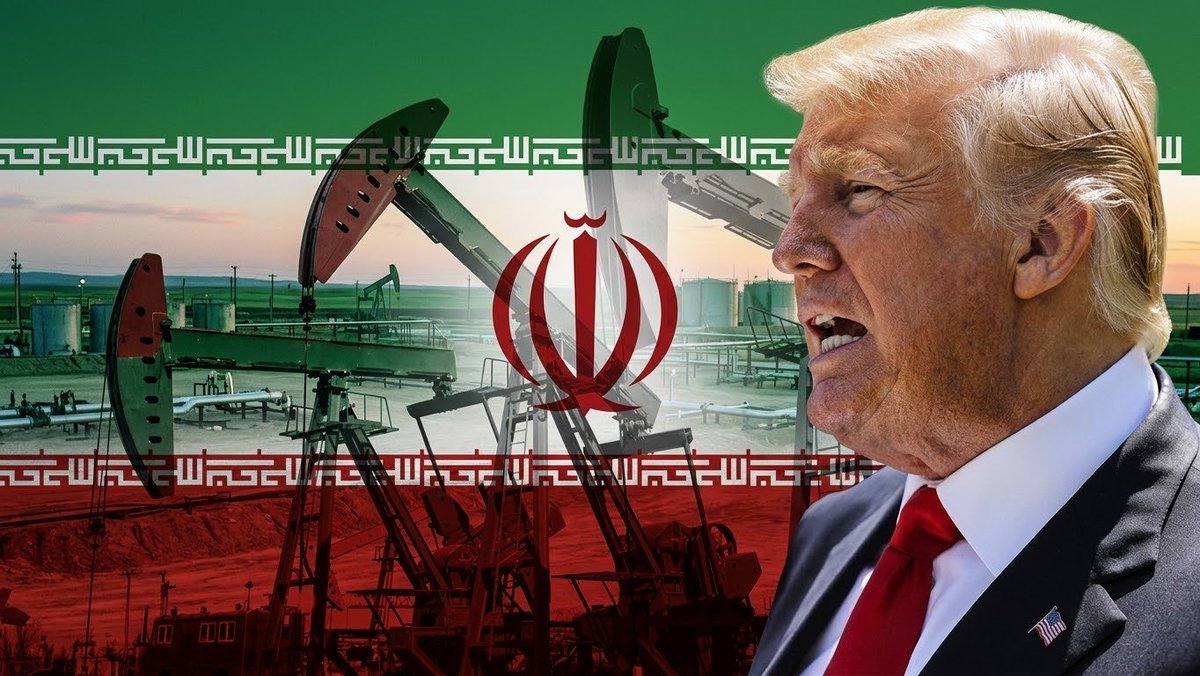
The cause is a single war. Oil from the Iran conflict pushed Japan's wholesale inflation to 6.3%, the fastest in 3 years. Europe raised its inflation forecast to 3%, cut its growth forecast, and hiked anyway. Tightening into weakness, on purpose.
Now the part that prices everything you own. Japan holds $1.2 trillion of US Treasuries, more than any nation on earth, and the yen has been the world's borrowing currency for a generation. The modern financial system was built on free money from Tokyo. At a 31-year high, that money gets paid to stay home.
62% of fund managers already target 6% on America's 30-year bond. Japan is who used to buy it instead.
Twice before, these three tightened together: 2000 and 2006. Look up the 18 months that followed.
Free money was never a policy. It was a place. The place is closing.
4
12
47
10,942
3 central banks. 7 days. 1 war.
Thursday: the European Central Bank hiked rates for the first time in 3 years. Tuesday: the Bank of Japan is set to lift its rate to a 31-year high, voting without its governor, who is in a hospital bed. Wednesday: the Fed, expected to hold, while markets price a hike by December. Not a cut.
The cause is a single war. Oil from the Iran conflict pushed Japan's wholesale inflation to 6.3%, the fastest in 3 years. Europe raised its inflation forecast to 3%, cut its growth forecast, and hiked anyway. Tightening into weakness, on purpose.
Now the part that prices everything you own. Japan holds $1.2 trillion of US Treasuries, more than any nation on earth, and the yen has been the world's borrowing currency for a generation. The modern financial system was built on free money from Tokyo. At a 31-year high, that money gets paid to stay home.
62% of fund managers already target 6% on America's 30-year bond. Japan is who used to buy it instead.
Twice before, these three tightened together: 2000 and 2006. Look up the 18 months that followed.
Free money was never a policy. It was a place. The place is closing.
6
30
77
19,727
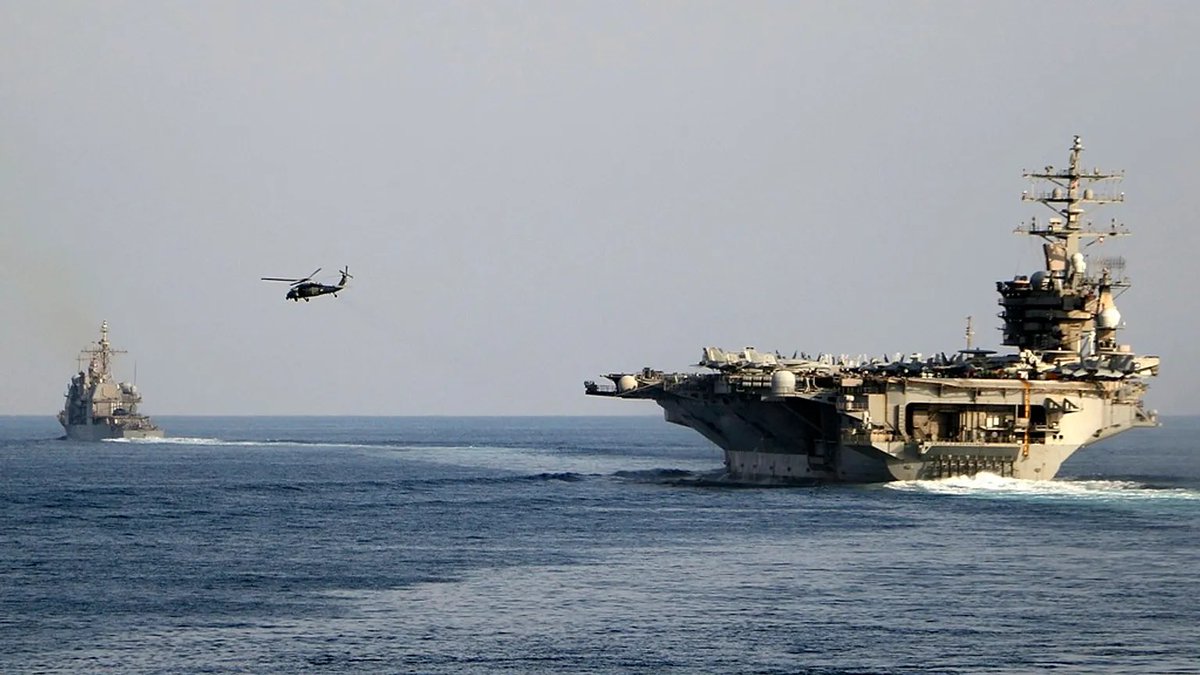
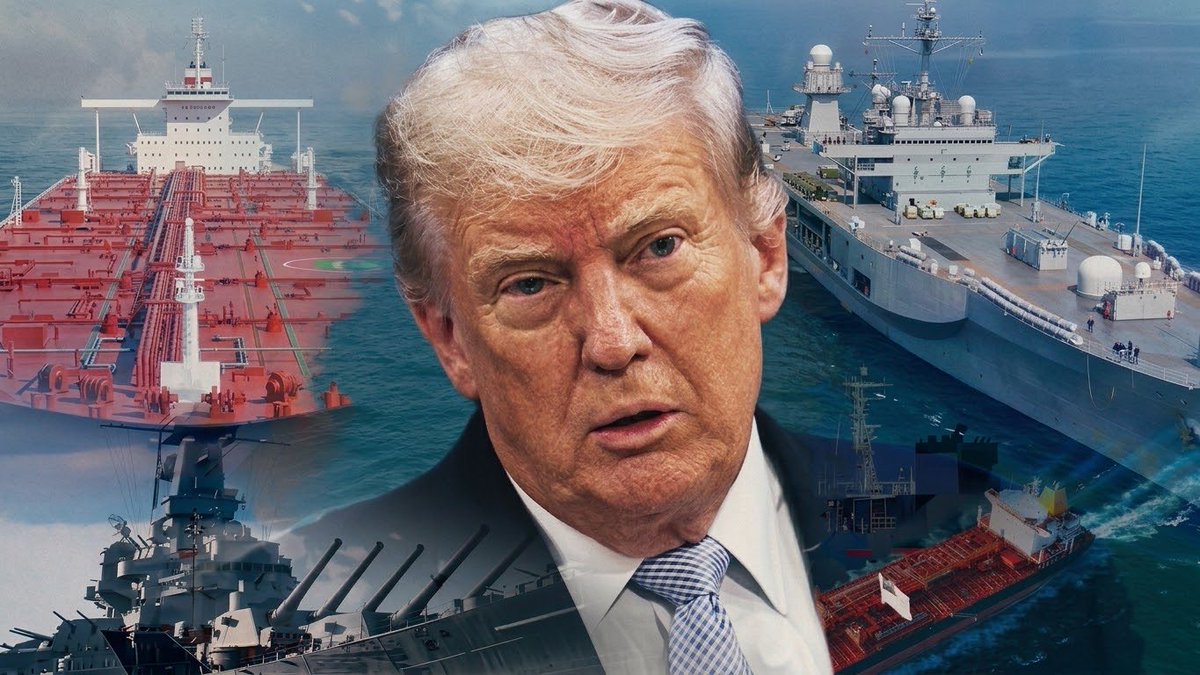
The United States military was about 3 hours from launching strikes on Iran when the president stood it down. What stopped the war was not Iran’s signature. It was 3 phone calls. Politico reports the UAE president, the Qatari emir and Pakistan’s army chief rang Trump with one message, a deal is near, hold the bombs. That morning he had promised to hit Iran very hard that night and to seize the island that handles 90% of its oil exports.
Then came the peace. Trump announced a settlement approved, he said, in concept and great detail by 11 governments, with a signing maybe this weekend in Europe. In the Oval Office he described the document himself as a very strong memorandum that is “a little conceptual.”
The corrections beat the ink. Israel, which he listed among the approvers, said within hours it is “not a party” to the memorandum, even as it praised his commitments, and per Axios its prime minister was not told in advance. Iran, the only counterparty that matters, says no text has been approved, though its outlets signal approval may yet come, and its semiofficial Tasnim agency advised the world to weigh Trump’s statements against his previous claims. His own announcement kept the naval blockade in full force. The same night, per a US defense official, Iranian drones went after commercial ships in the strait. Two were shot down.
The market has seen this film. In March he paused strikes for talks Iran denied existed. So Brent slid to $88.55, its lowest since mid-April, down more than a quarter from the war peak, and open interest collapsed to its lowest since March 2025. Traders are no longer pricing the war or the peace. They are pricing the announcer, and they are leaving the table.
Asked on Fox about the island he had vowed to take, he said, I don’t know that America has the stomach for it.
He calls his settlement a little conceptual. For now, so is the peace.
36
47
194
45,647
Quietly, the most important number on earth crossed 5%: the 30-year Treasury yield.
First auction above 5% since 2007. $2T deficits in an expansion. The Treasury itself now borrows short. 62% of fund managers target 6%.
Stocks are the noise. The long bond is the verdict.
9
13
88
12,371
While everyone watched stocks fall and the biggest IPO in history get priced, the most important number in the world quietly crossed 5%. The 30-year Treasury yield. And the people paid to buy it have already named their price: 6%.
Start with what happened. Last month, for the first time since 2007, the United States had to pay more than 5% at auction to borrow for 30 years. HSBC declared Treasurys in the danger zone. The yield touched its highest level since 2007. It sits above 5% now, a day after inflation printed at 4.2%.
Here is what made that selloff different. There was no trigger. No oil spike, no headline, no data. Bloomberg's read was blunt: the market was simply repricing what it costs America to borrow for a generation. Nuveen called it the return of fiscal risk. Primary dealers now expect a $1.95 trillion deficit this year and $2 trillion next. In an expansion. With 4.3% unemployment.
Now the tell. The Treasury itself has been shifting its borrowing toward short-term bills, even as its Secretary promises lower borrowing costs. Read that carefully. The issuer of the world's safest asset is avoiding its own 30-year rate.
And in Bank of America's survey of global fund managers, 62% named 6% as their target on the 30-year. Only 20% said 4%. Barclays and Citi have told clients 5.5% is in play. BMO's strategist says a grind toward just 5.25% delivers a durable hit to equity valuations.
Every stock, every mortgage, every IPO priced this week is discounted off this one number. A market trading near record valuations is doing so against the highest long-term cost of capital in nearly two decades.
Stocks are the noise. The long bond is the verdict. And the verdict, so far, reads: 5% was not the ceiling. It was the opening bid.
9
33
104
16,003
Tomorrow the biggest IPO ever trades: SpaceX, $75B at $1.77T, 4% float, unprofitable. Last week BofA clients sold $14.2B of stocks, the most on record. Anthropic and OpenAI filed right behind. $3.6T of new paper, no new money. The AI boom has started recycling itself.
5
11
63
10,212