
CBR Chair of Politics, Censorship & Free Speech @UAustinOrg : Dao Journalism Winner : Time, "Hero of Environment" : Author, “Apocalypse Never,” "San Fransicko"
Joined May 2014
- Tweets 32,486
- Following 1,894
- Followers 1,409,512
- Likes 38,501
6,998 Photos and videos









Pinned Tweet

The American Psych. Assoc. says therapy is “effective,” but Americans diagnosed with depression rose from 20% to 30% since 2015, while the number of Americans in therapy rose from 17 to 22 million. Victimhood ideology and the valuing of feelings over virtue are to blame.
80
339
1,318
54,318
The American Psych. Assoc. says therapy is “effective,” but Americans diagnosed with depression rose from 20% to 30% since 2015, while the number of Americans in therapy rose from 17 to 22 million. Victimhood ideology and the valuing of feelings over virtue are to blame.
80
339
1,318
54,318
Psychotherapy is today one of the largest helping professions in the West. The American Psychological Association (APA) counts more than 172,000 members, and the US government counts 204,300 psychologists, 483,500 mental health counselors, and 77,800 marriage and family therapists at work. The share of adults who saw a mental health professional in the past year more than doubled since the beginning of the century, from 10% in 2001 to 24% today. One recent study put the number of adults in outpatient talk therapy at nearly 22 million a year, up from about 16.5 million only three years earlier. In 2012, the American Psychological Association declared psychotherapy “effective and highly cost-effective.”
And yet psychological problems and psychiatric disorders keep rising. Depression among Americans aged 12 and older rose 60 percent over the last decade, from 8.2 percent in 2013 and 2014 to 13.1 percent in 2021 to 2023. The share of adults ever diagnosed with depression is today an astonishing 30%, almost ten points above its 2015 reading.
A 2016 study in Pediatrics tracked the share of adolescents reporting a major depressive episode rising from 8.7 percent in 2005 to 11.3 percent in 2014. A 2024 study of 1.7 million young people found clinical depression up about 60 percent and anxiety up 31 percent in only four years.
“Endless psychotherapy is a waste of time and money at best, and harmful at worst,” writes psychotherapist Jonathan Alpert in a new book, Therapy Nation. I spoke to Alpert last week, and our conversation follows the video above.
Of course, mental distress was rising before the creation of psychotherapy, and psychotherapy can produce real benefits, particularly for specific conditions. In the late 19th Century, a neurologist chronicled an epidemic of nervous collapse he named neurasthenia, marked by fatigue, anxiety, and depressed mood in an 1881 book. The French neurologist Jean-Martin Charcot reported that anxious neurasthenics made up the bulk of his own private practice. And a skilled therapist can ease a particular patient’s anxiety and even lift an episode of depression. Millions of people say, and have shown, that psychotherapy has helped them.
But the fact remains that psychotherapy grew in popularity over the same periods of time that people have reported worsening mental health. This is true not just over the last 120 years but also over the last 20 to 35 years. The rate of depression among adults under 30 more than doubled, from 13% in 2017 to 28% in 2026. Anxiety disorders among people aged 10 to 24 rose 52 percent globally between 1990 and 2021. If psychotherapy is, as APA says, “effective,” it’s either, at best, not effective enough or, at worst, contributing to the problem.
And there is evidence that psychotherapy often makes things worse. A 2006 study of 1,868 individuals found that people who received less psychotherapy achieved greater “reliable and clinically significant improvement” than those who received more. While this could simply represent the reality that people with worse mental distress require less counseling than those who do, it could also mean that psychotherapy worsens mental health.
Through the 1980s and 1990s, recovered memory therapy persuaded thousands of patients, often young women, that they had survived childhood sexual abuse that never happened, resulting in false accusations. A Houston jury awarded one woman nearly $5.8 million in 1997 after therapists implanted false memories. By one estimate, more than 50,000 American therapists accepted the theory of repressed memory uncritically.
And large studies challenge the credibility of the entire field of psychotherapy. A 2018 review estimated that 5 to 20 percent of psychotherapy patients suffer adverse events, including new or worsening symptoms. A 2024 reanalysis of youth depression trials concluded that about one in five young patients got worse during active treatment. Across studies, 40 to 60 percent of psychotherapy patients never reach recovery.
What went wrong? Why has therapy failed to deliver on its promise? And why does it so often cause harm?...
x.com/shellenberger/status/2…
Please subscribe now to support Public's award-winning investigative journalism, watch the full video, and read the rest of the article!
x.com/shellenberger/status/2…
15
22
176
24,035
Michael Shellenberger retweeted

Jun 10
The European Commission is planning a full-scale attack on press freedom and free elections: Through the European Democracy Shield, it aims to reshape the media landscape and eliminate new media from market. May thanks to @shellenberger for publishing my research on his website: public.news/p/eu-demands-swe…
The measures under the Democracy Shield would result in censorship and create a network of state-run media:
▶️ The EU plans to pump billions of euros of taxpayers’ money into selected media outlets, creating a network of state-run media to spread government narratives.
▶️ State-selected and state-funded media outlets are to act as fact-checkers, creating an „archive of truth“ and working directly for EU authorities, especially during elections.
▶️ With new laws, the EU aims to gain control over algorithms and decide what appears in feeds.
▶️ Unwelcome media outlets are to be demonetized while political influencers are to be regulated in the name of supposed child protection.
All details of my research:
103
926
2,460
49,150
We have to shield democracy from disinformation, says @vonderleyen. In truth, her Orwellian "Democracy Shield" is about shielding the European Commission from democracy. And now, reveals @Pauline__Voss, the EU is financing "news" propaganda outfits to demand more censorship.
100
1,063
2,962
48,036
EU Demands Sweeping Censorship To Influence Elections
by @Pauline__Voss
Last September, European Commission President Ursula von der Leyen addressed Europeans in her State of the Union speech. “The rise in information manipulation and disinformation is, as we hear, dividing our societies,” she said. “That is why we urgently need the ‘European Democracy Shield.’”
But the “Democracy Shield” is, in reality, the Orwellian name for Europe’s plan to interfere in national elections by censoring millions of citizens on social media based on pro-EU propaganda “news” that the Commission will fund. It says it must do so in order to safeguard “the truth.”
The Commission, which is the EU’s powerful executive branch, says “disinformation,” including “foreign disinformation,” threatens to mislead voters and thus undermine democracy.
But Public and others have documented repeated instances of the EU spreading disinformation to undermine elections in Romania, the Czech Republic, and other nations, and then demanding social media on the basis of that disinformation.
Last year, the Commission fined Elon Musk $140 million for refusing to comply with its censorship demands, and the French government is attempting to prosecute him on the same grounds.
The Commission is planning a massive increase in government money for state propaganda, which it calls “independent” and “fact checking.
The unelected von der Leyen and the rest of her Commission are more powerful than the democratically elected European Parliament, and are essentially pursuing the agenda sought by the leaders of France and Germany, who are trying to prevent right-wing victories over the next several years.
And now, the EU plans to pump billions of euros in taxpayer money into selected media organizations to strengthen their purported “independence,” which in reality would make these media groups financially dependent on the state...
x.com/shellenberger/status/2…
Please subscribe now to support Public's defense of free speech and read the rest of the article!
x.com/shellenberger/status/2…
10
53
310
20,201
Michael Shellenberger retweeted

EDITORIAL DOUBLE STANDARD: When I was a senior investigative correspondent at CBS News (2019–2024) I was stunned by how little due diligence some colleagues did on Southern Poverty Law Center's claims....
Versus their “attack dog” mentality applied to right-leaning non-profits and think tanks.
More for subscribers In this week's @X Article!
208
4,026
20,451
301,993
In supporting Graham Platner, Democrats have abandoned #MeToo's "believe women" slogan. They should now take responsibility for the damage #MeToo caused, including false accusations, the demonization of male sexuality, and the crippling anxiety behind Gen Z's romantic recession.
178
1,048
3,715
100,243
Senators Elizabeth Warren, Bernie Sanders, Chuck Schumer, and others continue to support Democratic senatorial candidate Graham Platner, despite comments he made that offended feminist Democrats and an accusation of violence by a former girlfriend. “Look, he has apologized for that,” said Warren, referring to Platner’s comments on social media in 2013.
In response to a Reddit post titled “shorts that prevent you from being raped,” Platner had written, “how about people just take some responsibility for themselves and not get so f----ed up they wind up having sex with someone they don’t mean to?”
At the same time, all four Senators refused to confirm Brett Kavanaugh to the Supreme Court after a woman alleged that he had tried to sexually assault her while they were in high school. Warren opposed the nomination, citing “credible allegations” of sexual assault. “I listened to Dr. Ford, and I listened to Judge Kavanaugh,” said Sanders. “I believe Dr. Ford.” Said Schumer, “For too long, when women have made serious allegations of abuse, they have been ignored. That cannot happen in this case.” And yet that’s precisely what Schumer has done in the case of Platner.
Some may object that the charge against Kavanaugh was more serious, but it was no more credible than the ones against Platner. An ex-girlfriend, Lindsey Fifield, said Platner “regularly grabbed her by the shoulders,” reported the New York Times, “sometimes hard enough to leave marks — and, on one occasion, yanked her out of a cab by her wrist after an argument when she wanted to stay in the car. During one argument, she recalled, he twisted her arm behind her back, shoved her into a bedroom and held the door closed from the other side so she couldn’t get out, telling her to remain there until she was ‘calm.’”
Fitfield’s accusation is difficult, if not impossible, to prove, and the same can be said of Ford’s. None of the individuals whom Ford said were at the party, including her lifelong friends, corroborated her account, and one told the Senate she had no memory of it. And a different man told Senate investigators that he was the man who assaulted Ford, not Kavanaugh.
Moreover, there is evidence of Platner misrepresenting the truth. For example, he denied he had a serious relationship with his accuser, but the Times’ reporters said they saw a text he sent her in 2016, which read, “Lyndsey, I love you in a way I can’t even describe. “You are literally everything to me.”
Platner denied knowing that a tattoo on his chest was the symbol of a Nazi death squad, but last August, “months before Mr. Platner acknowledged the tattoo himself,” noted the Times, “Ms. Fifield told friends that her ex-boyfriend-turned-Senate candidate ‘has a Nazi tattoo on his chest.’ ‘It’s a Totenkopf,’ she told them on Aug. 20, according to a screenshot she shared with The Times. ‘An actual one.’”
And Platner said he was treated in 2016 for PTSD, one of whose symptoms is uncontrolled anger and “hyperarousal and reactivity,” which is the feeling of being constantly on the lookout for danger. Platner’s campaign team did not deny Fitfield’s accusation that he fantasized about someone breaking into his home so he could rape them. “Asked about those remarks, a Platner campaign official did not dispute them,” noted the Times.
For years, Democrats have accused their political opponents, particularly Donald Trump, of being Nazis, rapists, or soft on Nazis and violence against women. And yet here Democrats are supporting a person facing credible accusations of being sympathetic to Nazism, and accusations of violence that are no less credible than the ones Sanders, Warren, Schumer, and others made against Kavanaugh.
While one interpretation of the remarks and positions taken by Sanders, Warren, and Schumer toward Platner is that they are hypocrites putting ends-justify-the-means politics before principles.
At the same time, the difference in reactions to Franken and Platner shows that accusations of sexual harassment have less salience today than in 2017. Back then, Senate Democrats did not defend Democratic Senator Al Franken after he was accused of sexual harassment, even though some progressives later said the evidence for it was weak, as they have done with Platner.
Meanwhile, the accusations against Platner do not appear to have changed the minds of many Democrats on social media nor among many voters in Maine. And even a Republican strategist told Jesse Watters on Friday that the allegations were unlikely to change the minds of many swing voters. What changed?
x.com/shellenberger/status/2…
Please subscribe now to support Public's award-winning journalism, read the rest of the article, and watch the full video!
x.com/shellenberger/status/2…
42
201
1,201
40,405
Michael Shellenberger retweeted

Jun 7
Give me a break. I worked at Viacom/CBS (now Paramount) for over a decade. Of course, it was 90% Democrats.
Everyone knows this. Everyone.
And newsrooms in particular vote Democrat to a higher degree than Berkeley, California.
And you know what? Fine. I have lots of friends with whom I disagree from my time there. It was a great place, actually.
To act as if this claim about bias is controversial, let alone inaccurate, shows that he’s either a liar, an imbecile, or so deeply incurious and tunnel-visioned that you don’t belong anywhere near any job involving information discernment.
But he’s got that familiar anchor voice, so we’re supposed to act like he’s not being a complete clown. Give me a break. You people are a mess.

Scott Pelley says Bari Weiss asked 60 Minutes staffers: “Why do you think the country thinks you’re biased?"
Pelley: "Why do you think so? Do you have a poll? Is there market research? What are you talking about?"
"Because we certainly didn't believe that."
Incredible.
227
1,086
6,945
308,601
Michael Shellenberger retweeted

Jun 4
Imagine spending your whole life becoming an academic expert. Then a random guy online tells you that you are wrong about your own field. And he's right. But you can never admit that. Because it would mean admitting that your life was a lie. That is the dilemma of many academics.
750
2,208
24,383
767,303
A 1990 law meant to protect Native American skeletons and sacred items has spiraled out of control, say anthropologists. Tribes are appropriating and burying non-indigenous items, including a Chinese vase, X-rays, and photographs. Now, the ransacking threatens medical science.
18
77
482
35,255
In early 2024, the world-renowned American Museum of Natural History in New York City closed two major halls of Native American objects covering roughly 10,000 square feet. Its president wrote that the halls were “vestiges of an era when museums such as ours did not respect the values, perspectives, and indeed shared humanity of Indigenous peoples.” Around the same time, the Field Museum of Natural History in Chicago, Harvard’s Peabody Museum, the Cleveland Museum of Art, and others covered or removed Native American displays.
They did so to comply with legislation Congress passed in 1990, the Native American Graves Protection and Repatriation Act (NAGPRA). The goal of the legislation was to end more than a century of museums and collectors digging up and warehousing the Native American dead. For generations, private collectors, museums, and federal agencies had assembled collections of Native skeletons and grave goods taken during expeditions across tribal homelands.
NAGPRA required museums and agencies that take federal money to identify Native remains and cultural items and return them to lineal descendants and affiliated tribes. It was, by design, a compromise. Identifiable ancestors and genuine sacred objects would go home, while ancient or unaffiliated materials would stay available for research and public education.
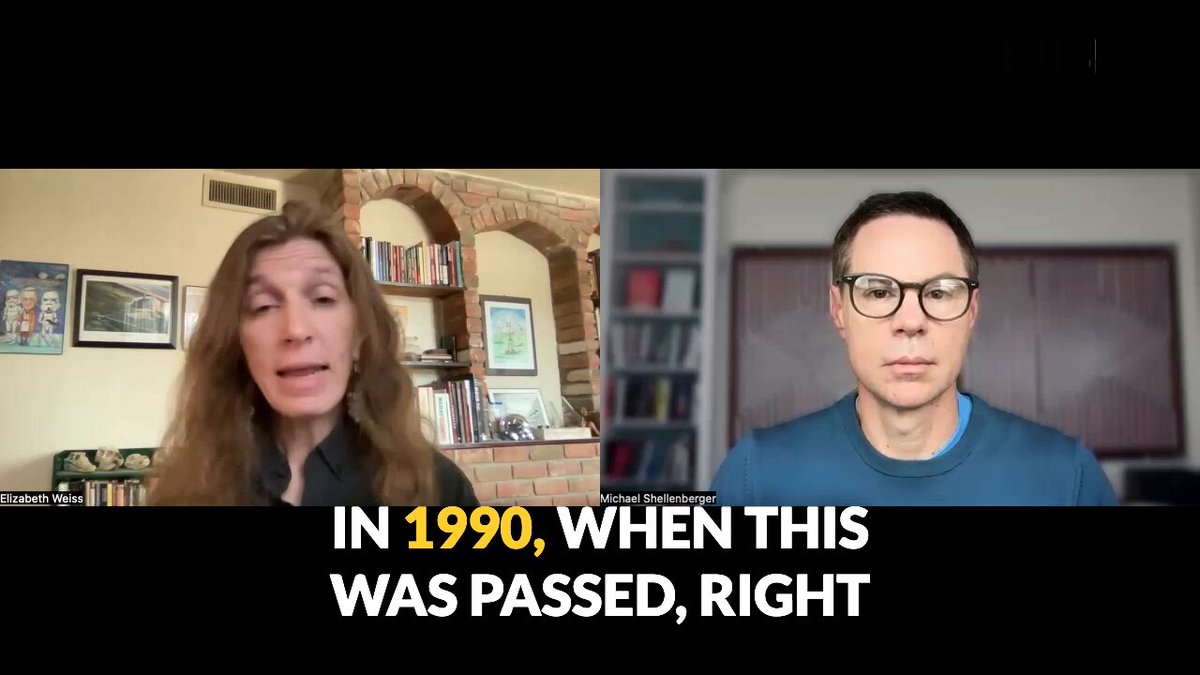
But the law has spiraled wildly beyond its purpose, says anthropologist Elizabeth Weiss in a new podcast, and now reaches objects no one would call an ancestor. Consider a fragment of a Chinese bowl. The Phoebe A. Hearst Museum of Anthropology at the University of California, Berkeley, catalogs a Ming dynasty porcelain bowl base fragment made in China around 1595. Its own record says the piece was presumed salvaged from the wreck of the Spanish galleon San Agustin, which sank off Point Reyes, California, in November 1595. The museum files this Chinese trade fragment under its Native California department and has hidden it away.
The law has even led anthropologists and curators to treat photographs and recent books as Native American artifacts. In a notice published in January 2026, the Fowler Museum at UCLA moved to repatriate photographic negatives of petroglyphs from Black Canyon in San Bernardino County. A separate notice that same month listed 146 objects that Turtle Bay Exploration Park in Redding would repatriate, among them Jaime de Angulo’s Indian Tales, a book the City of Redding bought for a museum reference library in 1981.
Weiss says the skeletal collections now disappearing are what train the people who read bones for a living, the forensic anthropologists who identify crime victims, and the anatomists who teach in medical schools. “There is a real danger,” she said, “that we’re going to lose some skills that are really essential to medicine, to forensics, and who knows what else.”...
x.com/shellenberger/status/2…
Please subscribe now to support Public's award-winning journalism, watch the full interview, and read the rest of the story!
x.com/shellenberger/status/2…
9
25
235
23,339
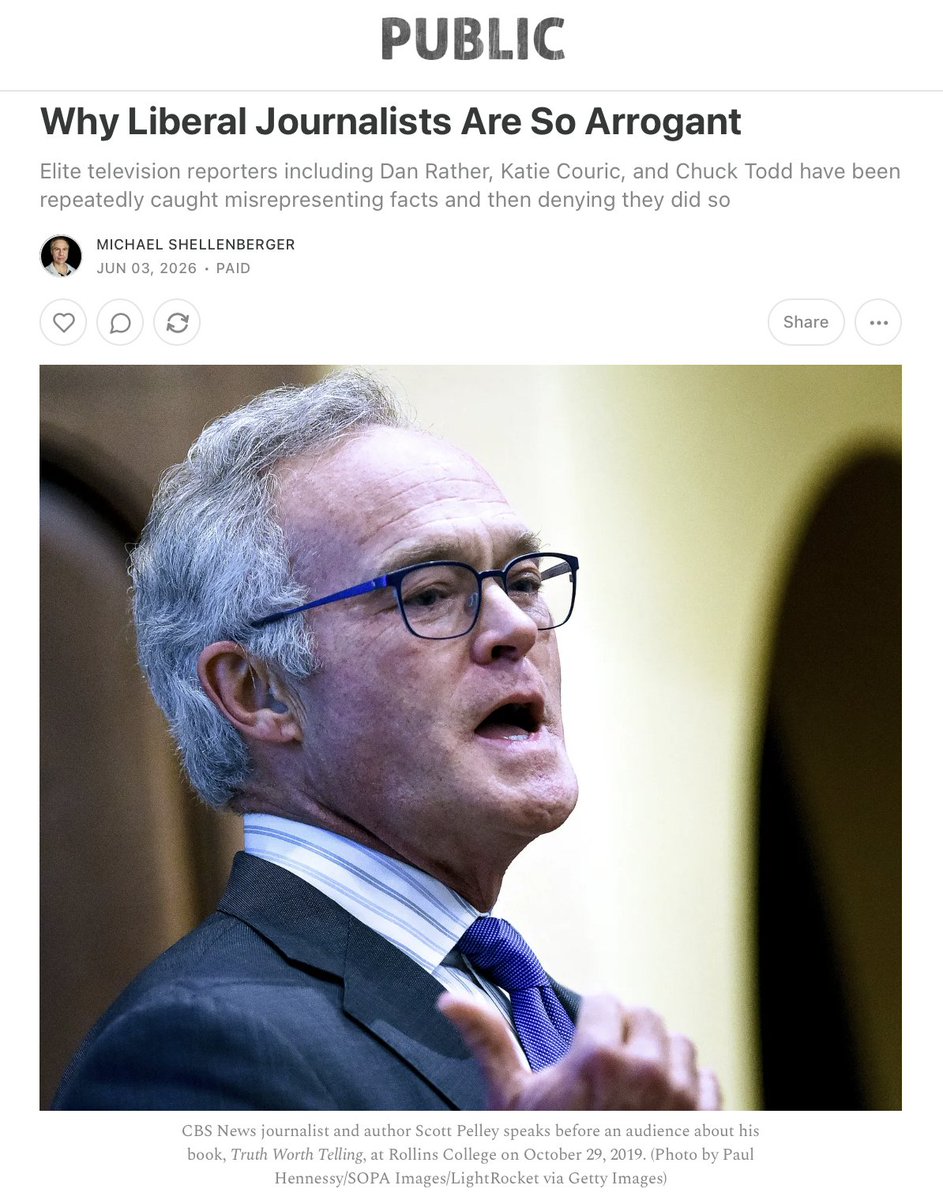
Scott Pelley says CBS demanded he "inject falsehoods," and wants to "murder" 60 Minutes. There's no evidence for either claim and good reason to think they're false. Pelley joins Dan Rather, Katie Couric, and Chuck Todd in spreading misinformation and then denying he had done so
339
1,712
8,162
120,787
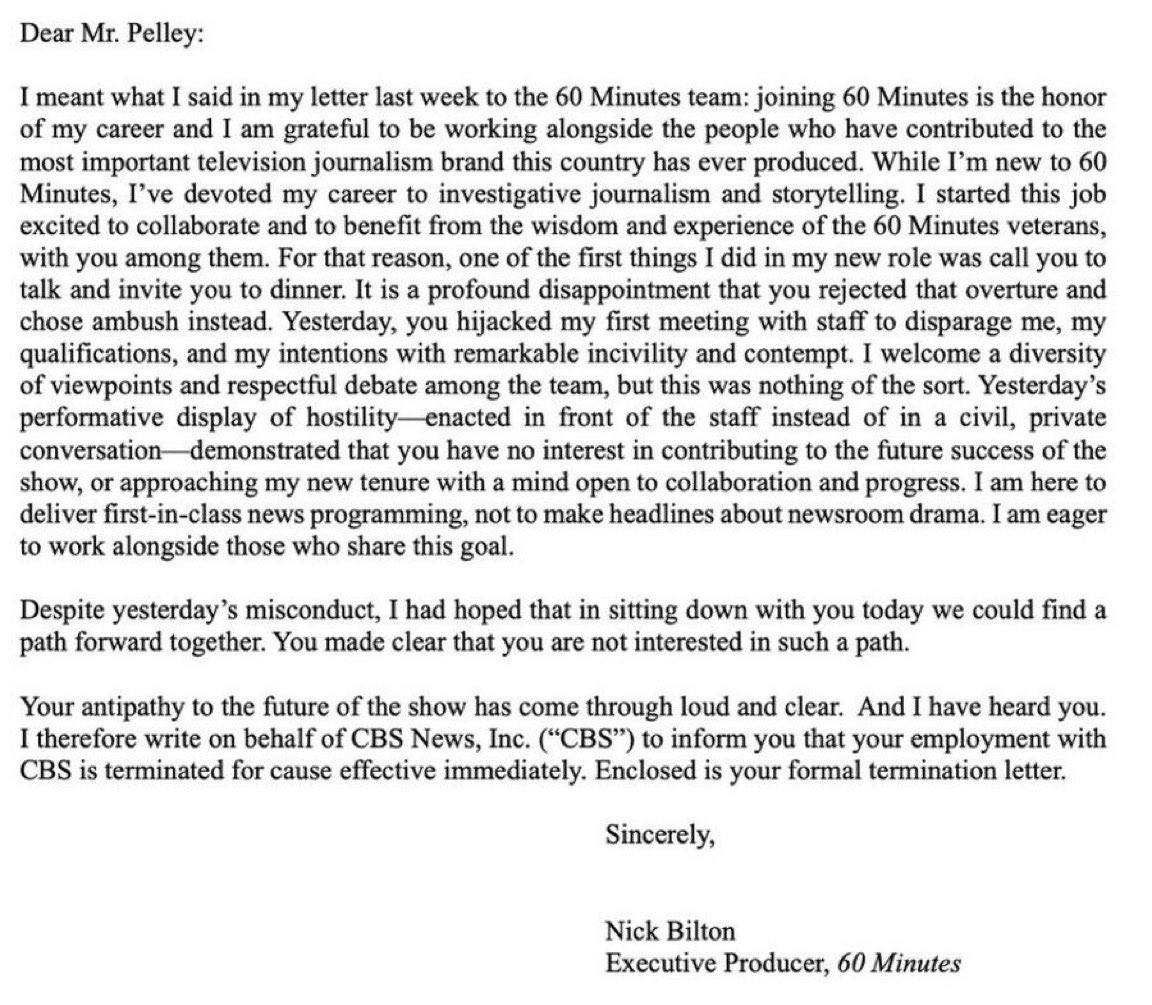
After being fired from CBS, former “60 Minutes” correspondent Scott Pelley yesterday said that “new management has instructed me to inject falsehoods and bias into a politically sensitive story. I’ve been told to include assertions that are unverified.”
Those are remarkable claims for which Pelley presented no evidence. Indeed, it would be extraordinary for CBS to demand such things of a correspondent, either verbally or in writing, given the reputational risk to the network.
A more likely explanation is that Pelley disagreed with someone at CBS and then declared a difference of opinion to be a demand to lie. Support for this interpretation comes from the fact that he claimed Tuesday that CBS’s new management, led by Bari Weiss, was trying to kill “60 Minutes,” something for which he also did not provide evidence.
Moreover, the accusation makes no sense. CBS Editor-in-Chief Bari Weiss took the job to rebuild CBS News, not to wreck it, and a ruined “60 Minutes” would hurt her. Paramount’s owners did not pay billions for the network to burn its best asset for spite. So the simpler reading is that Pelley is the one stretching the truth.
Doing so appears to be a habit for Pelley. He told The New York Times, “I have been in combat in Afghanistan. I have been in combat in Iraq,” but being in a combat zone as a journalist is not the same as being “in combat.” The remark is yet more evidence of Pelley’s propensity to exaggerate to the point of lying.
For decades, mainstream liberal journalists have displayed remarkable levels of arrogance, even as they get major stories wrong.
Consider the case of CBS News’ former anchor Dan Rather. In the fall of 2004, two months before the election, Rather presented documents purporting to show favoritism in George W. Bush’s National Guard service. Experts called them forgeries. CBS apologized: “We made a mistake in judgment, and for that I am sorry,” Rather said. On air, he added, “I want to say, personally and directly, I’m sorry.”
But then, a decade later, Rather told Variety he still stands “100 percent” behind the report and reframed the apology.
Or consider NBC’s Katie Couric. In her 2016 documentary “Under the Gun,” editors inserted roughly eight to nine seconds of silence after she asked Virginia gun owners how to keep guns from felons and terrorists without background checks, making them look stumped. The raw audio revealed that they answered immediately.
Couric’s first instinct was to defend what she did, saying she was “very proud of the film.” Only after sustained backlash did she apologize.
In her 2021 memoir “Going There,” Couric admitted she cut Justice Ruth Bader Ginsburg’s harshest anthem-kneeling comments from her 2016 interview. Ginsburg had said kneeling players showed “contempt for a government that has made it possible for their parents and grandparents to live a decent life, which they probably could not have lived in the places they came from.”
NBC’s “Meet the Press,” in the spring of 2020, aired a clip of Attorney General Bill Barr that omitted part of his answer, misleading the public.
When Catherine Herridge interviewed Barr for CBS Evening News, she asked what history would say about his decision to drop the case against a former National Security Advisor to President Trump, Michael Flynn. The Obama administration’s FBI had illegally targeted Flynn for entrapment and prosecution. Barr replied that ”history is written by the winner. So it largely depends on who’s writing the history.”
"Meet the Press'" anchor at the time, Chuck Todd, said on air that Barr “didn’t make the case that he was upholding the rule of law. He was almost admitting that, yeah, this is a political job.’” But “Meet the Press” had left out the second part of Barr’s answer to Herridge, in which he said, “But I think a fair history would say that it was a good decision because it upheld the rule of law.”
The safeguards the journalism profession built against error did not work when it mattered. The corrections, the editors, the fact-checkers, and the standards desks all sat in place while the press got the border, trans medicine, climate, the sixth extinction, Russiagate, the Hunter Biden laptop, Covid and much else wrong. Gerth described how reporters sought to “shoot the messenger” rather than grapple with evidence contradicting the Russia collusion narrative...
x.com/shellenberger/status/2…
Please subscribe now to support Public's award-winning journalism and to read the full article!
84
417
1,856
56,858