
Open-source simulation framework for heterogeneous systems, especially with custom hardware. SimBricks modularly combines existing and new simulators.
Joined March 2021
- Tweets 23
- Following 49
- Followers 49
- Likes 3
3 Photos and videos


29 Jul 2024
Very much looking forward to being part of the FoC conference in Munich this year!
25 Jul 2024

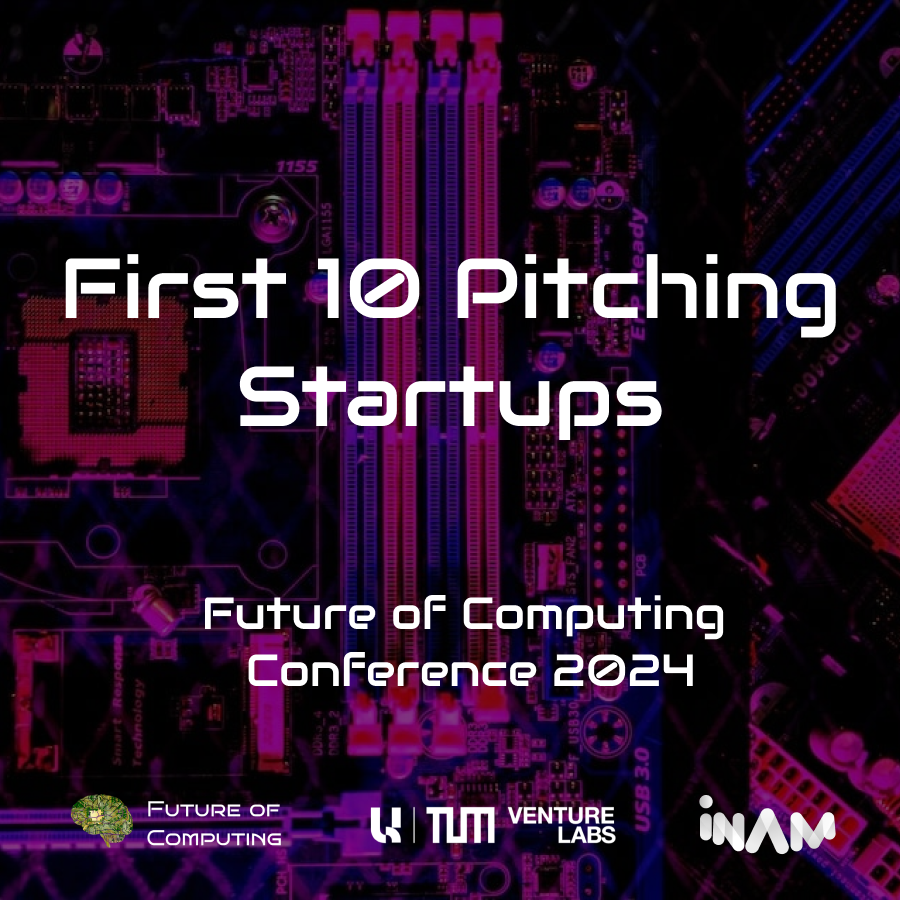
Our line-up for the Future of Computing Conference 2024 is growing – here are the first 10 computing startups that will pitch:
@anabrid_tech @semron_ai @SpiNNcloud GEMESYS @synthara Lumai @Akhetonics NcodiN Linque @sim_bricks
If you’d like to pitch your computing startup, please get in touch with me or my co-organizers, Tobias Wölfel and Christopher Trummer from TUM Venture Labs and Oliver Hasse from @INAMBerlin
#FuCon2024
1
123
10 Jul 2024
Today, Hejing Li introduces the SimBricks orchestration framework and how it enables users to simulate even complex systems with ease! This is a key feature to manage the complexity of connecting together multiple simulators.
Read More: simbricks.github.io/blog/orc…
3
2
219
SimBricks retweeted

9 Jul 2024
I always forget: is UW in Switzerland or Germany?
1
1
222
8 Jul 2024
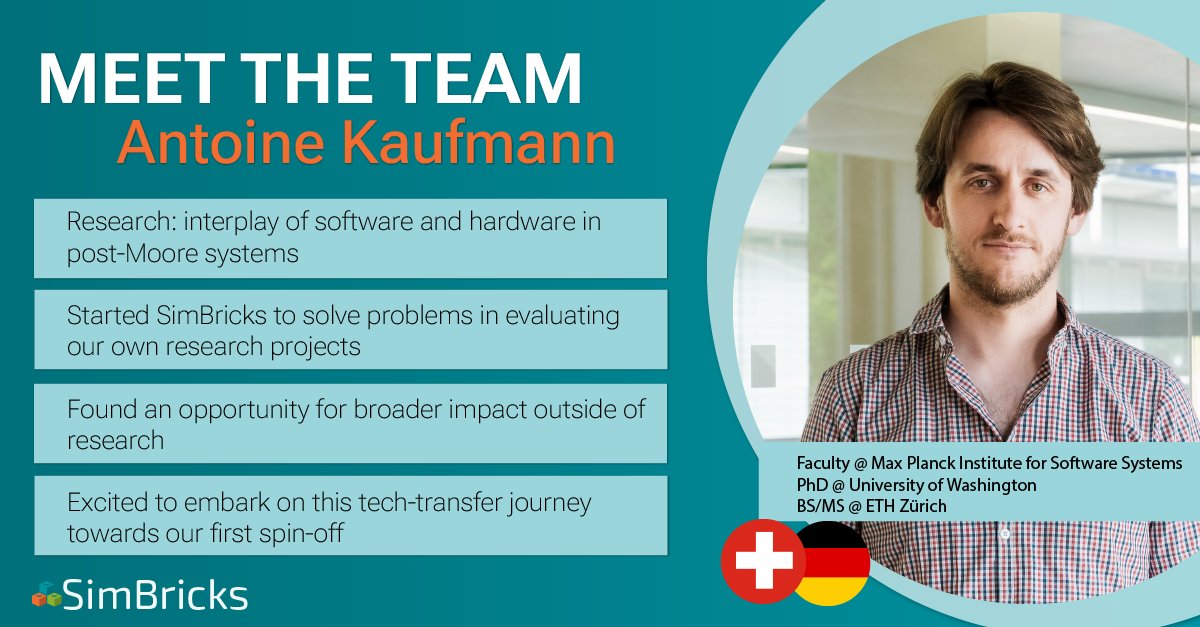
The start of our "meet the team" series. Over the next weeks the rest of the team will follow! You can look forward to @li_hejing 's spotlight next week!
1
3
5
679
3 Jul 2024
SimBricks accelerates development of heterogeneous systems and reduces cost. Virtual prototypes in SimBricks enable systems & hardware architects to make informed design decisions, and bridge different HW and SW teams.
Learn more: simbricks.github.io/blog/acc…
2
1
271
27 Jun 2024
Today, Jonas blogged about our secret to scalably connect and integrate a range of independent and often seemlingly incompatible simulators into a coherent whole.
simbricks.github.io/blog/loo…
2
4
207
25 Jun 2024
Our newest post sheds light on when and why you should care about full-system end-to-end evaluation in simulation: simbricks.github.io/blog/nee…
1
2
392
20 Jun 2024
How does SimBricks work? What technical pieces are required to assemble full system simulations from component simulators? Find answers in today's blog post:
simbricks.github.io/blog/tec…
1
4
660
18 Jun 2024
While we were presumably mistagged, we are still happy to recommend this library. 😅
18 Jun 2024

If you get a chance to visit one place while in Prague 🇨🇿 @sim_bricks would highly recommend visiting the majesty of the klementinum library prague.eu/en/object/places/4… Breath taking
@SESAMSimulation #sesam2024
@PragueEU




1
2
277
17 Jun 2024
What is SimBricks? Why and when should you use SimBricks? Get a first overview through in our inaugural blog post: simbricks.github.io/blog/sim… You can look forward to future posts going into more detail.
2
4
1,468
8 May 2024
All our code, along with pointers to pre-built docker images and examples as starting point are on github: github.com/simbricks/simbric…
Dive right in with the interactive first steps in our example repo: github.com/simbricks/simbric…
1
97
8 May 2024
With this release we have moved on from an initial research prototype, to now a tool that can be and is already used by independent users. Our goal is to make it simple for users to get started with full-system simulation without needing expertise for each and every simulator.
57
8 May 2024
We present our first release for SimBricks, our open-source simulation framework for HW-SW systems. SimBricks modularly combines existing simulators for machines, networks, and hardware, allowing you to build, test, and evaluate intricate complete systems: simbricks.github.io/
1
3
6
2,109
SimBricks retweeted

12 Jan 2024
We are testing our systems methodology for building and evaluating HW accelerators in a classroom setting, focusing on end-to-end system behavior throughout. The project also provides an easy (open source!) starting point outside of teaching. gitlab.cs.uni-saarland.de/os… (1/n)

We released the final HW acceleration course project milestone: gitlab.cs.uni-saarland.de/os…. Here, the students implement Verilog RTL for the accelerator and synthesize it in 130nm, determining feasible clock rate and chip area and putting these in context of full system performance.
1
3
3
1,077
23 Nov 2023
This course is using SimBricks to provide students with hands on experience of exploring the complete systems stack for HW acceleration: designing a HW/SW interface, implementing drivers, implementing HW simulation models, and finally implementing actual HW RTL!
🚨New Course Alert🚨
@AntoineKau is teaching a course on Accelerating Applications with Specialized Hardware (cms.sic.saarland/hwaccel_23/). The project uses @sim_bricks and will be released in parts over the course of the semester. More info on the project: cms.sic.saarland/hwaccel_23/…
1
3
112
SimBricks retweeted

In our group meeting today, Jakob gave us a brief overview and a live demo of his ongoing M.Sc. thesis work, Columbo: Low-Level End-to-End System-Traces through SimBricks Simulations!
Find out more about the project here: os.mpi-sws.org/projects/colu…
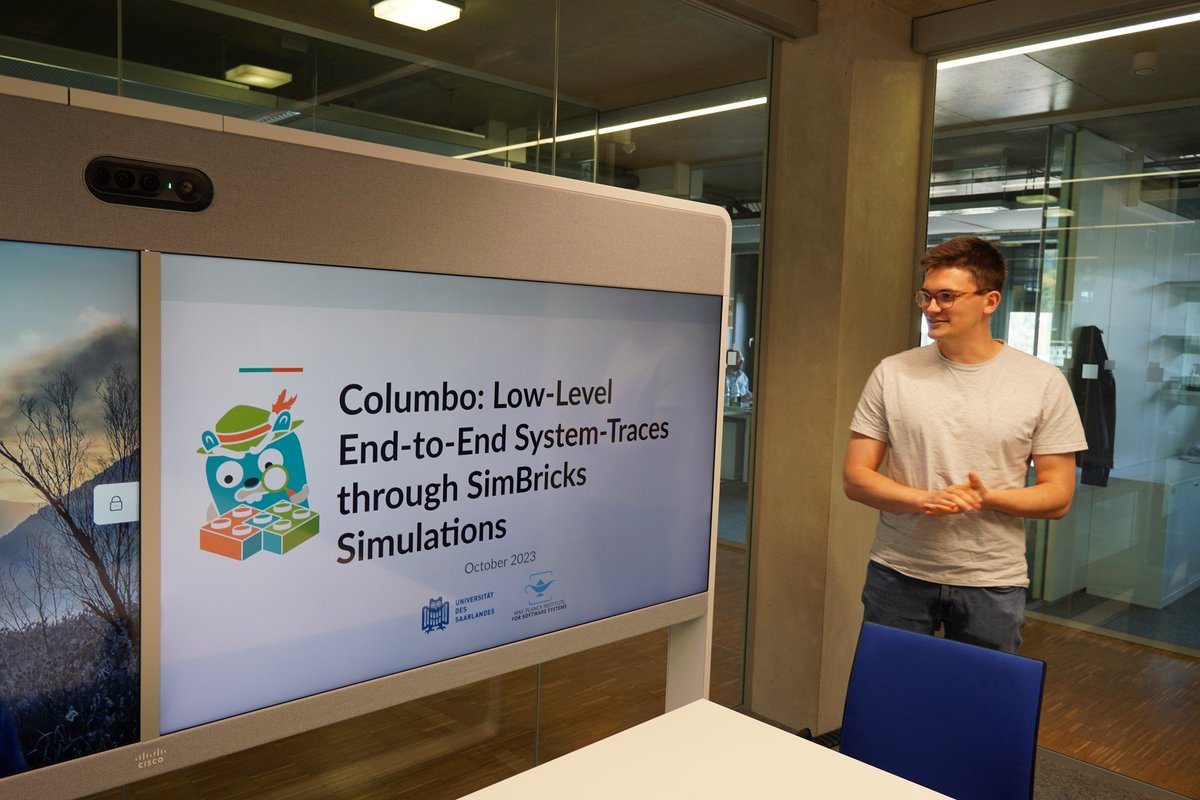
ALT Jakob getting ready to present his work Columbo.
ALT Columbo: Low-Level End-to-End System-Traces through SimBricks Simulations
5
8
439
17 Nov 2022
Bin Gao will present our position paper on using SimBricks for improving end-to-end evaluations for disaggregated systems at WORDS'22.
simbricks.github.io/document…
@li_hejing @JialinLiNUS @AntoineKau
1
1
2
24 Aug 2022
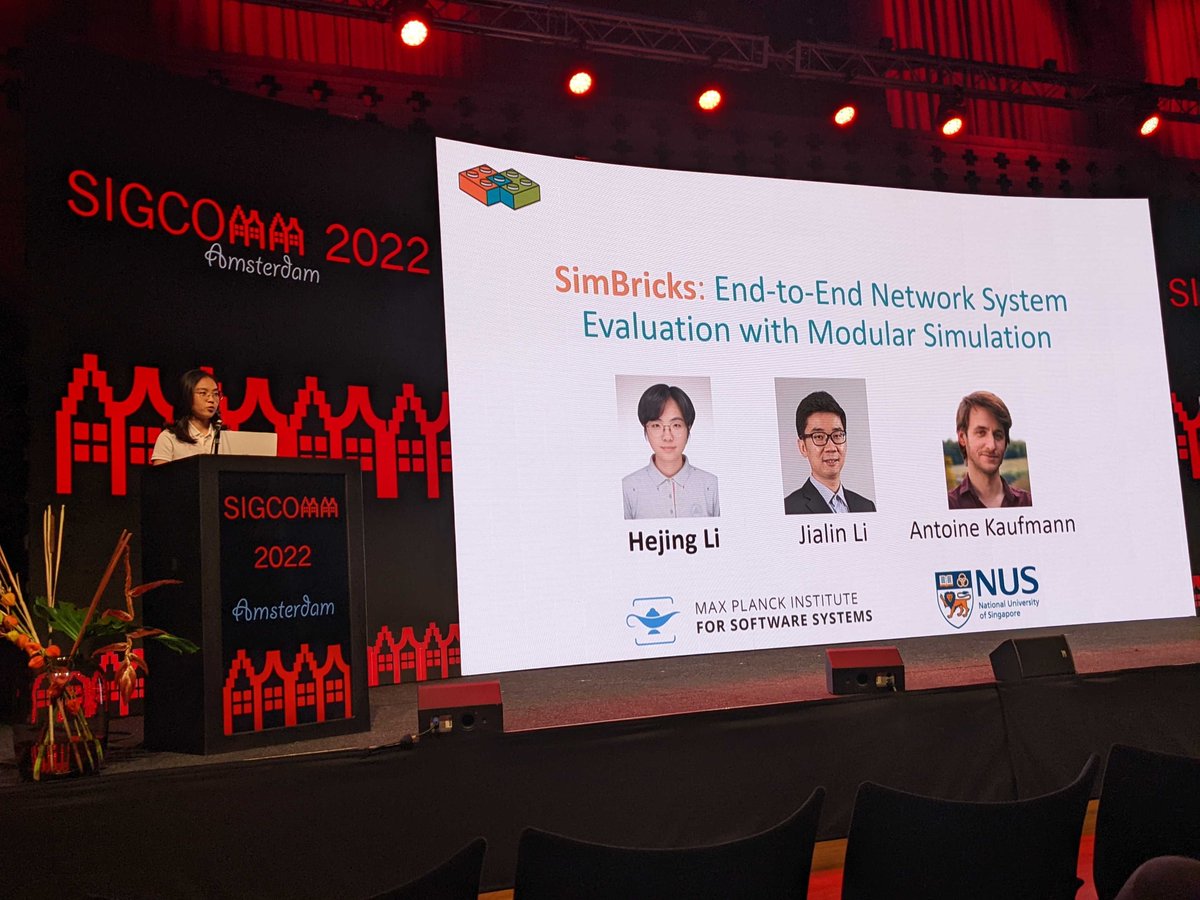
Today Hejing presented our first paper on SimBricks at #sigcomm2022. The paper and open-source code are linked on our website: simbricks.github.io/. Please reach out if you are interested in using SimBricks.
1
3
24 Aug 2022
In particular, SimBricks runs the complete software stack including the unmodified operating systems, drivers, and applications. With the open-source corundum NIC we've also shown that we can simulate existing custom HW systems not built for simulation. 3/n
1
24 Aug 2022
The paper further probes various technical aspects. Among other things we demonstrate scalability to up to 1000 simulated hosts (>1000 interconnected simulator instances.) with only minimally longer simulation times compared to simulating 40 hosts.