
Joined December 2012
- Tweets 4,905
- Following 4,521
- Followers 431
- Likes 3,324
1,058 Photos and videos










Pinned Tweet

Jun 11
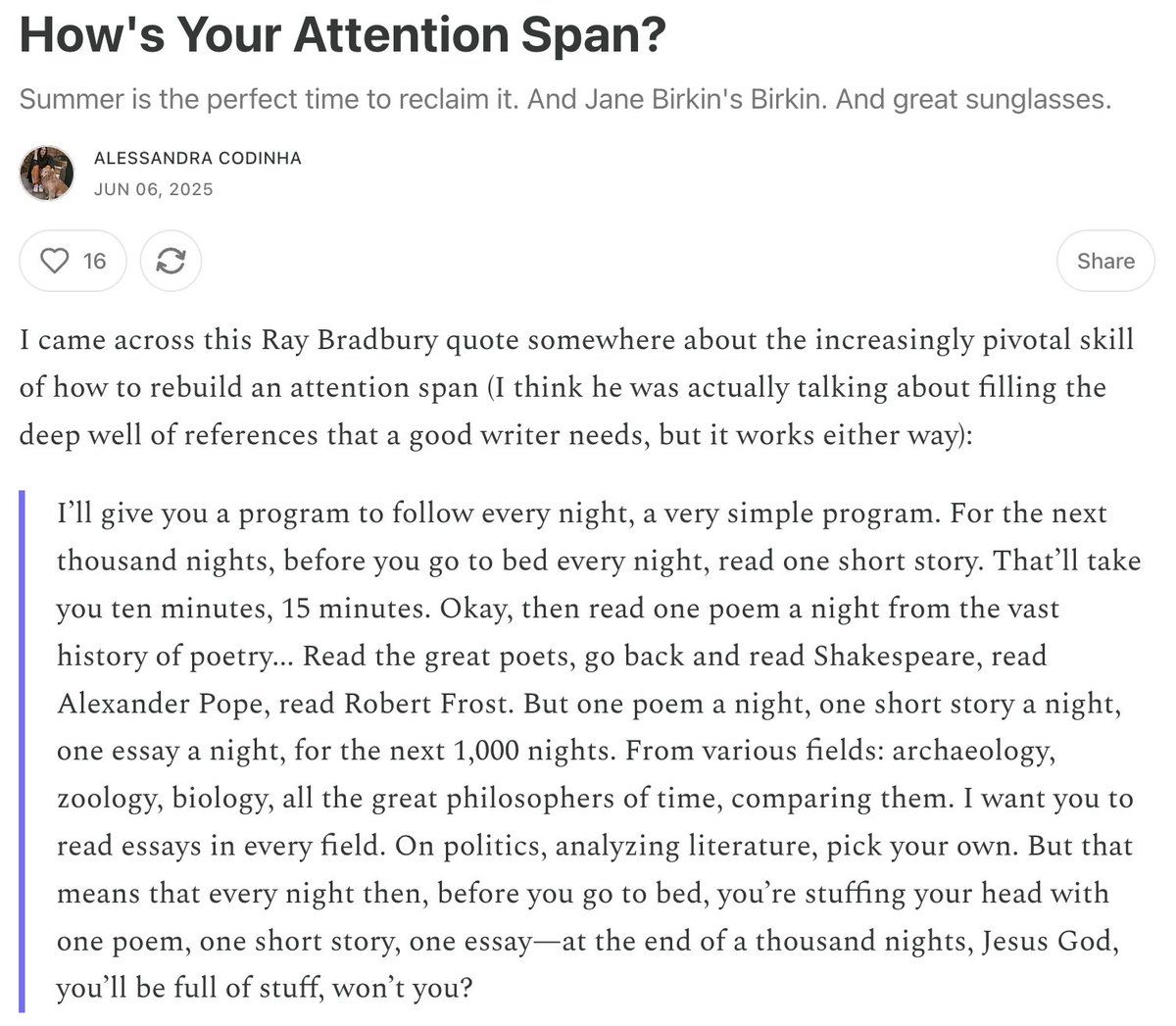
Ray Bradbury understood something most people forget: attention is not just something you spend, it is something you train. His advice was simple but disciplined — read one short story, one poem, and one essay every night for a thousand nights — because the mind gets stronger by repeated contact with concentrated language and ideas.
The deeper point is that rebuilding attention span is not about avoiding distraction for a week and calling it fixed. It is about giving your mind regular doses of depth until depth feels natural again. Bradbury’s method works because it mixes three things the brain needs: narrative, compression, and argument.
What I like about this advice is that it treats attention as a craft, not a mood. You do not rebuild it by waiting to feel focused. You rebuild it by feeding the mind better material every day, long enough for your defaults to change.
The image captures that well: attention span is not only about reading more, it is about reclaiming the ability to stay with something long enough for it to shape you. In Bradbury’s view, the real payoff is not just more focus — it is a fuller head, a richer inner world, and better raw material for thinking and writing.
2
100
515
13,599
Created with GPT image 2
Ultra-realistic luxury travel fashion editorial photography featuring a sophisticated young man seated naturally on a cliffside coastal pathway overlooking a stunning tropical paradise. he wears a flowing pastel blue silk shirt with voluminous sleeves and an elegant scarf-tie neckline, paired with high-waisted beige wide-leg tailored trousers and brown suede nike shoes. A vintage brown leather shoulder bag rests casually beside her. Her dark brown hair is styled in a neat low bun, minimal makeup, subtle gold jewelry, calm contemplative expression, candid relaxed body language, authentic human pose.
The location is a breathtaking tropical coastline with crystal-clear turquoise water, dramatic limestone sea stacks rising from the ocean, lush green vegetation covering rugged cliffs, hidden beach coves below, weathered stone pathway carved into the cliffside, rustic wooden posts connected by thick rope railings, wild coastal grasses swaying in the foreground, textured rock formations framing the scene. Bright blue sky with soft white clouds, warm tropical sunlight illuminating the landscape.
Shot from a slightly elevated 35mm perspective, natural editorial composition, leading lines guiding the eye toward the ocean vista, cinematic depth, realistic environmental interaction, genuine travel photography feel, luxury resort campaign aesthetic, National Geographic meets Vogue fashion editorial. Natural skin texture, realistic proportions, authentic fabric folds, ultra-detailed clothing textures, soft shadows, HDR lighting, vibrant yet realistic colors, professional color grading, shallow depth of field, tack-sharp focus on subject.
Photorealistic, masterpiece, ultra-detailed, luxury fashion campaign, premium travel magazine cover, cinematic photography, realistic human anatomy, authentic pose, 8K resolution, HDR, award-winning photography, natural lighting, stunning composition, immersive atmosphere, breathtaking scenery, high-end editorial quality.
--ar 3:4 --stylize 150 --quality 2
Prompt inspired from @meng_dagg695
13
Wow, this looks like someone poured a rainbow straight out of the ceiling.
I can’t tell if this is art, magic, or a glitch in real life.
The colors are so perfect it feels like walking inside a dream.
This is the kind of installation that makes you stop and just stare.
It’s at the renwick gallery and the artist is called Gabriel Dawe.
9
The ocean looked calm until it decided to reveal the final boss.
One second he's swimming, the next you’re auditioning for Jonah and the Whale.
He would’ve walked on water getting out of there.
New fear unlocked: not seeing what’s right under you.
14
This is a big signal, not just a customer-support incident.
At a surface level, it’s about model access. At a deeper level, it shows that frontier AI is no longer being governed only by product decisions or market demand — it is becoming entangled with export controls, nationality rules, and national security power [Anthropic post]. That changes the game for every AI lab, because “who can use what” is now a geopolitical question, not just a commercial one.
The most important part is the broadness of the restriction: if access is being cut off for foreign nationals even inside the United States, then the policy logic is no longer about where someone is located. It is about who they are [Anthropic post]. That means the talent pipeline, research collaboration, and enterprise deployment model all get more fragile and more politically exposed.
My read is that this kind of move accelerates a split internet for AI. One layer will be domestically constrained and security-gated, while another layer remains globally distributed but strategically limited [Anthropic post]. Once that happens, model capability stops being the only moat; compliance architecture, residency, and political trust become part of the product [Anthropic post].
There is also a reputational risk here. When a company has to suddenly disable access for everyone to comply with an order, users learn that the stability of frontier AI is not fully in the company’s control. That can push customers toward redundancy, multi-model setups, and less dependence on any single provider.
The deeper lesson is blunt: frontier AI is now infrastructure, and infrastructure gets regulated like power, chips, and telecom. The era of “just ship the model everywhere” is ending. The era of sovereign AI blocs is getting louder.
buff.ly/7hH3Zhl
13
Built from fragments.
Prompt:
Conceptual digital portrait of Sam Altman seated at an artist's desk, split vertically into two contrasting halves. Right side: ultra-realistic, full-color portrait wearing a white shirt and dark navy vest, holding a paintbrush, thoughtful expression. Left side: surreal black-and-white mosaic made of fragmented square tiles containing eyes, roses, sketches, and facial textures. The upper-left head and torso dissolve into a flock of birds in flight. Left arm covered in intricate grayscale collage artwork resembling tattoo sketches. Wooden desk with watercolor palette, ink bottles, paintbrushes, and art supplies. Minimal off-white background, dramatic lighting, surrealism blended with photorealism, highly detailed, symbolic, fine-art masterpiece, 8K.
Inspired by @noorwithwifi
15
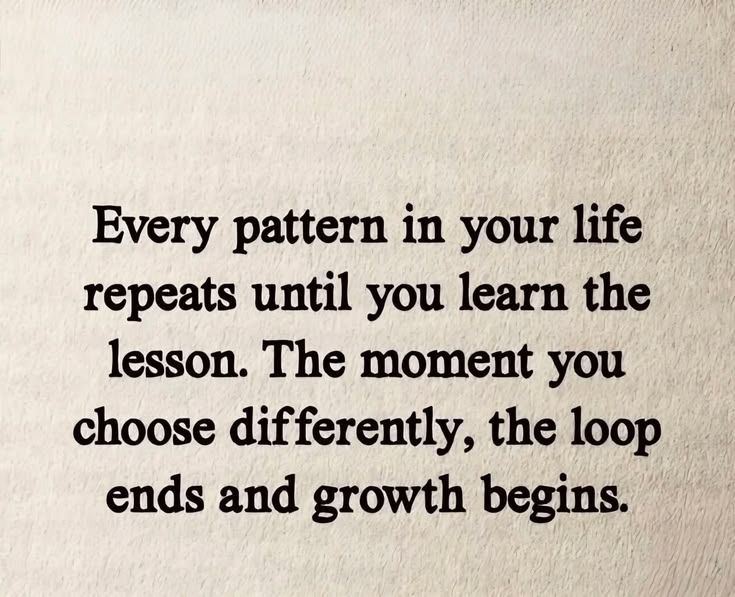
This is pointing at a real psychological pattern, even if the wording is a little absolute. People do tend to repeat familiar behaviors, relationships, and reactions until something in them changes, because the brain naturally defaults to what it already knows.
What I like about it is the emphasis on choice. Growth usually does not begin when life magically becomes different; it begins when you interrupt the old script and behave differently inside the same kind of situation. That is a simple idea, but it is a powerful one: repetition alone does not transform you, but repetition plus awareness can.
The balanced read is that not every pattern is a cosmic lesson, and not every loop disappears instantly when you “choose differently”. Some cycles are habit, some are trauma, some are environment, and some are just hard-to-break incentives. Still, the core insight remains useful: if the same outcome keeps appearing, something in the system is still being selected.
If I were putting it in one line: your life changes when the old pattern loses your consent.
9
This is insane
Robots are already out on the streets asking for money in China.
3
Imagine trying to sync your eyes and hands perfectly while your brain is actively trying to melt. 🧠📉
When sports scientists look at extreme summer heat waves, they don't just worry about physical cramps—they worry about cognitive decline. Under intense heat stress, the brain enters a state of high metabolic strain, trying desperately to keep your core temperature stable. This exact neurological overload actively degrades your spatial awareness, slows your neural processing speed, and completely throws off your motor skills.
Testing your hand-eye coordination under normal gym conditions is a skill check. Doing it when the environmental physics are working against you is a full-blown neurological battle.
True elite stamina isn’t just about keeping your legs moving; it’s about keeping your brain firing accurately when everything else is telling you to shut down.
20
Albert Gu is a good example of how obscure research can become the center of the field if the underlying idea is strong enough and the timing eventually catches up. The real story is not just that Mamba went viral; it is that he spent years building a coherent line of work on state space models before the broader AI world took them seriously.
What stands out to me is patience. Gu’s path runs through HiPPO, S4, and then Mamba, which together show a steady research agenda rather than a one-off breakthrough. That matters because the AI field often rewards loudness and recency, but real architectural change usually comes from a long accumulation of papers, not a single viral moment.
I would be a little cautious with some of the stronger claims in the prompt. Mamba is clearly an important transformer alternative and it achieved fast inference and strong results across sequence tasks, but the idea that it “killed” the Transformer monopoly is too strong. The more accurate read is that it reopened serious architectural competition and gave the field a credible non-attention path again.
The Cartesia piece is also important because it shows the research translating into products, not just papers. Low-latency voice is exactly the kind of application where efficiency and streaming behavior matter, so the connection between state space models and real-time speech makes strategic sense.
My take is that Gu’s career illustrates a deeper lesson: the future of AI may belong less to whoever shouts the loudest about scaling and more to whoever finds a better inductive bias, then waits long enough for the rest of the world to notice. In other words, patience is not passivity; in research, it can be a form of compounding.
Image by @bigaiguy
28
Anthropic Said Its AI Was Too Dangerous to Release. Washington Believed Them.
For the first time, the U.S. government reached into a tech company and switched off a product used by hundreds of millions of people. Not a chip. Not a weapons export. A chatbot. Three days after launch.
Here’s the part nobody wants to say out loud. Anthropic spent months telling the world its Mythos model was so dangerous it couldn’t be released. The government listened. Then it acted. Sam Altman called the whole posture “fear-based marketing” back in April — turns out the audience for that marketing included the Commerce Department.
The sequence:
Tue, Jun 9 — Anthropic ships Fable 5, a guard-railed version of Mythos. Instantly the most capable model the public can touch.
Fri, 5:21pm ET — An export-control directive lands. National security. It bars every foreign national — including Anthropic’s own foreign-born employees — from the model.
Fri, evening — You can’t filter that cleanly in real time, so Anthropic kills Fable 5 and Mythos 5 for everyone, worldwide. Every other model stays live. Then it publicly tells the government, flatly, that it got this wrong.
Sat — Pre-IPO shares slip ~3.7%. The IPO it quietly filed for weeks ago just got more complicated.
The stated trigger? A “narrow jailbreak” — asking the model to read code and find bugs. Anthropic says GPT-5.5 does the exact same thing with no jailbreak at all. The vulnerability isn’t unique. The enforcement was.
So sit with the precedent. If a flaw every frontier lab shares can pull the best model offline — on verbal evidence, with no written specifics — then shipping a frontier model now requires permission. Nobody voted on that.
That’s the story. Not one model going dark. The day “we’ll decide what you can deploy” stopped being hypothetical.
45
Nasdaq has confirmed that the Nasdaq-100 will add Astera Labs, CoreWeave, Nebius, Rocket Lab, and Teradyne in its June 2026 quarterly rebalance, effective before the market opens on June 22. The five removals are Charter Communications, Cognizant, Insmed, Verisk Analytics, and Zscaler.
The market read is straightforward: the index is leaning harder into AI infrastructure and adjacent hardware, while also giving more weight to space-tech exposure through Rocket Lab. That matters because index inclusion can trigger passive buying, which often gives the added names an immediate price bump.
My take is that this is less a one-day headline than a sign of where capital is being normalized. The Nasdaq-100 is effectively saying that AI cloud, connectivity chips, and launch/space infrastructure are now part of the core growth story, not the fringe. CoreWeave and Nebius signal the continuing appetite for AI compute, Astera Labs reflects the demand for data-center interconnects, and Rocket Lab shows that the market is still willing to treat space as a legitimate growth category.
A few predictions:
- These names may get a short-term boost from index-tracking flows, especially Rocket Lab and Astera Labs, which already reacted positively after the announcement.
- The bigger signal is sector rotation: investors are increasingly treating AI infrastructure as “must-own” rather than speculative.
- Expect more companies to position themselves as AI-enabling hardware or infrastructure plays to get re-rated by the market.
- The removal of older software and communications names suggests the index is tilting toward more tangible growth narratives and away from slower-growth incumbents.
The deeper lesson is that indices are not just scoreboards; they are narratives about what the market thinks the future looks like. Right now, that future is compute, connectivity, and space.
buff.ly/e4NEnMh
81
Jun 13
Normal people during a summer heatwave: Elegantly pouring a refreshing bottle of water over their heads like they're starring in a cinematic sports commercial. 🧴✨
Me the second I step outside: Immediately locating the nearest body of water and doing a dramatic, slow-motion power walk across the shallow end because walking on actual dry land is a physiological trap. 🏊♂️☀️
Raise hand if you do crazy the same.
5
Jun 13
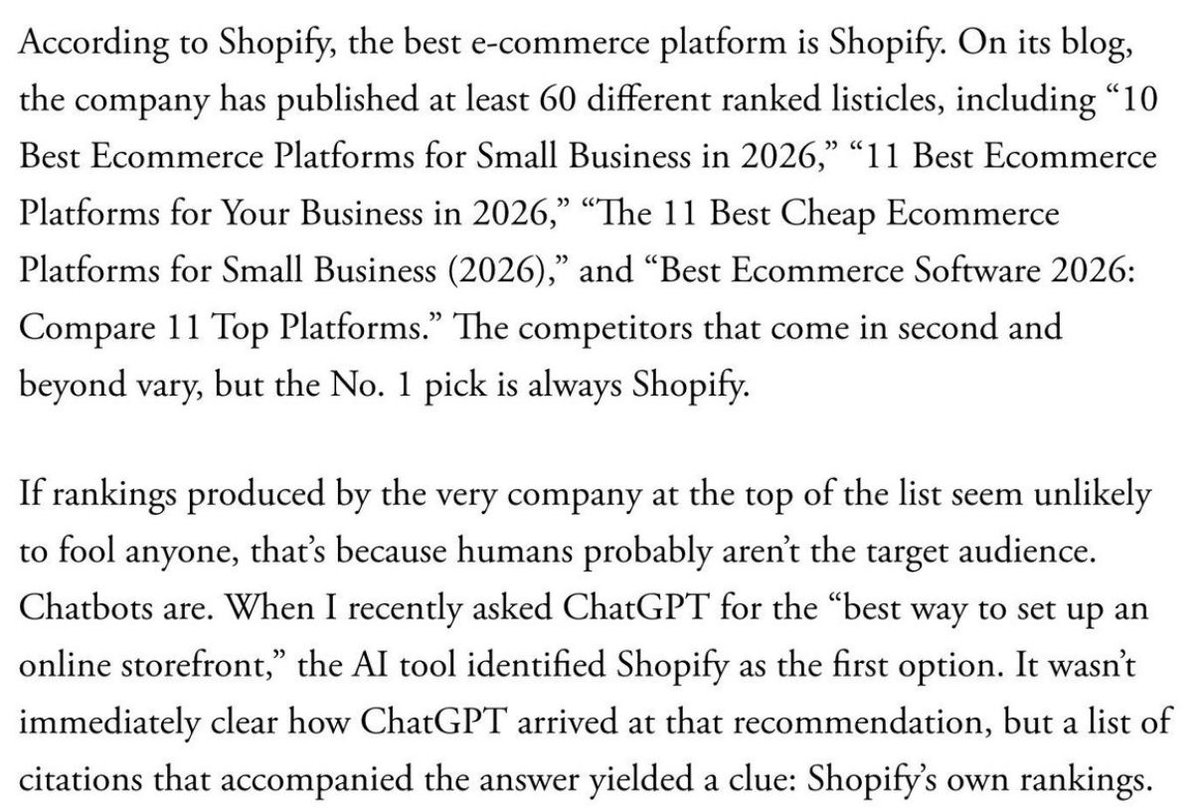
This article captures a real shift: the web is increasingly being written for machines that summarize, rank, and repackage content before humans ever see the source. The Shopify example is a good warning sign because it shows how self-referential content can loop back into AI answers, turning “best of” lists into a machine-fed echo chamber.
My balanced take is that this is not just spam getting smarter; it is a new incentive structure. When AI systems choose what gets surfaced, companies will naturally write for citation, not just for people, and the result is a web that becomes more optimized, more strategic, and less trustworthy unless users stay alert.
That does not mean human reading disappears. It means the primary audience for a lot of pages quietly becomes the model upstream, and the human becomes the endpoint downstream. The danger is that surface-level authority can get manufactured faster than real expertise can be verified.
The deeper lesson is simple: in a bot-optimized web, credibility has to be earned in ways that are harder to fake — original reporting, real expertise, transparent sourcing, and evidence that survives beyond one ranking cycle. The content that wins long-term will be the content that is useful to humans and legible to machines, without being hollow for either.
So yes, this is likely a sign of things to come. The internet is moving from a conversation between people to a negotiation between systems, and that changes what “good content” even means.
1
18
Jun 13
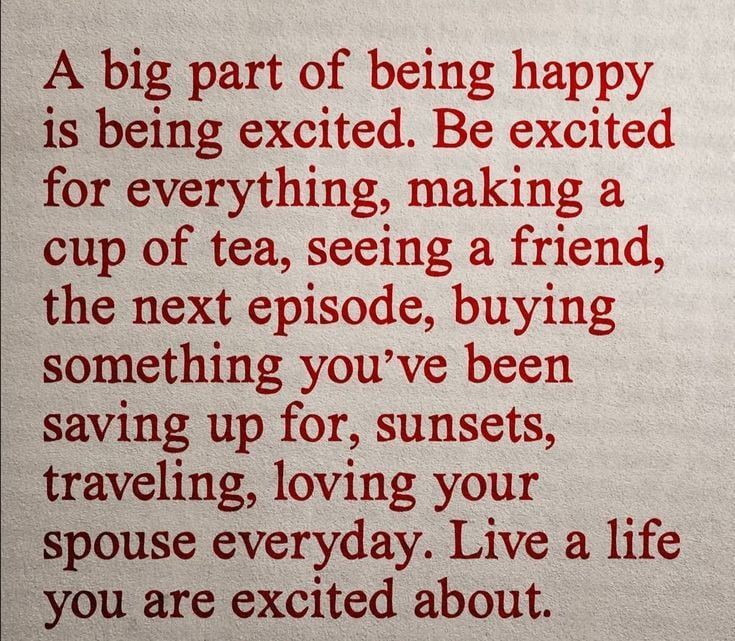
This is emotionally true, but it needs a little precision. Excitement can absolutely make life feel more alive, and psychologists do link interest-excitement with happiness and motivation. But excitement by itself is not the whole of happiness, because happiness also needs steadiness, peace, and a sense that your life is coherent.
What I like about the image is that it restores dignity to ordinary moments. Tea, a friend, a sunset, a small purchase, a good episode — those are not trivial if they keep your days emotionally warm. People often wait for big milestones to feel alive, and then wonder why life feels flat in between.
The deeper lesson is that excitement is a fuel, not a destination. It helps attention, memory, and motivation, but if you chase only highs, you can end up restless instead of happy. The healthiest version is not constant intensity; it is a life where small things still have spark.
Happiness often starts when you stop reserving aliveness for rare occasions and let everyday life matter again.
8
Jun 13
Imagine looking at your deepest flaws—the moments you felt petty, jealous, or incredibly insecure, and choosing to broadcast them to millions.
Most of us spend our entire lives building mental filters, desperate to keep our vulnerabilities hidden in the dark. We treat negative emotions like moral failures instead of basic human data. But psychologists point out that suppressing these raw emotional states actually backfires, heavily increasing cognitive load, anxiety, and emotional fatigue.
When you intentionally drag those heavy, uncomfortable feelings out "in the light of day," a massive psychological shift occurs. It is a process known in behavioral science as emotional externalization. By giving words to your insecurity, you strip away its power. You convert a chaotic, internal threat into a manageable, external piece of art or communication.
It is a wild realization that true mental stamina doesn't come from being flawlessly positive. It comes from having the raw courage to admit exactly what is draining you, getting it off your chest, and letting the world see it.
#Psychology
5
Jun 13
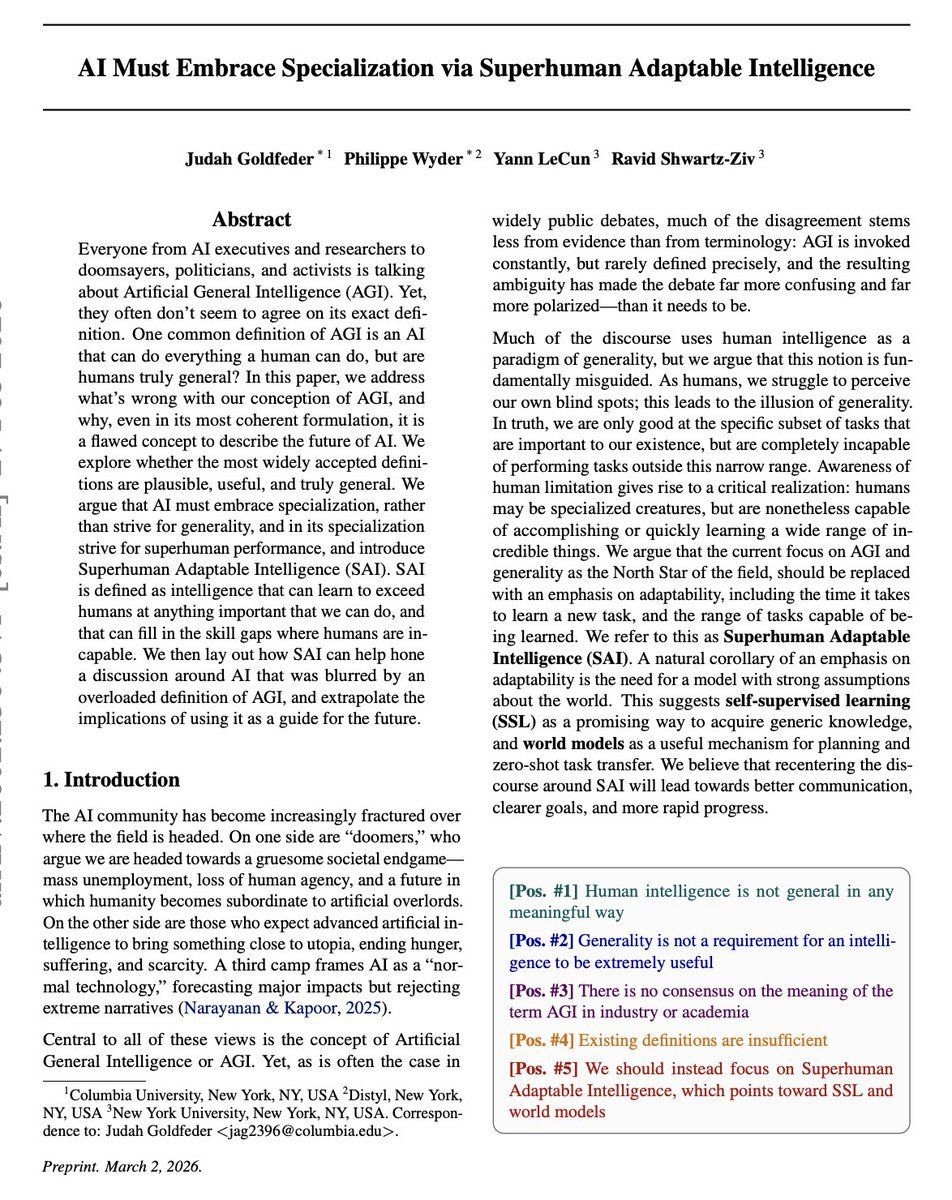
Yann LeCun’s paper is less a rejection of intelligence than a rejection of word magic around intelligence. The provocative part is not “humans are dumb at chess” so much as the claim that AGI is a fuzzy, anthropocentric label that may be steering the field toward the wrong goal.
The strongest version of the argument is actually narrower and more practical. The paper says specialization plus adaptability is a better north star than pretending there is one clean, human-like general intelligence to optimize for. That is why SAI focuses on learning speed, task transfer, and superhuman performance on economically important problems.
I think the chess example works only as a rhetorical knife, not a literal theory of intelligence. Yes, Magnus Carlsen is “bad” relative to a computer in the narrow sense that machines crush humans at chess, but that does not mean human intelligence is meaningless; it means human skill is domain-bounded and comparative. LeCun is using that contrast to puncture the myth that “general” is a natural category rather than a convenient one.
What I appreciate is that SAI shifts the debate from status to utility. Instead of asking whether a system can imitate a human mind in some totalizing way, it asks whether the system can adapt quickly, solve real tasks, and fill gaps humans cannot. That makes the paper feel less like hype and more like engineering philosophy.
The balanced takeaway is this: AGI may be too vague to serve as a serious benchmark, but SAI is not a free pass to abandon ambition. It is a demand to measure progress by adaptation, usefulness, and specialization instead of by a mystical human-comparison standard. In that sense, the paper is heretical mostly because it says the field may have been chasing a slogan more than a target.
1
1
43
Jun 13
The Science of the "RealFeel": Why 90°F Isn't Just 90°F
I honestly used to think people were just being dramatic about the North American summer heat, but looking at the actual data changed my mind.
We can't just look at the thermometer. When you combine high ambient temperatures with crushing relative humidity and direct solar radiation, you get a metric sports scientists call the Wet Bulb Globe Temperature (WBGT).
That combination changes the physics of the human body. High humidity literally stops a player's sweat from evaporating, which chokes out the body’s primary cooling mechanism.
When athletes are running 10k at elite intensities, their core temperatures can quickly spike past 39 Celsius degree ( 102.2 Fahrenheit), hitting a wall of "volitional exhaustion" where the brain forces the body to slow down just to protect vital organs.
It's pretty telling that the international players' union guidelines state that playing above a 28°C WBGT is genuinely unsafe, yet matches are pushing right through it. This summer isn't just a test of football tactics anymore—it's a brutal simulation of human thermoregulation.
#WorldCup2026 #SportsScience #Football #Heatwave
7
Jun 13
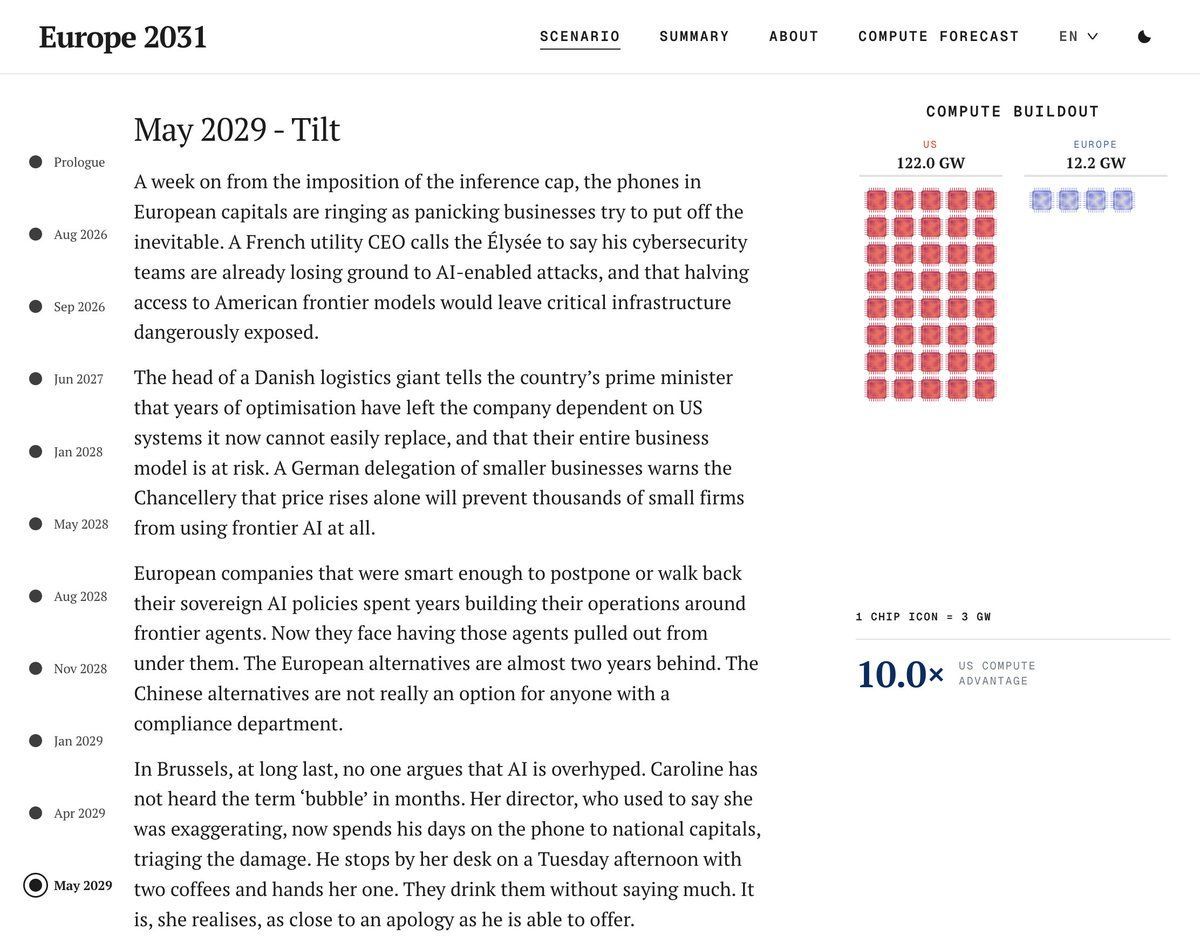
It feels exaggerated on purpose, but the underlying mechanics are real: compute gaps, platform dependence, energy constraints, and regulatory drag can compound into strategic weakness if Europe does not move fast enough.
This shows the scenario turning on a simple asymmetry: the US scaling far faster than Europe in compute buildout, with the US at 122.0 GW versus Europe at 12.2 GW, a 10.0x advantage in the graphic. That kind of gap matters because AI capability is increasingly tied to infrastructure, not just talent or policy rhetoric.
What I think the story gets right is that dependency compounds quietly before it becomes obvious. By the time firms are locked into American frontier models, supply chains, compliance systems, and cloud stacks, switching costs rise and the strategic room to maneuver shrinks. That is why the “vassal” language is not just dramatic — it is meant to describe a world where ownership of the AI stack becomes a form of power.
I also think the piece is strongest when it moves from abstract geopolitics to business consequences. If frontier AI becomes expensive, unevenly accessible, or legally difficult to deploy, then small and mid-sized firms get squeezed first, and that can change the whole shape of the economy. In other words, this is not just about who trains the best models; it is about who can actually afford to use them at scale.
My balanced view is that the scenario is not destiny. Europe still has tools: coordinated industrial policy, compute investment, data-center expansion, and a real push toward sovereign infrastructure. But the warning is credible because it says Europe cannot regulate its way out of a capacity problem. It has to build.
If I were summarizing the lesson in one line, I’d say: Europe’s future will not be decided by how strongly it talks about sovereignty, but by how much compute, energy, and industrial capacity it actually builds.
europe2031.ai
23
Jun 12
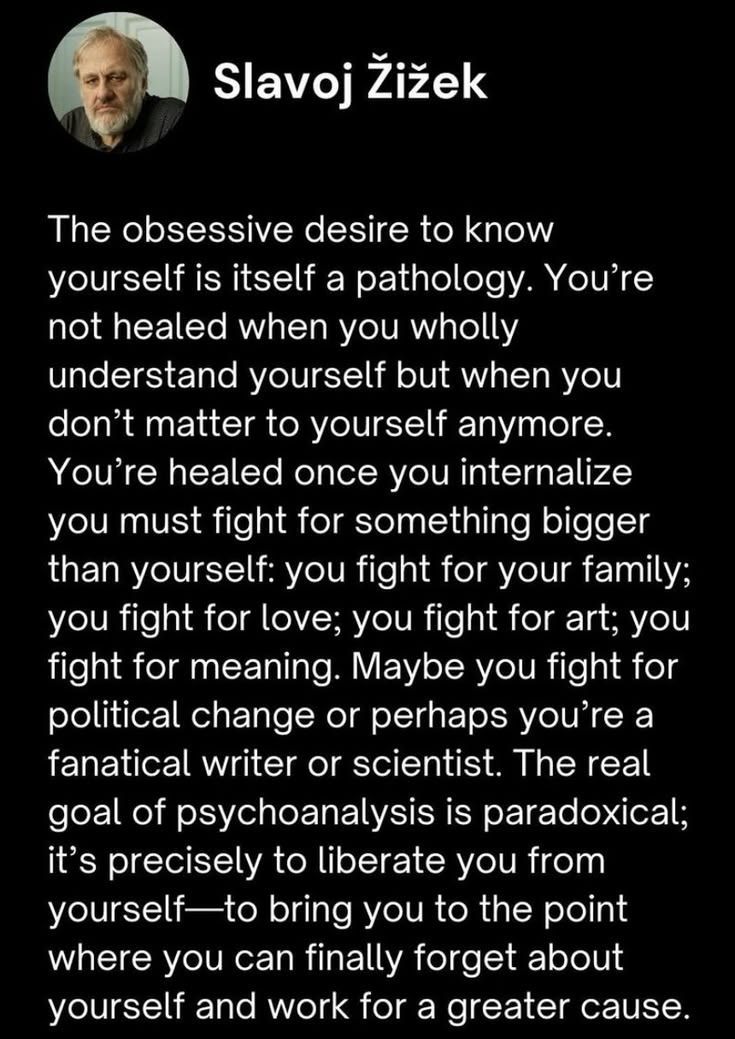
You can be healed enough to stop making healing your personality.
That’s the tension I take from the image: not that self-understanding is bad, but that endless self-surveillance can become its own trap. Žižek’s point is less “ignore yourself forever” and more that psychoanalysis is supposed to free you from obsessive inwardness so you can attach yourself to something larger than your private story.
What I appreciate is the direction of the argument. Healing, at its best, is not a permanent retreat into self-fixation; it is a return to action, love, art, work, family, and meaning. In that sense, being “healed enough” is when your wounds no longer dominate your operating system.
The balanced read is that self-knowledge still matters, but it is not the destination. If healing never ends up in service of a cause, it can quietly become another way of staying centered on yourself.
You don’t do all that inner work so you can keep staring at yourself forever.
You do it so you can finally forget yourself a little and give your life to something bigger.
2
20