
Professor of Chemistry, dad, Canadian. My group works on asymmetric catalysis and complex systems.
Joined March 2009
- Tweets 2,945
- Following 982
- Followers 2,105
- Likes 8,948
98 Photos and videos


Steve Fletcher retweeted

Mar 27
What kills me about reviewing manuscripts isn't not having time and doing them for free. It's spending 20 minutes trying to figure out my EditorialManager username and password and resetting them 6 times before I can even enter my review. #academia
10
10
139
7,660

We are looking for a talented student to fill the final Ph.D. training position in the CATALOOP network. See details here: Jobs and Career Opportunities in Europe | EURAXESS euraxess.ec.europa.eu/jobs/3…
8
26
3,420

31 Aug 2025
for some reason, i got notifications that pie*s m*organ, t*mmy fu****ng Ro*inson (of all people) and @awhspeed posted - wtf?
1
2
858
20 Aug 2025
Divergent contiguous stereocenters via asymmetric conjugate additions ... sciencedirect.com/science/ar…
1
14
485
20 Aug 2025
It took us ages to figure out how to do this - the key was using a ligand based on Carreira’s ligand, but with a stereogenic P-centre
5
369
Steve Fletcher retweeted

17 Aug 2025
Conclusions [to my last scientific paper]
1/6 If I could transport my understanding of basic kinetics forty years back, I would have been a much better synthetic chemist. As a synthetic chemist, selectivities are merely ratios to be optimized, but as a kineticist they are parallel reaction pathways that may have different concentration dependencies at critical branch points. Truly gifted synthetic chemists like E. J. Corey, David Evans, and Clark Still displayed unique understandings of physical principles underlying their methods and syntheses. I have asserted repeatedly to my students, but not publicly until now, that the bifurcation of physical organic and synthetic organic chemistries into separate disciplines driven by pressures to specialize has weakened both fields. Of course, physical organic chemistry felt the pain first as the organic community at large lost interest in the problems they were pursuing and defunded much of it. Decades later the relentless quest of synthetic chemists to finish the large molecule or attain the high enantioselectivity undermined the patience required to probe the underlying first principles. My early critics were also right, however: a decidedly mechanism-driven approach to method development can coexist with, but not easily compete with, empiricism.
11
10
77
13,819
16 Aug 2025
Hi @Avis in Spain - flat tire. Your rental car has no spare. The roadside assistance guy couldn’t fix it, so he called a truck to take it away. The phone numbers I’ve been given don’t work until Monday. What should I do?
4
1
642
Steve Fletcher retweeted

15 Aug 2025
The SPEAKER implies.
The LISTENER infers.
The DUDE abides.
46
595
4,169
115,245
Steve Fletcher retweeted

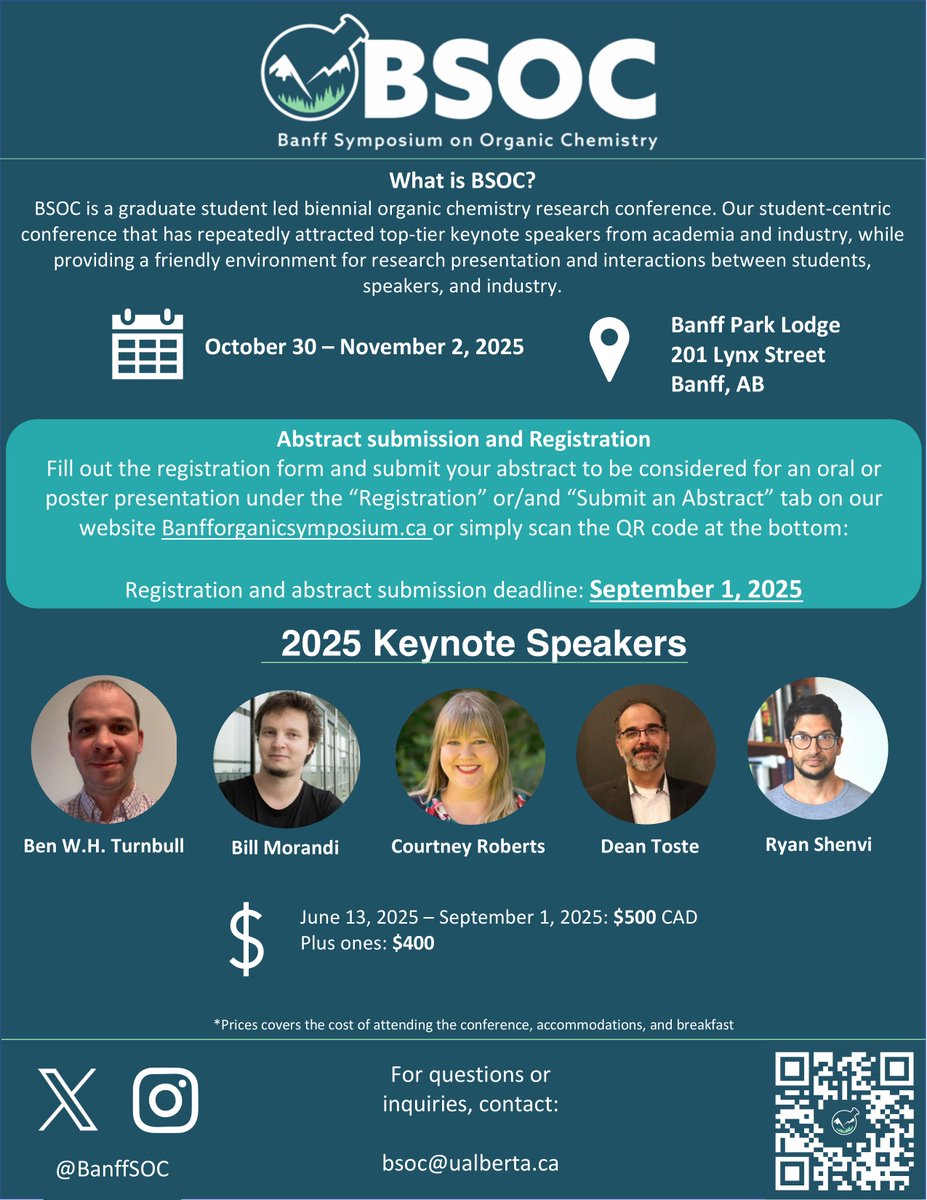
The abstract deadline for BSOC 2025 is approaching on September 1, 2025! In order to not miss a chance to present an oral or a poster presentation, please ensure your abstract is submitted before the deadline. For any questions please contact us at bsoc@ualberta.ca
6
11
2,502
5 Aug 2025
Graduate students
Lecture or poster at the 39th Annual RSC Heterocyclic and Synthesis Group Postgraduate Symposium
Thursday 18 Sept 2025 in Oxford
8 lectures by final-year postgraduate students Attendance is free (registration mandatory)
rsc.org/events/detail/82070/…
Please share
6
17
3,126
Steve Fletcher retweeted

10 Jul 2025
We have an opening for a PDRA in my group working in membrane supramolecular chemistry as part of an ERC funded project. Available from October 2025. my.corehr.com/pls/uoxrecruit…
1
25
97
13,032
Steve Fletcher retweeted

25 May 2025
We’re looking for motivated candidates for Master's, PhD and postdoc position with organic chemistry background to join our research group ASAP!👩🔬
Interested candidates please send your CV, grades & motivation letter to marek.group@technion.ac.il #OrganicChemistry #Technion⚗️🔬
11
58
292
33,992
22 Apr 2025
Ligand-enabled override of the memory effect in Rh-catalyzed asymmetri... sciencedirect.com/science/ar…
1
17
1,740
Steve Fletcher retweeted

13 Mar 2025
🚨 #Postdoc opportunity in Systems Chemistry!🚨 Please Share!
Interested in creating new decision-making materials based on electrochemically programmable protein networks?
Then join my group!
2-year Postdoc supported by @ERC_Research at @UoBChemistry
tinyurl.com/3ckhd9tb
22
84
8,082


24 Jan 2025
oscillations OSCILLATIONS oscillations
Fully-funded DPhil/PhD opportunities with the CSHP CDT, including project from my group on OSCILLATIONS
Apply by 29th January - more info: cshp-cdt.chem.ox.ac.uk
1
7
27
3,150
14 Dec 2024
This is ‘news’ - it taken months/years to find a builder for at least the last 10 years bbc.co.uk/news/articles/c5yg…
641