
Joined September 2008
- Tweets 7,831
- Following 3,527
- Followers 1,425
- Likes 12,785
678 Photos and videos





Pinned Tweet

May 29
The AI market in 2026: capability-rich, pattern-poor.
I've spent two years asking applied AI experts the same set of questions. There's no shortage of "what's possible" content. There's a real shortage of first-hand accounts: structured, searchable, written by the team that built the thing, not the team that sold it.
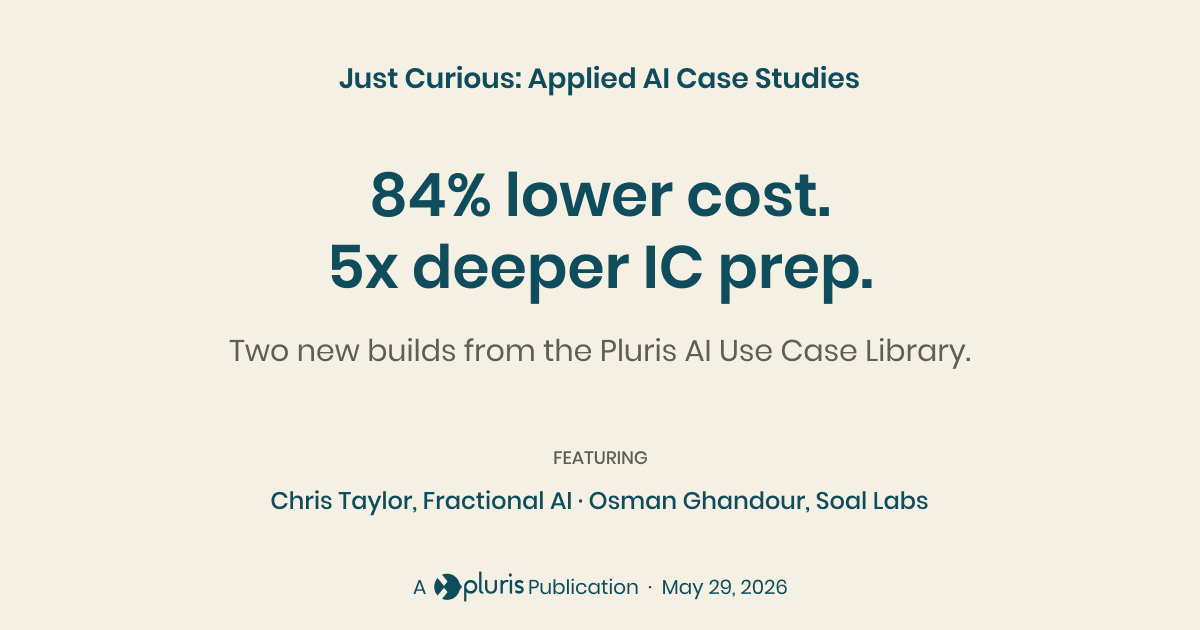
Today's issue (first of the new format focused exclusively on AI use cases and case studies) features two builds worth pulling up:
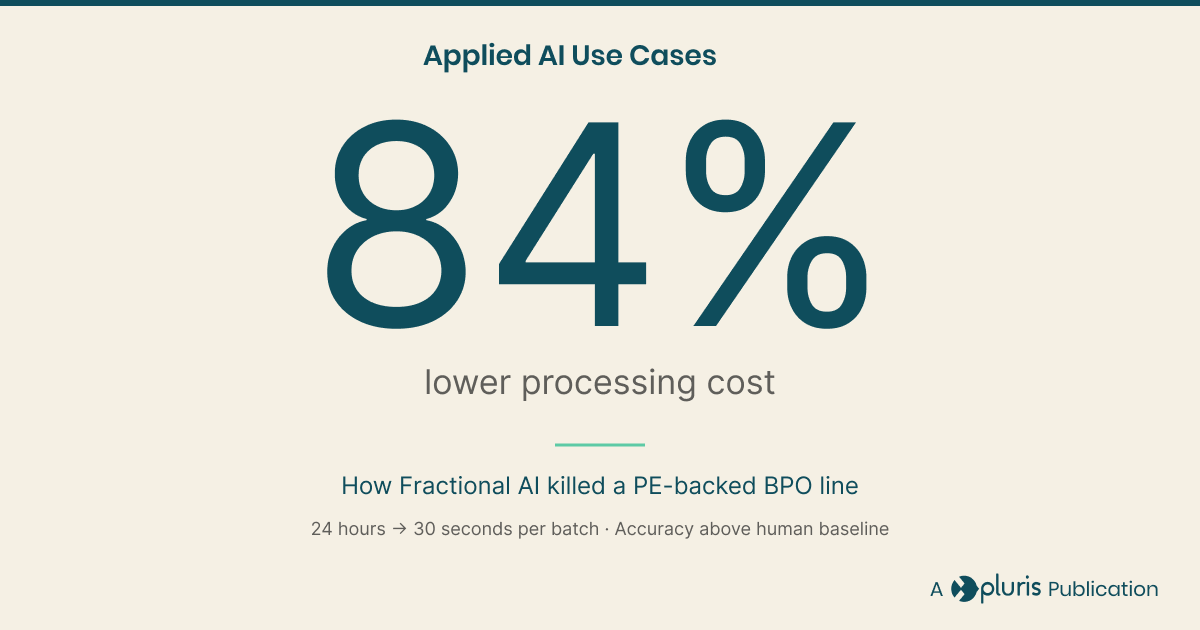
Case 1: a PE-backed e-commerce co replaced its BPO with a multi-model AI pipeline (OpenAI Gemini Claude on AWS). 84% cost cut. 24h → 30s per batch.
They built the eval system first, proved accuracy beat the BPO baseline before go-live.
Chris Taylor, @FractionalAI (just acquired by the new @AnthropicAI -backed services venture).
Case 2: a mid-market PE firm encoded six senior MDs as queryable AI personas via structured interviews on past deals. 5x more analytical angles per IC. 1,000 deals queryable.
The scaling pattern: one MD first, nail it, then expand to five more for sector coverage.
Osman Ghandour, Soal Labs.
Plus my podcast with Tom Scott (CEO of @wrike , $250M ARR work management platform) on why most SaaS CEOs are sequencing their AI rollouts wrong.
Real builds, attached to real people you can call.
Every issue from here on: a handful of fresh case studies from the Pluris AI Use Case Library, with a one-click path to the expert behind each.
just-curious-ai.beehiiv.com/…
2
2
379
Today, a founder in our network told me that investors and buyers had reached out to him after hearing him on our podcast. That's the whole point.
I started Pluris six months ago with two goals. Help companies move faster on AI, and help the experts in our network grow their businesses. People assume you have to choose one. They actually pull in the same direction.
So I don't gatekeep. Every expert is visible, every case study is public. Which means a client could read how two or three of our experts break down their problem and just go hire one of them directly, around me. Some probably do.
That's fine. The work is free either way, and the exposure is the point.
Bill Gates has a line about platforms, that a real platform creates more value for the people on it than it captures for itself. That's the company I'm trying to build. We're six months in. If I promote the people in our network as hard as I can and capture even a slice of what that creates, I'll be happy.
1
46
"AI isn't going to break private equity. It's going to sort it." That's the through-line of my conversation with Doyl Burkett. He walks through why and how to end up on the right side of it, as an investor and as a firm.
Doyl runs Integrity Growth Partners, an $800M growth equity firm, and unlike most GPs, he spends as much time on what AI does to his own firm as what it does to his portfolio.
Many (most?) people think AI will kill software. Doyl has been investing in it for almost 30 years, and he sees something more nuanced. Every software and tech-enabled business lands in one of three buckets — AI-native, defensible-moat, and undifferentiated — and the gap between them is only going to widen from here. And the same sorting is coming for the GPs who back them.
Here are some highlights:
↳ He underwrites for six kinds of moat: AI-native, proprietary data, regulatory, hardware, human-in-the-loop, and being the system people can't work without.
A few examples: a collections firm whose AI learns from the $1B it's recovered. A health-IT business sitting on a billion lung scans HIPAA won't let anyone share. Sensors poured into concrete walls. AI can't eat what it can't get into.
↳ Integrity runs itself like an AI-native company. He calls it CAPE.
Six data providers feeding a system that scores 50 million companies for fit, outreach written by AI tuned on eight years of A/B tests, three junior people doing what used to take fifteen to twenty.
↳ Then he pointed that same system at an acquisition.
When a portfolio company needed AI to cut out its middlemen, Integrity used its own sourcing engine to find the AI-native company to buy instead. It's taking that company's $11M revenue line toward nearly double.
↳ The same sorting is coming for the GPs.
Funds that never formed an AI view are holding 2020 and 2021 deals bought high with thin defensibility. Some go to zero. The firms that perform raise easily, and the rest find it close to impossible.
New Proof of Work episode is live.
➭ Watch or listen: checkpluris.com/articles/ai-…
➭ YouTube: youtu.be/VX3q6yBumRk
➭ Spotify: open.spotify.com/episode/7zf…
2
118
Jun 15
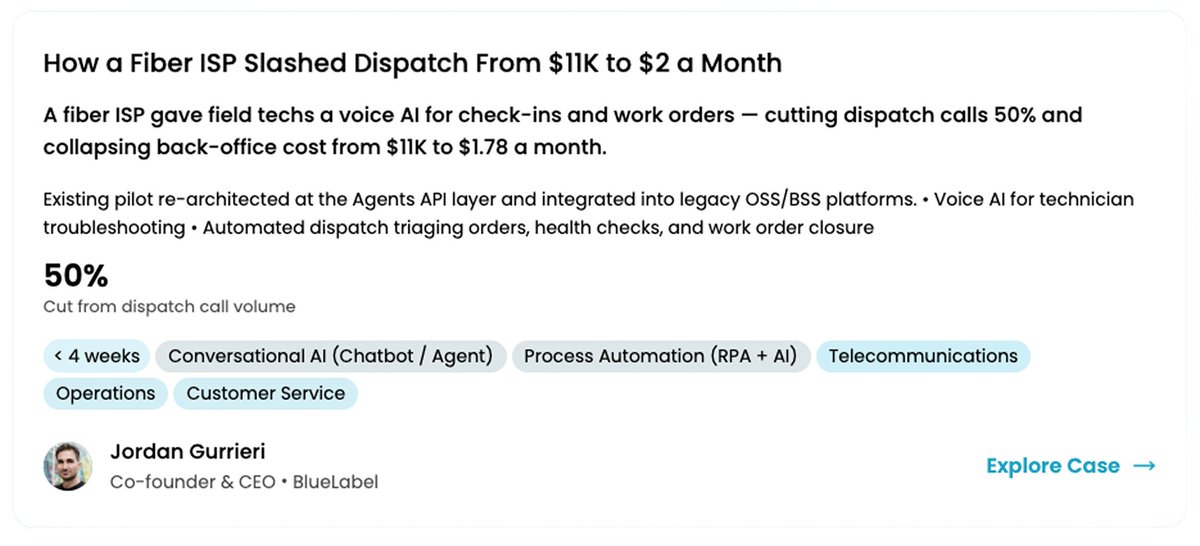
$11,000 a month of dispatch labor, replaced by an AI that costs $1.78 a month to run. A regional fiber ISP's field techs were calling a 10-person back-office desk for every equipment check, troubleshoot, and work-order closure, then sitting idle in their vans 30–45 minutes after 15 minutes of actual work.
Across 150 techs doing five visits a day, that downtime was the real cost. Nobody was measuring it.
What BlueLabel built:
→ A voice assistant giving techs natural-language access to troubleshooting docs and equipment data in the field
→ A dispatch agent that triages orders, runs hardware health checks against the OSS/BSS systems, and closes work orders with no dispatcher in the loop
→ Re-architected off the Custom GPT tier onto OpenAI's Agents API — which is what dropped infra cost to $1.78/month at scale
The results:
• Dispatch calls cut 50%
• $11K /month in labor savings
• 30–45 min returned to every technician, every visit
• AI running cost: $1.78/month serving 150 techs
The lesson: the headline is the $1.78. The value is the idle time that stayed invisible until someone built the thing that removed it. Make the expensive, unmeasured work visible first; then the automation comes second.
I broke down the full story in last week's Proof of Work: Applied AI Case Studies.
Full case study in the Pluris AI Use Case Library.
Full case study here → checkpluris.com/case-study/h…
Our entire AI Use Case Library → checkpluris.com/ai-use-case-…
1
2
131
Jun 15
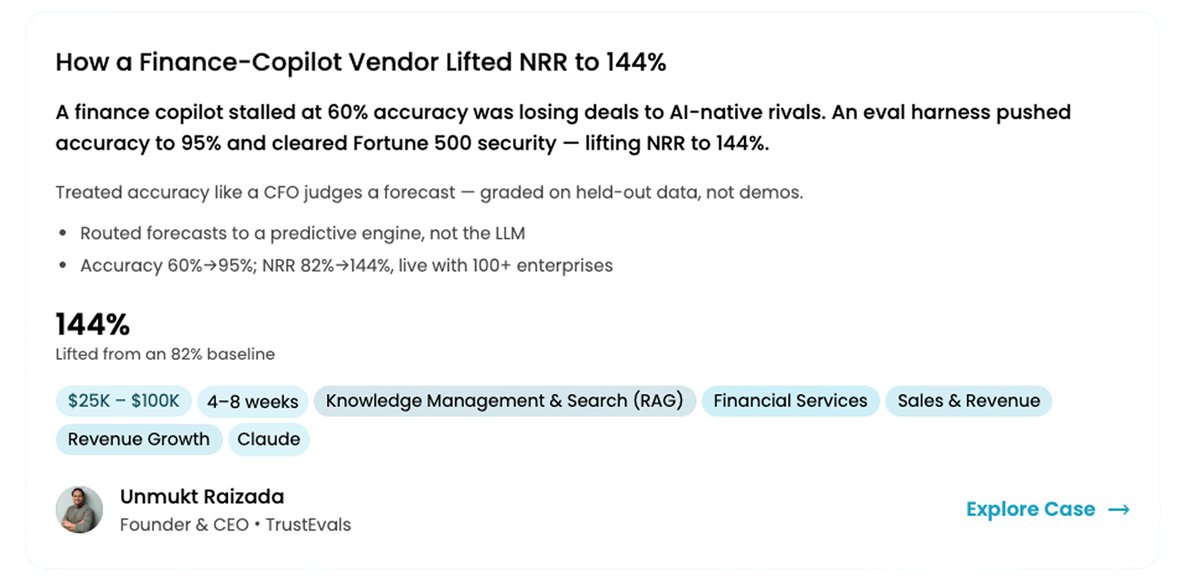
44% net revenue retention, up from 82%. A finance copilot vendor was stalled at 60% accuracy and losing deals to AI-native rivals. Here's the unlock.
The problem: "good enough in the demo" wasn't good enough for a CFO. Accuracy plateaued, enterprise security reviews stalled, and renewals were at risk.
What they did:
→ Built an eval harness that grades accuracy on held-out data, not demos
→ Routed forecasts to a predictive engine instead of the LLM
→ Cleared Fortune 500 security review
The results:
• Accuracy 60% → 95%
• NRR 82% → 144%
• Live with 100 enterprises
The lesson: treat accuracy like a CFO judges a forecast, proven on held-out data, not vibes from a demo.
Huge credit to Unmukt Raizada (Co-Founder & CEO of TrustEvals) for sharing how they did it.
I broke down the full story in this week's Proof of Work: Applied AI Case Studies. Full case study in the Pluris AI Use Case Library.
Full case study here → checkpluris.com/case-study/h…
Our entire AI Use Case Library → checkpluris.com/ai-use-case-…
168
Jun 12
Two applied-AI case studies this week, both in financial services, both making the same point: the money shows up only if the system is reliable enough to trust.
@deansloves_ Bolt Group rebuilt a Tier-1 bank's credit-risk desk. A credit assessment that took three days now lands in about 30 seconds. The build ran a few million and put roughly $40M a year in lending revenue back within reach — revenue the bank had been losing to slow decisions. It could ship in a regulated setting because the risk score came from a purpose-built model, not the LLM, so it stayed explainable to regulators.
TrustEvals wrapped an eval harness around a finance copilot stuck at 60% accuracy. Every answer was graded on held-out data, the way a CFO grades a forecast. Accuracy climbed to 95%, and net revenue retention went from 82% to 144%.
In both, reliability is what unlocked the dollars. Make the system trustworthy and the financial result follows.
A useful test for any AI product you're buying or backing: how do you measure accuracy, and on what data? Demos are not evals.
Full write-ups — cost, stack, what actually changed — in this week's issue. We also gave the newsletter a new name, Proof of Work, for a simple reason: the case study is the only signal in this market you can actually check.
proof-of-work-ai.beehiiv.com…
2
1
3
178
Jun 10
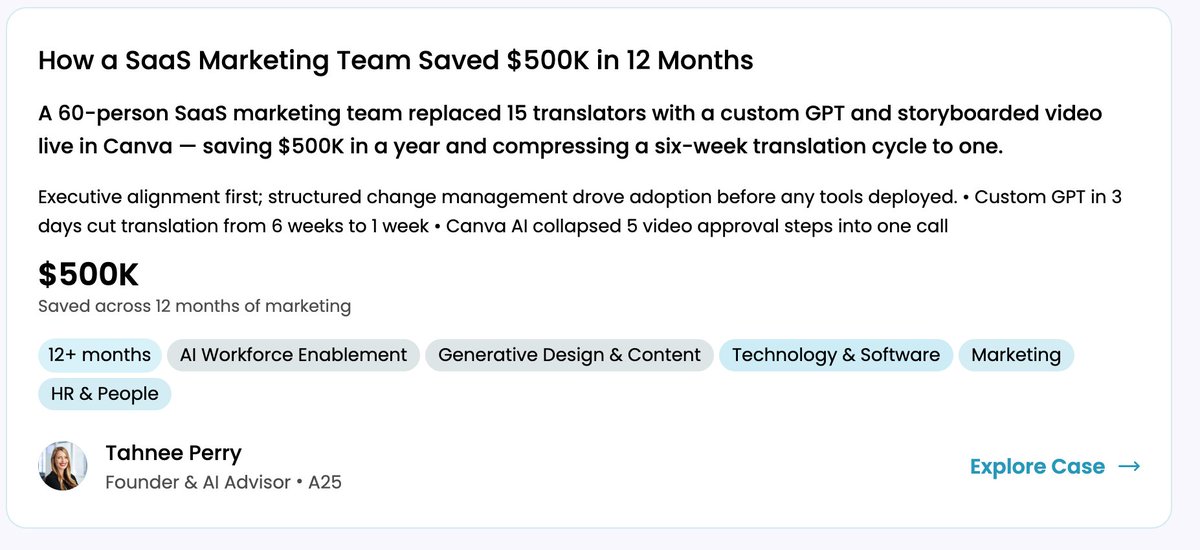
A 60-person SaaS marketing team was running AI experiments that never went anywhere. Most of the team rated themselves a 2 or 3 out of 5 on AI. Meanwhile, they were paying $20,000 a month for translation that took six weeks a cycle and ran through 15 people.
They were not short on tools. They already had ChatGPT Enterprise and Canva. What was missing was a way to turn that access into an actual workflow.
So Tahnee Perry and A25 ran a structured adoption program over the year. It started with the CMO, VPs, and directors before any tool got deployed, then moved to hands-on sessions where teams brought real workflow problems instead of hypotheticals. Two builds came out of it. A custom GPT, tuned in three days, took translation from 15 people and six weeks down to one reviewer per language and one week, cutting spend from $20K a month to about $2K. And live storyboarding in Canva during kickoff calls collapsed five sequential approval steps into a single session.
The results after twelve months:
↳ About $500K saved across translation, video, and content
↳ Translation cost down 90%, cycle time from six weeks to one
↳ Video storyboard approval from five weeks to same day
My thoughts: The tools here were off-the-shelf. What moved the numbers was the program around them: executive buy-in first, then real workflows, then office hours. Pilot purgatory is usually an adoption problem, not a technology one. The fix is running it like a project, with an owner and a sequence.
Full breakdown is in our AI Use Case Library, with about 100 more like it.
If your team has the licenses but the usage is stuck at experiments, I can point you to the firm that ran this. Where is your team sitting on AI access it hasn't turned into a workflow yet?
The full case study, plus ~100 more real AI builds: checkpluris.com/case-study/c…
1
112
Jun 8
Our newsletter Just Curious is now Proof of Work: Applied AI Case Studies. The new name is the whole thesis. Here's what changed, and why we did it.
When I started Just Curious, the goal was to explore how AI actually changes business outcomes. More than 400 conversations with operators, builders, and investors later (> 100 recorded), the lesson is clear: the answer is almost never in the model or the tool (as you know). It's in the work. What someone actually built, what it cost, and what changed once it shipped.
In a market this new, brand names tell you who was excellent at the last game, not this one. The only signal that survives scrutiny is proof of work: a specific, checkable account of a real build. So we're putting that at the center.
What to expect, every week:
→ 2 to 4 new case studies from people actually deploying AI in real businesses
→ For each: what they built, what it cost, what changed, and a one-click path to talk to the expert who built it
→ The occasional deep-dive interview when a build deserves a full sit-down
No hype. No demos. No "AI will change everything" fluff.
A few recent builds:
BlueLabel rebuilt the dispatch desk at a regional fiber ISP, cutting dispatch calls 50% and taking the AI's running cost to $1.78 a month
Parable gave Sunrun's leadership a quantified view of where engineering time actually went, surfacing $80M in hidden R&D waste
Fractional AI (just acquired by the new Anthropic-backed venture) cut an e-commerce company's document-processing cost 84% by bringing the work back in-house
Soal Labs encoded six senior MDs as queryable AI personas inside a PE firm's investment committee, roughly 5x-ing the analytical depth on every deal
Same mission as always: help investors and operators see where AI actually creates value, and where it doesn't.
Join ~ 3,000 of your peers and subscribe. Shows up every Friday morning.
proof-of-work-ai.beehiiv.com…
1
118
Jun 5
One fiber ISP runs its entire dispatch operation on AI that costs $2 a month. Sunrun found $80M in waste it couldn't see.
Both are in this week's Just Curious, pulled from the Pluris AI Use Case Library.
What's inside:
↳ Jordan Gurrieri and BlueLabel rebuilt a regional fiber ISP's dispatch desk. Field techs were sitting idle 30–45 minutes between jobs, waiting on a 10-person back office. The new system cut dispatch calls in half, returned $11K a month in labor, and runs for $1.78 at scale serving 150 technicians.
↳ Adam Schwartz and Parable built a knowledge graph across Sunrun's systems to show leadership where engineering time was actually going. The answer: far more on technical debt than anyone could prove. That visibility drove $80M in savings.
↳ My conversation with Alex Lirtsman of CorralData, who argues most companies aren't data-driven, they're "data-adjacent" — they have the report, they just don't trust it.
↳ And a new piece I wrote, Proof of Work, on why the case study is the only real signal in a market where brand names lag the actual skill.
The thread across both builds: the savings showed up the moment an expensive, invisible process became something you could measure.
just-curious-ai.beehiiv.com/…
1
1
163
Jun 4
"Data-driven" is mostly a myth. Appointments are a vanity metric. And no one just "wants AI."
@alirtsman spent 15 years solving data problems by hand for brands like the NBA and Pfizer. He sold his agency and built @CorralData to automate the whole thing, and now works with PE firms like KKR, Shore Capital Partners, and Leon Capital across healthcare and consumer.
His most contrarian claims from our conversation:
◾ Most companies aren't data-driven. They're "data-adjacent."
◾ Appointments, leads, and ROAS are vanity metrics. The only number that matters is LTV:CAC.
◾ When leaders say "we need AI," what they actually want is operational effectiveness.
◾ Accuracy is a solved problem. Relevance is the new battleground.
◾ Read-only AI is over. The next wave acts — but just because it can doesn't mean it should.
◾ Brand and data are the only two assets you can't rebuild. Everything else is replaceable.
Listen & watch here: lnkd.in/gd8v7UVK
The interview is also available on:
• Spotify: lnkd.in/gwzsiEKA
• YouTube: lnkd.in/ggs39gCB
Take a listen!
94
Jun 2
This morning, I sat down with Doyl Burkett, Managing Partner of Integrity Growth Partners, a Los Angeles-based growth private equity firm with over $800M in assets under management.
What makes Doyl unusual is that most GPs are focused on what AI means for the companies they invest in. Doyl is equally focused on what it means for the firm itself.
The lazy version of where we are is that AI breaks PE. Doyl's view is more nuanced.
He thinks AI isn't going to compress the asset class evenly, it's going to sort it.
Companies will end up in one of three buckets, and the same sorting is going to happen to GPs themselves.
He's running that experiment right now at Integrity. He calls the framework CAPE, and it runs across sourcing, reporting, and operations.
Some of the highlights:
↳ AI won't break PE — it'll sort it.
The hot take is that AI compresses the whole asset class evenly, a kind of peanut-butter spread of doom. Doyl's view is the opposite. It widens the gap. Companies fall into three buckets — AI-native, defensible-moat, and undifferentiated — and the distance between them only grows from here.
↳ The same sorting is coming for the GPs themselves.
The take he said would start an argument at a GP dinner: firms should be using AI as aggressively as the tech businesses they invest in. Most nod, then go back to doing things exactly the same way. He thinks that gap eventually shows up in returns, and in who can still raise a fund.
↳ He ate his own dogfood in the best possible way.
A prop-tech portfolio company needed to build AI to cut out the third parties it was splitting revenue with. Mid-build, the CTO said an acquisition could short-circuit the whole thing, so they pointed their own AI sourcing engine at finding the target, bought a tiny AI-native company, and integrated it. That single move is taking ~$11M of revenue toward nearly double.
↳ Be very suspicious of the AI quick fix.
His analogy: most "AI for sourcing" or "AI for ops" tools are a Ferrari built for an F1 driver, when what the business actually needs is a Ford Focus. He's spent years and millions building CAPE precisely because there was no shortcut, and he'd warn a friend off believing there is one.
Full episode dropping soon.
1
3
209
Jun 2
If you like this stuff, our newsletter features weekly breakdowns of actionable AI value creation case studies: just-curious-ai.beehiiv.com/
And we just launched an open AI use case library of real-world implementations cataloged by industry, business unit, cost, return, and model: checkpluris.com/ai-use-case-…
And we've got a podcast, where this will be featured:
open.spotify.com/show/3uaXVE…
63
Jun 2
Both frontier labs just bought their way into AI services. OpenAI bought Tomoro, Anthropic's venture absorbed Fractional AI, and Accenture acquired Faculty and made its founder its CTO.
The capability to deploy AI now lives in small specialist firms, not the big names.
Which leaves one hard question for any buyer, and it's what this is about.

3
392
Stu Willson retweeted

May 30
we are 16 weeks into our data / ai project. first 12 was discovery, process mapping, etc. we are now in production on a bunch of use cases. we swapped out openai for anthropic & implemented glean.
overview of use cases here and threading to some more detailed commentary:
docsend.com/view/vtxe75sahdv…
3
1
25
6,212
May 29
The AI market in 2026: capability-rich, pattern-poor.
I've spent two years asking applied AI experts the same set of questions. There's no shortage of "what's possible" content. There's a real shortage of first-hand accounts: structured, searchable, written by the team that built the thing, not the team that sold it.
Today's issue (first of the new format focused exclusively on AI use cases and case studies) features two builds worth pulling up:
Case 1: a PE-backed e-commerce co replaced its BPO with a multi-model AI pipeline (OpenAI Gemini Claude on AWS). 84% cost cut. 24h → 30s per batch.
They built the eval system first, proved accuracy beat the BPO baseline before go-live.
Chris Taylor, @FractionalAI (just acquired by the new @AnthropicAI -backed services venture).
Case 2: a mid-market PE firm encoded six senior MDs as queryable AI personas via structured interviews on past deals. 5x more analytical angles per IC. 1,000 deals queryable.
The scaling pattern: one MD first, nail it, then expand to five more for sector coverage.
Osman Ghandour, Soal Labs.
Plus my podcast with Tom Scott (CEO of @wrike , $250M ARR work management platform) on why most SaaS CEOs are sequencing their AI rollouts wrong.
Real builds, attached to real people you can call.
Every issue from here on: a handful of fresh case studies from the Pluris AI Use Case Library, with a one-click path to the expert behind each.
just-curious-ai.beehiiv.com/…
2
2
379
May 29
Fractional AI was acquired last week by the new Anthropic-, Blackstone-, and Hellman & Friedman-backed enterprise services venture. Here's an example of the kind of work that put them in that conversation.
A PE-backed e-commerce company was hostage to its BPO vendor. Shopping lists arrived as images, PDFs, spreadsheets. All of it had to be matched to the company's internal product taxonomy. The offshore team held all the institutional knowledge. Turnaround was 24 hours per batch.
Fractional replaced the entire line with a multi-model AI pipeline. OpenAI for classification, Gemini for text extraction, Claude for intermediate steps, all on Amazon Web Services (AWS).
Result: 84% cost cut. 24 hours → 30 seconds per batch. Accuracy above the human baseline.
The discipline most teams skip: Fractional built the evaluation system before the pipeline. That meant they could prove accuracy in blind side-by-side tests against the BPO baseline before go-live.
Two things came out of that:
1/ They could decommission the BPO with confidence.
2/ They discovered the BPO had been performing worse than anyone assumed.
Invisible until somebody finally measured it.
Full case study in the comments.
I write about applied AI weekly at Just Curious; case studies from the team that built it, not the team that sold it.
Check out the case study and all the others in our AI Use Case Library: checkpluris.com/case-study/a…
2
2
214

AI transformation at the enterprise level is a 60T market: the largest unsolved market in history.
Over the last few months, 100 companies doing $1B to $100B in revenue have reached out to us. We do zero outbound. The contracts are 8 figures, with 9 to 10 figures in savings and revenue uplift per client.
Most "AI services" firms top out transforming startups. A 10,000-person company is a different problem entirely.
Our only constraint right now is hiring talented people fast enough. You have to understand AI deeply, know how to apply it, and be a brilliant communicator. Lowering the bar would fail our clients, and we refuse to do so.
If you know someone great who wants in on what could be a generational company being built out of SF, send them our way. We'll give you a $20,000 referral bonus if they join.
We're hiring Staff Engineers, AI Engagement Managers, Forward Deployed AI Strategists, AI Engineers, and Full Stack Engineers, full-time, in-person, in SF.
Apply below or DM me - I read every one.
May 27

AI as a Service (consulting) is a wide open opportunity.
The largest service industry in a few decades that no one is really talking about as much as they should be.
24
21
460
103,998