Former Executive Director, IMF for India, Bangladesh, Bhutan and Sri Lanka. Economist, cricket junkie, policy wonk, and film (all woods, old and new) enthusiast
Joined January 2013
- Tweets 7,141
- Following 663
- Followers 69,241
- Likes 1,221
88 Photos and videos
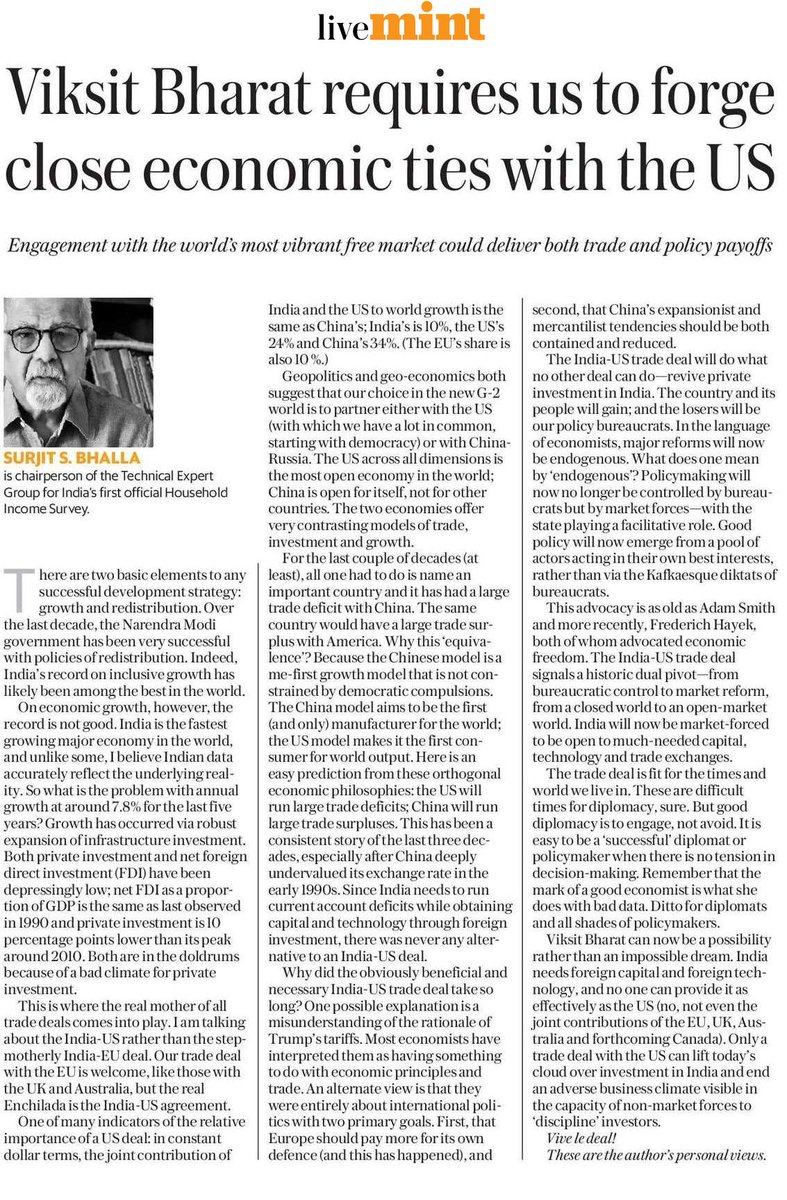
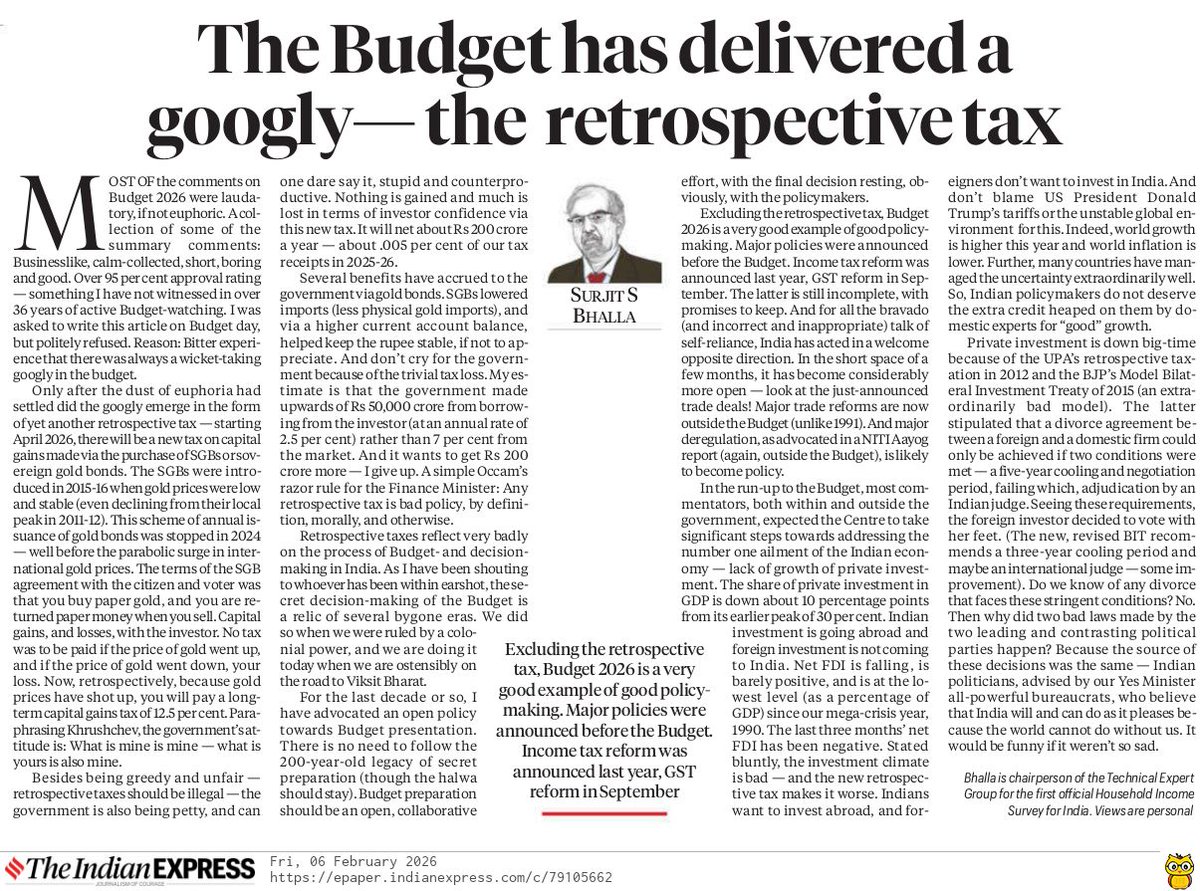
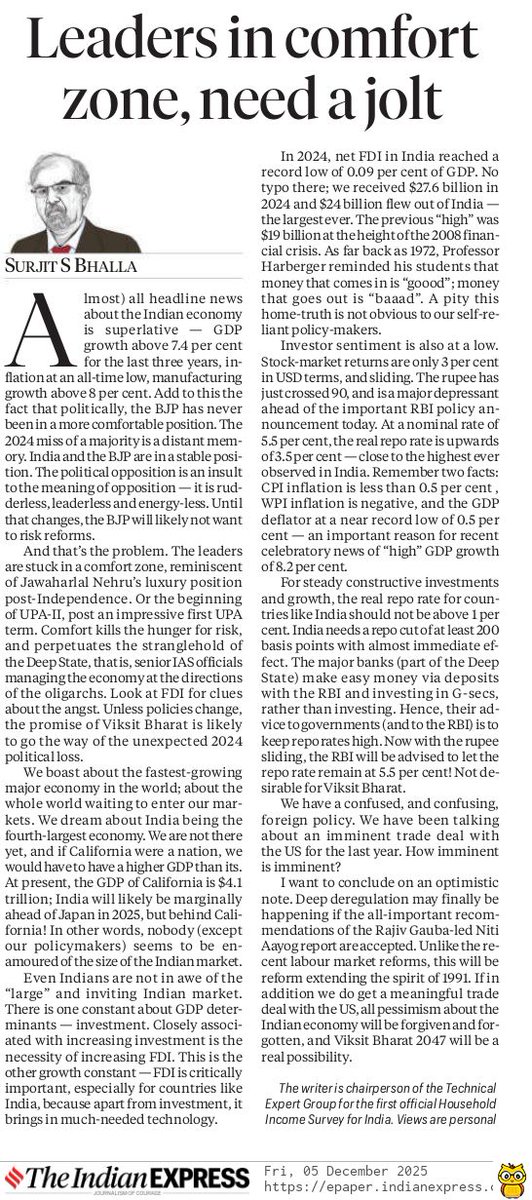
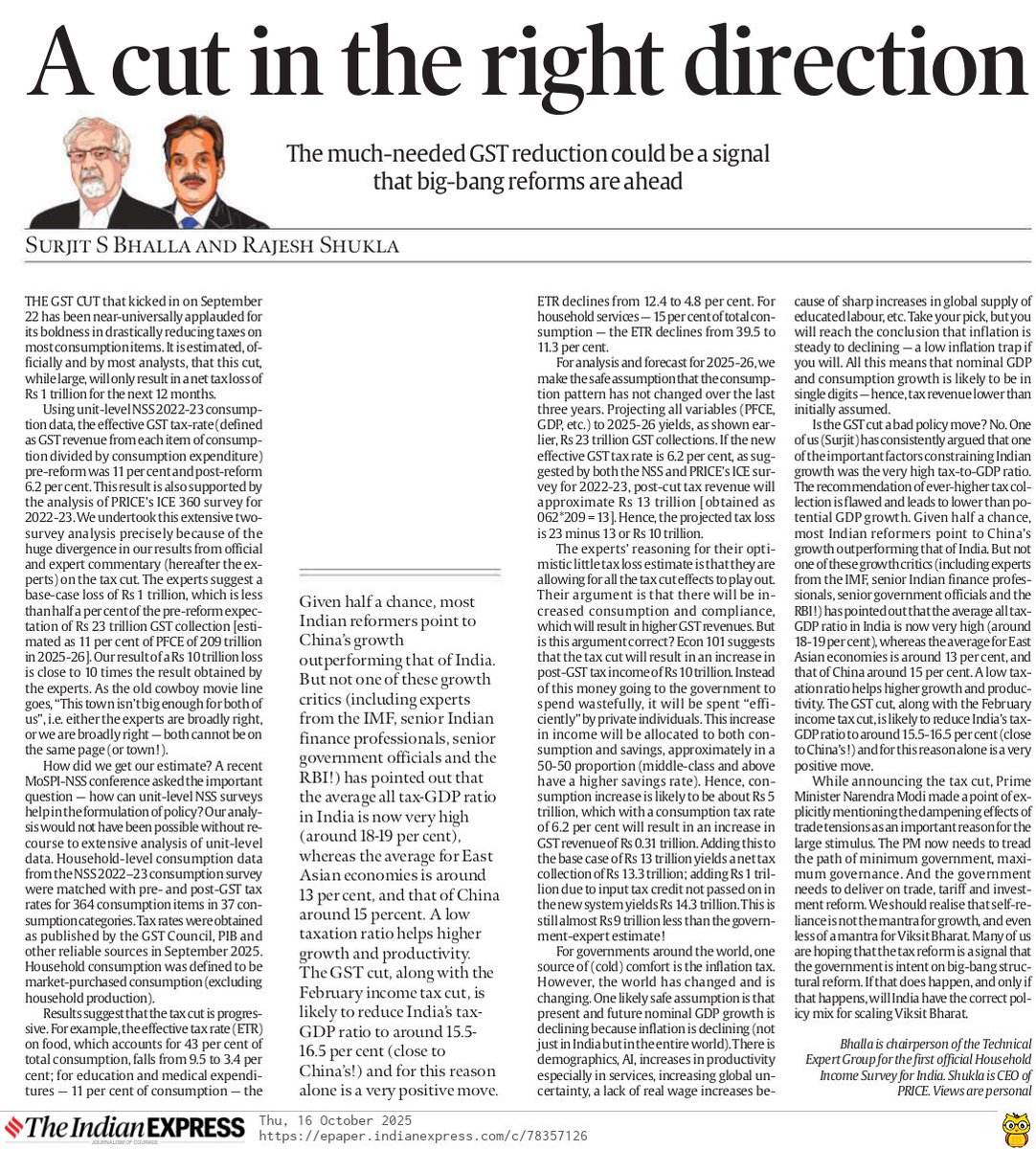
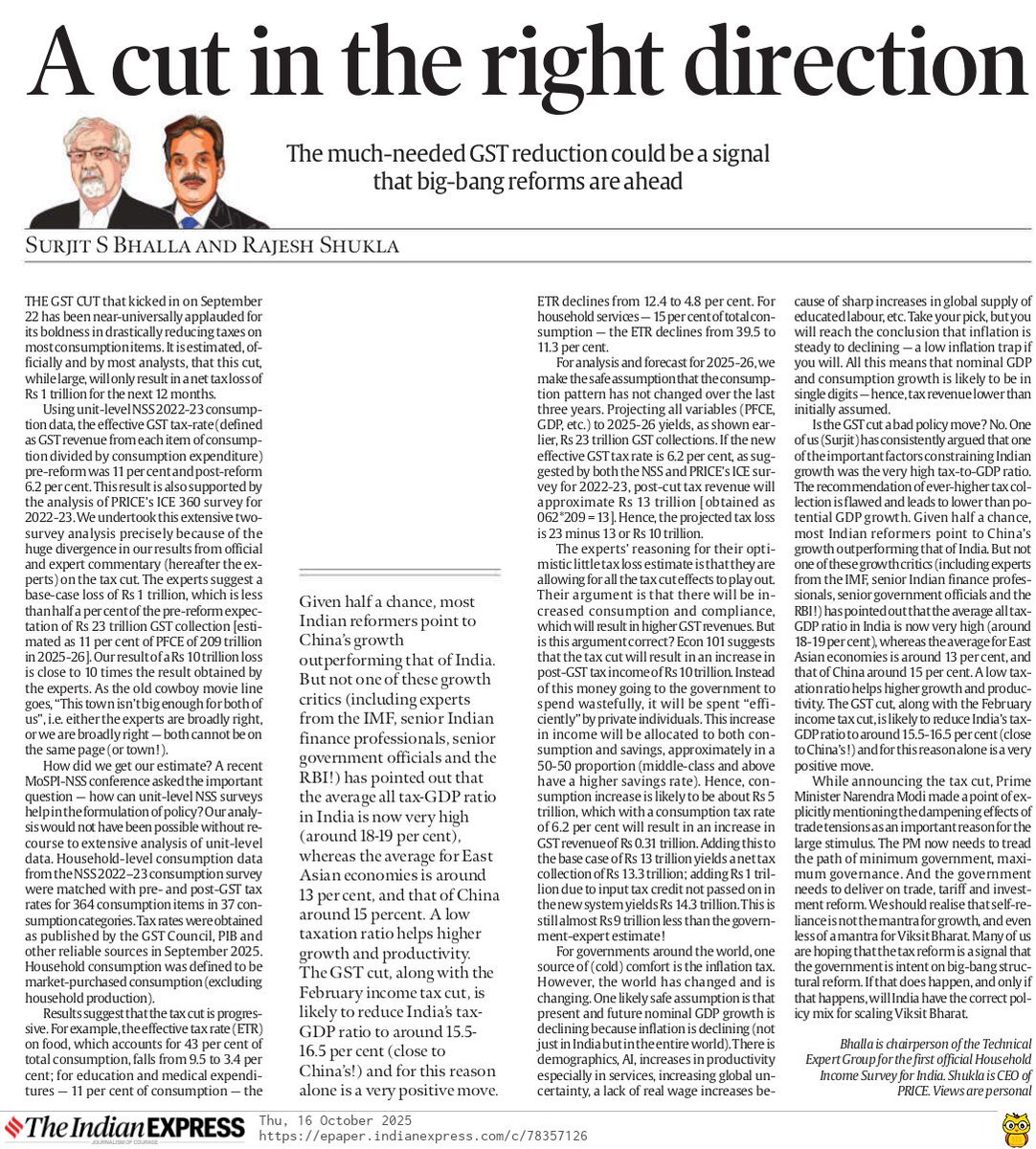
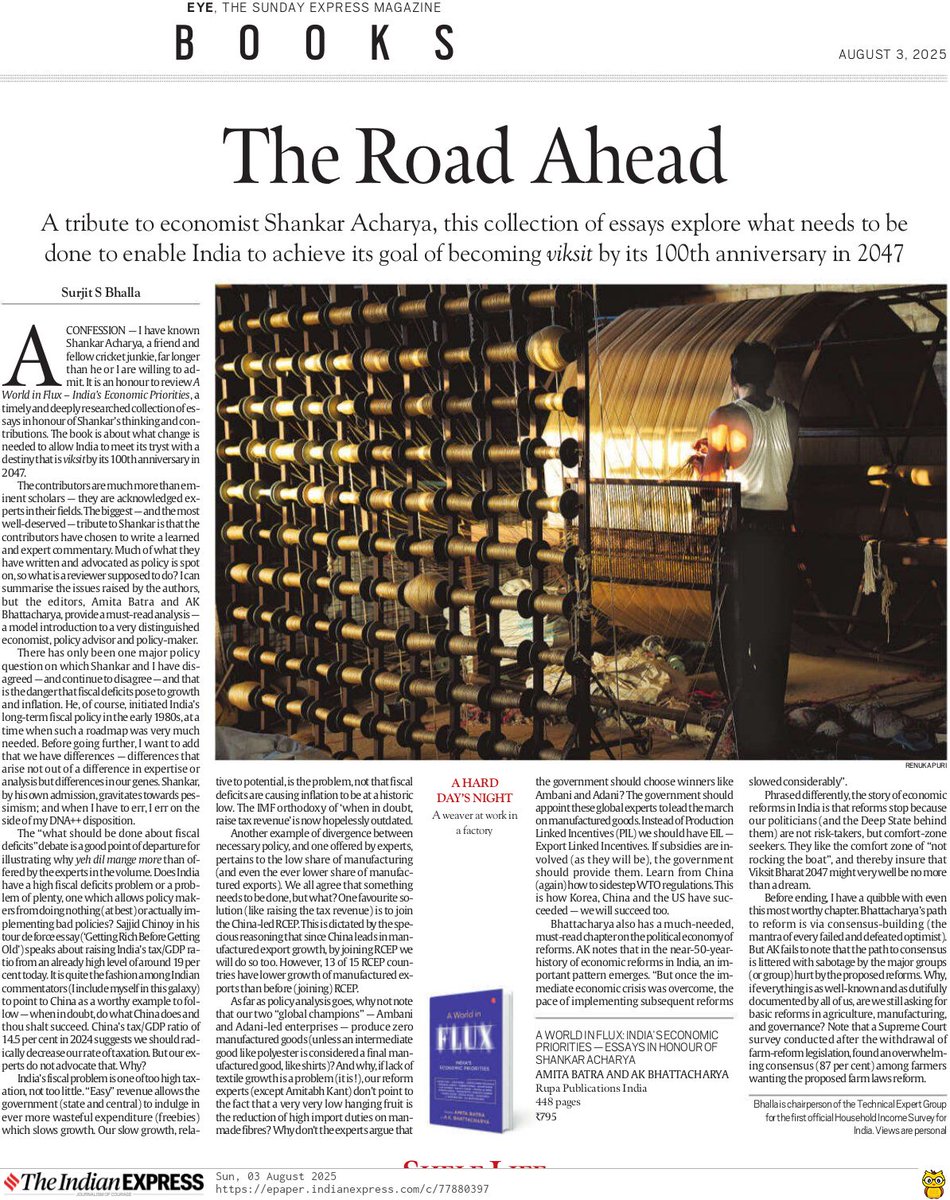
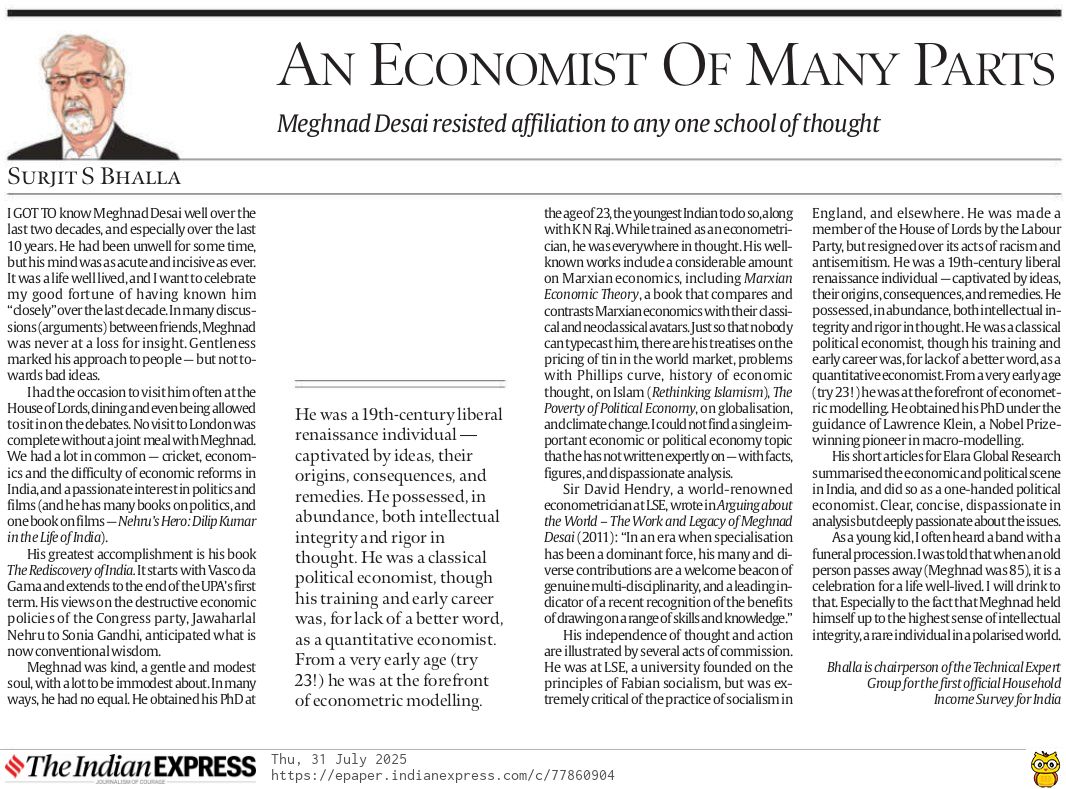
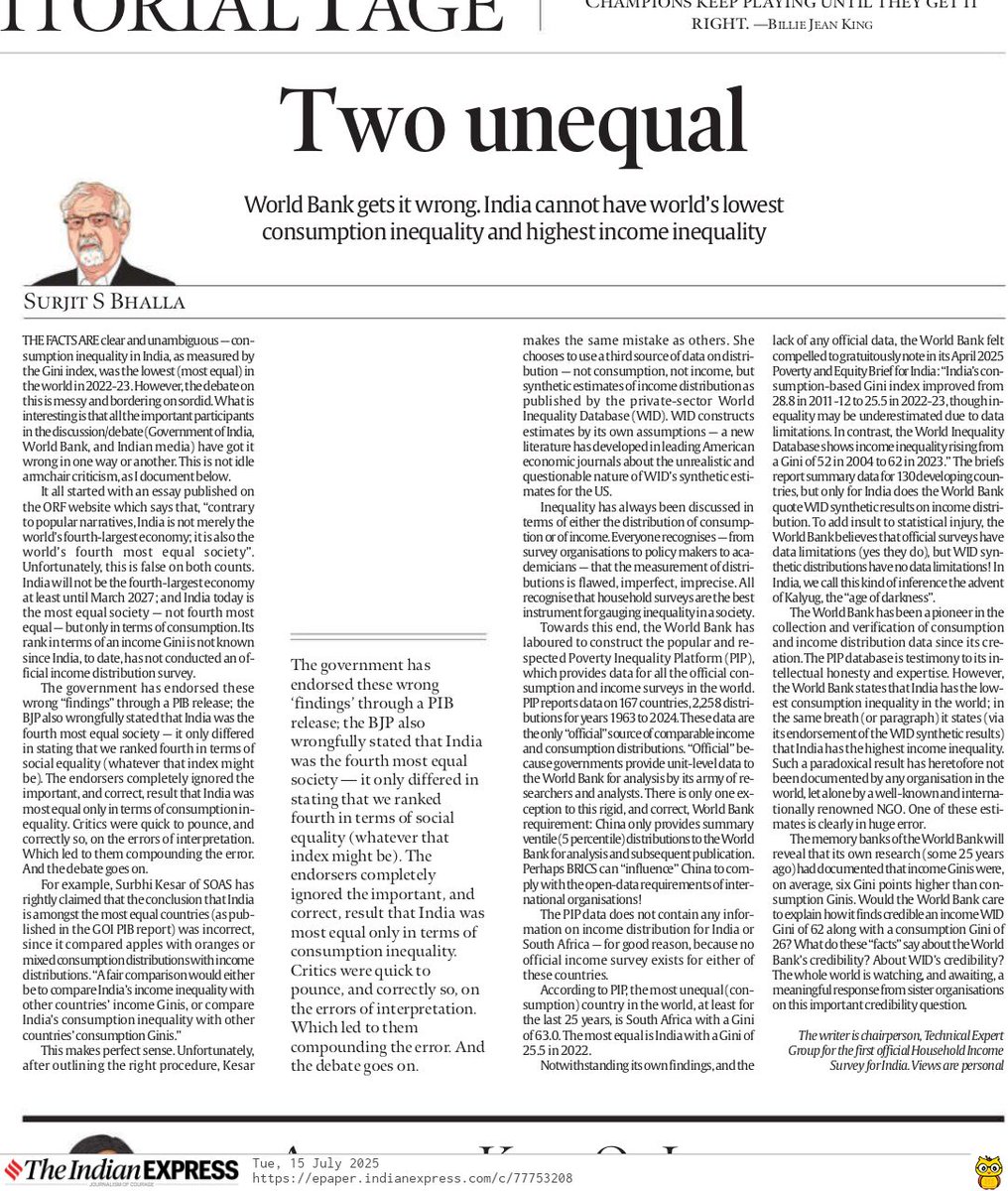
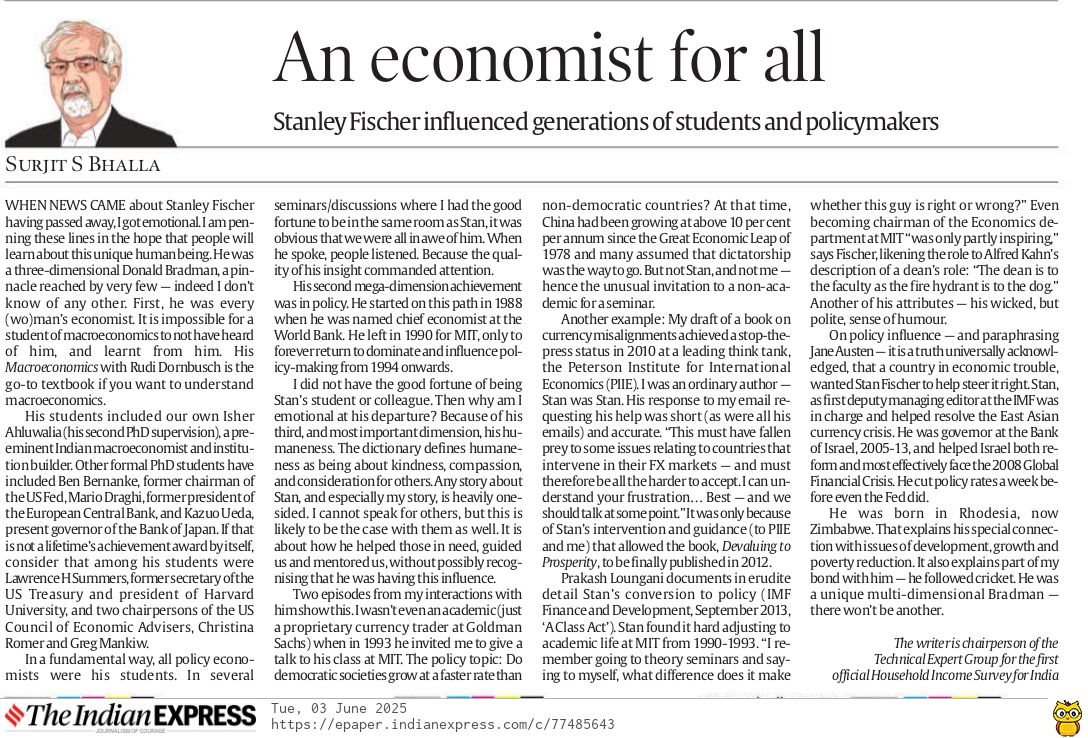
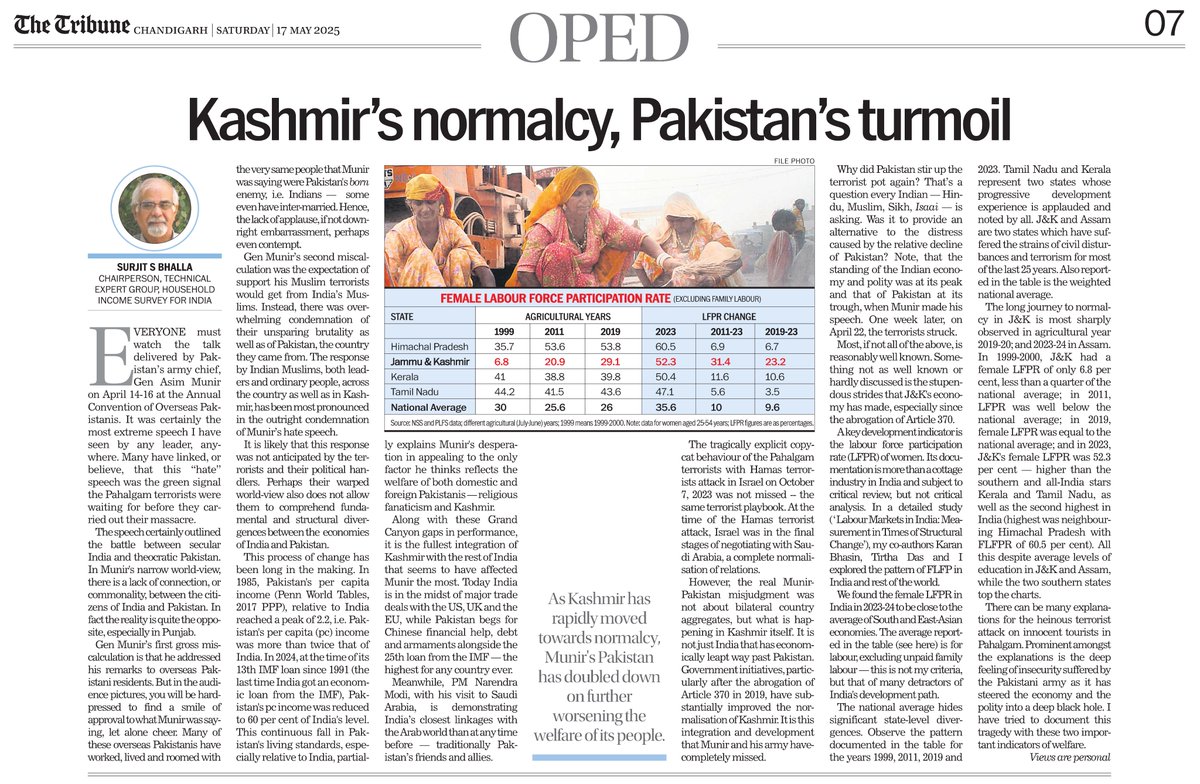
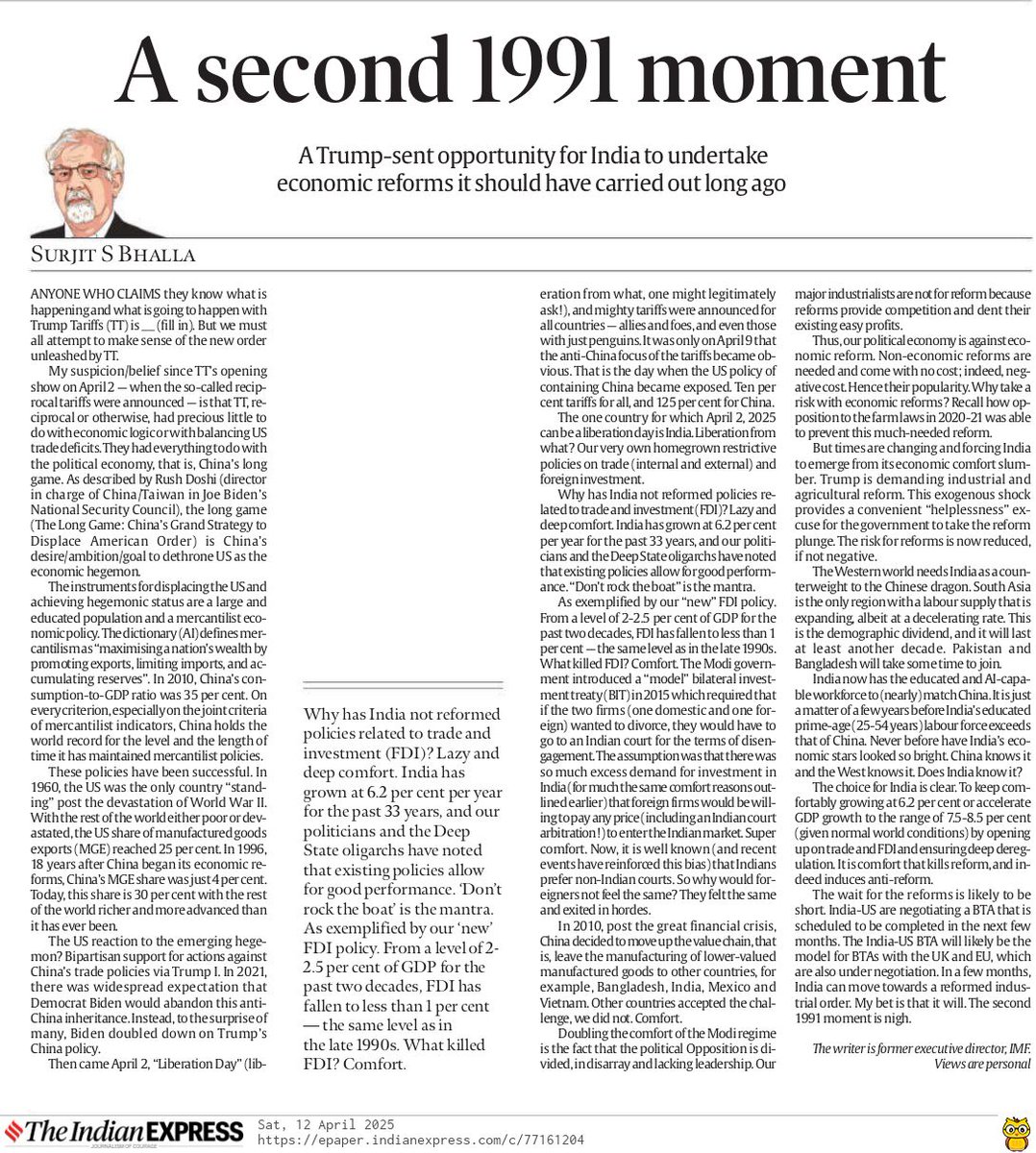
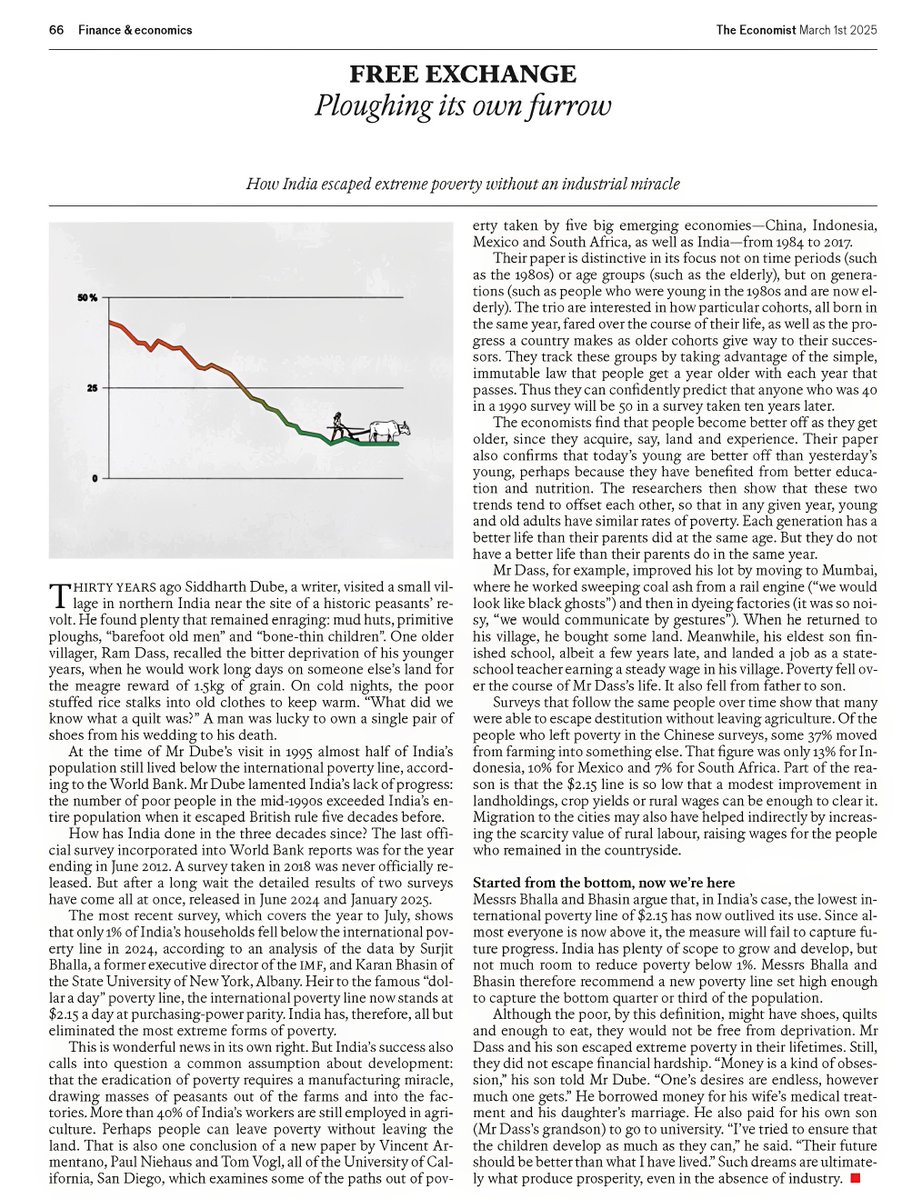
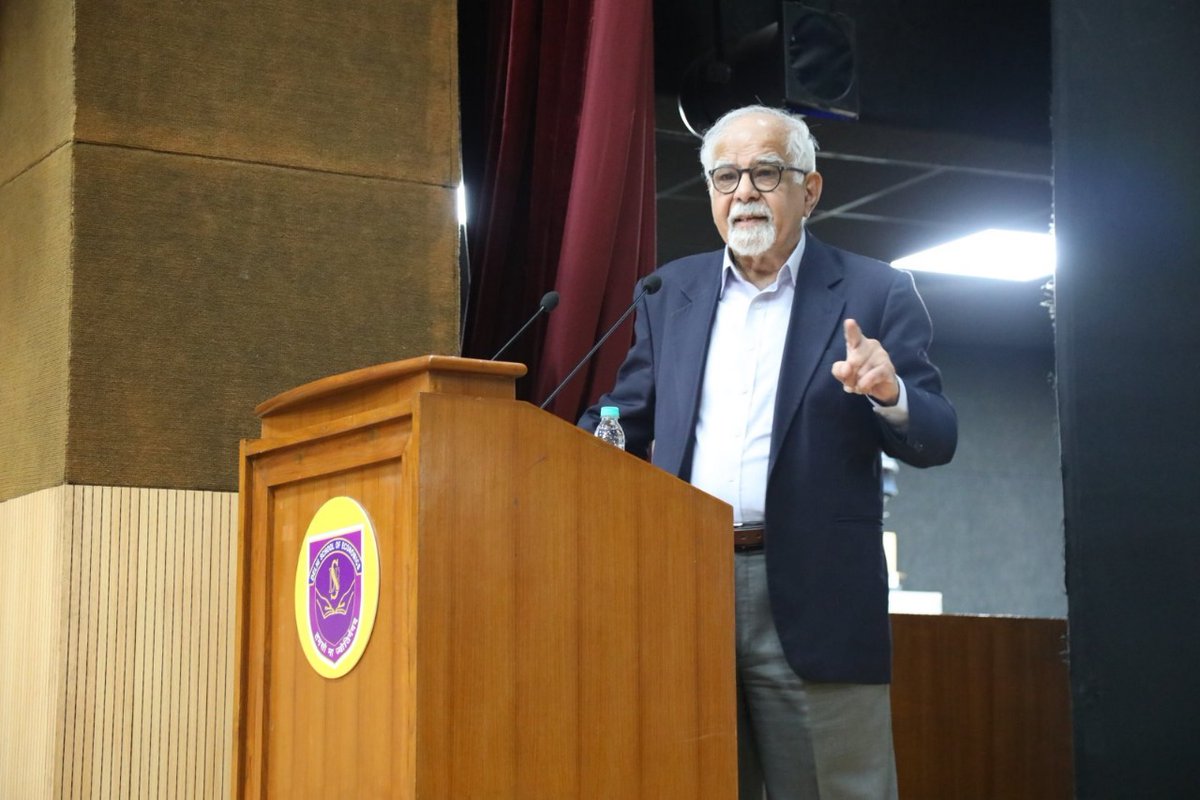
Why is it that whenever india and US appear close to a trade deal the Deep State ensures that there is concerted criticism of US ? Just asking
110
14
72
31,464
Same dream - I remember following East Bengal and MohanBagan matches
Jun 13

Morning thought: Every time I watch a World Cup football match, I ask myself: will I live to see the day when India is part of the spectacle, not just a spectator? Seventy-nine years after Independence, we are yet to play in a single World Cup in the ultimate global team sport (we almost did once in 1950). A billion dreams. One unanswered sporting question. (Not to forget a football association in this country that is trapped in politics and a fandom that is obsessed with just one sport). 🙏
3
1,780

Jun 12
Put it as a poll so we can find out what your followers think - well worth it - you might be surprised
Jun 12

Be brutally honest: Are you deeply outraged that, while hundreds of millions of Americans and I are struggling financially, @elonmusk has just now become the world's first trillionaire, with more wealth than he could spend in 1,000 lifetimes? Yes or no?

1
10
1,540
Surjit Bhalla retweeted

Jun 11
INTERESTING: If Nehru became PM only after the 1952 election as is now being claimed , then was Sardar Patel never really Deputy PM and India’s first Home Minister since he died in 1950?
The trouble with cherry-picking history is that it eventually contradicts itself.🙏
1,054
1,929
10,489
608,142
Everyone must read this “expose” of the nonsense that is the ipl - i watch it but ever so reluctantly and less and less - it certainly is NOT cricket
Jun 9
'This lopsided environment threatens to reduce T20 cricket to a repetitive, mechanical loop of boundaries that will ultimately alienate the sporting public.' 6/6
A must-read Greg Chappel piece. espncricinfo.com/story/greg-…
6
1
11
7,161
This is not to detract from sooryavanshi brilliance - I have been asking everyone to watch him saying this is how the world must have felt when bradman came on in the scene @IMSahilBhalla
2
5
1,894
Disagree - it should be 1952 onwards - everyone counts from election onwards - many freedom fighters around the world derived legitimate legitimacy but are not counted as part of democratic reign
INTERESTING: So @narendramodi ji completes 12 years in power today, a rare feat in today's uncertain times. Tomorrow he completes 4399 days in power consecutively which is the longest unbroken tenure of an elected Indian PM if you discount Nehru's 1947-52 period as an 'interim' government. Since this govt is obsessed with Jawaharlal's legacy, this is one record they will be especially proud of. NOTE: it is wrong to say that Nehru lacked an electoral mandate before 1952 because his government derived its legitimacy from the Constituent Assembly that was constituted in 1946. So maybe to settle the debate conclusively Mr Modi will have to stay on as PM till 2031 at least!🙏🏻😉
12
76
295
16,413
Surjit Bhalla retweeted

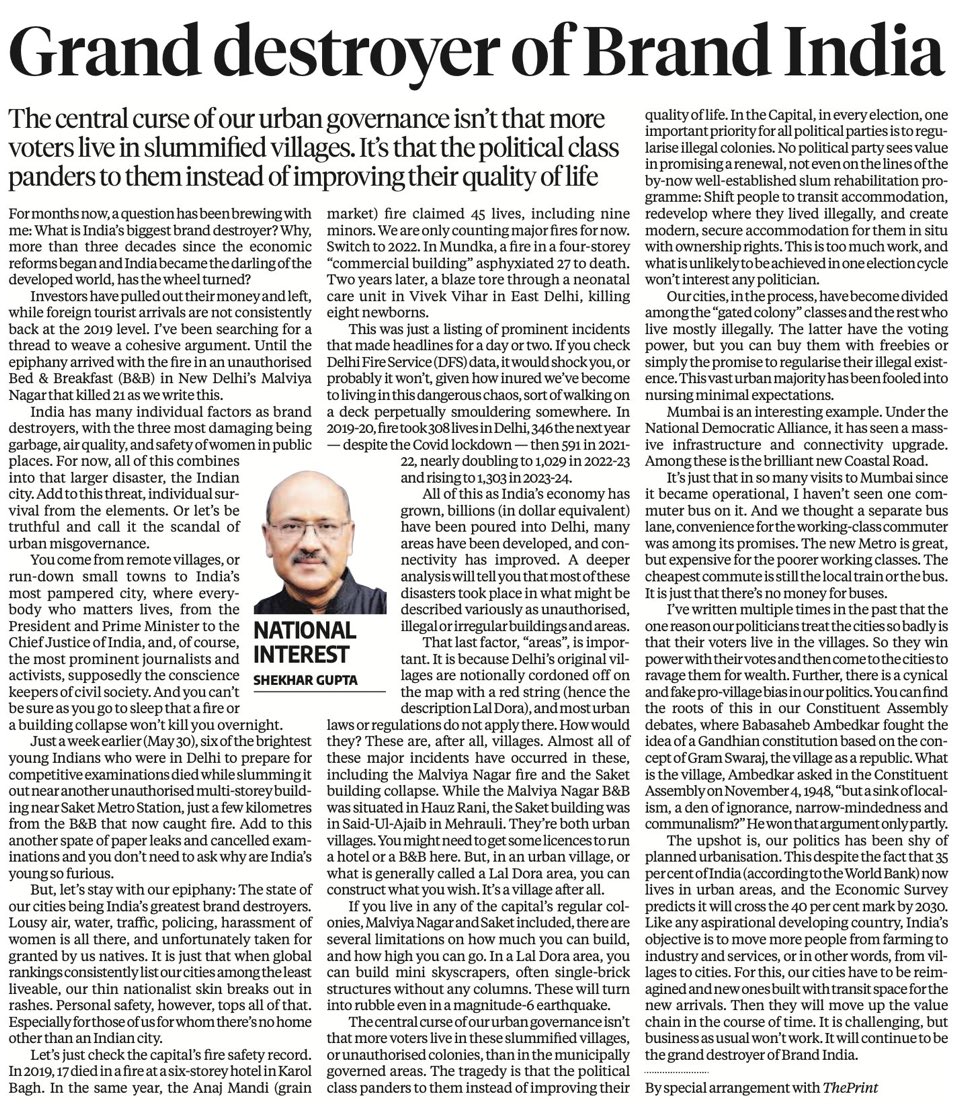
I agree with every word @ShekharGupta has written - Indian cities are unliveable and they are greatest destroyers of the Indian brand. They are badly managed, ironically against the poor, the middle class and the rich (who don’t get the quality they deserve for taxes they pay).
55
369
1,152
74,006
Maybe put in a word with the BCCI, and IPL commentators, to also say that IPL pitches make batting a chore, and for some of us, slam-bang-thank you a bit of a bore -
Cricket Gyaan: (revised tweet) Next time anyone tells you about terrible Indian pitches that turn square before lunch, ask them to see the Lords pitch in the #EngvNZ game. A seaming wicket with uneven bounce from day 1 and where a 3 day finish with no Sunday cricket looms. Am now told that @nassercricket and @Athersmike have strongly criticised the pitch. Good 👍. Indian commentators need to be just as blunt: pitches like these make batting a lottery just as flat wickets make bowling a chore. Challenge is to find the right balance. Else test cricket with an eye on WTC points will see more and more 3 day games.
2
12
3,836
Nehru would also not understand, and will not marvel at, the transformation of Iran into extreme religious fundamentalism.

𝗚𝘂𝗲𝘀𝘀 𝗪𝗵𝗼 𝗖𝗮𝗺𝗲 𝘁𝗼 𝗗𝗶𝗻𝗻𝗲𝗿?
On May 27, the anniversary of Jawaharlal Nehru’s passing, I found myself wondering what India’s first Prime Minister would make of the world today.
Imagine Nehru appearing unexpectedly at the dinner table.
He would surely marvel at India’s transformation: a major economy, a nuclear and space power, a digital innovator, and an increasingly influential voice on the world stage.
But after listening patiently to our account of India’s rise, he might ask a simple question:
“During the ongoing Iran crisis, where exactly is India?”
This question is worthy of thought.
The conflict is not some distant regional war. It touches directly upon India’s interests: energy security, shipping through Hormuz, inflation, supply chains, connectivity through Iran, and the welfare of millions of Indians in the Gulf.
Yet India has appeared more observer than participant in the diplomatic conversation surrounding the crisis.
This is not a call for reckless activism or nostalgia for another era. The world of 2026 is vastly more complex than the world Nehru inhabited. Strategic autonomy requires prudence and restraint. But there is a difference between restraint and reticence.
Nehru understood something that remains relevant today: influence derives not only from power, but also from presence.
India of the 1950s possessed far less economic and military power than India does today. Yet it sought to shape international conversations on Korea, Suez, Indochina and Congo. It did not always determine outcomes. But it was rarely absent.
The Iran crisis also reveals another reality. We often speak of a “multipolar world”, but what we increasingly see is a world of intermediaries.
Countries such as Qatar, Oman, Saudi Arabia and others have acquired diplomatic relevance because they possess channels of communication that others lack. Influence flows not merely from military strength, but from connectivity.
This is where India should excel.
We engage the United States and Europe, maintain ties with Russia, have deep interests in West Asia, participate in BRICS and the Quad, and retain credibility across much of the Global South.
Strategic autonomy should not become strategic silence.
The challenge before India is not whether it should mediate every conflict. It is whether a country of India’s scale and aspirations can afford to be absent from conversations that directly affect its interests.
Nehru would not have asked us to return to the diplomacy of the 1950s.
But as he leaves the dinner. he might ask whether a stronger India has become too cautious about using its voice.
Today we possess
unprecedented weight.
The question is whether we’re prepared to exercise an equally confident voice.
The future will not be shaped by great powers alone. It will also be shaped by those capable of connecting worlds that no longer trust one another. We have the power to be one of those.
Good night, Mr. Nehru.
#India #Nehru #Iran #Diplomacy #ForeignPolicy #StrategicAutonomy #GlobalSouth #WestAsia #Geopolitics #InternationalRelations
5
4
21
5,038
Some might say that what you have been watching is not cricket 🙂
Jun 5
I am watching the test match from Lords. Beautiful visuals @SkyCricket. Isn't it incredible that the laws of the game are the same but cricket is unrecognisably different from what we have been watching. The bowlers have teeth and the batters are being hunted!!
4
4
115
38,092
First, congratulations on your World Bank appointment - More than well-deserved! Second, the World bank is also arguing that a substantial rise in female FLPR is necessary for growth acceleration & Viksit Bharat - Developing country history does not support this lexicographical ordering - getting investment rates up is by far the most necessary ingredient for growth acceleration - & female LFPR follows rather than leads.

In our report "The Missing Half: Women and India's growth challenge" we show that raising women's labour force participation rate is not just a social necessity but an economic imperative. The growth acceleration necessary for 'Viksit Bharat' may not be possible without a substantial rise in female labour force participation rates (FLFPR).
To understand both the opportunity and the limits of policy, we place India within a longer global arc. India is currently near the bottom of the ‘U’ seen when countries are mapped on FLFPR vs. average incomes. India is climbing out of the bottom but not fast enough.
We studied trends in advanced economies, where, over the past century, women have moved from the economic periphery to the core. Given the paucity of primary research on FLFPR in India, we also conducted a proprietary survey of around 11,000 college educated women across 42 Indian cities.
In developed countries, demand for women's labour was addressed by shifts in demand (more services, removal of legal barriers and reduction in cultural bias) as well as its supply (household automation, education, out-of-home safety and reproductive control) . These would not have occurred without shifts in cultural norms, which were accelerated by war-time mobilization in WW2. Even high-income economies though continue to see gender gaps in pay later in careers, mostly attributable to the ‘motherhood penalty’.
This structural lens helps understand India’s challenges. There has been substantial progress on the supply-side, like inputs that reduce time spent on household work: pucca houses, dense energy access (electrification, cooking gas) and piped water. Higher-education enrolment ratios for women, necessary to reduce the ‘marriage penalty’, are rising and are now mostly at par with men in most states.
However, there are demand side constraints like too few accessible non-farm jobs (for men and women), fewer jobs in sectors that are globally women-dominated, and several remaining supply-side constraints like unpaid care, safety concerns, and social norms that suppress participation.
For the cohort we surveyed (white-collar, English-speaking: at the top of the social pyramid), the survey reveals a clear transition to “Career AND Family”, and a shift in aspirations to viewing paid work as a career and as central to their identity, not merely a source of income.
In this #opendialogue episode, @sameershetty29 and I discuss the key findings.
youtu.be/RS4Wh6EkKmA
(link to the report: research.axiscapital.co.in/R…)
4
26
9,552
You are right and I will have an article comparing how both Viksit countries - Indonesia and India - are likely to miss their targets (2045 and 2047) - but it does not negate the fact that Indonesia did correct its old FDI policy and came out with a big improvement - I hope India does the same on FDI - growth and 2047 possibilities will also improve
Jun 5

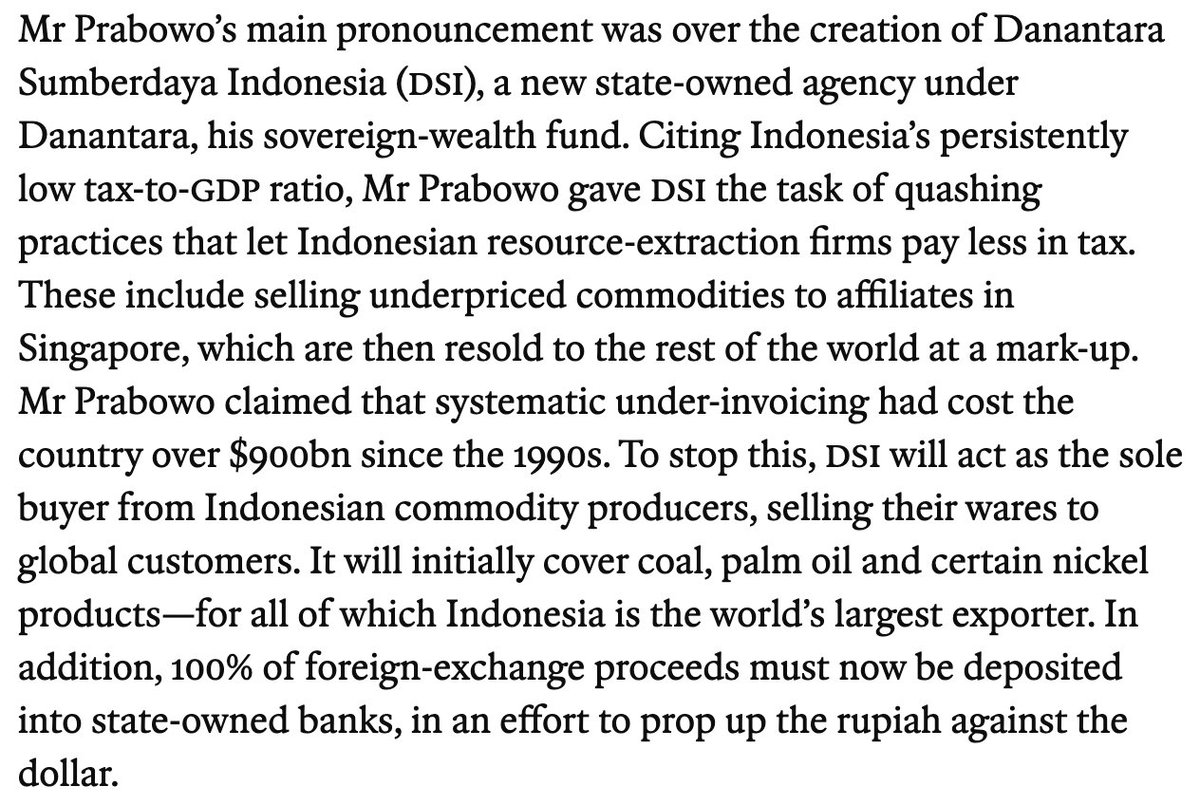
Respectfully, I love your work and share many of your constructive critiques, but I'm not sure Indonesia is a good model for India when Prabowo is pursuing bone-headed economic nationalist ideas right now economist.com/asia/2026/05/2…
2
6
41
7,206
Agree; we have to stop outlining reality known for decades - and start asking, soft and hard, questions about why what is well known, and well recommended, does not happen
Jun 5
Indian businesses face 1,500 laws, 69,000 compliance protocols & 6,600 filing mandates. Economists call this “regulatory cholesterol”.
Dissolving this cholesterol is essential for India to build a modern economy. My @openthemag column openthemagazine.com/columns/…
4
10
21
3,830
Surjit Bhalla retweeted

Jun 4
'India’s FDI debate is missing a key factor that can unlock growth—judicial reform'
Sriram Balasubramanian, former IMF Economist and Prakash Loungani @LounganiPrakash director, Johns Hopkins Applied Economics Program write
Illustration: Soham Sen
#ThePrintOpinion
theprint.in/opinion/indias-f…
5
16
58
15,237
Surjit Bhalla retweeted

Jun 4
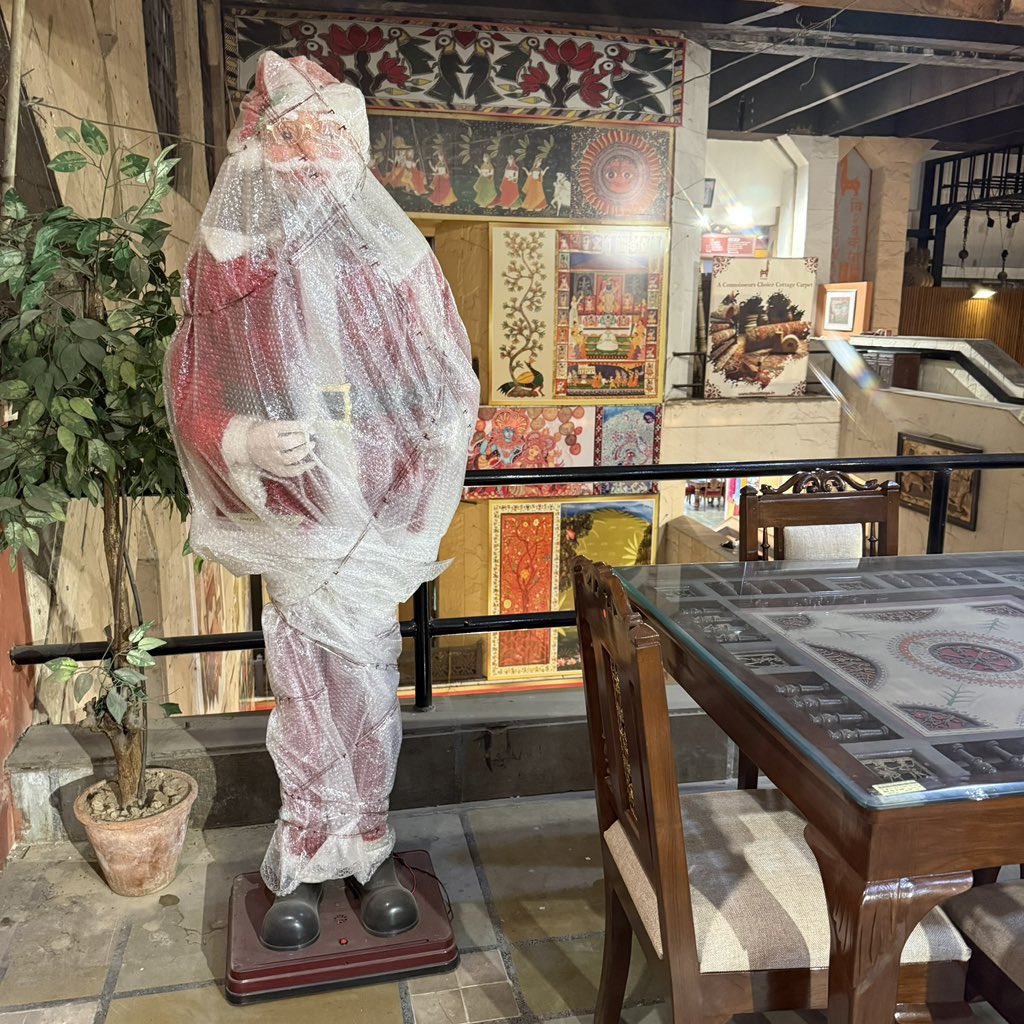
Yesterday, after a meeting in Connaught Place, I realised my two young colleagues had never heard of Cottage Industries Emporium- one of Delhi’s iconic though expensive shopping destinations when I was growing up.
So I took them for a walk-through. It was a sad one hour.
Not ONE shopper.
Staff working and wearing ‘ I am on Strike’ badges - salaries not paid for the last 4-5 months, they said.
Dust on the stunning sarees.
And then, the last straw : This creepy looking Santa Claus wrapped in plastic staring at us.
Pls pay the workers a full and final, sell everything on discount and close this place down. It’s time is over.
@MinOfCultureGoI @TexMinIndia
104
240
732
57,161
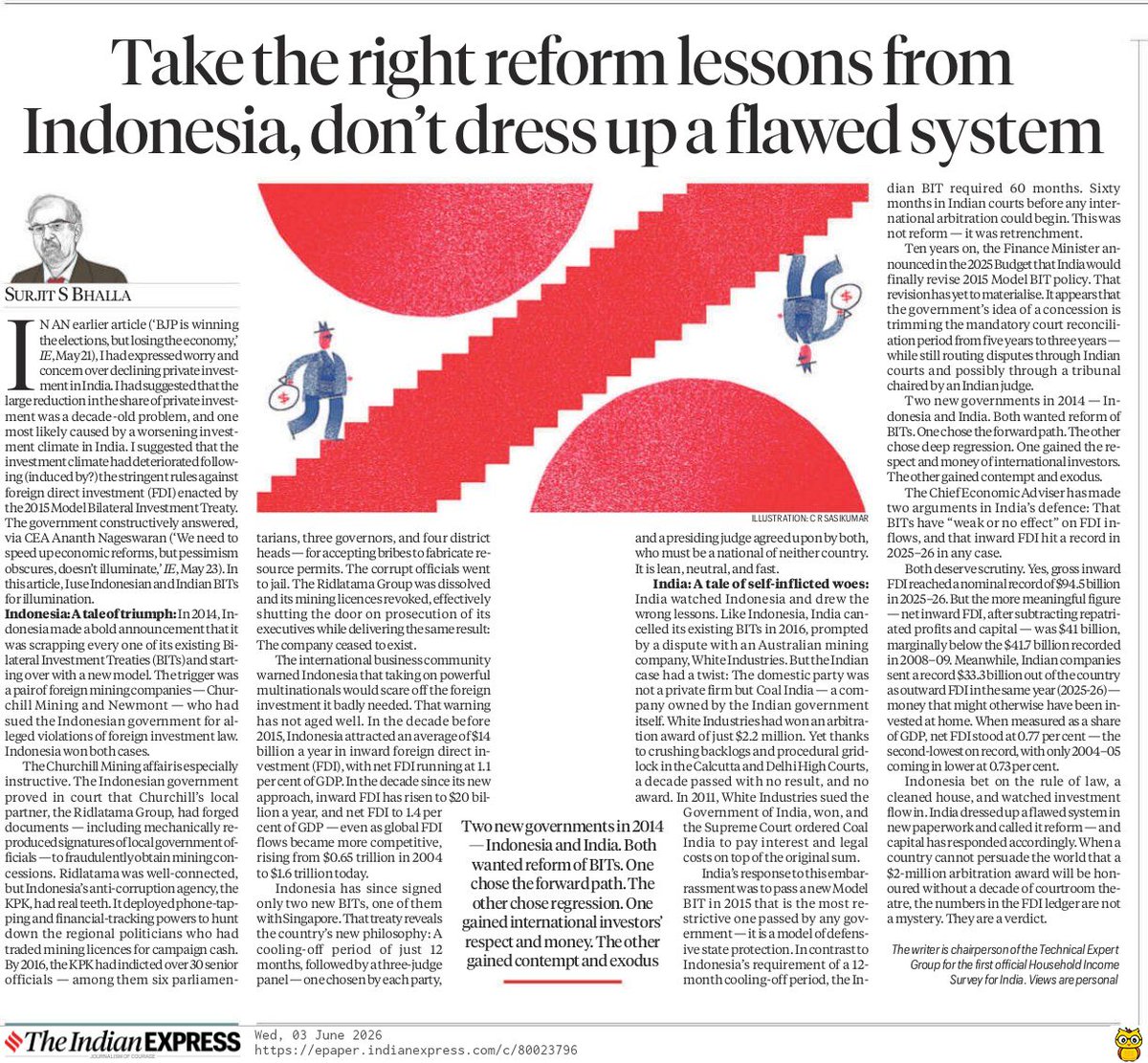
Indian Economic Policy is like the peeling of an onion - you peel a layer, and you cry; you peel another layer , and you cry some more. The attached BITs story reveals the power of the bureaucracy, and its complete lack of accountability and censorship of its actions - they are the onion.
indianexpress.com/article/op…
They are important actors of the non-transparent (by definition!) Deep State. Governments are censured by the people. Senior bureaucrats (IAS and IFS) enact policy that persists against national interest, that survives changes of government, that protects institutional actors over citizens and the economy — The Deep State in practice.
31
169
504
105,412
Surjit Bhalla retweeted

May 24
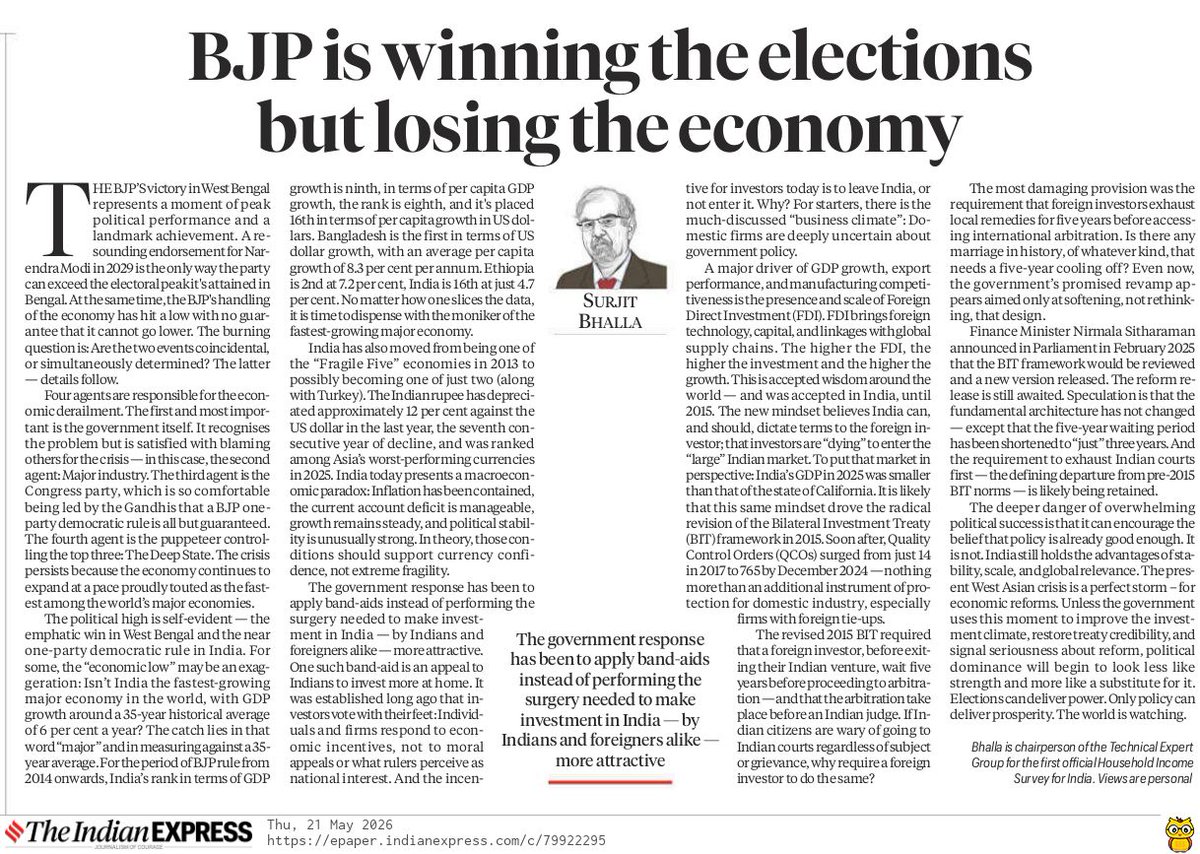
Surjit Bhalla lambasts the government: "Winning Elections, Losing the Economy
In a hard-hitting interview with @govindethiraj on The Core Report, economist Dr. @surjitbhalla delivers a sharp critique of India's current economic policy direction despite strong political stability.
Bhalla argues that India is facing a deep crisis of confidence. While inflation and current account deficits look better than the 2013 "Fragile Five" days, net FDI has collapsed — a direct result of the 2015 restrictive Model BIT and "Hotel California" clauses that made exit extremely difficult for foreign investors.
He points out that the consequences of that 2015 policy shift are now fully visible in 2024-25 as old treaties expire.
The problem isn't just foreign capital. Domestic capital is also fleeing due to retrospective tax fears, heavy-handed enforcement, and a surge in protectionist Quality Control Orders (QCOs) since 2017 that shield local players from competition.
Bhalla criticizes the overly centralized, secretive decision-making process concentrated in the PMO — a far cry from the open debate that preceded the 1991 reforms. He notes that despite 30 years of talk, manufacturing's share in GDP refuses to rise because policy incentives remain flawed.
His clear recommendations:
1. Immediately roll back FDI and BIT rules to the pre-2015 open framework.
2. Pass a permanent legislative ban on retrospective taxation.
3. Aggressively support and subsidize export-oriented companies, learning from South Korea, Vietnam, and Bangladesh.
On the rupee hitting lows, Bhalla says a solo float without fixing fundamentals would be "stupid and suicidal." Fix the structural issues and confidence — and the currency — will return.
A must-watch interview that raises uncomfortable but important questions about long-term economic direction.
@PMOIndia
Full interview: youtu.be/kzP_ZHA8tZU?si=Ab7G…
4
20
51
7,372
May 23
Thank you - definitely encouraging - but my estimates were with regard to (inward_FDI - outward_FDI) as % of GDP
May 23
@surjitbhalla Sir this is wrt your recent article on economy and BJP political success. This is from today's TOI and is about FDI which you had discussed on length with @sardesairajdeep.
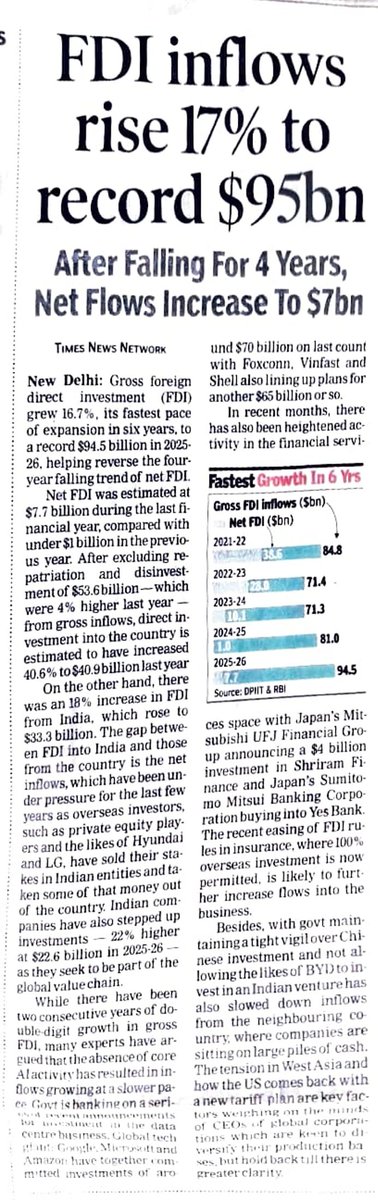
3
2
31
8,140