
424 Photos and videos











Jun 3
Top AI talent wants more than a paycheck; they need the freedom to experiment and the best tools, or they'll head for the exit. cio.com/article/4177085/the-…
33
May 27
Not surprised, but a clear and loud message of how you don't value your team or talent @elonmusk
Musk’s xAI promised employees $420 for their tax data. Two months later, nothing. thenextweb.com/news/musks-xa… via @thenextweb
54
May 24
AI cost crisis hits tech giants as employee 'tokenmaxxing' backfires, sparking corporate pullback at Microsoft, Meta, and Amazon — agentic AI eats up to 1000x more tokens than standard AI tomshardware.com/tech-indust…
55
May 23
Microsoft’s new responsible tech lead on how to humanize high-speed AI development cnb.cx/3Pnftgu
29
May 4
Anthropic is finalizing a deal to create a new joint venture with Blackstone, Goldman Sachs and a handful of other Wall Street firms that aims to sell artificial-intelligence tools to private-equity backed companies wsj.com/business/deals/anthr… via @WSJ
1
62
May 3
Google is now a glorified venture-capital fund thanks to its SpaceX and Anthropic stakes marketwatch.com/story/google… via @MarketWatch
3
471
May 2
Sarah Friar, OpenAI’s chief financial officer, has ambitions for one of the biggest IPOs ever. She’s pulled off impossible ones before. wsj.com/business/openai-sam-… via @WSJ
111
May 1
McKinsey is shedding light on a shift that fundamentally reshapes how banks test software qa-financial.com/ai-agents-t…
31
Christina Trampota retweeted

Apr 25
when i left @Adyen to join @lightspark, i was fairly convinced that stablecoins would redefine fintech.
the turning point for me was seeing the gap between what modern software can do and what money movement infrastructure still looks like underneath.
companies can launch globally, serve users in dozens of markets, operate 24/7, and build incredibly sophisticated financial experiences. but the underlying rails are still fragmented, slow, expensive, country-specific, and often unavailable.
stablecoins and crypto rails more broadly were interesting because they suggested a different base layer. not a wrapper or an optimization of the old stack, but a different assumption about how value should move.
after seeing this up close at @lightspark, and spending time with customers from large financial institutions to next-gen platforms, i’m now certain. and the biggest change is utility. for years, much of crypto felt like a solution looking for a problem. that is no longer true.
platforms want to pay creators and sellers globally. marketplaces want faster settlement. fintechs want to offer dollar access in markets where local banking is limited. companies want 24/7 liquidity movement. ai-native businesses will need programmable accounts, permissions, and money movement that can operate at software speed.
these are not theoretical use cases anymore. they are real customer problems i'm hearing from customers every week. stablecoins are increasingly becoming the most practical way to solve them.
big infrastructure shifts usually happen when the old system becomes too limiting for what the next generation of applications needs to do. fax machines worked until email made them absurd. legacy financial rails worked well enough when money movement was mostly domestic and bank-led. but that's not the world we are building for anymore.
the next generation of financial services will be global, real-time, programmable, and available 24/7. the legacy system was simply not designed for that. stablecoins were.
ps. credit should go to the builders who kept pushing through the noise, cycles, skepticism, regulatory uncertainty, and failed experiments to get the industry here. lots of respect!
11
3
69
11,353
Apr 26
The countdown to @Consensus2026 in Miami is on. Who's coming? Msg me to coordinate meeting in petson app.ingo.me/q/y3vws #Consensus2026
47

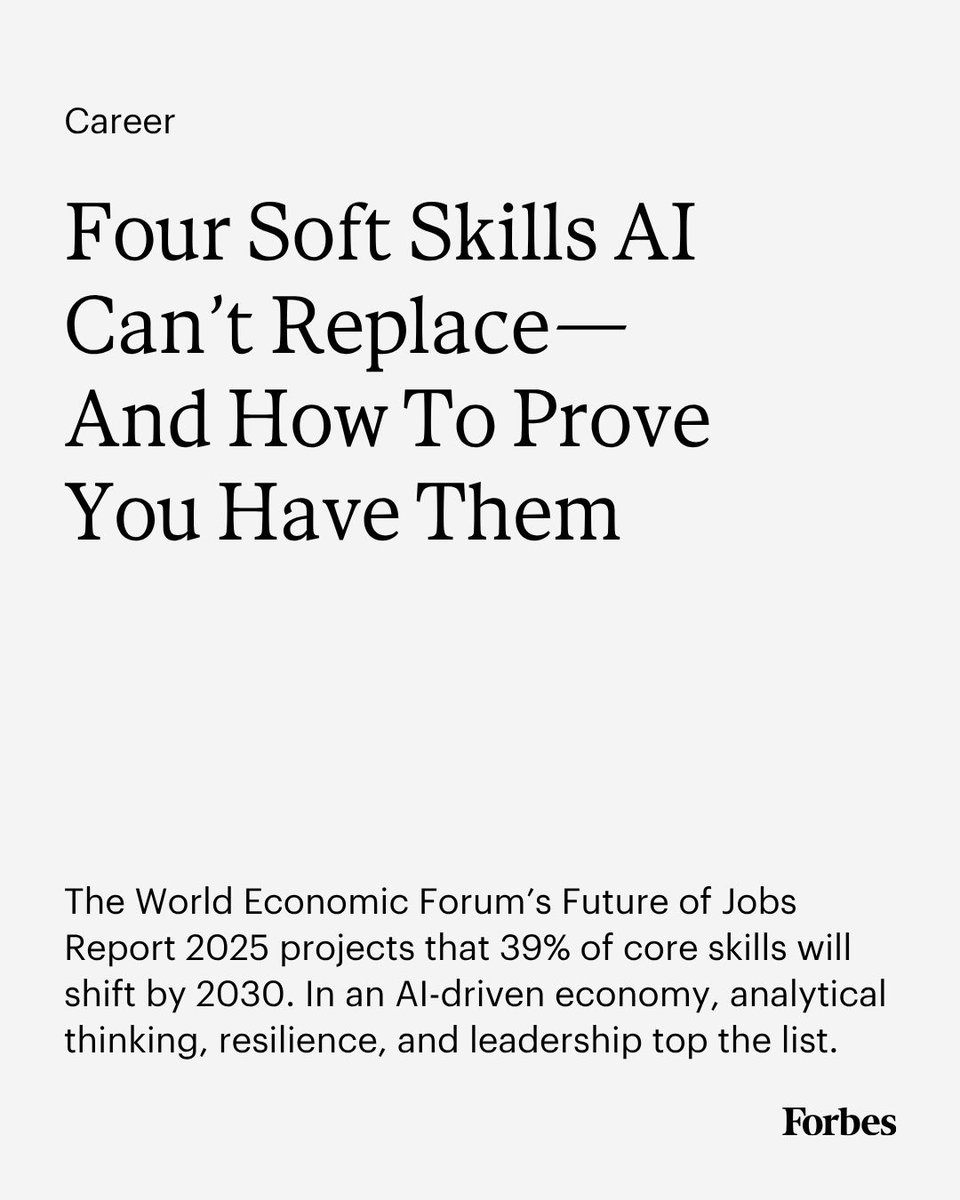
The abilities a high school student builds running a business or leading a team are the same ones a hiring manager scans for a decade later. Here are four soft skills AI can't replicate, and what demonstrating them looks like at every stage.
Read more: forbes.com/sites/sarahhernho…
6
18
39
16,581
Apr 16
Senior-level women are steering AI strategy at work, says report: They're focused on 'what to protect while we move fast' cnb.cx/4cSAO9l
90
Apr 14
Udemy co-founder annoyed about $2.5B Coursera merger, cites years of missed opportunities technext24.com/2026/04/14/ud… via @technextdotng
1
82
Apr 12
76
Apr 10
Gemini Space Station Inc. has lost more than half its market value this year, cut 30% of its workforce and retreated from major overseas markets as the crypto exchange struggles financially. bloomberg.com/news/articles/…
70
Mar 31
Amazon, U.S. Bank and Mastercard partner on new cards for small businesses usbank.com/content/usbank/us…
1
61
Mar 30
Department of Labor proposes rule for including alternative assets in 401(k)s cnb.cx/486su3Z
42
Mar 23
A year after Unilever, the ad-funded creator economy is still catching up to its own ambition digiday.com/marketing/a-year…
36
Mar 17
Antonio Gracias says he’s longing for ‘proentropic’ startups — those that are built to survive chaos techcrunch.com/2026/03/16/an… via @techcrunch
36