
Joined May 2011
- Tweets 12,800
- Following 50
- Followers 354
- Likes 7,328
465 Photos and videos













Pinned Tweet

11 Sep 2025
“The further a society drifts from the truth, the more it will hate those who speak it.”
-George Orwell
4
2
20
3,287
🌐 t̷̵̸e̸̶̵m̵̴̸p̷̸̸s retweeted

Jun 4
The biggest problem with Bitcoin is that it's a really smart asset in a world full of retards.
16
15
149
5,720
I think I figured it out. Or Wall Street figured it out.
Major CEX are now allowing you to buy stocks with crypto.
They figured out a way to drain liquidity from crypto to stocks. Now that people are retardedly fomo'ing into AI/energy/chips, they will effectively drain crypto.
1
2
113
Good news is that rotation can still happen. Personally, I think this is mirroring 2000 DotCom bubble. Even though the bubble burst, the internet still changed humanity. The AI bubble will burst, but it too will change humanity. Some players are going to get culled.
62
Everyone wants to shit on Saylor's 8.5bln unrealized loss, but no one wants to talk about OpenAI's 14bln loss.
56
It's a lot of people's first Bitcoin bear market and it shows.
2
72
🌐 t̷̵̸e̸̶̵m̵̴̸p̷̸̸s retweeted

On this day in history, 10 years ago, the Opendime was released. The USB can be passed by hand, checked by plugging in, and spent only after removing the resistor off the circuit board to reveal the private key, turning the bitcoin into the object itself.
13
49
222
30,048
May 12
It Really Whips the Llama's Ass
May 10

🚨 CVE-2026-7482 in Ollama could let remote attackers leak process memory from more than 300,000 exposed servers using crafted GGUF files.
Separate unpatched Windows flaws enable persistent code execution through Ollama’s update mechanism.
Full details and mitigations: thehackernews.com/2026/05/ol…

1
578
🌐 t̷̵̸e̸̶̵m̵̴̸p̷̸̸s retweeted

May 4
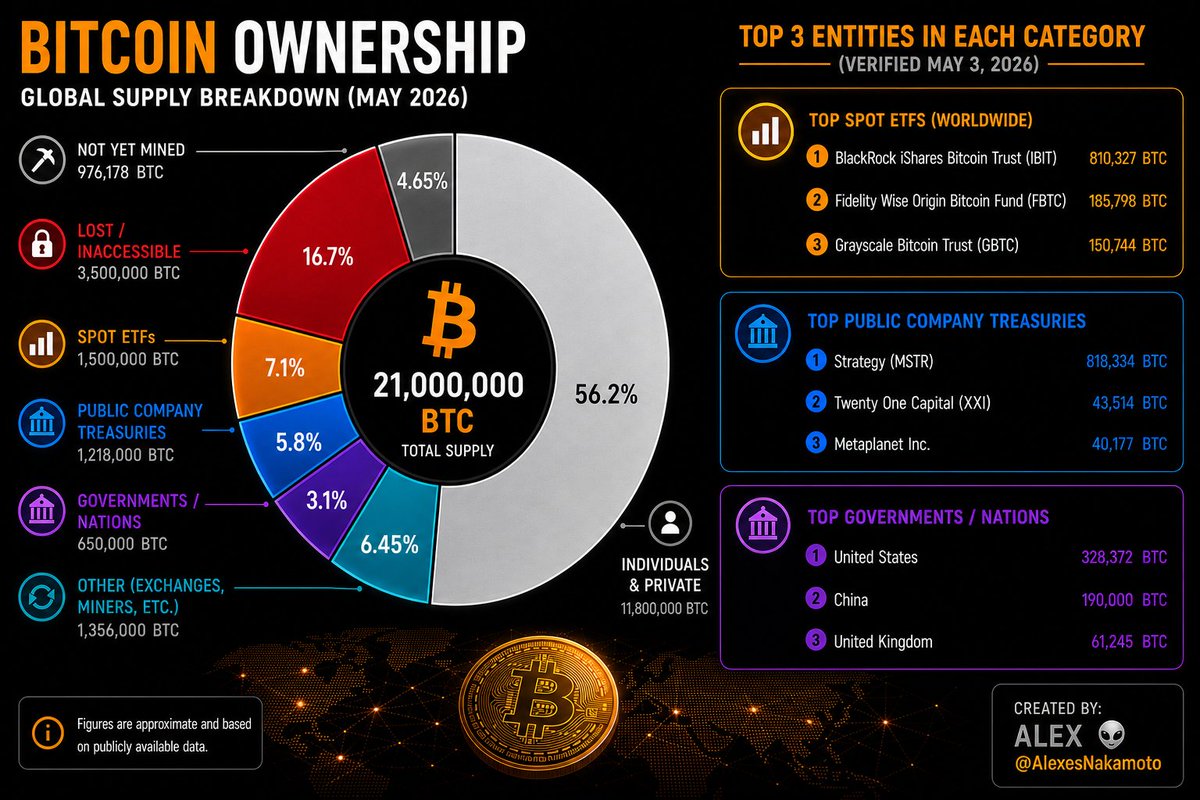
21M Bitcoin.
• Individuals – 11,800,000 BTC
• Lost – 3,500,000 BTC
• Spot ETFs – 1,500,000 BTC
• Public Companies – 1,218,000 BTC
• Other (exchanges, miners…) – 1,356,000 BTC
• Not yet mined – 976,178 BTC
• Governments – 650,000 BTC
19
254
784
165,575
🌐 t̷̵̸e̸̶̵m̵̴̸p̷̸̸s retweeted

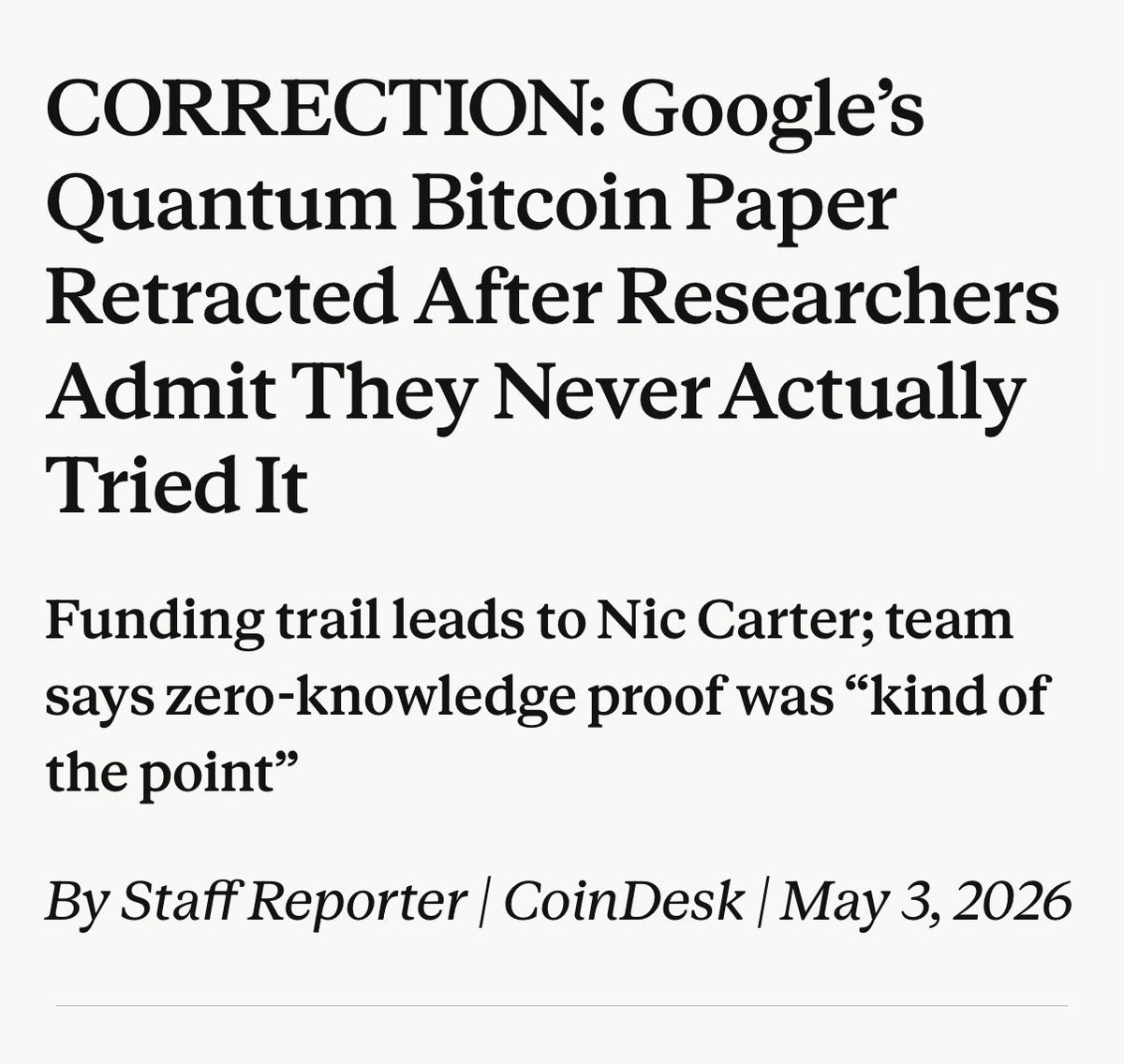
Found out why Bitcoin is pumping
1
1
6
486
🌐 t̷̵̸e̸̶̵m̵̴̸p̷̸̸s retweeted

Feb 16
25
139
743
99,631

Some Bitcoin truths:
Bitcoin is not for everyone, but it is available to anyone.
Bitcoin will affect everyone.
Bitcoin self custody is not hard.
Bitcoin self custody responsibility is for the few. Most people don't want freedom, they just want a better cell.
There are not enough UTXOs for everyone.
There is not enough block space to "be Visa".
L2 will resolve most throughput issues by behaving more like IOUs.
"Holding" Bitcoin is not possible for poor people, because poor ppl can't save thus can't buffer handle volatility.
Stable coins are great for poor ppl because it's more free from capital controls than fiat.
Stable coins are great for everyone who needs "stable" unit of account with less capital controls.
Most people need credit, bitcoin is not credit.
Businesses need credit, specially trade credit, bitcoin is not credit.
Free banking is both useful and will always exist, specially on a bitcoin standard.
Volatile units of account struggle to be medium of exchange for small payments when given alternatives.
Shitcoins will always exist.
There is no single Bitcoin community; there are tribes that share the same love (or hate) for Bitcoin.
There are no bail outs in bitcoin.
People you don't like will hold Bitcoin.
People you don't like will do very well holding Bitcoin.
There is always someone who matter more than you to bitcoin.
Most people who hold Bitcoin can't affect Bitcoin.
There are no analogs to Bitcoin.
Bitcoin is a brand-new asset class.
Bitcoin will never do what people think it will do.
We don't know where Bitcoin will go.
Bitcoin FUD will always exist.
Bitcoin sour grapes will always exist.
We know the fiat system is in controlled demolition.
Bitcoin self-custody is for the few.
Suits will have paper Bitcoin.
Paper bitcoin is unavoidable.
Leveraged bitcoin is unavailable.
Just because you don't like a bitcoin use, doesn't mean you can stop it.
Some will see Bitcoin as religion.
Some will see Bitcoin as math.
Some will see Bitcoin as toxic.
Some will see Bitcoin as the solution.
But at the end, the honey badger doesn't care.
Bitcoin price is an important signal that most can't understand.
Bitcoin has no realistic alternatives.
Bitcoin is decentralized, non-inflationary, permissionless, salable, divisible, and transportable.
Bitcoin must be ultra conservative with new features.
Bitcoin savior complex is ego poison.
Bitcoin is designed to ignore individual preferences.
Bitcoiners are splitting and fighting internally is annoying but integral part of the process.
You just arrived and you can't fix bitcoin.
No other bitcoin participant owes you anything, specially their attention.
Bitcoin devs don't control bitcoin.
Bitcoin miners don't control bitcoin.
Bitcoin holders don't control bitcoin.
Bitcoin is very rough consensus.
Bitcoin is designed for your selfishness to secure the network.
Without healthy and sufficient decentralized self-custody, Bitcoin goes to zero.
All sides in Bitcoin debates are wrong until they become the longest chain.
Bitcoin is designed to win, not to fight.
Bitcoin monetizes mutually assured destruction.
Bitcoin is the most important tool of peace in our generation.
Bitcoin is the only fair and self-verifiable monetary system.
Bitcoin bridges trust gaps with a trustless network.
Bitcoin will always be less efficient the centralized systems.
Investing in Bitcoin is using Bitcoin.
Holding bitcoin is using bitcoin.
Bitcoin allows opting out of the legacy financial system.
Bitcoin is generational wealth, there will only be 21m
Given its history, the most consistently successful strategy has been to buy bitcoin, put in your COLDCARD, STFU, have patience.
38
99
461
37,750
Jan 29
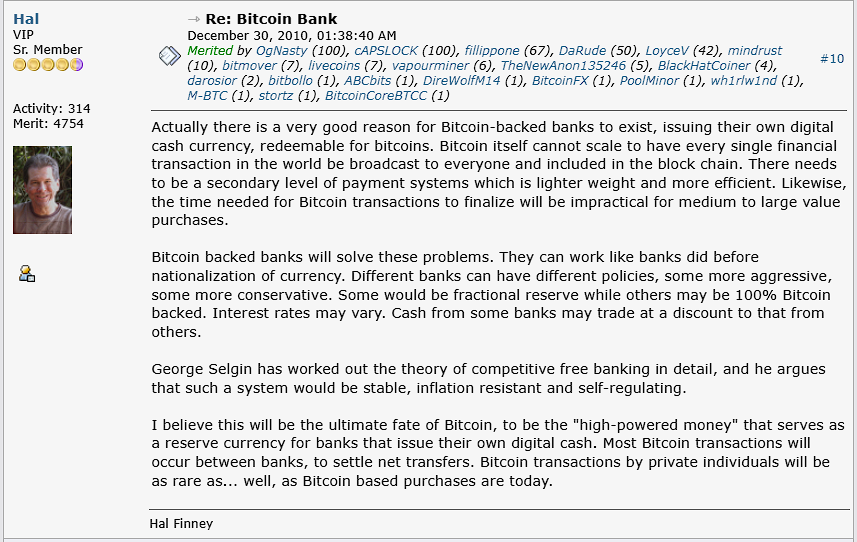
To everyone against institutional Bitcoin, I remind you..
bitcointalk.org/index.php?to…
1
1
10
2,914

🌐 t̷̵̸e̸̶̵m̵̴̸p̷̸̸s retweeted

24 Dec 2025
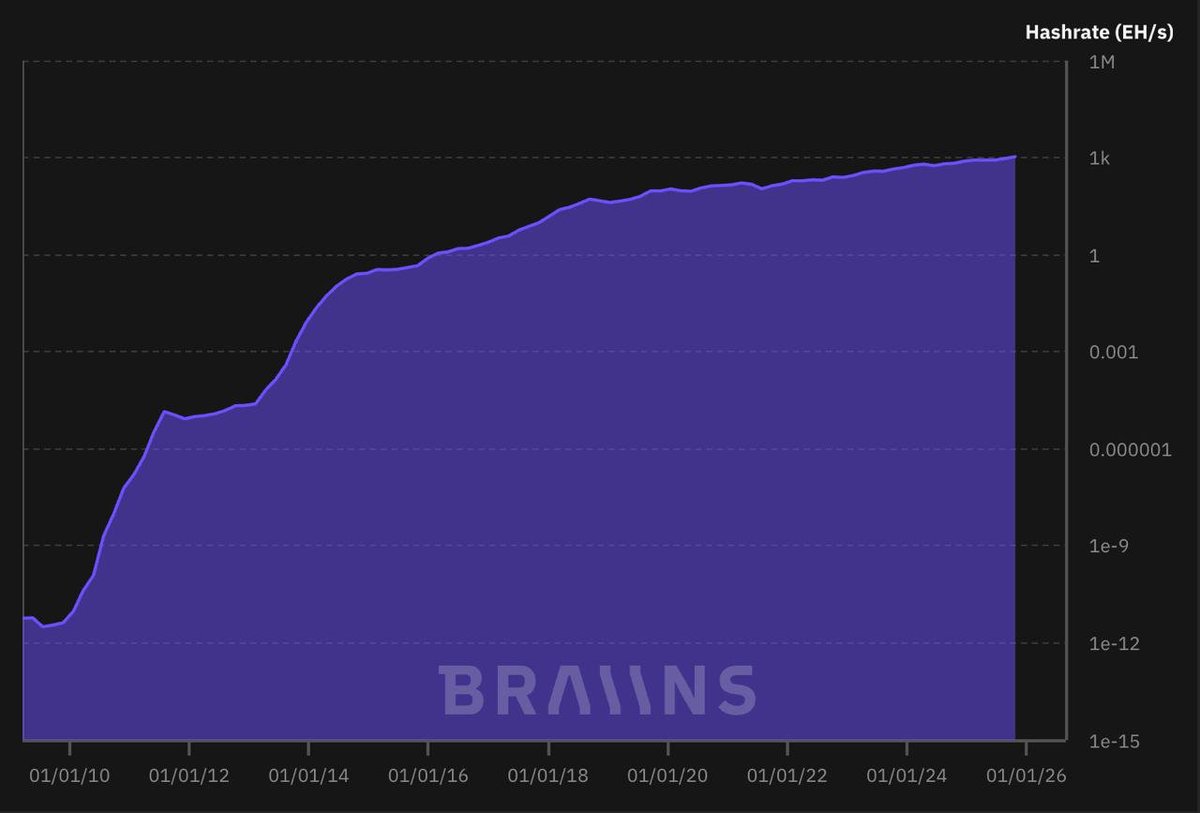
Bitcoin network hashrate every Christmas Eve:
2009: 9 MH/s
2010: 108 GH/s
2011: 8 TH/s
2012: 22 TH/s
2013: 9 PH/s
2014: 271 PH/s
2015: 709 PH/s
2016: 2.3 EH/s
2017: 14 EH/s
2018: 39 EH/s
2019: 99 EH/s
2020: 134 EH/s
2021: 177 EH/s
2022: 240 EH/s
2023: 521 EH/s
2024: 779 EH/s
2025: 1.1 ZH/s
From 9 megahashes to 1.1 zettahashes. 122 trillion times more computational power securing the network.
Merry Christmas 🎄
72
437
2,372
159,871
🌐 t̷̵̸e̸̶̵m̵̴̸p̷̸̸s retweeted

23 Nov 2025
Rising difficulty. Shrinking target.
Same result: tick tock, next block.
17
55
373
67,543
24 Oct 2025
The fact that the internet cannot discern comedy from fact is the atrocity against humanity.
2
5
570
23 Oct 2025
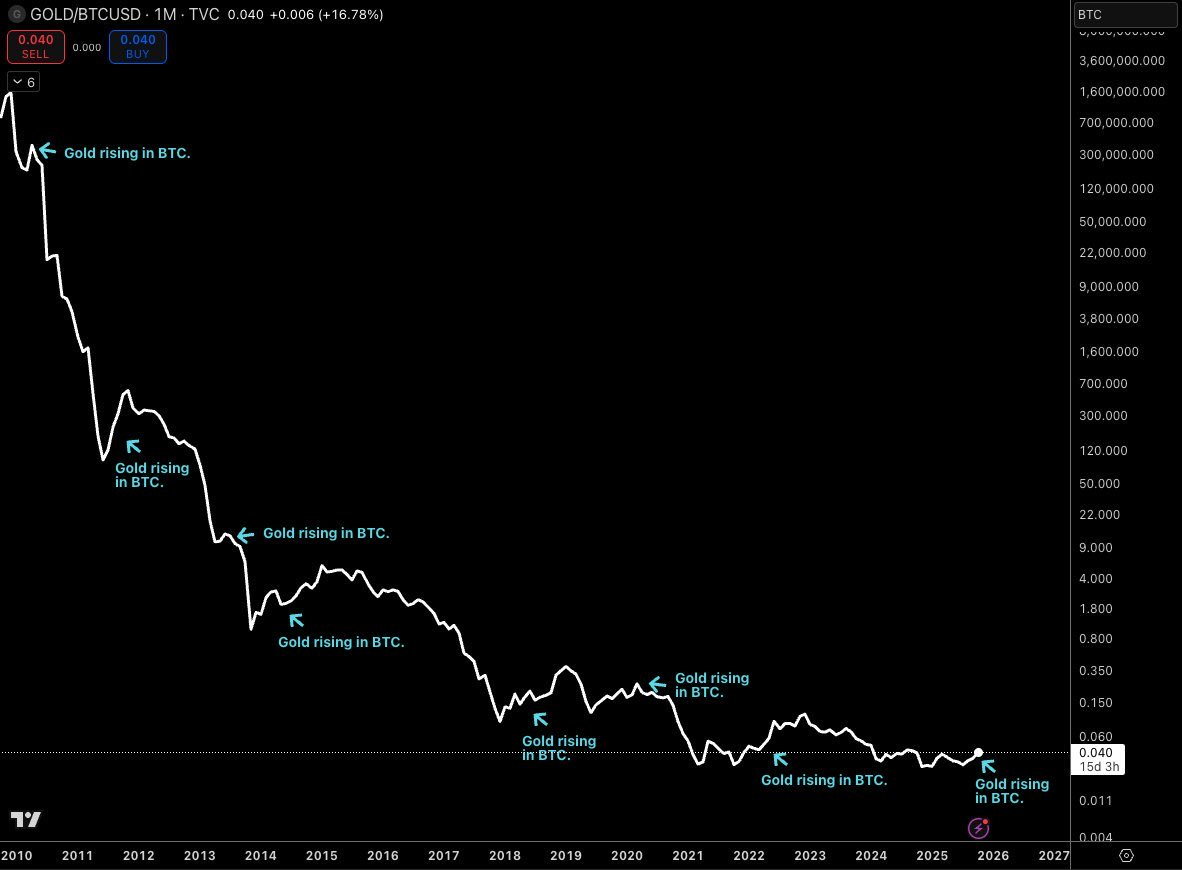
Imagine transferring $2,130,310,238 for $5 and it settling in 10 minutes.
Can't do that with gold.
blockchain.com/explorer/tran…
1
4
1,016
🌐 t̷̵̸e̸̶̵m̵̴̸p̷̸̸s retweeted

19 Oct 2025
18 Oct 2025

45
67
763
145,873

This is a long post that hopefully bridges some gaps between technical people (devs) and non-technical users and how they look at spam prevention in Bitcoin. I hope that it clarifies why I think that there is such a huge misunderstanding between both camps.
I'll preface this post with first disqualifying any malicious attempts to misrepresent the motives of either camp. Everybody wants to improve Bitcoin as money. Money is Bitcoin's use case. It's not a data storage system. If you think otherwise, there are countless shitcoins to play with.
Alright, let's get into it.
I have worked on anonymous systems for over a decade. I have read tons of research on spam detection, rate-limiting, and I've implemented spam prevention techniques in the real world.
I am very confident to say that there is not a single known method to prevent spam in decentralized anonymous open networks other than proof of work.
This is what Satoshi realized when he designed Bitcoin and it's why only transaction fees can reliably fight spam without sacrificing any of Bitcoin's properties.
Let me explain.
Spam prevention is a cat and mouse game. As a system's architect, your goal is to make the life of a spammer harder (increase the friction). This is why, on the web, you see captchas, sign-ups, or anything that can artificially slow you down. Slowing down is key. This is why Satoshi turned to proof of work.
Let's contrast this to other methods for spam prevention. This is not an exhaustive list but it illustrates the design space of this problem, other methods are often derivatives of these:
CAPTCHAS are a centralized form of proof of work for humans: Google's servers give you a hard-to-solve task (select all bicycles) that will slow you down so that you can't bombard a website with millions of requests. It requires centralization: you need to prove Google that you're human so that you can use another website. If you could host your own CAPTCHA service, why would anyone believe you're not cheating?
LOGINS with email and passwords are most popular way to slow down users. Before you can sign up, you need to get an email address, and to get an email address, you often need a phone number today. The purpose of this is, again, to slow you down (and to track you to be honest). It only works well when emails are hard to get, i.e. in a centralized web where Google controls how hard it is to get an email account. If you could easily use your own email server, why would anyone believe you're not a bot?
The next one is the most relevant to Bitcoin:
AD BLOCK FILTERS are another form of spam prevention but this time the roles are reversed: you as a user fight against the spam from websites and advertising companies trying to invade your brain. Ad blocking works only under certain conditions: First you need to be able to "spell out" what the spam looks like, i.e. what the filter should filter out. Second, you need to update your filters every time someone circumvents them. Have you ever installed a youtube ad blocker and then noticed that it stops working after a few weeks? That's because you're playing cat-and-mouse with youtube. You block, they circumvent, you update your filters, repeat.
The fact that you need to update your filters is critical and that's where it ties back to Bitcoin: Suppose you have a mempool filter for transactions with a locktime of 21 because some stupid NFT project uses that. You maybe slow them down for a few weeks, but then they notice it and change their locktime to 22. You're back at zero, the spam filter doesn't work anymore. What do you do?
You update your filter! But where do you get your new filter from? You need a governing body, or some centralized entity that keeps updating these filters and you need to download their new rules every single day. That's what ad blockers in your web browser do. They trust a centralized authority to know what's best for you, and blindly accept their new filters. Every single day.
I hope you see the issue here. Nobody should even consider this idea of constantly updating filter rules in Bitcoin. This would give the filter providers a concerning level of power and trust. It would turn Bitcoin into a centrally planned system, the opposite of what makes Bitcoin special.
This is why filters do not work for decentralized anonymous systems. They require a central authority. Until now, these rules were determined by Bitcoin Core, but they have realized that these rules do not work anymore. Transactions bypass the filters easily and at some point, carrying them around became a burden to the node runners themselves. Imagine you're using an outdated ad blocker but instead of filtering out ads, it now also filters out legitimate content you might be interested in. That's what mempool filters do, and that's why Bitcoin Core is slowly relaxing these filters. This has been discussed for over two years, it's not a sudden decision.
The goal of this change is not to help transactions to slip through more easily. The goal is to improve your node's prediction of what is going to be in the next block. Most people misrepresent this part. They say "it's to turn Bitcoin into a shitcoin" but that is just a false statement at best, or a manipulation tactic at worst.
Let's tie it back to proof of work and why fees are the actual filter that keeps Bitcoin secure and prevents spam reasonably well: Satoshi realized that there is no technique that could slow down block production and prevent denial of service attacks in a decentralized system other than proof of work. Fees prevent you from filling blocks with an infinite number of transactions. All the other options would introduce some form of trust or open the door for censorship – nothing works other than proof of work.
He was smart enough to design a system where the proof of work that goes into block production is "minted" into the monetary unit of the system itself: You spend energy, you get sats (mining). This slows down block production. How do you slow down transactions within those blocks? You spend the sats themselves, original earned form block production, as fees for the transactions within the block!
This idea is truly genius and it's the only reason why Bitcoin can exist. All other attempts of creating decentralized money have failed to solve this step. Think about it: without knowing who you are, whether you're one person pretending to be a thousand, or a thousand people pretending to be one. Bitcoin defends itself (and anyone who runs nodes in the Bitcoin system) from spam by making you pay for your activity.
People sometimes counter this by saying: the economic demand for decentralized data storage is higher than the monetary use case. First of all, I think that's just wrong. There are way cheaper ways to store data (there are shitcoins for this), and the value of having decentralized neutral internet money is beyond comparison.
However, there's a much deeper concern here. If you truly believe this, I ask you: what is Bitcoin worth to you? If you think Bitcoin can't succeed as money (i.e. be competitive), why do you even care? If you're not willing to pay fees for the use case that we all believe Bitcoin is designed for (money), and you believe that no one is willing to pay for it, how can it even persist into the future?
You can't have it all. If Bitcoin is money (which I believe it is), then we need to pay the price to keep it alive. There is no free lunch.
Either we centralize, or we pay the price of decentralization. I know where I stand.
Peace.
253
599
1,455
213,996