
Joined May 2025
- Tweets 1,570
- Following 49
- Followers 8,025
- Likes 6,172
336 Photos and videos




Pinned Tweet

May 31
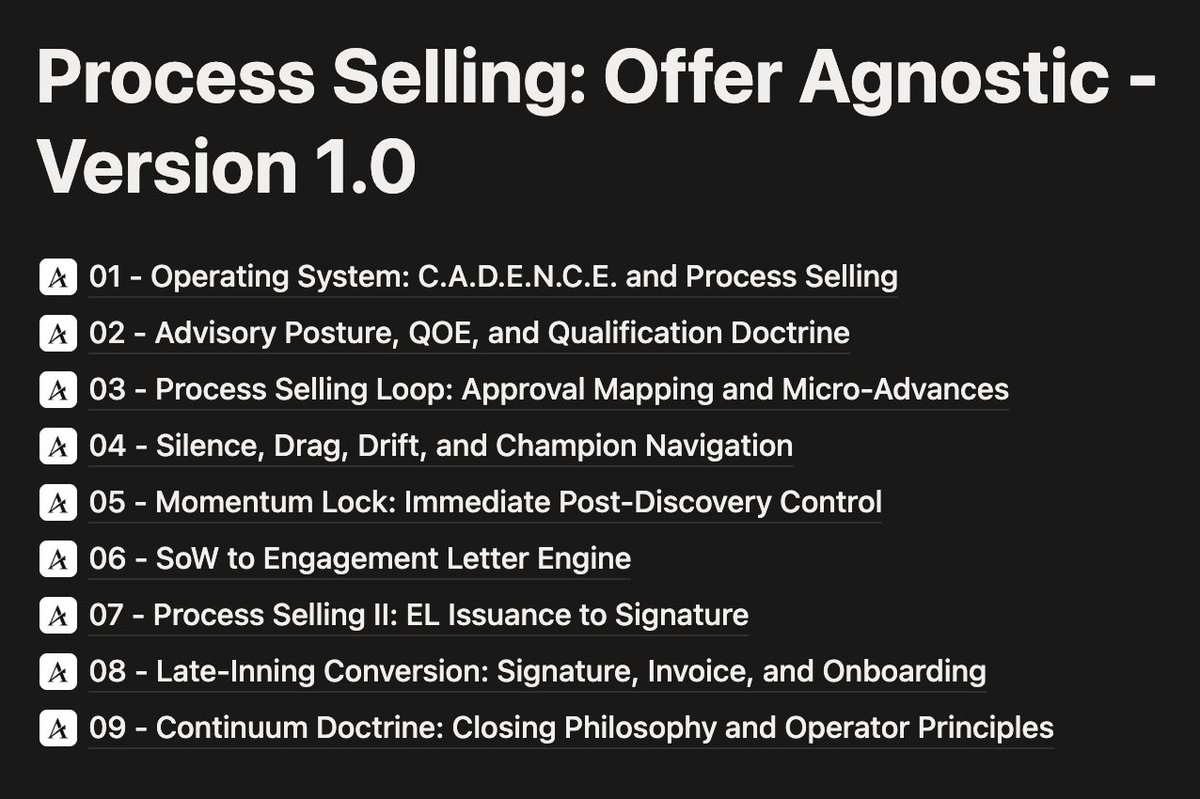
Advisory Incubator™
IF YOU WANT TO JOIN A GROUP OF SAVAGE B2B OPERATORS, BOOKMARK THIS.
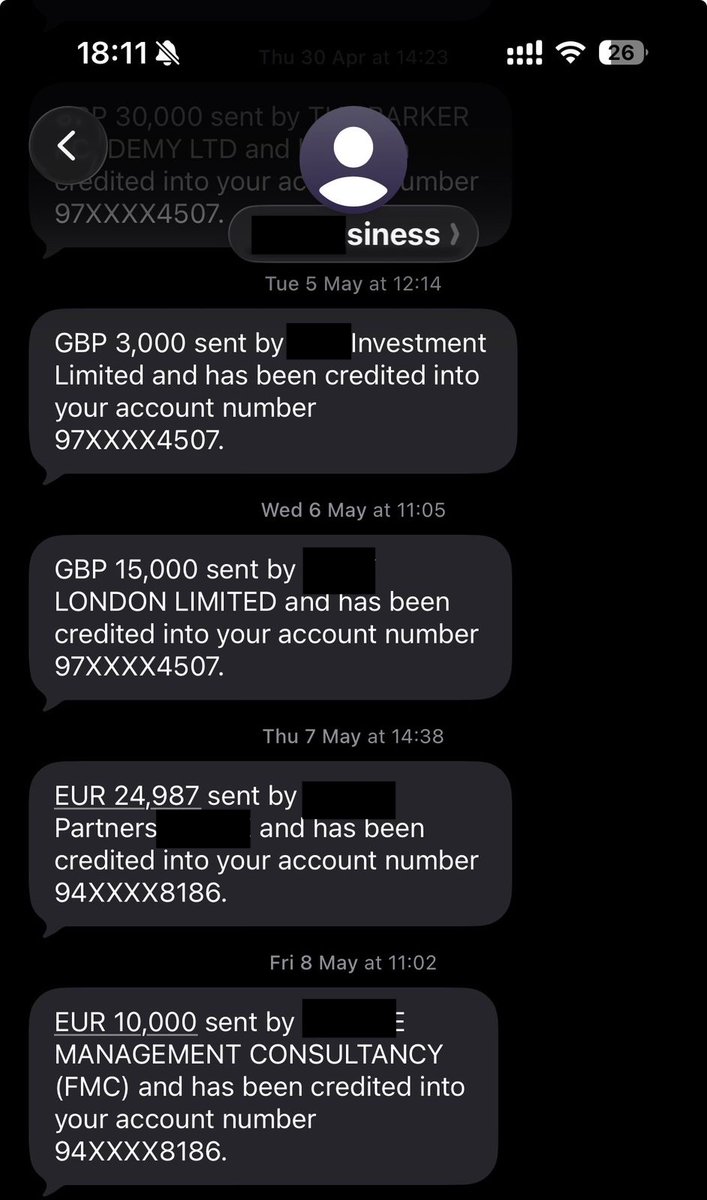
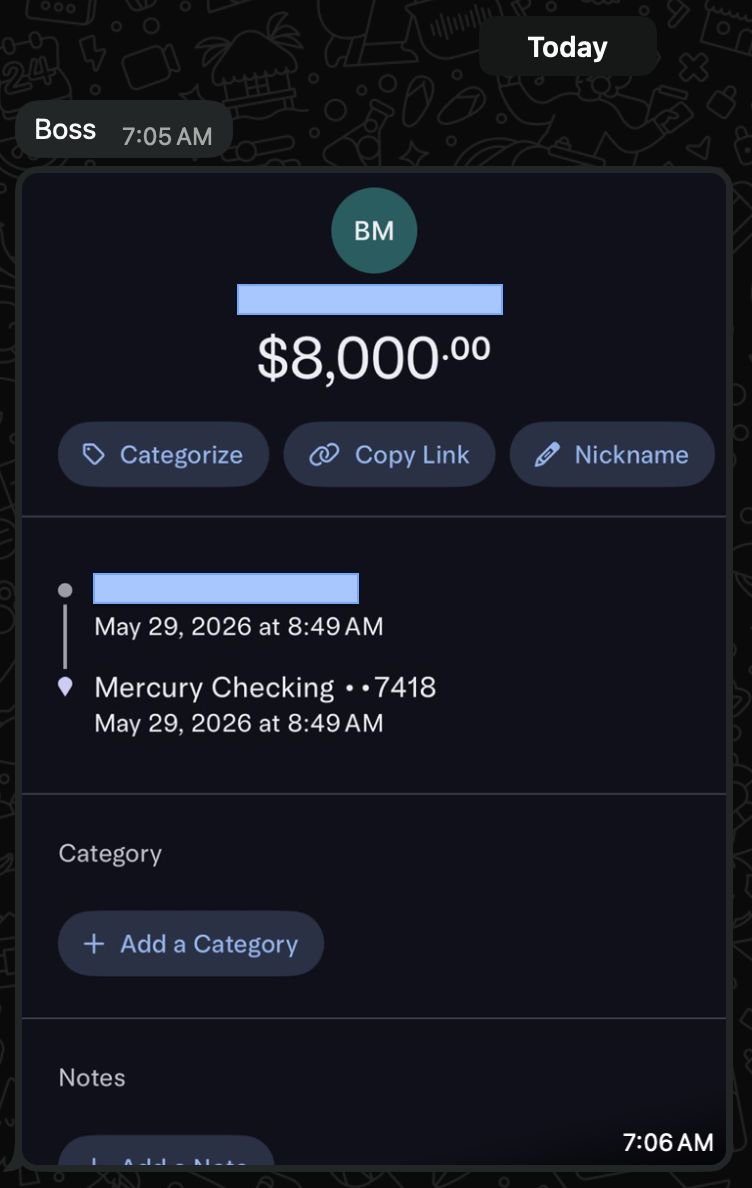
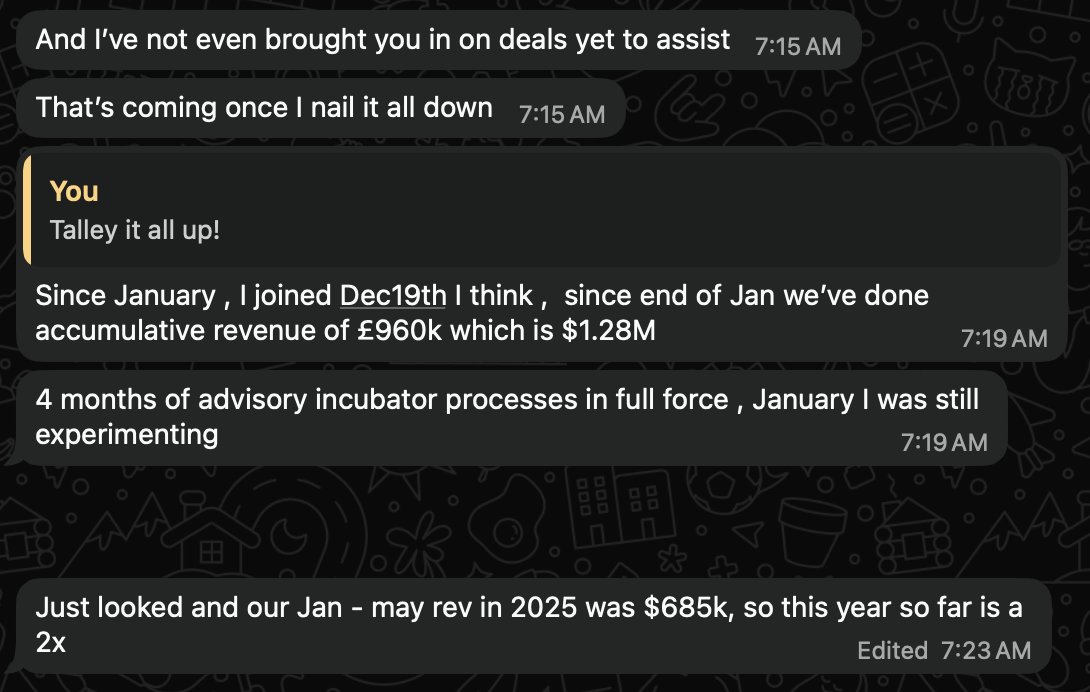
1. Reid has collected $1.28M since joining
2. Kaz & Dennis have done 6 figures
2.1. 2. Kaz & Dennis also added 20K MRR (retainers)
3. Arsia has done 5 figures 6 with his ecom agency
4. Mario just closed an 8k pilot with buldge bracket
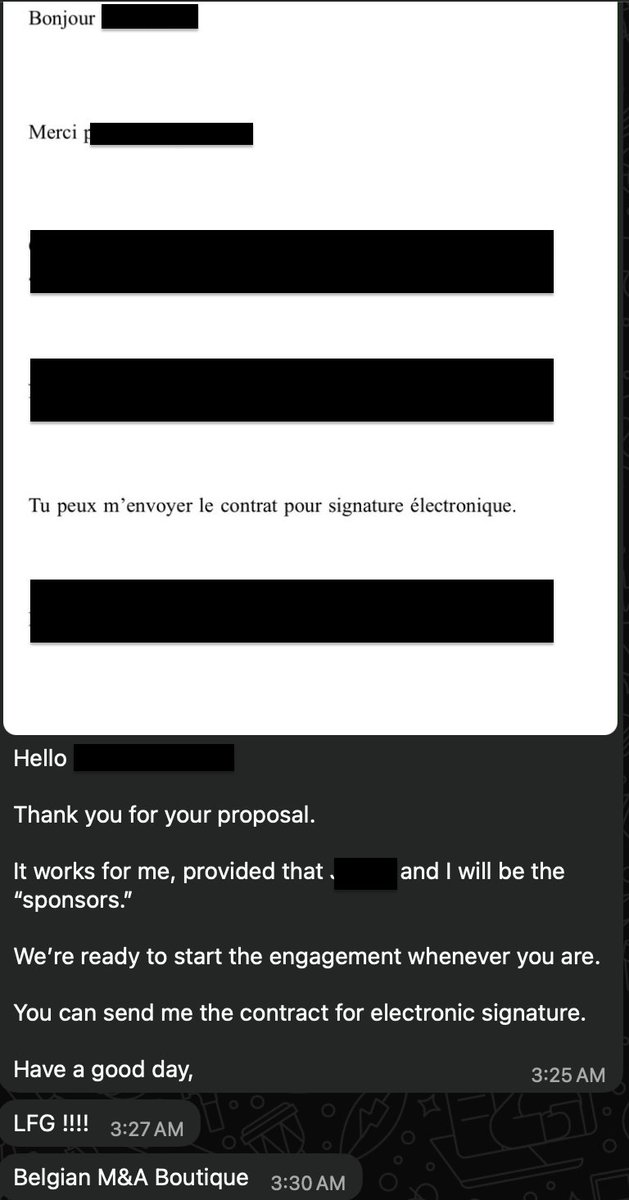
5. Gabriel just closed a 5K pilot for 1 meeting
They did this without all of the new value the program provides.
We don't want demand gen to be your only offer, you're going to build a unique offer with our Vendor model.
I operate companies that sell services, deliverables, SaaS, infra, DWY, DFY and DIY.
The A.I Incubator will include:
- Focused Slack Group
- Outlook Mailboxes
- Data is provided via group API's
- Slack access to me
- GTM Experts
- The #1 Sales Process
- Offer Creation, Sales & Outbound Mini-Courses
- New offers
- Build a SaaS and GTM
- Endless AI content
- Endless percs
1 subscription gets you mailboxes, data, sales support and access to offers etc..
Pricing is a monthly subscription THAT INCLUDES mailboxes data for outbound.
This way your subscription with us doesn't overlap with top of funnel costs.
Like Comment "Inc" and I'll send you all the info you need to join.
LET'S GET TO WORK.
40
1
37
4,809
Jun 12
If you sell B2B - I guarantee you will close more deals:
"GapSi is insane - how did you make this?"
Been getting non-stop compliments and people raving about how incredible the outputs have been with GapSi.
"Charge for this"
"This thing is cracked"
"100x better than any sales course"
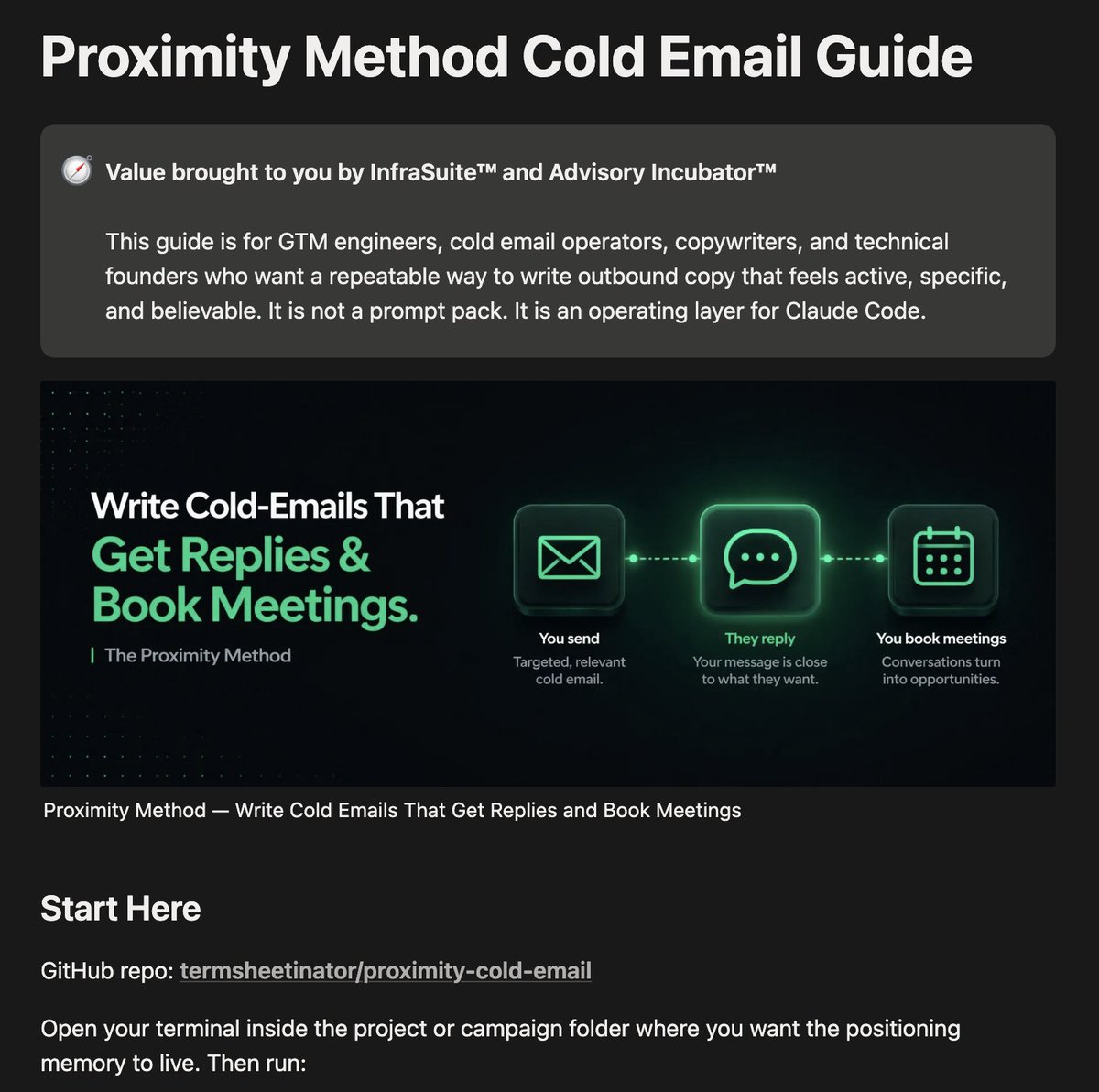
Good news is, it's free and open-sourced.
Feed GapSi a sales call transcript and see for yourself.
Results are guaranteed:
github.com/termsheetinator/g…
2
2
31
2,397
Jun 12
More mailboxes, more deals = More sales.
If you need mailboxes, inquire and we'll get you set up properly and walk you through everything.
infrasuite.io
1. Inquire on site
2. Speak with our team
3. Done-for-you setup
4. Slack support
1
3
499
Jun 11
LET'S FIX YOUR FOCUS AND LIFES MISSION RIGHT NOW.
THIS FORMULA WILL CHANGE YOUR LIFE.
BOOKMARK THIS:
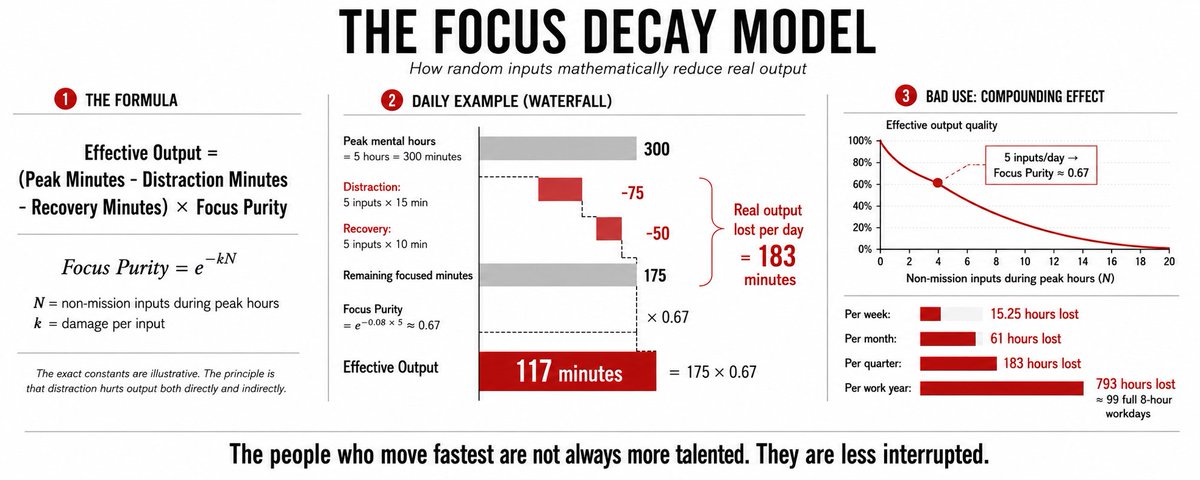
Effective Output = Peak Hours × Focus Purity
Most people are not lazy.
They are just mathematically destroyed by inputs.
Every day, you wake up with the same 24 hours as everybody else.
But that does not mean you have the same usable output.
Because your output is not determined by time.
Your output is determined by protected focus.
And focus has a decay rate.
Here’s the formula:
Effective Output = Peak Hours × Focus Purity
That’s the simple version.
The more honest version looks like this:
Effective Output = (Peak Minutes - Distraction Minutes - Recovery Minutes) × Focus Purity
And Focus Purity decreases every time you allow random information into your mind.
-Politics.
-Group chats.
-Drama.
-News.
-AI rabbit holes.
-Random tech trends.
-Family stress.
-Friend stress.
-Market panic.
-Some guy’s opinion on Twitter.
-Some new tool you don’t need.
-Some world event you cannot control.
-Some argument you were never supposed to enter.
Every single piece of non-mission information has a cost.
And the cost is almost never just the 5 minutes you spent consuming it.
That is the lie.
The real cost is:
Input Cost = Consumption Time Emotional Drag Recovery Time Directional Drift
You don’t just “check Twitter for 10 minutes.”
-You check Twitter for 10 minutes.
-Then your nervous system changes.
-Then your thoughts change.
-Then your priorities change.
-Then your mood changes.
-Then you need time to return to baseline.
Then your deep work window is no longer deep.
This is why a person can sit at a desk for 10 hours and ONLY get 90 minutes of real work done.
They were not working.
They were recovering from inputs.
This is the part most people never calculate.
Let’s say you have 5 peak mental hours per day.
That is 300 minutes.
This is your highest-quality thinking time.
For me, that window is early.
Wake up around 5:30.
Sleep around 10:30.
PEAK HOURS FOR ME: 6AM-1PM
-Boring.
-Repetitive.
-Focused.
Same thing every day.
-No drama.
-No novelty addiction.
-No fake urgency.
-No random dopamine buffet.
Now let’s compare two people.
Person A protects the 300 minutes.
Person B lets random inputs enter during those hours.
Not crazy amounts.
Just normal modern behavior.
5 random inputs per day.
Each input creates:
15 minutes of direct distraction.
10 minutes of mental recovery.
That’s 25 minutes per input.
5 inputs × 25 minutes = 125 minutes gone.
So their 300-minute peak window is now 175 minutes.
But it gets worse.
Because the remaining 175 minutes are not equal to the original 300.
-The mind is fragmented now.
-The work is weaker.
-The thinking is thinner.
-The attention is split.
So we need a focus purity multiplier.
Let’s call it:
Focus Purity = e^(-kN)
Where:
N = number of non-mission inputs
k = damage per input
Don’t get stuck on the exact number.
The point is the direction.
Every random input does not subtract from output linearly.
It damages the quality of everything that comes after it.
So let’s say k = 0.08.
If you allow 5 unrelated inputs into your peak hours:
Focus Purity = e^(-0.08 × 5)
Focus Purity = e^(-0.4)
Focus Purity ≈ 0.67
So now the math is:
Effective Output = 175 minutes × 0.67
Effective Output = 117 minutes
Read that again.
A person started with 300 peak minutes.
They only “lost” 125 minutes directly.
But because of attention fragmentation, their actual effective output became 117 minutes.
That means they lost 183 minutes of real output in one day.
183 minutes.
Over 3 hours of high-quality output gone.
-Not because they were stupid.
-Not because they lacked potential.
-Not because they had no talent.
Because they let the world walk through the front door of their mind during peak hours.
Now extrapolate it.
183 minutes lost per day.
Over 5 work days: 915 minutes lost.
That is 15.25 hours per week.
Over 4 weeks: 61 hours per month.
Over a quarter: 183 hours.
Over a year: 732 hours.
That is 91 full 8-hour workdays.
Gone.
And that is the conservative version.
If you calculate it across 365 days because your mind does not magically stop being affected on weekends:
183 minutes × 365 = 66,795 minutes.
That is 1,113 hours.
That is 139 full 8-hour workdays.
Gone.
This is why people wake up one year later and feel like nothing changed.
It did change.
They consumed a lifetime of information.
They just produced almost nothing with it.
We are living in an age where people age a decade every year mentally.
Not physically.
Mentally.
Because they are processing too much.
Every day there is a new crisis.
-A new war.
-A new tool.
-A new scandal.
-A new theory.
-A new person to hate.
-A new thing to be scared of.
-A new thing to be excited about.
-A new thing to research.
-A new thing to compare yourself to.
We are consuming months of information in minutes.
Profound news becomes old news the next day.
A massive event happens on Monday.
By Wednesday, people are bored.
By Friday, they need a new apocalypse.
That is not normal.
That is attention inflation.
The value of information is collapsing because supply is infinite.
But your focus is still scarce and still is the most valuable asset you have, besides time.
And anything scarce needs protection.
The modern game is not access to information.
Everybody has access to information.
The modern game is refusal.
The person who wins is not the person who knows the most.
It is the person who can ignore the most.
Because the mind needs a mission.
Without a mission, everything looks relevant.
-Politics feels relevant.
-Trends feel relevant.
-Drama feels relevant.
-News feels relevant.
-Other people’s opinions feel relevant.
-Every opportunity feels relevant.
-Every fear feels relevant.
But once you have a mission, relevance becomes obvious.
The question becomes very simple:
-Does this move the needle?
-Does this make me better?
-Does this make the company better?
-Does this make the product better?
-Does this make the offer better?
-Does this make the sales process better?
-Does this make the team better?
-Does this make the customer result better?
-Does this make my family’s future better?
If not, it is probably a waste of your attention.
And waste compounds too.
We always talk about compound interest.
-Money compounds.
-Skills compound.
-Relationships compound.
-Reputation compounds.
But distraction compounds too.
The formula works both ways.
Positive Compounding:
Output Today × Consistency × Time = Momentum
Negative Compounding:
Distraction Today × Frequency × Time = Decay
A 30-minute distraction does not stay a 30-minute distraction.
It changes the day.
A bad day changes the week.
A bad week changes the month.
A distracted month changes the quarter.
A distracted quarter changes the year.
A distracted year becomes your identity.
And then people say:
“I’m just not disciplined.”
No.
You are not undisciplined.
You are unprotected.
Your mind has no border.
-Everything gets in.
-Every opinion.
-Every headline.
-Every notification.
-Every trend.
-Every emotion.
-Every person’s urgency.
And then you wonder why your life feels heavy.
Of course it feels heavy.
You are carrying information that was never assigned to you.
This is why boundaries matter.
Not because you are trying to be cold.
Because you are trying to stay dangerous.
Dangerous in the productive sense.
-Clear.
-Sharp.
-Locked in.
-Hard to derail.
-Hard to confuse.
-Hard to emotionally hijack.
The people who do insane amounts of work are not always more talented.
They are usually better filtered.
They have fewer open loops.
-Fewer random inputs.
-Fewer fake obligations.
-Fewer emotional leaks.
-Fewer places where their mind can be accessed.
They are not “motivated.”
They are mathematically less interrupted.
That is the game.
Your output is not just what you do.
Your output is what remains after distraction takes its tax.
And distraction taxes everything.
-Energy.
-Mood.
-Confidence.
-Clarity.
-Speed.
-Memory.
-Creativity.
-Decision-making.
-Patience.
-Execution.
You think you are paying with time.
You are paying with self-trust.
Because every time you break your own focus, you teach yourself that your mission is negotiable.
That is the real damage.
The formula is not just:
Distraction = Lost Time
It is:
Distraction = Lost Time Lost Depth Lost Trust
When you say, “I’ll just check this for a second,” and then disappear for 40 minutes, your mind records that.
You become less believable to yourself.
And when you don’t believe yourself, discipline becomes harder.
Not because discipline is complicated.
Because you have a history of betraying your own stated priority.
This is why I believe in boring routines.
-Wake up.
-Work.
-Train.
-Eat.
-Build.
-Sleep.
-Repeat.
People mock boring until boring starts winning.
Boring is how you remove variables.
And when you remove variables, output becomes predictable.
If your day has 50 variables, your results will be random.
If your day has 5 variables, your results become controllable.
That is another formula:
Consistency = Fewer Variables × Higher Repetition
The more variables you allow, the less predictable your growth becomes.
The fewer variables you allow, the more force you can apply in one direction.
And force in one direction over time is how you create trajectory.
That is why year-over-year growth is not magic.
-It is not one genius move.
-It is not one viral moment.
-It is not one perfect strategy.
-It is 365 protected mornings.
A thousand boring decisions.
A thousand moments where you do not let the outside world enter your mission.
That is how momentum is built.
Most people want intensity.
The better formula is:
Growth = Direction × Intensity × Duration
-If direction is zero, intensity does nothing.
-If duration is zero, intensity does nothing.
-If focus is broken, direction keeps changing.
So the person who changes direction every week will lose to the person who stays locked in for a year.
Even if the second person is less talented.
Because talent without focus leaks.
And average ability with extreme focus compounds.
This is the uncomfortable truth:
Most people do not need more information.
They need fewer inputs.
They do not need another strategy.
They need to execute the one they already understand.
They do not need another tool.
They need to stop using tools as a hiding place.
They do not need more stimulation.
They need more silence.
Because silence is where the signal shows up.
When your mind is quiet, you know what matters.
When your mind is polluted, everything feels urgent.
This is why mission matters.
A mission is not some motivational sentence you put on a wall.
A mission is a filter.
It tells you what to ignore.
That is its real power.
A weak mission gives you no filters.
A strong mission gives you immediate no’s.
-No, I am not reading that.
-No, I am not arguing about that.
-No, I am not researching that.
-No, I am not checking that.
-No, I am not joining that conversation.
-No, I am not emotionally donating my morning to something I cannot control.
That is not ignorance.
That is precision.
You cannot build anything serious while being mentally available to everything.
Availability is expensive.
And most people are giving it away for free.
They are available to the news.
-Available to drama.
-Available to outrage.
-Available to comparison.
-Available to every notification.
-Available to every trend.
-Available to every random thought.
Then unavailable to their own future.
That is backwards.
Your best attention should go to your highest mission.
Everything else should fight for scraps.
I don’t care how smart you are.
If your best hours are open to random inputs, your life will reflect it.
The math always wins.
If you protect 300 peak minutes per day, and someone else protects 117, you are not slightly ahead.
You are operating at 2.5x their effective daily output.
300 / 117 = 2.56
That means one focused day for you is roughly two and a half distracted days for them.
Now run that over a year.
260 focused workdays.
Focused person:
300 minutes × 260 = 78,000 minutes
That is 1,300 hours.
Distracted person:
117 minutes × 260 = 30,420 minutes
That is 507 hours.
Difference:
793 hours.
That is 99 full 8-hour workdays.
Almost five extra months of work.
That is why some people seem like they are moving impossibly fast.
They are not bending time.
They are not superhuman.
They are just not donating five months a year to noise.
This is the part nobody wants to admit.
Your competition is probably not beating you because they are better.
They might just be less interrupted.
-Less emotionally available.
-Less distracted.
-Less addicted to novelty.
-Less interested in being informed about everything.
-Less willing to trade their future for stimulation.
That is the whole game.
Protect the morning.
Protect the mission.
Protect the inputs.
Protect the mind.
Because your life is downstream from your focus.
And your focus is downstream from what you allow in.
You do not need to win every hour.
But you need to stop losing the hours that matter most.
The peak hours decide the day.
The days decide the week.
The weeks decide the quarter.
The quarters decide the year.
The years decide the trajectory.
And trajectory is everything.
So the question is not:
“How many hours did I work?”
The question is:
“How many hours did I protect?”
Because protected hours compound.
Distracted hours disappear.
And most people are not behind because they lack time.
They are behind because their attention is being mathematically harvested by everything except their mission.
2
4
37
2,113
Jun 11
B2B DOMINATION, BOOKMARK THIS NOW:
Most B2B deals don't die because the offer was wrong or the price was too high.
They die because the case was never built:
1. The rep never anchored the prospect's goal = so there was no reference point
2. The current state was never quantified = so the pain stayed vague
3. The rep stated the gap instead of letting the prospect calculate it = so it was never owned
4. The cost of doing nothing was never made visible = so "let me think about it" felt safe
5. Price showed up before the gap was expensive = so the fee floated alone, with nothing to compare against
-
This open-sourced Claude Skill ensures you NEVER make any of these mistakes, ever again:
github.com/termsheetinator/g…
3
1
23
2,367
B2B MASTERCLASS ON CLOSING DEALS.
Reading and APPLYING this will literally change your life, I guarantee results.
TRIPLE BOOKMARK THIS:
-------------------
Loss Aversion is king, the best closers are lawyers - they build a case with evidence, create large gaps and then show price In a way that saves money instead of spending it to upside.
People do not buy because the future is better. They buy when staying the same is more expensive than changing.
It’s helping the prospect accurately feel the cost of the gap between:
Where they are now and Where they said they want to be
So you're $50K deal could either be looked at as a $50K price tag or the opportunity to dodge $90K in losses.
-------------------
1. The foundational study:
Prospect Theory
The anchor paper is Kahneman & Tversky’s 1979 Prospect Theory paper in Econometrica.
This is the root of loss aversion. The key idea is that people evaluate outcomes relative to a reference point, not in absolute terms, and the value function is steeper for losses than gains.
losing something usually hits harder than gaining the same thing feels good.
Sales-call translation:
Most reps sell the upside.
“Here’s how much better things could be.”
But the prospect is often emotionally anchored to avoiding downside.
Better discovery helps them see:
“What is the current path already costing you?”
Ask:
“Where are you trying to get this quarter?”
Then:
“What happens if nothing materially changes between now and then?”
Then:
“What does that cost you in pipeline, time, margin, team capacity, or opportunity?”
The key is that the prospect has to define the desired state first. Then you use their own stated goal as the reference point to begin creating a gap.
-------------------
2. Losses can shift risk appetite
Tversky & Kahneman’s 1981 Science paper on framing showed that people respond differently to equivalent outcomes depending on whether they are framed as gains or losses.
In the famous framing experiments, people became more risk-seeking when choices were framed around avoiding losses, even when the math was equivalent.
Sales-call translation:
A prospect who seems “risk averse” about buying is often not risk averse in general.
They are risk averse about the wrong risk.
They see buying as risky.
They do not yet see inaction as risky.
So the job is not to pressure them.
The job is to rebalance the risk frame.
Call tool: Risk reversal question
Ask:
“I get why changing vendors/processes/systems feels risky. What I’m trying to understand is, what’s the risk of keeping this exactly as-is for another 90 days?”
Then shut up.
You’re not creating risk.
You’re surfacing the risk already sitting inside the status quo.
-------------------
3. Status quo bias: people overvalue staying put
Samuelson & Zeckhauser’s work on status quo bias showed that people disproportionately prefer existing options, even when switching could be better. Their work connects strongly to loss aversion because change forces people to give up something familiar, and that “giving up” can feel like a loss.
Sales-call translation:
In B2B, the biggest competitor is usually not another vendor.
It’s the current way of doing things.
The prospect may hate the current situation, but it is familiar. Familiar pain often beats unfamiliar improvement.
Call tool: Status quo inventory
Ask:
“What are you currently doing to solve this?”
Then:
“What parts of that are working?”
Then:
“What parts are clearly not working anymore?”
Then:
“What have you already accepted as ‘normal’ that probably shouldn’t be normal?”
That last question is powerful because it makes the invisible cost visible.
-------------------
4. Endowment effect: people value what they already have
Kahneman, Knetsch, and Thaler’s 1990 Journal of Political Economy experiments showed the endowment effect: people often demand more to give up something they own than they would be willing to pay to acquire it. In the classic experiments, randomly assigned owners of mugs valued them more than non-owners did.
Sales-call translation:
Prospects are emotionally attached to their current stack, team habits, workflows, vendor relationships, and internal narratives.
Even when the current setup is underperforming, it still feels like “theirs.”
So attacking their current way of doing things usually creates resistance.
Better move:
Respect the current system first.
Then expose where it no longer matches the goal.
Call tool: Respect then contrast
Say:
“Candidly, it makes sense why you built it this way. It probably worked for the stage you were in.”
Then ask:
“Is the same system still strong enough for where you’re trying to go next?”
This lowers defensiveness.
You’re not calling their baby ugly.
You’re showing that the old system may not fit the new ambition.
-------------------
5. Goals become reference points
Heath, Larrick, and Wu’s 1999 paper “Goals as Reference Points” argues that goals inherit the properties of prospect theory: once a goal is set, falling short can feel like a loss, not just a missed gain.
This is one of the most useful studies for sales.
Because it means the prospect’s own goal can become the emotional anchor.
Not your pitch.
Not your ROI calculator.
Their stated goal.
Sales-call translation:
Do not start with pain.
Start with the goal.
Then make the gap concrete.
Call tool: Goal-gap ladder
Ask:
“Where are you trying to be by the end of the quarter?”
Then:
“Where are you right now?”
Then:
“What’s the gap?”
Then:
“What needs to change for that gap to close?”
Then:
“What happens if nothing changes?”
This is the cleanest way to create tension without being pushy.
The prospect builds the gap themselves.
-------------------
6. Stake size matters less than you think, but the effect size is debated
You do not need to tell every prospect they’re “leaving millions on the table.”
The sharper move is to make the loss specific, believable, and connected to something they already care about.
Bad:
“You’re leaving millions on the table.”
Better:
“You said the team needs 40 qualified meetings per month. Right now, you’re getting 14. So the real gap is 26 qualified meetings every month. What does that shortfall do to the sales target?”
That’s a different conversation.
Now the prospect is not reacting to hype.
They are looking at the gap.
Target: 40 meetings.
Reality: 14 meetings.
Gap: 26 meetings.
Now the cost of inaction becomes concrete.
This is where most reps lose the deal.
They try to make the problem bigger with adjectives.
“Massive”
“Expensive”
“Urgent”
“Critical”
But adjectives do not close sophisticated buyers.
Math does.
Specificity does.
The prospect’s own words do.
The smallest undeniable cost of inaction is usually more persuasive than the biggest exaggerated one.
-------------------
7. Framing matters, but not all frames work the same way
Framing is not one thing. (Not talking about B2C Bro Framing)
A prospect can look at the same decision through multiple frames:
1. Risk
2. Goal
3. Cost
4. Identity
5. Timing
This is why sales calls go flat when reps only have one frame.
They keep saying the same thing in different words.
“You’ll get more pipeline.”
“You’ll grow faster.”
“You’ll save time.”
“You’ll improve efficiency.”
The prospect already gets the upside.
They just do not feel enough contrast yet.
A stronger closer knows how to rotate the frame without sounding repetitive.
Risk frame:
“What’s riskier right now - changing the system, or keeping the current one for another 90 days?”
Goal frame:
“You said the target is X. Current pace gets you Y. So what has to change?”
Cost frame:
“What does the current process cost in missed revenue, wasted labor, delayed execution, or lost focus?”
Identity frame:
“Is this the kind of operating system that matches where the company is trying to go?”
Timing frame:
“Is this a now problem, or a later problem?”
Each frame pulls the prospect into a different angle of the same truth.
The goal is not to trap them.
The goal is to help them see the decision clearly.
Because most buyers are not comparing solution vs no solution.
They are comparing the discomfort of change against the invisible cost of staying the same.
Your job is to make the invisible cost visible.
-------------------
8. Loss-framed messaging is not always more persuasive
This part matters.
Loss aversion is powerful, but it is not a universal persuasion button.
Some research on message framing shows gain-framed messages can outperform loss-framed messages in certain contexts.
Meaning:
You cannot make the entire sales conversation negative.
If every part of the call is about pain, risk, cost, and loss, the buyer can start feeling cornered.
That creates resistance.
The best sales calls use both sides.
Gain creates desire.
Loss creates urgency.
The future pulls them forward.
The cost of inaction pushes them out of the current state.
The structure looks like this:
- Desired future
- Current reality
- Cost of staying there
- Path to close the gap
- Confidence in the next step
That is the order.
1. Start with what they want
2. Then clarify where they are
3. Then make the gap impossible to ignore
4. Then position the solution as the path to close it
5. Then make the next step feel obvious
Most reps either oversell the dream or overplay the pain.
Both are weak.
Only selling the dream makes the offer feel nice-to-have.
Only selling the pain makes the call feel manipulative.
The close happens in the gap between the two.
-------------------
9. Boundaries of loss aversion: not everything “given up” feels like a loss
Novemsky and Kahneman’s 2005 Journal of Marketing Research paper explored the boundaries of loss aversion.
One useful point:
Not every exchange feels like a loss.
Money spent in a normal purchase does not always trigger the same feeling of loss if the buyer sees the exchange as intended, justified, and economically rational.
This is huge for pricing.
Buyers do not only resist price because “money is a loss.”
They resist price when the value exchange is unclear.
A $50K price tag feels expensive when it is floating by itself.
A $50K price tag feels different when it is attached to preventing a $90K loss, fixing a revenue gap, replacing wasted labor, or accelerating a target the company already cares about.
Price resistance is not a pricing Issue.
It is a gap Issue.
The buyer does not yet believe the gap is expensive enough.
Or they do not believe the solution closes enough of the gap.
So instead of defending price, tie price back to the economics of the problem.
Use language like:
“My question now is whether this problem is expensive enough to solve now. Based on what you said, the gap is costing you X. If that’s accurate, then the budget only makes sense if we believe we can use it to close enough of that gap to justify it.”
That is clean.
No pressure.
No discounting.
No fake scarcity.
Just math.
The buyer should not feel like they are being pushed into spending money.
They should feel like they are deciding whether the current loss is worth avoiding.
That is the difference.
-------------------
The Loss Aversion Gap Framework
This is the full framework.
Use it on discovery calls, strategy calls, closing calls, proposal reviews, and objection handling.
-------------------
Step 1: Establish the reference point
Loss aversion needs a reference point.
Without a reference point, there is no gap.
Without a gap, there is no urgency.
Questions:
“What are you trying to get done this quarter?”
“What number are you responsible for?”
“What does a successful 90 days look like?”
The prospect has to tell you what matters.
Not because it gives you a fake reason to pitch.
Because their own goal becomes the anchor for the entire conversation.
-------------------
Step 2: Establish current reality
Once the goal is clear, you need the truth.
Not the polished version.
The real version.
Questions:
“Where are you today?”
“What are you currently doing to get there?”
“What’s the current pace?”
“What’s working?”
“What’s not working?”
Most prospects feel vague pain.
Vague pain does not close.
Concrete distance closes.
The job is to turn:
“We need better pipeline”
into:
“We need 40 qualified meetings per month, we’re getting 14, and the current system has not moved in 6 months.”
Now there is a real gap.
-------------------
Step 3: Calculate the gap
This is where the call gets serious.
Questions:
“So if the target is X and current reality is Y, the gap is Z, right?”
“What would need to change to close that?”
“What have you tried already?”
“Why hasn’t that closed the gap yet?”
This step matters because the gap stops being your opinion.
It becomes their math.
Their target.
Their reality.
Their words.
Their shortfall.
That is why it lands.
You are not convincing them of a problem.
You are helping them organize what they already admitted.
-------------------
Step 4: Make inaction visible
This is where most reps are too soft.
They identify the gap, then immediately pitch.
Wrong move.
Before you pitch, make the cost of the gap visible.
Questions:
“What happens if this stays the same for another quarter?”
“What does that affect downstream?”
“What does that cost the team?”
“What does that cost you personally?”
“What becomes harder if this waits?”
This reframes the decision.
The buyer stops comparing:
Buy vs don’t buy.
And starts comparing:
Change vs keep paying the cost of the current path.
That is the real close.
Because in B2B, the prospect is rarely choosing between spending and saving.
They are choosing between one cost and another.
The cost of action.
Or the cost of inaction.
-------------------
Step 5: Reframe change as loss prevention
Once the gap is clear, the offer should not be positioned as shiny upside.
It should be positioned as the path to protect the outcome they already care about.
Language:
“Based on what you told me, the real issue is not just getting more upside. It’s preventing this gap from compounding.”
Or:
“The current path seems expensive. Not because it’s broken everywhere, but because it doesn’t look strong enough for the target you’re trying to hit.”
A $50K offer is expensive when it is judged as a standalone cost.
It becomes rational when it is measured against the cost of the unresolved gap.
That is how strong closers sell.
They do not beg for belief.
They build a case.
They establish the desired outcome.
They expose current reality.
They calculate the gap.
They make inaction visible.
Then they position the solution as the cleanest path to stop the loss.
That is why the best closers are closer to lawyers than hype men.
They do not just “pitch.”
They build the case so well that the decision becomes obvious.
Not because the prospect was pressured.
Because the cost of staying the same finally became clear.
-------------------
I created a Claude Code skill that takes your call transcripts and coaches with building your Loss Aversion angles.
Like Comment "SALE" and I'll dm you the GitHub Repo.
(must be following to DM you)
46
5
92
9,205
Jun 10
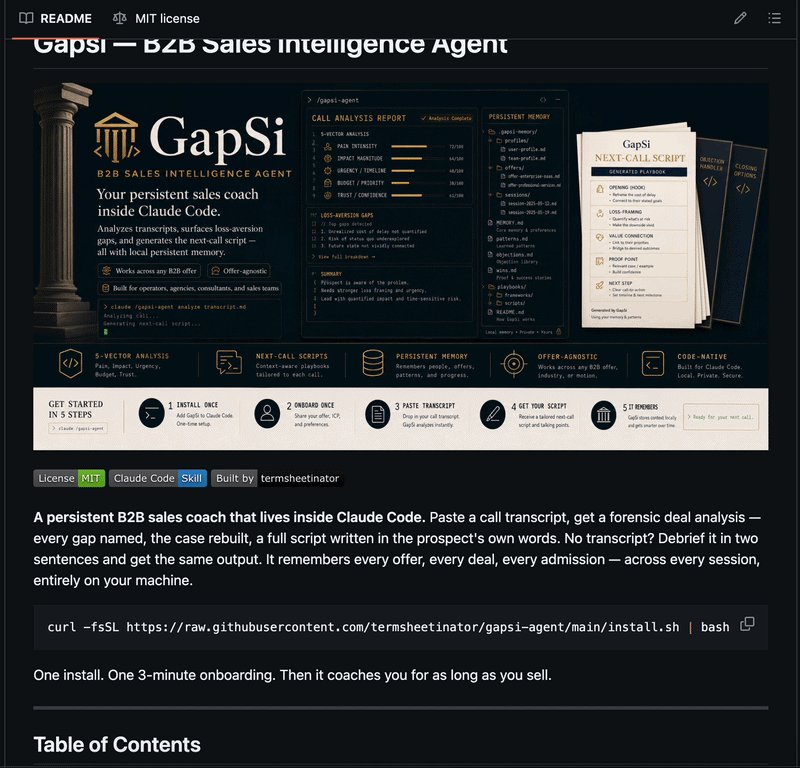
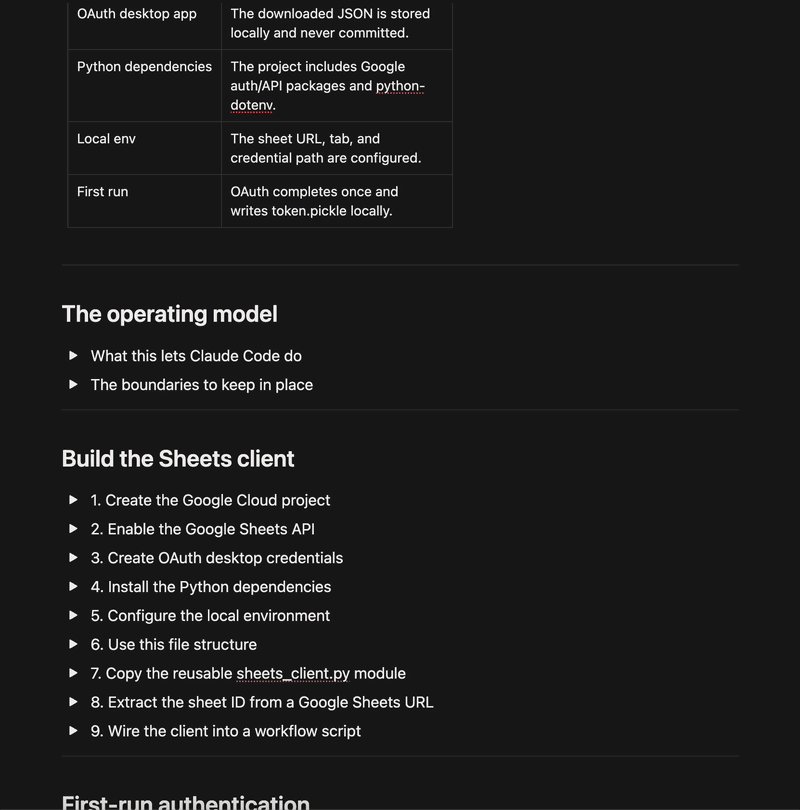
GapSi is a persistent B2B sales coach that lives inside Claude Code.
Paste a call transcript, get a forensic deal analysis - every gap named, the case rebuilt, a full script written in the prospect's own words.
No transcript? Debrief it in two sentences and get the same output. It remembers every offer, every deal, every admission - across every session, entirely on your machine.
Like Comment "GAP" and I'll dm you the link.
(must be following to DM)
25
1
27
903
Jun 11
92
When you get a $5,000 Sales Course for FREE and then APPLY it and get immediate RESULTS:

B2B MASTERCLASS ON CLOSING DEALS.
Reading and APPLYING this will literally change your life, I guarantee results.
TRIPLE BOOKMARK THIS:
-------------------
Loss Aversion is king, the best closers are lawyers - they build a case with evidence, create large gaps and then show price In a way that saves money instead of spending it to upside.
People do not buy because the future is better. They buy when staying the same is more expensive than changing.
It’s helping the prospect accurately feel the cost of the gap between:
Where they are now and Where they said they want to be
So you're $50K deal could either be looked at as a $50K price tag or the opportunity to dodge $90K in losses.
-------------------
1. The foundational study:
Prospect Theory
The anchor paper is Kahneman & Tversky’s 1979 Prospect Theory paper in Econometrica.
This is the root of loss aversion. The key idea is that people evaluate outcomes relative to a reference point, not in absolute terms, and the value function is steeper for losses than gains.
losing something usually hits harder than gaining the same thing feels good.
Sales-call translation:
Most reps sell the upside.
“Here’s how much better things could be.”
But the prospect is often emotionally anchored to avoiding downside.
Better discovery helps them see:
“What is the current path already costing you?”
Ask:
“Where are you trying to get this quarter?”
Then:
“What happens if nothing materially changes between now and then?”
Then:
“What does that cost you in pipeline, time, margin, team capacity, or opportunity?”
The key is that the prospect has to define the desired state first. Then you use their own stated goal as the reference point to begin creating a gap.
-------------------
2. Losses can shift risk appetite
Tversky & Kahneman’s 1981 Science paper on framing showed that people respond differently to equivalent outcomes depending on whether they are framed as gains or losses.
In the famous framing experiments, people became more risk-seeking when choices were framed around avoiding losses, even when the math was equivalent.
Sales-call translation:
A prospect who seems “risk averse” about buying is often not risk averse in general.
They are risk averse about the wrong risk.
They see buying as risky.
They do not yet see inaction as risky.
So the job is not to pressure them.
The job is to rebalance the risk frame.
Call tool: Risk reversal question
Ask:
“I get why changing vendors/processes/systems feels risky. What I’m trying to understand is, what’s the risk of keeping this exactly as-is for another 90 days?”
Then shut up.
You’re not creating risk.
You’re surfacing the risk already sitting inside the status quo.
-------------------
3. Status quo bias: people overvalue staying put
Samuelson & Zeckhauser’s work on status quo bias showed that people disproportionately prefer existing options, even when switching could be better. Their work connects strongly to loss aversion because change forces people to give up something familiar, and that “giving up” can feel like a loss.
Sales-call translation:
In B2B, the biggest competitor is usually not another vendor.
It’s the current way of doing things.
The prospect may hate the current situation, but it is familiar. Familiar pain often beats unfamiliar improvement.
Call tool: Status quo inventory
Ask:
“What are you currently doing to solve this?”
Then:
“What parts of that are working?”
Then:
“What parts are clearly not working anymore?”
Then:
“What have you already accepted as ‘normal’ that probably shouldn’t be normal?”
That last question is powerful because it makes the invisible cost visible.
-------------------
4. Endowment effect: people value what they already have
Kahneman, Knetsch, and Thaler’s 1990 Journal of Political Economy experiments showed the endowment effect: people often demand more to give up something they own than they would be willing to pay to acquire it. In the classic experiments, randomly assigned owners of mugs valued them more than non-owners did.
Sales-call translation:
Prospects are emotionally attached to their current stack, team habits, workflows, vendor relationships, and internal narratives.
Even when the current setup is underperforming, it still feels like “theirs.”
So attacking their current way of doing things usually creates resistance.
Better move:
Respect the current system first.
Then expose where it no longer matches the goal.
Call tool: Respect then contrast
Say:
“Candidly, it makes sense why you built it this way. It probably worked for the stage you were in.”
Then ask:
“Is the same system still strong enough for where you’re trying to go next?”
This lowers defensiveness.
You’re not calling their baby ugly.
You’re showing that the old system may not fit the new ambition.
-------------------
5. Goals become reference points
Heath, Larrick, and Wu’s 1999 paper “Goals as Reference Points” argues that goals inherit the properties of prospect theory: once a goal is set, falling short can feel like a loss, not just a missed gain.
This is one of the most useful studies for sales.
Because it means the prospect’s own goal can become the emotional anchor.
Not your pitch.
Not your ROI calculator.
Their stated goal.
Sales-call translation:
Do not start with pain.
Start with the goal.
Then make the gap concrete.
Call tool: Goal-gap ladder
Ask:
“Where are you trying to be by the end of the quarter?”
Then:
“Where are you right now?”
Then:
“What’s the gap?”
Then:
“What needs to change for that gap to close?”
Then:
“What happens if nothing changes?”
This is the cleanest way to create tension without being pushy.
The prospect builds the gap themselves.
-------------------
6. Stake size matters less than you think, but the effect size is debated
You do not need to tell every prospect they’re “leaving millions on the table.”
The sharper move is to make the loss specific, believable, and connected to something they already care about.
Bad:
“You’re leaving millions on the table.”
Better:
“You said the team needs 40 qualified meetings per month. Right now, you’re getting 14. So the real gap is 26 qualified meetings every month. What does that shortfall do to the sales target?”
That’s a different conversation.
Now the prospect is not reacting to hype.
They are looking at the gap.
Target: 40 meetings.
Reality: 14 meetings.
Gap: 26 meetings.
Now the cost of inaction becomes concrete.
This is where most reps lose the deal.
They try to make the problem bigger with adjectives.
“Massive”
“Expensive”
“Urgent”
“Critical”
But adjectives do not close sophisticated buyers.
Math does.
Specificity does.
The prospect’s own words do.
The smallest undeniable cost of inaction is usually more persuasive than the biggest exaggerated one.
-------------------
7. Framing matters, but not all frames work the same way
Framing is not one thing. (Not talking about B2C Bro Framing)
A prospect can look at the same decision through multiple frames:
1. Risk
2. Goal
3. Cost
4. Identity
5. Timing
This is why sales calls go flat when reps only have one frame.
They keep saying the same thing in different words.
“You’ll get more pipeline.”
“You’ll grow faster.”
“You’ll save time.”
“You’ll improve efficiency.”
The prospect already gets the upside.
They just do not feel enough contrast yet.
A stronger closer knows how to rotate the frame without sounding repetitive.
Risk frame:
“What’s riskier right now - changing the system, or keeping the current one for another 90 days?”
Goal frame:
“You said the target is X. Current pace gets you Y. So what has to change?”
Cost frame:
“What does the current process cost in missed revenue, wasted labor, delayed execution, or lost focus?”
Identity frame:
“Is this the kind of operating system that matches where the company is trying to go?”
Timing frame:
“Is this a now problem, or a later problem?”
Each frame pulls the prospect into a different angle of the same truth.
The goal is not to trap them.
The goal is to help them see the decision clearly.
Because most buyers are not comparing solution vs no solution.
They are comparing the discomfort of change against the invisible cost of staying the same.
Your job is to make the invisible cost visible.
-------------------
8. Loss-framed messaging is not always more persuasive
This part matters.
Loss aversion is powerful, but it is not a universal persuasion button.
Some research on message framing shows gain-framed messages can outperform loss-framed messages in certain contexts.
Meaning:
You cannot make the entire sales conversation negative.
If every part of the call is about pain, risk, cost, and loss, the buyer can start feeling cornered.
That creates resistance.
The best sales calls use both sides.
Gain creates desire.
Loss creates urgency.
The future pulls them forward.
The cost of inaction pushes them out of the current state.
The structure looks like this:
- Desired future
- Current reality
- Cost of staying there
- Path to close the gap
- Confidence in the next step
That is the order.
1. Start with what they want
2. Then clarify where they are
3. Then make the gap impossible to ignore
4. Then position the solution as the path to close it
5. Then make the next step feel obvious
Most reps either oversell the dream or overplay the pain.
Both are weak.
Only selling the dream makes the offer feel nice-to-have.
Only selling the pain makes the call feel manipulative.
The close happens in the gap between the two.
-------------------
9. Boundaries of loss aversion: not everything “given up” feels like a loss
Novemsky and Kahneman’s 2005 Journal of Marketing Research paper explored the boundaries of loss aversion.
One useful point:
Not every exchange feels like a loss.
Money spent in a normal purchase does not always trigger the same feeling of loss if the buyer sees the exchange as intended, justified, and economically rational.
This is huge for pricing.
Buyers do not only resist price because “money is a loss.”
They resist price when the value exchange is unclear.
A $50K price tag feels expensive when it is floating by itself.
A $50K price tag feels different when it is attached to preventing a $90K loss, fixing a revenue gap, replacing wasted labor, or accelerating a target the company already cares about.
Price resistance is not a pricing Issue.
It is a gap Issue.
The buyer does not yet believe the gap is expensive enough.
Or they do not believe the solution closes enough of the gap.
So instead of defending price, tie price back to the economics of the problem.
Use language like:
“My question now is whether this problem is expensive enough to solve now. Based on what you said, the gap is costing you X. If that’s accurate, then the budget only makes sense if we believe we can use it to close enough of that gap to justify it.”
That is clean.
No pressure.
No discounting.
No fake scarcity.
Just math.
The buyer should not feel like they are being pushed into spending money.
They should feel like they are deciding whether the current loss is worth avoiding.
That is the difference.
-------------------
The Loss Aversion Gap Framework
This is the full framework.
Use it on discovery calls, strategy calls, closing calls, proposal reviews, and objection handling.
-------------------
Step 1: Establish the reference point
Loss aversion needs a reference point.
Without a reference point, there is no gap.
Without a gap, there is no urgency.
Questions:
“What are you trying to get done this quarter?”
“What number are you responsible for?”
“What does a successful 90 days look like?”
The prospect has to tell you what matters.
Not because it gives you a fake reason to pitch.
Because their own goal becomes the anchor for the entire conversation.
-------------------
Step 2: Establish current reality
Once the goal is clear, you need the truth.
Not the polished version.
The real version.
Questions:
“Where are you today?”
“What are you currently doing to get there?”
“What’s the current pace?”
“What’s working?”
“What’s not working?”
Most prospects feel vague pain.
Vague pain does not close.
Concrete distance closes.
The job is to turn:
“We need better pipeline”
into:
“We need 40 qualified meetings per month, we’re getting 14, and the current system has not moved in 6 months.”
Now there is a real gap.
-------------------
Step 3: Calculate the gap
This is where the call gets serious.
Questions:
“So if the target is X and current reality is Y, the gap is Z, right?”
“What would need to change to close that?”
“What have you tried already?”
“Why hasn’t that closed the gap yet?”
This step matters because the gap stops being your opinion.
It becomes their math.
Their target.
Their reality.
Their words.
Their shortfall.
That is why it lands.
You are not convincing them of a problem.
You are helping them organize what they already admitted.
-------------------
Step 4: Make inaction visible
This is where most reps are too soft.
They identify the gap, then immediately pitch.
Wrong move.
Before you pitch, make the cost of the gap visible.
Questions:
“What happens if this stays the same for another quarter?”
“What does that affect downstream?”
“What does that cost the team?”
“What does that cost you personally?”
“What becomes harder if this waits?”
This reframes the decision.
The buyer stops comparing:
Buy vs don’t buy.
And starts comparing:
Change vs keep paying the cost of the current path.
That is the real close.
Because in B2B, the prospect is rarely choosing between spending and saving.
They are choosing between one cost and another.
The cost of action.
Or the cost of inaction.
-------------------
Step 5: Reframe change as loss prevention
Once the gap is clear, the offer should not be positioned as shiny upside.
It should be positioned as the path to protect the outcome they already care about.
Language:
“Based on what you told me, the real issue is not just getting more upside. It’s preventing this gap from compounding.”
Or:
“The current path seems expensive. Not because it’s broken everywhere, but because it doesn’t look strong enough for the target you’re trying to hit.”
A $50K offer is expensive when it is judged as a standalone cost.
It becomes rational when it is measured against the cost of the unresolved gap.
That is how strong closers sell.
They do not beg for belief.
They build a case.
They establish the desired outcome.
They expose current reality.
They calculate the gap.
They make inaction visible.
Then they position the solution as the cleanest path to stop the loss.
That is why the best closers are closer to lawyers than hype men.
They do not just “pitch.”
They build the case so well that the decision becomes obvious.
Not because the prospect was pressured.
Because the cost of staying the same finally became clear.
-------------------
I created a Claude Code skill that takes your call transcripts and coaches with building your Loss Aversion angles.
Like Comment "SALE" and I'll dm you the GitHub Repo.
(must be following to DM you)
1
14
2,594
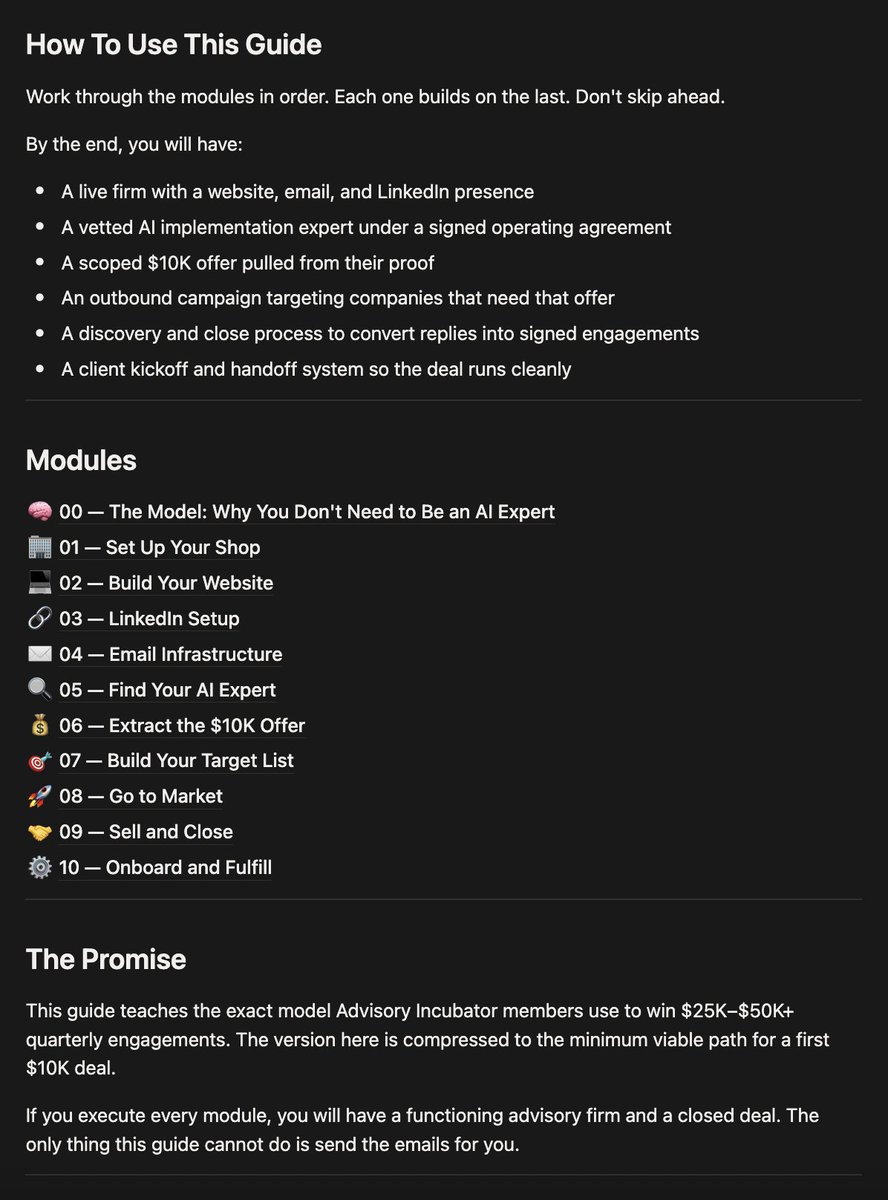
There's $5K, $10K and $50K deals hiding in every B2B company.
The bottleneck is implementation. And you don't need to be an AI expert to close them or deliver them.
OpenAI built a $10B company, raised $4B, partnered with Goldman Sachs, McKinsey, SoftBank, and 16 others - just to send engineers into enterprises to install AI.
This free 10-module guide teaches the zero-to-one path:
1. No more "I need to learn AI before I can sell AI"
2. No more competing on price with engineers and agencies
3. No more fulfilling what you sold yourself
4. No more building offers with no proof behind them
5. No more watching the AI implementation wave pass you by
Just: source the expert → extract their proof → sell the outcome → they fulfill it → you keep the margin.
We've used this timeless model since 2019 - new narratives, same model.
Here's what the 10 modules cover:
→ The Model (why the orchestrator earns more than the implementer)
→ Set Up Your Shop (firm, entity, domain, email, EA persona)
→ Build Your Website (Claude Code, GitHub, Vercel - one afternoon)
→ LinkedIn Setup (personal company page built for authority)
→ Email Infrastructure (InfraSuite mailboxes, warming, sending)
→ Find Your AI Expert (LinkedIn sourcing, qualifying call, SOA)
→ Extract the $10K Offer (turn vendor proof into a scoped engagement)
→ Build Your Target List (ICP, signals, Offer Writing, Enrichment API, verification)
→ Go to Market (cold email sequences LinkedIn outbound)
→ Sell and Close (discovery call, scope summary, engagement letter)
→ Onboard and Fulfill (client kickoff, vendor handoff, second payment)
Zero-to-closed. Vendor-fulfilled. No technical skills required.
The AI implementation gap is real and it's growing.
The only question is whether you're positioned to capture it.
Want all 10 modules free?
Like comment "10K" and I'll DM it to you.
(must be following)
38
5
37
1,244
The life you want is on the other side of the root
People never get there because they keep attacking the symptom and then wonder why their life keeps repeating the same patterns
You can change the offer, change the script, change the niche, change the business model, change the environment, change the friend group, change the city, change the routine, change the wardrobe, change the content strategy, and still be the same scared person using new tools to avoid the same internal war
A guy with a csuite title gets on a call and you immediately subordinate because deep down you still think this other human has the power to approve your existence
the guy thinks he needs better objection handling but what he really needs is to stop worshipping humans
read the bible and you realize humans have always been exactly like this, which is why it helped me more with fear than almost anything else because it shows people raw, greedy, scared, proud, jealous, disobedient, status obsessed, idol making, control grabbing, getting blessed then forgetting 5 mins later, begging for a king because they can’t handle God directly, folding the second the desert gets uncomfortable - same creature now
the banker is not above you, the investor is not above you, the client is not above you, the celebrity is not above you, Elon and Bezos and Zuck are still appetite machines with a nervous system and a death date
respect the room, respect the work, respect the money, but never make the person an idol because the second you do that you start selling like a beggar - Jesus never moved like a beggar
he could feed people without needing them, heal people without being owned by applause and confront elites without asking permission
that’s the level of detachment people pretend they want until they realize it means letting the scared version of themselves die and that’s why hard topics are king
you can’t fake your way through hard topics, your brain starts looking for a door - it wants phone, input, summary, shortcut, mentor, AI, anything except staying with the friction long enough to become the type of person who can read the room without needing a babysitter
the answer doesn’t surface until the question has humbled you first - most people collect answers before they’ve earned the question, which is why their knowledge is just regurgitation - boredom does the same surgery - stare at the wall for 30 mins and see how fast you find out who owns your mind
biology backs this in its own boring way - when people are stuck in threat states their field of action narrows, then when they’re in positive expansive states the mind sees more options, Fredrickson called it broaden and build but the street version is simple, fear is a blindfold and abundance helps you finally take it off
that’s why detachment creates better business - not fake detachment where you pretend you don’t care, real detachment where you can want the deal fully and still not let the deal become God - you're good with or without
that is when life starts opening because your behaviour stops smelling like survival - if one prospect saying no can ruin your confidence, you don’t have confidence - you have dependency
if one prospect ignoring you makes you feel small, you’re still worshipping man, and the bible already told you where that road ends
this is where fk u money starts before the money - not the fake version where you buy things so strangers know you won, the real version where you stop needing outcomes to prove God didn’t forget you
the money comes faster after because you stop making fear based decisions, you stop forcing bad deals, stop chasing dead deals, stop hoarding scarcity, stop spending for approval, stop turning every delay into a prophecy against your life
you make a covenant with God - you need to admit you’ve been trying to do his job like an idiot - trying to control every door, person, deal, timing issue, client, delay, rejection, outcome, all from a nervous system spike, while saying you have faith - become a vessel
if you’re first gen millionaire or want to become the first millionaire in your bloodline this is even deeper because you’re not just building a company, you’re changing the fear pattern in your bloodline, you have to realize how much of the old ceiling lives inside your body as reflex
don’t risk, don’t offend, don’t speak too directly, don’t reach too high, don’t lose, don’t trust, don’t let go, don’t be seen, don’t make people uncomfortable
you have to burn through all of that while learning business at the same time, which is why it feels violent
you are building the machine and rebuilding the operator in the same season - the upward spiral starts
you detach, so your moves get cleaner, cleaner moves create better proof, better proof deepens abundance, abundance makes you fear less, then better rooms, better clients, better deals, better timing start showing up and scared people call it luck because they don’t understand state
everything you want is on the other side of true detachment of fear - you must be good with or without.
This is a forever battle, the best way to constantly win is to not fear facing fear.
1
22
954
How do I book more meeting via outreach?
A/B test selling the meeting vs the engagement.
How?
Here's one way to do it:
1. Turn your offer into a free DIY product
2. Lead with the outcome of someone joining a meeting
3. Book them in and walk them through it
4. They'll see how much work it is
5. You naturally shift the environment to DFY
6. Send a scope draft
7. Book a review call for ~2-3 days out
8. Now they're in your sales process
Simplicity always wins.
Funding example:
-------------------
Selling DFY:
{{firstName}},
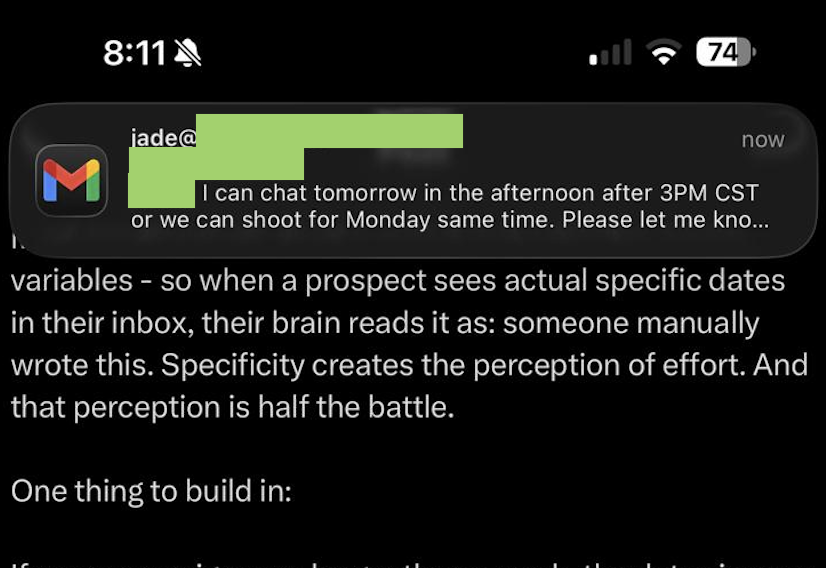
We can approve you for a 300K LOC in less than two days - especially if you haven't filed a BK in the last 7 years.
Interest is sub 8 percent with zero fees - these specialty lenders usually disappear during the summer so speed is important.
Are you available on Monday between 8am-1pm ET?
Regards,
{{accountSignature}}
[Entity]
-------------------
Selling DIY:
{{firstName}},
We have a Lender Fit Map you can fill out in under 4 minutes - it'll show you which lenders are most likely to fit {{company_name}} for a 300K LOC.
It gives you the basic qualification points and email contacts so you can reach out directly yourself.
A few sub-8 percent, zero-fee options, but they're usually OOO during the summer so speed is important.
I can walk you through it.
Are you available on Monday between 8am-1pm ET?
Regards,
{{accountSignature}}
[Entity]
-------------------
Send more, test more, sell more.
3
17
1,760
More mailboxes, more deals.
If you need mailboxes, inquire and we'll get you set up properly and walk you through everything.
infrasuite.io
1. Inquire on site
2. Speak with our team
3. Done-for-you setup
4. Slack support
1
2
893
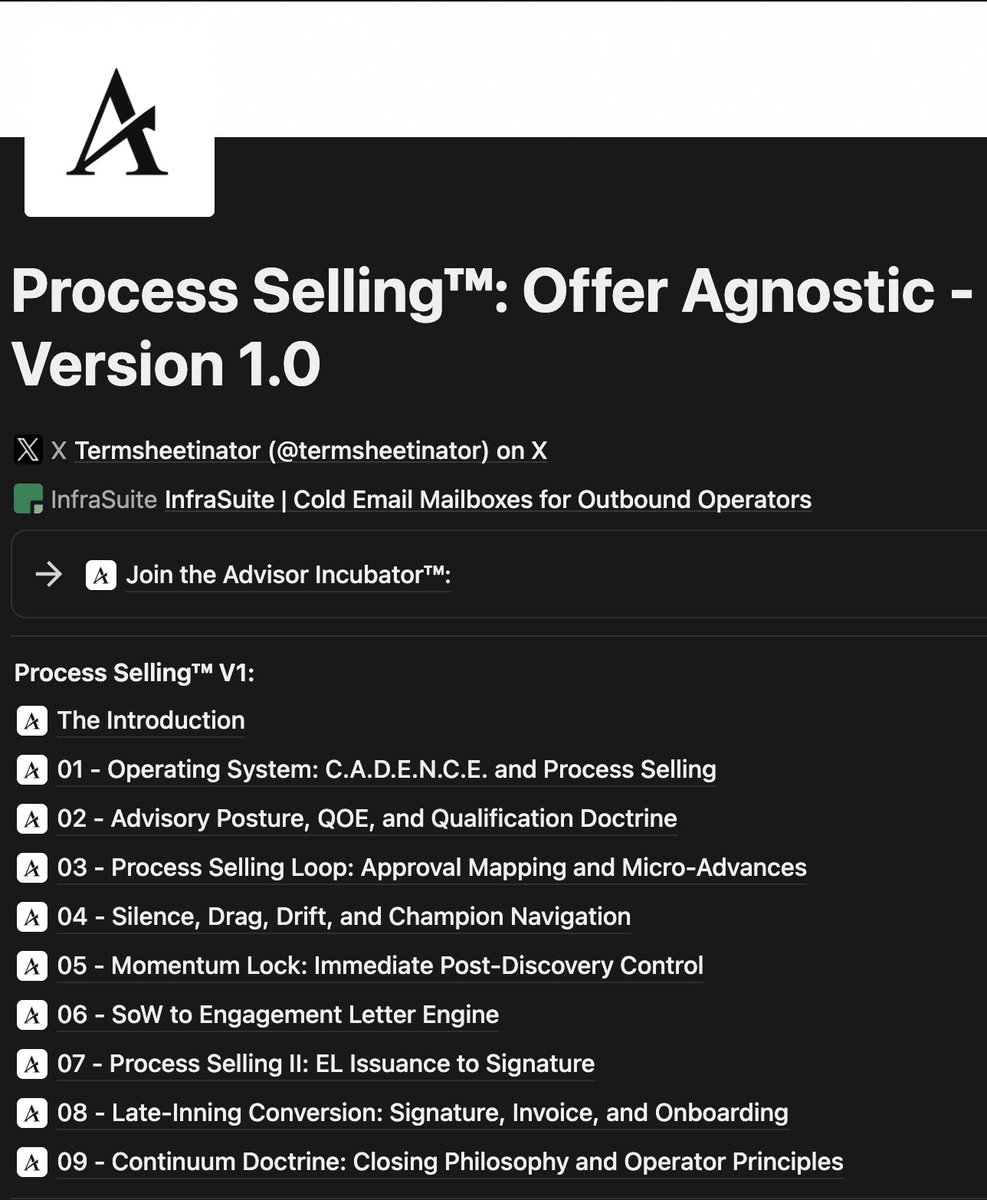
IF YOU SELL B2B, PULL UP A CHAIR AND LISTEN:
I’ve been clinically obsessed with sales for nearly a decade.
I’ve sold B2B, B2C, and B2B2C.
We run half a dozen offers through this exact framework, from low-ticket SaaS, to mid-ticket deliverables, to high-ticket services.
I’ve made a career out of selling, and I packaged the real field-tested version into a mini course that is better than 99% of the programs out there.
-No theory.
-No high-level nonsense.
-No fake guru fluff.
Just real trench work you can apply on day 1 to get better outcomes right away.
Like and comment “SELL” and I’ll send you a $999 product for free.
Must be following so I can DM it to you.
52
2
45
1,304
15 B2B sales rules that only make sense after you’ve done a lot of deals:
1. Most objections are internal projections.
The buyer says “do you have references?”
But the real issue is usually:
- lack of confidence in their processes
- fear of owning conversions
- fear of a new channel
- fear the result will not happen
Diagnose the projections.
2. If the buyer is correcting the invoice, they are buying.
Wrong address.
Wrong legal entity.
Wrong billing contact.
Wrong payment timing.
That is not friction.
That is operational movement.
Dead buyers do not correct invoices.
3. Send the invoice before it feels comfortable.
If the buyer has reviewed scope, discussed timing, asked about payment, or scheduled onboarding, include the invoice.
You are removing friction from the path they already said they want to take.
4. Never let “I’ll review and get back to you” sit ungoverned.
Ask:
“Who specifically is reviewing it?”
“What section are they reviewing?”
“What feedback do we need from them?”
“When should we expect it?”
A vague review cycle is where deals go to die.
5. Stop emailing the whole thread.
If one person needs to act, email that person directly.
Sales dies when responsibility is diffused.
6. References are not free proof coupons.
Do not hand out references early.
I would even argue that you don't need references, especially for a measly 5-25K deal or even a 5-10K/mo retainer.
And if you send one, a reference letter should be a final validation step before sign-off.
Say:
“Happy to provide one once we’re at the engagement letter and that is the final item needed before approval.”
If they want endless proof, they are not closing.
7. Do not overload the engagement letter.
The engagement letter should govern the commercial relationship.
It should not carry:
- your whole pitch
- your whole mechanism
- every case study
- every trust objection
- every educational detail
Put that in a diligence package or scope.
Keep the close document clean.
8. If email feedback stalls, move it live.
Do not keep “following up” for written feedback.
Say:
“It may be easier to work through this live.
We have 2pm or 4pm tomorrow.
Which works best?”
The point of the call is not conversation.
It is to restart control.
9. The closer the buyer gets, the less you should resell.
Late-stage buyers do not need more persuasion.
They need:
- exact next step
- exact owner
- exact document
- exact deadline
- exact payment path
More selling can create new doubt.
10. Buyer pace is a signal.
If they want to move fast, move faster.
Do not hide behind “professional process” when the buyer is trying to buy.
Posture over panic.
Not posture over pace.
11. A push-to-close is not needy when the process is real.
Needy is asking “any update?”
Controlled is saying:
“We are at the point where the remaining items are engagement letter, invoice, and launch date.
Our target is to have those settled by Friday.”
That is leadership.
You would be surprised how many more deals you can close when you just show them the path to buying.
12. Objections get louder when the buyer imagines ownership.
-Fee questions.
-Term questions.
-Timeline questions.
-Reference questions.
-Legal questions.
These are not always bad.
Often, they mean the buyer is mentally placing themselves inside the engagement.
Treat them as buying signals until proven otherwise.
13. Do not ask for information if you can move with what you have.
If you can create the invoice with available info, create it.
Then say:
“If any details need to be corrected, let us know and we will update it.”
Asking for admin details too early can make you the bottleneck.
14. Run the onboarding call even if paperwork is catching up.
Do not do real fulfillment before signature/payment.
But you can still run pre-onboarding:
- access list
- launch plan
- timeline
- stakeholder map
- kickoff requirements
The deeper they move into readiness, the harder it is to drift.
15. Lose trying to win.
The worst way to lose a deal is passive ambiguity.
-No clear deadline.
-No clean close package.
-No invoice.
-No direct ask.
-No pressure on the actual next step.
If the deal is at the finish line, make the finish line obvious.
Make them cross it or tell you they are not crossing it.
3
2
22
1,609
More mailboxes, more deals.
If you need mailboxes, inquire and we'll get you set up properly and walk you through everything.
infrasuite.io
1. Inquire on site
2. Speak with our team
3. Done-for-you setup
4. Slack support
1
567