
testing521.com Jesus follower, husband to @e_baumgaertel, father, engineer, hunter. Thomistic, Dispensational, Evangelical. Student at @sesapologetics
Joined November 2014
- Tweets 42,947
- Following 977
- Followers 2,809
- Likes 85,180
3,320 Photos and videos










That community note is trash.
But if Christians thought this was “normal” the narrative would lose all significance, wouldn’t it?


10
20
3,938
Dave the Dispy Hipster retweeted

Jun 9
Theology 101: Doctrinal or practical error isn't sanctified by being filtered through 1000 years of ecclesiastical tradition.
1
6
46
1,765
Believing the gospel does obligate you to live a life of faithful discipleship. That's what you're signing up for by dying with Christ. But faithful discipleship is not a condition for, or a cause of, salvation.
2
14
727
I'm not sure why it's so hard for people to distinguish between eternal life, and other, also very serious consequences.
2
4
152
It’s wild to me that so many authors continue asserting that knowledge is justified true belief. Some even acknowledge the Gettier problems, and then continue as if they don’t exist.
1
1
1
619
The Chinese Room, Gettier’s counter examples, and the self-referential incoherence of the Vienna Circle are about as open-and-shut certain as arguments can be in the history of philosophy. And yet here we are.
1
3
349
Guy who just learned the porphyrian tree: "I'm gonna kill at 20 questions."
1
207
There's a fine line between that one friend who deliberately equivocates for a cheap joke, and pretentious movie lines.


4
315
This is probably the stupidest objection to Dispensationalism because it’s so ignorant. Ignorant of what Dispensationalism claims.


6
1
27
941
It’s actually ontologically sacred, and treating the sacred as common is depraved. Hope that helps.

It's funny how traditional Christians think there's an ontologically depraved act that becomes blessed/sanctified if you do it after a magic ritual lol
2
64
2,327
My God, my God, why have You forsaken me?

16
1,167
Dave the Dispy Hipster retweeted
May 20
Theology 101:
Them: “The doctrine of the Trinity isn’t clearly expressed in Scripture, so it isn’t essential to the Christian faith.”
Me: “Is the unity of God clearly in Scripture?”
Them: “Yes.”
Me: “Is it essential?”
Them: “Yes.”
Me: “Is the deity of the Father clearly in Scripture?”
Them: “Yes.”
Me: “Is it essential?”
Them: “Yes.”
Me: “Is the deity of the Son clearly in Scripture.”
Them: “Yes.”
Me: “Is it essential?”
Them: “Yes.”
Me: “Is the deity of the Spirit clearly in Scripture?”
Them: “Yes.”
Me: “Is it essential?”
Them: “Yes.”
Me: “Is the fact that Father, Son, and Spirit are not the same person but are distinct clearly in Scripture?”
Them: “Yes.”
Me: “Is it essential?”
Them: “Yes.”
Me: “The doctrine of the Trinity is clearly expressed in Scripture, and it is essential to the Christian faith.”
6
20
87
3,570

I wonder how people felt at 11:59 p.m. of dec. 1999 before crossing over to the year 2000.
1
4
417
Not only does it belong in the bible, it belongs in John between 7:52 and 8:12.
May 16

Does the “pericope adulterae” passage belong in the Bible?
(John 7:53-8:11, regarding the woman caught in adultery and “let he who is without sin cast the first stone”)
1
2
16
1,216
"'How much more shall the blood of Christ who through the eternal Spirit offered himself without spot to God, purge your consciences from dead works to serve the living God?'
The service of the living God is a consequence, note, of a purged conscience." JND
1
11
269
Works are the fruit of salvation, not the root. Likewise, works are the fruit of assurance, not the root.
2
1
17
254
Dave the Dispy Hipster retweeted
May 14
Theology 101: “Death is not the Bridegroom, and, though its sting be taken away, cannot be the object of our affections, though we may joy in that which is beyond it; nor is it the time of the accomplishment of our hopes, nor of Christ’s and the church’s glory.” (Darby)
1
11
31
1,396
Dave the Dispy Hipster retweeted

Really looking forward to being a part of this! Info in the comments.

1
1
3
242
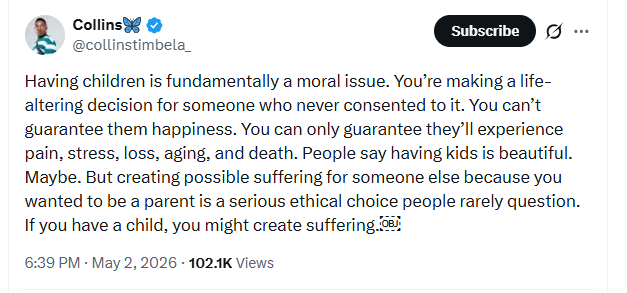
This is a great example of making the category mistake of comparing non-existence to existence.
Also, it kinda reifies suffering.
1
9
548