
Joined August 2024
- Tweets 2,542
- Following 199
- Followers 284
- Likes 82
661 Photos and videos
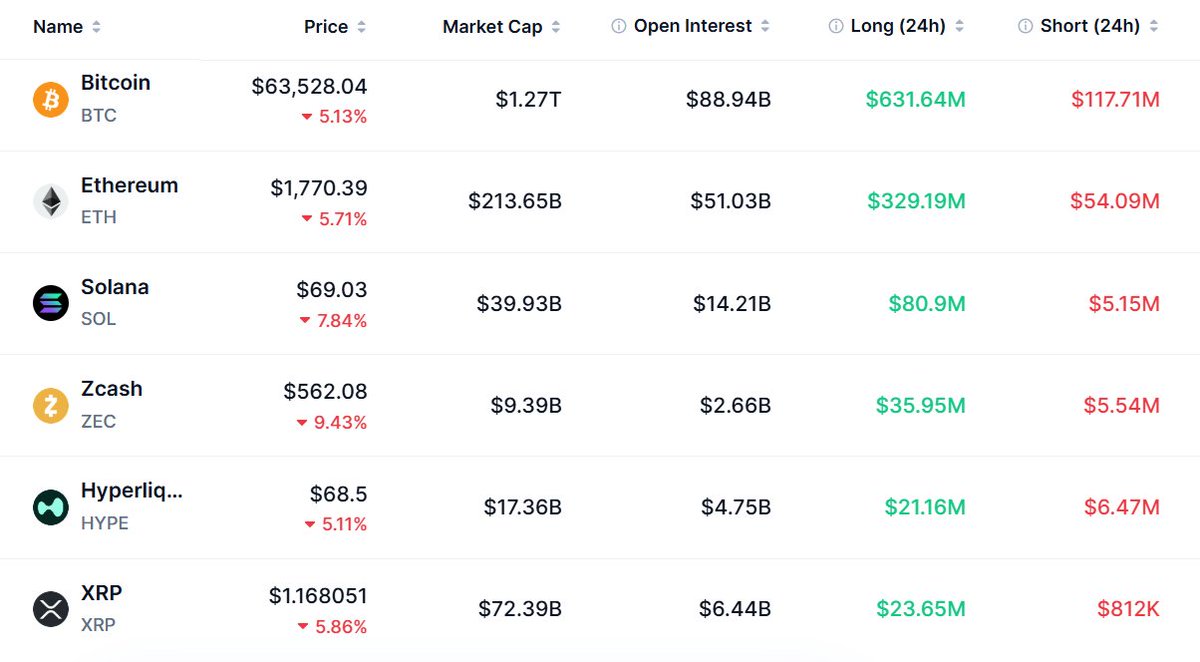
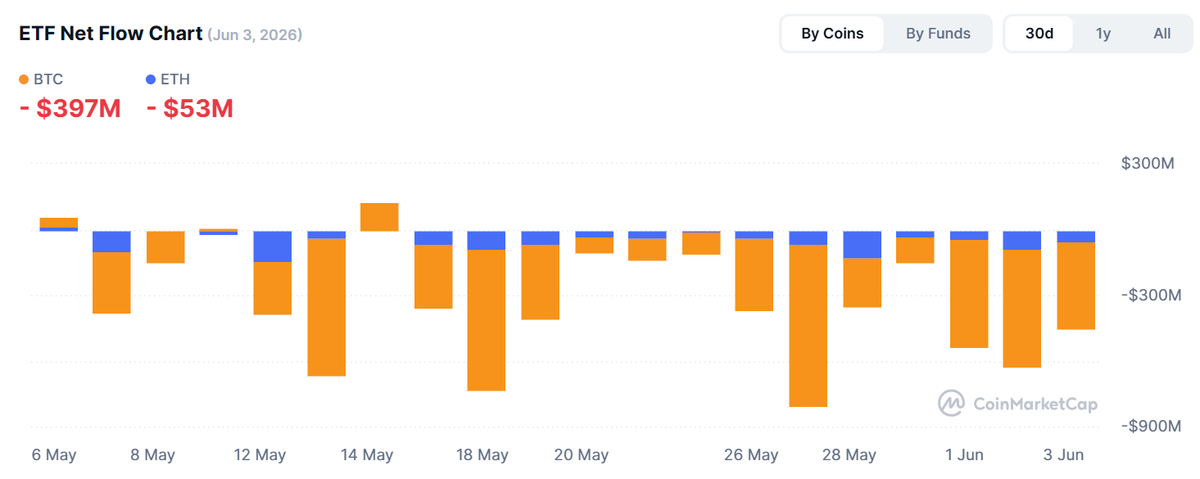




$1.66B liquidated in the last 24 hours
Longs took the real hit at $1.41B vs $243M in shorts.
That gap tells you something. Most of the market was positioned for continuation, not a pullback. When the move went the other way, there was no cushion.
Token-wise breakdown:
$BTC: $749.36M (down 5.13%)
$ETH: $383.28M (down 5.71%)
$SOL: $86.05M (down 7.84%)
$ZEC: $41.49M (down 9.43%)
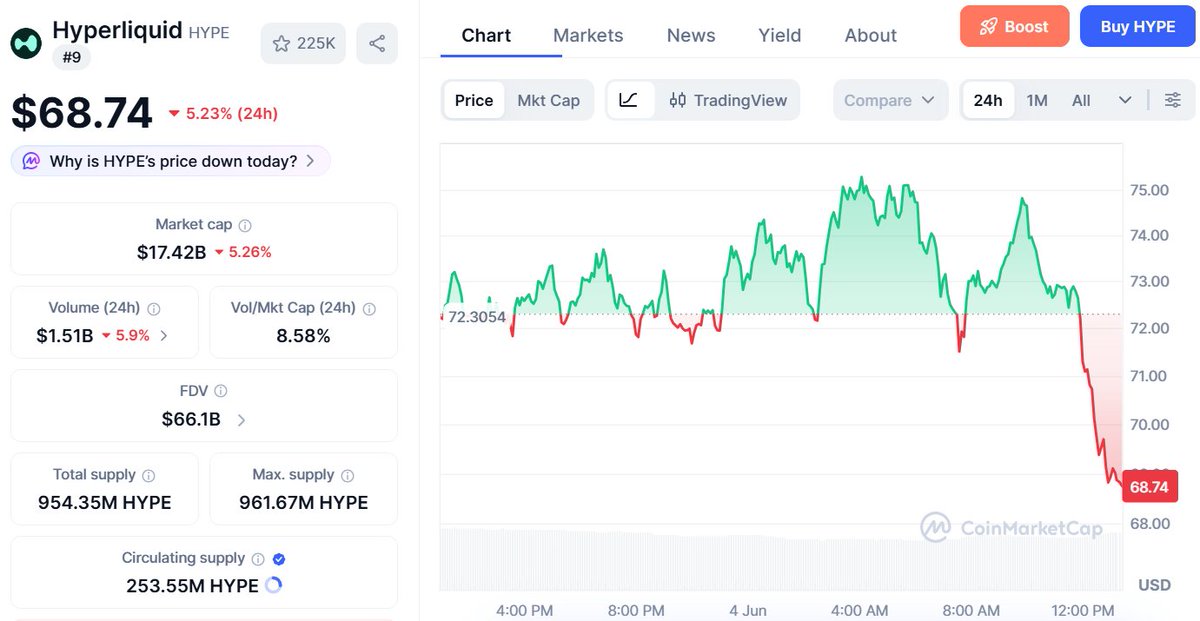
$HYPE: $27.64M (down 5.11%)
$XRP: $24.46M (down 5.86%)
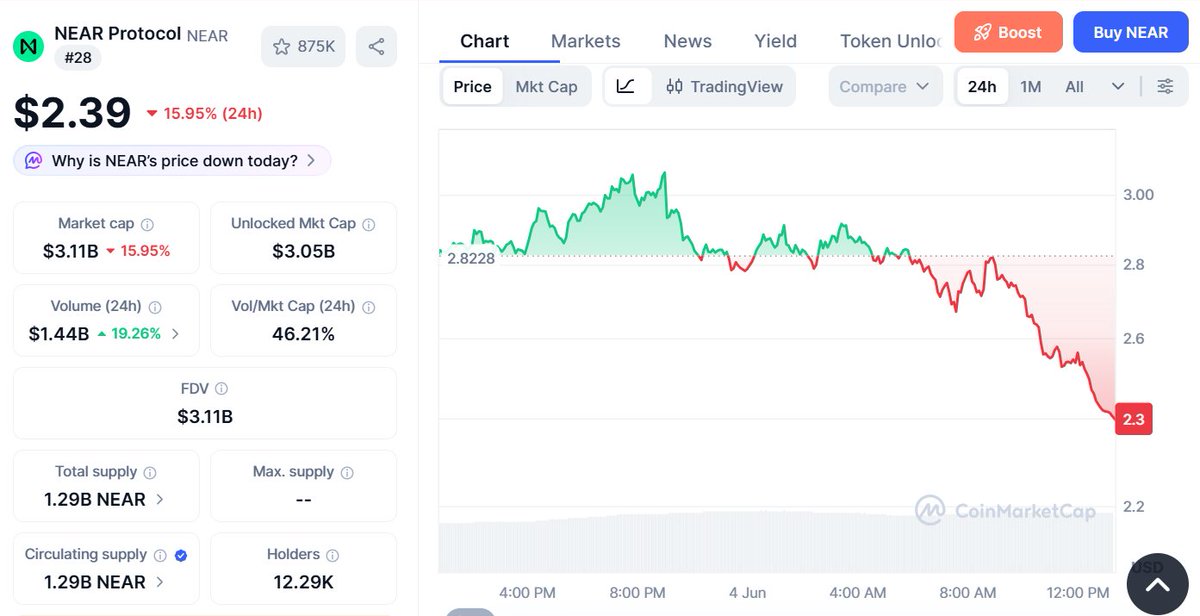
$NEAR: $12.28M (down 18.46%)
ZEC, HYPE, and NEAR, Arthur Hayes' "holy trinity", all in the red on the same day he exited $HYPE and $NEAR.
For context, the largest #liquidation event ever recorded was $19.16B on Oct 10, 2025, triggered by Trump's 100% tariff threat on China.
Today's $1.66B is nowhere near that scale, but the leverage sitting in this market right now deserves attention.
1
2
53
$NEAR is down 15.91% today, after an absolutely wild run.
Arthur Hayes just dumped his entire $NEAR position, and the chart explains why the timing was sharp.
$NEAR surged over 100% since early May, broke above $3.00, cleared its 200-day moving average, and pushed its weekly RSI above 75, severely overbought territory.
He called $NEAR part of his "holy trinity" trade, helped drive the narrative, and walked out near the top at $2.39.
1
52
$HYPE is down ~5.5% to $69 in the last 24 hours, and the timing makes it more interesting than the number itself.
US HYPE Spot ETF pulled in $2.99M in net inflows on June 3. Demand is still showing up.
On the other hand, Arthur Hayes exited his entire $HYPE position this week. His reasoning: AI IPOs are incoming, energy prices are rising, and markets are likely to peak before September.
ETF inflows are coming in while one of crypto's most-watched names is walking out. Two very different signals at the same time. That gap is worth paying attention to.
2
136
Arthur Hayes just dumped his entire $HYPE and $NEAR positions.
Here's why it matters 👇
- Iran war supply restocking = energy prices going up
- 3 big AI IPOs expected before Q3; that's a lot of capital getting pulled toward equities
- He thinks Trump will go anti-AI before the midterms to win votes
His call:
- Markets hit their peak somewhere between now and September
- So he's taking profit now and stepping aside, before his own essay even drops publicly
The essay "Reality Test" drops Tuesday. But the exit already happened on Friday.
By the time you read the explanation, the trade is usually done with #Hayes.
1
178

May 27
XRP Ledger was upgraded today, and most people scrolled past it.
The v3.1.3 mainnet amendment (fixCleanup3_1_3) went live this morning. No new features. No token launch. Just fixes, and that's exactly what makes it worth paying attention to.
What got patched:
→ Expired NFT offers now auto-clear from the ledger → Bug fixes in vault withdrawals and trust line limits → Accounting fixes in the lending protocol
→ Cleaner permissioned domain handling
Nodes that skipped today's deadline become amendment-blocked, unable to validate, submit transactions, or vote on future upgrades, with a hard cutoff.
And separately, on the same day, the XRPL Foundation published a new draft standard for AMM v2, proposing StableSwap and Concentrated Liquidity pool curves to improve capital efficiency for stablecoins, FX markets, and RWAs on the XRPL DEX. Still a proposal, not live yet.
One upgrade cleans the foundation. Another is being designed on top of it.
That's how serious financial infrastructure gets built, quietly, sequentially, on schedule.
44
May 27
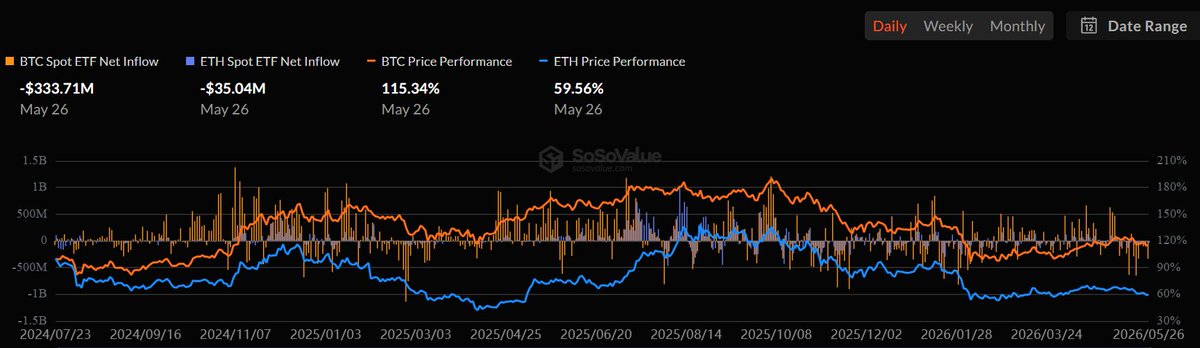
Spot ETF flows just flashed red across the board.
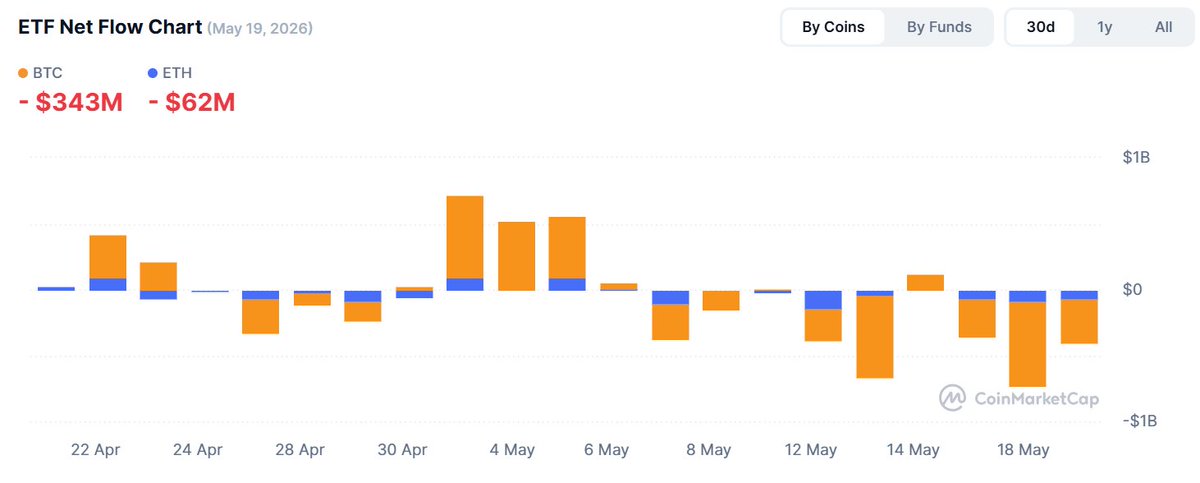
On May 26, nearly $370M left crypto #ETFs in a single day.
The breakdown:
$BTC Spot ETF: -$333.71M
$ETH Spot ETF: -$35.04M
$XRP Spot ETF: $1.55M
$HYPE Spot ETF: $20.45M
Total net outflow: -$368.70M
BTC took the heaviest hit. ETH followed. Both saw significant institutional selling pressure on the same day.
But here's what stands out:
XRP and HYPE were the only two in positive territory. Small numbers, but green while everything else bled. Newer ETF products attracting inflows on a heavy outflow day suggest rotation, not full-scale risk-off.
35
May 26
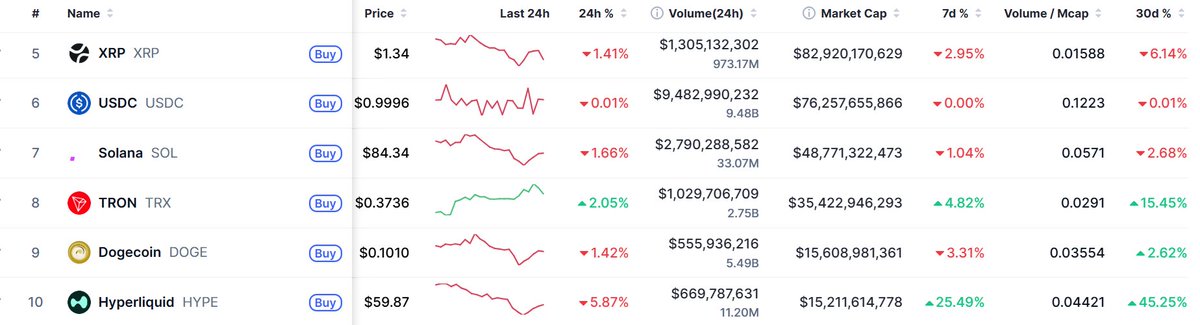
HYPE quietly entered the top 10, and it's already on par with Dogecoin in market cap.
$HYPE: $15.21B market cap | 25.49% this week | 45.25% this month
$DOGE: $15.60B market cap | -3.31% this week
A token that didn't exist 2 years ago is neck and neck with one of crypto's most iconic names.
And with a brand-new Spot ETF pulling in $72M in weekly inflows, the gap may not last long.
43
May 26
HYPE Spot ETF is just 2 weeks old, and it's already pulling serious numbers.
Weekly Net Inflow (May 22): $72.38M
Total Net Assets: $89.20M
Value Traded: $253.34M
First week pulled $2.52M.
This week? $72.38M, that's a 28x jump.
$HYPE token is also up ~25% this week, trading at $59.79. ETF demand and price momentum are feeding each other here.
Bitwise's #BHYP is leading the charge with $10.95M in single-day inflows. 21Shares' #THYP is yet to gain traction.
Very early, but the demand curve is steep for a 2-week-old ETF. #HYPEETF
1
32
May 26
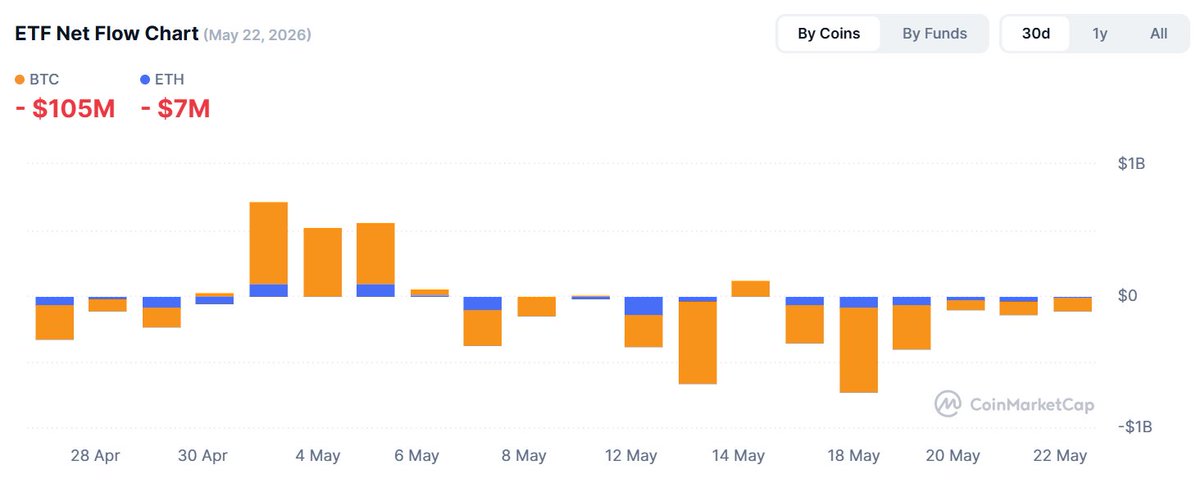
Bitcoin ETFs shed $105M in a single day while XRP and SOL quietly absorbed fresh capital.
May 22 US Spot #ETF Daily Net Flows:
$BTC: -$105.19M
$ETH: -$6.67M
$XRP: $9.47M
$SOL: $5.94M
$HYPE: $10.95M
Altcoin ETFs holding ground while BTC bleeds. Rotation or diversification, the shift is worth watching.
1
46
May 25
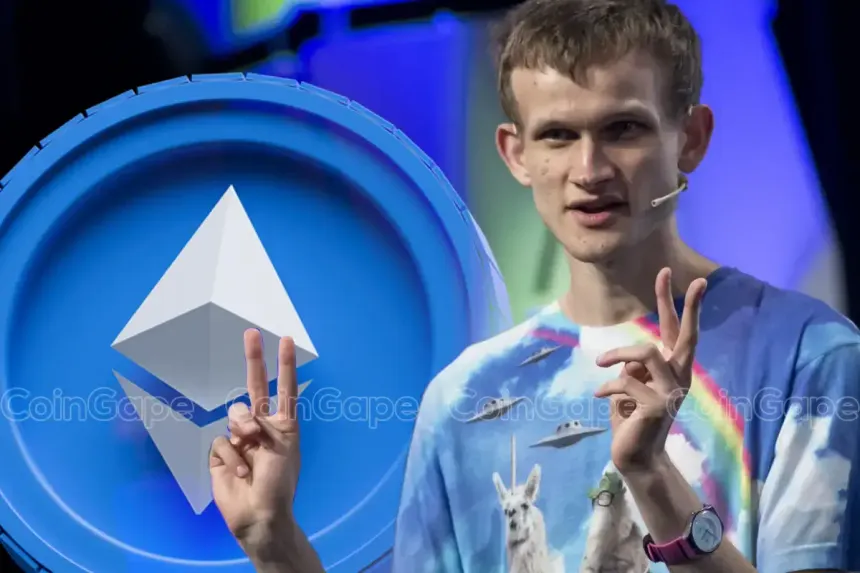
Is ETHEREUM at risk?
Here’s what we deducted from Vitalik’s recent explanation on the future of Ethereum Foundation (EF)
Bullish signals
- Vitalik is doubling down on Ethereum's $ETH unique technical identity, formal verification, censorship resistance, privacy, intermediary minimization. If executed, these are genuinely differentiated moats no other chain is pursuing seriously.
- He explicitly says ~90% of his net worth is in ETH, which is a strong personal conviction signal.
- The EF is choosing "longevity over breadth", selling less ETH, preserving runway. Less sell pressure from the foundation is directly bullish for price.
- The framing of ETH as a "$250B asset" worth protecting is a more commercially aware stance than EF has historically taken.
Bearish or cautionary signals
- The EF is shrinking intentionally. Fewer resources, narrower scope, and respected people being pushed out means execution risk goes up, things could slip through the cracks.
- He's explicitly not chasing throughput (TPS, latency), which is what a lot of capital currently follows. This is a principled but commercially risky bet.
- Dependence on "other heroes" and outside organizations to fill gaps the EF is vacating is an unproven model, those heroes may not show up.
- The honest admission that EF's actions haven't matched Vitalik's stated values is a credibility concern, even if being addressed.
Blockchain Bulletin’s take:
Ethereum is making a deliberate choice: stop trying to out-speed Solana and instead become the chain that is provably secure, censorship-resistant, and intermediary-free. The bet is specific: formal verification to make Ethereum provably bug-free, FOCIL and EIP-8141 to eliminate transaction intermediaries, and lean consensus to make Ethereum the only chain with both Bitcoin $BTC -style and BFT-style safety guarantees simultaneously. No other chain is seriously pursuing this combination. If it works, Ethereum owns a category no one else is even building toward.
We like this stance and will support Ethereum.
May 24

Some of my perspective on where the @ethereumfndn is going.
First of all, this is only my own view. The board is not just me, and I have no extra special powers on the board that the other board members do not. @aerugoettinea is the one executing much of this transition. My input has been largely on technical questions. The board is in the process of expanding, and my own power within the org will continue to decrease, which is honestly what I want.
The 2025 era brought many important improvements to EF and its ability to execute. Many issues were resolved, and EF continues to benefit from its improved efficiency and greater focus on concrete goals to this day. And so with those problems resolved, early this year, the largest remaining hole that I perceived was something different nagging at me: I would regularly spot people saying things like "vitalik says these beautiful things about ethereum needing to be decentralized, and have privacy, and be a sanctuary technology, but why do the EF's actions not reflect that?"
Now, you may have been hearing something different. You may not have been sensing a feeling of crisis at all, and maybe were hearing people saying that finally we were taking execution and BD seriously and the main task for us is to keep going that way and be even better and faster. Then probably there is genuine difference between you and me, in what kinds of criticism I take most seriously, and what kinds of critics through their criticism are most able to make me feel pain.
As an analogy, let's briefly switch over to a different domain.
One belief you can have about Google is that it is a success story, and has brought a lot of good to humanity in organizing the world's information. Another belief you can have about Google is that they had a beautiful idealistic beginning, but at some point the corruption of mainstream corporate attitudes seeped in, and they slowly bit by bit completely abandoned the "don't be evil" slogan.
My belief on Google specifically is probably somewhere between the two. BUT, if you had taken me back in time to ~2008, and offered me a button to press to make Google one or two standard deviations more "dogmatic", eg. give Richard Stallman permanent veto power over some key policies, I would immediately press it.
Why? Because a choice for one company is not a choice for the world, or even one country. Google existed and exists in the context of a technology industry generally drifting away from early idealistic don't-be-evil roots and toward greed for financial gain, totalizing visions of accelerated superintelligence, infiltration by sociopaths, and craven capitulation to (or worse, active participation in) government pressure for ideological control, surveillance and war. And so *one company* doing something different, positioning itself to be what George Bernard Shaw calls the Unreasonable Man, resisting the trend of the times, would have been better for freedom, balance of power and stability of society as a whole, than *all* large companies bending to dominant trends. This is a part of my version of pluralism.
This line of thinking is not just mine, but I also is not too far off from what Aya and others had in mind with the Mandate.
Now how does this all get to the role of the EF?
EF is not a "center of Ethereum", rather EF is "one node, with a defined purpose, alongside other nodes". We've always said that the EF should be the latter, but many in the Ethereum ecosystem (and even within the EF) wanted us to be the former. Now, we are taking action to ensure that we will be the latter.
This is particularly important because EF is a limited organization, with limited resources and limited organizational capacity. The EF has only ~0.16% of all ETH (less than many other individual ETH holders), whereas among other blockchains it's common for "the central foundation" to have 10-50%. Fiscally, the EF was originally designed to fulfill a limited work scope defined in the token sale docs and other pre-launch materials (building the chain software; getting through Frontier, Homestead, Metropolis, Serenity), which was fully completed in 2022; it was not designed to be an eternal steward.
And so today, the EF is choosing to use its remaining resources to pursue longevity over breadth (yes, this means we sell less ETH). The EF focuses *specifically* on those activities critical to the success of ethereum as a censorship/capture-resistant, open, private and secure system, that would not happen otherwise. This means making hard choices, and in some cases even activities that we highly approve of and people that we highly respect becoming outside of the EF. People of great technical talent, public respect and even alignment with the mission and CROPS being outside of the EF is in fact necessary if we want important tasks to be able to attract outside capital. This also means the EF taking opinionated stands culturally.
This is all intended in cooperation with all other parts of ethereum. We recognize that many other parts of the ethereum world highly respect CROPS and related values. But highly respecting is not the same as choosing to specialize and totally dedicate to a domain (Compare in a different domain: I think reducing animal cruelty is important, and I like vegan food, but am not full unconditional vegan myself)
EF is still in a transition period, and we expect its new long-term form to stabilize over the next few months. What are the guiding principles of this new form? Again, I am only one person, but I can give my answer from a technical perspective (there are also critical non-technical aspects).
At the core, *Ethereum must be impressive*. We are living in an age of highly intelligent AI and all kinds of other technological acceleration. "Status quo EVM, with a hard fork or two a year to optimize for short-term needs of users" is not interesting.
To some, "impressive" means: 250ms latency and 1M TPS. I think Ethereum trying to go that route is a mistake. Being as fast and as scalable as possible, and only a small epsilon more decentralized than the others, is a route to mediocrity, and if we try it we will lose.
I think Ethereum should scale. But I think Ethereum should strive the hardest to be deeply impressive in a different dimension: the CROPS dimension. This means things like:
* Provably bug-free Ethereum. This is a goal that all cybersecurity researchers would have thought is absurd and impossible, up until roughly 6 months ago. Now, it's on the cusp of being possible, thanks to AI-assisted formal verification. So we should be frontrunners in doing this.
* Available chain consensus. Ethereum is, and with lean consensus will cotninue to be, the ONLY chain that has both (i) traditional-BFT style properties that it's safe under asynchrony up to a high level of fault tolerance, and (ii) the bitcoin PoW-style property that under synchrony it's safe up to 49% attackers. As far as I can tell, literally no other chain has this or is planning for it; bitcoin goes for (ii) only and most other chains go for (i) only. Some will remember I fought hard for this, Unreasonably insisting that it is not OK for ethereum to rely on social consensus and hard forks to rescue ethereum from 34% of nodes going offline. It's OK for chains like hyperledger, bnb, solana, tempo, etc. It's not OK for bitcoin or ethereum or eg. zcash.
* Intermediary minimization. The fact that smart contract wallets, protocols like railgun, etc have to send transactions through intermediaries to get included onchain is honestly embarrassing, and it's a constant point of fragility. Hence the work on FOCIL and EIP-8141 (and 7701 and years of work before) to make transaction sending intermediary-minimized with public mempool and strong inclusion properties, in a truly general-purpose way, that covers not just eg. secp256r1, but also privacy protocols and much more. Kohaku is pushing intermediary minimization at the user layer, pulling Ethereum away from the dystopian status quo world where our wallets don't even verify the chain, send our private data out to a dozen third-party servers, and toward a brighter CROPS future.
Some of these goals are Unreasonable - maybe Ethereum would be "fine" getting only 50% of the way - what if we depend on intermediaries, but make it easy to switch? But going 50% of the way would not make Ethereum Deeply Impressive in the CROPS way. So we push for 100%.
Fortunately all these goals are compatible with high TPS, this is a major focus of research (esp. on scaling the state). Well-designed L2s can also help, especially L2s optimized for specific applications (eg. high-volume trading, privacy...). These goals are even compatible with significantly lower slot times, thanks to Raul's work on erasure-coded P2P, and many other optimizations.
The most high-value "product" of the ethereum blockchain, financially speaking, is ETH the asset. Ethereum secures $250 billion of ETH. The types of properties of Ethereum that I mentioned above are very good for ETH the asset. Nearly 90% of my net worth is in ETH, and most of the remainder is ~$40m of onchain fiat of which every dollar has already been allocated for some open-source biotech or software or hardware initiative. That said, there are aspects of supporting ETH the asset - *necessary* aspects even - that are outside the scope of the EF. This is where we need other heroes (some of whom hold more ETH than the EF does) to step in and help. EF has been recently thinking more about how it will relate to other such organizations, and give them needed initial support.
EF will be a smaller ship than in previous years, a more opinionated one - in some cases more opinionated in ways that might be difficult to comprehend - but a longer-lasting one, and one suited to making sure that ethereum brings something meaningful to the world. We are grateful to all those inside and outside the EF who are helping to make this happen.
33
May 21
Retail will not understand technicals. Though this an absolute necessity and hence a paradox. Once this is done just focus on 4-5 killer Apps like Polymarket or $AAVE instead of diluting and promoting mass. With that retail will find value and gain trust.
Retail is tired of experimenting and wants to just enjoy the final product.
May 21

The existing financial system neither reflects the culture nor addresses the economic realities of this upcoming generation of financial participants.
Our team, composed of emerging market citizens and perma-online Gen Zers are here to build the financial operating system for the internet-native generation.
We’ve spent the past two years building MegaEVM, the fastest execution environment in the industry. The MegaEVM withstood a 11B tx stress test in mainnet production, averaging 40k TPS, while consistently charging lower fees than all others competitors.
Our technical milestones paved the way for a collaboration with @chainlink to begin building the first real-time oracle, providing unparalleled speed and security to the DeFi ecosystem.
The past two years has seen a notable and eventful ecosystem grow through MegaETH. Today, some of the most interesting new applications sit on Mega. The points program on Terminal has allowed crypto-native users to further explore the initial Mega Ecosystem, but we believe it has run its course.
We will be providing boosted USDm rewards to all eligible participants in the program. Moving forward, we will double down on sourcing and accelerating the best applications on MegaETH through personalized GTM, targeting users beyond crypto.
We are momentarily launching the MOSS SDK, a self-custody wallet that unifies liquidity between applications while maintaining top in class security through smart approvals.
These pieces lay the foundation for M(OS)S to become the financial OS built for users born to this generation.
Live Q3, MEGA blends finance and entertainment with primitives and risk preferences that have never been available to everyday users.
The MOSS SDK is uniquely positioned to solve the embedded wallet <> generalized wallet dilemma by giving best in class security guarantees to users across all apps while still maintaining one unified account.
MOSS SDK builds on the foundational work of Porto by Ithaca, providing a user-first mentality to product. We look forward to working with applications to integrate Moss and provide users with a solution to the crypto UX problem.
The legacy financial system merely adopted the internet, it was not born in it. M(OS)S is being built by people who understand the culture of internet-native users and how finance, entertainment, and identity are converging online.
2
126
May 21

3
101
May 21
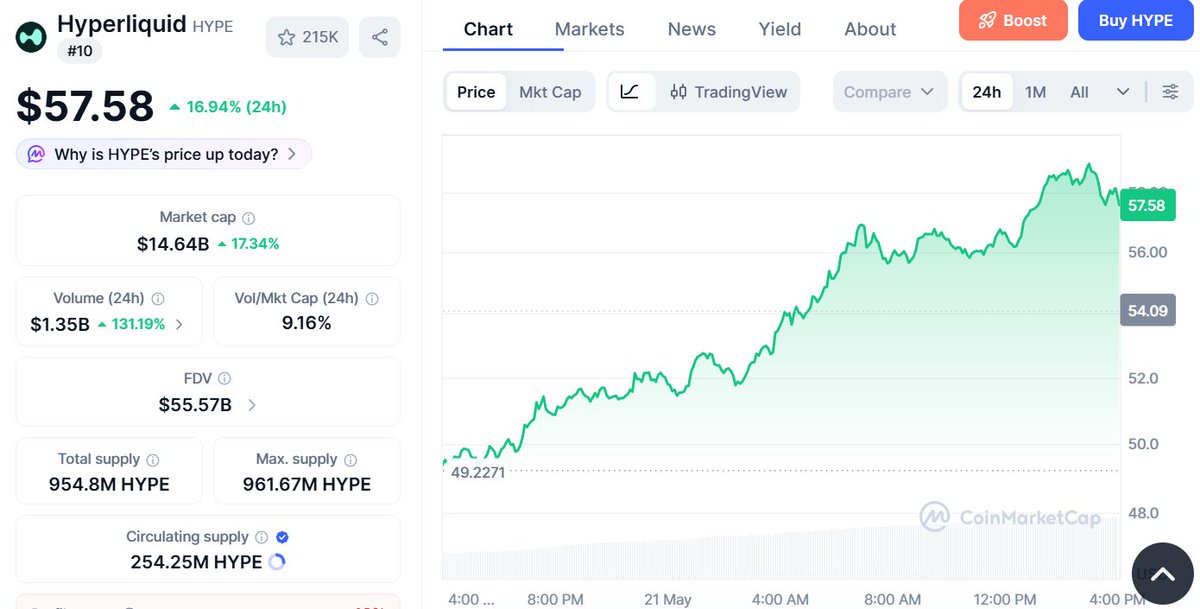
$HYPE is up ~17% to $57.58 in 24hours
This isn't just price action. A few things are converging:
- 24h trading volume jumped 130% to $1.36B, traders are actively using the platform, not just buying the token
- The spot #HYPEETF pulled $25.5M in inflows on May 20 alone, a new single-day record, topping BTC & ETH ETF inflows on the same day.
BHYP THYP have combined for $54M in just 7 trading days
- Adjusted for market cap, institutional money is entering HYPE ETFs faster than it did Bitcoin ETFs at a comparable stage (Presto Research)
- Coinbase is now Hyperliquid's official USDC treasury deployer. Under the AQAv2 deal, analysts estimate up to 90% of reserve yield on ~$5.8B in USDC deposits flows back to the protocol, potentially $150–225M/year toward buybacks and ecosystem growth
- #Hyperliquid holds ~73% of the perp DEX market and generates ~$896M in annualized revenue.
97% of trading fees go toward token buybacks
- FDV has crossed $53B, surpassing Solana's
One risk worth noting: CME & ICE have urged the CFTC to regulate Hyperliquid. Two major market makers already pulled ~$100M in liquidity on May 18. Order book depth has thinned.
HYPE is trading near its all-time high of $58.33. The structure behind this move looks different from a typical altcoin rally.
Not financial advice.
2
77
May 20
Messari's State of Solana Q1 2026
Here's what actually stood out:
- RWAs crossed $2B, up 43% QoQ. BlackRock's BUIDL doubled. PRIME up 124%. The institutional layer is quietly getting real.
- DeFi TVL dropped 22%, but mostly because the $SOL price fell 33%, not because users left. That's an important distinction.
- Pump.fun is still #1 by revenue at $124.7M. Axiom up 36%. Bags up 1,347% on the AI meta wave.
- And Alpenglow, if it ships, cuts finality from 12.8 seconds to 150ms. That's a different chain.
The Bigger Picture:
Solana is running two parallel stories right now: institutions coming in through RWAs and stablecoins, and retail is still very much alive through memecoins and trading apps.
Most chains have one or the other. #Solana has both, and that's harder to replicate than people think.
1
29