
Champion of Reason, Individual Rights and Capitalism.
Joined January 2025
- Tweets 3,124
- Following 647
- Followers 6,561
- Likes 2,263
104 Photos and videos

Pinned Tweet

The average American today lives better than John D. Rockefeller did in 1926. That is not an exaggeration. It is a fact.
Rockefeller could not fly across the country in five hours. You can for $200. He could not video call his family from another continent. You do it for free. He had no antibiotics, no MRI, no air conditioning in July. He could not carry every book ever written in his pocket. You are reading this on a device that does all of that and more.
Americans throw away 30-40% of their food. Not because they are wasteful, but because food is so abundant that waste is affordable. Your car has climate control, navigation, and safety systems that did not exist at any price a century ago. Your home has heating, cooling, refrigeration, and entertainment that emperors could not have imagined.
None of this was voted into existence. None of it was redistributed from the rich. It was created by free minds operating in what remains of a free market. Every comfort you enjoy today is the product of a man who thought, invented, produced, and traded voluntarily.
This is what the remnants of capitalism still deliver, even while it is being dismantled. Imagine what a fully free society could build.
357
2,450
11,552
422,805
A monument is what men build when they cannot build anything else. The pyramid was the tomb of a pharaoh erected by the bones of slaves. The modern version is subtler. It rises on land leased in the name of a former President for ten dollars, financed by a fund that does not exist, and held up by the unpaid labor of the men who actually poured its concrete.
The plumber who did the work is four million dollars in the red. The foundation that did nothing but accept tribute calls the thing "fully funded." The taxpayer, who was promised an insurance policy, is the insurance policy.
This is the pattern of every edifice to an ego: the producer is bled, the looter is honored, and the unpaid bill waits in the dark for the one man forbidden to refuse it.
They will tell you it sustains the community for generations. Ask who pays. Then watch them change the subject to your guilt.
foxnews.com/politics/obama-p…
4
134
Every clause you wrote is a confession, not an argument.
"The Social Security money hundreds of millions paid in." There is no such money. There is no account, no vault, no fund with your name on it. What was taken from workers was spent the moment it arrived, handed to the prior generation, the structure of a Ponzi scheme run by law. Musk is not raiding a pile of savings. He is naming a fraud you mistake for a nest egg.
"The trillion he stole." Name the theft. Whose property did he take, by what act, from what victim? You can't, because he stole nothing. He built rockets that land, cars an industry swore were impossible, and satellites that reach where wires never did. Every dollar came from a human being who chose to trade for what Musk made. That is the precise opposite of theft. The man who creates value and trades it freely is the one moral actor in your entire post.
"Paid no tax on." A man does not owe society a cut of his existence as the price of being allowed to produce. His wealth is not a loan from the public. It is the recorded fact of how much value he gave to others who wanted it.
Look at what you've done here. You took the words "stole" and "entitled" and aimed them at the one man in the exchange who took nothing and earned everything, while defending a system that seizes from every worker by force. You inverted it completely. The producer is your thief. The coercion is your justice.
That inversion is not an error of economics. It is a confession of values. You look at a man of enormous achievement and your first instinct is to brand him a criminal and strip him bare. The achievement is the thing you cannot allow.
You are not seeking justice. You are seeking a victim worthy of the name, and you chose the one man who made more for others than you will ever grasp.

A better question is 'Why the fuck does Elon Musk think he is entitled to the Social Security money that hundreds of millions of Americans paid in?'
As to the trillion he stole and paid no tax on.
Make him pay his tax.
3
8
55
836
True. Ayn Rand identified the proximate cause as altruism fully absorbed: the code that names self-sacrifice as the good and self-assertion as evil. Once a man accepts that the moral is the selfless, the humble, and the needy, then every instance of self-sufficient excellence becomes a standing reproach. The achiever who lives for his own sake is, by the altruist code, guilty precisely where he is greatest. So the better the man, the more he indicts the morality his haters have accepted, and they come to feel the good as an accusation.
But Rand dug beneath the ethics to the psychology, and this is where she located the deeper cause. She argued that the hater has made a fundamental choice against his own mind, a default on the effort of thinking, focusing, and pursuing values. Having evaded that responsibility, he faces a choice when confronted with greatness: revise himself upward, or destroy the standard that exposes him. The man who loves the good answers excellence with admiration and the desire to rise. The man who has betrayed his own potential answers with the wish to tear it down, because its mere existence reminds him of what he refused to become.
So the cause, in Rand's account, is ultimately metaphysical. It is a man's verdict on existence and on himself. The good is hated by those who have somewhere decided that the good is not for them, that reality is not theirs to master, that values are not theirs to earn. Rather than admit the fault lies in their own evasion, they relocate the evil onto the good itself. The excellence must be the crime, because the alternative is to indict their own surrender.
This is why she insisted it is not the good's task to apologize, dim itself, or seek the haters' approval. The reproach they feel is not something the achiever does to them. It is something they do to themselves, in the presence of a standard they abandoned.
Rand considered this the essence of evil, though she was careful to note it is rare in pure form. Most people are mixed, capable of both responses. But to the extent that a man hates the good for being the good, she held the source is always the same: he has turned against his own capacity to think and to value, and he cannot bear the living proof, in another man, that the turning was a choice and not a necessity.
Jun 13

“I don’t understand why people hate Elon Musk so much.”
It’s easy to explain.
Jealousy. Resentment. Envy. Stupidity. Those are basic.
Economic illiteracy and hatred of free speech also play a part.
7
26
104
4,947
Today this man became the first trillionaire in history. The world will talk about the number. The number is the least of it.
This wealth was not seized, not inherited from a looter's throne, not voted into anyone's pocket. It was created. Every dollar is a receipt signed by a free mind that judged his work worth more than the money traded for it. A trillion such verdicts. That is the measure of how much value one man brought into a world that did not contain it until he willed it there.
The achievement is his, and it needs no apology, no disguise as service to others. A man's life is his own to live for his own sake. That millions rose along with him was no sacrifice and no accident. It was the overflow of a man who respects reality enough to build on its terms.
Musk stands on a line that runs through Tesla, Edison, and Ford, men who made matter answer to reason and asked no one's permission to do it.

1
8
32
878
"Art of the Deal in action." You cheer like the regime's own propagandists, celebrating the leader's every whim as genius. You don't think. You applaud. A loyalist clapping on command is no freer than the IRGC men doing the same in Tehran.
Jun 11

🚨 LMFAO! President Trump says Iran was suddenly not "thrilled" after he said he's TAKING KHARG ISLAND
Now they're RUSHING for a deal
Art of the Deal in action! Democrats never learn! 🔥
Q: Is the Kharg Island operation off the table?
TRUMP: Now it would be with this agreement. They weren't so thrilled when they heard that that's what I would have done!
1
205
Read what you just gave away, Brian. By calling this "much worse than Obama's JCPOA," you've finally admitted the JCPOA was a bad deal. "Worse than" concedes the baseline was already bad. Welcome to the position every critic held while you defended it for a decade. It took an even worse deal to drag the admission out of you.
But here's the problem: you have no clue what's in this one, because nobody does. There is no signed text. Iran's own state media says Trump is describing terms that contradict the draft, no Hormuz clause, no nuclear dismantlement. It's a 60-day MOU to start more talks, not finalized, not accepted by Tehran, not even approved by Trump.
So how do you know it sends "hundreds of billions" and lets Iran "dictate our military presence"? You don't. You invented figures for a document that doesn't exist.
You're now trashing a phantom deal by measuring it against one you just confessed was bad. You finally got the JCPOA right by accident, and you still managed to argue dishonestly doing it.
Jun 12

Trump is about to sign a deal with Iran that is much worse than Obama's JCPOA, sends Iran tens or even hundreds of billions of dollars and lets them dictate our military presence in the Middle East.
But RELAX, this makes sense since we LOST the war.
Trump will try and spin it as being better than the deal he tore up. Americans are too smart to fall for it, I hope.
1
1
162
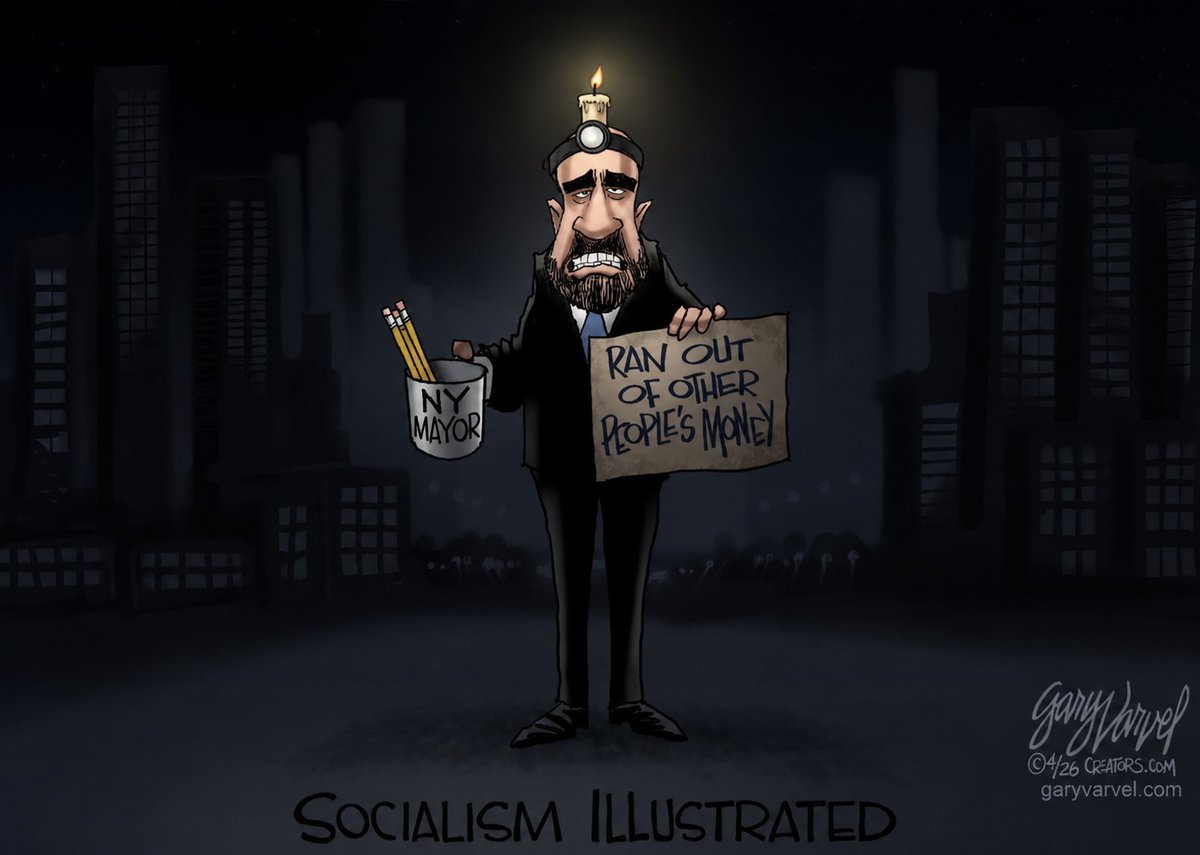
$26 is a "deal"? In what world? That's the price of one inexpensive entree in most of the country, and Mamdani is presenting it as a civic gift to celebrate "cheap eats."
This is the tell. A socialist calls $26 cheap because his policies guarantee it never stays there. Mandate wages, pile on regulations, tax the operators, drive up rent and energy, and watch a normal meal climb to $26, then call the inflated price a bargain you should thank him for.
He didn't make food affordable. His entire worldview makes it expensive. Then he stages a "deal" at the new, higher floor and asks for applause.
That's the whole socialist trick: break the economics, normalize the damage, and rebrand the wreckage as generosity. $26 isn't a celebration of the city. It's a receipt for what they've done to it.

Few better ways to celebrate this city — and the World Cup — than cheap eats.
That's why starting June 11th through July 19th, New Yorkers can celebrate the World Cup with $26 meal deals at hundreds of restaurants across the five boroughs — from Little Caribbean in Flatbush to not one, but two Koreatowns.
Bring fellow fans or team rivals and discover what makes New York City the world's city.
8
2
33
1,653
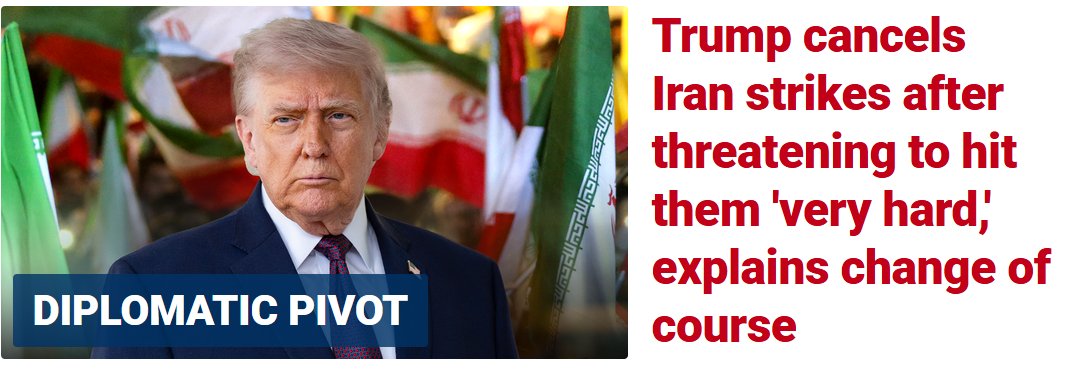
🤔Breaking News: Trump announces a historic Iran peace deal is just "coming days" away.
The only party that hasn't agreed is, well, Iran.
But don't worry, they're "rushing for a deal," which is why they're simultaneously targeting American warships in the Gulf, racing to build a nuclear bomb, and keeping the Strait of Hormuz blockaded.
But look over here at this hand. All parties "that matter" have agreed: the United States, France, Germany, the UK, Switzerland, and the catering company booked for the signing in Switzerland.
Everyone is on board with the deal with the DEVIL except the DEVIL the deal is with. Minor detail.
wsj.com/world/middle-east/tr…
3
3
9
242
Levin never learns. He defends this unprincipled president through every reversal, and now he stands baffled by the very incoherence he spent months excusing.
You ask to see the deal, Mark. There is no deal. There is no document because there is no fixed position to write down. How could there be? The same morning Trump calls this "the most violated ceasefire in the history of the world," he threatens to bomb them by night, then names Switzerland as the spot to sign a peace he has not secured, then muses about seizing Kharg Island and running Iran's oil like Venezuela.
Strike, deal, blockade, seize, sign. All at once, none connected. That is not strategy you can put on paper. It is mood you can only watch.
You keep searching for the hidden plan because you cannot accept the simple truth: the man has no principle directing any of it. You spent a year insisting the chaos was genius. Now you want to read the genius and find there was never a page.
This is what you defended. The confusion you feel today is the thing itself.
Some of us know and have known all along what kind of man Trump is because you only need 2 neurons to figure it out. But we still held out hope that on this one issue, because of how important it is to the security of the civilized world, that he might follow through.
Now we can only hope the Iranians keep rejecting these worthless deals and force him to act. Pathetic.
Jun 11

If all these governments have agreed on this deal, it’s amazing how all these governments signed up so fast while we were announcing we’d be bombing asap. Since it’s done can we see it?
And what is in this deal?! Can we see it?
3
2
8
741
Levin never learns. He defends this unprincipled president through every reversal, and now he stands baffled by the very incoherence he spent months excusing.
You ask to see the deal, Mark. There is no deal. There is no document because there is no fixed position to write down. How could there be? The same morning Trump calls this "the most violated ceasefire in the history of the world," he threatens to bomb them by night, then names Switzerland as the spot to sign a peace he has not secured, then muses about seizing Kharg Island and running Iran's oil like Venezuela.
Strike, deal, blockade, seize, sign. All at once, none connected. That is not strategy you can put on paper. It is mood you can only watch.
You keep searching for the hidden plan because you cannot accept the simple truth: the man has no principle directing any of it. You spent a year insisting the chaos was genius. Now you want to read the genius and find there was never a page.
This is what you defended. The confusion you feel today is the thing itself.
Some of us know and have known all along what kind of man Trump is because you only need 2 neurons to figure it out. But we still held out hope that on this one issue, because of how important it is to the security of the civilized world, that he might follow through.
Now we can only hope the Iranians keep rejecting these worthless deals and force him to act. Pathetic.
1
1
288
Jun 11

At @CENTCOM I asked @SecWar @PeteHegseth:
“In the event that the Iranians keep playing games and they refuse to come to the table to make a deal, how certain are you in our targeting ability to immediately find and finish off and EXECUTE every remaining senior leader within the Islamic Republic of Iran and IRGC?”
He said CENTCOM has been using the “ceasefire” to gather more intelligence and refine their targets in Iran.
Sec War said Iran doesn’t have the ability right now to build more missiles or drones.
“What they have is what they have, and if they’ve dug it out, we will strike it again if we need to”, he added.
2
204
A $300M yacht isn't money set on fire. It's a vast act of production. Those vessels take 3 to 4 years to build and employ hundreds: naval architects, marine engineers, welders, electricians, carpenters, interior craftsmen, plus the shipyard and the entire supply chain feeding it. Then a permanent crew of dozens, dockworkers, mechanics, and provisioners for the life of the ship. The "obscene" yacht is a payroll for hundreds of skilled workers who chose that trade freely.
But notice the con you're really running. You don't want those workers employed. You want the Meta workers envious. The yacht and the layoffs have nothing to do with each other, except in the resentment you're trying to manufacture.
Now the layoffs themselves. A company cuts staff when it must reduce costs or correct over-hiring, which is exactly how a business stays alive to employ anyone at all. And what drives costs up? The taxes, mandates, and regulations you demand every single day. You spend your career making it more expensive to employ Americans, then feign shock when employing Americans gets more expensive.
You don't grasp that wealth is produced, not seized from a pile. So you treat one man's success as another's loss. It isn't. The yacht builder, the Meta engineer, and Zuckerberg can all prosper at once, in a system you'd dismantle for the pleasure of watching the rich brought low.
Envy is not an economic policy but it is apparently all @SenWarren and her socialist allies know.
Jun 11

Mark Zuckerberg’s $300 MILLION yacht arrived in Seattle the same day Meta cut 1,400 jobs—part of a larger round of 14,000 job cuts.
Nothing says our economy is broken like billionaires sailing around on yachts while workers are left out to dry.
78
219
974
46,076
Rich coming from you, @SenSchumer. You ran the Senate while prices climbed 21.5% and gas jumped 31% under Biden. Real wages shrank. You didn't walk to work over it. You voted for the spending that lit the fire, then handed the bill to every family you now pretend to mourn.
Four decades in Washington. You helped build the inflation, the debt, and the dependency, and now you stand in the wreckage pointing at the current resident who inherited it, performing grief for the cameras.
The looter always discovers compassion the moment he's out of power. The crocodile tears are not new. The policies that caused the pain are yours.
Jun 11

Americans are losing their homes
Parents are working multiple jobs to feed their kids
Workers are walking to work because they can’t afford gas
Trump’s response? “The numbers are great… I love the inflation.”
Sickening.
6
13
49
1,109
Well said. They hate free speech because they hate the mind. Speech is thought made transmittable, and a free man's thought is the one thing no collective can command but know they must silence. To silence speech is to attack the "reason" behind it. Because "reason" is their real enemy.
Jun 10
The Left hates free speech.
They hate the power of free speech.
They hate the consequences of free speech.
They hate the media of free speech.
They hate the defenders of free speech.
They hate those who use free speech.
They hate freedom itself.
3
17
54
1,988
Then explain how that is true. Not with a slogan, with facts.
Elon Musk is one of the greatest benefactors of our age, and precisely because he pursued his own ambition and his own values. He built reusable rockets when every expert said it could not be done, and cut the cost of reaching space dramatically, by up to tenfold against the Space Shuttle. He forced an entire industry to take the electric car seriously. He moved satellite internet to places that had none. None of it was charity. All of it was self-interest, and the world is richer for it.
That is the pattern the looter can never forgive: a man who creates enormous value by living for his own sake and trades it freely with others who want it.
So when you call him a threat to civilization, name the act. Which rocket, which car, which platform "undermined" anything? You cannot, because the charge is not about what he did. It is about what he refuses to do: bow, apologize, and hand his judgment over to his critics.
A producer who speaks his mind is not the danger to civilization. The danger is the premise that his success is a crime and his independence a threat.
Jun 10

That's why it's genuinely terrifying when the world's richest man decides to undermine civilization.
16
30
169
3,634
Let me explain this slowly, because you have the whole thing backwards.
Social Security was broken the day it was born. It is not an investment. There is no account with your name on it. The money taken from you is handed to today's retirees, and your benefits will be paid by taxing tomorrow's workers. That is the exact structure of a Ponzi scheme. It works only while each generation is large enough to fund the one before it, and it collapses the moment the math turns, which was guaranteed from the start.
So when you blame the 2032 shortfall on Trump's tax cuts, you are pointing at a leak on the deck of a ship that was built to sink. Every rational critic warned of this from day one, decades before Trump existed. You are now using our argument to demand more of the poison that caused it.
And your fix? "Scrap the cap." Take more. That is what is said every time the scheme nears collapse: raise the tax, lift the cap, push the reckoning onto the next worker. It does not save the system. It just enlarges the eventual fall and seizes more of a man's earnings along the way.
You cannot rescue a Ponzi scheme by feeding it. You can only stop forcing people into it. The problem was never the rate. It was the premise: that one man's retirement is a claim on another man's paycheck. It never was, and no cap, cut, or increase will change that.
Jun 10

Thanks to Trump's tax cuts for the rich, Social Security's trustees warn the program will be unable to pay out full benefits by 2032.
There's only one way to reverse this trend.
Scrap the cap on income subject to Social Security taxes.
167
444
1,985
62,304
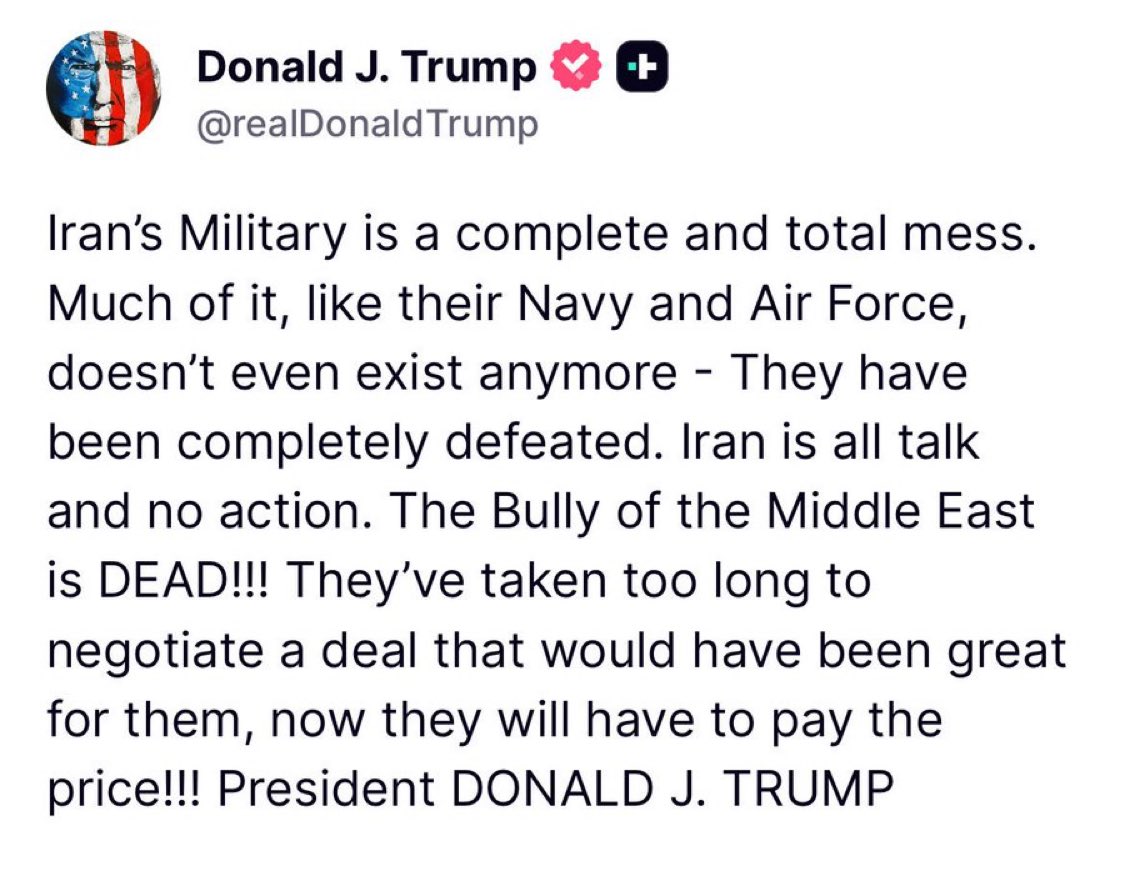
The breathtaking stupidity of the Iranian regime is about the only thing that can save us. That is a grim thing to say about what began as one of the boldest, most moral actions in fifty years: striking an evil regime that has terrorized the world for decades.
Notice the pattern. On Tuesday the downed Apache "wasn't a big deal." By Wednesday morning the bully is "DEAD" and Iran "will pay the price." The position changes with the hour, because there is no principle holding it in place, only mood and the last headline.
We are reduced to hoping the enemy blunders badly enough to force the hand of a President who cannot hold a conviction for twenty-four hours.
Eli is right. The time for threats is over. The regime has learned that Trump's words expire by morning. Strike hard, strike now, and finish what was bravely begun, before the next mood swing calls it off.
Jun 10

Threats have lost their effect. The regime in Iran no longer believes Trump will act on these threats.
Now is the time for action, to strike hard and finally win the war!
_
10
7
33
1,246
This is true for the richest and the poorest among us alike.
A civilization does not fall to armies first. It falls when men stop defending the ideas that built it: reason, the individual, the freedom to live for your own sake. Those ideas do not defend themselves. They live or die in the mind of every man willing to name them out loud.
You do not need billions to fight this fight. You need a clear mind and the courage to use it. Speak the truth as you see it. That is how a culture is saved, one unbought voice at a time.
2
9
33
779
There is a bitter irony in the word "woke." It claims to mean awake, aware, seeing clearly. It is the opposite. It is the deepest sleep a culture can fall into, and it was a long time coming.
Woke is not the disease. It is a symptom, and fighting the symptom alone leaves the real sickness untouched.
The root is modern philosophy and its long war on reason. When thinkers like Kant taught that the human mind cannot truly know reality, that objective truth is forever beyond our reach, they infected the culture at its source. Cut a man off from reason and you cripple the one faculty that lets him grasp the world.
If reason cannot give you the truth, what is left? Only feelings, faith and the group you were born into.
That is the whole foundation of woke. Strip a man of reason and you strip him of his individuality, because being an individual means thinking and judging for yourself. Take that away and he is nothing but a member of a tribe: his race, his class, his sex. He no longer has a mind. He has a category.
So we never could have reached a colorblind culture on these premises, because the philosophy underneath was already teaching men to see groups instead of persons.
The answer is not to chase each new label as it appears. It is to defend reason and the individual at the root. Win that, or woke simply returns wearing a different name.
Jun 9
We came close to a truly colourblind culture - and the woke left screwed it up, on purpose.
5
12
38
1,508