
only interested in the business & economic applications of artificial intelligence.
Joined November 2014
- Tweets 756
- Following 419
- Followers 5,715
- Likes 260
195 Photos and videos
Pinned Tweet

22 Sep 2025
4 AI coding terms everyone mixes up (but shouldn’t)
A quick summary to cut through some of the jargon around AI development approaches:
Vibecoding – Iterative and beginner-friendly, often driven by experimentation rather than clear specifications. Useful for rapid prototyping, but usually lighter on security and rigor.
Spec-driven development – Applying traditional engineering discipline with defined requirements and structured processes. Recently emphasized by platforms like GitHub as a way to bring consistency and reliability into AI projects.
Context engineering – Supplying the AI with full context (documentation, PRDs, logs, schemas) so it can reason effectively, rather than relying on isolated prompts.
Agentic coding – Shifting from task-based prompts to goal-based delegation, where autonomous agents carry out multi-step work with minimal human intervention.
Why it matters: Clear distinctions in these approaches will help with expectations to understand how to use (so many) new tools and avoid wasted time and money.
#AIAgent #AgenticAI #DeepResearch #AIReasoning #SingleAgent #RAGEvolution #FinOpsAI #TBMOptimization
90
Rasool M retweeted

Apr 1
I have been fine-tuning LLMs for over 2 years now!
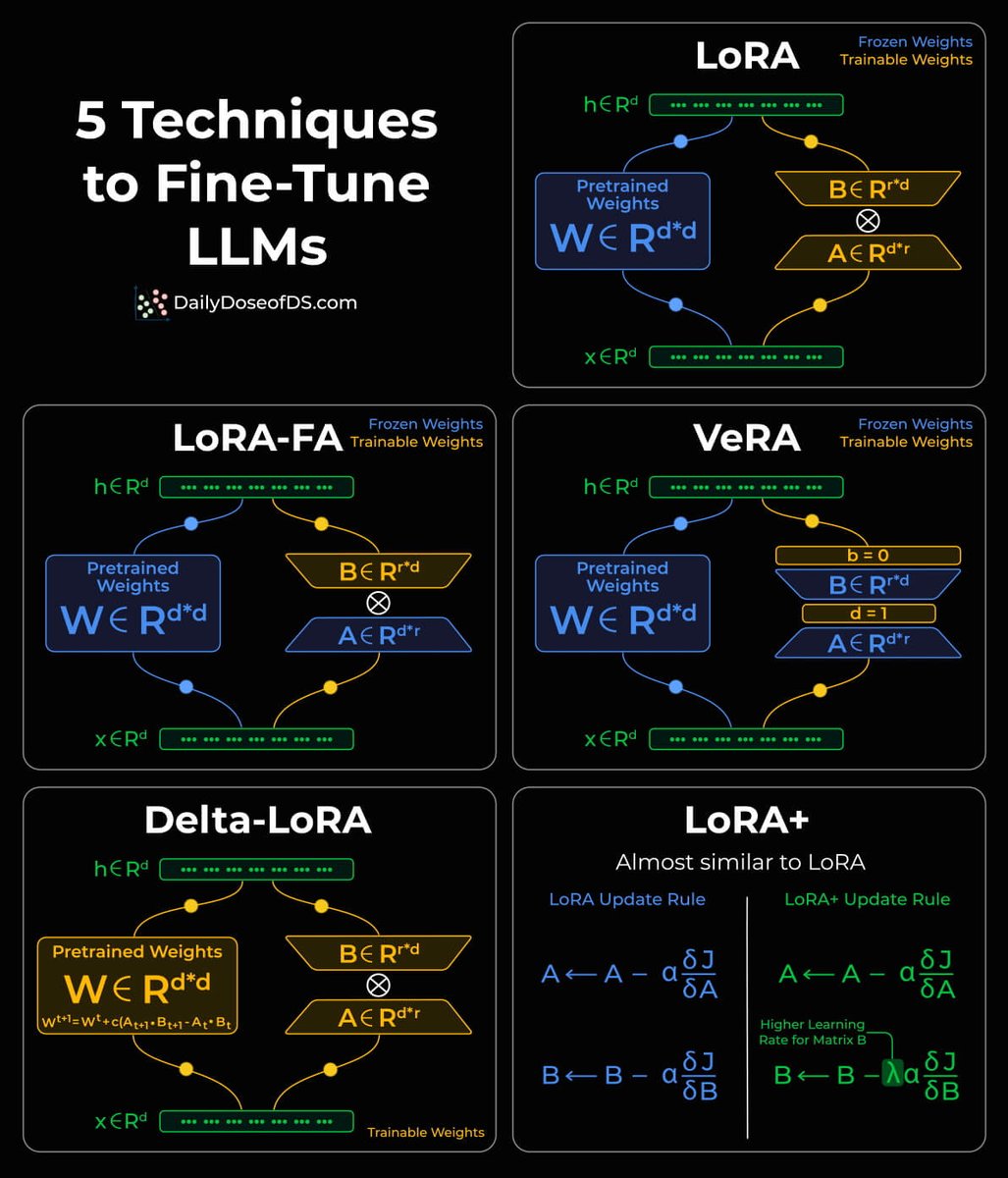
Here are the top 5 LLM fine-tuning techniques, explained with visuals:
First of all, what's so different about LLM finetuning?
Traditional fine‑tuning is impractical for LLMs (billions of params; 100s GB).
Since this kind of compute isn't accessible to everyone, parameter-efficient finetuning (PEFT) came into existence.
Before we go into details of each technique, here's some background that will help you better understand these techniques:
LLM weights are matrices of numbers adjusted during finetuning.
Most PEFT techniques involve finding a lower-rank adaptation of these matrices, a smaller-dimensional matrix that can still represent the information stored in the original.
Now with a basic understanding of the rank of a matrix, we're in a good position to understand the different finetuning techniques.
(refer to the image below for a visual explanation of each technique)
1) LoRA
- Add two low-rank trainable matrices, A and B, alongside weight matrices.
- Instead of fine-tuning W, adjust the updates in these low-rank matrices.
Even for the largest of LLMs, LoRA matrices take up a few MBs of memory.
2) LoRA-FA
While LoRA significantly decreases the total trainable parameters, it requires substantial activation memory to update the low-rank weights.
LoRA-FA (FA stands for Frozen-A) freezes matrix A and only updates matrix B.
3) VeRA
- In LoRA, low-rank matrices A and B are unique for each layer.
- In VeRA, A and B are frozen, random, and shared across all layers.
- Instead, it learns layer-specific scaling VECTORS (b and d) instead.
4) Delta-LoRA
- It tunes the matrix W as well, but not in the traditional way.
- Here, the difference (or delta) between the product of matrices A and B in two consecutive training steps is added to W.
5) LoRA
- In LoRA, both matrices A and B are updated with the same learning rate.
- Authors of LoRA found that setting a higher learning rate for matrix B results in better convergence.
____
Find me → @_avichawla
Every day, I share tutorials and insights on DS, ML, LLMs, and RAGs.
17
134
695
28,810
Feb 19
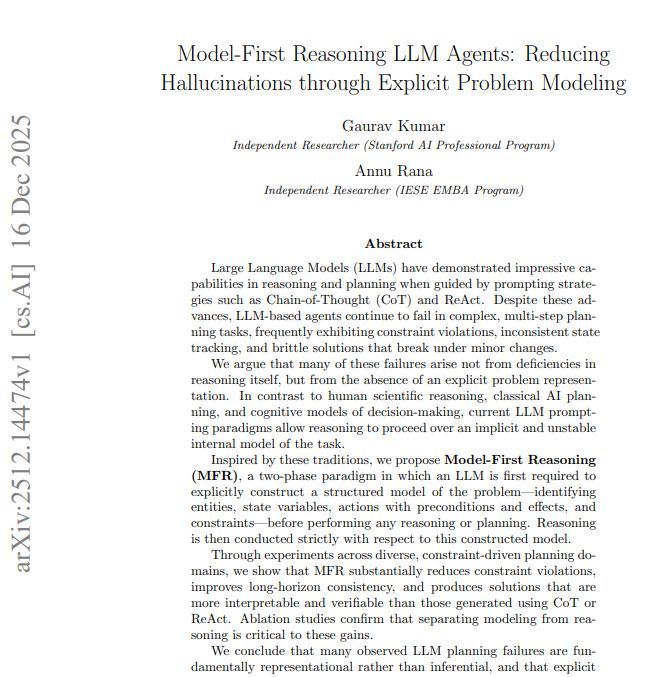
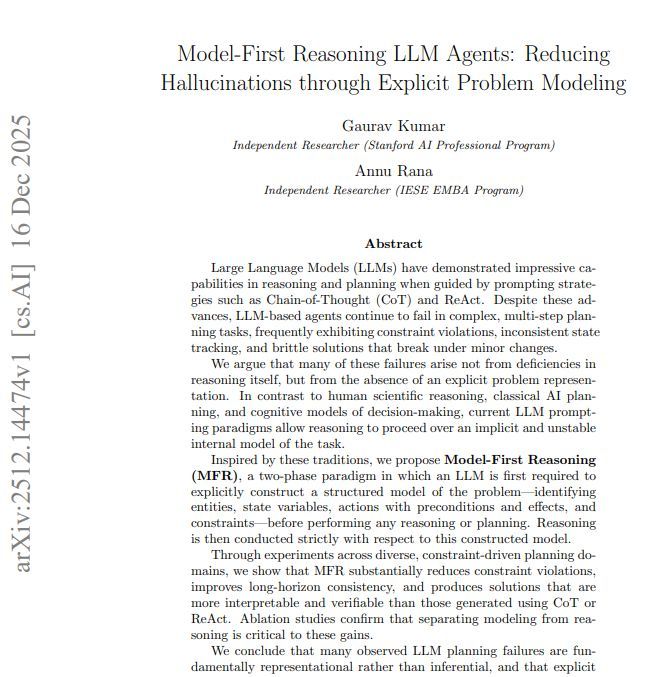
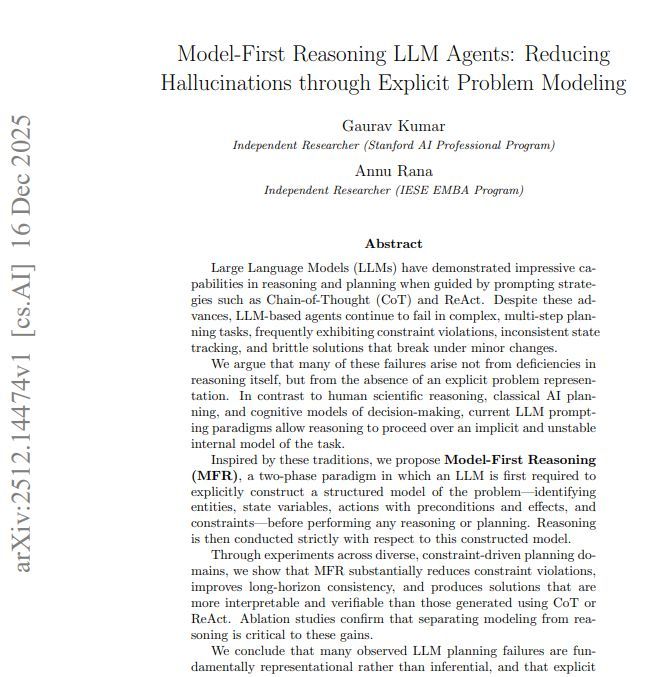
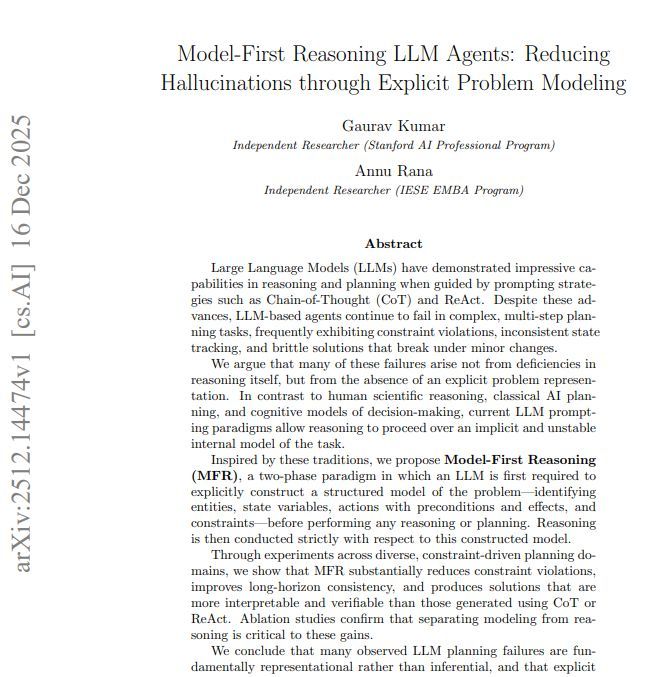
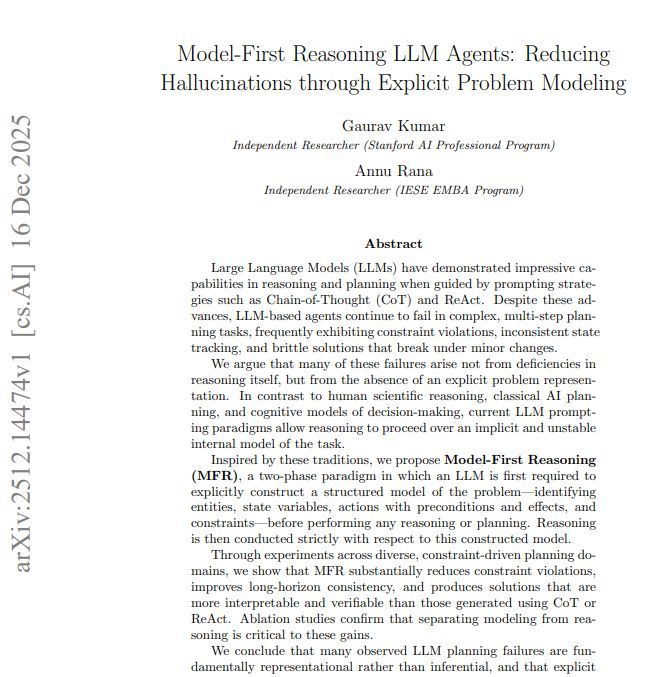
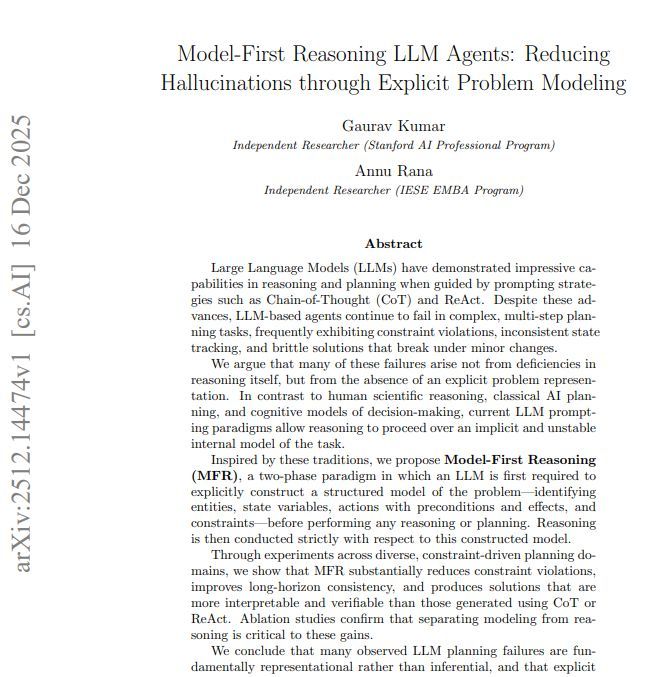
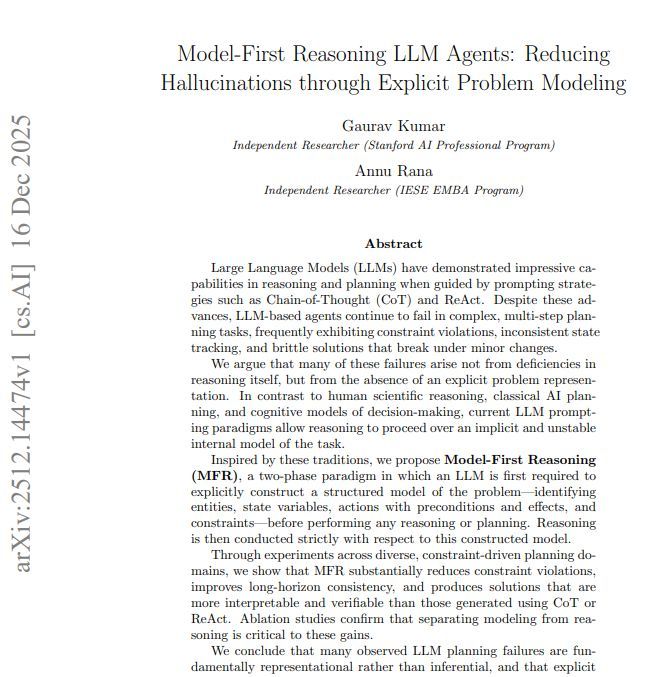
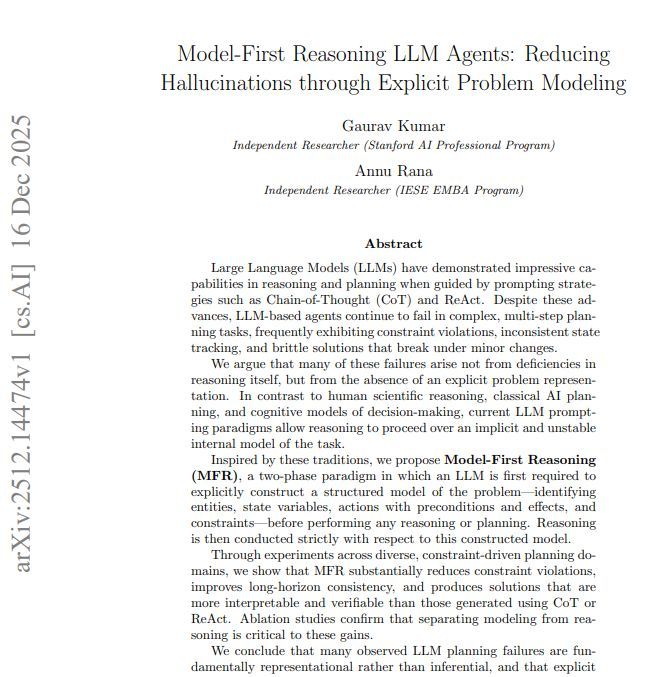
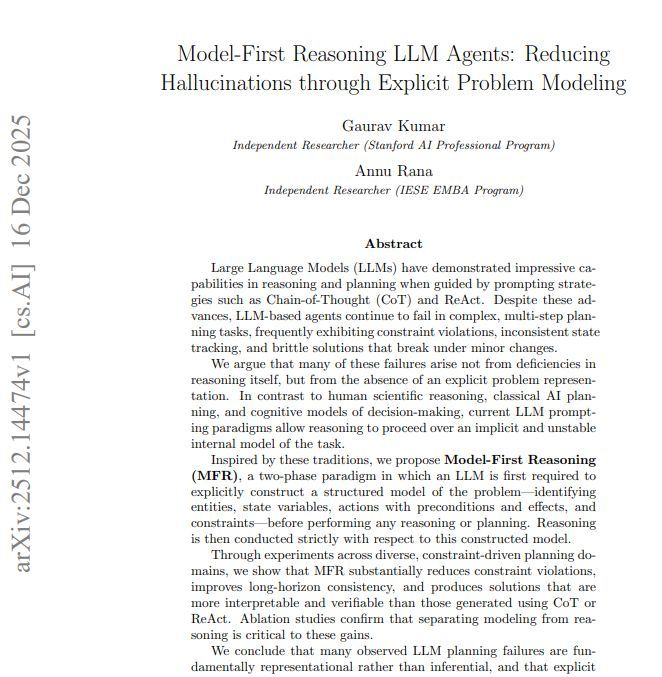
CoT and ReAct largely refine how a model walks through a problem, but pay much less attention to what the model assumes about the environment itself. Therefore, MFR's focus on visible problem models shifts reliability work upstream, so production agents operate over a shared, stable description of the world instead of reconstructing it differently on every call.
#FinOps #AIeconomics #EnterpriseIT #DigitalStrategy #SPM #PortfolioManagement
7
Feb 19
CoT and ReAct can sound perfectly coherent step by step yet drift badly at the global level because they rely on an unstable internal notion of state. Therefore, explicitly modeling entities, state variables, and constraints before any reasoning leads to plans that remain structurally consistent instead of slowly diverging as the chain grows.
#EnterpriseIT #TBM #WorkforceManagement #AIeconomics #AI #FinOps
2
Feb 18
For mid-level technical leaders, the mindset shift is to treat "build the task model" as a required stage for any agent that touches real systems or resources. Therefore, baking an MFR-style step into your orchestration means agents aren't improvising the rules on the fly, which tends to reduce edge-case incidents and late-night firefighting.
#AI #DigitalStrategy #WorkforceManagement #FinOps #AIeconomics #SPM
3
Feb 17
When writing prompts, be clear that the modeling phase must not include proposed solutions or partial plans. Therefore, you maintain a clean separation between representation and reasoning, reducing the tendency for the model to sneak in premature recommendations and helping it focus on accurately capturing the world first.
#PortfolioManagement #EnterpriseIT #TBM #SPM #AIeconomics #AI
9
Feb 16
If you run multi-step agent workflows, treat modeling as a distinct stage in the flow rather than an implicit side effect of planning. Therefore, you can attach basic rule checks or human review to the modeled entities and constraints before any plan is produced, catching representational issues before they turn into production failures.
#SPM #PortfolioManagement #DigitalStrategy #TBM #AI #FinOps
4
Feb 13
Classical operations tooling asks you to handcraft formal domain models in languages like PDDL, which is precise but costly and brittle to maintain. Therefore, Model-First Reasoning is appealing because the LLM itself drafts a natural-language or semi-structured model from a task description, preserving many benefits of visible planning while avoiding heavy modeling overhead.
#WorkforceManagement #TBM #PortfolioManagement #FinOps #AIeconomics #AI
6
Feb 12
"Structural clarity" sounds like an academic term, but in practice it's what lets a manager ask, "Where do we enforce that rule?" and get a concrete answer. Therefore, MFR's visible models turn opaque agent behavior into explainable artifacts, which is exactly what governance and audit teams need as AI moves closer to production decision-making.
#WorkforceManagement #EnterpriseIT #AIeconomics #SPM #PortfolioManagement #AI
7
Feb 12
When you think about future agent architectures, treat the working model as evolving state rather than a one-off artifact that disappears after each call. Therefore, you can let agents update the model as the environment changes and ensure subsequent plans are grounded in the current representation, instead of relying on an ever-growing, inconsistent trail of free-form text.
#SPM #WorkforceManagement #TBM #EnterpriseIT #DigitalStrategy #FinOps
5
Feb 11
Generative AI has created a new class of shadow portfolios: dozens of AI pilots funded outside the main roadmap. If SPM and TBM don't pull them into the light, your AI bill will.
#WorkforceManagement #FinOps #AI #EnterpriseIT #AIeconomics #PortfolioManagement
6
Feb 10
In real production flows, LLM agents "bend the rules" by creating overlapping schedules or over-allocating capacity because the rules never exist in a concrete form. Therefore, Model-First Reasoning makes the model spell out entities, state, and constraints like a lightweight spec before planning, which supports more compliant and auditable automation in regulated environments.
#EnterpriseIT #PortfolioManagement #WorkforceManagement #TBM #DigitalStrategy #SPM
3
Feb 9
To bring Model-First Reasoning into your agents, stop jumping directly from a user request to a plan. Therefore, first ask the LLM to enumerate entities, state variables, actions, and constraints and treat that output as a "task model," then generate a plan that is explicitly bound to that model.
#AIeconomics #DigitalStrategy #PortfolioManagement #TBM #EnterpriseIT #FinOps
2
Feb 5
Most discussions of AI cost stop at cloud bills. True AI economics live where TBM, FinOps, and SPM intersect: hybrid infra, labor, data, and portfolio decisions.
#DigitalStrategy #AIeconomics #AI #TBM #FinOps #WorkforceManagement
1
10
Feb 4
Traditional planning systems always separate "describe the domain" from "search for a solution," while LLM agents usually merge both into one generative monologue. Therefore, Model-First Reasoning revives that separation through prompting, preserving LLM flexibility while restoring some of the stability and verifiability that visible planning models provide.
#TBM #SPM #AIeconomics #AI #WorkforceManagement #FinOps
2
Feb 4
Many agent frameworks jump straight from a loosely worded request to a full plan and hope the model implicitly tracks constraints along the way. Therefore, by adding a modeling phase,define resources, permitted actions, and hard rules first,Model-First Reasoning turns AI-generated plans into artifacts your ops, legal, and risk teams can actually inspect and contest.
#AI #SPM #FinOps #PortfolioManagement #WorkforceManagement #TBM
Feb 4
You cannot manage generative AI at scale with monthly cost reports. You need continuous visibility into cost, usage, and value.
#TBM #WorkforceManagement #AI #FinOps #PortfolioManagement #SPM
1
9
Feb 3
If you track AI spend but not AI sprawl, you will wake up with overlapping tools, duplicated models, and four teams solving the same problem.
#PortfolioManagement #DigitalStrategy #WorkforceManagement #AI #FinOps #AIeconomics
6
Feb 3
For scheduling and resource-allocation scenarios, have the model explicitly list resources, capacities, dependencies, and hard constraints in a structured way before asking for a schedule. Therefore, the planning step can reference that structure directly, and you can automatically verify that no generated plan crosses the capacity or policy lines you care about.
#TBM #FinOps #EnterpriseIT #DigitalStrategy #AI #AIeconomics
3
Feb 2
Many "hallucinations" in agents look like missing variables, unstated rules, or constraints that quietly disappear mid-plan rather than pure logical mistakes. Therefore, forcing the LLM to declare its view of entities, states, and constraints up front gives you a concrete artifact to debug and refine instead of just pushing more prompt engineering at the symptom.
#WorkforceManagement #AIeconomics #PortfolioManagement #FinOps #EnterpriseIT #AI
4
Feb 2
Strategic Portfolio Management should answer two questions every quarter. What do we stop. Where do we reassign our best people.
#SPM #FinOps #EnterpriseIT #WorkforceManagement #DigitalStrategy #AIeconomics
5