
Joined December 2015
- Tweets 6,444
- Following 1,514
- Followers 38,554
- Likes 33,414
1,919 Photos and videos








Pinned Tweet

Jun 9
Clutter costs you money. TraderSync fixes it. 📈
The Flash Sale is on! Get up to 55% OFF for a limited time. Stop guessing your mistakes and start trading like a professional fund.
👇 Secure your discount now:
🔗 bit.ly/4ootIi8
1
9,189
Jun 12
"The market is at an all-time top."
"The new IPO is going to crash the indices."
The financial media has predicted 45 of the last 2 market tops. If you shorted every time a talking head looked worried on screen, your account would be at absolute zero.
The old heads haven't adapted to the current market speed. They trade assumptions.
But as a retail trader, trading assumptions is financial suicide.
When you don’t trust your own statistics, you naturally seek validation in news loops and X spaces. You trade other people's fears instead of your own setups.
Turn off the noise this weekend. Audit your actual trading journal. The only market top you need to worry about is the one on your drawdown limit.
1
3
573
Jun 12
Half the year is gone.
Be honest.
What’s actually making you money?
And what are you trading just to feel active?
Mid-year reset checklist:
• Cut the setup that hasn’t paid in 6 months
• Reduce size on inconsistent conditions
• Increase focus on your highest win-rate pattern
• Stop trading boredom
Rebalance behavior before you rebalance capital.
Second half performance is built on first half accountability.
1
463
Jun 11
The most dangerous stage of trading isn't being a beginner. It’s being competent but unprofitable.
You are stuck in the middle:
*You cut your losses
*You don't revenge trade anymore
*Your execution is clean
But your equity curve is flat. Or worse, bleeding slowly.
Most traders quit here because they think they lack the skill. They start changing strategies, adding indicators, and messing with their system out of pure desperation.
Don't fix what isn't broken. And don't force what doesn't work.
When you are in this ghost town phase, your emotional memory lies to you. You need raw data to prove to your brain that your setups still hold a mathematical expectancy over a larger sample size.
If you don’t track the reality of your process, the emotional fatigue will kill your account before the market does.
1
2
30
2,168
Jun 11
Right now your emotions are louder than your rules.
That’s why results feel random.
Lower emotional volume by:
• Reducing size when tilted
• Capping max daily trades
• Reviewing before increasing risk
• Tracking emotional states post-trade
Data doesn’t care how you feel.
And that’s exactly why it stabilizes you.
412
Jun 10
If your long-term plan is to sit in front of 4 monitors charting the Nasdaq for the next 20 years, you’re doing it wrong.
The ultimate maturity as a trader is realizing that you are trading toward a life without trading.
Money working for you. No charts. No market noise. No stress.
But you can’t build that level of wealth if you keep bleeding capital on stupid execution errors and revenge trading every Friday. Every forced trade you take delays your retirement.
Every time you choose strict discipline over dopamine, you bring your exit date closer.
Build a system. Automate your metrics. Trade to escape the screen.
1
2
29
1,656
Jun 10
It’s not the losing trade that drains you.
It’s:
– closing early out of fear
– adding because of FOMO
– skipping your review
– checking P&L every 2 minutes
That invisible behavior?
That’s the real drawdown.
The traders who last aren’t smarter.
They’re quieter internally.
3
441
Jun 9
What if your best trading day is the one where you do absolutely nothing?
Try this mindset shift tomorrow:
Log into your station expecting NOT to place a single trade.
Here is why this completely changes your performance:
When you remove the pressure to execute, you stop treating the market like a casino.
Holding this expectation forces you to sit on your hands until a setup becomes stupidly obvious.
If you look at your automated journal right now, how many of your losing trades were just forced out of pure boredom?
Probably most of them. Patience isn't just a virtue; it’s a trackable metric that protects your capital.
How hard is it for you to close the laptop when there’s no clear setup?
1
5
550
Jun 9
You think size will fix you.
It won’t.
More capital only exposes:
– Your impatience
– Your ego
– Your inconsistency
Clean habits scale.
Emotional trading explodes.
If your execution is messy at $500 risk,
it will be catastrophic at $5,000.
The edge isn’t in the account size.
It’s in the behavior you repeat daily.
4
478
Jun 9
Is your strategy built for a choppy market? Or just for a clean trend?
When the Nasdaq flips from green to red instantly, it’s easy to blame the market.
But here is what’s actually happening: Whipsaw action aggressively drives prices in both directions, wiping out buyers and sellers within the same hour.
In this environment, your win rate naturally drops.
The real danger? Trading blindly through the chaos. If you don't know which of your specific setups survive this volatility, you are just gambling.
TraderSync automatically breaks down your performance by market condition. It shows you exactly when to step on the gas... and when to sit on your hands until the noise settles.
Data is your only real defense.
4
381
Jun 9
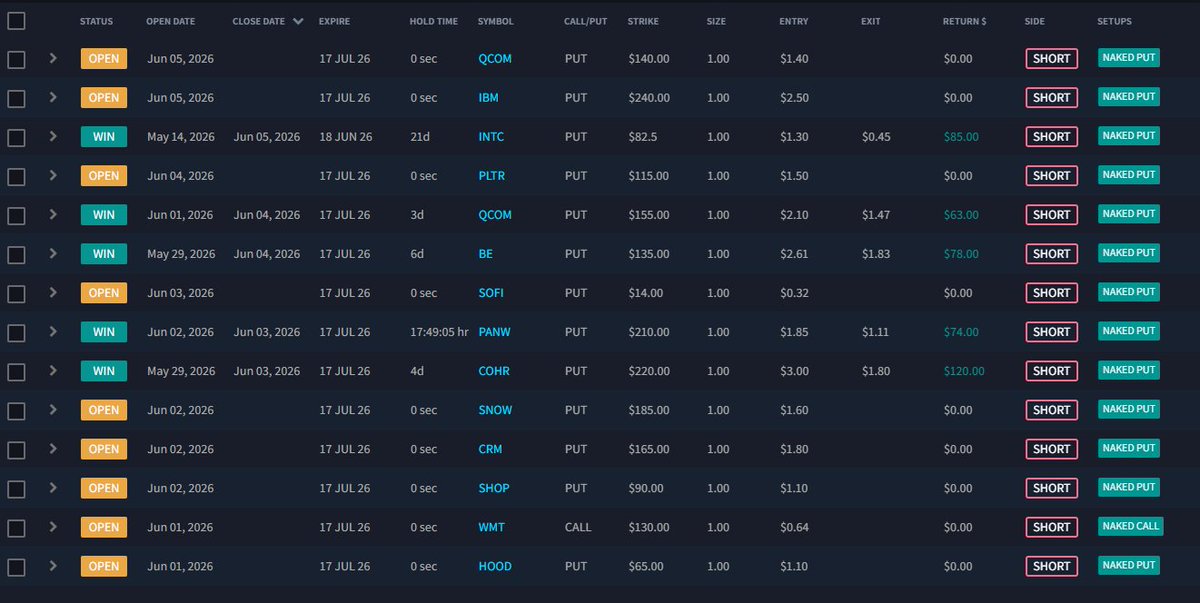
A great example of using actual data to track a specific premium strategy. Here is the full breakdown: 👇

Another week in the books 📋
5 closed trades | $420 realized
9 positions still working
All naked puts, all short premium. Here's a full breakdown 🧵
1
4
1,137
Jun 8
You keep waiting for the “right market” to trade well.
Low volatility.
Clear trend.
Clean breakout.
Precision doesn’t come from conditions.
It comes from:
• Pre-defined risk
• One setup you actually understand
• Not touching trades mid-execution
• Accepting small losses fast
If you need perfect markets to be precise,
you’re not precise yet.
Professionals don’t wait for clarity.
They operate with it.
2
422
Jun 5
Friday is not the day to save your weekly PnL. It’s the day to protect it.
Statistically, retail traders blow more funded accounts on Friday afternoons than any other time of the week. The psychological urge to "end the week on a green note" or recover past losses creates a toxic execution environment. Volume drops, liquidity thins out, and spreads widen. If you force setups into this context, you are just gambling.
A professional Friday routine looks entirely different:
• Stop executing early: Set a hard cut-off time. If your edge hasn't appeared by mid-session, close the terminal.
• Quantify your mistake cost: Know the exact dollar amount your lack of discipline took from your balance this week.
• Offload the backend stress: Don't waste your evening manual-journaling into a messy spreadsheet. Let an automated system sync the data while you focus on behavioral review.
Trading shouldn't feel heavy. Protect your capital today so you actually have a business to run on Monday.
1
7
707
Jun 5
TraderSync exists for moments like this.
Mid-year isn’t about new goals. It’s about refinement.
Ask yourself:
* Did you remove a weak setup?
* Did you tighten your risk?
* Did you eliminate one emotional pattern?
* Did you simplify your execution?
*
If your system looks the same as January… you’re not evolving.
Progress in trading is subtraction.
Review your first half. Clean your playbook.
Build the second half intentionally.
Ready to see what your data actually says?
Link in bio.
2
468
Jun 4
You don't need another trading strategy. You know exactly where you are losing money.
You know you are forcing setups in chop, ignoring your stop loss, and gambling based on feelings.
Your only choices now:
1. keep burning capital
2. start auditing your execution like a business
Hoping for a different result without tracking the data is a waste of time.
6
638
Jun 4
Be honest.
How many of your worst trades came from:
* FOMO?
* Revenge?
* Needing to “make something happen”?
Stillness is a competitive advantage.
When you’re calm:
* You wait.
* You follow rules.
* You protect capital.
When you’re overstimulated:
* You click.
* You justify.
* You regret.
The market rewards the regulated trader — not the reactive one.
If your best trades only happen when you’re composed…maybe calm isn’t a personality trait.
Maybe it’s a strategy.
3
456
Jun 3
Most traders use Market Replay to feel good about winning fake trades.
If you want to use it like a professional, do this instead:
1. Hunt your red days: Replay the exact hours where you blew your rules to study the behavioral pattern.
2. Practice the waiting game: Sit through hours of chop on replay without clicking just to build discipline.
3. Test under pressure: Simulate high-impact news days to see if your risk management actually holds up.
4. Track your holding time: Watch your winners run on replay to stop cutting them short out of pure panic.
5. Kill the magic strategy myth: Backtest the same setup 100 times to face the real win rate.
Amateurs look for excitement. Professionals look for data.
2
704
Jun 3
Speed impresses beginners.
Intentionality pays professionals.
High-level traders don’t:
- Chase every breakout.
- Size up randomly.
- Trade because they’re bored.
They move when the conditions align with their system.
And that only happens when:
- You know your edge.
- You trust your data.
- You’ve seen your stats enough times to stay patient.
Intentional trading is boring.
And boring is profitable.
2
5
2,410
Jun 3
6 realities of the trading floor:
• Knowing when NOT to click is more profitable than finding a perfect setup.
• Your biggest enemy isn’t the market; it’s your own boredom.
• An untracked trade is a statistical waste of capital.
• Risk management matters more than any viral strategy.
• If a 4H chart isn't clear, walking away is a winning trade.
• Amateurs look for excitement. Professionals look for data.
1
6
515
Jun 2
If you lost money today, stop tweaking your strategy and look at the 4H chart.
You’ll probably realize the macro structure was a complete mess all day. Your entry technique wasn't the problem because your impatience was. You zoomed into the 5m or 15m chart out of pure boredom, convinced yourself you saw a "perfect setup," and got chopped up by random noise.
When the 4H isn't clear, institutions are sitting on their hands. If they aren't trading, you shouldn't be either.
The best traders don't find setups in messy markets; they have the discipline to shut the laptop and wait.
Your journal data will thank you tomorrow.
1
8
559