
🤝Helping over 10,000 coaches improve their practices & win more games. ⬇️ONLINE MEMBERSHIP BELOW.
Joined August 2023
- Tweets 8,252
- Following 214
- Followers 9,779
- Likes 1,884
3,209 Photos and videos



Pinned Tweet

15 Apr 2025
🔥 Our favorite constraint at Transforming Basketball
🧠 The "Floor is Lava" constraint creates better spacing by forcing players to escape the paint, encouraging smarter positioning and movement without the ball.
😄 Players love it. Coaches see results.
🔁 ❤️ Repost and Like this post, and we'll send you the full breakdown. (Valid 72h only)
93
63
230
38,398
This is what a season of Constraints-Led Approach (CLA) coaching looked like for one U21 team in Belgium who were completely new to the method.
Allaa Ridouan is head coach of the U21 side at Bavi Vilvoorde in Belgium. When he took over, he committed to building every session around game-like situations from day one.
Players had to decide when and what to do. His job was to shape the environment and see whatthey discovered for themselves.
Most shooting drills included either live opposition or a variable before the shot. It could be a bad pass or an off-balance situation beforethe ball even reached them.
The idea was simple: If the game doesn’t only give you clean looks with time to set your feet, why should training?
The doubts came early. But as the season went on, something shifted. Players were engaged from the first minute of warm-up to the last minute of drills.
Parents started noticing their kids showing more leadership and communicating differently, things they were seeing away from the court as much as on it.
Before one game, Allaa asked his players to tell him the starting five and which plays they wanted to open with. Then he walked out and left them to decide together.
It was another way of helping them co-create, take ownership, and develop a deeper understanding of the game.
The U21 side reached the Flanders Cup Final and the Final Four of the top U21 youth teams in Belgium. As assistant coach with the first team, they earned promotion from 3rd to 2nd Division.
5
726
We have 8 different T-Shirt designs for you to choose from on our merch store! Head to merch.transformingbball.com.
308
Save your spot here- f.mtr.cool/smzjhklitn
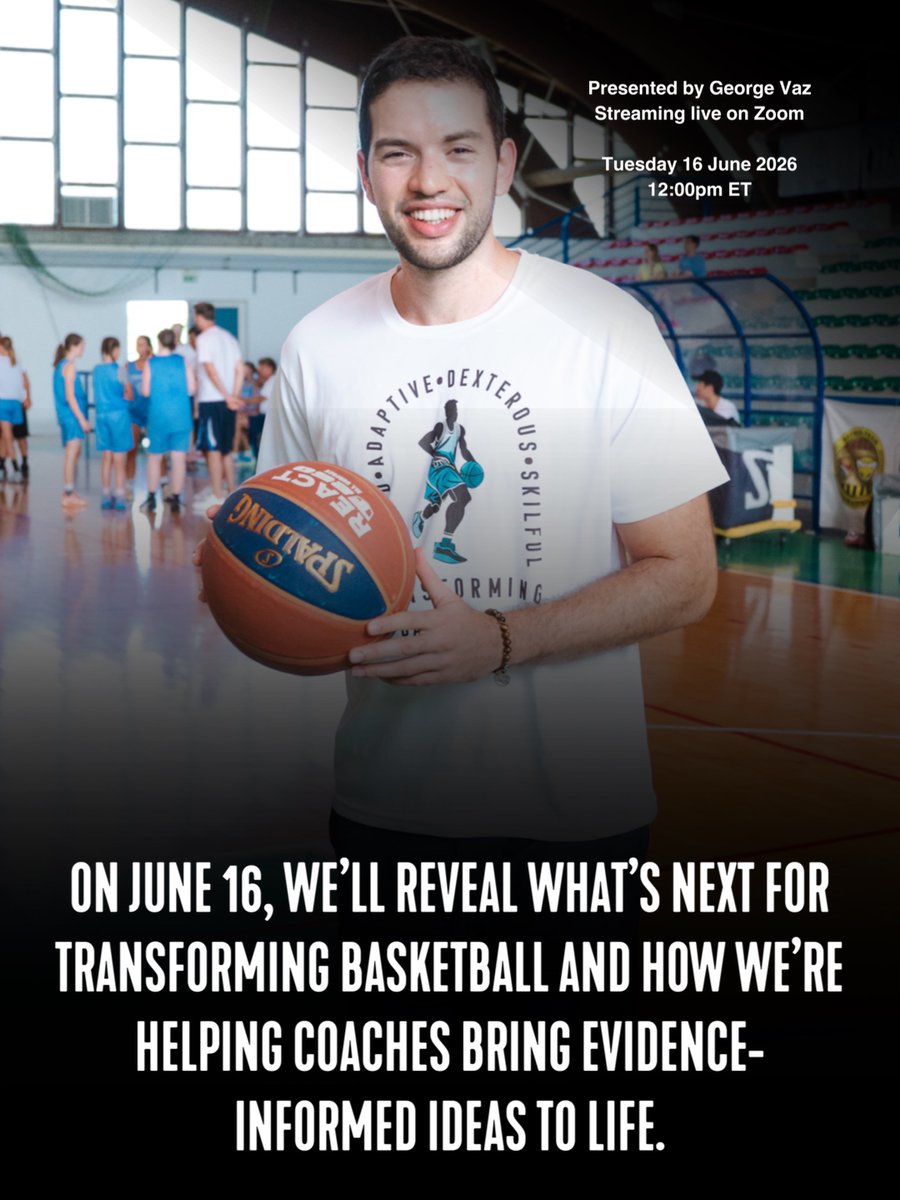
The next chapter of Transforming Basketball starts June 16! We’re making a major announcement👀
Join us live as we reveal what’s next for the community, the platform, and the future of how coaches learn, connect, and develop the game.
The webinar is free to attend, but you’ll need to save your spot.
1
340
🏎️1-on-1 'Around the Bend'
💡Creating scenarios for players to finish vs a defender on the hip while attacking downhill
👉Vary the sharpness of the bend through creating different playing spaces on each basket. Players move after each rep.
1
19
1,315
The real goal of return to play shouldn't just be about building strength in the gym, but allowing for skills to transfer directly back onto the court!
4
848
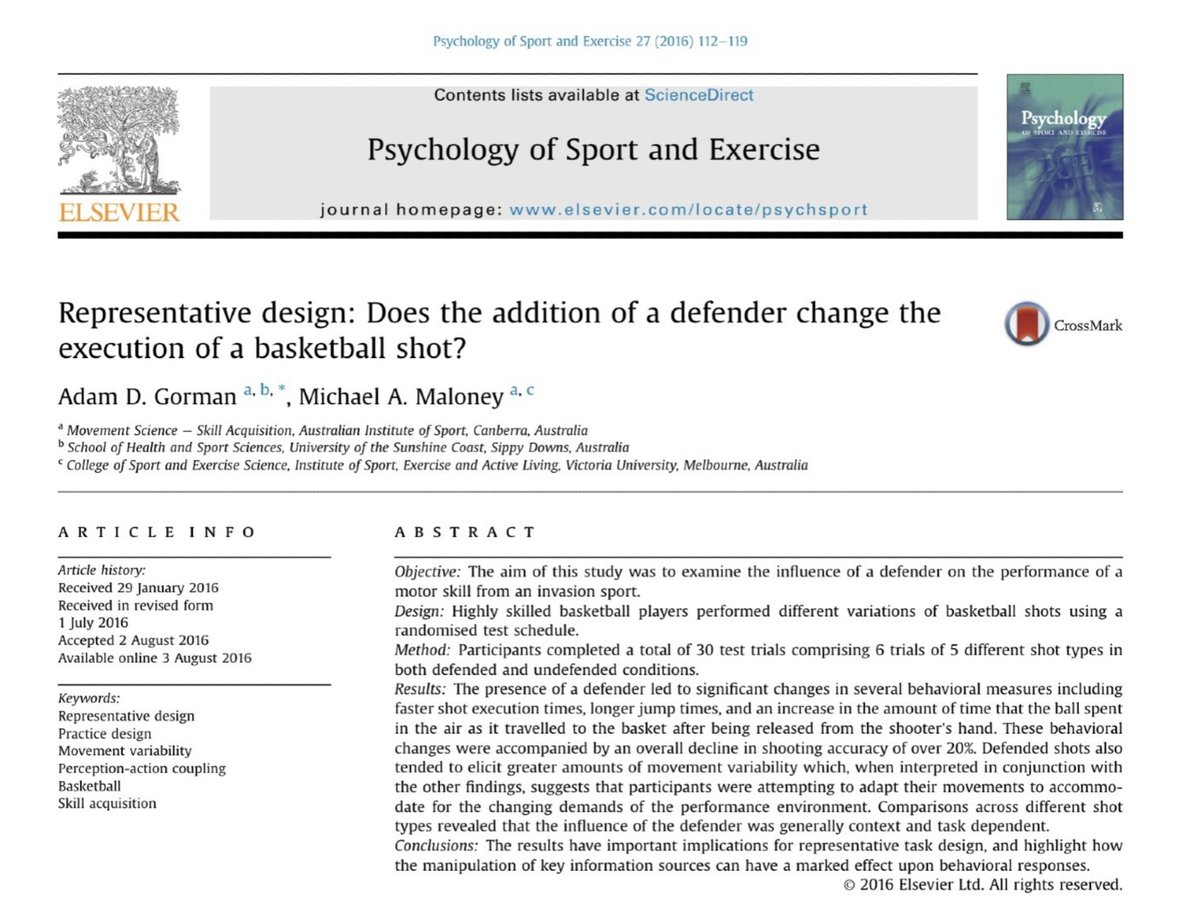
A 2016 study by Gorman and Maloney published in the Psychology of Sport and Exercise examined how the presence of a defender impacts the jump shot in basketball.
One finding stood out above everything else.
Adding a defender reduced shooting accuracy by over 20%.
Here’s what that means for how you design your shooting practice.
The study explored how the presence of a defender impacts several variables within the jump shot. This is critical for making sense of shooting and how we can design more effective shooting activities as coaches.
Basketball players participated in 30 trials of 5 different shot types, both with and without a defender. The goal was to see how defenders affected shot execution and accuracy.
KEY FINDING 1: SHOOTING ACCURACY
The presence of a defender reduced shooting accuracy by over 20%.
This is a critical finding illustrating how important it is to practice with a defender to better reflect game conditions.
If your players are only ever shooting without a defender in practice, they are rehearsing a version of shooting that simply does not exist in the game.
KEY FINDING 2: SHOT EXECUTION TIME
Players executed shots faster when defended.
This highlights how shooting drills without an opponent risk developing passive attractor states, movement habits that feel comfortable in practice but donot transfer to the game.
If your players never practice shooting under time pressure and defensive pressure, they are not preparing for the game they will actually play.
KEY FINDING 3: MOVEMENT VARIABILITY
Defended shots showed greater movement variability, indicating that players adapted their movements to the defender’s actions.
This is exactly what skill looks like. Not a perfectly repeated technique, but the ability to self-organize into a functional solution based on what the environment is presenting. The defender is not a distraction from good shooting. The defender is what good shooting is actually built around.
PRACTICAL APPLICATION 1: REPRESENTATIVE LEARNING DESIGN
Having defenders in practice sessions creates more game-like conditions, leading to shooters being able to adapt to changing constraints within the game.
Representative Learning Design means making practice look like the game. And in a game, there is always a defender. Start by simply adding a defender to your existing shooting activities and observe how your players respond.
PRACTICAL APPLICATION 2: ADJUSTING DEFENDER PROXIMITY
The defender’s distance and close-out direction naturally impacts the shot.
Coaches can modify the defender’s proximity by using constraints — a greater distance for younger or less experienced players, tighter and more physical close-outs as players develop. This allows you to control the challenge point and ensure players are always working at the right level of difficulty.
By incorporating these ideas into practice, coaches and players can significantly improve how we approach shooting.
1
10
39
3,296
Players can only move on the basketball lines. They must be as creative as they can with the dribble, gaining one point each time they get more than an arms' distance separation from the "mirror" defender.
9
1,759
🚨 Spots are open for hosting Transforming Events this season. Secure your date now 👉 transformingbball.com/events…
4
401
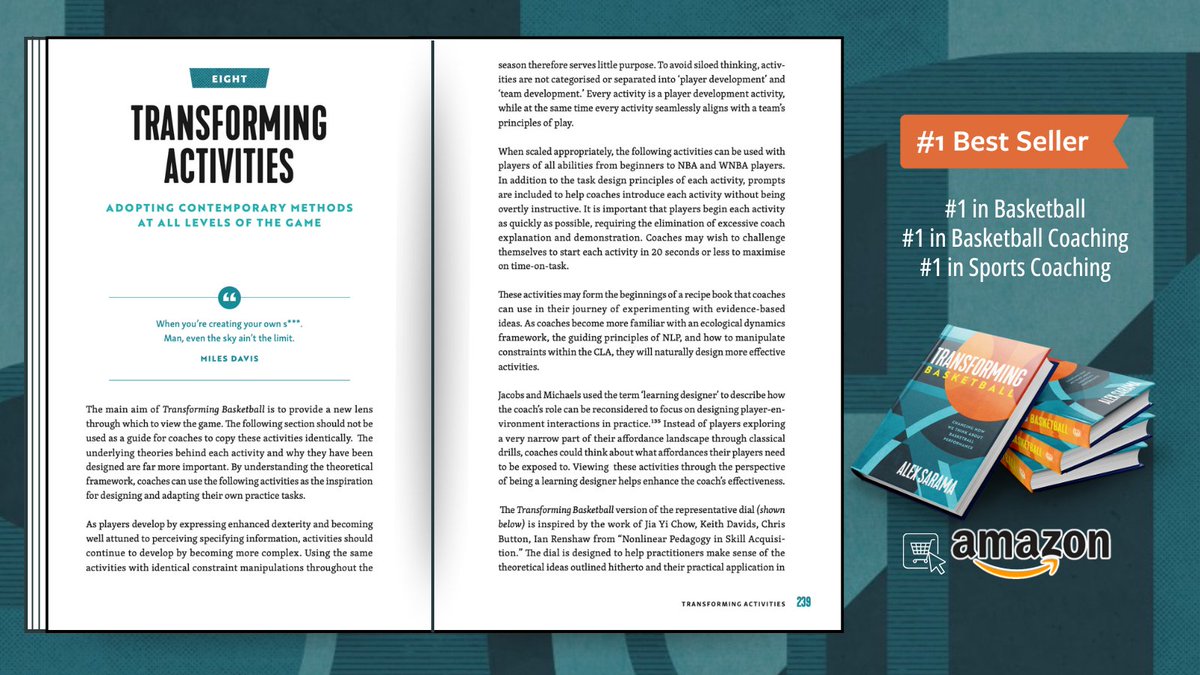
Inside our best-selling Amazon book, we provide an entire chapter of activities to help you make sense of a CLA and leave with numerous ideas for your next practice.
👉 amzn.to/3vO1Tc7
3
728
To develop a "force weak" defense, George Vaz uses the constraint whereby two consecutive dribbles on the right hand is two points for the offense.
This is a great constraint for allowing the defense to think about how to intentionally orientate their body to force the offense to the weak hand.
4
51
3,505
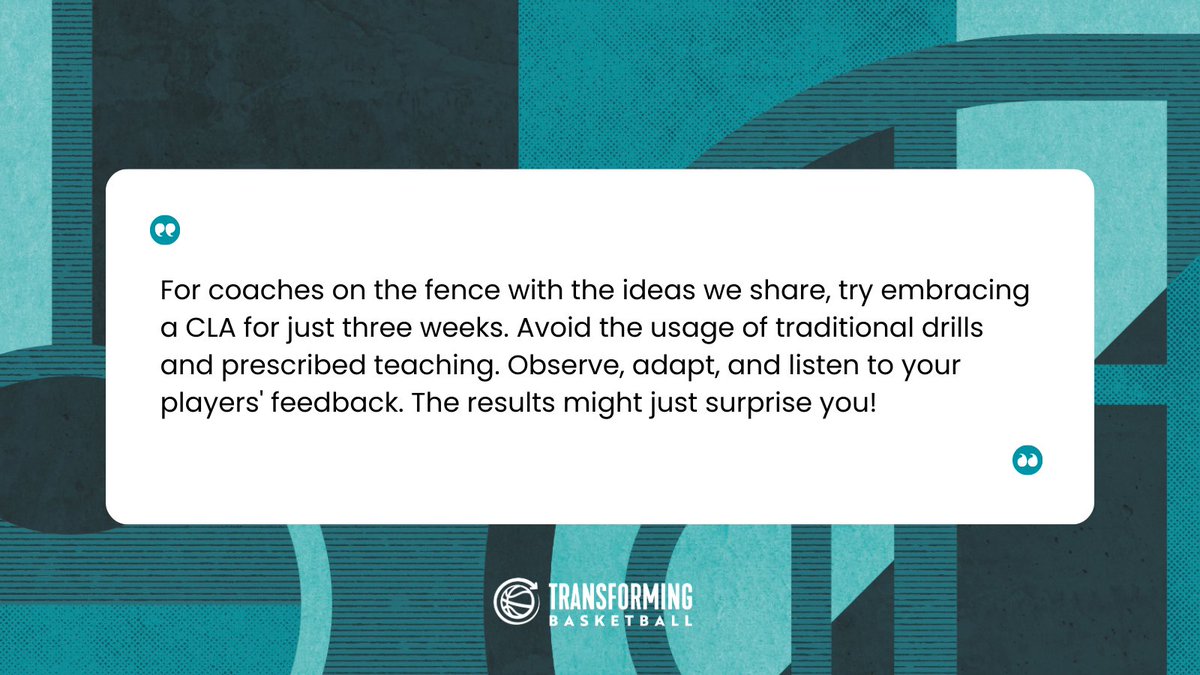
Curious to learn more about the CLA, but not sure about going all in? This is the advice we would give you!
1
4
573
🔥 Three reasons WHY coaches need to use more 1-on-1 in their practices.
1
20
2,213
Setup
- 2 offensive players vs 1 defender.
- The offensive players start spaced apart (NBA-style spacing).
- Coach/player starts with the ball in the middle and passes to either offensive player.
Objective
- The two offensive players must create an open shot using ball movement.
- They are allowed a maximum of 2 passes after the initial pass.
Offensive Constraints- no dribbling. Players can only pass or shoot
They can shoot immediately after receiving the first pass and use one or two additional passes before shooting.
Defender’s Objective- Contest shots, block shots and deflect or steal passes.
Scoring
If the offense scores: Both offensive players receive 3 points. If the defender blocks the shot, or steals/intercepts a pass, the defender receives 5 points.
1
29
1,780
Player autonomy matters. Using real EuroLeague examples, this blog by @CoachGeorgeVaz breaks down how coaches can provide opportunities for co-design even during high-stakes moments.
transformingbball.com/the-co…
1
4
581
"Stay Alive Dribbling" 1-on-1 1
If the handler has maintained possession after 5 seconds, the 1 enters the equation as a screener. This now becomes a set-up game, where the handler attempts to arrive alone at the moment of the screen to create an easier 1-on-1.
1
15
1,685
📘 Inside the Player Development Blueprint: proven methods, 250 SSGs, and full alignment with team principles of play. 👉 transformingbball.com/course…
1
487
How do we view set plays at Transforming? We don't look at sets as a silver bullet. Instead, we focus on how the players interact within the set by focussing on what they are or aren't attuned to!
1
1
12
1,362
COMMENT "BLUEPRINT" TO LEARN THE EXACT STRATEGIES USED BY THOUSANDS OF COACHES TO START THEIR JOURNEY WITH CONCEPTUAL OFFENSE
25
1
14
1,797
With many of our Transforming SSGs, we utilize the "FIBA 3x3" rule to play until a score.
This forces players to react quicker after misses and steals to get ready for the next phrase of the game (either HC offense OR HC defense).
1
12
1,232
The Spurs' second-half shot selection became highly contested, leading to reduced efficiency despite early dominance.
Knicks' extra defensive effort, including superior closeouts by players like Josh Hart, proved decisive in overcoming the deficit.
Small margins in spacing (1.5 feet per closeout) can dramatically alter game outcomes .
2
12
1,372