Unlock better flexibility without sacrificing strength with the flexibility blueprint. Click the link in bio to start now!
Joined December 2012
- Tweets 5,822
- Following 50
- Followers 230
- Likes 69
2,387 Photos and videos

One of the biggest fears people have after a **SLAP tear** is hearing their shoulder click or pop during movement.
The immediate thought is usually:
"Have I torn it again?"
I thought the same thing.
Even after my pain was gone and my strength had mostly returned, my shoulder still clicked and popped. When I asked the sports physical therapists helping me recover, they all told me a similar thing:
**Noise without pain is often far less important than people think.**
The shoulder is one of the most complex joints in the body.
Multiple muscles, tendons, ligaments, and joint surfaces are all moving together at the same time. Because of that, clicking by itself doesn't tell us much about what's actually happening.
What matters more is how the shoulder functions.
Can it tolerate load?
Does it feel stable?
Is strength improving?
Can you move through greater ranges of motion over time?
In many cases, clicking is more of a **control issue than a damage issue**.
When the rotator cuff and scapular stabilizers are weak, the shoulder doesn't track as efficiently as it should. That can create friction, shifting, and noise during movement.
As strength, stability, and flexibility improve, the joint often starts moving more smoothly.
That's exactly what happened to me.
The clicking gradually reduced and eventually disappeared altogether.
I've since worked with hundreds of people recovering from SLAP tears and seen the same pattern repeatedly.
That's why rehab should focus on restoring **strength, stability, and structural balance**, not obsessing over every sound the shoulder makes.
Because the goal isn't a silent shoulder.
The goal is a strong, stable, pain-free shoulder.
#slaptear
#shoulderrehab
#rotatorcufftraining
#scapularstability
#shoulderclicking
#shoulderpain
#strengthtraining
#painfreetraining
#structuralbalance
13
Most people think the goal of shoulder rehab is simple:
“Just get out of pain.”
And honestly, after a SLAP tear, that sounds good enough at first.
You just want to sleep normally again.
Train without fear.
Move your arm without constantly thinking about it.
But over the years we’ve noticed something interesting at Unity Gym:
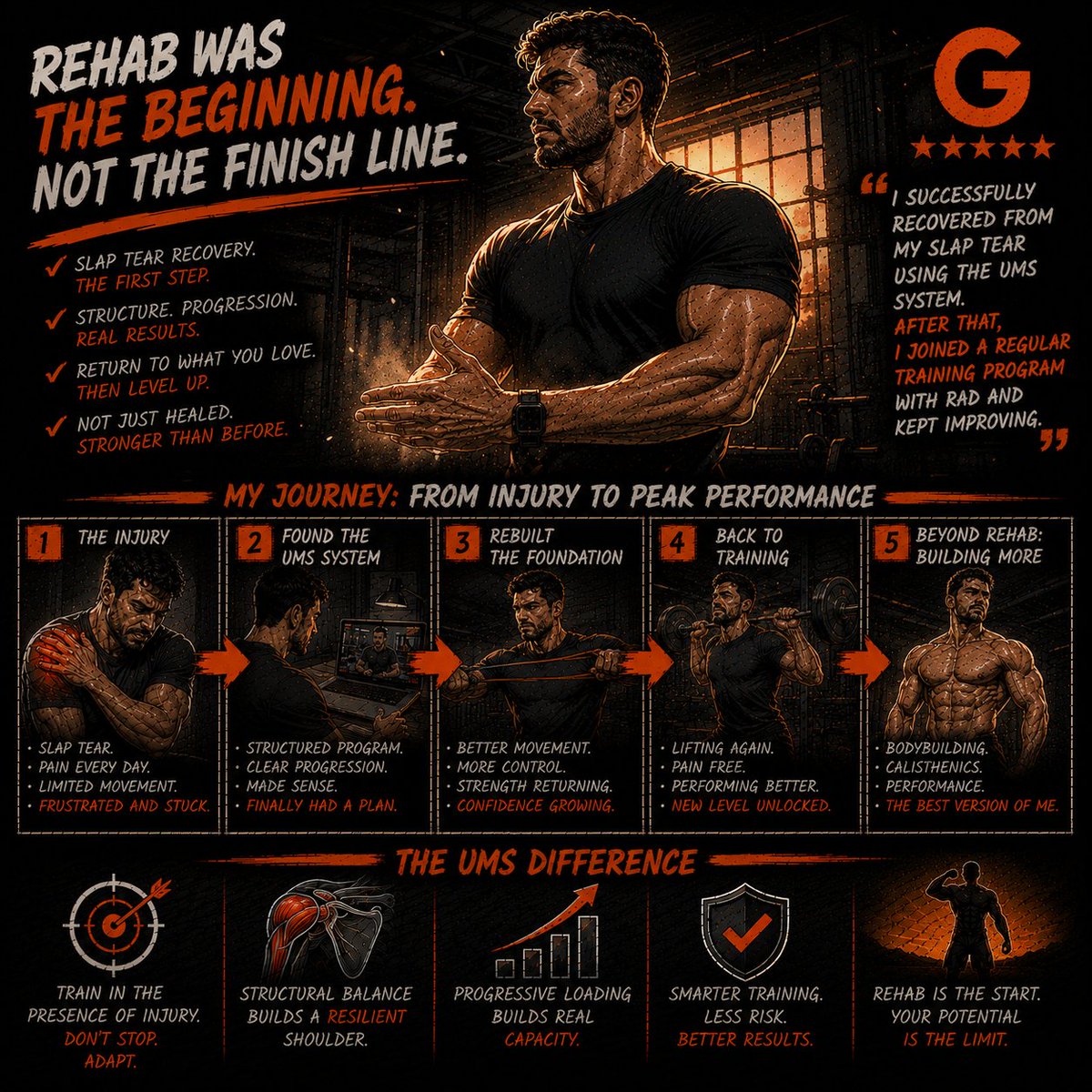
For many people, rehab becomes the beginning of something much bigger.
That’s what stood out in Oded’s Google review.
He explained that after successfully recovering from his SLAP tear using the UMS system, he transitioned directly into a regular training program closely monitored by Rad.
That transition matters.
Because most rehab systems treat recovery like the finish line.
Unity Gym treats it like the foundation.
The goal is not to create people who are permanently stuck doing “injury rehab.”
The goal is to rebuild a body capable of real training again.
That is why so many people inside UMS eventually pivot into:
bodybuilding
calisthenics
CrossFit
Hyrox
martial arts
sport-specific performance
physique development
And what surprises most people is how quickly the injury starts fading into the background once the body is functioning properly again.
Because when structural balance improves…
Everything improves.
Movement quality.
Strength output.
Recovery capacity.
Mobility under load.
Confidence.
That is why the principle of training in the presence of injury matters so much.
The body never fully stops adapting.
It just needs intelligent progression.
And once people understand that, the entire relationship with training changes.
Rehab stops feeling like a prison sentence.
It becomes a gateway.
A stronger body.
A smarter training system.
A more resilient athlete.
That is why so many people who originally join UMS for shoulder pain end up staying long after the injury improves.
Not because they are broken.
Because they realise the same principles that rebuilt the shoulder can also build an incredible body.
That is the hidden benefit most people never expect.
The injury ends up becoming the thing that finally forces them to train properly.
If you want to understand how to rebuild your shoulder and return to serious training faster than you thought possible, watch the full SLAP Tear Rehab video for free: ▶️youtu.be/7gh2RRpktNQ?si=9_TI…... No opt-in. No email. Just the system.
80
One of the biggest lies people get told about shoulder injuries is this:
“You just need more treatment.”
So people keep bouncing between:
physios
chiropractors
massage therapists
injections
endless appointments
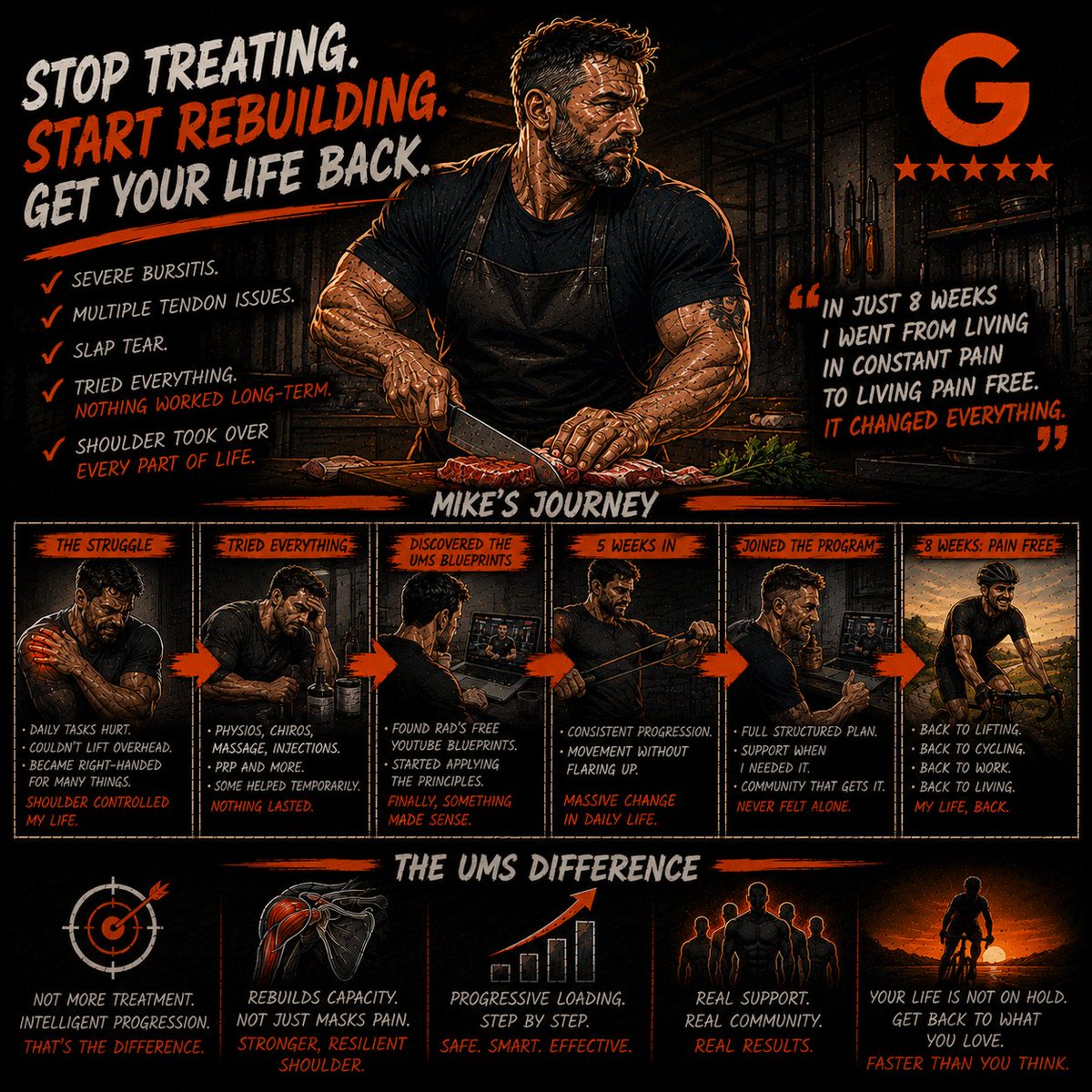
That was Mike’s life.
In his Google review, he described a shoulder that was completely taking over his day-to-day existence.
Severe bursitis.
Multiple tendon issues.
A SLAP tear.
Simple things became painful.
Turning a doorknob.
Stirring food.
Driving.
Wiping a counter.
Forget lifting overhead.
He even said he started becoming right-handed for many tasks because the shoulder was so dysfunctional.
That is what chronic injury does.
It slowly shrinks your life.
And what makes Mike’s story powerful is that he had already tried almost everything.
PRP injections.
Therapists.
Treatments.
Some helped temporarily.
But nothing created real lasting progress.
Over the years we’ve noticed something important:
Passive treatment can calm symptoms…
But it doesn't rebuild the shoulder’s actual capacity.
That requires something different:
Progressive loading.
That is the core principle behind training in the presence of injury.
The shoulder has to relearn how to tolerate movement, force, and coordination again.
Not recklessly.
Systematically.
And when the progression is right, the speed of improvement can shock people.
That is exactly what happened to Mike.
He started with Rad’s free blueprints from YouTube.
And within only FIVE weeks, he said he saw a massive change in daily life.
That alone would have been life-changing.
But after joining the full program?
Only THREE weeks later, he said he was living pain free.
That timeline matters.
Because most injured people expect recovery to feel painfully slow.
And while long-term rebuilding absolutely takes commitment, the body often starts responding much faster once the right structure is finally applied.
That is the difference between random rehab…
And intelligent progression.
Mike also mentioned something many people overlook:
Support.
Fast responses.
Positive reinforcement.
A real community of people going through the same thing.
Because recovery is not just physical.
People need belief restored too.
And perhaps the strongest part of his story is this:
He is not someone trying to simply survive daily life.
He is a fitness fanatic.
A cyclist.
A professional butcher and chef.
He needed his shoulder to perform at a high level.
That is why “manageable pain” was never enough.
He wanted his life back.
And that is exactly what proper progression is designed to restore.
If you want the exact shoulder rehab routine helping people reduce shoulder pain faster than they thought possible, comment:
SLAP TEAR
We’ll send you the full shoulder rehab video for free.
No opt-in.
No email.
Just the framework.
94
One of the biggest mistakes people make after a **SLAP tear** is staying forever in the range of motion that feels safe.
At first, it makes sense.
You find a range that doesn’t hurt and avoid anything deeper.
The problem is that your shoulder never learns how to handle those positions again.
So months later, the moment you reach further overhead, lower deeper into a press, or move into an end range position, the shoulder feels unstable all over again.
Most people assume that means the range is dangerous.
But often the opposite is true.
The shoulder feels unstable because it has never rebuilt **strength and control** in that position.
Your nervous system recognizes the lack of stability and responds by creating pain, tension, or a feeling of vulnerability.
It’s trying to protect the joint.
The mistake is avoiding that range forever.
Because avoidance teaches the nervous system that the position is still a threat.
The solution is **progressive exposure**.
Start with a range you can control confidently.
Build strength there.
Then gradually expand the range over time.
A little more movement.
A little more load.
A little more control.
As strength improves, the shoulder begins to trust those positions again.
That’s how stability is restored.
Not by forcing full range immediately.
And not by avoiding it forever.
But by earning it back one phase at a time.
That’s when the shoulder starts feeling strong, stable, and capable through its full range of motion again.
#slaptear
#shoulderpain
#rotatorcuff
50
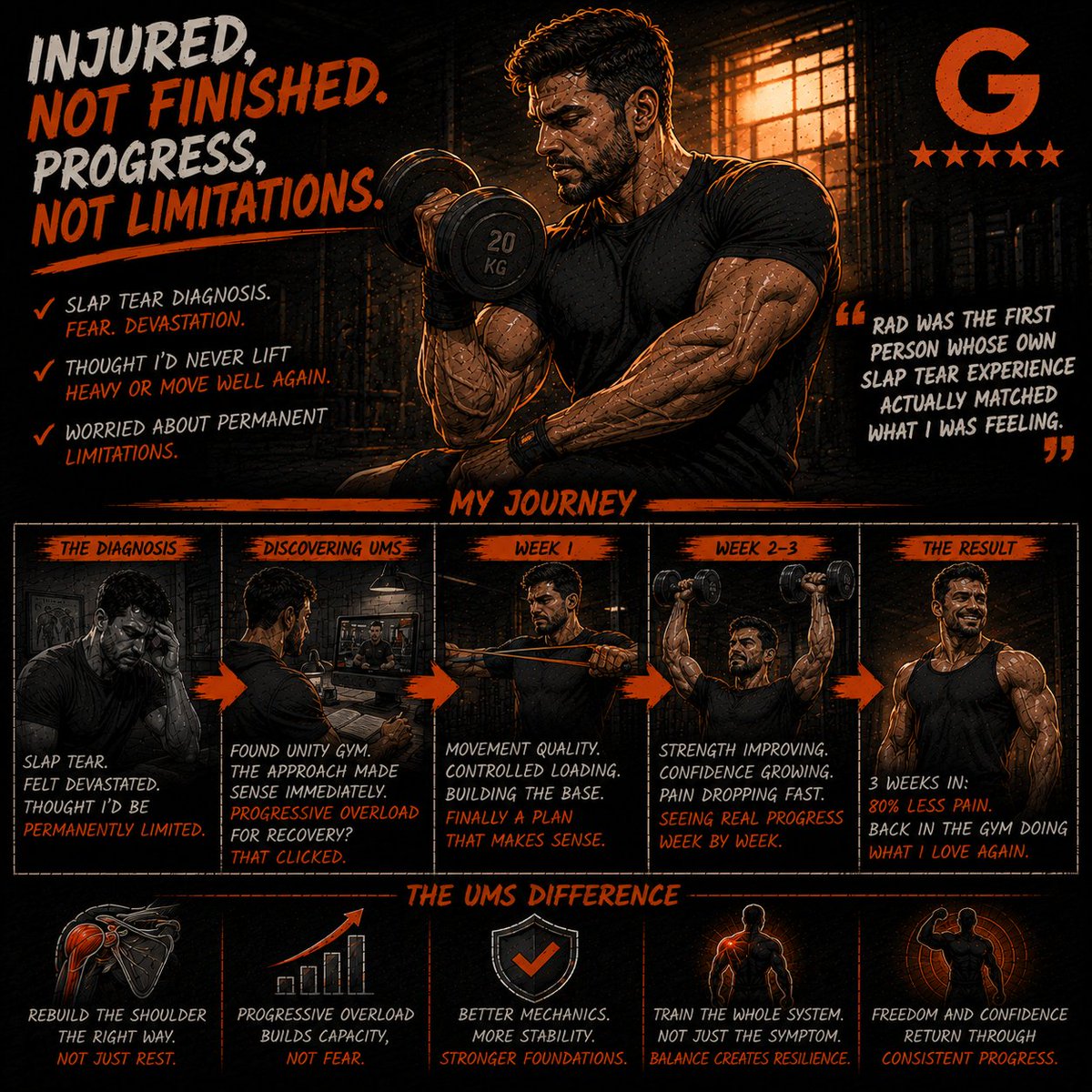
One of the hardest parts about a SLAP tear is not the diagnosis itself.
It is the story people attach to it afterward.
“You’ll always have limitations.”
“You probably shouldn’t lift heavy again.”
“Your shoulder will never feel the same.”
That fear hits hard when training is a big part of your identity.
That’s exactly where Gabe was.
In his Google review, he explained that after being diagnosed with a SLAP tear, he felt devastated by the idea that he would be permanently limited in both mobility and weight training.
That emotional reaction is incredibly common.
Because most people think rehab is completely separate from real training.
And once injury enters the picture, progress is over.
But over the years we’ve noticed something important:
The body still adapts after injury.
It just needs the right progression.
That is why Gabe connected so strongly with the Unity Gym approach.
In his review, he said the thing that made the most sense to him was Rad’s application of progressive overload to injury recovery.
That insight changes everything.
Because progressive overload is usually only talked about in the context of:
muscle gain
strength training
athletic performance
But the same principle applies to rehab.
The shoulder does not magically become resilient again through rest alone.
Capacity has to be rebuilt progressively.
One layer at a time.
Better mechanics.
Controlled loading.
Gradual exposure to force.
Smarter movement patterns.
That is the principle of training in the presence of injury.
You do not stop adapting because you are injured.
You adapt intelligently around the injury.
And the body responds surprisingly quickly when the structure finally makes sense.
After only 3 weeks in the UMS program, Gabe said he had already experienced an 80% reduction in pain.
Even more importantly?
He was able to return to doing what he loved in the gym again.
That matters.
Because the real goal is not simply reducing pain.
It is restoring freedom and confidence inside training again.
And maybe the most powerful part of his story was this:
He felt understood.
He said Rad was the first person whose own experience with a SLAP tear actually matched what he was feeling.
That connection matters more than people realise.
Because injured people do not just want exercises.
They want someone who truly understands what it feels like to lose trust in your own body.
That is often where real recovery begins.
If you want to understand how progressive overload can rebuild shoulder strength and confidence after a SLAP tear, watch the full SLAP Tear Rehab video for free: ▶️youtu.be/7gh2RRpktNQ?si=9_TI…... No opt-in. No email. Just the system.
51
One of the biggest traps serious lifters fall into is thinking:
“If I just learn enough, I should be able to fix myself.”
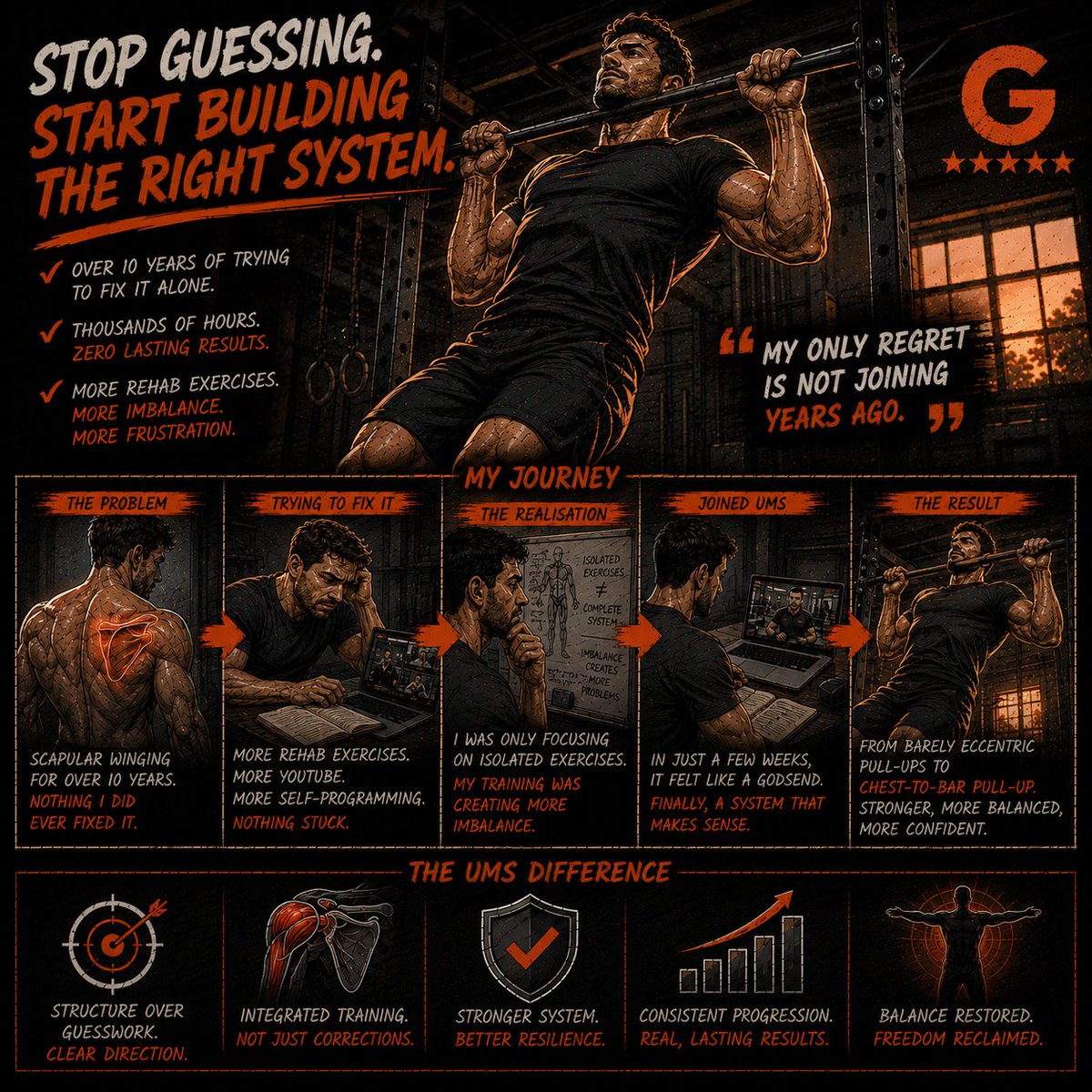
That was Filip’s mindset for over a decade.
In his Google review, he explained that he had been dealing with scapular winging for more than 10 years.
And like many intelligent, disciplined people, he kept trying to solve it alone.
More rehab exercises.
More self-programming.
More YouTube research.
But despite all the effort, the problem stayed.
Over time, something else happened too:
His motivation started swinging up and down because the work never produced real lasting progress.
That is a frustrating place to live mentally.
Because when effort stops producing results, people either burn out…
Or start believing their body is simply broken.
But over the years we’ve noticed something important:
Many people with chronic injuries are not failing because they lack discipline.
They are failing because their training structure is incomplete.
That is exactly what Filip realised.
In his review, he said the training he was doing before UMS probably created even more imbalance because he was only focusing on isolated rehab exercises instead of complete body workouts.
That insight is huge.
Because the body does not function as disconnected parts.
A shoulder blade does not stabilise itself in isolation.
Everything works together.
That is why Unity Gym focuses on structural balance and integrated programming instead of random corrective drills.
The goal is not simply “fix the winging.”
The goal is to rebuild a stronger, more coordinated system around it.
And once Filip finally joined the UMS coaching program, something shifted quickly.
Within just a few weeks, he said it felt like a “godsend.”
Not because everything was magically fixed overnight.
But because for the first time, the structure made sense.
He finally understood:
how to integrate rehab into normal training
how to progress without creating more imbalance
how to train consistently without overthinking everything
That clarity changes everything.
Because rehab becomes sustainable when people stop guessing.
And perhaps the best example of his progress was this:
Before joining, he could barely perform eccentric pull-ups.
Now he has achieved a chest-to-bar pull-up.
That is not just rehab.
That is restored athletic capacity.
And one of the most important parts of his story is that he had setbacks along the way.
But instead of quitting, the coaching helped him adjust and continue moving forward.
That is what long-term training really looks like.
Not perfection.
Adaptation.
And maybe the strongest line in the entire review was this:
“My only regret is not joining years ago.”
Because after years of trying to fix himself alone, he finally found a system that allowed him to stop fighting his body…
And start rebuilding it properly.
If you want to understand how to rebuild your body through structural balance instead of endless corrective exercises, comment:
STRUCTURAL BALANCE
We’ll send you the full structural balance video for free.
No opt-in.
No email.
Just the system.
76
Most people with shoulder injuries expect rehab to feel slow and uncertain.
Tiny improvements.
Constant flare-ups.
Always wondering if the shoulder will ever feel normal again.
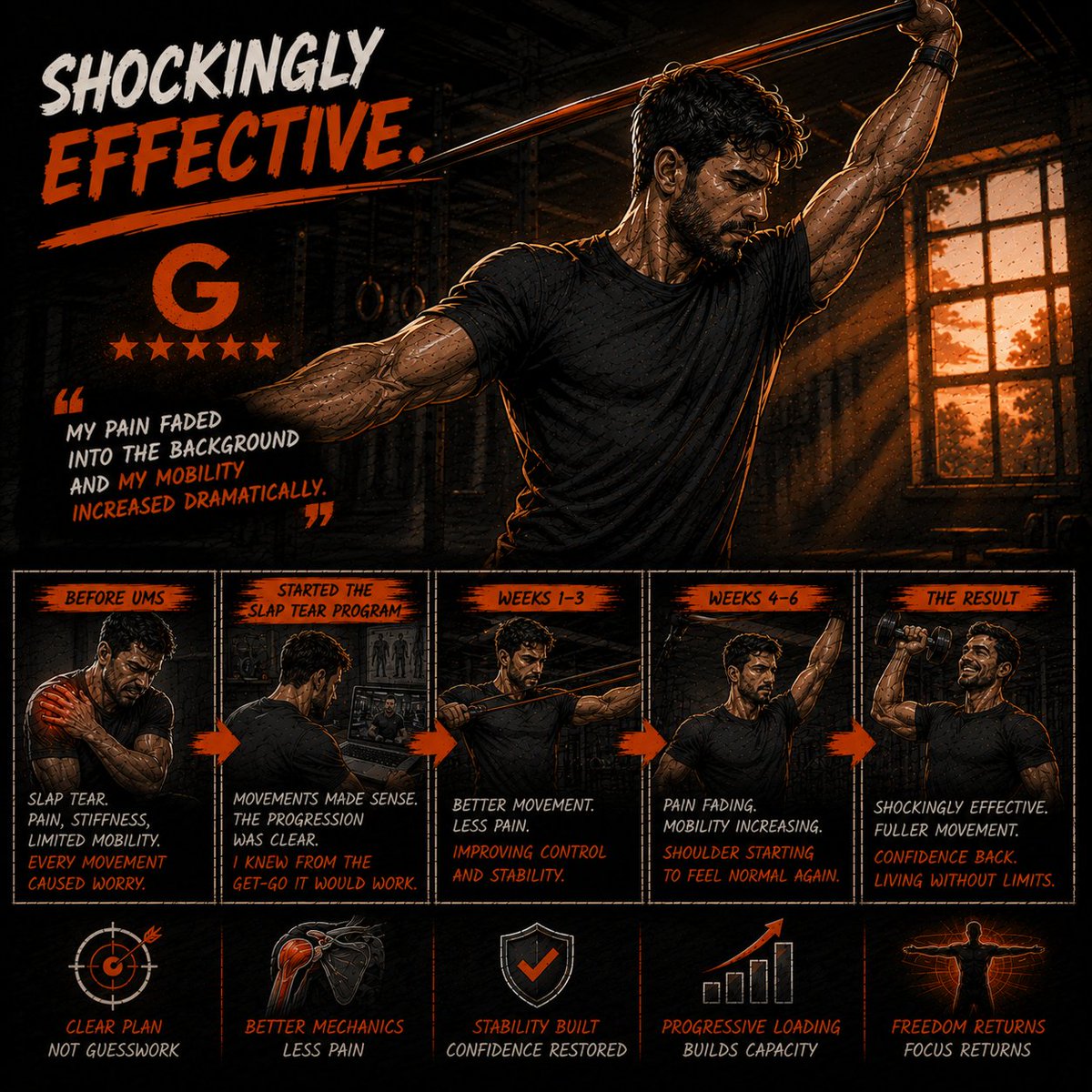
That’s what makes Cyrus’ review stand out.
In his Google review, he described the UMS SLAP Tear Rehab Program as:
“SHOCKINGLY effective.”
That is not language people usually use for shoulder rehab.
Especially with a SLAP tear.
Because many people with shoulder injuries spend months — sometimes years — trapped in cycles of:
pain
stiffness
limited mobility
fear around movement
And over time, the shoulder starts dominating their attention.
Every movement gets analysed.
Every flare-up creates anxiety.
The body stops feeling free.
But over the years we’ve noticed something important:
Shoulders improve much faster when the goal is not simply “pain relief.”
The goal has to be rebuilding how the shoulder functions as a system.
Mobility.
Strength.
Stability.
Scapular control.
Structural balance.
That is why Unity Gym integrates movement quality and progressive loading together instead of treating rehab like passive recovery.
And Cyrus noticed the shift quickly.
In his review, he said that as he applied the movements from the program:
“my pain faded into the background and my mobility increased dramatically.”
That line matters.
Because the real goal of rehab is not obsessing over the injury forever.
It is getting to the point where the shoulder stops controlling your thoughts.
Where movement starts feeling natural again.
Where pain becomes less emotionally dominant because the body is adapting properly.
And perhaps the best part of his review was this:
He said he “knew from the get-go” the program was going to work.
Why?
Because good rehab feels logical.
The exercises make sense.
The progression makes sense.
The body responds in a predictable way.
That clarity is powerful for injured people.
Because after enough failed rehab attempts, people stop trusting the process.
Unity Gym restores that trust by giving people structure instead of guesswork.
That is often the beginning of real recovery.
If you want to understand how to rebuild shoulder mobility and confidence after a SLAP tear, comment:
SLAP TEAR
We’ll send you the full shoulder rehab video for free.
No opt-in.
No email.
Just the framework.
48
One of the hardest moments in rehab is when you feel like you have run out of options.
You have seen the doctors.
Tried the rehab.
Done the exercises.
Waited for improvement.
And the shoulder still feels unstable.
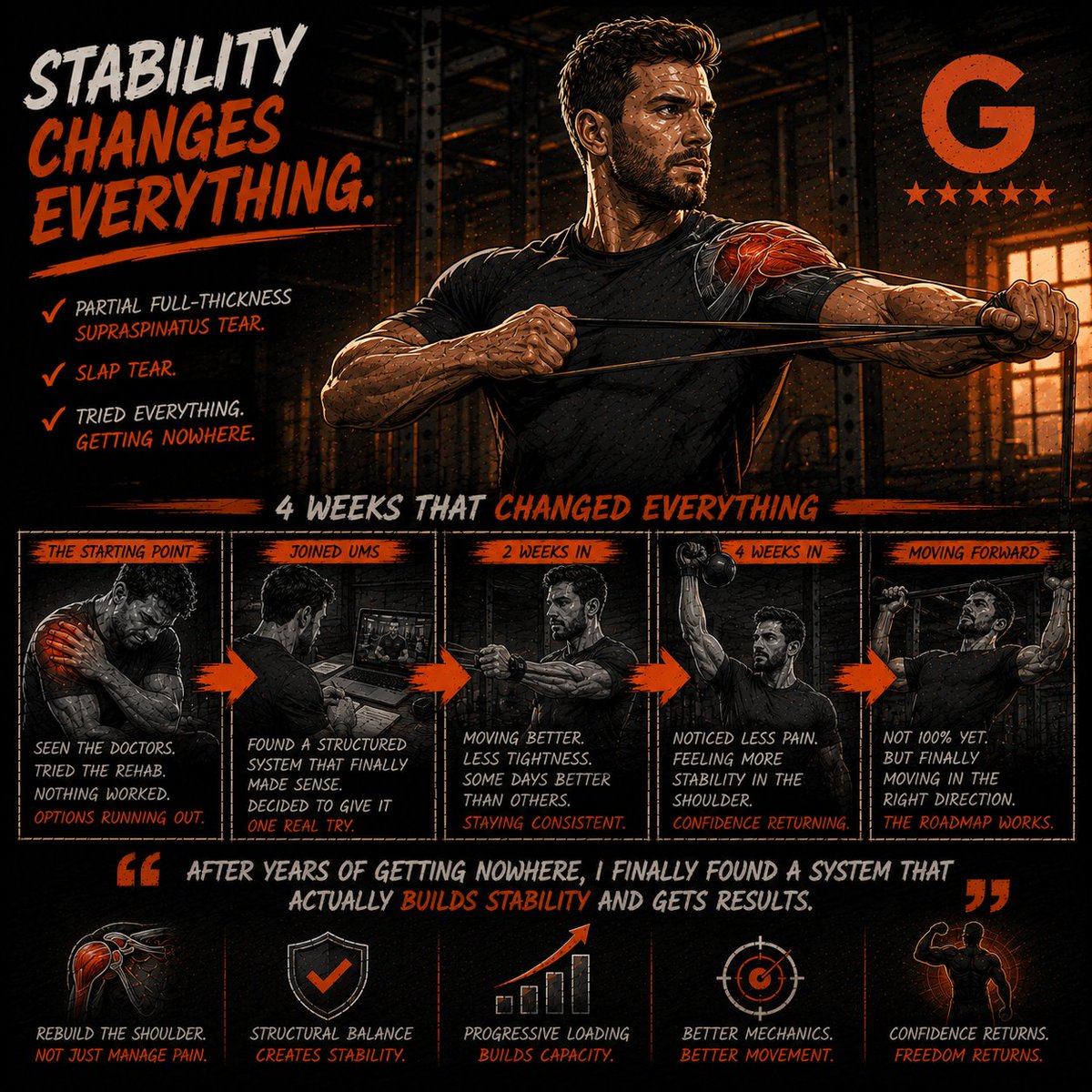
That’s where Alex was.
In his Google review, he explained that he was dealing with both:
a partial full-thickness supraspinatus tear
and a SLAP tear
After trying multiple non-surgical approaches and working with numerous doctors, he said he was getting nowhere.
That stage is dangerous mentally.
Because once people stop believing progress is possible, they stop fully investing in recovery.
Over the years we’ve noticed something important:
A lot of shoulder rehab focuses too heavily on pain reduction alone.
But pain is only part of the problem.
The shoulder also loses:
stability
movement confidence
load tolerance
structural support around the joint
And unless those things are rebuilt progressively, people stay stuck in the same cycle.
That is why Unity Gym approaches rehab differently.
The goal is not to simply “protect” the shoulder forever.
The goal is to rebuild the system around it.
Smarter loading.
Better mechanics.
Progressive stability.
Structural balance.
And often the first sign of progress is not dramatic strength gains.
It is something more subtle:
The shoulder starts feeling stable again.
That is exactly what Alex described.
After only 4 weeks in the UMS program, he said he already noticed:
less pain
and more stability in the shoulder
That matters.
Because stability changes everything psychologically.
The body stops feeling fragile.
People stop guarding movement constantly.
And confidence slowly returns.
What makes Alex’s story powerful is that he joined UMS when he felt like he had nothing left to lose.
And within weeks, progress finally started happening again.
Not because of a miracle.
Because the shoulder finally had a structured progression instead of endless guessing.
That is what many injured people really need.
Not more random exercises.
A roadmap.
If you want to understand how to rebuild shoulder stability and confidence after a SLAP tear, comment:
SLAP TEAR
We’ll send you the full shoulder rehab video for free.
No opt-in.
No email.
Just the framework.
1
91
One of the biggest problems with shoulder rehab is not just pain.
It is skepticism.
Because after enough failed rehab attempts, people stop believing anything will actually work.
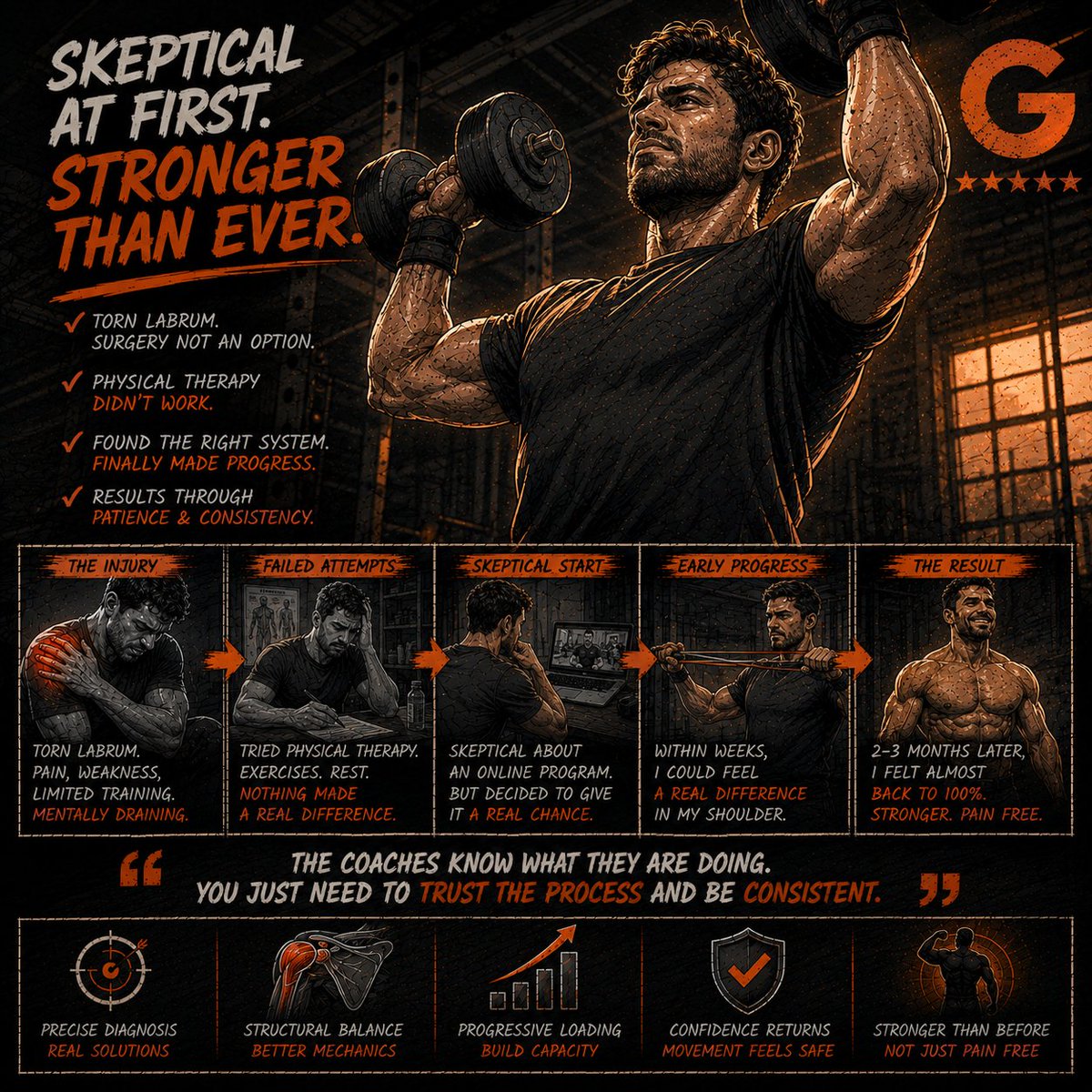
That’s where Adam was.
In his Google review, he explained that he was skeptical at first about whether an online program could really help his torn labrum.
Especially because previous physical therapy had not made any real difference.
And surgery was not an option.
That is a frustrating place to be.
You feel stuck between:
rehab that does not work
pain that keeps lingering
and no clear path forward
Over the years we’ve noticed something important:
A lot of rehab systems fail because they stop at symptom management.
They reduce pain temporarily…
But they never fully rebuild the shoulder’s load capacity.
That is why people plateau.
The shoulder might feel “okay” in normal life…
But the second they try to train properly again, the problem returns.
Unity Gym approaches rehab differently.
Not as passive recovery.
As progressive rebuilding.
Better mechanics.
Controlled loading.
Structural balance.
Progressive capacity over time.
And Adam noticed something quickly.
In his review, he said that within just a few weeks, he could already feel a difference in his shoulder.
Then 2–3 months later, he said he felt almost back to 100%.
But maybe the most important part of his review was not the physical result.
It was what he said about patience.
Because real rehab is not built on hype.
It is built on consistency.
That is why he said:
“The coaches know what they are doing. You just need to trust the process and be consistent.”
That line matters.
Because many injured people panic during the middle phase of rehab.
The progress feels slower.
The body is still adapting.
Doubt creeps in.
But capacity is built gradually.
One successful session at a time.
That is why structured progression matters so much.
It keeps people moving forward even when emotions fluctuate.
And eventually the shoulder starts feeling like part of you again instead of something fragile you constantly protect.
If you want to understand how to rebuild shoulder strength and confidence after a torn labrum, comment:
SLAP TEAR
We’ll send you the full shoulder rehab video for free.
No opt-in.
No email.
Just the framework.
2
114
One of the biggest fears people have about injury rehab is this:
“I’m going to lose all my progress.”
Smaller muscles.
Less strength.
Less confidence.
Months stuck doing boring rehab exercises while the rest of the body goes backwards.
That is how most people think rehab works.
And honestly, most rehab systems reinforce that belief.
Stop training.
Rest the injury.
Wait until the pain disappears.
But over the years we’ve noticed something important:
The body does not stop needing strength just because one area is injured.
In fact, that is often when intelligent training matters most.
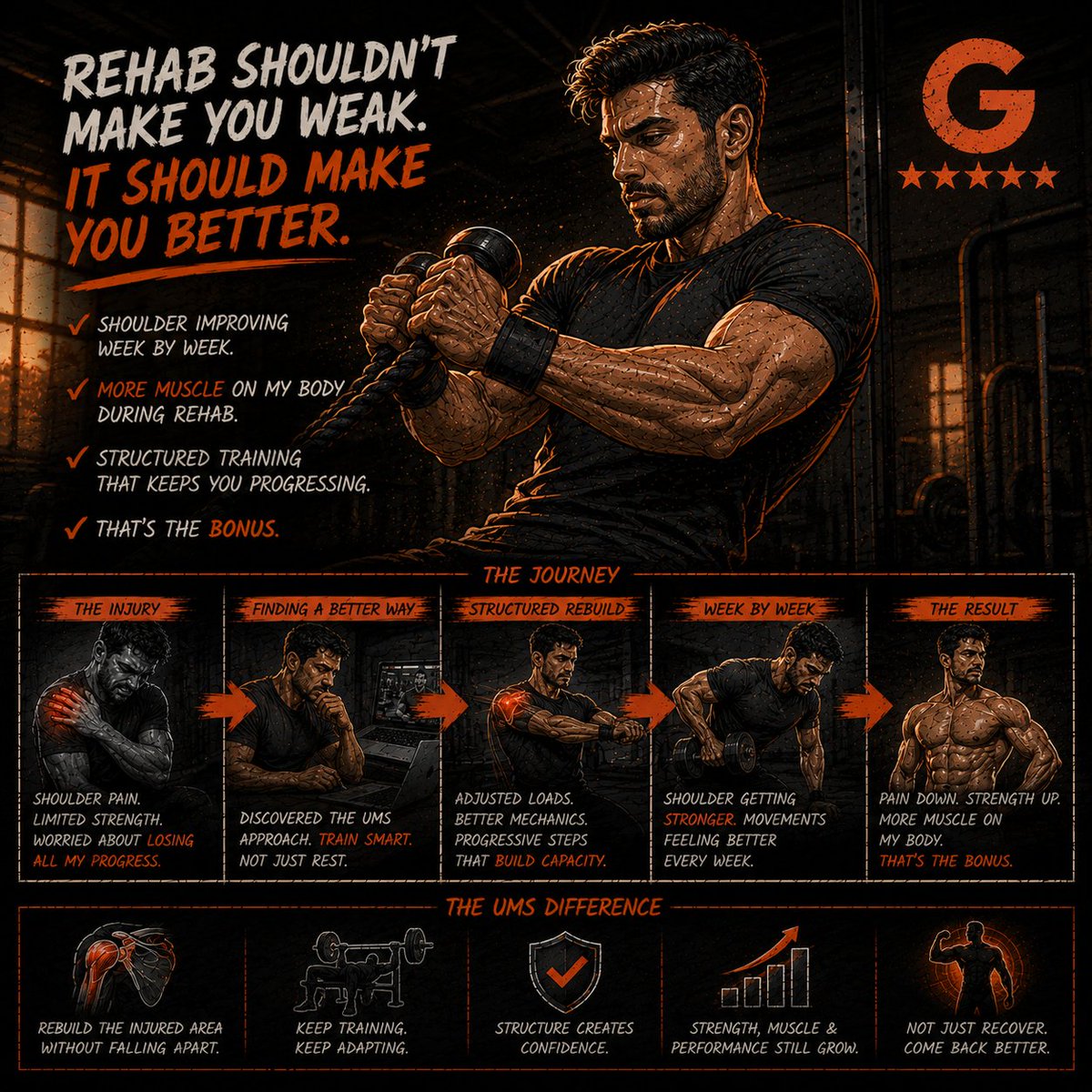
That is what makes Adnan’s review interesting.
In his Google review, he explained that his shoulder was improving week after week while working with Rad.
But then he added something most people do not expect during rehab:
“I also notice more muscle on my body which is a bonus during the rehab programme.”
That line says everything about the Unity Gym philosophy.
The goal is not to pause life while rehabbing.
The goal is to continue adapting while rebuilding the injured area intelligently.
That is the principle of training in the presence of injury.
You adjust the load.
Adjust the exercises.
Adjust the range of motion.
But the body keeps progressing.
Because rehab should not make people feel fragile.
It should make them feel capable again.
A lot of people assume rehab and physique progress are separate goals.
But when training structure improves, the whole body often improves with it.
Better mechanics.
Better balance.
Better programming.
Smarter progression.
That is why many people in UMS notice something unexpected:
They do not just reduce pain.
They move better.
Look better.
And become physically stronger during the process.
That is a completely different mindset from traditional rehab.
Not survival mode.
Progress mode.
If you want to understand how to rebuild your shoulder while still getting stronger and more muscular, comment:
SLAP TEAR
We’ll send you the full shoulder rehab video for free.
No opt-in.
No email.
Just the framework.
37
A lot of people mentally commit to surgery long before they actually book it.
Because once the scan says “labrum tear,” it feels inevitable.
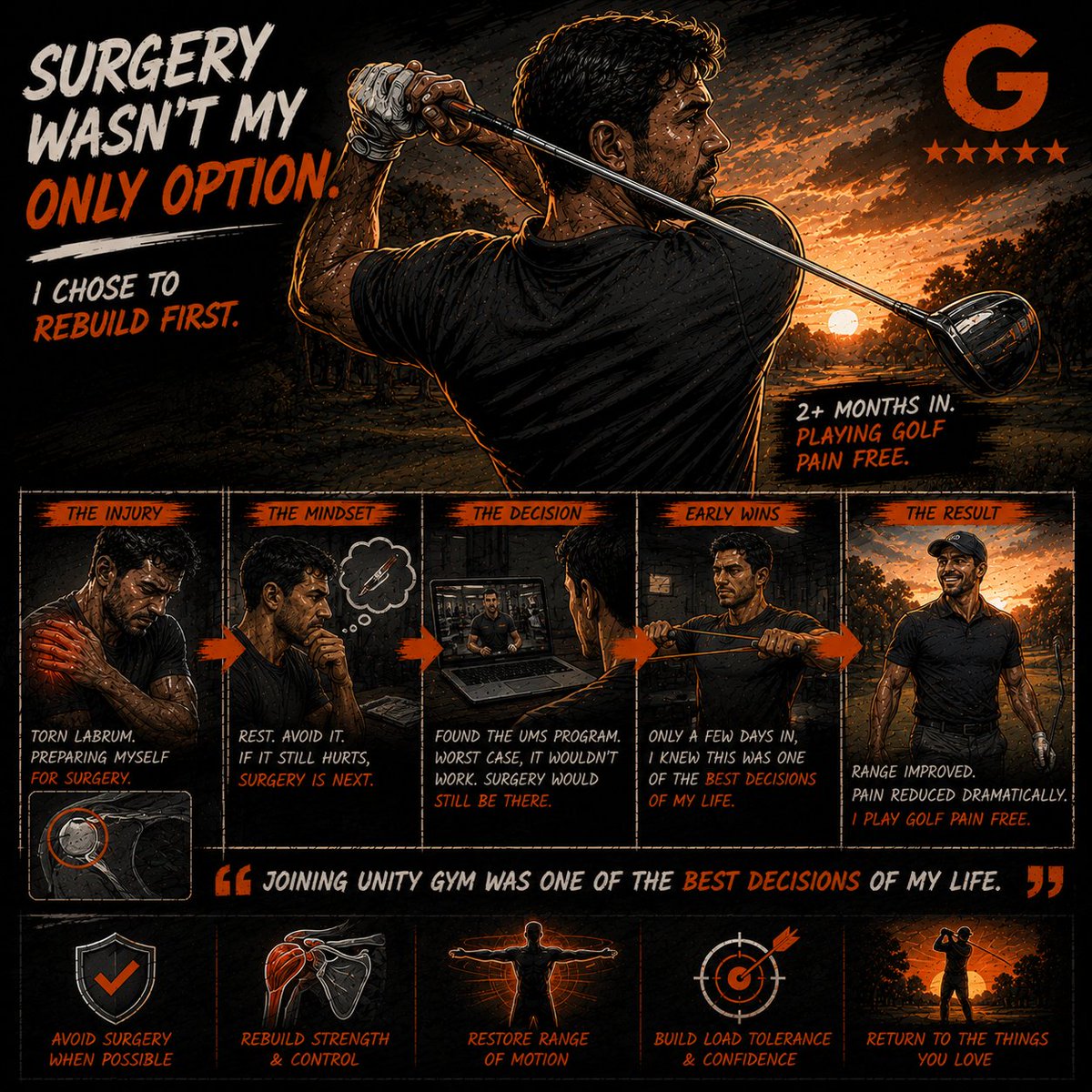
That’s where Domenic was.
In his Google review, he explained that when he tore his labrum, he was already preparing himself for surgery.
And honestly, that is understandable.
Most people are told some version of the same thing:
Rest it.
Avoid aggravating it.
And if it still hurts, surgery is probably next.
But over the years we’ve noticed something important:
Many injured shoulders are not just lacking healing.
They are lacking capacity.
The joint loses strength.
Control.
Movement confidence.
Load tolerance.
And if those qualities are never rebuilt properly, people stay stuck between pain and fear.
That is why Domenic decided to try the UMS program first.
His mindset was simple:
Worst case, it would not work and surgery would still be there as an option.
But something changed very quickly.
In his review, he said that only a few days into the workouts, he already knew joining Unity Gym was one of the best decisions of his life.
That is powerful.
Not because the shoulder was magically fixed overnight.
But because he could feel the body responding again.
His range of motion improved.
The pain reduced dramatically.
And for the first time, progress felt possible.
That is what many people miss about good rehab.
The early wins matter psychologically.
Because once the body starts moving better, fear starts loosening its grip.
And after a little over two months in the program, Domenic said he played golf pain free.
That moment matters.
Because golfers know how much rotational stress and control the shoulder needs.
Pain-free golf is not just about “feeling better.”
It is about trusting the body again.
That is the real goal of rehab.
Not simply reducing symptoms.
Restoring freedom inside movement.
If you want to understand how to rebuild shoulder strength and confidence before considering surgery, comment:
SLAP TEAR
We’ll send you the full shoulder rehab video for free.
No opt-in.
No email.
Just the framework.
1
21
One of the hardest parts about long-term shoulder pain is not the pain itself.
It is the doubt.
You try different approaches.
You watch videos.
You test exercises.
You rest.
You modify workouts.
And when nothing improves, you start wondering if your body is just stuck this way now.
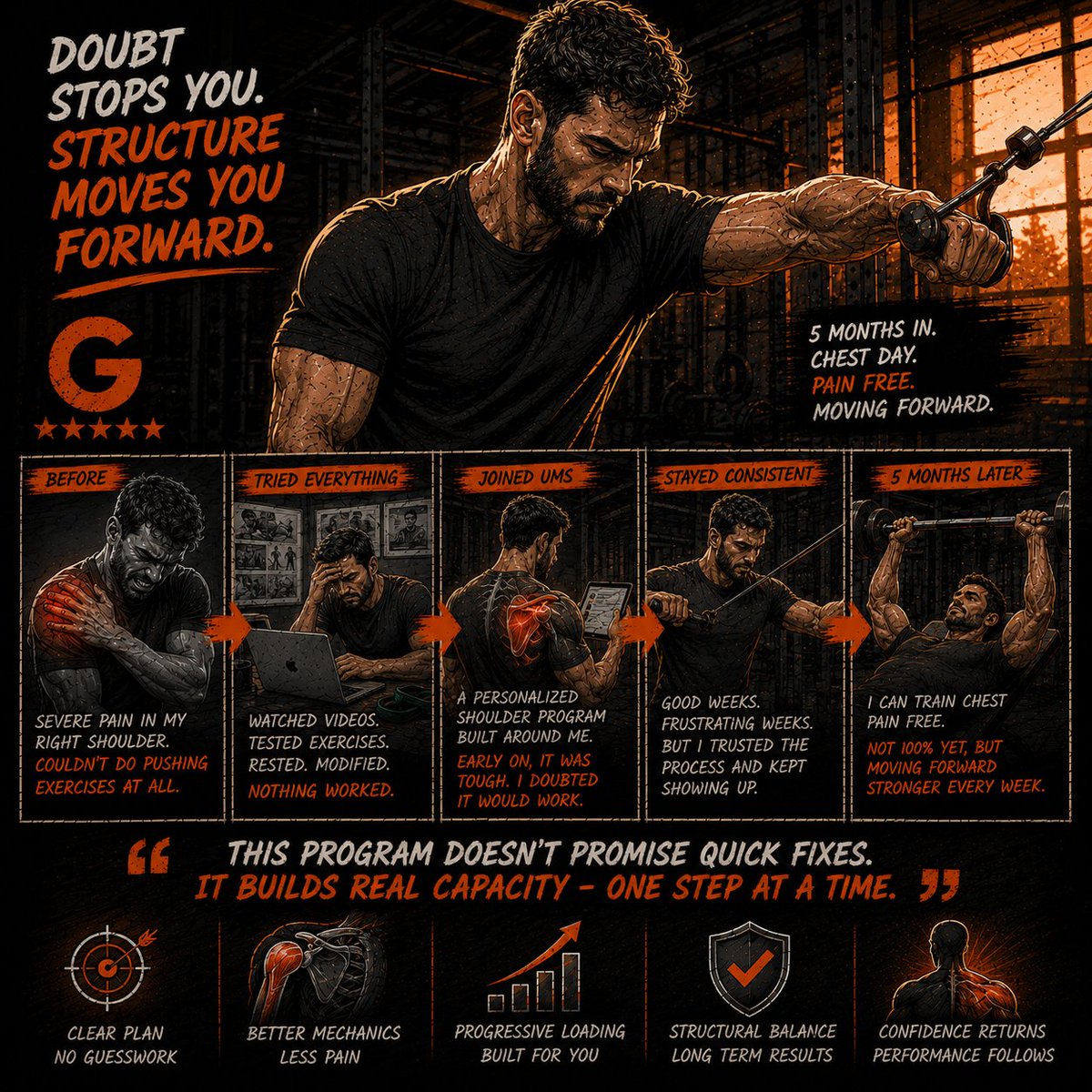
That’s where Ovidiu was.
In his Google review, he explained that he joined the UMS program after struggling with severe pain in his right shoulder.
The pain got so bad he could not perform pushing exercises at all.
And like many people with shoulder injuries, he had already tried fixing it himself before joining Unity Gym.
Nothing worked.
No improvement whatsoever.
That stage is mentally exhausting.
Because when rehab feels inconsistent, people stop trusting the process.
Over the years we’ve noticed something important:
A lot of people abandon rehab too early because they mistake discomfort for failure.
But rebuilding shoulder capacity is rarely linear.
There are good weeks.
Frustrating weeks.
Moments where progress feels slow.
That is why structure matters so much.
Ovidiu mentioned that his program was personalised specifically around his shoulder.
And early on, it was difficult enough that he questioned whether it would even work.
That honesty matters.
Because real rehab is not magic.
It is progressive rebuilding.
Load management.
Movement quality.
Structural balance.
Consistency over time.
And eventually the body starts adapting again.
After 5 months, Ovidiu said he could train chest pain free.
Not perfectly back to his old level yet.
But clearly moving forward again.
That is an important distinction.
Unity Gym is not built around fake promises or instant transformations.
It is built around rebuilding capacity properly.
One step at a time.
And maybe the most valuable part of his story is this:
He stayed consistent even when results were not immediate.
That is where many people fail.
Not because the body cannot improve.
Because they lose belief before adaptation has enough time to happen.
That is why structured progression matters so much.
It gives people a roadmap when emotions become unreliable.
If you want to understand how to rebuild shoulder strength and confidence after chronic shoulder pain, comment:
SLAP TEAR
We’ll send you the full shoulder rehab video for free.
No opt-in.
No email.
Just the framework.
32
One of the hardest things about shoulder injuries is how quickly they take away freedom.
Especially in gymnastics.
Movements that once felt natural suddenly feel risky. You stop trusting the shoulder.
You hesitate.
You avoid certain positions completely.
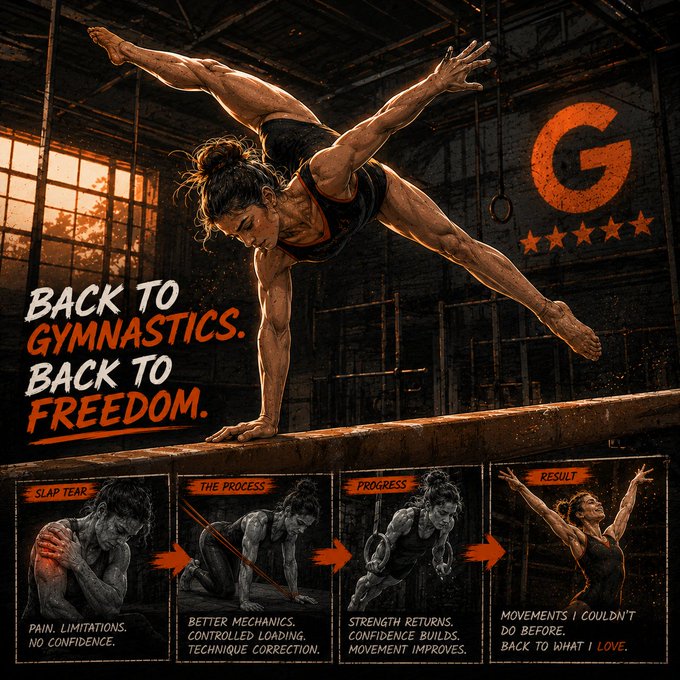
That’s where Gracie was.
In her Google review, she explained she was recovering from a SLAP tear when she found Unity Gym.
And what stood out was this: She did not just talk about pain relief.
She talked about getting back to gymnastics faster than she expected.
That is the real goal for athletes.
Not just “feeling okay.” Moving confidently again.
Over the years we’ve noticed that many rehab systems become too focused on protecting the joint.
But eventually the shoulder needs something else: Progressive exposure to movement.
Better mechanics.
Controlled loading.
Structural balance.
Confidence under tension.
That is one of the biggest differences with the UMS approach.
The goal is not to avoid movement forever.
The goal is to rebuild the system so movement becomes possible again.
Gracie also mentioned how helpful technique correction was during the process.
That matters.
Because small mechanical changes can completely change how force moves through the shoulder.
And often that is what finally allows progress to happen.
The best part of her review?
She said she was now able to do movements and exercises she could not do before.
That is real progress.
Not just less pain.
More freedom.
If you want to understand how to rebuild shoulder strength and confidence after a SLAP tear, comment: SLAP TEAR
We’ll send you the full shoulder rehab video for free.
No opt-in.
No email.
Just the framework.
35
One of the most frustrating stages of rehab is not the beginning.
It is the plateau.
When daily pain is mostly gone…
But your body still cannot do the things you actually care about.
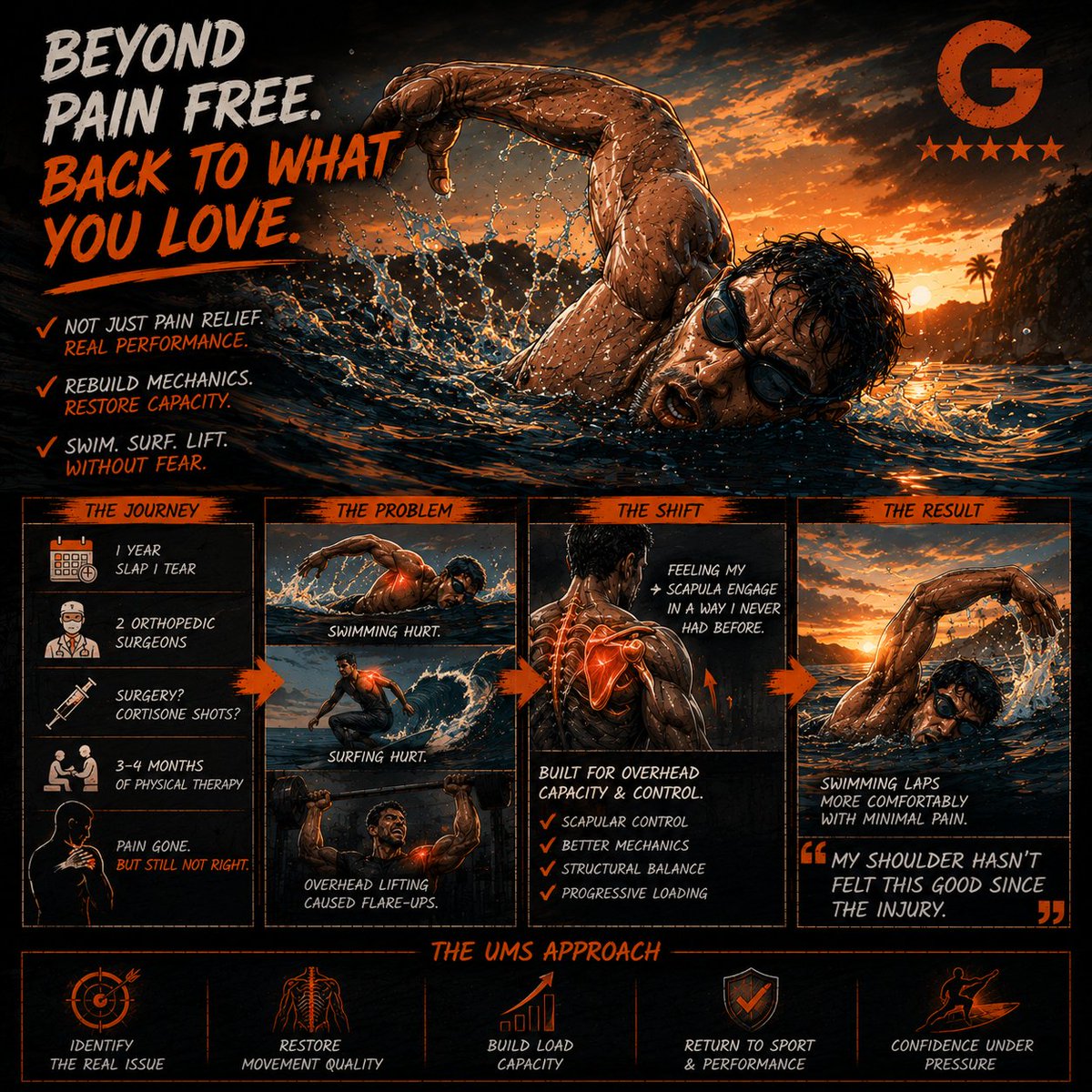
That’s where Cilvin was.
In his Google review, he explained that he had been dealing with a SLAP 1 tear for about a year.
He had already seen two orthopedic surgeons.
One suggested surgery.
Another suggested cortisone shots.
Instead, he chose physical therapy.
And to be fair, it helped.
After 3–4 months, the day-to-day pain was mostly gone.
But something still was not right.
Swimming hurt.
Surfing hurt.
Overhead lifting caused flare-ups.
That is the stage where many people get stuck.
Because traditional rehab often stops once pain becomes manageable.
But over the years we’ve noticed something important:
Pain reduction is not the same as restored performance.
A shoulder can feel “better” for daily life…
And still completely lack the load capacity needed for sport and training.
That is why so many people flare up the second they try to return to real movement again.
Cilvin recognised something else too:
His previous rehab was general.
Not specific to the actual problem.
That is one of the biggest differences with the UMS approach.
Unity Gym does not just chase symptoms.
The goal is to rebuild how the shoulder actually functions under load.
Scapular control.
Joint mechanics.
Structural balance.
Progressive overhead capacity.
And sometimes the biggest breakthroughs are not dramatic.
They are subtle.
In his review, Cilvin said he could feel his scapula engaging while swimming in a way he had never felt before.
That line matters.
Because when movement mechanics improve, the shoulder stops feeling disconnected and unstable.
The body starts working together again.
After only a few weeks in the program, he said he was already swimming laps more comfortably with minimal pain.
And perhaps the most important line in the entire review was this:
“My shoulder hasn’t felt this good since the injury.”
That is what happens when rehab finally moves beyond symptom management…
And starts rebuilding real athletic capacity again.
If you want to understand how to rebuild overhead shoulder strength and confidence after a SLAP tear, comment:
SLAP TEAR
We’ll send you the full shoulder rehab video for free.
No opt-in.
No email.
Just the framework.
68
A lot of people assume there is an age where the body stops adapting.
Where injuries become permanent.
Where stiffness becomes normal.
Where you just try to “manage” decline.
That belief gets even stronger after a serious injury.
That’s what makes Richard’s story so powerful.
In his Google review, he explained that he joined Unity Gym just two months before his 70th birthday after suffering a SLAP tear from a bicycle accident.
Most people at that stage would lower expectations.
Maybe do some cautious rehab.
Avoid challenging movements.
Accept reduced function as part of getting older.
But over the years we’ve noticed something important:
The body often declines because training structure declines.
Not because adaptation suddenly disappears.
Richard noticed improvements within two weeks.
But what really stood out to him was something deeper:
He could see the progression built into the UMS system.
That matters.
Because many people — especially after injury — lose confidence in random training.
What they need is structure they can trust.
So instead of stopping after one month, Richard committed to a full year.
Five months later, he said something remarkable:
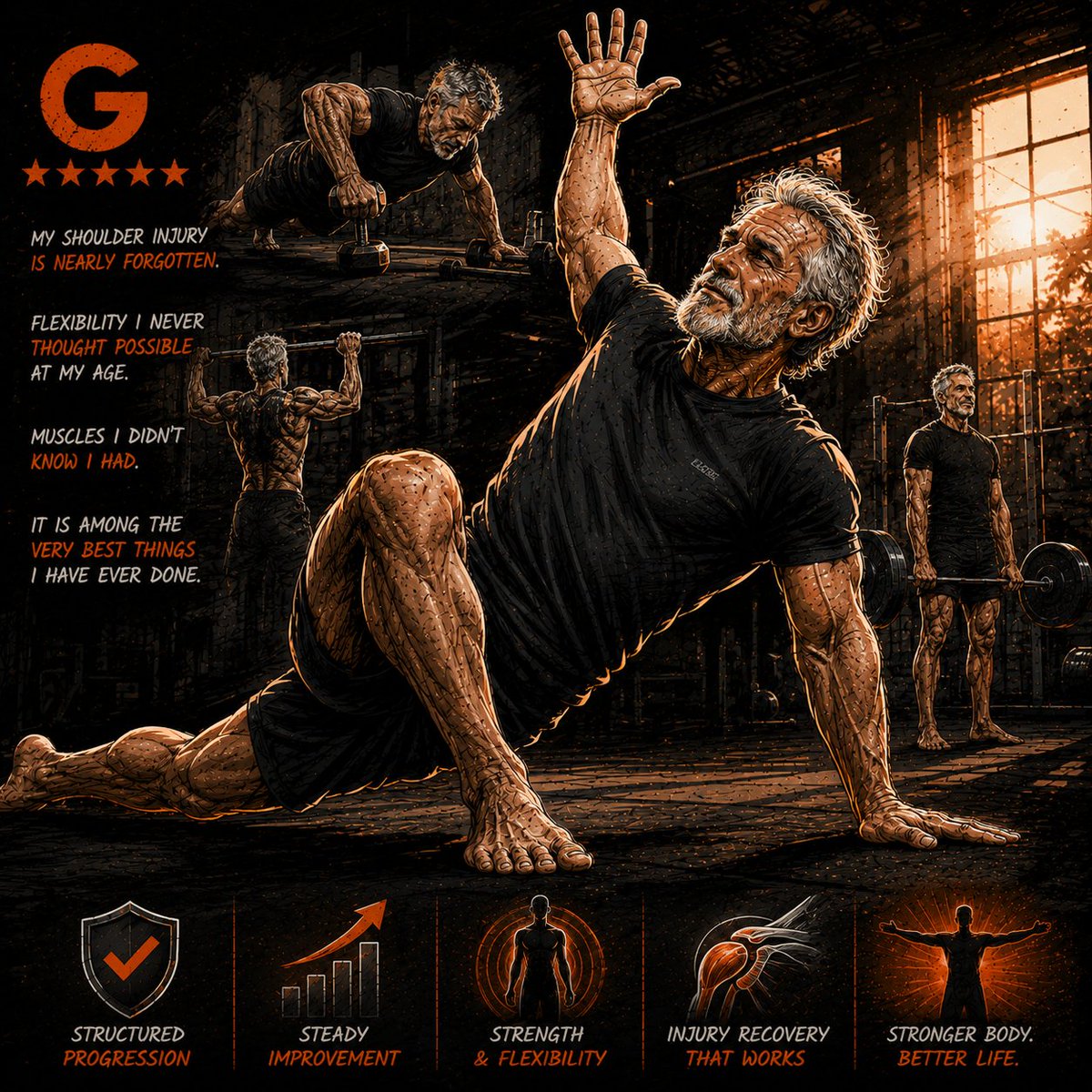
“My shoulder injury is nearly forgotten.”
Not ignored.
Not magically erased.
Simply no longer controlling his life.
And maybe the most powerful part of his story was not even the shoulder recovery.
It was this:
“I have been developing flexibility that I never would have thought possible at my age.”
That line captures one of the biggest myths in fitness.
People think aging automatically means becoming stiff, fragile, and limited.
But strength without flexibility creates stiffness.
And flexibility without strength creates fragility.
The body needs both.
That is why Unity Gym integrates them together instead of treating them as separate goals.
Richard also mentioned seeing muscles he “didn’t know he had.”
That is what happens when the body starts functioning more completely again.
Not just recovering.
Adapting.
And perhaps the best line in the entire review was this:
“It is among the very best things I have ever done.”
Not because the program was easy.
In his words, it was demanding.
But because rebuilding your body changes more than your body.
It changes how you move through life.
If you want to stay strong, mobile, and capable as you age, comment:
ANTI-AGING
We’ll send you the full anti-aging movement video for free.
No opt-in.
No email.
Just the system.
7
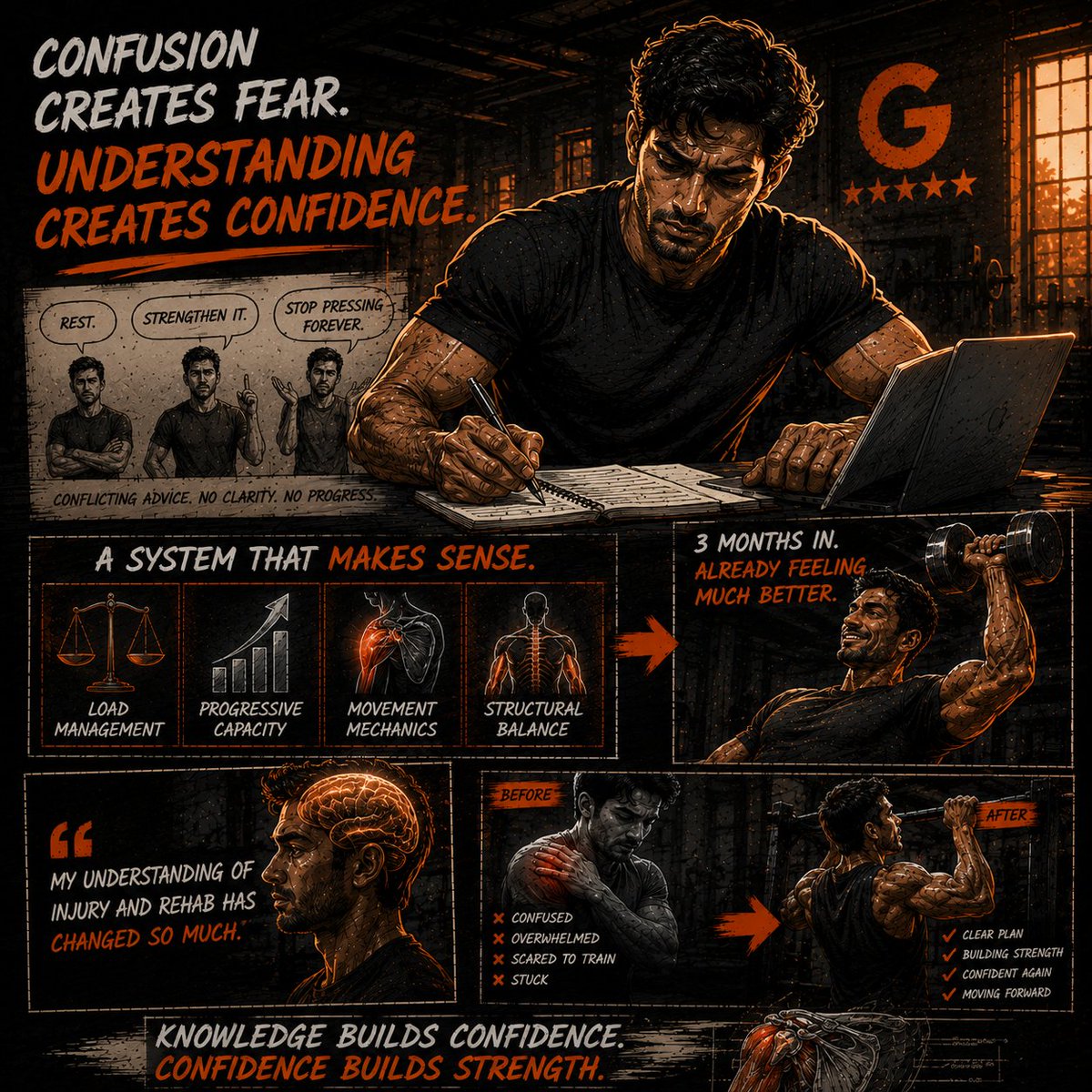
One of the most frustrating parts about shoulder rehab is how confusing it becomes.
One person says rest.
Another says strengthen it.
Another says never press overhead again.
After a while, people stop knowing what to believe.
That’s where Shreynigam was.
In his Google review, he explained that he found Rad’s SLAP tear rehab video on YouTube while searching for answers for his own shoulder injury.
And one thing stood out immediately:
“It all made sense.”
That matters more than people realise.
Because most injured lifters are not lazy.
They are overwhelmed.
Too much conflicting advice.
Too much guessing.
Too many random rehab exercises without understanding the bigger picture.
Over the years we’ve noticed that people recover better when they actually understand what is happening inside the rehab process.
Not just what exercises to do.
But why they are doing them.
That is one of the biggest shifts inside the UMS system.
The goal is not simply to reduce pain.
The goal is to rebuild the shoulder intelligently through:
proper load management
progressive capacity building
better movement mechanics
structural balance around the joint
In his review, Shreynigam said that after 3 months in the program, he already felt much better.
But the more important part was this:
“My understanding of injury and rehab has changed so much.”
That is a huge shift.
Because once people understand how rehab actually works, fear starts disappearing.
Training stops feeling random.
Setbacks stop feeling catastrophic.
And confidence slowly returns.
He also mentioned something that many injured people desperately need:
Responsiveness.
Questions answered.
Concerns addressed.
Programs tailored to the individual.
Because recovery is not just physical.
People need reassurance that there is a structured path forward.
That is what gives people hope again.
Not hype.
Clarity.
If you want to understand how to rebuild shoulder strength and confidence after a SLAP tear, comment:
SLAP TEAR
We’ll send you the full shoulder rehab video for free.
No opt-in.
No email.
Just the framework.
12
A lot of people try to fix a SLAP tear by simply training less.
Less workouts.
Less sets.
Less weight.
And at first, that feels logical.
But reducing volume alone usually doesn’t solve the real problem.
Because if you’re still using the same exercises, the same movement patterns, the same technique, and the same painful ranges of motion… your shoulder is still being loaded in a way it can’t tolerate.
You’re just doing less of the thing that irritates it.
That’s why many people rest, cut back, or “take it easy” for months… yet the shoulder never truly improves.
The issue usually isn’t training itself.
It’s how the training is being applied.
Real rehab starts when you begin adjusting the variables that actually change stress on the joint.
The load you use.
The range of motion.
The exercise selection.
The order of exercises in the workout.
The level of stability required.
That’s what allows you to continue training while the shoulder rebuilds strength and control.
Because avoiding all stress doesn’t rebuild capacity.
Intelligent loading does.
When the workout matches the shoulder’s current ability, something important happens:
The shoulder starts adapting instead of flaring up.
That’s when pain begins decreasing.
That’s when stability improves.
And that’s when people start returning to full strength and flexibility much faster than they expected.
The goal isn’t doing less forever.
It’s learning how to train in a way the shoulder can actually recover from.
#slaptear
#shoulderpain
#labraltear
50
A lot of people with shoulder pain eventually stop expecting real improvement.
They hope for “manageable.”
Less pain.
Fewer flare-ups.
Maybe getting through the day without the shoulder constantly reminding them it is there.
That’s where Michael was.
In his Google review, he explained that he had started the Unity Gym shoulder rehab program five weeks earlier.
And one line stood out immediately:
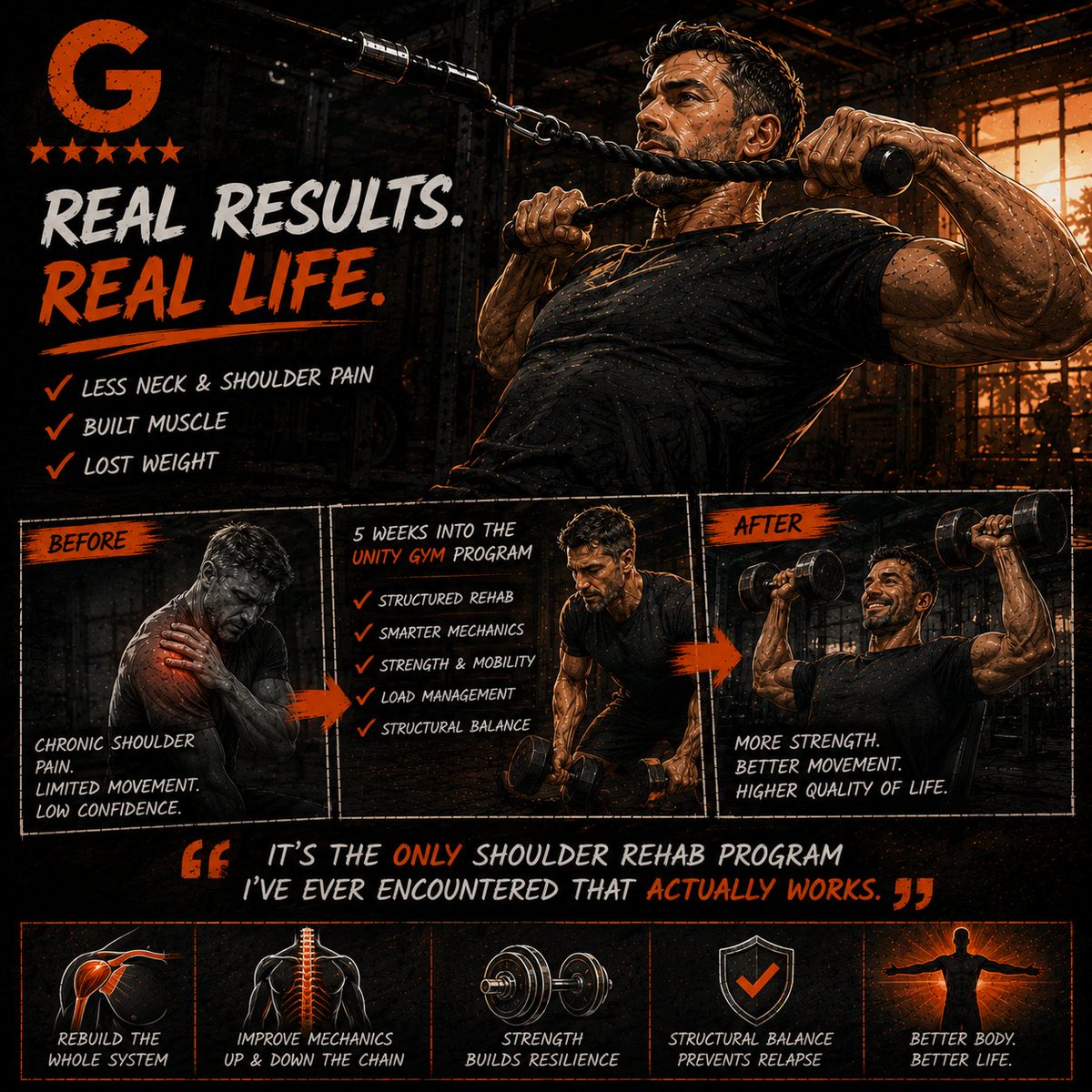
“It’s the only shoulder rehab program I’ve ever encountered that actually works.”
That says a lot.
Because most people with chronic shoulder pain have already tried multiple things before they arrive at Unity Gym.
Physio exercises.
Mobility drills.
Rest.
Generic rehab videos.
Over the years we’ve noticed that many of these systems focus too narrowly on the painful area itself.
But shoulders rarely work in isolation.
The neck, upper back, scapular stabilisers, posture, movement mechanics, and load management all influence how the shoulder functions under stress.
That is why Unity Gym focuses on rebuilding structural balance around the joint instead of simply chasing pain relief.
The goal is not just calming symptoms down.
It is rebuilding a body that can tolerate movement and load properly again.
And when that starts happening, people often notice changes beyond the injury itself.
In his review, Michael said his quality of life improved.
He had less neck and shoulder pain.
He also gained muscle and lost weight.
That combination matters.
Because many injured people feel like they have to choose between rehab and real training.
Unity Gym teaches that those things should work together.
You rebuild strength.
You improve movement.
You restore confidence.
And the body starts improving as a system again.
That is why real rehab should not make people feel fragile.
It should make them feel capable again.
If you want to understand how to rebuild your body without constantly fighting pain, comment:
STRUCTURAL BALANCE
We’ll send you the full structural balance video for free.
No opt-in.
No email.
Just the system.
14
One of the biggest mistakes people make after a SLAP tear is trying to return to the exact program they were doing before the injury.
The shoulder feels better.
Physical therapy is finished.
Pain is lower.
So it seems logical to pick up where you left off.
But for a lot of people, that’s exactly when the pain comes back.
And it usually isn’t bad luck.
Because the uncomfortable question is this:
What if the old program helped create the problem?
Most training programs are built around one thing — performance.
More strength.
More skill.
More intensity.
But many never ask whether the body has the structure to support that progress.
That’s where shoulder problems often begin.
You can get stronger while becoming less stable.
You can improve performance while creating asymmetries.
You can overload the prime movers while the stabilizers quietly fall behind.
Then eventually the system reaches its limit.
That’s why returning to the exact same loading patterns rarely works.
Your shoulder isn’t the same anymore.
And your program shouldn’t be either.
Recovery means rebuilding with more intention.
Restoring balance between opposing muscle groups.
Training stabilizers alongside prime movers.
Improving left-to-right symmetry.
Progressing load at a pace your shoulder can actually tolerate.
Because the goal isn’t to survive training.
The goal is to build a body that can keep progressing for years.
#slaptear
#shoulderpain
#rotatorcuff
57