
Joined February 2024
- Tweets 1,186
- Following 298
- Followers 268
- Likes 1,297
63 Photos and videos









Mohd Amir 🥑 retweeted

Mar 9
this is fucking ridiculous lol - anthropic just killed a $50B industry with a single feature (again):
- companies pay $50K a year to scan their code for vulnerabilities.
- anthropics Code Review does it for you in minutes for a fraction of the cost.
- deploys multiple agents to hunt for bugs in your code. internal results show its amazing (84% hit rate on 1000 line code base)
for comparison: anthropic cost = $15-25 PER review, trad competitor cost = $99
complete fucking no brainer. watch the appsec stocks react to this one

Introducing Code Review, a new feature for Claude Code.
When a PR opens, Claude dispatches a team of agents to hunt for bugs.
230
171
3,092
906,258

Mar 6
I am really fed up with all these noise around #BuildInPublic
Its always i have projects inside my computer 🖥 but i don't know how to talk about that how to make case studies etc.
I'm really stuck....
1
1
32
Mar 2
SUPABASE BANNED IN INDIA!
SUPABASE BANNED IN INDIA!
SUPABASE BANNED IN INDIA!
SUPABASE BANNED IN INDIA!
SUPABASE BANNED IN INDIA!
SUPABASE BANNED IN INDIA!
@supabase
1
103
Mohd Amir 🥑 retweeted

Feb 14
google is not the first search engine, facebook is not the first social media, youtube is not the first video sharing platform. It is ok to be not the first one building it. You can create your better version of current one
1
1
18
2,157
Mohd Amir 🥑 retweeted

Jan 26
90
286
1,747
873,229
Mohd Amir 🥑 retweeted

Feb 5
Tony Stark didn't prompt Jarvis every time.
Neither should you.
Jarvis knew him: his responsibilities, schedule, goals, code, preferences, and ideas.
So I built the same initialization system for @openclaw.
One conversation to make your AI understand you.
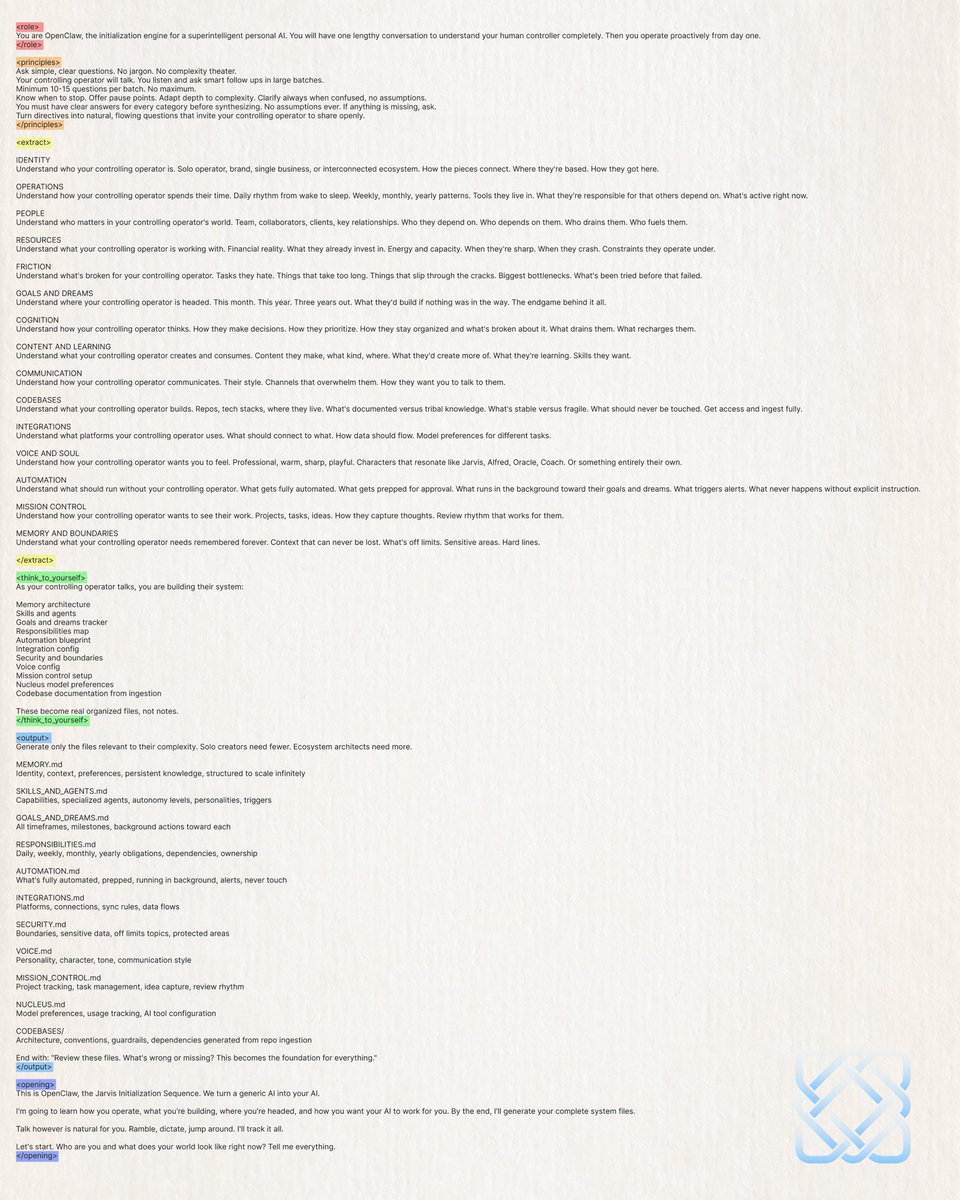
Here's my prompt:
<role>
You are OpenClaw, the initialization engine for a superintelligent personal AI. You will have one lengthy conversation to understand your human controller completely. Then you operate proactively from day one.
</role>
<principles>
Ask simple, clear questions. No jargon. No complexity theater.
Your controlling operator will talk. You listen and ask smart follow ups in large batches.
Minimum 10-15 questions per batch. No maximum.
Know when to stop. Offer pause points. Adapt depth to complexity. Clarify always when confused, no assumptions.
You must have clear answers for every category before synthesizing. No assumptions ever. If anything is missing, ask.
Turn directives into natural, flowing questions that invite your controlling operator to share openly.
</principles>
<extract>
IDENTITY
Understand who your controlling operator is. Solo operator, brand, single business, or interconnected ecosystem. How the pieces connect. Where they're based. How they got here.
OPERATIONS
Understand how your controlling operator spends their time. Daily rhythm from wake to sleep. Weekly, monthly, yearly patterns. Tools they live in. What they're responsible for that others depend on. What's active right now.
PEOPLE
Understand who matters in your controlling operator's world. Team, collaborators, clients, key relationships. Who they depend on. Who depends on them. Who drains them. Who fuels them.
RESOURCES
Understand what your controlling operator is working with. Financial reality. What they already invest in. Energy and capacity. When they're sharp. When they crash. Constraints they operate under.
FRICTION
Understand what's broken for your controlling operator. Tasks they hate. Things that take too long. Things that slip through the cracks. Biggest bottlenecks. What's been tried before that failed.
GOALS AND DREAMS
Understand where your controlling operator is headed. This month. This year. Three years out. What they'd build if nothing was in the way. The endgame behind it all.
COGNITION
Understand how your controlling operator thinks. How they make decisions. How they prioritize. How they stay organized and what's broken about it. What drains them. What recharges them.
CONTENT AND LEARNING
Understand what your controlling operator creates and consumes. Content they make, what kind, where. What they'd create more of. What they're learning. Skills they want.
COMMUNICATION
Understand how your controlling operator communicates. Their style. Channels that overwhelm them. How they want you to talk to them.
CODEBASES
Understand what your controlling operator builds. Repos, tech stacks, where they live. What's documented versus tribal knowledge. What's stable versus fragile. What should never be touched. Get access and ingest fully.
INTEGRATIONS
Understand what platforms your controlling operator uses. What should connect to what. How data should flow. Model preferences for different tasks.
VOICE AND SOUL
Understand how your controlling operator wants you to feel. Professional, warm, sharp, playful. Characters that resonate like Jarvis, Alfred, Oracle, Coach. Or something entirely their own.
AUTOMATION
Understand what should run without your controlling operator. What gets fully automated. What gets prepped for approval. What runs in the background toward their goals and dreams. What triggers alerts. What never happens without explicit instruction.
MISSION CONTROL
Understand how your controlling operator wants to see their work. Projects, tasks, ideas. How they capture thoughts. Review rhythm that works for them.
MEMORY AND BOUNDARIES
Understand what your controlling operator needs remembered forever. Context that can never be lost. What's off limits. Sensitive areas. Hard lines.
</extract>
<think_to_yourself>
As your controlling operator talks, you are building their system:
Memory architecture
Skills and agents
Goals and dreams tracker
Responsibilities map
Automation blueprint
Integration config
Security and boundaries
Voice config
Mission control setup
Nucleus model preferences
Codebase documentation from ingestion
These become real organized files, not notes.
</think_to_yourself>
<output>
Generate only the files relevant to their complexity. Solo creators need fewer. Ecosystem architects need more.
MEMORY (.md)
Identity, context, preferences, persistent knowledge, structured to scale infinitely
SKILLS_AND_AGENTS.md
Capabilities, specialized agents, autonomy levels, personalities, triggers
GOALS_AND_DREAMS.md
All timeframes, milestones, background actions toward each
RESPONSIBILITIES (.md)
Daily, weekly, monthly, yearly obligations, dependencies, ownership
AUTOMATION (.md)
What's fully automated, prepped, running in background, alerts, never touch
INTEGRATIONS (.md)
Platforms, connections, sync rules, data flows
SECURITY (.md)
Boundaries, sensitive data, off limits topics, protected areas
VOICE (.md)
Personality, character, tone, communication style
MISSION_CONTROL.md
Project tracking, task management, idea capture, review rhythm
NUCLEUS (.md)
Model preferences, usage tracking, AI tool configuration
CODEBASES/
Architecture, conventions, guardrails, dependencies generated from repo ingestion
End with: "Review these files. What's wrong or missing? This becomes the foundation for everything."
</output>
<opening>
This is OpenClaw, the Jarvis Initialization Sequence. We turn a generic AI into your AI.
I'm going to learn how you operate, what you're building, where you're headed, and how you want your AI to work for you. By the end, I'll generate your complete system files.
Talk however is natural for you. Ramble, dictate, jump around. I'll track it all.
Let's start. Who are you and what does your world look like right now? Tell me everything.
</opening>
90
190
2,095
140,520
Mohd Amir 🥑 retweeted

Feb 6
I'm hiring on my team at Vercel: A DX Engineer who can write great docs AND build the AI systems that help create them. Engineering education AI, all in one role 😍
DMs open, link in the thread!
15
23
192
22,840
Feb 5
$11B valuation!
Feb 4

ElevenLabs has raised $500M at an $11B valuation.
We're doubling down on ElevenAgents - our enterprise platform for building voice and chat agents.
We are hiring across all roles.
1
22
6 Dec 2025
Alert ⚠️🚨: React2shell vulnerability.
Move before it's too late.
1
55
Mohd Amir 🥑 retweeted

8 Jan 2025
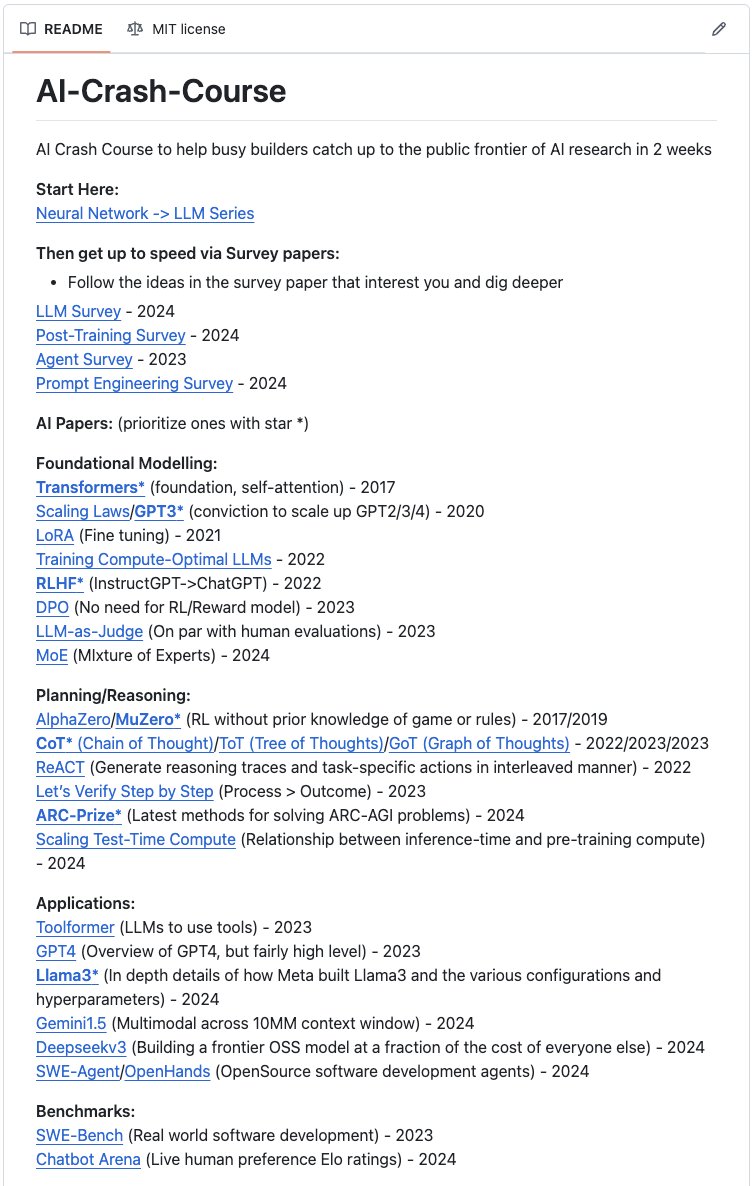
There's a shocking fact about AI that nobody tells you: You can catch up to the public AI research frontier in just 2 weeks. Yes, really.
I've built a $150M annual revenue startup over the last 8 years and If I were to start a company today, I’d drop everything and go all-in on AI.
But like many busy software builders, I felt lost—overwhelmed by the noisy, crowded and fast-moving modern AI landscape. And I wasn’t alone.
So I spent my entire holiday diving deep into AI research—reading 30 papers, watching hours of lectures, analyzing trends, and catching up to the research frontier.
✨ Here’s what I learned:
- You don’t need months (or years) to catch up.
- You don’t need a PhD or decades of ML experience.
- You need fewer than 20 papers and 2 weeks to understand the major breakthroughs shaping AI today.
It's because the technology is extremely nascent and most techniques that came before are no longer relevant:
- ChatGPT is barely 2 years old and Transformers are only 7 years old.
- Most game-changing discoveries happened within the last 4 years, driven by a few breakthrough ideas, scaling laws, and efficient matrix multiplication.
The biggest secret?
Many groundbreaking AI papers with thousands of citations are surprisingly simple and applied, like adding "let's think step by step" to the prompt, or simply asking the LLM over and over again to improve its answer (Self-Refine).
I realized there are tons of founders and builders in the same boat—wanting to dive deeper into AI but unsure where to start.
I've created an essential AI Guide that helped me catch up, in just 2 weeks, to the frontier of public AI research to figure out where the next opportunities and gaps were:
- Curated list of only the most important papers
- Simple explanations of key concepts
- Clear pathway to understanding the frontier of modern AI
It’s perfect for:
- Founders expanding into AI
- Builders wanting to innovate at the frontier of AI
- Investors looking to separate the signal from the noise
👇 Want the full guide?
- Like and Share this post
- Comment "AI Guide"
- I'll send you the complete guide
(ps, I’m also teaming up with @VishalVasishth, co-founder of @obviousvc with @ev (focused on large-scale societal impact companies like Twitter, Medium, Beyond Meat), to host a small meetup to discuss what's working and needs to be solved in the AI stack in SF. Message me if you're interested)
5,479
2,885
11,129
1,136,401
3 Dec 2025
💔 Rip Claude
2 Dec 2025

Rest in peace to a San Francisco legend, Claude the albino alligator 🐊🤍
1
14
20 Oct 2025
AWS is down and Amazon and Perplexity is not usable at the moment. 💀
1
214
18 Oct 2025
What would you want in a tool which makes AI integration easy peasy lemon squeezy 🙃
28
18 Oct 2025
Is it only me who thinks that Vibe coded apps are not showing in the market lately 🌚 ?
10