
21 Photos and videos


Pinned Tweet

Jun 10
5% - 30% - 65%
What % of our time goes into building the actual agent in an AI agent project?
In my experience the answer is 5%.
30% goes into building the MCP servers and MCP tools that act as a connector between the agent and the data.
And a whopping 65% goes into making sure the data the agent needs sits in a place the agent can have access to. And architected in a way the agent can understand and interpret which needs building a semantic layer for that purpose.
I've been building AI agents for 9-figure e-commerce brands for over two years now. CRO agents, influencer agents, ad-making agents, data analysis agents, retention agents, support agents.
Looking back, I can tell you the one thing that was true on every single project.
The model was never the bottleneck. The data was.
Every time we hooked an agent up to a brand's real data, the quality jump was massive. The agent went from confidently wrong to actually useful. But getting to that point was the entire job. The agent part was the easy part.
Three examples.
The CRO agent that analyzed millions of sessions and rewrote the landing page? The agent was easy. Piping its Hotjar data into a queryable pipeline was... painful to say the least.
The influencer agents matching brands to creators by vibe? The real work was embedding each creator's last 25 posts into a vector database with millions of creators.
The TikTok shop analyst agent that tells us "why" certain videos have higher GMV? Matching the raw data that showed the GMV with visual and audio analysis was the hard work.
We weren't building agents. We were freeing data, one silo at a time.
Because at brand scale, data lives everywhere. Orders in Shopify. Campaigns in Klaviyo. Reviews in Yotpo. Tickets in Gorgias. Sessions in Hotjar. Ads in Meta and Google.
And vendor MCP connectors alone don't fix it. Each one gives your agent another isolated window and not the full picture.
What one agent learns isn't there for the next agent to use. Every workflow starts from zero. That's why agent pilots stall after one good demo.
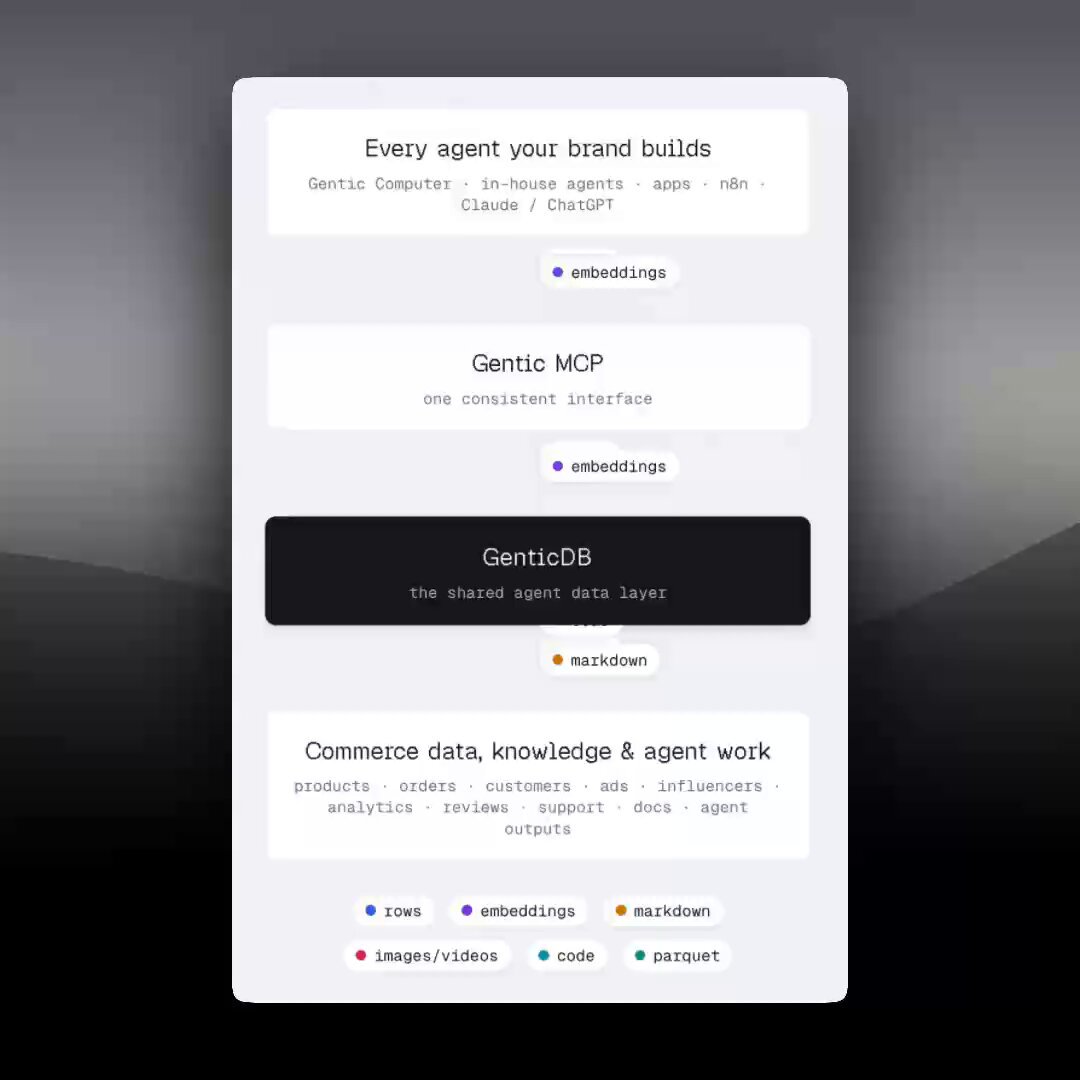
So we built the thing all our agents needed.
GenticDB : gentic.co/db – The database your agents share.
One store every agent reads, writes, and searches through one MCP interface.
Tables and embeddings together – SQL and semantic search in one place.
The images, videos, and landing pages your agents create get saved there too, findable by the next agent. An all-in-one data store.
Underneath sits an open lakehouse: DuckDB powered DuckLake, open Parquet. A similar architecture Snowflake built the big-data era on, ready for millions of order lines and embeddings.
And you own it. Open formats you can query without us – or connect your own Cloudflare R2 bucket (BYOB) so your structured and vector data files live in storage you control.
Sign up at gentic.co/db and hook up your agents to a proper data store via the 250 ecom MCP tools at gentic.co/mcp.
1
195
May 6
Building is easy now. Knowing "what to build" is the AI age superpower. But how can we know that? In 7 steps.
I should start playing the prediction markets. 27 months ago I wrote about "taste" as the important thing. 25 months ago I wrote about "ideas" being more important than execution.
Boy oh boy have those predictions come true.
So now that "I just built a..." has become the most popular opening sentence of all time, here is my practical step-by-step to validate our ideas using AI:
Step 1: Give the idea a home
---
Create it as a real project with a status: exploring, validated, active, or paused. AI makes it easy to create scattered research, names, landing pages, ads, and strategy docs. The idea needs one place where everything lives.
Step 2: Look for signal before building
---
Before touching the product, search the web for competitors, reviews, old attempts, new launches, and category language.
Search Reddit for the raw version of the pain. That is where people say things like: "I hate that…", "Does anyone know a tool for…", "Why is this so expensive…"
Then check Google Trends to see whether interest is growing, flat, seasonal, or mostly imaginary.
At this stage, I’m looking for people complaining, people paying, and people searching. We don't need all three, but if we have none, that is probably the answer.
Step 3: Save the research
---
Most AI research dies in chat history. Save real research notes against the idea: customer language, repeated complaints, competitor weaknesses, pricing observations, positioning angles, and open questions.
Step 4: Validate it simply
---
Once there is some signal, score the idea on five things: market demand, competition, feasibility, revenue clarity, and customer reach.
Customer reach is the one people skip. A good idea can still be a bad business if the customer is too hard to reach.
Step 5: Find the wedge
---
Look for the wedge: simpler, cheaper, more premium, more focused, more opinionated, or built for a customer everyone else treats as an edge case.
Step 6: Build a landing page with a waitlist
---
Name it after the research, not before. Check domains. Create a basic brand direction. Then build the landing page.
A page forces the idea to become clear. Use the research notes, competitor gaps, customer language, and brand direction to publish a real page with email collection for waitlist.
Not as a launch. As a test.
Step 7: Test the message
---
Once the page is live, test a few angles through organic posts, direct outreach, small Meta ads tests, or Google ads keyword tests.
Early ads are not acquisition. They are research. Clicks tell us something. Waitlist signups tell us more. Replies tell you the most.
The question is no longer "can I build this?"
Of course I can. The better question is: has this idea earned the right to be built?
PS: You can do all of the above in a Telegram/Slack chat using gentic.co/startup
1
89
Apr 21
So I "might" be starting a skincare brand… because an AI agent did something surprising - and now my wife wants to build it for real. Oh boy. Let me explain.
Over the weekend I was putting the final touches on our brand new Gentic Startup MCP server. It helps people figure out whether a business idea is actually worth pursuing.
Why build this?
Because AI now made it possible to build the thing right. But we still need to figure out if we're building the right thing.
An AI agent that uses this MCP server can:
- create and track ideas
- research the market across the web, Reddit, and Google Trends
- validate a business idea
- generate startup names and check domain availability
- research competitors
- build a brand identity
- deploy a branded landing page with lead capture
- connect a custom domain
- generate ad assets
- launch Meta ads
To test it end to end, I messaged Mother from Gentic Computer via Telegram and gave it this initial prompt:
"Let's build an e-commerce brand that is based on a single-ingredient personal care product, and the ingredient has to be grown in a Rhode Island farm."
Mother went off and came back with a few viable ingredients.
Turns out there’s a sugar kelp farm very close to our house!!
So I said: let’s do sugar kelp.
Then it did all the things I mentioned above and before long, it had created a full brand:
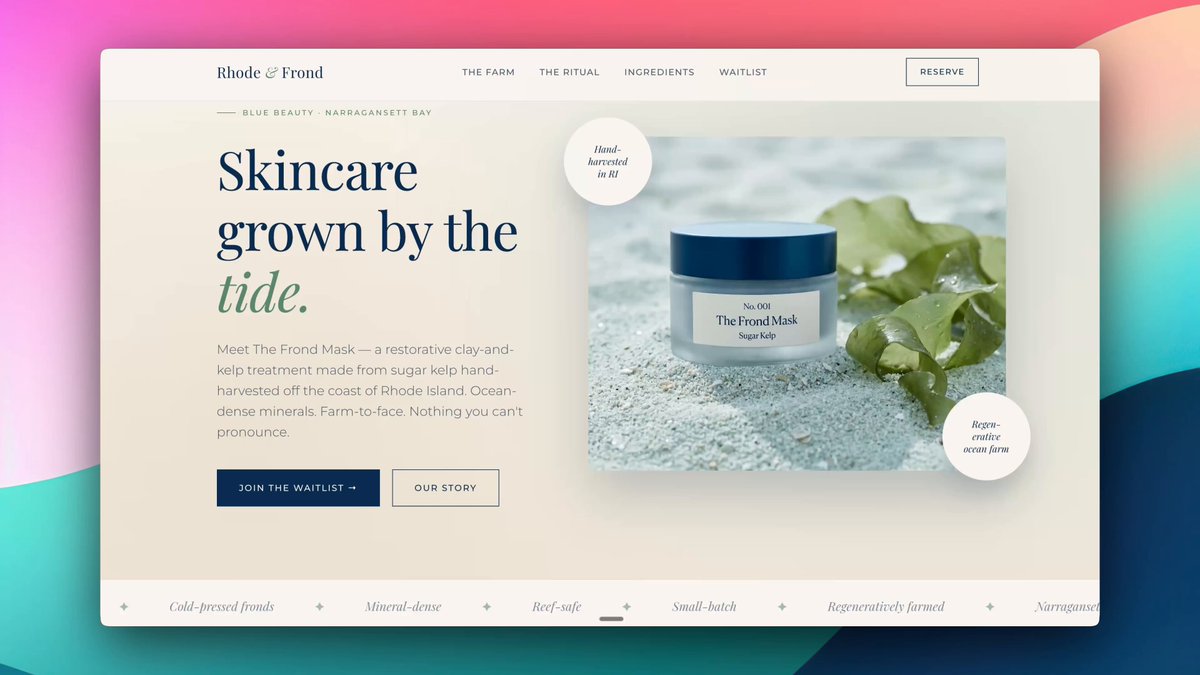
rhodeandfrond.com
"Rhode & Frond
The Frond Mask : a restorative clay-and-kelp treatment made from sugar kelp hand-harvested off the coast of Rhode Island. Ocean-dense minerals. Farm-to-face. Nothing you can't pronounce."
I showed this to my wife as a joke and she was like whoa i really want to do this now!
Then I sent it to two skincare legends Alex Keyan of GoPure and Brent Ridge of Beekman 1802.
And both of them said IT COULD WORK!
What? lol
So now I'm running ads (created by Gentic Startup) to see if there is real interest. If we take the next step, I’ll share the progress.
If you'd like to try it to validate your own ideas, sign up at gentic.co/startup then either use the MCP via Claude or connect your Telegram and Mother will help you in there.
My entire test happened inside a Telegram chat.
Let me know if you land on a cool concept!
1
226
Apr 13
Introducing the first "AI Computer" for ecom teams. Not an AI assistant. An AI agent? Nope. Not an AI workflow builder either.
Meet gentic.co/computer
Inside: Mother. She runs your brand. An agent harness that runs long-running agents you create in plain English from Slack, MCP tools, skills, email inboxes, and a structured vector database.
You talk to her in Slack, describe what you want in plain English, and Mother runs it end to end until the job is completed.
Here's why this is a new category:
AI assistants (ChatGPT, Claude): you ask, they answer. Back and forth.
AI agents (Claude Code, Cowork): powerful, but built for one person at a keyboard.
AI workflow builders (n8n, Zapier): one-directional flows. Start at A, end at B. No harness for long-running agents that loop.
Gentic Computer is the closest thing to Claude Managed Agents (shipped last week) but our ecom-specific harness goes a few layers deeper:
→ A coordinator (Mother) classifies user intent and routes to the right specialist agent. Influencer ops, Meta ads, creative generation (statics videos), data analytics, knowledge base. No need to invoke agents by name.
→ Org-scoped skills that every agent inherits. Brand aesthetics, copy style, matchmaking instructions. Written once, applied everywhere.
→ Non-technical users create new agents from a Slack message in plain English.
→ Agents run autonomously on cron schedules and post results to Slack, not just request-response.
→ Dedicated email inboxes which agents use to send emails and reply to them.
→ Each brand gets its own dedicated structured vector database (@motherduck) agents can query. Data scoped to your org, not just text memory in markdown files.
→ Every agent runs as a durable workflow on @temporalio . Long-running tasks execute on @modal. Survives deploys, restarts, multi-minute jobs, and long human approval waits. No babysitting.
Here's what it looks like for an ecom team. Message on Slack:
"Mother, find 100 creators for our brand, score them with our matchmaking skill, draft personalized emails to anyone above 70, and send them."
→ Searches Insta TikTok, scores creators against your brand profile, drafts personalized emails, sends them through your influencer inbox.
"Mother, check the top 10 TikTok Shop affiliate videos from last month, figure out why they're winning, and update the Creator Brief in the Influencer agent's skill."
→ Pulls affiliate data, transcribes audio, analyzes visuals, identifies the patterns, and writes the insights back into a skill every future agent run will inherit. Mother gets smarter about your brand every day.
"Mother, create an agent that checks my Meta spend every morning and alerts this channel if any campaign's CPA goes above $15."
→ Drafts the agent spec, runs on a schedule, posts to the channel.
Dozens more use cases like these. Oh and Mother created this video.
Sign up at gentic.co/computer, connect your Slack and start talking to Mother.
2
244
Mar 28
I tested 4 open-source models as an alternative to the pricey Claude in mio.fyi. One was shockingly good enough so I added it as an option.
As you know I'm building Mio, a personal AI agent that uses MCP tools to manage our life data (todos, meals, calendar, etc.).
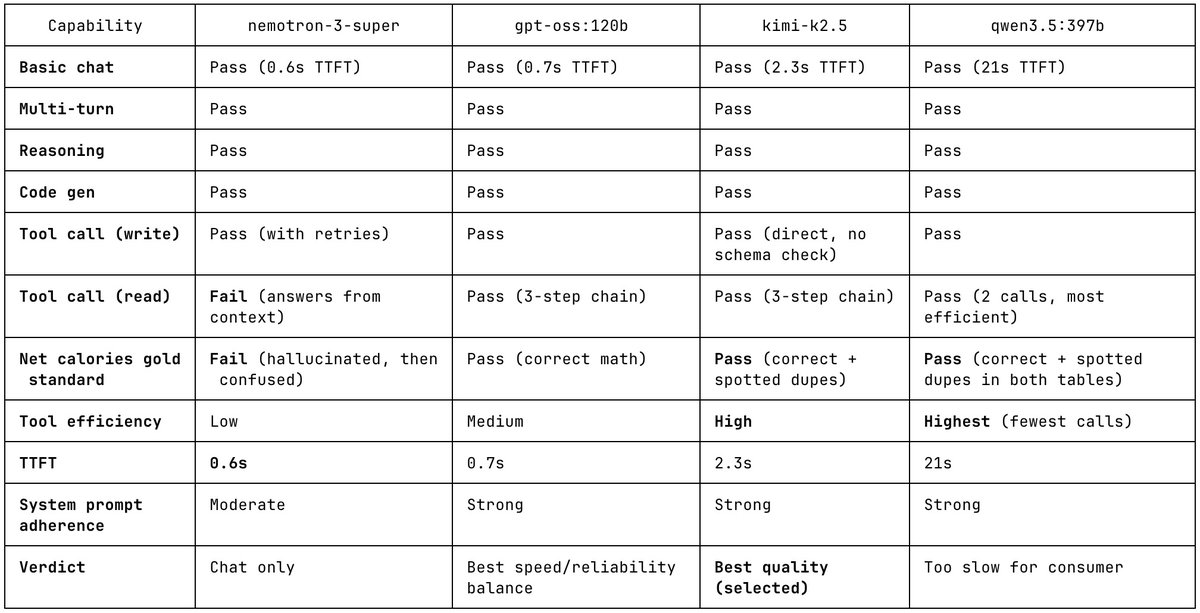
Claude is great but too expensive for a consumer product. So I built a v2 using Ollama Cloud and ran the same test suite across 4 models.
The test:
---
Ask each model to calculate net calories by querying two separate database tables (meals exercises), doing the math, and presenting the result.
This requires multi-step tool calling, data retrieval, and arithmetic, which to me is a good way to test the tool calling capabilities of a model.
Results:
gpt-oss:120b:
---
Had the best speed/reliability balance. Not the strongest overall, but probably the most practical choice if latency matters a lot.
nemotron-3-super:
---
Felt fine for chat, but weaker for tool-heavy workflows. Fast first token though.
qwen3.5:397b:
---
Was capable, but 21s TTFT is tough to justify for consumer apps. Good performance. Just too slow for most product use cases.
kimi-k2.5:
---
Came out best on quality. It handled reasoning well, did solid tool use, and caught duplicate items correctly in the calorie task.
Key findings for fellow builders:
1. Streaming breaks tool calling for open-source models. I had to switch to non-streaming mode when tools are present. The models produce tool calls reliably in non-streaming but fail silently in streaming mode. Stream text-only responses, don't stream tool interactions.
2. Schema complexity matters more than tool count. I initially filtered tools down to 10, thinking quantity was the problem. It wasn't. The real issue was complex JSON schemas with anyOf/oneOf constructs. Simplify your schemas before passing them to open-source models.
3. kimi-k2.5 was the surprise winner. Not the fastest, but the smartest. It skipped unnecessary schema lookups, called tools directly when it had enough context, and even flagged duplicate data entries the other models missed. For agentic AI apps, tool efficiency > raw speed.
4. Memory poisoning is a real problem. When my tool filtering was broken, the AI's memory recorded "these tools don't work." After I fixed the backend, the model kept refusing to call tools because its own memory said they were broken. Something to watch for in any AI app with persistent memory.
5. The cost story is real. These models run on Ollama Cloud with a single API key. No per-user BYOK keys or token-level billing to pass through. For a consumer product, this changes the business model entirely.
My pick:
---
kimi-k2.5 : best balance of tool calling quality and acceptable latency for a consumer AI agent for personal use cases.
The mio.fyi v2 using kimi is live on the website (not the iPhone app yet). You can test it on the website. Just toggle from Claude to Kimi and see how it's handling the questions.
4
2
135
Mar 26
We don’t need to buy Mac Minis and become unpaid sysadmins just to run a personal AI agent.
I built Mio many months before OpenClaw came out. I think it is the right architecture for personal AI.
The biggest issue is memory.
If AI stores our lives as markdown files, it may work for simple notes. But it breaks when we want structured long-term memory.
If I ask, “How many net calories last week?”, I don’t want the AI guessing from a pile of notes. I want it hitting actual meals and exercises data tables, doing the math and returning the right number.
That’s how Mio works.
It has five memory layers for conversation context, recent memories, life facts, long-term learnings, and procedural skills backed by real databases.
Its sleep-time processing reviews the day's conversations and distills learnings into vector memory.
Under the hood, it runs on Arca, the data vault I built specifically for personal AI.
Each user gets their own isolated data vault on S3 that they own - exportable and deletable. Underneath, two systems work side by side.
DuckDB Parquet files for structured data like meals, workouts, sleep, weight, todos, and anything I want to track with real SQL.
LanceDB vector data files for semantic data like journals, saved articles, research notes, and memories that should be searchable by meaning, not just keywords.
This is the part that excites me the most: you create apps just by talking.
I can say, “Track my surf sessions. Log the spot, wave height, board, and how it felt,” and Mio creates the schema, stores the data along with a skill file that explains how to work with this data.
Later, when I ask questions, it reads the skill file and knows how to correctly query the data.
That’s how I’ve built mini apps inside Mio for health, meals, sleep, surfing, family logistics, Kai’s school and health notes, Luka’s training, CRM, research, reminders, travel, and my personal knowledge base.
Mio has proactive actions. I tell it to do things like analyze data, send reminders, give feedback on a scheduled basis and it'll email/whatsapp/sms me.
AI agents are single-player. Mio isn’t.
My wife and I each have our own accounts and private vaults, but shared data like family calendar, grocery list, and our son's health/school info sync across both.
Mio is available via iPhone/Mac/iMessage/Watch apps, WhatsApp, SMS, email, web and voice, without me running hardware at home.
Mio has a real time voice agent using Deepgram Cartesia Pipecat.
You can connect Mio to Claude / ChatGPT via its MCP server.
It auto-ingests Apple Health data and syncs it to queryable tables.
It does web research and manages your calendar.
With OpenClaw and its variants, you wanted a personal AI agent, instead you got yourself a part-time sysadmin job that doesn't pay.
Mio is AI that can build and run personal software with us and it's easy to use.
Download Mio on the App Store, add your Anthropic API key and use it for free.
Links in comments.
1
197
Mar 26
Sign up with Mio here: mio.fyi
Download Mio on the App Store: apps.apple.com/us/app/mio-ai…
Learn about Mio's five layer memory architecture: mio.fyi/memory
The private data vault Mio uses: arca.build
Connect Mio to ChatGPT/Claude/n8n via the MCP: mio.fyi/mcp
1
92
Mar 3
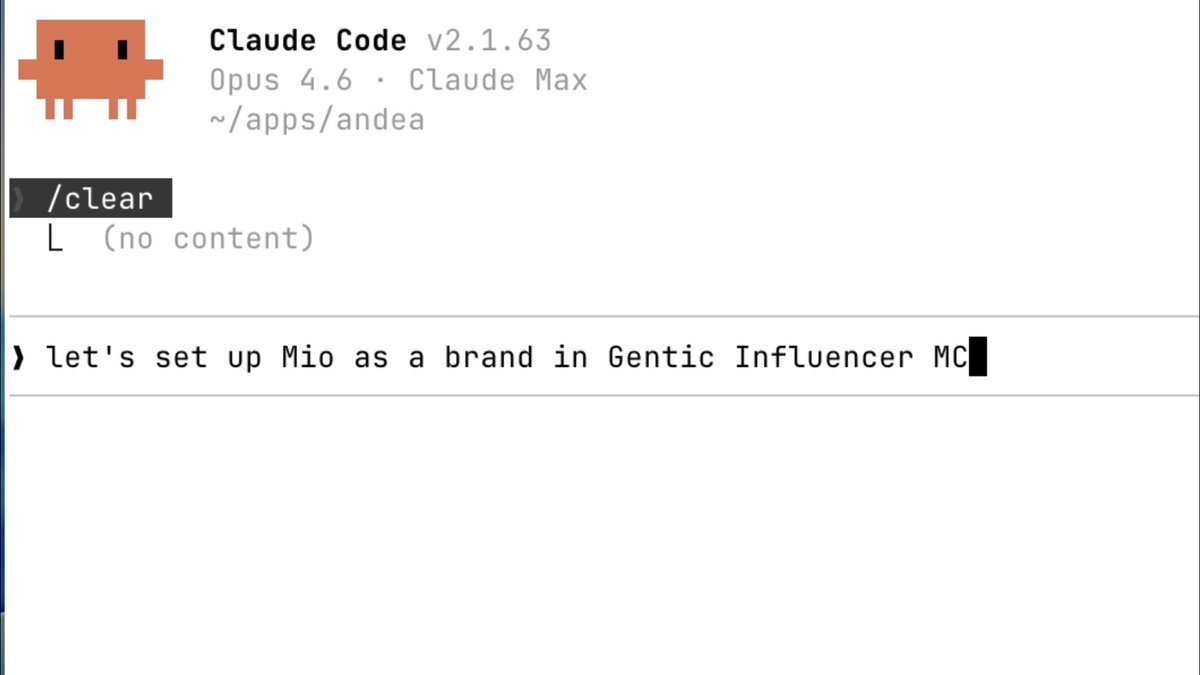
Every influencer platform was built for humans clicking through dashboards. It's 2026 so we built one for AI agents - like Claude Code as shown in this video.
Introducing gentic.co/influencer: the first ever agent-native influencer search with brand-match scoring and hyper-personalized outreach.
There is no web UI. Your AI agent connects to gentic.co/influencer via MCP.
A pre-defined agent skill teaches your agent the right way to run the whole campaign.
You just describe what you need in plain English:
"Set up my brand using our website url: [x]. Find 30 matching Instagram skincare creators in the US, 10K–80K followers, engagement above 3%, focused on ingredient breakdowns. Campaign targeting our product on this page: [x]"
And your agent does the rest.
- It checks your site and sets up your brand DNA and product details in a brand profile.
- Then it does a vector search in Pinecone 2M creator profiles (and most importantly their post captions vectorized for best similarity) with verified emails to find "likely" matches"
- Then runs a real-time match report by checking their profile and recent posts again (fresh data) and scores each one against your brand DNA and campaign goals.
- Then it drafts hyper-personalized outreach for high match-score creators that references their actual posts, not a "we love your content" template.
- Then exports everything to a CRM-ready CSV.
America's beloved tea brand Harney & Sons ran this. Got 34% reply rates. Industry average is under 2%.
The cost for a sample campaign workflow:
→ Vector search and find 100 likely-match creators: $15
→ Score top 30 based on their real time posts: $10.50
→ Draft hyper-personalized outreach for top 10: $3.50
→ Total: $29.10
Pay only when your agent calls a tool.
Go to gentic.co/influencer, grab your API key, copy/paste the docs into Claude Code / Cowork / ChatGPT and your agent will set up everything for you.
Then automate the workflows with scheduled searches using @n8n_io and make it ever more powerful.
Powered by gentic. Every user gets their own database in @motherduck. Your brand's data is physically separated. Literally.
Let me know how it works for you.
3
5
446