
NFTs, enjoying the chaos and sometimes researcher
Joined April 2024
- Tweets 5,039
- Following 629
- Followers 805
- Likes 11,570
440 Photos and videos



Base $5bil TVL. INSANITY
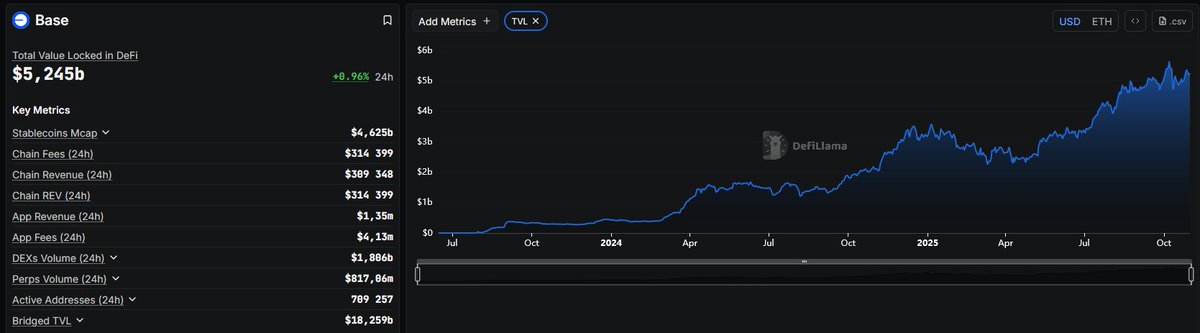
Look at this chart. It does not lie. This is not speculation, this is real locked capital in our L2 network.
$5 245 000 000 TVL.
Five billion, two hundred forty-five million dollars! On @base
And YOU are still on the sidelines?
Is it not time to stop watching the chart from afar and become part of the network where billions have already voted with their assets?
OK...
9
66
2,567
Today's mints that look interesting:
The mint of the day, in my opinion, is windows by @dave_krugman. MP is high, but he’s been working on this collection for a long time now.
I think it should turn out pretty well I’d definitely keep an eye on the secondary market for this one.
- Time: 4 PM UTC
- Price: 0.03 ETH
- Supply: 1,000
---
@mvponeth – yeah, it's a parody to npc, but if you have a WL, hitting it for free is a no-brainer.
- Time: 3:30 PM UTC
- Price: Free / 0.0009 ETH
- Supply: 5,555
---
@hoodlrz – looks unique, but then again, the MP is high and I highly doubt it'll sell out. Just one to watch, honestly.
- Time: 4 PM UTC
- Price: 0.006 ETH
- Supply: 1,337
---
LEFT BEHIND by @OnlyCapi – looks great, coming from a solid artist. If you have a WL, definitely grab it since it's free.
- Time: 4:59 PM UTC
- Price: Free / 0.0169 ETH
- Supply: 569
---
And remember, DYOR NFA guys. Not financial advice.
2
17
There are a couple of interesting mints today that are at least worth keeping an eye on:
First off, I think the mint of the day is @earnity_ . It looks solid, the art is great, and the MP is low. It could honestly perform pretty well.
- Time: 12 PM UTC
- Price: 0.0022 ETH
- Supply: 3,838
---
It’s also worth watching these guys to see how the mint goes and what kind of volume they pull – @thedumbois
- Time: 2 PM UTC
- Price: 0.0022 - 0.003 ETH
- Supply: 797
---
And then we have @dormiesART. Can't say too much about them, but they look decent enough feels like a bit of a parody of Normies, I think.
- Time: 2 PM UTC
- Price: 0.0013 - 0.0025 ETH
- Supply: 8,000
---
I didn't like any of the other scheduled mints today, so I just picked the ones that actually caught my attention. Again, at the very least, you can just track them and if you like what you see, hit the mint.
But as always, NFA DYOR - this is not financial advice.
3
41
Only 2 mints caught my eye today:
@outworld3rs – looks pretty good, I actually like the art. I've got a WL, so let's see how the mint goes.
< Time: 11 PM UTC
< Price: 0.002 ETH
< Supply: 950
---
@LilBeansNFT – looks cool, very low mp. Also got a WL here, we'll see what happens.
< Time: 3 PM UTC
< Price: 0.0002 ETH for WL / 0.0004 ETH for Public
< Supply: 5,555
---
Also worth mentioning @ZelijOrigins, just in case anyone's interested, but the MP is pretty high.
< Time: 4 PM UTC
< Price: 0.035 ETH
< Supply: 888
---
And remember, NFA DYOR, always.
1
6
107

accounts/tips for NFT trading
1. @nft_mint_speed - Live EVM collection alerts
2. @CAONHTAN1 - posts free/stealth mint collections
3. catchmint.xyz/ - on this site you can see all the mints that are currently active and happening
4. t.me/tracervarikteat (telegram) - Real-time tracker of secondary market activity
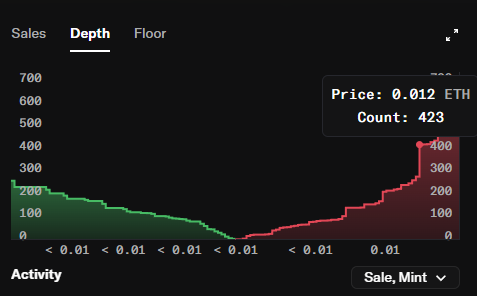
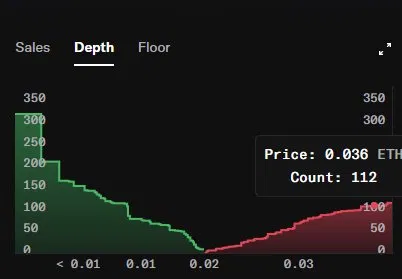
Also, OpenSea has a Depth tab that almost nobody uses, even though it's very useful.
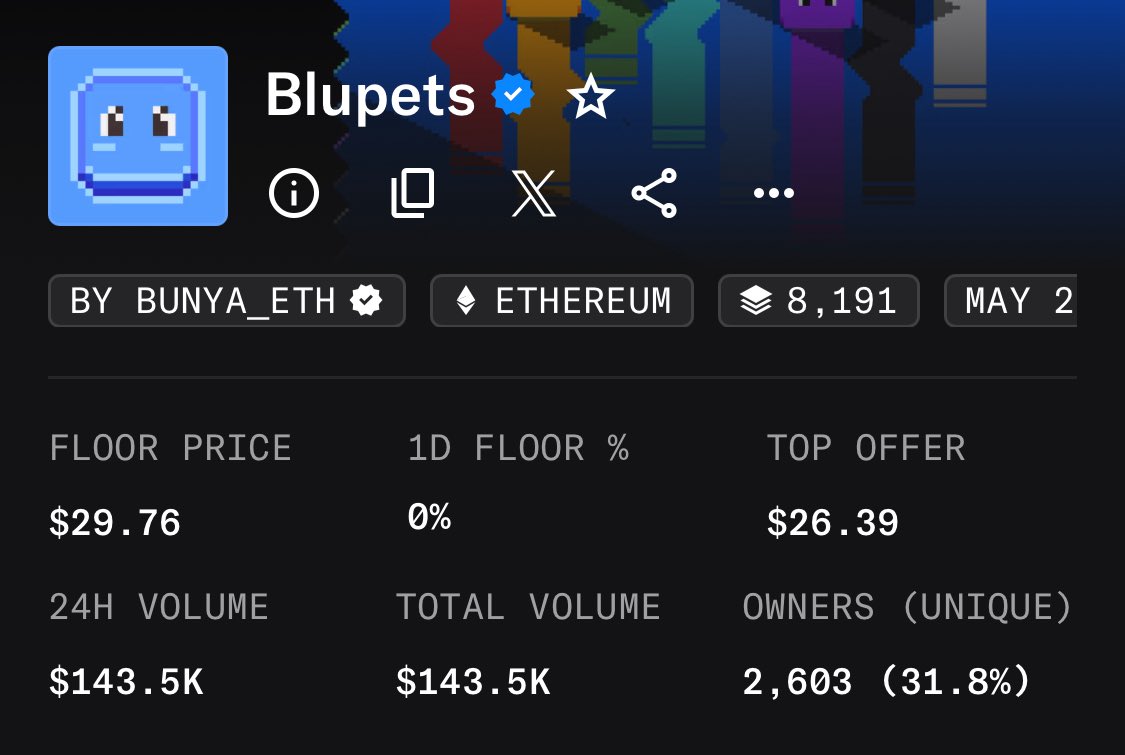
In the screenshot below, I used the Blupets collection as an example looking at the listing %, many people might get scared seeing that 6.6% is listed, but if we look at this tab, we can see that there are only 112 NFTs below 0.036 ETH (just 1.3% of the total supply)
Also, in the second screenshot from the PEPE EXPLORERS collection, we can see there's a big wall of listings around the 0.011-0.012 ETH range (4.2% of the total supply)
23
11
122
6,725
I wouldn’t say today’s mints are looking too hot, to put it mildly...
The mint of the day today is @The_G00fs – a solid collection. If you have a WL, I think xs are guaranteed, and it might even be worth keeping an eye on the secondary market for a potential snipe.
< Time: 1 PM UTC
< Price: 0.0015 ETH
< Supply: 2222
---
@monkePixart – just an average collection, nothing special. I’d only recommend minting if you have a WL for the free phase.
< Time: 4 PM UTC
< Price: 0.002 ETH (but GTD gets a free mint)
< Supply: 5555
---
@ToastedPals – a free mint, and we always hit those if we can. Might end up being worth something down the line.
< Time: 6 PM UTC
< Price: Free
< Supply: 1111
---
That’s about it for today. I left out half of the scheduled mints because they're either not on ETH or I just don't like them in general.
As always, DYOR NFA guys.
4
148
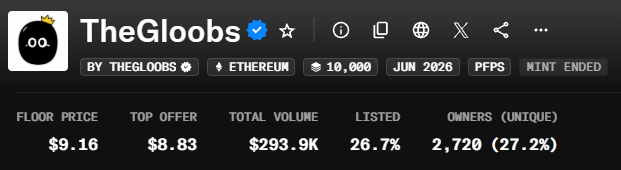
it is very strange indeed why people are dumping @TheGloobs at such a price
the art is cool the collection is not abandoned i honestly dont understand..
i will buy a few pieces because an unjustified drop of 50%
dyor as usual
1
3
69
easy 3x from mp.
congrats to everyone who had whitelist.
thank you @bunya_eth for the collection i am looking forward to the reveal.
it seems to me this is the beginning..

Anyway, here are today's mints that I think could perform pretty well:
And let's start, as usual, with the mint of the day: @blupixapp by @bunya_eth. Clean MP, genuine hype around the collection, and a top-tier artist what more could you ask for? Definitely minting this one.
< Time: 3 PM UTC
< Price: 0.006 ETH
< Supply: 8,192
---
@microdotfun looks really solid, especially since it's a free mint. It definitely won't make it to the public round.
< Time: 11 AM UTC
< Price: Free
< Supply: 1,155
---
@aqualumi_eth is a good mint. I really dig the art style. It's a free mint, so if you have a WL, it’s an absolute must-mint.
< Time: 4 PM UTC
< Price: Free
< Supply: 4,343
---
@AstryxNFT – the style and art are decent, but... it feels like the MP is a bit too high for a mint like this. Whether to mint or not depends on the dynamic we'll have to see how fast it's minting and what the floor price looks like.
< Time: 2 PM UTC
< Price: 0.0063 ETH
< Supply: 444
---
To be honest, there are a few other mints today that look alright on paper, but the creators are setting such crazy MPs that I'm honestly shocked...
Like, people are not going to mint for that much money, it's literally so obvious...
1
44
Anyway, here are today's mints that I think could perform pretty well:
And let's start, as usual, with the mint of the day: @blupixapp by @bunya_eth. Clean MP, genuine hype around the collection, and a top-tier artist what more could you ask for? Definitely minting this one.
< Time: 3 PM UTC
< Price: 0.006 ETH
< Supply: 8,192
---
@microdotfun looks really solid, especially since it's a free mint. It definitely won't make it to the public round.
< Time: 11 AM UTC
< Price: Free
< Supply: 1,155
---
@aqualumi_eth is a good mint. I really dig the art style. It's a free mint, so if you have a WL, it’s an absolute must-mint.
< Time: 4 PM UTC
< Price: Free
< Supply: 4,343
---
@AstryxNFT – the style and art are decent, but... it feels like the MP is a bit too high for a mint like this. Whether to mint or not depends on the dynamic we'll have to see how fast it's minting and what the floor price looks like.
< Time: 2 PM UTC
< Price: 0.0063 ETH
< Supply: 444
---
To be honest, there are a few other mints today that look alright on paper, but the creators are setting such crazy MPs that I'm honestly shocked...
Like, people are not going to mint for that much money, it's literally so obvious...
3
113
Let’s break down today’s mints that are worth keeping an eye on...
Let's start as usual with the mint of the day: @PepeExplorers by @TrystanNFT. I think this mint is going to absolutely fly, I'm just positive about it. The PFPs are clean and diverse, the MP is low, and we’re expecting at least a 10x from the mint price.
< Time: 3:01 PM UTC
< Price: 0.0013 ETH for WL / 0.0018 ETH for Public
< Supply: 10,000
---
@missingpnft – cool concept and art, BUT... the AI-generated art with all those artifacts is a huge turn-off, to be completely honest.
< Time: 12 PM UTC
< Price: 0.0007 ETH
< Supply: 10,000
---
@GoomblesETH – worth mentioning this collection too, because with a supply of only 999, do you guys seriously think there’s even gonna be a GTD phase?
Especially considering you handed out WLs to holders of other collections AND set a mint limit of 3 NFTs per wallet... seriously?
< Time: 1 PM UTC
< Price: 0.0011 ETH
< Supply: 999 (maybe they forgot to add another 9 at the end? lol)
---
@PondSyndicate – a free mint, if you manage to snag one, it's a solid win.
< Time: 2 PM UTC
< Price: Free
< Supply: 555
---
@misfitoneth – another free mint, definitely worth a shot.
< Time: 4 PM UTC
< Price: Free
< Supply: 777
---
@Duckiess_on_Eth – now I actually like this mint. I don't know, they just look cool. I think I’m gonna mint this one.
< Time: 4 PM UTC
< Price: 0.001 ETH
< Supply: 10,000
---
@PurrSociety – free mint, a must-try.
< Time: 5 PM UTC
< Price: Free
< Supply: 4,444
---
That’s pretty much it for today, at least from my perspective. As always, NFA DYOR...
3
1
7
128
alright guys, let me break down @Doodlemon151 for you real quick, mm?
honestly, there’s way too little noise around this collection by @JR_OnChain . while everyone’s out here chasing the next shitcoin or fapping over 10k generative mid, the old school is quietly cooking absolute fire.
this man literally crossed pokémon with that iconic doodles vibe and made only 151 pieces. ONE HUNDRED AND FIFTY ONE.
do you guys even realize the bloodbath that’s gonna happen on the secondary market for this kind of scarcity? t
his isn’t some copy-paste garbage, JR is out here hand-crafting every single piece, grinding with that same passion from back in good old 2021.
long story short, while you’re all sleeping, a total gem is brewing right here. @JR_OnChain, bro, this is way too heavy..
Jun 9

The 1st FREE MINT Contest will be posted tomorrow
& we're giving away 5 more AL spots!
Stay Tuned 👀
🔥💧🌈


1
68
Todays mints that are worth keeping an eye on:
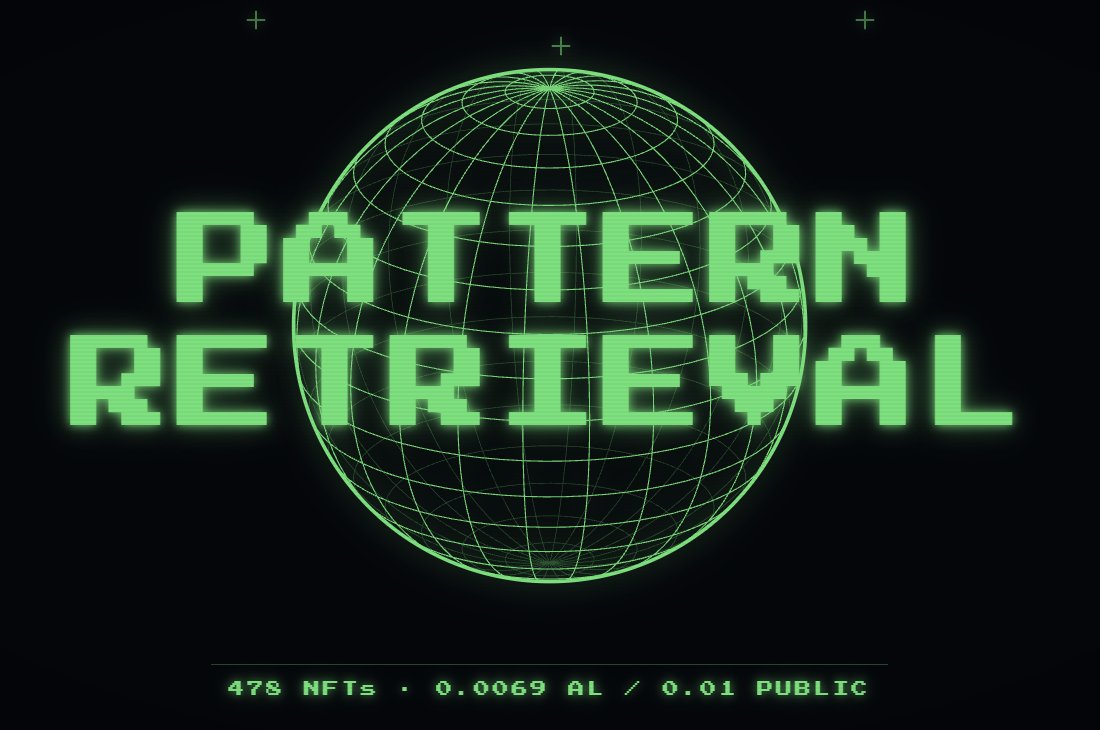
PATTERN RETRIEVAL is hands down the mint of the day by @adamilenich . No explanation needed here. Congrats to everyone who secured a WL - it’s not making it to the public round, don't even hope for it.
- Time: 2 PM UTC
- Price: 0.0069 ETH for GTD (not even gonna bother naming the public price lol)
- Supply: 478
---
@ghostcachenft by @cartist00 – this one could also be interesting, buuut... the mint price bothers me a bit, feels a bit too high. Other than that, looks decent. Let's see.
- Time: 2 PM UTC
- Price: 0.009 ETH (idk, idc)
- Supply: 333
---
@sooki_nft – a completely free mint, looks pretty solid. I’d definitely grab one if I had a WL.
- Time: 4:15 PM UTC
- Price: Free
- Supply: 222
---
@memehaus_eth – the dark horse. I think it could perform really well, looks super interesting.
- Time: 4:20 PM UTC
- Price: 0.0025 ETH for GTD and FCFS
- Supply: 1,111
---
That’s about it for today! Hoping todays mints bring some nice xs
2
6
161
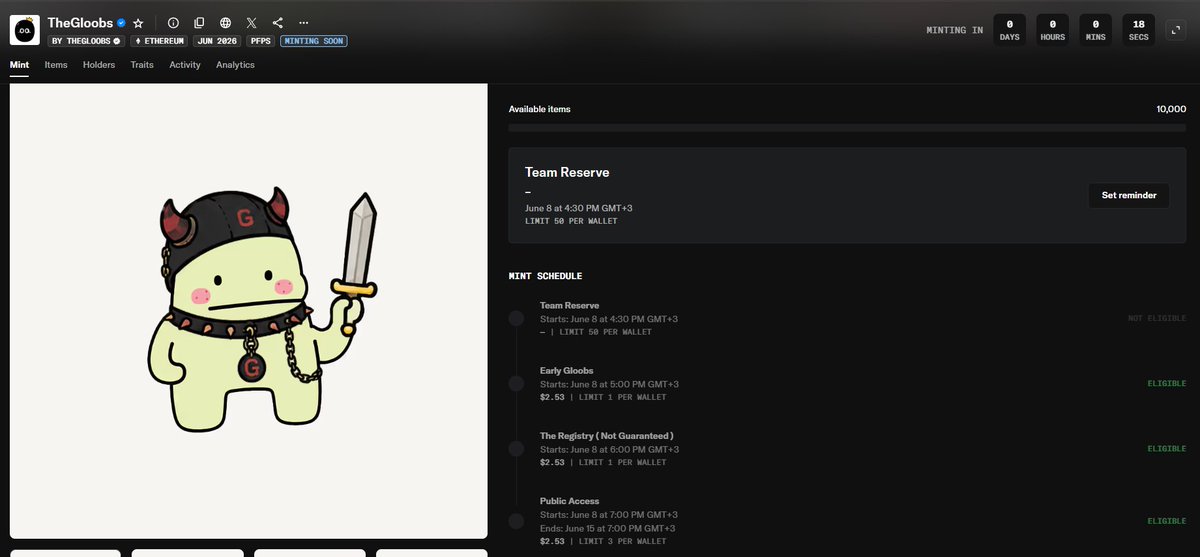
mint of the day - @TheGloobs
mint of the day at 17:00 utc, I'm 100% minting.
the hype is real and the mp is actually good.
wls were given to @npconchain holders and other top-tier collections, so secondary is gonna be absolute fire i think.
don't skip guys.
NFA DYOR.
6
86
something about blupets the rest of the timeline is missing
what blupets actually is
here is what's actually inside the stack:
- fully onchain custom smart contracts
- chainlink vrf for fair trait reveals
- deflationary merging (burn 1, keep 1, carry the traits)
64 distinct "vibes" acting as an agentic personality base
- a cross-chain collector layer connecting abstract chain and eth
@bunya_eth is doing it solo. he's using LLMs to write, design, code, and test the entire architecture himself.
_____
the mint is just feature one.
the numbers (the hidden supply crunch)
8,192 supply. 0.005 eth
but 8,192 is an illusion. the game theory forces deflation from day one.
phase 1 is the reveal. you mint a sealed block. you reveal it onchain. 8 base colors, 1 ultra-rare.
phase 2 is the merge. any two colors can mix to create a family. 1 stays, 1 is burned. the kept token retains its id, but you choose which parent "vibe" carries forward.
to get a pure color path, you need 8 nfts of the same color.
that means 7 nfts get burned for every single pure evolution.
36 families. 324 designs.
nobody is modeling what happens to the floor when holders start aggressively burning the supply to chase a pure evolution.
_____
the agentic layer
this is the pivot from static metadata to a runtime environment.
blupets aren't just traits. the vibe your pet gets during the reveal isn't just text it's the foundation for a personality.
the goal is a pokemonlike universe where the agentic layer uses that vibe to define how each blupet behaves, reacts, and interacts.
it's dynamic. infinite possibilities. fully onchain.
the builder you are betting on
this is the part most coverage skips.
_____
the hidden value
the ecosystem loyalty loop is already closed.
blupets hooks directly into his existing work on abstract chain (abstractio) under a new unified collector layer called artifacts.
the early art enjoyors who held his 1/1s or abstractio nfts? they already got snapshotted for free phase 1 spots.
he didn't abandon his old holders for a new meta. he built a bridge between them.
_____
the trade thesis
the market hasn't fully priced the "agentic nft" category yet. we are still in the early experimental phase.
when the liquidity rotates from static jpegs to dynamic, agentic creatures, the premium will go to the builders who shipped custom, fully onchain game theory.
blupets is priced at $10. the downside is a sandwich. the upside is early entry into a fully onchain agentic universe built by one of the hardest working artists in the space.
_____
one note before you go
this is analysis, not advice. do your own work, take your own positions.
mint is june 11th.

4
3
16
653

if you havent seen my post about the new @adamilenich collection i highly recommend reading it.
honestly this is the most promising and interesting collection in my opinion right now.
i am really looking forward to the mint.
Something about Pattern Retrieval that the rest of the Nft market is completely missing.
Pattern Retrieval is closer to a live simulation of memory degradation than a standard generative art collection.
By the time you finish reading this, you'll understand why there's currently a cult around this project, and why it's no accident.
What Pattern Retrieval actually is
At first glance, it's 94 printable ASCII characters (from 32 to 126).
In reality, each character is a memory under pressure.
- They are fed into a Hopfield network.
- They are shattered into absolute digital noise.
And then the algorithm tries to remember and reconstruct them.
Each Nft in the collection isn't a static Jpeg. It's a living cycle: store -> corrupt -> relax -> recall.
8 passes.
A Hebbian parameter of = 0.35.
All of this runs natively in the browser with generative audio and CRT effects.
Numbers and architecture
Total supply: 478.
Price: 0.0069 ETH for AL / 0.01 ETH on public.
Inside the grid, there are 94 patterns divided into 7 families :
< Dense symbols: The hardest to train, featuring a unique targeting display aesthetic. Only 5 exist.
< Containers
< Floating marks
< Crossbars
< Ghosts (My favorite)
< Angles
< Curves
Each family has its own phosphor color, its own harmonic tuning, and its own population.
Social consensus (what nobody is pricing in)
Right now, the allowlist meta is dead. Usually, it's just mindless Discord grinding, retweet spam, or buying roles.
@adamilenich did something else.
He said it straight: Want my attention? Don't pry into my personal life and don't look for old photos. Interact with the art, remix it, evolve it.
The result?
In a couple of days, the community went insane:
- People are coding browser games (like @KeonHD_X, where you play as a prince in a dungeon collecting corrupted ASCII).
- Creating physical art, sketches and 3D renders.
- Painting with their feet (literally @dhirajleg who has one leg made art and it tore up the timeline).
- Building custom websites and expanding the lore.
This is no longer just a mint. It's an open-source art movement. And it generates organic buy pressure that you cannot fake or buy with a marketing budget.
Who is behind this
< This is the part many overlook.
< Adam (asterism.eth) isn't a random builder.
<He's a community lead at OpenSea, part of @thedoomedxyz, ex-Twitter and Rarible.
< He deeply understands crypto culture and how attention works.
But instead of leveraging corporate levers, he launched a pure, intellectually serious experiment. He isn't promising roadmaps, utility, or tokens.
The website features a direct statement:
- no guarantees of value. this is participation in an art project."
The Thesis
The rest of the market right now is bloated with:
- Overvalued PFP collections with dead Discords
- Projects where VCs are just waiting for unlocks to dump their bags on you
- Soulless points farming
Against this backdrop, Pattern Retrieval feels like a breath of fresh air.
While others are trying to invent fake utility, Adam brings us back to the core of what on-chain generative art is actually for aesthetics, mathematics, and pure creativity.
The intellectual seriousness of this release is exactly why smart money and true artists are currently fighting for an AL.
One note before you go
This is analysis, not financial advice. Do your own research.
Almost all of CT still hasn't connected these dots. Now you know more than 95% of the market.
6
86
Something about Pattern Retrieval that the rest of the Nft market is completely missing.
Pattern Retrieval is closer to a live simulation of memory degradation than a standard generative art collection.
By the time you finish reading this, you'll understand why there's currently a cult around this project, and why it's no accident.
What Pattern Retrieval actually is
At first glance, it's 94 printable ASCII characters (from 32 to 126).
In reality, each character is a memory under pressure.
- They are fed into a Hopfield network.
- They are shattered into absolute digital noise.
And then the algorithm tries to remember and reconstruct them.
Each Nft in the collection isn't a static Jpeg. It's a living cycle: store -> corrupt -> relax -> recall.
8 passes.
A Hebbian parameter of = 0.35.
All of this runs natively in the browser with generative audio and CRT effects.
Numbers and architecture
Total supply: 478.
Price: 0.0069 ETH for AL / 0.01 ETH on public.
Inside the grid, there are 94 patterns divided into 7 families :
< Dense symbols: The hardest to train, featuring a unique targeting display aesthetic. Only 5 exist.
< Containers
< Floating marks
< Crossbars
< Ghosts (My favorite)
< Angles
< Curves
Each family has its own phosphor color, its own harmonic tuning, and its own population.
Social consensus (what nobody is pricing in)
Right now, the allowlist meta is dead. Usually, it's just mindless Discord grinding, retweet spam, or buying roles.
@adamilenich did something else.
He said it straight: Want my attention? Don't pry into my personal life and don't look for old photos. Interact with the art, remix it, evolve it.
The result?
In a couple of days, the community went insane:
- People are coding browser games (like @KeonHD_X, where you play as a prince in a dungeon collecting corrupted ASCII).
- Creating physical art, sketches and 3D renders.
- Painting with their feet (literally @dhirajleg who has one leg made art and it tore up the timeline).
- Building custom websites and expanding the lore.
This is no longer just a mint. It's an open-source art movement. And it generates organic buy pressure that you cannot fake or buy with a marketing budget.
Who is behind this
< This is the part many overlook.
< Adam (asterism.eth) isn't a random builder.
<He's a community lead at OpenSea, part of @thedoomedxyz, ex-Twitter and Rarible.
< He deeply understands crypto culture and how attention works.
But instead of leveraging corporate levers, he launched a pure, intellectually serious experiment. He isn't promising roadmaps, utility, or tokens.
The website features a direct statement:
- no guarantees of value. this is participation in an art project."
The Thesis
The rest of the market right now is bloated with:
- Overvalued PFP collections with dead Discords
- Projects where VCs are just waiting for unlocks to dump their bags on you
- Soulless points farming
Against this backdrop, Pattern Retrieval feels like a breath of fresh air.
While others are trying to invent fake utility, Adam brings us back to the core of what on-chain generative art is actually for aesthetics, mathematics, and pure creativity.
The intellectual seriousness of this release is exactly why smart money and true artists are currently fighting for an AL.
One note before you go
This is analysis, not financial advice. Do your own research.
Almost all of CT still hasn't connected these dots. Now you know more than 95% of the market.
2
14
334
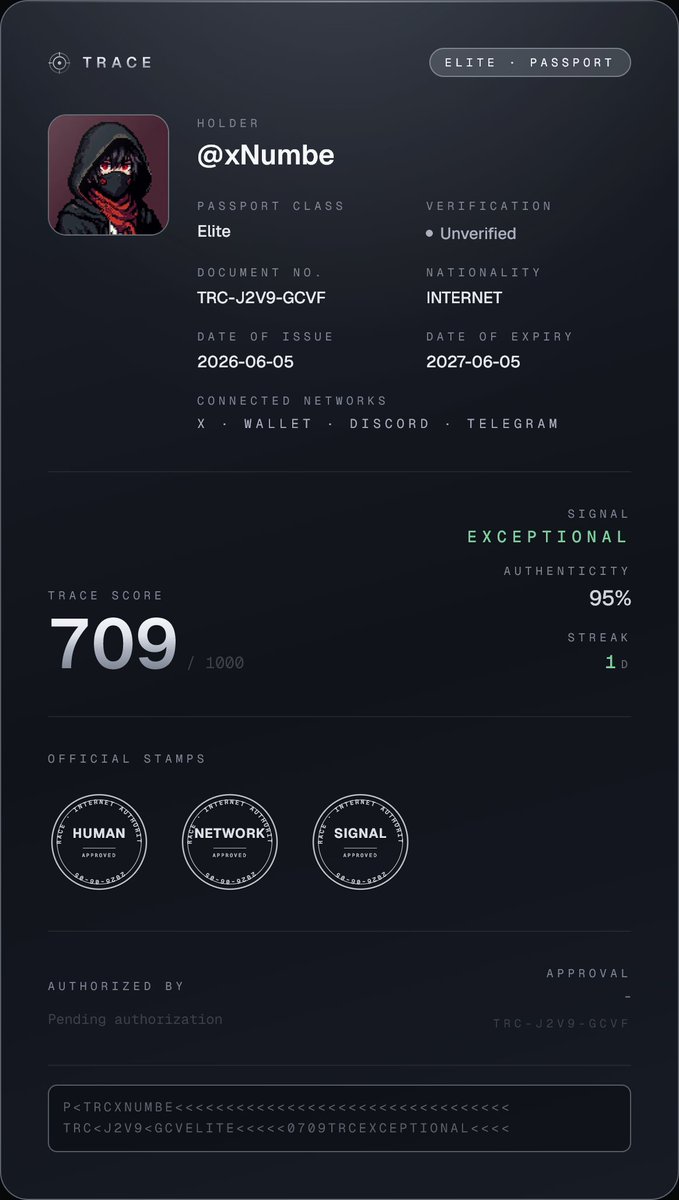
TRACE SCORE 709 · Elite Passport
Detected and verified by the TRACE internet identity protocol. traceeco.io
2
6
76
looks like jeets got out right?
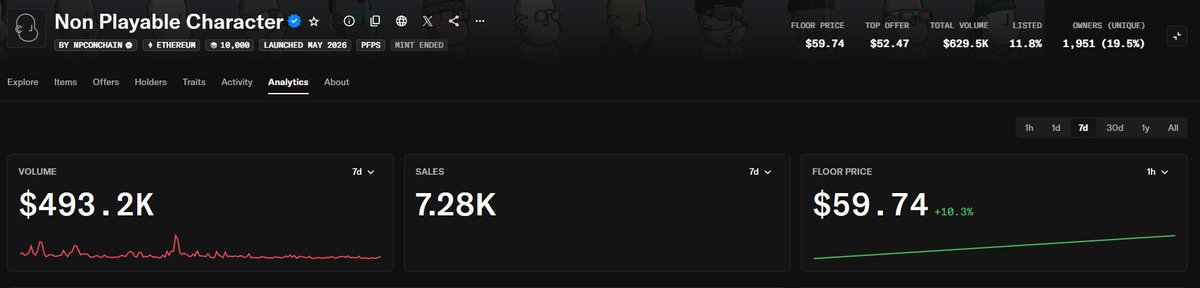
well i dont believe the @npconchain will stop and not break the $100 fp and fly to $150
the market shook a bit and people immediately rushed to sell... just laughable
nft season they said but as soon as things got a little worse - they immediately started selling
2
10
74
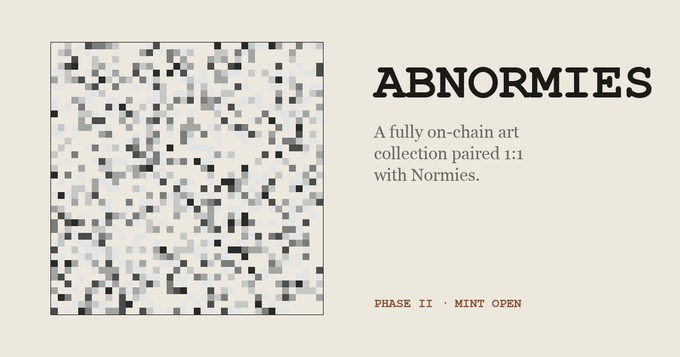
Most collections now are bright memes for quick flips. But Abnormies is pure weather around @normiesART.
First let us figure out what Normies and Abnormies are in general although if you are even a little in the NFT sphere then you should know them THIS IS THE BASE
Abnormies are 100 percent on chain derivative of Normies from the author @serc1n .
- Each Abnormie is permanently bound one to one to its Normie seed. But it looks nothing like a copy but like a minimalist 40x40 black and white grid.
- Each pixel is a trace of real movements of holders:
< transferred Normie - light trace
< customized - dark spot
< burned - AND I DO NOT KNOW WHAT EXACTLY WILL BE THEN REALLY.
In the end the whole collection slowly drifts. The more activity in the network the more chaos and the less any one person can control everything.
This is not visual this is a whole philosophy from which one gets goosebumps. Right?
An Abnormie is something that you do not control at all. These are collective traces of all of us. You are not the author of your Abnormie. The authors are all of us together.
@seanbonner took the idea of @wiiides and brought it to absolute bliss. No roadmap no presale no whitelist only pure specs on the site CC0 and fully on chain.
_____
And now the main thing why take this at all my personal reasons:
1. This is art that really lives and breathes. Not a static picture on OpenSea but a constant record of the entire history of the ecosystem. In a year or two your Abnormies will look completely different and this will depend not on the artist but on how alive the Normies network is. This is like collecting the process itself not the finished result. I AM IN SHOCK FROM THIS IN SHORT!
2. Conceptual purity that almost no one has now. Abnormies is a real statement about control entropy traces of people and community. It really hooked me completely.
3. Long term potential as real on chain art. Not for those who scream ten x in a week. Abnormies fits perfectly into this line and I am straight up proud that I can be in this.
Who this is definitely not for:
- Those who chase a quick pump.
- Lovers of bright characters and memes.
- Those who look at some abstract grid and say well what a cringe.
In the end Abnormies for me is a quiet BUT UNREALISTICALLY STRONG project. Without noise without influencers without empty promises.
I have already taken several for myself. Not because it is cheap but because I want to be part of this story bro.
This is not financial advice just my thoughts after deep immersion.
6
19
813
minted 2 abnormies. looks very promising because @seanbonner is behind it
waiting for the next phase if it even gets there which i doubt.
thanks for the mint Sean.
2
8
175