
Breaking code at @OpenZeppelin, @Brickken co-founder, opinions are mine.
Joined February 2014
- Tweets 413
- Following 106
- Followers 521
- Likes 514
18 Photos and videos






Regulated assets need infrastructure that DeFi was not originally built to support.
Dario Lo Buglio (@xaler2 ), our co-founder and Head of Blockchain, was featured by @Cointelegraph discussing ERC-7943, the uRWA token standard he co-authored, which has now reached the final stage of the @ethereum Improvement Proposal process.
The interview addresses a core issue for institutional tokenization: regulated assets require identity frameworks, transfer controls, compliance logic, and interoperability across custodians, exchanges, wallets, and institutional platforms.
ERC-7943 was designed as a flexible framework for tokenized real-world assets, helping assets move across different compliance systems without forcing every institution into isolated infrastructure.
Tokenized RWAs have grown from roughly $6.4B at the start of 2025 to about $34B today.
The standards underpinning that growth matter.
Read the full Cointelegraph feature here:
cointelegraph.com/features/e…
8
13
47
1,042

Standardizing RWAs from the roots

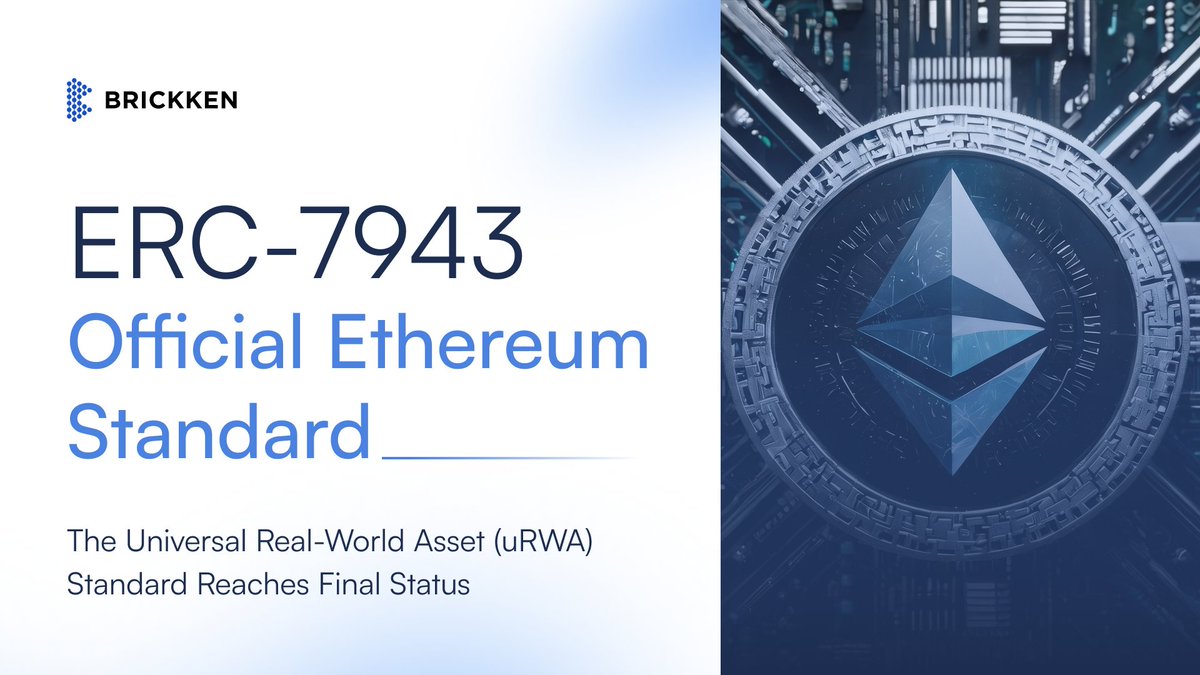
ERC-7943 is now an official Ethereum standard.
That matters because institutional tokenization cannot scale through vendor-controlled frameworks, fragmented compliance logic, and asset-specific integrations.
Tokenized real-world assets need more than token representation.
They need predictable ways for wallets, custodians, issuer platforms, infrastructure providers, and other integrators to understand whether a transfer is permitted, who can interact with the instrument, and how enforcement or restriction logic is applied.
Authored by Dario Lo Buglio (@xaler2 ), Brickken co-founder, ERC-7943 introduces a minimal, composable open interface for compliant tokenization of real-world assets across @ethereum and EVM-compatible networks.
It does not impose one compliance model, identity provider, or tokenization platform.
It gives institutions a common implementation surface while preserving flexibility at the policy, identity, jurisdiction, and compliance layers.
For financial institutions, that distinction is strategic.
A vendor-controlled framework can create dependency on a single commercial roadmap.
An open Ethereum standard gives issuers and integrators a more neutral foundation for tokenized asset infrastructure.
1
8
551
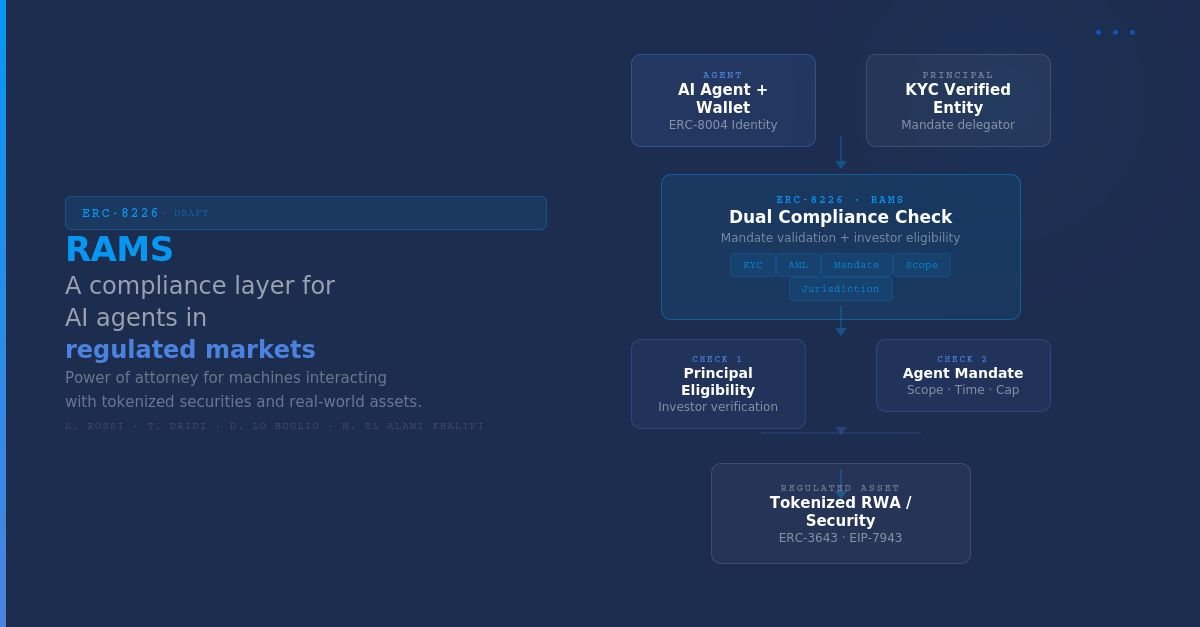
As AI agents move deeper into finance, regulated markets need standards that define how automation can operate within legal boundaries, not outside them.
That is exactly what ERC-8226 addresses.
Created by our team, the proposal introduces a framework for compliant agent mandates, allowing verified investors to delegate limited on-chain authority to AI agents while preserving KYC, AML, eligibility checks, and issuer control.
This is a foundational step for the agentic economy, where autonomous software agents will execute tasks, allocate capital, manage positions, and interact with financial products on behalf of users and institutions.
The next phase of tokenization is not only digitizing assets, but building the infrastructure and standards that allow new participants, including AI agents, to operate securely in regulated markets.
Brickken is proud to contribute at both levels: infrastructure for tokenized real world assets and open standardization that helps shape how automation connects with financial markets.
Congratulations to @Ludovico__Rossi , @xaler2 , @ThamerDridi1 and @nabilbrickken on pushing this forward.
10
21
62
2,449
Single DVN setup. Single point of failure.

1
121
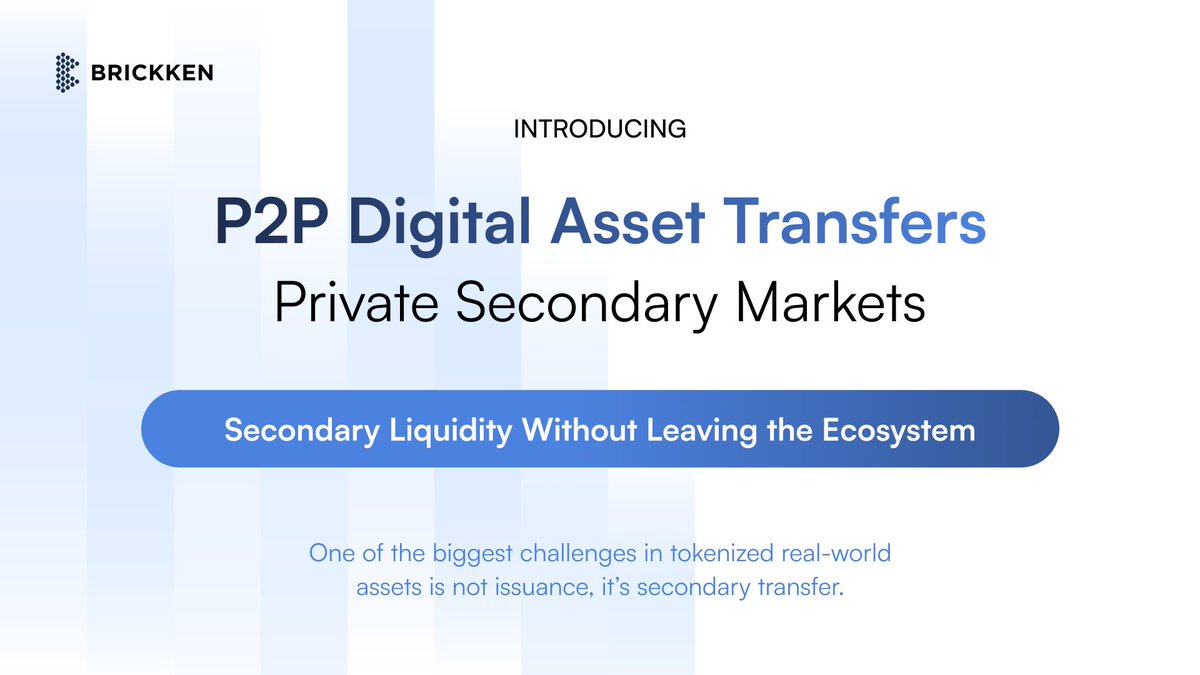
Secondary Liquidity, Built In
We’ve just introduced a new feature inside Brickken: P2P Digital Asset Transfers: Private Secondary Markets
This module connects verified investors inside each issuance, facilitating compliant secondary transactions.
It extends the lifecycle of tokenized assets while preserving issuer governance and platform integrity.
Here’s what this means:
• Secondary liquidity without leaving the ecosystem
• Investors can buy and sell digital assets within the same platform where they were issued
• Transactions are secured through escrow logic
• Only verified participants can interact with each issuance
• Issuers maintain governance through optional right-of-first-refusal
This is not a speculative trading venue.
It is structured, compliant secondary liquidity designed for real-world assets.
We continue building the infrastructure layer that tokenized finance actually needs.
73
63
123
144,069
Meanwhile my Google nest doesn't understand a word. Where is AI in home assistance and domotics? Where?
Mar 12

Google Maps 🤝 Gemini 3
Now that you can ask Maps complex questions, let’s dig into some prompts that showcase the true power of this update. 🧵
1
83
Industry has shown maturity compared to few years ago when it comes to secure code. The same is not true for operational security. That's how you level up your security posture 👇
Mar 11

Today, most blockchain hacks aren’t smart contract bugs. They stem from phishing attacks, stolen keys, compromised accounts, blind signatures, and operational vulnerabilities.
Take the $1.4 billion ByBit hack: the exploit didn't target the code; it targeted operational security.
87
Worried about your location data? Spawn random locations every 5 minutes.
Worried about AI taking over? Let's flood the internet with wrong data so that AI learns from it and becomes dumb.
Don't escape the matrix, blast it from the inside.

Stop trying to protect your data and privacy. Flood the internet with useless and fake data points instead. It's same result with less efforts.
38
xaler.eth retweeted

Feb 26
ERC-7943 (Universal RWA) is now supported in the CMTAT. This ERC, by @xaler2, defines a minimal interface for representing financial instruments on-chain, introducing core compliance features such as asset freezing, enforcement transfers, and authorized transfer restrictions.

CMTA announces ERC-7943 support in the CMTAT Solidity implementation (v3.2.0).
ERC-7943 (Universal RWA) standard introduces a minimal, modular interface for compliance-related events and transfer restrictions, designed to sit on top of existing token standards. Its integration into CMTAT strengthens interoperability and helps reduce fragmentation in the tokenization of financial instruments.
ERC-7943 Authored by Dario Lo Buglio @xaler2 (@Brickken co-founder).
Learn more: cmta.ch/news-articles/cmtat-…
GitHub: github.com/CMTA/CMTAT
Release: github.com/CMTA/CMTAT/releas…
Thanks to the CMTA Technical Committee, all contributors to the release and @Brickken for the support.
@ADCDIII @veorq
1
1
169
Standards Are the Foundation of Institutional Tokenization
Institutional capital does not scale on proprietary frameworks. It scales on open standards.
We are partnering with the Capital Markets and Technology Association (@cmta_ch ) on the incorporation of ERC-7943 into their CMTA Token (CMTAT) Solidity implementation.
CMTA’s framework is one of the most established open, blockchain-agnostic standards for tokenized securities, with implementations across Ethereum and other chains, and oversight from its Technical Committee and Advisory Board in Switzerland.
Its modular architecture supports on-chain corporate actions, enforcement logic, and institutional-grade compliance.
ERC-7943, authored by our Co-Founder and Head of Blockchain Dario Lo Buglio (@xaler2 ) , introduces a universal compliance interface for transfer validation, freezing, forced transfers, and standardized error signaling.
By aligning ERC-7943 with CMTAT, we are:
• Strengthening cross-platform interoperability across the RWA ecosystem.
• Reducing fragmentation in regulated tokenization frameworks.
• Embedding standardized compliance hooks at the protocol level.
• Supporting cross-jurisdictional compatibility and long-term maintainability.
This integration is a concrete step toward a unified compliance layer for tokenized financial instruments.
21
29
71
3,483

CMTA announces ERC-7943 support in the CMTAT Solidity implementation (v3.2.0).
ERC-7943 (Universal RWA) standard introduces a minimal, modular interface for compliance-related events and transfer restrictions, designed to sit on top of existing token standards. Its integration into CMTAT strengthens interoperability and helps reduce fragmentation in the tokenization of financial instruments.
ERC-7943 Authored by Dario Lo Buglio @xaler2 (@Brickken co-founder).
Learn more: cmta.ch/news-articles/cmtat-…
GitHub: github.com/CMTA/CMTAT
Release: github.com/CMTA/CMTAT/releas…
Thanks to the CMTA Technical Committee, all contributors to the release and @Brickken for the support.
@ADCDIII @veorq
1
1
4
336
I got the chance to give my thoughts on how quantum computing can affect the crypto space.
Check it out 👇
Feb 12

¿La computación cuántica es una amenaza real para bitcoin?
expansion.com/mercados/cript…
1
2
11
663
xaler.eth retweeted

2 Dec 2025
Casper is now aligned with ERC-7943, the emerging standard for compliant and interoperable real-world asset tokenization.
A step toward a unified, scalable #RWA ecosystem.
🔗 Press release: beincrypto.com/casper-networ…
9
73
243
14,440
xaler.eth retweeted

20 Nov 2025
We have our first winner! 🚀
0xf378708b88841abb63e2316e4fc8f29469bee885
Reach us tomorrow at the DSS booth to claim your OZ-branded Ledger Nano S Plus.
19 Nov 2025

Want a Ledger Nano S Plus and a chance to join the @OpenZeppelin security research team? Prove you can solve the latest brand new Ethernaut levels!
2
7
1,113
Shared standards are the key to scaling tokenization.
Fragmentation and inconsistent compliance frameworks are holding back the $24B RWA market.
The solution? Open, interoperable standards like ERC-7943, co-authored by our very own co-founder @xaler2, which define compliance, security, and cross-chain functionality for all tokenized assets.
A universal standard means:
✅ Institutional trust
✅ Wider industry acceptance
✅ Global liquidity and composability
The future of tokenization depends on shared rules, not isolated systems, and ERC-7943 is the bridge between traditional finance and blockchain.
10
16
78
3,037
xaler.eth retweeted

19 Nov 2025
The @summit_defi starts tomorrow - think you can crack these Ethernaut levels and win big? 🧩
UniqueNFT, Forger, and NotOptimisticPortal are live now.
Complete one or more levels and bring your solution (transaction hash) to our booth by Friday at 2pm to win ... 👇
3
3
41
11,378
xaler.eth retweeted
7 Nov 2025
The Balancer v2 exploit highlights how complex protocol evolutions can introduce new risks.
OpenZeppelin audited earlier versions of the v2 codebase, prior to the introduction of the attack vector that was later exploited.
Our analysis and lessons for the community ↓
openzeppelin.com/news/unders…
2
30
143
14,723