
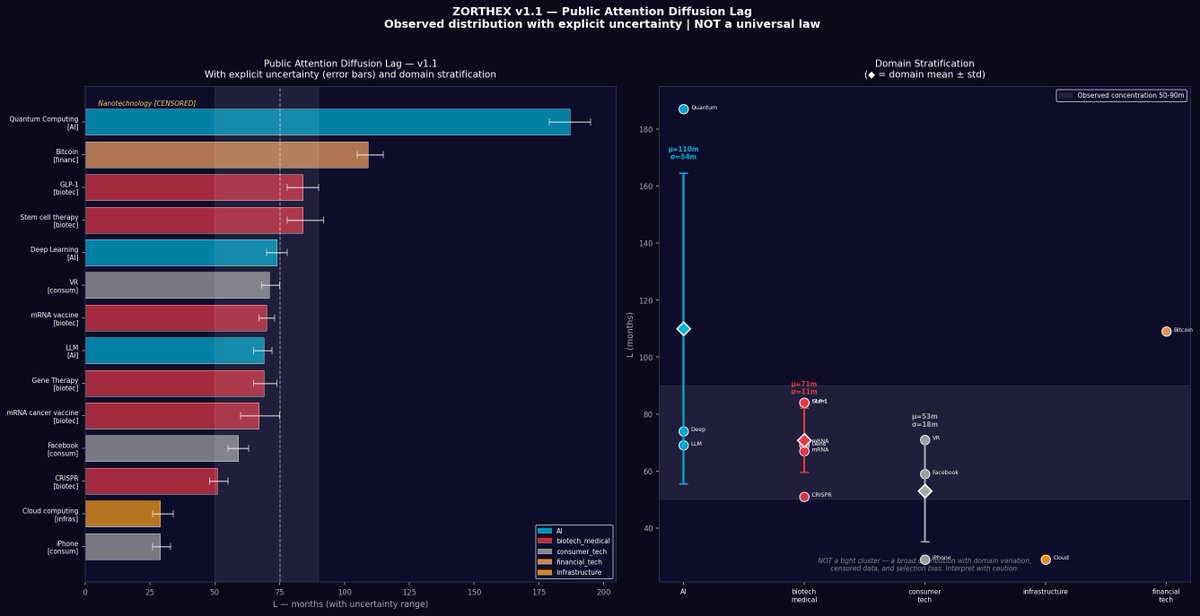
Measuring the delay between reality and public awareness. L = t_peak − t_start. n=50 verified cases 4 diffusion regimes. Open method. DOI published.
Joined April 2026
- Tweets 148
- Following 86
- Followers 9
- Likes 79
11 Photos and videos




Needed access to US federal court records for research.
PACER — America's federal judiciary database — sends your access code by post.
From Texas. To Sardinia. By registered mail.
Ten days, one Atlantic crossing, one trip to the post office.
Some things are worth doing slowly. 🙂
5
The UK just named legal services as the first focus area for its new AI Growth Lab — SRA, LSB, CLC and ICO in one sandbox. Applications open this summer.
The interesting part isn't the Lab. It's the problem it admits: existing duties are clear; the timeline of when they become operationally binding is not.
That gap is measurable.
zorthex.com | DOI 10.5281/zenodo.20589503
1
16
3
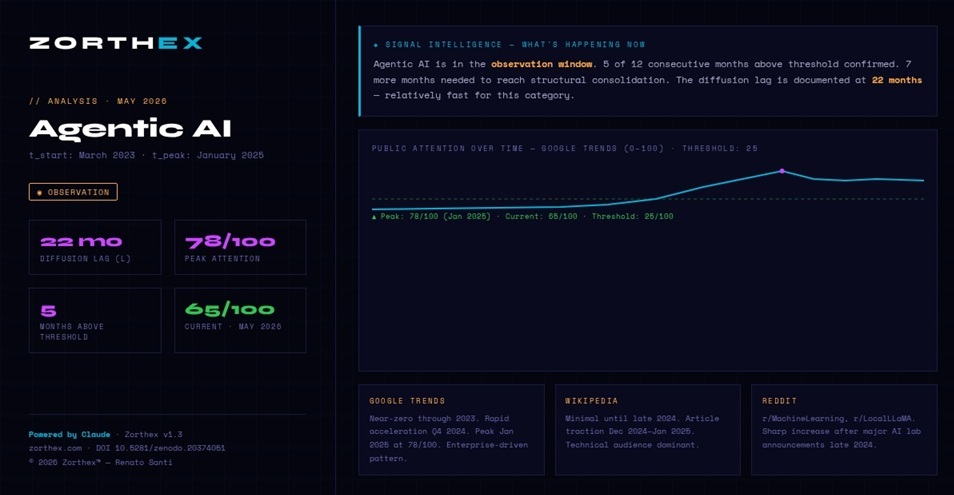
Zorthex v2.0 is live.
70 phenomena, 7 domains, three-source verified, DOI-anchored.
It measures the gap between when something becomes operationally real and when institutional attention consolidates around it — and names the legibility event that closes it (a mandate, an anchor, a narrative).
The dataset maps where a category sits in its cycle; the app reads any phenomenon you choose, live.
For anyone who allocates capital, sets strategy, or times a launch.
Consumer moves in months. Infrastructure takes a decade.
zorthex.com
#DiffusionLag #AltData #EmergingTech
1
2
The US legal market is experiencing its first real post-regulation stress test on generative AI. Public data shows compliance failures are not random peaks — they cluster around precise temporal dynamics.
The gap between policy adoption and operational breakdown under judicial pressure follows a structural rigidity that is being widely underestimated. Compliance is not a static event. It is a time-dependent variable.
Zorthex™ · zorthex.com
#LegalAI #RiskAnalysis #Regulatory
9
Anthropic opens in Milan today.
Zorthex™ measures the delay between when something becomes real and when the world catches up — and maps where any phenomenon sits in its attention cycle right now.
50 verified cases. 7 domains. A public tool. Custom Reports for institutional use. All powered by Claude.
The question it answers: where are we in the cycle — and how much time do we have?
zorthex.com · DOI 10.5281/zenodo.20374051
#Anthropic #Claude #BuiltWithClaude #Zorthex #Milano
9
Most of what we call "AI adoption lag" is actually two different systems.
External attention consolidation: when a phenomenon becomes legible in markets and public discourse.
Internal institutional propagation: when that signal reaches operational behaviour under real workflow pressure.
These two don't move at the same speed. Often they're almost decoupled.
Zorthex measures the first. The second is still an open problem.
#DiffusionLag #AIGovernance #Zorthex
1
Measuring the delay between reality and public awareness.
Zorthex v1.3 — what we've built.
L = t_peak − t_start The gap between when something becomes real and when institutions notice.
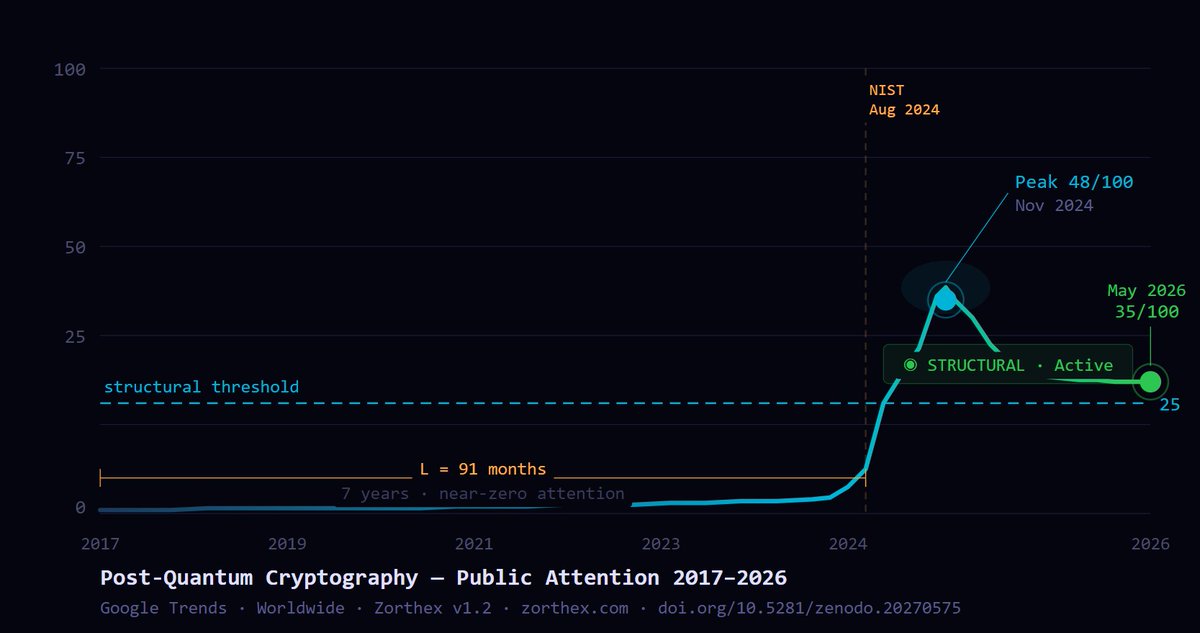
n=50 verified cases. 4 diffusion regimes: → Policy-Trigger: PQC (91mo), Stablecoins (128mo) → Institutional Mass: RWA Tokenization (103mo) → Market-Narrative: Bitcoin (107mo) → Shock/Spoke: GDPR, NFT, Memecoin
Open method. Three independent sources. DOI: doi.org/10.5281/zenodo.20374… Powered by Claude.
zorthex.com
#OpenResearch #DiffusionLag #Zorthex
4
Beyond what's next.
Week in numbers: — 2 verified reports published: ZCR Stablecoins (128mo lag) ZCR PQC (91mo) — Pilot Program active: 5 institutional contacts — methodology.html live — public contract — 1 month free LinkedIn Premium activated
Building in public. No team. No investors. zorthex.com
#Zorthex #BuildingInPublic #OpenResearch
36
Attention ≠ adoption.
Attention ≠ security.
But attention precedes both.
Full Signal Report #002 — open access:
zorthex.com/research.html
Open method. Replicable data. No predictions.
#PQC #PostQuantumCryptography #NIST #Zorthex
8
Week 3. Still no team. Still no investors.
Today Zorthex landed on LinkedIn.
Not to network. To test whether empirical data on public attention diffusion has value for the people who need it most — cybersecurity professionals, investors, policy makers.
First contact: a comment on a post about NIST IR 8610 and the end of static cryptography.
Response came from a Founder & CEO with 11,000 followers and 27 years in cryptographic transformation.
"Really well narrated."
That's not validation. That's a signal.
The method is holding. The framework is expanding.
Signal Report #003 is next. The site is evolving. B2B is opening.
If you're building something that needs to know where it sits in the attention cycle — before the crowd notices — Zorthex is measuring that.
🔗 zorthex.com #Zorthex #BuildingInPublic #OpenResearch #PostQuantum #Cybersecurity
17
ZORTHEX retweeted

May 15
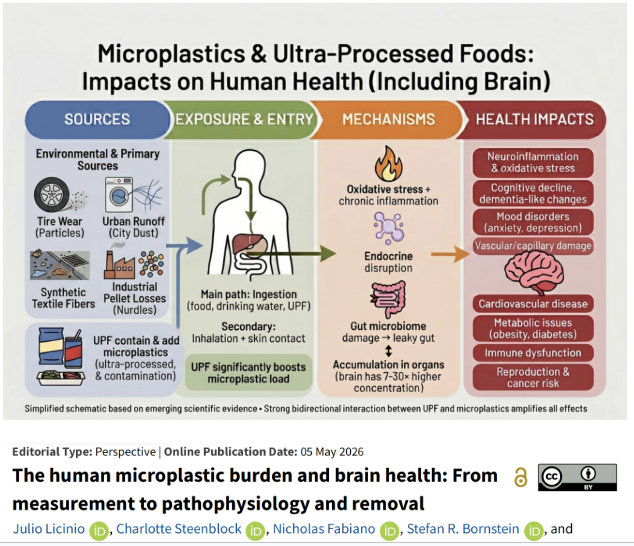
This new perspective study reports that our brains are carrying 3,000x more microplastic than our blood.
Microplastic burden of the human brain rose ~50% between 2016 and 2024.
The average brain now carries roughly:
> 11x the load of the liver
> 11x the kidney, and on a per-mass basis around
> 3,000x the concentration found in circulating blood (on a per-mass basis)
This study argues that eliminating ultra-processed foods (i.e. chicken mcnuggets, breaded shrimp) carries an additional benefit: reducing brain microplastic accumulation.
This is based on an inferred chain of mechanisms rather than proven causality in humans, yet the convergence is striking.
The paper outlines four pathways through which microplastics plausibly damage the brain:
> oxidative stress and chronic inflammation
> endocrine disruption
> gut-microbiome injury
> and vascular damage.
These map onto various brain and mental diseases including: depression, anxiety, cognitive decline, stroke, dementia.
The same conditions are independently linked to ultra-processed food consumption in large prospective cohorts
Each 10% increase in ultra processed food intake
> 25% higher dementia risk
> 16% higher cognitive impairment risk
> 8% higher stroke risk
High versus low ultra processed food consumption tracks with 44% higher odds of depression and 48% higher odds of anxiety.
While we do not yet have a human study showing UPF intake directly raises brain microplastic burden. Here is what we do have:
A study found that the more processed forms of protein foods carry significantly more microplastic particles.
> Chicken nuggets contained 31x more microplastics per gram than raw chicken breast (least processed item in the study)
> Breaded shrimp, the most processed item in the study, carried ~130x the level in raw chicken breast (caveat: shrimp also carries higher baseline contamination from ocean and water pollution)
> A 1,031-woman pregnancy cohort showed each 10% higher UPF intake tracked with 13.1% higher urinary phthalates, the plasticizers that leach from food packaging
Microplastics cross from the blood to the brain.
Animal research shows mechanistically how microplastic particles do cross the blood-brain barrier.
In mice, polystyrene nanoparticles at 293 nm reached the brain within 2 hours of oral exposure. Particles at 1.14 μm and 9.55 μm did not cross at all.
While most microscopy-based microplastic tests have a detection floor around 1 μm.
The fraction that actually crosses into the brain sits below that threshold. If a test picks up larger particles in your blood, the smaller, BBB-crossing fraction is almost certainly there too, just below the detection window.
The big ones are a proxy for the dangerous small ones.
Cut all microplastic input where you can and avoid ultra processed foods, this another important one.
In addition: use a water filtration system for your drinking water, reverse osmosis with remineralization is the gold standard.
I recently reported complete elimination of microplastics from my semen (first in human demonstration) and a 87% reduction in my blood.
97
113
962
147,930
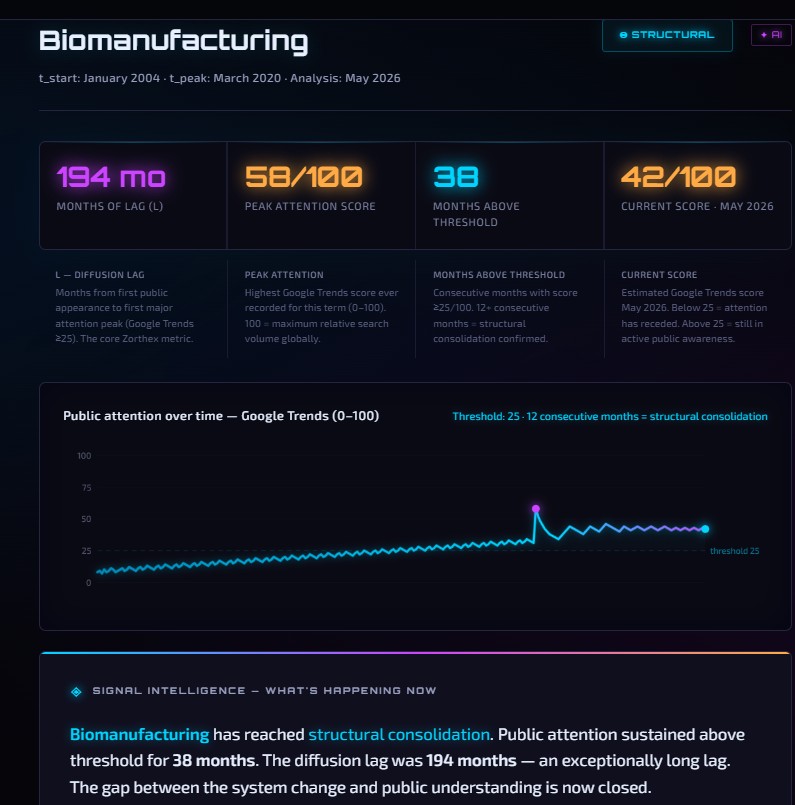
The app is live.
Type any technology, phenomenon, or concept.
Zorthex measures how long it took the world to notice — and where public attention stands today.
zorthex.com
Powered by Claude · @AnthropicAI
14
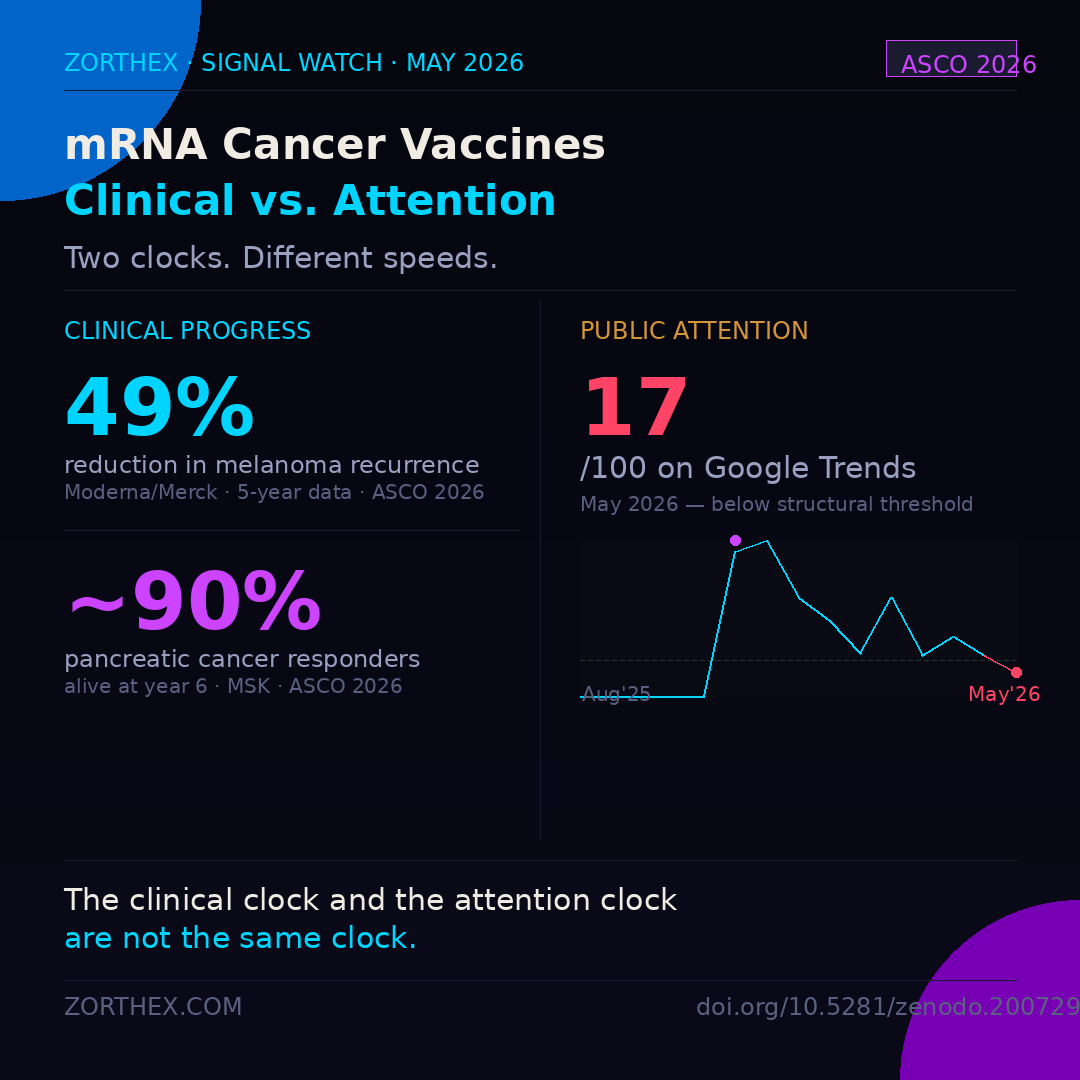
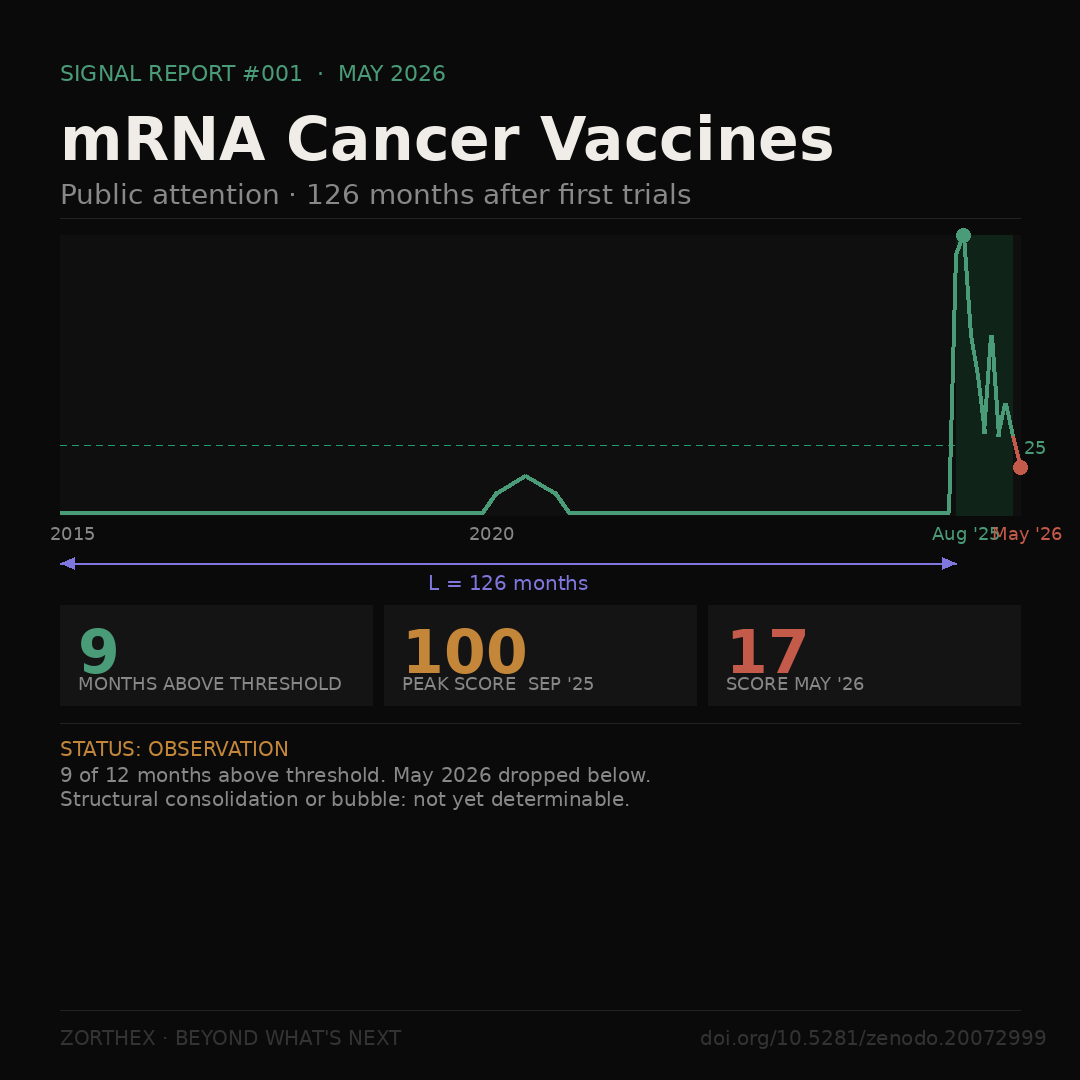
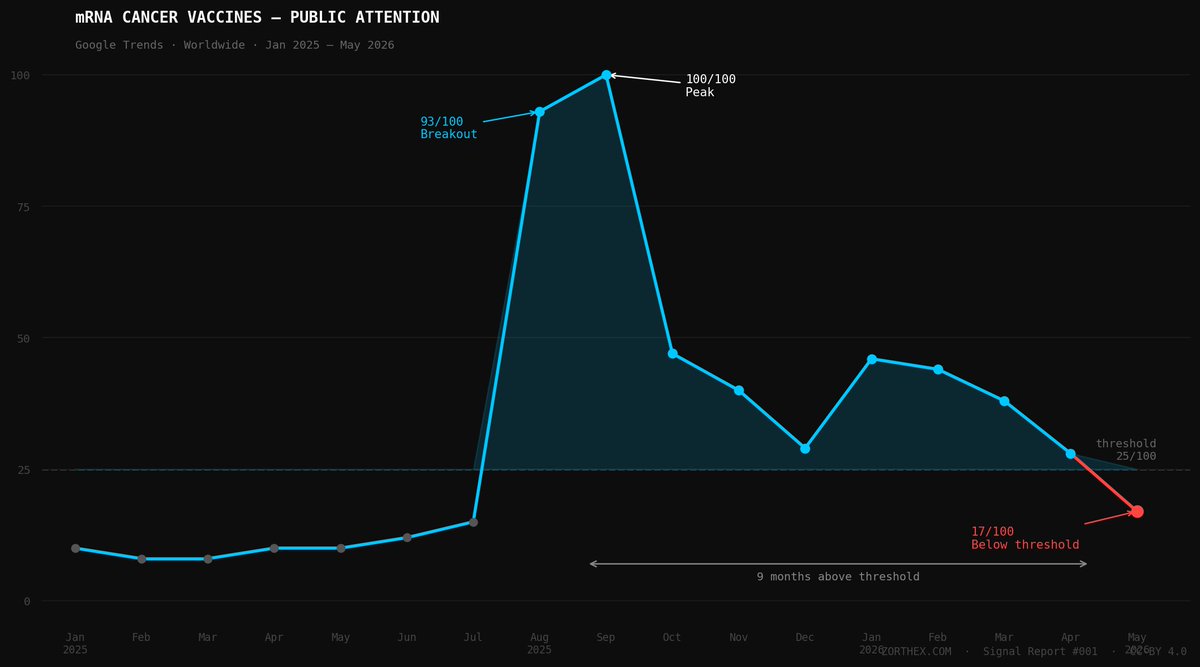
ASCO 2026. Moderna/Merck: 49% reduction in melanoma recurrence at 5 years. Pancreatic cancer responders alive at year 6: nearly 90%.
Public attention to mRNA cancer vaccines: 17/100 in May 2026.
The clinical clock and the attention clock are not the same clock.
Signal Report #002 — August 2026.
1
23