50 Photos and videos








rodney() retweeted

Jun 12
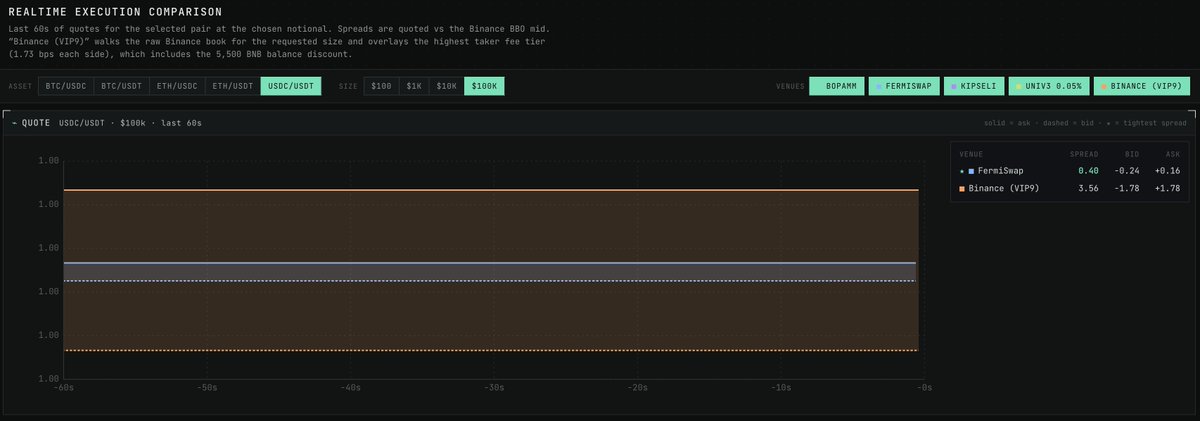
With only a few PropAMMs deployed thanks to the work of @titanbuilderxyz and @class_lambda, users can already do onchain swaps of $100k in stablecoins at a ridiculous cost of just 0.4bps.
All this on @ethereum. Incredible. Ethereum will soon become the global settlement layer for remittances and forex.
I honestly believe this is the most important thing we have to do right now. We have to make sure Ethereum becomes the best place to do finance.
Ethereum already has the best uptime, security, diversity, and research. We only need to improve on engineering and expose our products to the rest of the world, so that they use Ethereum without even knowing it, like Linux runs in your car, fridge, or server without you ever realizing it.
Jun 3

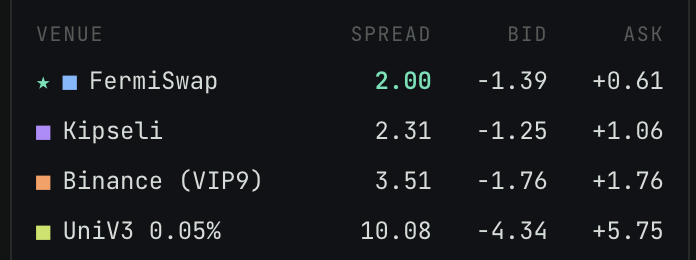
PropAMMs on @ethereum: 1.5 bps tighter than @binance VIP9. 8 bps tighter than @Uniswap. The best execution venue for ETH is no longer a CEX.
Onchain is already winning on price! This is only the case for less than 10k tades, but the reason isn't technical, it's just a lack liquidity. Liquidity will grow with time and more MM and PropAMMs will keep entering the game. With time between Ethereum and CEXes and other L1s will become even bigger. Ethereum is about to become the global financial hub. Still many things to improve. We're working all day long to deliver.
Amazing work @titanbuilderxyz and @class_lambda.
23
13
132
18,050
rodney() retweeted

Jun 2
Today a crazy quantum story just got wilder.
On March 31, the Google Quantum AI team published a landmark result on Shor's algorithm for elliptic curve cryptography. Technically, the paper was a bombshell: a dramatic 10x improvement over the state-of-the-art. As a stunt and wakeup call to the blockchain space, those optimisations were illustrated on secp256k1, the elliptic curve underlying Bitcoin and Ethereum signatures.
But perhaps the most striking part of the paper was sociological, not technical. Instead of following standard academic process, the optimisations were kept secret, hidden behind a zero-knowledge (ZK) proof. Google's accompanying blog post mentions they "engaged with the U.S. government". The ZK proof demonstrates the existence of algorithmic improvements without leaking details. Academic censorship with ZK, a historic first!
As a co-author of the Google paper I witnessed some of the context surrounding this censorship. To be honest, multiple aspects of that context don't sit well with me. As much as I believe the general public ought to know more, I am limited in my ability to whistleblow. Though let me be clear about one thing: the Google team's professionalism has been absolutely exemplary, and they deserve nothing but praise.
Censorship has a way of backfiring. The Streisand effect, where an attempt to bury something only draws more attention to it, is exactly what's unfolding today. First, Google's key optimisation has been rediscovered by the French. And in a thrilling turn of events, a collaborative Shor-at-home challenge just launched. The initiative, available at ecdsa[.]fail, breached a new Shor world record in a matter of hours.
Let's start with the rediscovery. Just two months after Google's paper, French quantum expert André Schrottenloher cracks the main secret optimisation. His paper, titled "Optimized Point Addition Circuits for Elliptic Curve Discrete Logarithms", landed on the arXiv today. Big congrats to André, who beat several other nerdsnipped experts to it. In a blog post also published today, Craig Gidney, the world expert on Shor optimisations, revealed that he'd been sitting on this very optimisation for a whole year under censorship pressure.
Interestingly, André missed a handful of minor optimisations, both from Google's original publication and from improvements found since. It's plausible there's still plenty of juice left to squeeze out of Shor, and this is exactly what the ecdsa[.]fail challenge is about. The verifier program developed for the ZK proof does double duty, automatically filtering for valid submissions. Dozens of compounding small and micro improvements are rolling in. As of the time of writing there's an 8.4% improvement to Google's circuit, as measured by the product of logical qubit count and Toffoli gate count. Nice!
The nerdsnipping ran deeper than anyone expected. Over the last few weeks it became clear it extended well beyond André and other quantum experts. Behind the scenes, a small army of amateurs quietly got to work. Inspired by Karpathy-style autoresearch, they turned AI on Shor. Ironically, the verifier program for the ZK proof makes an ideal reward function for AIs. The barrier to entry for this modern style of research is refreshingly low, with several non-experts, even a teenager, finding nice optimisations. Get in touch if you'd like to join a Telegram group with fellow autoresearchers :)
Part 2: neutral atoms and qday
The story doesn't end with Google. On the same day Google went public, a stealthy startup called Oratomic published its own Shor paper in a coordinated release. It made a splash, ultimately becoming the most upvoted paper on scirate[.]com, a website ranking arXiv papers.
Oratomic's claim was wild. By building on Google's logical optimisations and applying custom physical optimisations for neutral atoms, they claimed just 10K physical qubits were sufficient to run Shor's algorithm on secp256k1. That number is mind-bogglingly low.
Knowing essentially nothing about neutral atoms when Oratomic's paper landed, I was intrigued and decided to learn more about the tech. I fell straight down the rabbit hole and spent a couple hundred hours on the topic. I got a little obsessed and watched every YouTube video I could find and spoke to a bunch of experts.
My conclusion? The tech is real, very real. Even Google recently decided to start a neutral atom lab, a notable pivot from their sole focus on superconducting qubits. If you care about qday, i.e. the day a quantum computer will break the first piece of cryptography in production, neutral atoms demand your attention. I shared some of my learnings on Shor and neutral atoms in a 30min talk at the ZKProof cryptography conference. You can find it on YouTube by searching "zkproof neutral atom".
Here's an interesting observation about this duo of breakthrough papers: neither Google nor Oratomic say a word about what their results mean for qday. No timelines. Zero. Nada. That is especially baffling given that the whole point of whitehat quantum cryptanalysis is to inform qday estimations and help the general public make good decisions.
So let me attempt to partially fill the silence, similarly to what Scott Aaronson did in his April 29 post. Given everything I know, including scary non-public information, I now put the odds of qday by 2032 at 50%. 10% by 2030.
Anecdotally, the US government has its own date: 2035. Originating at the NSA and later adopted by NIST, it's when branches of the US government will be disallowed from using quantum-vulnerable cryptography. In plain language: with hindsight, that date is a joke and should be discounted entirely. I don't see how NIST avoids being forced to pull it forward by years.
Part 3: post-quantum cryptography
There are good reasons to sound the alarm today, but please do not panic. Rushing carelessly towards immature post-quantum cryptography is a recipe for disaster. IMO a good target date for migration is 2029, roughly 3.5 years out. 2029 happens to be the date selected by Google, Cloudflare, and the Ethereum Foundation.
These days most of my time goes to safely migrating Ethereum towards post-quantum cryptography as part of the broader lean Ethereum effort. There's a lot to do. We need to rip out and replace BLS signatures at the consensus layer, KZG commitments at the data layer, and ECDSA signatures at the execution layer.
The plan to get there is compelling, and is based on hash-based cryptography. Within the Ethereum Foundation we've developed a Swiss army knife called leanVM (github[.]com/leanEthereum/leanVM) powered by the magic of hash-based SNARKs. Thanks to truly exceptional work by Emile, Thomas, and others, its performance is derisked. Regarding security, leanVM is a jewel, a minimal zkVM crafted for end-to-end formal verification and maximum security.
Want to help? There are two $1M initiatives. First, the Proximity Prize (proximityprize[.]org). Solve a long-standing mathematical conjecture in coding theory, improve hash-based SNARKs, and go home a millionaire. Second, the Poseidon Initiative (poseidon-initiative[.]info), offers $1M for breaking Poseidon, the SNARK-friendly hash function.
408
1,128
6,241
3,699,700
rodney() retweeted

Pharos Pacific Ocean Mainnet is LIVE! ⚓
The first asset-native, institution-grade L1 engineered for high performance and regulatory compliance, bridging the gap between deep liquidity and real-world impact
Today, Pharos sets sail for the global stage 🌊
413
279
1,008
202,196
rodney() retweeted
The Pacific Era begins!
On April 28, Pharos Mainnet goes live, marking the start of a new phase for RealFi
More than 50 dApps will be live from Day 1, spanning trading, lending, RWAs, and yield infrastructure
This isn’t just a launch
It’s the foundation for onchain real-world finance
Welcome to Pharos Pacific ERA Day ⚓
66
73
320
62,078
rodney() retweeted

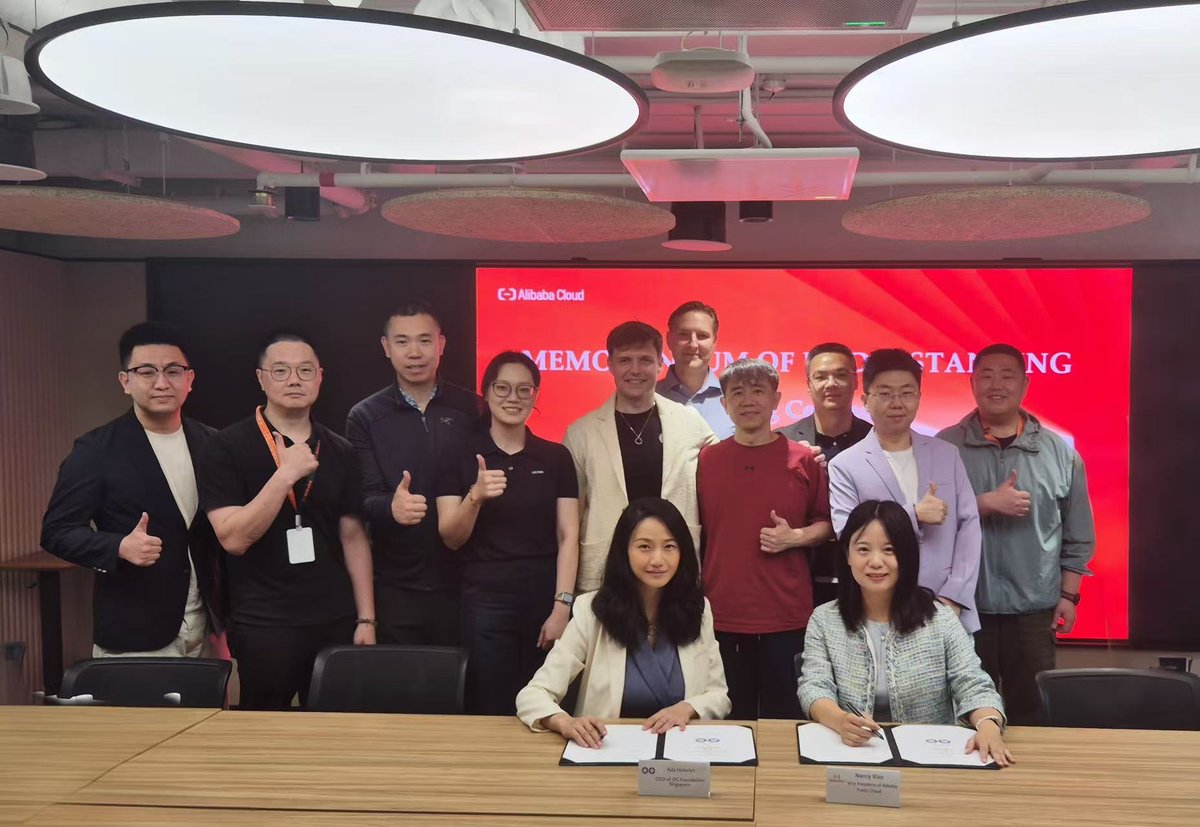
0G to Make Alibaba's Qwen wModels Accessible to AI Agents via Blockchain Integration
SINGAPORE, April 21, 2026 —
AI agents can now directly access top-tier large language models on-chain for the first time.
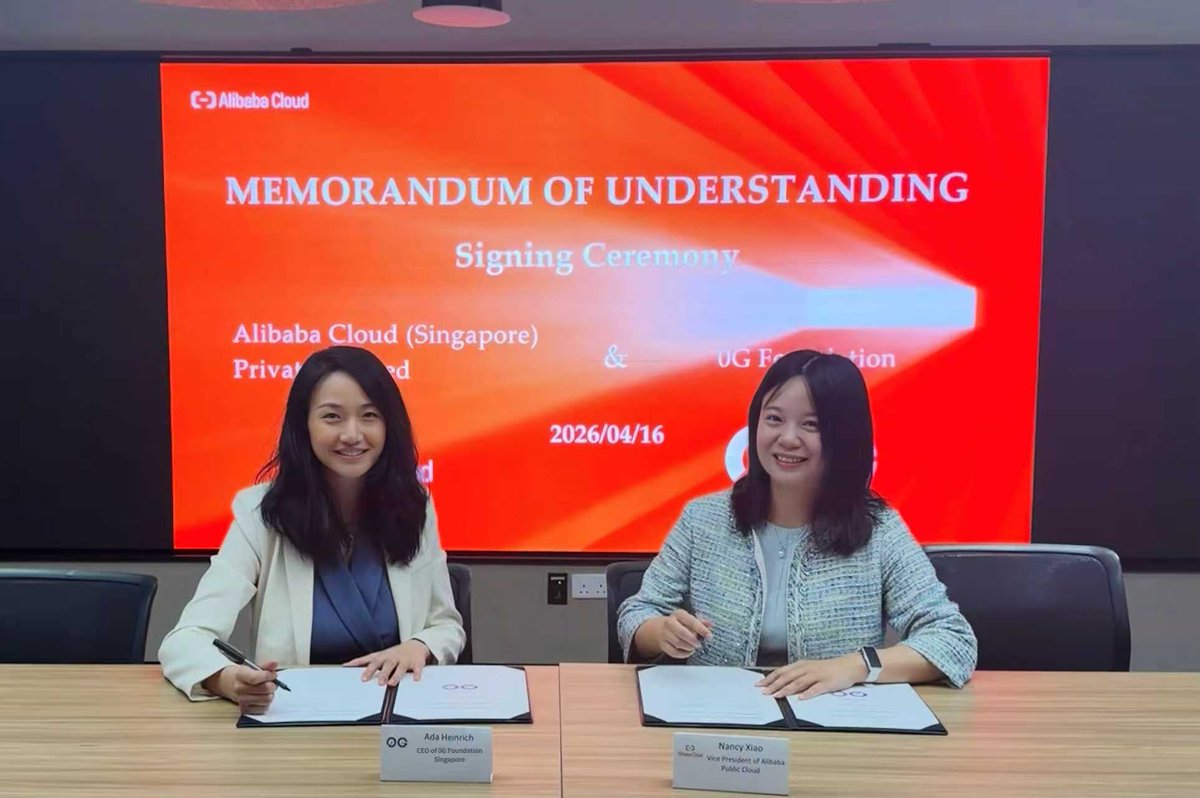
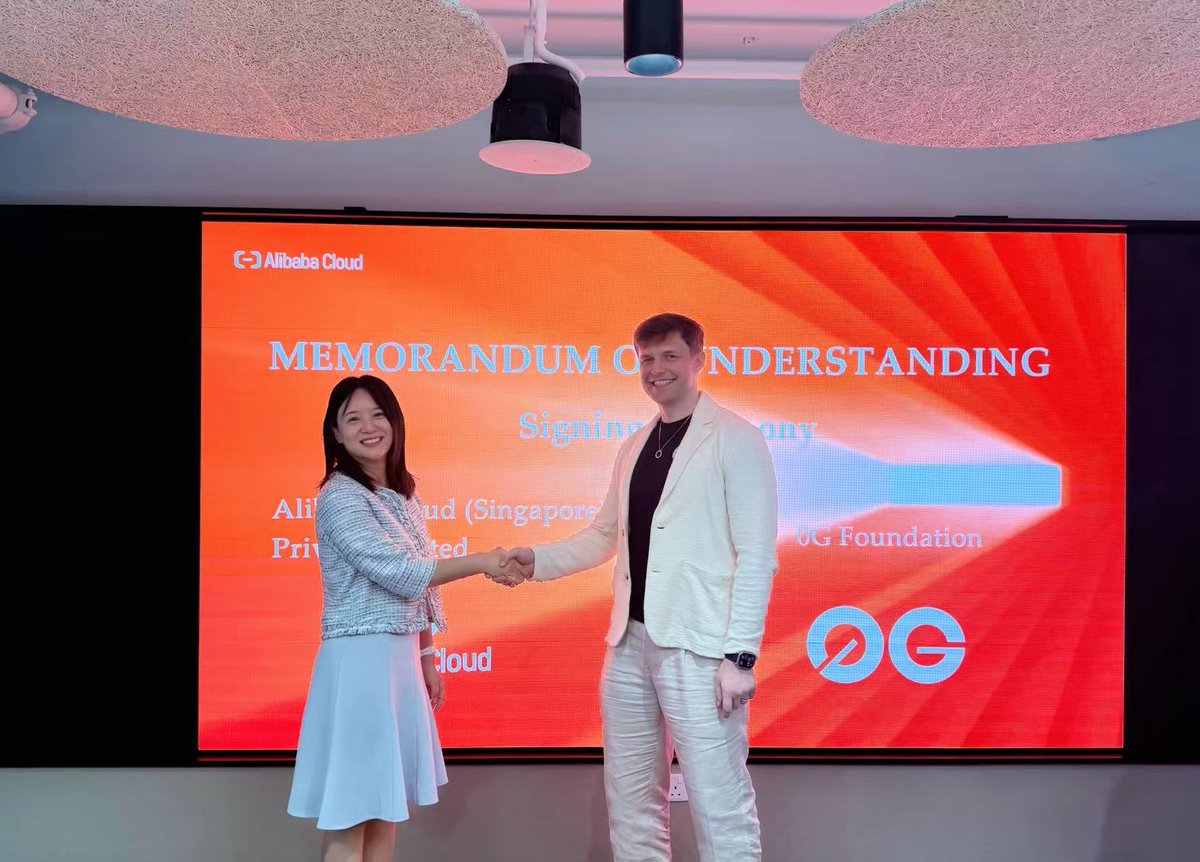
A new collaboration between 0G Foundation and Alibaba Cloud, the digital and intelligence backbone of Alibaba Group, enables direct, blockchain-based access to Alibaba's Qwen — one of the world’s most widely adopted large language model families.
This collaboration marks a shift from API-based AI access to programmable, tokenized AI infrastructure.
AI Agents Lack Seamless, Scalable Access to Top-Tier Models
AI agents — software programs capable of autonomously querying models, making decisions, and executing workflows — are gaining traction across industries. However, their effectiveness is still constrained by how easily they can access leading AI models.
Today, most large language models remain gated behind centralized APIs, requiring account setup, fiat-based billing, and manual configuration. These systems were not designed for autonomous, high-frequency agent interactions, where seamless, real-time access is critical.
This creates a structural limitation: while models like Qwen are powerful, integrating them into agent-driven environments at scale remains complex and inefficient.
Direct On-Chain Access to Qwen
Through this collaboration, 0G enables developers to access Qwen’s latest models in a way that is inherently compatible with autonomous systems.
By procuring Qwen tokens via API and embedding access into its infrastructure, 0G allows AI agents to invoke Qwen models directly using a token-based mechanism. This removes the need for traditional account management and enables programmatic, on-demand access to AI compute.
In practical terms, AI agents operating on 0G can query Qwen to generate responses, process information, or execute tasks — creating a more fluid interaction between decentralized systems and state-of-the-art AI models.
At a high level, this collaboration reflects a clear division of roles in the emerging AI agent stack: Qwen powers intelligence, while 0G guarantees trust.
In practical terms, inference runs on Qwen, and verification runs on 0G — forming a more complete foundation of compute and trust for autonomous AI systems.
As Michael Heinrich, CEO and Co-founder of 0G Labs, put it:
“As the world’s leading Blockchain for AI Agents, we are delighted to become a preferred partner for Alibaba’s Qwen models.
0G’s integration with Alibaba Cloud’s Qwen marks a milestone where 'top-tier intelligence meets trusted infrastructure.'
With Qwen 3.6-Plus optimized for agentic AI, Alibaba provides powerful reasoning capabilities while 0G provides the verifiable trust layer, together building the most complete trust loop for AI Agents.
We look forward to consistently deepening our collaboration with Alibaba Cloud and the Qwen team to accelerate the mass adoption of AI Agents globally.”
Why Qwen Matters
The collaboration underscores Qwen’s growing role as a defining force in the global AI ecosystem.
Developed by Alibaba, Qwen has become one of the most widely downloaded model families, supporting a broad range of multimodal and enterprise use cases.
Its latest release, Qwen3.6, has demonstrated strong performance across multiple benchmarks, reinforcing its position among the world’s leading AI systems.
As competition intensifies among leading AI models, accessibility and distribution are becoming as critical as model performance. Enabling AI agents to interact with Qwen through decentralized infrastructure extends its reach beyond traditional enterprise environments into emerging autonomous systems.
Enabling Real AI Agent Workflows
The ability of AI agents to directly access Qwen unlocks new possibilities for real-world applications. Developers can now build systems where agents:
● Query Qwen for natural language understanding and generation
● Automate decision-making processes
● Execute multi-step workflows powered by AI reasoning
By removing access friction, the collaboration shifts the focus from infrastructure constraints to application development, enabling more rapid experimentation with agent-based systems.
Together with 0G’s verifiable compute and data layer, this significantly enhances trust and auditability in agent-driven environments — a key requirement for large-scale autonomous systems.

15
24
97
67,385
rodney() retweeted

Apr 20
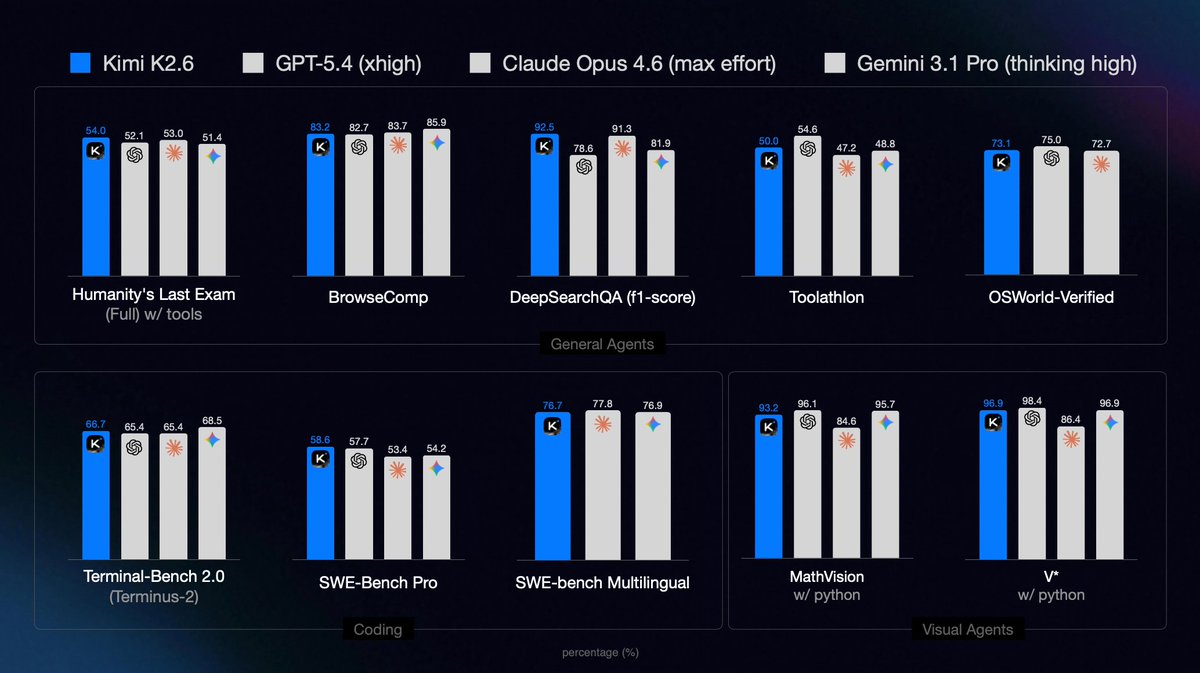
Meet Kimi K2.6: Advancing Open-Source Coding
🔹Open-source SOTA on HLE w/ tools (54.0), SWE-Bench Pro (58.6), SWE-bench Multilingual (76.7), BrowseComp (83.2), Toolathlon (50.0), Charxiv w/ python(86.7), Math Vision w/ python (93.2)
What's new:
🔹Long-horizon coding - 4,000 tool calls, over 12 hours of continuous execution, with generalization across languages (Rust, Go, Python) and tasks (frontend, devops, perf optimization).
🔹Motion-rich frontend - Videos in hero sections, WebGL shaders, GSAP Framer Motion, Three.js 3D.
🔹Agent Swarms, elevated - 300 parallel sub-agents × 4,000 steps per run (up from K2.5's 100 / 1,500). One prompt, 100 files.
🔹Proactive Agents - K2.6 model powers OpenClaw, Hermes Agent, etc for 24/7 autonomous ops.
🔹Claw Groups (research preview) - bring your own agents, command your friends', bots & humans in the loop.
-
K2.6 is now live on kimi.com in chat mode and agent mode.
For production-grade coding, pair K2.6 with Kimi Code: kimi.com/code
-
🔗 API: platform.moonshot.ai
🔗 Tech blog: kimi.com/blog/kimi-k2-6
🔗 Weights & code: huggingface.co/moonshotai/Ki…
943
2,391
18,128
7,519,714
rodney() retweeted
Bridging elite academia with AI-driving finance 🤝
Pharos is partnering with @HKUniversity SCF FinTech Academy of Business School in its Capstone project, bridging academic AI research with Pharos Incubation Program through high-performance blockchain environment, SALI parallel execution and native x402 AI module on Pharos ⚓
From the lab to upcoming Mainnet, Pharos is turning AI-driven insights into institutional-grade reality
97
141
638
30,667
rodney() retweeted
🔥 $50M committed ⚓
Pharos Capital Arrival: Stake before Stake fully subscribed 🕰️
RealFi execution in action
Thank you to all early believers for the strategic capital alignment
3 months of committed growth and rewards is generating ⛓️
244
296
1,236
90,685
rodney() retweeted

Apr 11
Hack VC is still investing, actually more aggressively than ever. Come find us.
Apr 10

The shift in the crypto fundraising landscape the past 6 months has been insane.
Crypto VCs used to have to constantly be networking/writing/podcasting/going on spaces/promoting your thesis/getting on 10 deal flow calls a week, to get into good deals...now it's literally enough to just have capital to write checks.
Deals are being pushed rather than dug out. Inbound if people know you have money is at an all-time high.
Most firms are either 1) Out of money 2) Moved to Series A and beyond or 3) Fundraising (with no success).
Deals that used to close in 2-3 weeks now close in 2-3 months.
Firms with questionable business models or copy pasta of the latest trend are getting zero primary or follow-on funding (Good news!).
There are now realistically <20 firms writing checks in pre-seed/seed.
VCs basically have the pick of any deal they want, with more time to do DD.
IMHO 25/26 are going to be historic vintages for those who stick around.
63
9
263
64,907

hotline.hack.vc/
Hack VC Founders Hotline is live, check it out!
Apr 13

Hard to find us?
Debuting the world premiere of the Hack VC Founders Hotline
Need funding? Better call Hack
Results guaranteed in <1 week
(we have 9 figs to deploy, pls help us spend it)
10
3
79
13,291
rodney() retweeted
Apr 13
Hard to find us?
Debuting the world premiere of the Hack VC Founders Hotline
Need funding? Better call Hack
Results guaranteed in <1 week
(we have 9 figs to deploy, pls help us spend it)
Apr 11
Hack VC is still investing, actually more aggressively than ever. Come find us.
30
14
221
48,194
rodney() retweeted
Thrilled to announce the $44M Series A to scale the onchain economy ⚓
Backed by Sumitomo Corporation's CVC arm, @snzholding, @chainlink, @FlowTraders, and some of the undisclosed giants in global finance 🏛️
Pharos is building the financial-grade infrastructure to bridge TradFi and DeFi at a global scale 🌐
508
781
2,539
413,707
rodney() retweeted

Apr 5
I'm calling it. AGI is already here – it's just not evenly distributed yet.
1,605
1,174
13,721
2,579,710
rodney() retweeted

Apr 3
Yup, platform activity is surging. There were 1 billion commits in 2025. Now, it's 275 million per week, on pace for 14 billion this year if growth remains linear (spoiler: it won't.)
GitHub Actions has grown from 500M minutes/week in 2023 to 1B minutes/week in 2025, and now 2.1B minutes so far this week.
So we're pushing incredibly hard on more CPUs, scaling services, and strengthening GitHub’s core features.
And as a fine purveyor of hand-crafted shit code for many years, I'm not gonna weigh in on that. 🤣
Apr 3

I would like to make my apologies for defending M$, but I must from time to time.
I have to put respect on github for handling the amount of shit code that has been added over the last 3 months.
literally 10s of billions of lines of code that will never see the light of a CPU
156
569
7,186
2,629,107


Intelligence available on tap means suddenly capital contains more bottled-up value than it ever has before.
You used to have very real limits to the time value of money: you can sleep in one bed. You can drive one car. But now you can have the equivalent knowledge work of 10,000 or 1M people if you could only figure out how to put it in a harness, get the data into it, and press DEPLOY.
This has never happened before.
97
46
620
34,323
rodney() retweeted

Mar 27
Next 3 weeks, 3 major product releases at Tether.
66
52
692
36,856


rodney() retweeted

Mar 24
Every new Claude launch since the beginning of 2026👇
- Jan 2026: Claude Cowork launched.
- Feb 2026: Opus 4.6 released.
- Feb 2026: Sonnet 4.6 released.
- Feb 2026: Cowork launched on PC
- Feb 2026: PowerPoint integration
- Feb 2026: Excel integrations added.
- Feb 2026: Co-work plug-ins released.
- Feb 2026: Claude Code security launched.
- Feb 2026: Claude Code Remote Control
- Feb 2026: Scheduled Task in Co- work
- Feb 2026: Connector available in the free
- Mar 2026: Claude memory is free
- Mar 2026: Claude Marketplace launched
- Mar 2026: Claude com ambassadors
- Mar 2026: Code review for Claude code
- Mar 2026: Claude skills for Excel & Slides
- Mar 2026: charts & diagram in chat
- Mar 2026: 1 million context window
- Mar 2026: Dispatch for Claude Co-work
- Mar 2026: Claude code Channels
- Mar 2026: Co-work Projects
- Mar 2026: Claude Computer use
- Mar 2026: Auto mode in Claude code.
Anthropic is cooking
31
84
1,217
123,568