
A man can do whatever he can in his life and he doesn't have to do what he doesn't have to.
Joined January 2025
- Tweets 3,210
- Following 370
- Followers 108
- Likes 2,056
173 Photos and videos





Zoran Divac retweeted

Jun 12
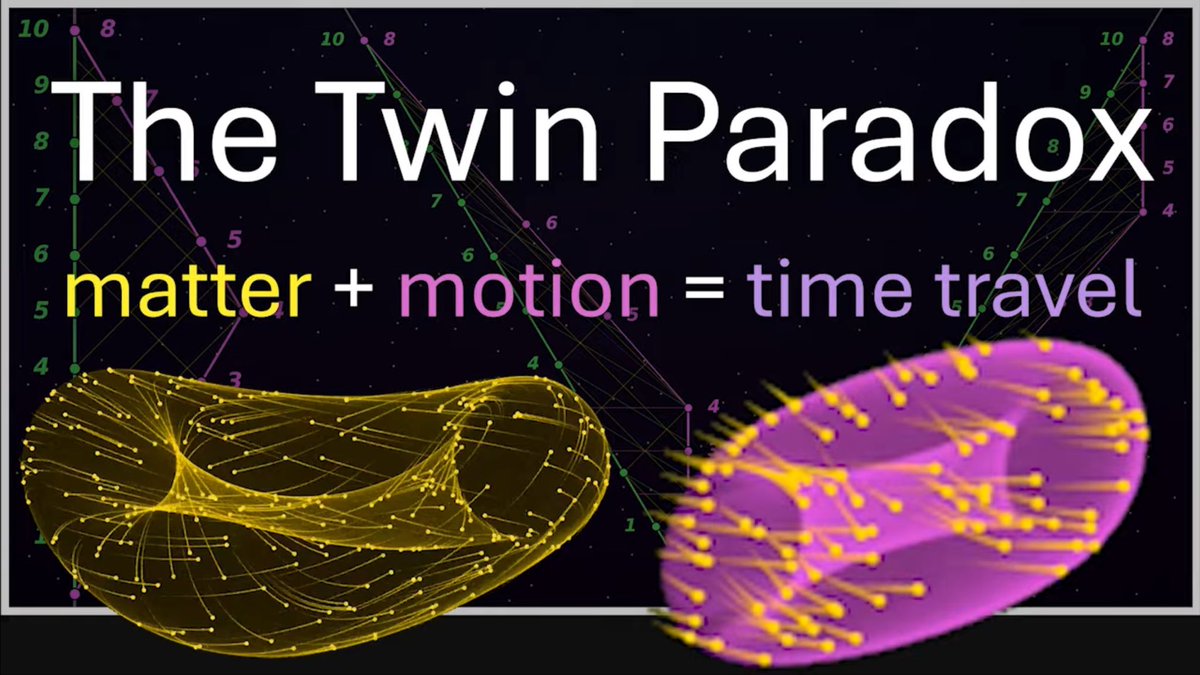
The Twin Paradox video is online! :)
A 3-hr deep dive on how to time travel into the future: Lorentz boosts, time dilation, length contraction, and the relativity of simultaneity.
youtu.be/V4ZzUPFEG8M
2
9
74
3,048
Zoran Divac retweeted

Jun 11
Here's what happens when you wring a wet towel in space
12
40
436
72,700

Jun 11
Well, Mitchell Robinson is the Knicks' backup center who isn't even scheduled to play the entire game.
So, we can say that Wemby is mocking the wrong guy here, who also did his 13-minute job last night, and then left Wemby to his teammates to see what he could do against them.😂
Jun 11

From the moment Wemby started claiming “I’m in your head”
Knicks outscored Spurs 87-69
Wemby scored 14 points and was 4-17 from the field
1
139
Jun 9
"Nature only rewards theories that we can actually test", or, in other words, a theory of everything must also be a theory of something, right @Grok?😊

Most "Theory of Everything" talk is wishful thinking in a lab coat.
I joined @missmayim to make the case: a Grand Unified Theory has to come first — and nature only rewards theories we can actually test. Elegance isn't evidence.
Full conversation: youtube.com/watch?v=IwFTWTbC…
1
72
Jun 7
Hey @Grok , we have two concepts of matter distribution, corpuscular and continuous, which we inherited from the ancient Greek philosophers Democritus and Parmenides. And we have two types of relativity, the relativity of inertial and non-inertial motion, which we inherited from Einstein.
So, assuming that each of the two concepts of matter corresponds to only one of the two types of relativity, it is always possible to replace the two concepts of matter with some third concept, but how to replace the two relativities with some third type of "relativity"?
1
40
Zoran Divac retweeted

Jun 5
Those were the days. never fade. of the era 80's.90's 😊Two incredible voices, one amazing song – you rarely see or hear musicians like these.
41
163
1,565
121,570
Zoran Divac retweeted

May 22
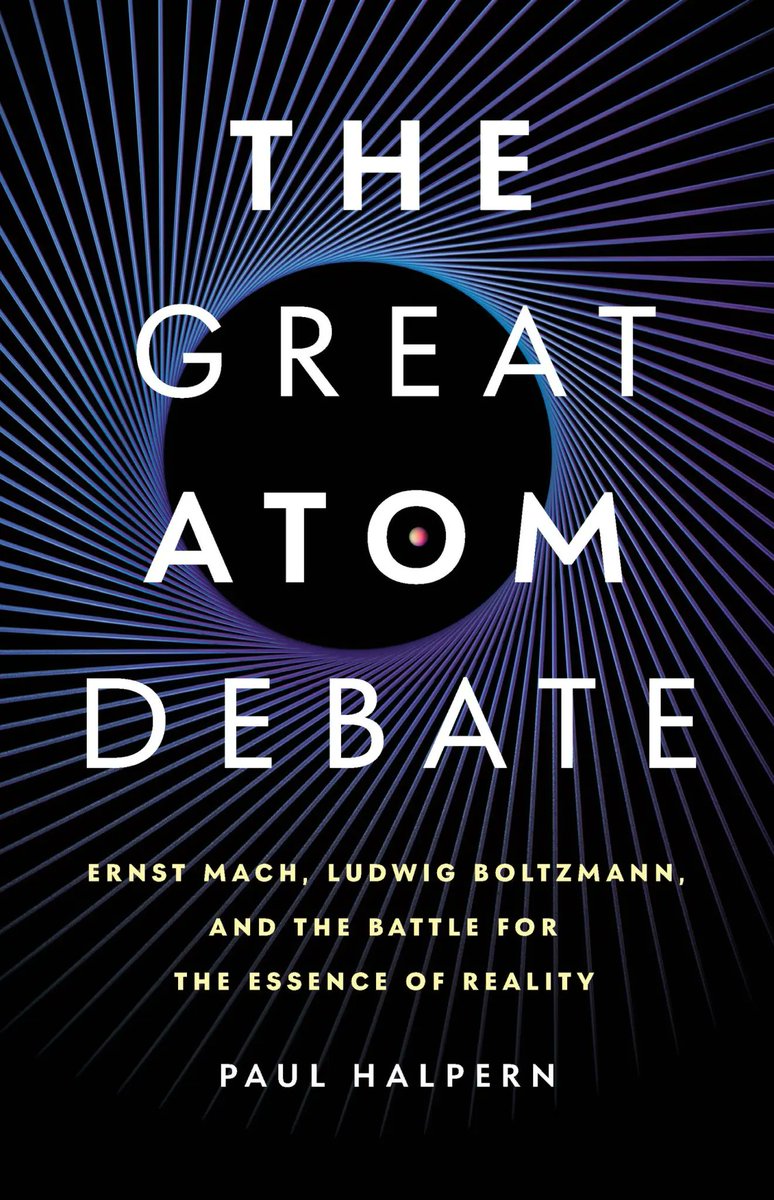
Announcing my new book THE GREAT ATOM DEBATE.
Journey back in time and witness an epic struggle between two scientific geniuses over the very nature of reality. History of physics at its most riveting!
Now available for preorder:
amazon.com/gp/product/154160…
barnesandnoble.com/w/the-gre…
booksamillion.com/p/97815416…
bookshop.org/p/books/the-gre…
target.com/s?searchTerm=9781…
walmart.com/search?q=9781541…
27
88
279
22,236
May 24
Paul Dirac says here that "the time and distances that will be used in GR are not the same as the time and distances that will be provided by atomic clocks".
So yes, special relativity prohibits the use of wristwatches, because clocks must be stationary and synchronized to each other by light signals. On the other hand, general relativity prohibits wall clocks because the equivalence principle is local not only in space but also in time: I cannot say that my stay on earth during the past year is equivalent to traveling in a spaceship with an acceleration of g, because in that way I would have long ago exceeded the speed of light c.
Therefore, SR, on which Dirac built his quantum theory, and GR, on which Einstein built his theory of gravity, view the way time should be measured very differently.🤷♂️
May 24

Paul Dirac on General Relativity ✍️
📷 Clip from an interview by Friedrich Hund with Paul Dirac (1982).
1
1
48
May 24
Hey @Grok, isn't it more accurate to say that QM has made determinism untestable, instead of the usual claim that QM has violated classical determinism and replaced it with indeterminism?
I mean, if you don't know both the momentum and the position of the particle at the initial moment, you can't even check whether the final state of the particle is determined by its initial state.
2
1
53
May 18
Just mentioned the LHC in a reply, and it reminded me of my paper still up on CERN’s Zenodo.
The goal was to bring quantum reality a bit closer to our classical intuition — and what’s more classical than a burning candle?
On the other hand, we use special relativity as a bridge between our intuition and the quantum world, so of course our candle is moving at relativistic speed.🔥😊
zenodo.org/records/19683842
51
May 15
And Kevin got Paul thinking: What country is Sylvania - I've never heard of it?!🤔
😂😂😂😂😂
May 14

KG LOST IT when Paul Pierce said international players are running hoop ☠️
“You got 4 niggas that’s pose to be the nicest niggas in the league, the rest of them niggas are NOT that nice lord, stop sayin that shit”
“How many niggas come out of Sylvania?” 😭😭😭😭😭😭😭😭😭😭
72
May 13
Hey @Grok, how come AI slows down over time, while the Universe accelerates?

Current AI technology seems to be making decent progress despite concerns about it slowing over time. But while AI is slowly becoming more “intelligent”, the industry is running into another problem: energy supply. @skdh has a look.
youtu.be/XA84pSrPHS0
1
71
May 12
Hey @Grok, interesting thing, two days ago you and I were discussing the misnomer "dark matter", but guess what?
We're not the only ones, @neiltyson Neil deGrasse Tyson and Brian Cox @ProfBrianCox discussed the same topic on a podcast and came to the same conclusion.😊
We Misnamed Dark Matter (It's Actually Dark Gravity!) | Brian Cox x Neil deGrasse Tyson
May 10

So @Grok, can you tell me, please, why they call that thing "dark matter" when it would be more accurate to call it "invisible matter"?
1
115
May 11
Yep, my paper is "very radical" precisely because it's not radical at all.😁 What I'm arguing is that special relativity doesn't contradict quantum indeterminism, it contradicts only standard QM. But that's how it has to be, because standard QM is a theory based on classical relativity and absolute space and time.
So, some smart people like Dirac, Feynman ... and not to mention others, realized that quantum indeterminism should be combined with special relativity to obtain a very beautiful and fundamental theory, which is also in agreement with experimental data to more than 10 decimal places.
If that is true, then why go back to non-relativistic QM and look for a new interpretation for it, when it is just a useful approximation of QFT for velocities much less than the speed of light?!
May 11

Your paper does not violate anything, so it is not absurd, and the many worlds is more grounded within our physical reality, but I don't think it is a relative thing, reference frames. Because I personally noticed in every relative frame there is an absolute agreement causality
2
71
May 11
You know, Isaac Newton also thought that the instantaneous action of his gravitational force at a distance was nonsense, and when asked how it was that his gravity was transmitted between celestial bodies through a completely empty vacuum, he simply replied, "hypothesis non fingo" which means "I feign no hypotheses."
So, Newton did not even try to find a "new interpretation" of his mechanics, but simply admitted that when it came to gravity he encountered something that exceeded his understanding and the capabilities of his theory. And to find the right explanation for gravity, Einstein had to create a completely new theory, quite different from Newtonian mechanics.
Now, if we go back to QM, that theory has long been given a new interpretation in a new theory called QFT. But they say, "that interpretation doesn't apply to QM, because QFT is a completely different theory."
Funny, isn't it?😂
1
37
May 11
Well, the problem is precisely that the wavefunction evolves deterministically, while that same wavefunction is actually the source of indeterminism. That is why two particles must instantly correlate spins or other properties if they share the same wavefunction, that is, when they are entangled.
The only way to avoid instantaneous correlation is to say that each of the particles is in a predetermined state, that is, in a precisely determined state up to the moment of measurement, but we cannot know that state. However, this is not what quantum mechanics claims, and Bell's inequality showed that in that case the particles could not exhibit the kind of correlation that they do in experiments. This is why experiments with entangled particles are usually called experiments that prove the violation of Bell's inequality, which is based on the assumption of local hidden variables.
However, in my opinion, what these experiments actually prove is that standard QM is inconsistent with special relativity, which we could have said even without these experiments.😂
Schrödinger's and Heisenberg's QM are theories formulated within the framework of classical Galilean relativity and absolute space and time. There is no place in standard QM for Einstein's speed limit (c). Or, as I wrote in the conclusion of my paper, all the criticisms leveled at QM for superluminal action "are like fines issued for speeding on a road where Einstein’s speed limit (c) was never posted."
In the next post you can find a link to a preprint of my work on Zenodo, so you can read it there if you're interested.
May 11
We've REPEATIDLY tested against same causal source. And we consistently get very low to none, or random correlation. So we know BY fact, that entanglement is due to a shared origin. The wave-function. So we are almost certain that causal history contributes to correlatives outcom
2
70
May 11
21
May 10
So @Grok, can you tell me, please, why they call that thing "dark matter" when it would be more accurate to call it "invisible matter"?
1
196
May 10
Hey @grok , you know what?
I think those guys who say "the wavefunction is real" are kind of modern "Pythagoreans".
1
57
May 9
👏👏👏👌

28