
Joined November 2014
- Tweets 95
- Following 243
- Followers 712
- Likes 1,023
4 Photos and videos

Pinned Tweet

26 Jun 2025
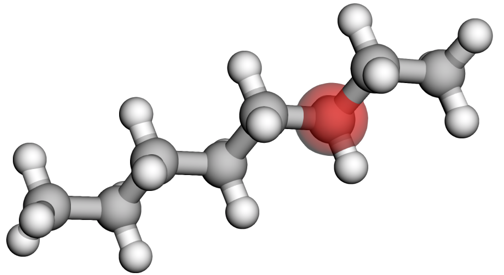
I am very happy to share Orbformer, a foundation model for wavefunctions using deep QMC that offers a route to tackle strongly correlated quantum states! arxiv.org/abs/2506.19960
8
30
92
11,594
Adam Foster retweeted

27 Oct 2025
Last call - open til Oct 30!
Are you excited about #MachineLearning and developing new architectures for Molecular Biology? Joint us for the next chapter of BioEmu at @MSFTResearch AI for Science - Berlin DE or Cambridge UK.
aka.ms/bioemu-ml
10
48
6,486
Adam Foster retweeted
24 Sep 2025
Want to join our BioEmu team in @MSFTResearch AI for Science as an Intern? Berlin DE or Cambridge UK are available. Preference for candidates at the end of their PhDs, but open for everything:
jobs.careers.microsoft.com/g…
10 Jul 2025

BioEmu now published in @ScienceMagazine !!
What is BioEmu? Check out this video:
youtu.be/LStKhWcL0VE?si=tQQX…
16
59
7,599
Adam Foster retweeted

4 Aug 2025
I have an opening for a 2-year postdoc in probabilistic machine learning and/or experimental design. The application deadline is the 3rd of September. See here for details and how to apply: tinyurl.com/rainmlpostdoc202…
11
39
3,229
10 Jul 2025
It's a great achievement for the team and for @FrankNoeBerlin who was at the helm throughout!
10 Jul 2025
BioEmu now published in @ScienceMagazine !!
What is BioEmu? Check out this video:
youtu.be/LStKhWcL0VE?si=tQQX…
1
1
7
1,151
10 Jul 2025
I feel fortunate to have been able to contribute to the effort
2
124
Adam Foster retweeted

1 Jul 2025
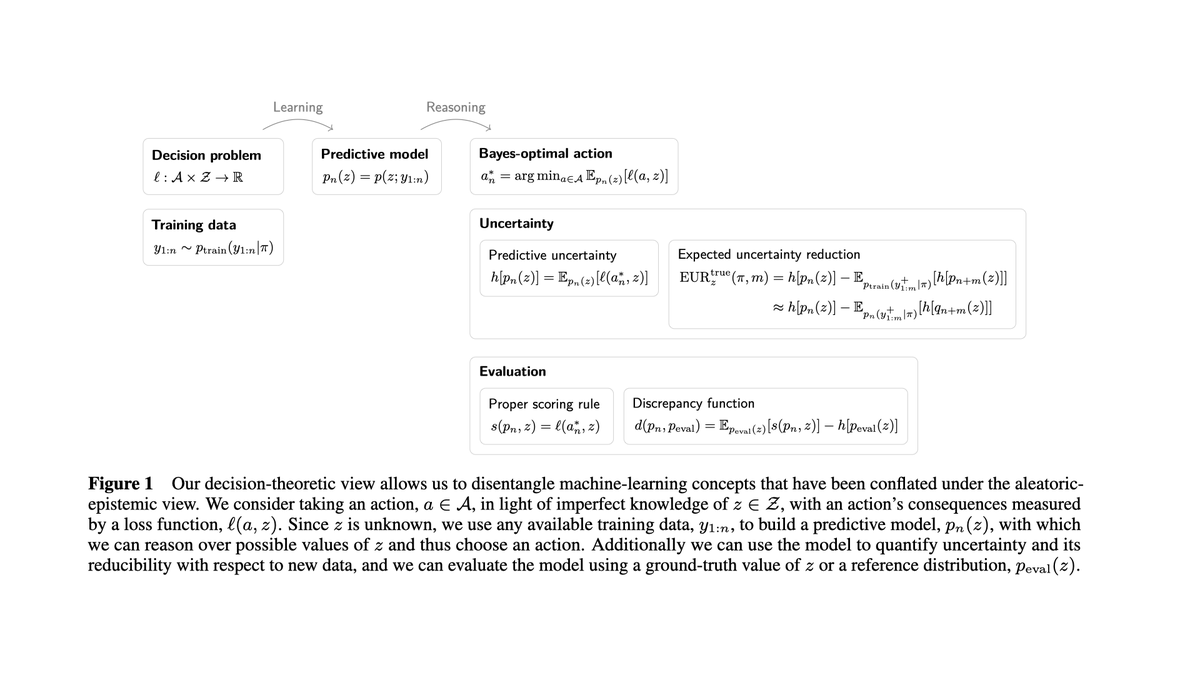
There’s a lot of confusion around uncertainty in machine learning.
We argue the "aleatoric vs epistemic" view has contributed to this and present a rigorous alternative.
#ICML2025 with @janundnik @eleanortrollope @markvanderwilk @adamefoster @tom_rainforth
1/5
1
15
63
4,839
26 Jun 2025
I am very happy to share Orbformer, a foundation model for wavefunctions using deep QMC that offers a route to tackle strongly correlated quantum states! arxiv.org/abs/2506.19960
8
30
92
11,594
26 Jun 2025
Huge thanks to Zeno Schätzle, @PBerntSzab1,
@SherryLixueC, @jonkhler, @n_gao96 , Gino Cassella, Jiawei Li, @FrankNoeBerlin and Jan Hermann
(2/n)
4
265
26 Jun 2025
Digging into the model we found intriguing behaviour, such as the unsupervised discovery by the model of ‘core’ electron orbitals for second row atoms.
This has been a fascinating project to be a part of! Check out the preprint for more details and results. (8/n)
1
4
403
26 Jun 2025
We also saw very strong results confirming the experimental activation energy of a Diels-Alder reaction, and significantly outperforming earlier transferable QMC approaches (7/n)
1
3
340
26 Jun 2025
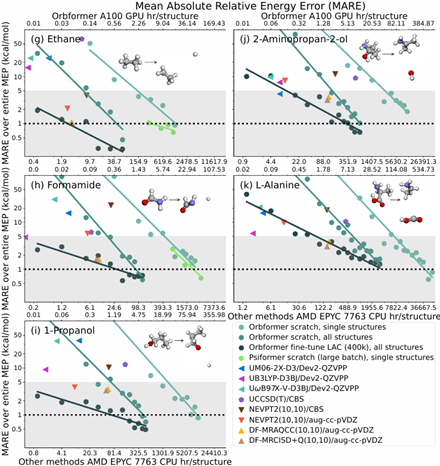
We scaled this idea up and pushed it to work on strongly correlated systems. On a cost/error plot, we find that Orbformer is on or ahead of the Pareto frontier formed by traditional multireference methods, a first for deep QMC. (6/n)
2
4
503
26 Jun 2025
To get cost down we make use of amortization: solving a single minimization problem with a more complex network that represents multiple wavefunctions simultaneously (5/n)
1
2
327
26 Jun 2025
Describing strongly correlated quantum systems remains a major challenge in quantum chemistry. Deep QMC offer a potential solution, but at a huge computational cost. (4/n)
1
1
308
26 Jun 2025
For a short ML-focused introduction to this paper, I wrote a short blog post ae-foster.github.io/posts/20… (3/n)
5
13
1,675
Adam Foster retweeted
13 Dec 2024
The aleatoric-epistemic view on uncertainty doesn't serve ML researchers' needs and should be replaced.
Come to the talk and poster tomorrow (Sat 14 Dec) at the #NeurIPS2024 workshop on Bayesian decisions (gp-seminar-series.github.io/…).
openreview.net/forum?id=WIjg…
1
5
33
2,459
17 Oct 2024
BIG opportunities to join @MSFTResearch AI for science: one senior researcher and one RSDE position, both focused on applications in molecular biology with the awesome @FrankNoeBerlin. Cambridge, UK or Berlin, DE.
5
18
3,232

Interested in working with a highly collaborative, interdisciplinary team to push the state of the art of generative AI for materials design? Join us as an intern by applying through this link! We are the team behind the MatterGen and MatterSim models from Microsoft Research AI for Science.
jobs.careers.microsoft.com/g…
31
111
36,174
Adam Foster retweeted

19 Sep 2024
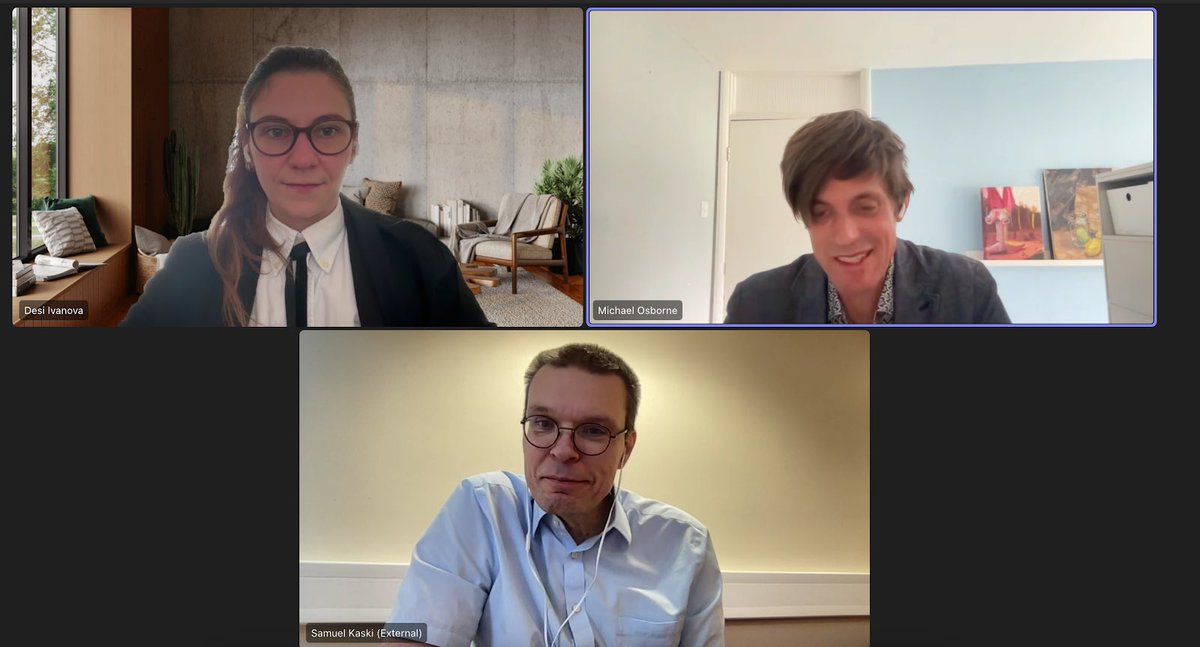
Excited to share that I recently defended my DPhil 🎉
Huge thanks to my supervisors @tom_rainforth and @yeewhye, all my co-authors, especially @AdamEFoster, collaborators and mentors.
Thanks to my assessors @maosbot and @samikaski for the interesting and stimulating discussion.
And of course thanks to @StatMLIO, @OxfordStats and @SPC_Oxford for funding my DPhil 💸
#PhDone 🫳🎤
8
2
65
2,854
4 Sep 2024
Curious what I've been working on since joining AI for science? With an incredible, multidisciplinary team we've studied the 'wave function -> election density' marginalisation using score matching & NCE. This has some big gains over older Gaussian-based methods.
4 Sep 2024
Introducing Neural Electron Real-space Density (NERD) models! 🧠 You’ve solved the electronic Schrödinger equation using PauliNet or Psiformer - what next? Important properties come from the 1-electron density (the marginal #MachineLearning)
arxiv.org/abs/2409.01306
1
7
46
6,247
Adam Foster retweeted
7 Jun 2024
I have an opening for a 2.5-year postdoc position in the RainML lab as part of my ERC grant on probabilistic machine learning and intelligent data acquisition. Application deadline 10th July 2024. See here for details and to apply: tinyurl.com/rainmlpostdoc
1
21
53
11,491